
Algorithms for Computing Limit distributions of
Oscillating
M
[ ]
X
/ G / 1
Systems with Finite Capacity
Mohammad Taremi
iReceived 25 Jan 2012; received in revised 03 Sep 2012; accepted 3 Oct 2012
A
BSTRACTWe address the batch arrival
M X /G/1systems with finite capacity under partial batch acceptance
strategy where service times or rates oscillate between two forms according to the evolution of the number
of customers in the system. Applying the theory of Markov regenerative processes and resorting to Markov
chain embedding, we present a new algorithm for computing limit distributions of the number customers in
the system. The numerical results are given in the paper for a clearer expression of the proposed
computational methodologies.
K
EYWORDS X / /1
M G
Systems, Finite Capacity, Oscillating Systems, Acceptance Strategy, Batch Arrivals
i Mohammad Taremi, Department of Statistics, Faculty of Economics, Allameh Tabataba’i University, Tehran, Iran (e-mail: [email protected])
1. INTRODUCTION
One way to increase server utilization while keeping customer waiting times under control is to consider queuing systems whose characteristics (such as service rate or input rate) depend on the evolution of the state of the system (such as the number of customers in the system or the workload). For instance, Choi et al. [6], [7], Harris [14], [15], Larsen and Agrawala [21], Ramalhoto [25], Rhee and Sivazlian [26] and Welch [30] studied queuing systems whose service characteristics depend on the evolution of the number of customers in the system; Chydzinski [9] and Takagi [28] studied queuing systems with an input rate depending on the evolution of the number of customers in the system; Ivnitskiy [16], Li [22] and Lu and Serfozo [24] studied queuing systems with input rates and service rates depending on the evolution of the number of customers in the system; Altman et al. [1] studied queuing systems with workload dependent service times; and Bekker et al. [3] and Golubchik and Lui [13] studied queuing systems in which the arrival rate and service rate depend on the system workload.
In this paper, we investigate the limit distribution of the number of customers in oscillating M X /G/1 systems with finite capacity. We use the term (service) oscillating systems in the sense used in [4], [8] and [10], i.e., as a queuing system that oscillates between two operating phases, 1 and 2, which impact the service rates or service characteristics, as described below.
The limit distribution of the number of customers in a queuing system is an important characteristic of the system, as it provides information about the evolution of its congestion level over time. Federgruen and Tijms [12] compute the limit distribution of the queue length in
oscillating M G/ /1 systems recursively by using the theory of Markov regenerative processes (MRGP). Bratiychuk and Chydzinski [4] and Chydzinski [8] have addressed the limit analysis of the number of customers in oscillating systems with infinite capacity, and Chydzinski [10] has studied steady state characteristics of oscillating systems with single arrivals and finite capacity using the potential method.
In general terms, when an oscillating system is in phase 1 the number of customers moves between 0 and b
-1
, and when it is in phase 2 the number of customers moves between a+1
and n, 0 a b n , with the integers aand
b denoting the lower barrier and the upper barrier of
the system, respectively. More precisely, if at timet the
system is operating in phase 1, so that the number of customers in the system is smaller than the upper barrierb, then the system remains in phase 1 until the first
subsequent epoch at which the number of customers in the system becomes greater or equal to the upper barrier b. At this epoch, the system changes to phase2
and remains in this phase until the first subsequent epoch at which the number of customers in the system becomes (smaller or) equal to the lower barriera, at this time the system
changes again to phase1
, and so on.We consider two types of oscillating systems (i.e., I
and II), that are characterized in terms of two distribution functions
A
1andA
2as follows: In type II systems, a customer service initiated in phase 2 has customer service time distributionA2, and is independent of the both customer arrival process and previous customer service times. Conversely, a customer service initiated in phase 1 is started with service time distribution
A
1. However, if Before this service time finish the system moves to phase 2 (due to the number of customer in the system becoming greater or equal to the upper barrier b) then a reset of the service is done at the instant the system changes phases and an additional time with distribution function A2 is added to the customer service time. This time also is independent of the customer arrival process and of previous customer service times.Type I oscillating systems have been addressed by several authors, including Bahary and Kolesar [2], Choi and Choi [5], Sriram et al. [27], Loris-Teghem [23] and [4], [7] and [12]. In particular, type I oscillating systems introduced in [5], [7] and [27] the analysis of cell-discarding schemes for voice packets in ATM networks by allowing dropping of low-priority (less significant) bits of information during congestion periods. It is noteworthy that [22] uses similar models for overload control in message storage buffers such that both the input and service rates or characteristics may depend on the phase of the system. In addition, type II oscillating systems coincide with the queuing systems defined in [8] and [10].
In this paper, we address oscillating batch arrival X / /1
M G systems with finite capacity n. These are queuing systems with a single server, at which customers arrive in batches, with independent and identically distributed (i.i.d) sizes, according to a Poisson process. The sequences of batch sizes and batch inter-arrival times are independent, and the system has finite capacity
n,
including the customer in service (if any). As regards the customer acceptance policy, we consider what is known as partial blocking (see e.g., Vijaya Laxmi and Gupta [29]) in which if at the arrival of a batch ofl
customers there are only m, m < l, free positions available in the system, thenm customers of the batch enter the system and the
remaining l-mcustomers of the batch are blocked.Our approach to investigate the limit distribution of the state of the system based on the fact that the state process in these systems constitutes a MRGP associated with appropriate Markov renewal sequences by means of the embedded Markov chain (EMC) (see e.g., Kendall [17], [18]). Specifically, the information on the state of the system in continuous time is obtained from the analysis of the embedded discrete time Markov chains (DTMCs) associated with the sequence Post-customer departure instants. We remark that other authors have used the theory of MRGP to derive recursive relations in M G/ /1 systems, as, e.g., Fakinos and Economou [11] and [12].
We end this introduction with a brief outline of the paper. In Section 2, we present a Markov renewal process formed by the number of customers in the system at the departure epochs. We use this Markov chain embedding to characterize the limit distribution of the state of the system at post-customer departure epochs in Section 3 and then resort to the Markov regenerative structure of the state of the system to obtain the limit distribution of the state of the system in continuous time in Section 4. We detail in Section 5 how the computation of the limit distribution of the state of the system may be implemented for the considered system. In sequence, we provide in Section 6 numerical results for the limit distribution of the state of the system obtained using the proposed computational methodologies.
2. THE EMBEDDED MARKOV CHAIN (EMC)
We denote the oscillating batch arrival M X /G/1 systems with finite capacity n and with lower barrier a and upper barrier b as
1 2
/ /1/ /( , )
X
M GG n a b systems, the service times oscillate between two forms according to evolution of the number of customers in the system, as described in the introduction.
We assume
(
0)
denote the batch arrival rate and ( )fi idenote the batch size probability function, where
1,2,3,... ,
N and ( )r i
f denotes the probability that the total number of customers in r customer batches is equal to i. Note that (0)
0
j j
f = , and
(1)
( ) ( )
j
r r
j j i i
i r
f f f
1 11
for rN and
j
r r
, +1,...,
wherei j
is the Kronecker delta function, i.e., i j1 if
i
j
and i j0 otherwise.As mentioned in the Introduction, we let
A
1 and2
A denote the distribution function associated with operating phases 1 and 2, respectively, in
1 2
/ /1/ /( , )
X
M GG n a b systems. Moreover, we let 11,
2
1 denote the expected values of the distributions
A
1 andA2, respectively.In addition, we let r Aj( ),i j N
0,1,2,...
, denote the probability that j customers arrive during a customer service time with distributionA
i.
Then, by conditioning on the number of batches arriving during a customer service time with distributionA
i, we have(2) ( )
0
( ) ( ), 1 2
j l
j i j l i
l
r A f A i or
where
l( )Ai is l–th mixed-Poisson probability with[20], [31]),
(3)
0
( )
( ) ( ).
!
t l
l i i
e t
A A dt
l
We also assume that
Y
Y t
( )
( ( ),
Y t Y t
1 2( )),
t
0
denotes the (continuous time) state process in
1 2
/ /1/ /( , )
X
M G G n a b system, where
Y t
1( )
is the number of customers in the system at time t andY t
2( )
is the phase of the system at time t, andY
has state space
( , , ) ( , , )
(0,1) ,
n a b n a b
E
E
with
( , , )
1 1 1 1
( ,1) :1 1 ( , 2) : 1
.
n a b
E c c b c a c n
We now use the method of the EMC and apply it to our considered systems. The fundamental idea behind this method is that we select a special set of points in the state process
Y. These special epochs in this approach must
have the property that, if we specify the number in the system at one such point, then at the next suitable point in time we can again calculate the number in system. There are many such sets in the state processY. An extremely
convenient set of points with this property is the set of departure instants from service. Therefore, we define
Tm m N as the time sequence of customer service completion epochs, i.e.,T
m is the instant at which the m-th service completion takes place. In addition, we let
(
1,
2),
p p p p
m m m
Y
Y
Y
Y
m
N
denote the post-customer departure state process in this system, where1 1
(
)
p
m m
Y
Y T
is the number of customers that stay in the system after them
-th service completion and2 2
(
)
p
m m
Y
Y T
is the phase of the system after them-th
service completion. Clearly, because of the Markov property of the Poisson distribution the processY
pis a Markov chain with discrete-parameter and because of the imbedded nature of the process it is known as an embedded Markov chain.3. POST-CUSTOMER DEPARTURE STATE IN OSCILLATING
SYSTEMS
In this section, we present the derivation of the limit distribution of the post-customer departure state in type I
and type II M X /G1G2/1/ /( , )n a b systems, i.e., the limit distribution of
Y
p.Note that the transitions in state process
Y
p are depending on the number of customers that arrive to the system during the successive customer service times. Thus, to characterizeY
p it is useful to first characterize the probability that l customers arrive to the system duringa customer service initiated in state
c
, denoted by ( )bcl
r
,for
l
N
and ( , , )n a bcE . In lemma 1 we show how the probabilities ( )b
cl
r
may be computed for both type I andtype II M X /G1G2/1/ /( , )n a b systems.
Lemma 1: In type I M X /G1G2/1/ /( , )n a b
systems, the
r
( , )( )i j lb probabilities are computed as:(4)
( )
( , )
(
)
b
i j l l j
r
r A
for ( , , ) ( , ) n a b
i j E and
l
N
, where, as defined in (2),(
)
l j
r A
is the probability that l customers arrive during a customer service time with distributionA
j.
and in type II M X /G1G2/1/ /( , )n a b systems, the
( ) ( , )
b i j l
r
probabilities are such that1
( ) *
( , ) , 1 2
2
( ) 1 0 1
( , ) 1
( ) 2
l b
i j l b i l
l
r A j and l b i
r r A A j and b i l
r A j
(5)
where(6)
*
,( , ) ( ) ( ), 1
l
m l mu l u
u m
r A B q A r B m l
for distribution functions A and B of nonnegative random variables, with
q
mu( )
A
,1
m
l
.
denoting the probability that duringa
customer service with distribution A, m or more customer arrivals take place and exactly ucustomers arrive until the first moment at whichm or more customer arrivals have occurred.
Moreover,
(7)
1 1 ( ) 0
( ) ( )
m m s
mu v u v s
s v s
q A
f f
A
with
(8)
0 ( , )
( )
( ) ( )
!
s s
s t
e t
A A u du dt
s
denoting the s-th mixed-Poisson expected value with rate
and mixing distribution A, satisfying(9)
0 0
1
( )A (1 ( ))A
(10) 1
1
( ) ( ) ( ), 1
s A s A s A s
where
s( ),A the s-th mixed-Poisson probability with rate
and mixing distributionA is defined in (3).
Proof: In type I M X /G1G2/1/ /( , )n a b system, we
customer service time distribution is A1 if the service starts with the system in phase 1, and is
A
2 if the servicestarts with the system in phase 2. Similarly, the
r
( ,2)( )ib lprobabilities in (5) for type II M X /G1G2/1/ /( , )n a b systems follow by conditioning on the number of batches arriving during a customer service that starts with the system in phase 2, which has distribution
2
A . In the same
way, the
r
( ,1)( )ib l probabilities, l b i 1, in (5) for typeII M X /G1G2/1/ /( , )n a b systems follow by conditioning on the number of batches arriving during a customer service that starts with i customers in the system and the system being in phase 1, which has distribution
A
1 if fewer thanb i
customers arrive during the service time.We now address the computation of
r
( ,1)( )ib lprobabilities,
l
b i
,
for type II M X /G1G2/1/ /( , )n a b systems. These probabilities are associated to customer services initiated with the system in phase 1 such that the system changes from phase 1 to 2 during the customer service. For that, let Cml denote the event that during a random time with distribution1
A, independent of the customer arrival process, m or more customer arrivals take place and exactly l customers arrive until the first moment at which
m
or more customer arrivals have occurred, whose probability isq
ml(
A
1).
Moreover, letD
u denote the event that during a random time with distribution A2, independent of the both customer arrival process and the events
1 ,
ml m l
C u customer arrivals take place, whose
probability is
r A
u(
2).
Then, for 1 i b 1 and l b i , we have:( )
( ,1) , ,
*
, 1 2 , 1 2
( ) ( ) ( )
( ) ( ) ( , ).
l l
b
i l b i u l u b i u l u
u b i u b i
l
b i u l u b i l
u b i
r P C D P C P D
q A r A r A A
As the previous relations leads to (6), it remains to show (7) to conclude the proof. The Equation (7) follows since, by conditioning on the value of the product of the time it takes to observe m or more customer arrivals by the indicator function of this time being smaller than an independent random variable with distribution A, we conclude that, for
1
m
l
:1 1
( )
0 (0, ) 0
1 1
( )
0
( )
( ) ( )
! ( ).
s
m m
t s
ml v l v
u
s v s
m m
s v l v s
s v s
t
q A e f f dt A du
s
f f A
Finally, (9) and (10) follow since, from Kwiatkowska et al. ([20], Theorem 2),
(11) 1
1
( ) ( ).
s j
j s
A A
We are now able to characterize the post-customer departure state process
Y
p. We first note thatY
pis a DTMC with state spaceE
( , , )n a b
E
ˆ
( , , )n a b
(0,1)
where
1 1
1 1
( , , )
1 1 1 1
( ,1) :1 2 ( , 2) : 1 1 , 1
ˆ
( ,1) :1 1 ( , 2) : 1 1 , 1
n a b c c b c a c n a b
E
c c b c a c n a b
Moreover, by a careful inspection, we can conclude the following theorem 1 for the transition probability matrix of
Y
p.
Theorem 1: The (one-step) transition probability
matrix
cd
P p , where
c
andd
E
( , , )n a b , of the DTMC pY
is such that forc
(0,1)
,1 1 1 1
1
( )
, 1 2 2 1 1
( )
, 1 2 2 1 1
( ) 0
( ) 1
1 2
max ( 1, 1) 2
( , ) (( 1, 2), ( ,1)) 1
0
b c d c
b c d c
b
cd c
b cl l n c
r c d and c d b
r c d and b c d n
p r c d a a
r d n
otherwise
(12) with
r
cl( )b defined in Lemma 1. Moreover,1
1 1
1 ( )
( ,1) 1 1
1 (0,1)( ,1) 1
( ) ( )
( ,1) ( ,2)0 1 1
1 1
d b
l l d l l
d b
b b
l l b l b b l
f r d b
p
f r f r d b a
(13) and
1
1 1 1
1 1 ( ) 1 ( )
(0,1)( ,1) 1 ( ,1) 1 ( ,2) 1 1
1 ( ) ( )
( ,1) ( ,2) 1
1 ( )
0 1 1
1 1
1
b b d b
d l l l d l l b l l d l
b b b
l l j l l n j
l j n l l b j n l
a d b
p f r f r b d n
f r f r d n
(14) with xmax( ,0)x and x y min( , ).x y
4. CONTINUOUS TIME STATE IN OSCILLATING SYSTEMS
In this section, we characterize the limit distribution of the continuous time stateprocess for the type I and type II
1 2
/ /1/ /( , )
X
M G G n a b systems, i.e., the limit distribution Y.
To begin, we assume that
S A
l( )
denotes a random variable, whose distribution is the distribution of the duration of a customer service time, S, with distribution functionA
given thatl customers arrive to the system
during this customer service time. Furthermore, let,,1 ,
j l
epoch at which
j or more customer arrivals take place,
given that exactly lcustomers arrive until the first moment at whichj or more arrivals have occurred in a service
period with a distribution functionA
1.The following lemma shows how absolute moments of the conditional random variables
S A
l( )
andk jl
S
may be computed.Lemma 2: The absolute moment of order kN, of
conditional random variables
S A
l( )
i andS
kjl, satisfies(15) ( ) 0 ( )! ( ) [ ( )] ( ) ! l k j l
l k k j l
j
k j
r A E S A A f
j
for
l
N
,
and2
( )
1 0 0
( )!
( ) [ ( )] [ ( )] ( )
!
n l
k k j
l
l k k j l
l n l j
k j
r A E S A E S A A f
j
(16) moreover, (17) 1 1 ( ) 1 1 0 ( )! ( ) [ ] ( ) . ! j j k mjl jl k m k s l s
m s m
m k
q A E S A f f
m
Proof: Let G denotes the number of customer arrivals
in duration of service a customer. For
k
N
andl
N
,
we have:
( ) 0
0
( ) [ ( )] ( )1
( )
( )
!
k k
l
l G l
j l
k u j
l j
r A E S A E S A
u
u e f A du
j
( ) 0 0 ( ) 0 ( )! ( ) ( ) ! ( )! ( )! ( ) ! k j l u j l k j l jk j l
k j
k j u
e A du f
j k j
k j A f j
Finally, equation (16) follows from equation (15) since 2
1 0
( ) [ ( )] [ ( )] ( ) [ ( )],
n
k k k
l l
l l
l n l
r A E S A E S A r A E S A
by taking into account that
0
[ m( )] ( ) [ k( )].
l l l
E S A r A E S A
We now address the computation of
E S
[
kjl],
which goes as follows:1 ( )
1 0 1
0 1
1 ( ) 1 0 0 ( ) ( ) [ ] ( ) ! ( )! ( ) ( ) ! ( )! m l j
k k u m
jl jl s m s l s
m
m k j
j
u m
s l s
k s m
m
u
q A E S u e f f A u du
m
m k u
e A u du f f
m m k
which leads to (17), in view of (2).
We use the above lemma to address the limit distribution
Y
. We first note that the state processY
is a MRGP with state spaceE
( , , )n a b associated with the time sequence( )
T
k k N of post-customer departure epochs. Therefore, using Kulkarni [19] (Theorem 9.30), we conclude that the limit probability vector ofY,
( , , )
(
d d E)
n a bp
p
, given by the following function of the limit post-customer departure state probability vector,( , , )
(
c c E)
n a b,
(18)
( , , ) ( , , )
n a b
n a b
c cd c E
d
c c c E
p
with dE( , , )n a b , where:
cdenotes the mean time elapsed between twoconsecutive service completions conditioned on the state of the system after the first of these service completions being c, i.e.,
c
E T
[
k1
T Y T
k(
k)
c
]
forc
E
( , , )n a b .
cddenotes the expected sojourn time of Y in state din-between two consecutive service completions conditioned on the state of the system after the first of these service completions being c, i.e.,
1
{ ( ) }
1 ( )
k
k
T
Y t d k
T
cd E dt Y T c
for
c
E
( , , )n a b,
d
E
( , , )n a b.
Theorem 2: The mean time elapsed between two
consecutive service completions conditioned on the state of the system after the first of these service completions being
c,
c, obtains in type I 1 2
/ /1/ /( , )
X
M G G n a b
systems as: 2 1 2 1 1 2 2 1 1 (0,1) 1 1 1 (0,1) 1 1 1 0 1 2 c
c and b c and b c and c
c (19) and, in type II
1 2
/ /1/ /( , )
X
M G G n a b systems
1 1 1 1 1 2 2 1 1 ( 1) 1 1 0 1 2 1 ( 1)
1 2 1
1 1 1 ( ,1) 1 2 1 2 1 1 ( ) ( ) 1
( ) 1 0
1 1
(0,1)
b c l
j
l j l
l b c l j
c b c b c
l
s u m
l s l u l m b c u
b
l l l
l l b
c r A j A f
l A f f c and c
f f c
(20).Proof: We first note that equation (19) for type I
initiated with the system in phase
i has expected value
2
1
,i1, 2.Suppose now that the oscillating system is of type II. The first branch of (20) follows from the fact that a service time initiated with the system in phase 2 has distribution function
A
2with mean 12. In addition, if1 1
( ,1), 0
c c c , then
c is the mean duration of a service time initiated with the system in state c, for which conditioning on the number of customers that arrive to the system during the first service time, we obtain1 1 1 1 1 1 1 0
, 1 ,
2
( ) [ ( )]
1
( ) [ ] .
b c
c l l l
b c l b c l
l b c
r A E S A
q A E S
(21) Now, taking into account Lemma 2, we have1 1
1
1 1 ( )
1 1 1 1
0 0 0
1 1 ( 1)
1
0 1
1
( ) [ ( )] ( 1) ( )
1
( ) .
b c b c l j
l l j l
l l j
b c l j
j l
l j
r A E S A j A f
j A f
(22) Similarly, taking into account equation (17), in Lemma 2, and (11), we have1 1
1 1
, 1 ,
1 ( 1) 1
1 1
( ) [ ]
1
( )
b c m b c m
b c b c l
s u m u
l s l u l
q A E S
l
A f f
for
m
b c
1,
so that1 1
1
1 1
1
, 1 ,
1 ( 1) 1
1 1
( ) [ ]
1
( ) .
b c m b c m
m b c
b c b c l
s u m u
l s l u l m b c
q A E S
l A f f
(23) Now, the validation of the second branch of (20) follows from (21), by taking into account (22)-(23) and the fact that1
1 , 1 1 1
( ) ( ).
b c m l
l b c q A l b c r A
Finally, the third branch of (20) follows from the facts already established by conditioning on the size of the first batch arriving after a service completion that leaves the system empty, taking into account that the mean waiting time for this batch to arrive to the system is equal to1
. By conditioning on the number of customer arrivals in the first service that takes place after a service completion that leaves the system in state
c, we conclude the
following result.Theorem 3: In
1 2
/ /1/ /( , )
X
M G G n a b systems,
0,
cd
if d1c1. In type I and type II systems,1 1 1 1
1
2 1 1
,2)(
2 1
( ,2)
( ) 1
( )
d c
l l n c
c d
r A c d n
r A d n
(24)In turn, in type I systems,
1 1
1
1
1 1 1 2 1 2
1 2 ,1)
1 1
(
( ) ( 1) ( 2)
0 2
( ) d c d
l l n c
c
r A d c and d or b d n and d
d b and d
r A d n
(25) and in type II systems,1 1
1 1
1 1 1 1
1
1
1 1
1 1 1 2
1 2
, 1 2 1 2
,1)
, 1 2 1
( )
(
( ) 1
0 2
( ) ( ) 2
( ) ( )
d c
d c
b c l d c l d
l b c
b c l j
l b c j n c l
c
r A d c and d
d b and d q A r A b d n and d
q A r A d n
(26) ifc
1
0.
Moreover,1
1
1
( ,1) 1 2
1
1 2
) 1
( ,1) ( ,2) 1
1 1
( ,1)( ,2) ( ,2)( ,2) 1 1 (0,1 1 0 0 1 0 2 d l l d l
d
d b
l l d l l d
l l b
b
l l n l b l l n n l
d
f d and d
d b and d
f f b d n
f f d n
(27)in type I and type II systems.
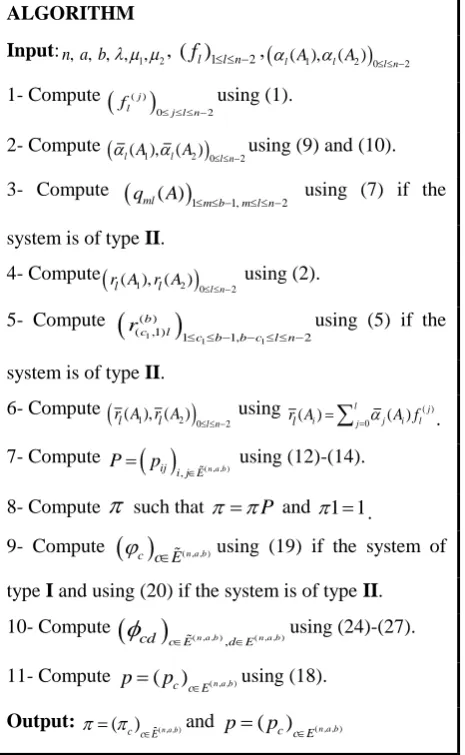
5. ALGORITHMIC ANALYSIS
We summarize the obtained results in previous sections as a procedure to calculate the limit distributions of the post-customer departure state and the continuous time state in type I and type II
1 2
/ /1/ /( , )
X
M GG n a b systems by the algorithm given in Figure 1.
This algorithm requires as input the mixed-Poisson probabilities
1
0 2
( )
l A l n
and
2
0 2
( )
l A l n
, along with
the batch size probabilities
( )
f
l 1 l n 2. The algorithmALGORITHM
Input:n a b, , , , , 1 2,
( )
f
l 1 l n2‚
l( ),A1 l(A2)
0 l n21- Compute
( )
0 2j l j l n
f
using (1).
2- Compute
1 2 0 2
( ), ( ) l A l A l n
using (9) and (10).
3- Compute
1 1, 2
( )
ml m b m l n
q A using (7) if the
system is of type II.
4- Compute
1 2 0 2
( ), ( ) l n
l l
r A r A using (2).
5- Compute
1
1 1
( )
( ,1) 1 1, 2
b
c l c b b c l n
r
using (5) if the
system is of type II.
6- Compute
1 2 0 2
( ), ( ) l n
l l
r A r A using ( )
0
( ) l ( ) j
i j j i l
l
r A
A f .7- Compute
( , , )
, n a b
ij i j E
P p
using (12)-(14).
8- Compute
such that
P and
1 1 .9- Compute
c c E ( , , )n a b using (19) if the system of type I and using (20) if the system is of type II. 10- Compute
( , , ) ( , , ), n a b n a b
c E d E
cd
using (24)-(27).11- Compute p(pc c E) ( , , )n a busing (18).
Output: ( ) ( , , )n a b
c c E
and p(pc c E) ( , , )n a b
Figure 1: Algorithm to compute the limit distributions of the post-customer departure state and the
continuous time state in type I and type II
1 2
/ /1/ /( , )
X
M G G n a b system.
6. NUMERICAL RESULTS
In this section, we use the result proposed in the previous sections to solve several oscillating
/ /1/ X
M G n systems and illustrate the sensitivity of their
associated limit distribution and performance measures with respect to batch size and service time distributions.
Specifically, to evaluate the influence of the batch size distribution we consider the following batch size distributions with common mean
: deterministic - the constant
, D( ) ; geometric with success probability1/ν
, Geo (1/ν) ; shifted binomial - a binomial with m trials and success probability(ν-1)/madded of one unit, 1+ ( , ( -1)/ )B m n m ; and, discrete uniform on the set
1,2,...,2ν-1
, Unif(1,2ν-1).
The service time distributions presented in this section have the following parameterization with positive mean
-1
: deterministic with value -1, D(1); exponential
with rate
, M( )
; Erlang with k phases, EkE kk( ); and, Pareto with parameters ( , )
k with 1 and( 1) /
k , ( ,(P 1) /). We let also
0 1
( )i i n
denote the limit probabilityvector of the number of customer in the system at post-customer departures, and p(pi)0 i ndenote the limit
probability vector of the number of customer in the system in continuous time, so that
( ,1)
( ,1) ( ,2)
( ,2)
0
1 1
i
i i i
i
i a
a i b
b i n
and
( ,1)
( ,1) ( ,2)
( ,2)
0
1 1
i
i i i
i
p i a
p p p a i b
p b i n
First, to illustrate the methodology, we present in tables 1, 2 and 3 the limit probability vector of the number of customers at post-customer departures,
0 1
( )i i n
, and
in continuous time, p(pi)0 i n, of regular and type I
and type II oscillating M X /G/1/n systems.
TABLE 1
LIMIT PROBABILITY VECTORS OF THE NUMBER OF CUSTOMERS IN
THE SYSTEM AT POST-CUSTOMER DEPARTURES IN REGULAR AND IN
TYPE IOSCILLATING Geo(2/ 3)/ /1/ 20
M D SYSTEMS WITH BATCH
ARRIVAL RATE2 / 3 .
k
( 2/3)
/ (4 / 3) (2 / 3) / 1 / 20 Geo
M D D
with barriers
(5,12)-Type I
(2/3) 1
/ ( ) / 1 / 20 Geo
M D
-1
2 / 3
-1
1.09
-1
4 / 3
k
k k k
0
1
2
3
4
5
6
7
8
9
10
11
12
13
14
15
16
17
18
19
1.2034.10-2
2.1249.10-2
3.1666.10-2
4.4862.10-2
6.2532.10-2
8.6708.10-2
9.8208.10-2
1.0344.10-1
1.0325.10-1
9.7780.10-2
8.6561.10-2
6.8463.10-2
5.3697.10-2
4.0162.10-2
2.9311.10-2
2.1115.10-2
1.5104.10-2
1.0763.10-2
7.6544.10-3
5.4376.10-3
2.2251.10-1
1.9869.10-1
1.5761.10-1
1.1847.10-1
8.6671.10-2
6.2506.10-2
4.4736.10-2
3.1888.10-2
2.2680.10-2
1.6113.10-2
1.1440.10-2
8.1201.10-3
5.7626.10-3
4.0892.10-3
2.9016.10-3
2.0589.10-3
1.4609.10-3
1.0366.10-3
7.3551.10-4
5.2188.10-2
1.2831.10-2
1.7986.10-2
2.1492.10-2
2.4308.10-2
2.6926.10-2
2.9589.10-2
3.2417.10-2
3.5476.10-2
3.8807.10-2
4.2445.10-2
4.6422.10-2
5.0770.10-2
5.5525.10-2
6.0725.10-2
6.6413.10-2
7.2633.10-2
7.9436.10-2
8.6876.10-2
9.5012.10-2
1.0391.10-1
4.0928.10-4
7.2269.10-4
1.0770.10-3
1.5258.10-3
2.1268.10-3
2.9491.10-3
4.0827.10-3
5.6493.10-3
7.8158.10-3
1.0813.10-2
1.4959.10-2
2.0695.10-2
2.8630.10-2
3.9608.10-2
5.4795.10-2
7.5805.10-2
1.0487.10-1
1.4508.10-1
2.0071.10-1
2.7767.10-1
Mean
St.Dev.
8.1002
3.8230
2.8083
2.9441
12.4549
5.2285
16.4273
TABLE 2
LIMIT PROBABILITY VECTORS OF THE NUMBER OF CUSTOMERS IN
CONTINUOUS TIME IN REGULAR AND IN TYPE IOSCILLATING
(2/ 3)/ /1/ 20
Geo
M D SYSTEMS WITH BATCH ARRIVAL RATE2 / 3 .
k
(2/3)
/ (4 / 3) (2 / 3) / 1 / 20 Geo
M D D
with barriers
(5,12)-Type I
(2/3) 1
/ ( ) / 1 / 20 Geo
M D
-1
2 / 3
-1
1.09
-1
4 / 3
k
p pk pk pk
0 1 2 3 4 5 6 7 8 9 10 11 12 13 14 15 16 17 18 19 20 1.7971.10-2 2.5742.10-2 3.6711.10-2 5.1237.10-2 7.1052.10-2 9.8361.10-2 1.3050.10-1 1.0559.10-1 1.0270.10-1 9.4626.10-2 8.0549.10-2 5.9152.10-2 4.6109.10-2 3.3247.10-2 2.3781.10-2 1.6942.10-2 1.2045.10-2 8.5550.10-3 6.0731.10-3 4.3101.10-3 1.7058.10-3 3.3362.10-1 1.8670.10-1 1.2606.10-1 9.0523.10-2 6.5973.10-2 4.7982.10-2 3.4684.10-2 2.4927.10-2 1.7835.10-2 1.2722.10-2 9.0567.10-3 6.4390.10-3 4.5743.10-3 3.2480.10-3 2.3055.10-3 1.6363.10-3
1. 1612.10-3
8.2399.10-4 5.8469.10-4 4.l488.10-4 2.8730.10-2 1.7347.10-2 1.8535.10-2 1.9679.10-2 2.2137.10-2 2.4810.10-2 2.7521.10-2 3.0316.10-2 3.3267.10-2 3.6439.10-2 3.9878.10-2 4.3626.10-2 4.7717.10-2 5.2189.10-2 5.7078.10-2 6.2424.10-2 6.8271.10-2 7.4665.10-2 8.1659.10-2 8.9307.10-2 9.7671.10-2 5.5463.10-2 4.6023.10-4 6.5925.10-4 8.9447.10-4 1.2733.10-3 1.7949.10-3 2.5050.10-3 3.4781.10-3 4.8184.10-3 6.6694.10-3 9.2284.10-3 1.2768.10-2 1.7664.10-2 2.4437.10-2 3.3807.10-2 4.6770.10-2 6.4703.10-2
8. 9512.10-2
1.2383.10-1 1.7132.10-1 2.3701.10-1 1.4640.10-1 Mean St.Dev. 7.6549 3.8052 2.7949 4.0829 12.8091 5.4386 16.9493 3.0111
Tables 1 and 2 show how the number of customers in the system evolves in regular (2/ 3)
/ (2 / 3) /1/ 20,
Geo
M D
(2/ 3)
/ (1.09) /1/ 20
Geo
M D and (2/ 3)
/ (4 / 3) /1/ 20
Geo
M D
systems and in type I MGeo(2/3)/ (4 / 3)D D(2 / 3) /1/ 20 /(7,11) systems with customer batch arrival rate
2/3.
The second regular system considered has the same mean service rate of the overall mean service rate in the oscillating system, i.e.,1 1
0 1
4 2
( ,1) ( , 2) 1.09
3 3
a n
i i a
p i p i
where, for instance,
1 0
( ,1)
a ip i
is the proportion of time the oscillating system is in phase 1.In Table 3 we can compare type I and type II
(1/ 4)
/ (2) (5 / 4) /1/ 20 /(7,11)
Geo
M D D systems. The results
show that the limit probability vectors of the number of customer at post-customer departure and in continuous time are similar for the compared type I and type II
oscillating systems and the barriers of oscillating systems
TABLE 3
LIMIT PROBABILITY VECTORS OF THE NUMBER OF CUSTOMERS AT
POST-CUSTOMER DEPARTURES EPOCHS AND IN CONTINUOUS TIME IN
TYPEI AND TYPE II (1/ 4)
/ (2) (5 / 4) /1/ 20 /(7,11)
Geo
M D D
SYSTEMS WITH BATCH ARRIVAL RATE1/ 4.
k Type I Type II
k
pk k pk 0 1 2 3 4 5 6 7 8 9 10 11 12 13 14 15 16 17 18 19 20 4.6378.10-3 6.4870.10-3 8.8699.10-3 1.1978.10-2 1.6061.10-2 2.1450.10-2 2.8581.10-2 3.8031.10-2 4.3690.10-2 4.8890.10-2 5.3317.10-2 5.7881.10-2 6.2644.10-2 6.7651.10-2 7.2945.10-2 7.8565.10-2 8.4549.10-2 9.0936.10-2 9.7764.10-2 1.0507.10-1 -1.3358.10-2 8:6658.10-3 1.1534.10-2 1.5338.10-2 2.0386.10-2 2.7087.10-2 3.5984.10-2 4.7799.10-2 4.3685.10-2 4.6437.10-2 4.7955.10-2 5.2511.10-2 5.6159.10-2 6.0126.10-2 6.4426.10-2 6.9074.10-2 7.4090.10-2 7.9496.10-2 8.5317.10-2 9.1580.10-2 4.8992.10-2 4.5711.10-3 6.3937.10-3 8.7423.10-3 1.1805.10-2 1.5830.10-2 2.1142.10-2 2.8170.10-2 3.7484.10-2 4.3062.10-2 4.8187.10-2 5.2550.10-2 5.7504.10-2 6.2572.10-2 6.7823.10-2 7.3315.10-2 7.9100.10-2 8.5226.10-2 9.1739.10-2 9.8683.10-2 1.0610.10-1 -1.3185.10-2 8.5534.10-3 1.1385.10-2 1.5140.10-2 2.0122.10-2 2.6736.10-2 3.5518.10-2 4.7179.10-2 4.3119.10-2 4.5835.10-2 4.7334.10-2 5.2182.10-2 5.6086.10-2 6.0267.10-2 6.4748.10-2 6.9554.10-2 7.4710.10-2 8.0243.10-2 8.6182.10-2 9.2559.10-2 4.9365.10-2 Mean St.Dev. 13.1145 4.57138 12.8558 5.0917 13.1568 4.5603 12.9020 5.0822 has a big effect on the number of customers in the system.
We next proceed to illustrate the sensitivity of performance measures associated with oscillating type II
/ /1/
X
M G n systems with respect to batch size and service time distributions.
In Figure 2 we consider type II
[X]
/
(0.6)
(1.1) /1/ 20
M
M
M
systems with service rate0.6 in phase 1 and service rate 1.1 in phase 2. The figure shows how the mean number of customers in the system depends on the batch size distribution and how it evolves as a function of the lower and upper barriers.
Figure 2: Mean number of customers in type II
[ ]
/ (0.6) (1.1) /1/ 20 /( , ) X
M M M a b systems with a batch
arrival rate 1/3, for several batch size distributions with mean 3.
Figure 3: Mean number of customers in type II
(3)
/ (0.6) (1.1) /1/ 20 /( , )
D
M G G a b systems with batch
arrival rate 1/3, for several batch size distributions.
Figure 4: Mean number of customers in type II
[ ]
/ (0.6) (1.1) /1/ 20 X
M G G systems with unit customer
arrival rate and shifted binomial batch size
distribution on the first one, and geometric batch size distribution on the next one, as a function of the mean batch size for several service time distributions.
Figure 4 gives the mean number of customers in type II
[ ]
/ (0.6) (1.1) /1/ 20 /(8,15)
X
M G G systems with customer
arrival rate (f) kept fixed equal to the unit; and shifted binomial batch size distribution on the left hand-side, and geometric batch size distribution on the right hand-side. We observe that for a given service time distribution, the mean number of customers in the system depends on the both batch size distribution and its mean.
7. CONCLUSION
8. REFERENCES
[1] Altman, E. and A. Jean-Marie (1998). Loss probabilities for messages with redundant packets feeding a finite buffer. IEEE Journal of Selected Areas in Communications 16 (5), 779-787. [2] Bahary, E. and P. Kolesar (1972). Multilevel bulk service queues.
Operations Research 20, 406-420.
[3] Bekker, R., S. C. Borst, O. J. Boxma, and O. Kella (2004). Queues with workload-dependent arrival and service rates. Queuing Systems 46 (3-4), 537-556.
[4] Bratiychuk, M. and A. Chydzinski (2003). On the ergodic distribution of oscillating queuing systems. Journal of Applied Mathematics and Stochastic Analysis 16 (4), 311-326.
[5] Choi, B. D. and D. I. Choi (1996). Queuing system with queue length dependent service times and its application to cell discarding scheme in ATM networks. IEE Proceedings Communications 143 (1), 5-11.
[6] Choi, B. D., Y. C. Kim, Y. W. Shin, and C. E. M. Pearce (2001). The M/G/1 queue with queue length dependent service times. Journal of Applied Mathematics and Stochastic Analysis 14 (4), 399-419.
[7] Choi, D. I., C. Knessl, and C. Tier (1999). A queuing system with queue length dependent service times, with applications to cell discarding in ATM networks. Journal of Applied Mathematics and Stochastic Analysis 12 (1), 35-62
[8] Chydzinski, A. (2002). The M/G-G/1 oscillating queuing system. Queuing Systems 42 (3), 255-268.
[9] Chydzinski, A. (2003). The M-M/G/1-type oscillating systems. Cybernetics and Systems Analysis 39 (2), 316-324.
[10] Chydzinski, A. (2004). The oscillating queue with finite buffer. Performance Evaluation 57 (3), 341-355.
[11] Fakinos, D. and A. Economou (2001). A new approach for the study of the M/G/1 queue using renewal arguments. Stochastic Analysis and Applications 19, 151-156.
[12] Federgruen, A. and H. C. Tijms (1980). Computation of the stationary distribution of the queue size in an M/G/1 queuing system with variable service rate. Journal of Applied Probability 17 (2), 515-522.
[13] Golubchik, L. and J. C. S. Lui (2002). Bounding of performance measures for threshold-based queuing systems: Theory and application to dynamic resource management in video-ondemand servers. IEEE Transactions on Computers 51 (4), 353-372. [14] Harris, C. M. (1967). Queues with state-dependent stochastic
service rates. Operations Research 15 (1), 117-130.
[15] Harris, C. M. (1970). Some results for bulk-arrival queues with state-dependent service times. Management Science 16 (5), 313-326.
[16] Ivnitskiy, V. A. (1975). A stationary regime of a queuing system with parameters dependent on the queue length and with nonordinary flow. Engineering Cybernetics 13 (85-90).
[17] Kendall, D. G. (1951). Some problems in the theory of queues. Journal of the Royal Statistical Society B 13 (2), 151-185. [18] Kendall, D. G. (1953). Stochastic processes occurring in the theory
of queues and their analysis by the method of the imbedded Markov chain. The Annals of Mathematical Statistics 24 (3), 338-354.
[19] Kulkarni,V.G. (1995). Modeling and analysis of stochastic systems. London: Chapmanand Hall.
[20] Kwiatkowska, M., G. Norman, and A. Pacheco (2002). Mo del checking CSL until formulae with random time bounds. Lecture Notes in Computer Science 2399, 152-168.
[21] Larsen, R. L. and A. K. Agrawala (1983). Control of a heterogeneous two-server exponential queuing system. IEEE Transactions on Software Engineering 9 (4), 522-526.
[22] Li, S.-Q. (1989). Overload control in a finite message storage buffer. IEEE/ACM Transactions Communications 37 (12), 1330-1337.
[23] Loris-Teghem, J. (1981). Hysteretic control of an M/G/1 queuing system with two service time distributions and removable server. In Point Processes and Queuing Problems, Volume 24 of Col loq. Math. Soc. Janos Bolyai, pp. 291-305. Amsterdam: North-Holland. [24] Lu, F. V. and R. F. Serfozo (1984). M/M/1 queuing decision processes with monotone hysteretic optimal policies. Operations Research 32 (5), 1116-1132.
[25] Ramalhoto, M. F. (1991). Some inventory control concepts in the control of queues. In W. C. Vogt and M. H. Mickie (Eds.), Model ling and Simulations, Volume 22, pp. 639-647. University of Pittsburg Press.
[26] Rhee, H.-K. and B. D. Sivazlian (1990). Distribution of the busy period in a controllable M/M/2 queue operating under the triadic (0; K; N; M) policy. Journal of Applied Probability 27 (2), 425-432.
[27] Sriram, K., R. S. McKinney, and M. H. Sherif (1991). Voice packetization and compression in broadband ATM networks. IEEE Journal on Selected Areas in Communications 9 (3), 294-304. [28] Takagi, H. (1985). Analysis of a finite-capacity M/G/1 queue with
a resume level. Performance Evaluation 5 (3), 197-203.
[29] Vijaya Laxmi, P., , U.C. Gupta (2000). Analysis of finite-buffer multi-server queues with Group arrivals: / / /
X
GI M c N. Queuing Systems 36(1-3): 125-140.
[30] Welch, P. D. (1964). On a generalized M/G/1 queuing process in which the first customer of each busy period receives exceptional service. Operations Research 12 (5), 736-752.

![Figure 2: Mean number of customers in type II M[X] /M(0.6)M(1.1)/1/ 20/( , )a bsystems with a batch arrival rate 1/3, for several batch size distributions with mean 3](https://thumb-us.123doks.com/thumbv2/123dok_us/8944744.1854112/9.595.68.268.68.340/figure-mean-number-customers-bsystems-arrival-batch-distributions.webp)
