Volume 6
Issue 3 Summer 2018 Article 14
July 2018
Development and Evaluation of a Collaborative Model Level II
Development and Evaluation of a Collaborative Model Level II
Fieldwork Program
Fieldwork Program
Annmarie T. Kinsella
Utica College - USA, [email protected]
Catherine V. Piersol
Thomas Jefferson University - USA, [email protected]
Follow this and additional works at: https://scholarworks.wmich.edu/ojot
Part of the Curriculum and Instruction Commons, and the Occupational Therapy Commons
Recommended Citation Recommended Citation
Kinsella, A. T., & Piersol, C. V. (2018). Development and Evaluation of a Collaborative Model Level II Fieldwork Program. The Open Journal of Occupational Therapy, 6(3). https://doi.org/10.15453/ 2168-6408.1448
This document has been accepted for inclusion in The Open Journal of Occupational Therapy by the editors. Free, open access is provided by ScholarWorks at WMU. For more information, please contact
Abstract Abstract
This project developed a Collaborative Model Level II Fieldwork (CM-FWII) program to evaluate the effect of the program on fieldwork educator and student understanding of the model and changes in knowledge, perceptions, and satisfaction. Four fieldwork educators (FWEd) were recruited from two pediatric and two adult practice settings. Eight occupational therapy (OT) students met participation criteria and agreed to participate. A pre/post design was used to evaluate change in knowledge and perceptions. Satisfaction with the collaborative model (CM) was examined after the 12-week fieldwork rotation. Analysis
procedures included a priori coding, calculation of frequency distributions, and thematic analysis of transcribed interviews. Initially, the FWEds indicated knowledge of 23-54% of the essential elements of the CM and the students indicated knowledge of 23-54%. Following the experience, the FWEds indicated knowledge of 67-82% of the essential elements of the CM, while the students reported knowledge of 23-54%. The FWEds and students rated the experience as positive. The participants cited peer support and improved self-confidence and clinical competence as factors of satisfaction. Challenges included caseload, workspace, and student compatibility. Evaluation of the CM-FWII program shows positive outcomes for FWEds and OT students when structured training and support was provided from the academic program.
Comments
Disclosure statement: the authors report no conflicts of interest.
Keywords Keywords
fieldwork education, collaborative models, supervision, clinical education
Cover Page Footnote Cover Page Footnote
This project is in partial fulfillment of the Post Professional Occupational Therapy Doctoral Degree at Thomas Jefferson University (TJU) School of Health Professions by the first author and was inspired by a study from Queensland Occupational Therapy Collaborative in the United Kingdom entitled Increasing the Occupational Therapy Mental Health Workforce through Innovative Practice Education: A Pilot Project (Rodger et al., 2009). We thank Dr. Silvia Rodger for granting permission to use her surveys, the TJU faculty, and the student peers and colleagues for contributing extensive knowledge and experience. Finally, we thank the fieldwork educators and student participants for their willingness to participate and step outside of tradition. Portions of this project were presented at the New York State Occupational Therapy 2016 Annual Conference in Syracuse, NY, and the 2017 AOTA Annual Conference & Expo in Philadelphia.
Credentials Display
Annmarie T. Kinsella, OTD, MS, OTR/L Catherine Verrier Piersol, PhD, OTR/L, FAOTA
Copyright transfer agreements are not obtained by The Open Journal of Occupational Therapy (OJOT). Reprint permission for this Topics in Education should be obtained from the
corresponding author(s). Click here to view our open access statement regarding user rights and distribution of this Topics in Education.
DOI: 10.15453/2168-6408.1448
Fieldwork education is a vital component of the occupational therapy (OT) and occupational therapy assistant (OTA) entry-level academic curriculum and serves to propel individuals from the “role of student to that of practitioner” (American Occupational Therapy Association [AOTA], 2009, p. 821). This role transformation occurs as students apply theoretical and scientific principles learned in the classroom to authentic practice environments under the supervision of a senior occupational therapist (AOTA, 2009; AOTA, 2013). The responsibility of the fieldwork educator (FWEd), who is on-site at the fieldwork setting, is to guide, teach, and provide feedback to students while ensuring quality services to their clients (Costa, 2007). The academic fieldwork coordinator, who is employed at the college or university, must ensure that the fieldwork experiences reflect the scope and content of the curriculum and evaluate the implementation and effectiveness of the fieldwork experience (Accreditation Council for Occupational Therapy Education [ACOTE], 2012).
Changes in the health care environment, specifically cost containment efforts, have reduced the supply of therapists working in traditional sites (Casares, Bradley, Jaffe, & Lee, 2003). Over 2 decades ago, a shortage of fieldwork placements caused a national crisis, and this shortage still exists (Cohn & Crist, 1995; Roberts & Simon, 2012). Cohn and Crist (1995) declared the traditional one student to one supervisor ratio (1:1) approach to fieldwork supervision is no longer a viable option to meet the demand for fieldwork placements. This trend prompted the profession to explore alternative approaches to the 1:1 model of supervision (Cohn & Crist, 1995); however, the strong adherence to the traditional model remains a contributing factor to the persistent shortage of placements (Cohn & Crist, 1995; Martin, Morris, Moore, Sadlo, & Crouch, 2004).
The American Occupational Therapy Association (AOTA) cites multiple factors influencing the need to expand fieldwork options, such as increasing academic enrollments, a dwindling number of available sites, an increasing demand for OT services in emerging practice areas, and decreasing human resources (AOTA, 2014b). The AOTA Commission on Education (COE), recognizing the increasing enrollment trends and the difficulty of securing sufficient fieldwork placements, implemented a national survey of FWEds regarding fieldwork capacity and retention (AOTA, 2014a). The 2014 survey
revealed the preferred model of supervision for OT and OTA students is the 1:1 model, with 78% frequency of use for OT students and 87% for OTA students (Roberts, Evenson, Kaldenberg, Barnes, & Ozelie, 2015). As a result, the COE recommended that academic programs foster collaborative
relationships with fieldwork sites to meet the growing demand for fieldwork experiences. Collaboration with fieldwork sites should include the provision of education, support for available fieldwork resources, and fieldwork education research regarding the use of alternative supervision models and outcomes (AOTA, 2014a; Evenson, Roberts, Kaldenberg, Barnes, & Ozelie, 2015; Roberts et al., 2015).
The collaborative model of fieldwork education (CMFE) is often referred to as the 2:1 or 3:1 model and involves one fieldwork educator supervising two or more students throughout the 12-week Level II fieldwork experience. When compared to the traditional 1:1 model, the advantages of
collaborative models include the facilitation of active learning, increased collaboration and greater open communication, and increased clinical competence and skills needed to work in multidisciplinary environments (Bartholomai & Fitzgerald, 2007; DeClute & Ladyshewsky, 1993; Martin et al., 2004; O’Connor, Cahill, & McKay, 2012). Despite the reported advantages, there is a reluctance to use collaborative models (Martin et al., 2004; O’Connor et al., 2012). A lack of understanding and unfamiliarity with these nontraditional models of fieldwork education may be the most substantial barriers to their use (Bartholomai & Fitzgerald, 2007; Hanson & Deluliis, 2015), indicating the need for
fieldwork educator education and support in the development and application of collaborative fieldwork models.
To meet this need, the Collaborative Model Level II Fieldwork (CM-FWII) program was developed using transformative learning theory, which posits that individuals tend to uncritically assimilate their values, beliefs, and assumptions from family, community, and cultural influences (Cranton & Taylor, 2012). Transformative learning occurs when an alternate perspective calls one to question previously held beliefs or meanings. This reflection prompts the critical appraisal of
assumptions underlying our roles, priorities, and beliefs, and then the decision to take action or not (Baumgartener, 2012; Mejiuni, 2012; Mezirow, 1998).
Purpose of the Project
The purpose of this project was to evaluate the effectiveness of the CM-FWII program on student and FWEd knowledge acquisition, perception of the experience, and satisfaction with the model using a pre/post survey design. To guide this program evaluation, three focused questions were
developed:
1. Upon completion of the CM-FWII program, what change in knowledge did the students and FWEds experience?
2. What is the students’ and the FWEds’ level of satisfaction with their experiences after completion of the CM-FWII?
3. What is the level of satisfaction with the CM-FWII preparatory educational materials for the students and the FWEds?
Collaborative Model Level II Fieldwork Program
The CM-FWII program included a preparation phase and an implementation phase. The program coordinator established the preparation phase to involve a process for identifying students to participate in the collaborative model and an education session for students and FWEds, followed by distribution of a resource binder with guidelines for implementing the CM-FWII program. The program coordinator organized the implementation phase to include ongoing support throughout the fieldwork experience.
Preparation Phase
In collaboration with the OT program faculty, the program coordinator identified students who were autonomous and self-directed learners and who demonstrated a strong command of academic content. This included a review of student grades and professional behaviors, both in and out of the classroom. According to Hanson and Deluliis (2015), students who possess these characteristics are a good fit for collaborative models. Since fieldwork sites for the project had already been determined, the faculty reviewed student preference sheets. Those students who indicated an interest in going to the sites identified for implementation of the CM-FWII program were offered the choice to participate.
The students and FWEds participated in an education session 1 week before commencement of the fieldwork. The session included a PowerPoint slide presentation of the following topics: key characteristics; benefits and challenges of collaborative models; the importance of peer learning; peer coaching and peer feedback; FWEd and student roles; and elements to consider promoting success, such as clear orientation and caseload delegation procedures, feedback strategies, and collaborative learning activities that facilitate positive peer relationships (Bartholomai & Fitzgerald, 2007; Hanson & Deluliis, 2015; Ladyshewsky, 2006; Rindflesch et al., 2009). The program coordinator reviewed resources and
2 https://scholarworks.wmich.edu/ojot/vol6/iss3/14
distributed a binder that included a 12-week guideline of the roles and responsibilities specific to the collaborative supervision model. Other items in this resource binder are listed in Appendix A. Implementation Phase
The unprecedented nature of the collaborative supervision model to the participants meant that the implementation phase included ongoing support throughout the 12-week experience. This level of support was two-fold: it ensured that peer relationships enabled student progress toward fieldwork objectives and that the students and FWEds received support as they trialed this new model. The project coordinator scheduled site visits during Weeks 3, 6, and 9 in addition to reaching out via email in
between site visits. Each site visit included individual student meetings with the project coordinator and group meetings that included the FWEd. During these formal contacts, support was provided and the following topics were discussed: How the fieldwork was progressing as a collaborative model, the challenges in need of remediation, the progression of caseload delegation, and the status of peer relationships.
Method
Ethical clearance for the study was obtained from the Utica College Institutional Review Board (IRB). The IRB classified the study Non-human Subject Research and further determined the study a systematic collection of information about the activities and outcomes of programs to improve or inform decisions about future development. The program evaluation occurred over 8 months in two pediatric and two adult practice settings. A mixed methods design was adopted to evaluate the effectiveness of the program. Quantitative and qualitative data were collected before and after the program.
Participants
The program coordinator and academic fieldwork coordinator approached FWEds from sites in a contractual relationship with the college to explore their knowledge and perceptions of collaborative supervision models. The FWEds expressed apprehension about the model regarding the quality of student experience and a concern about increased workload required to supervise two or more students. Clinical space was also raised as a limiting factor. Further discussion included the various models of fieldwork supervision and the benefits to the FWEd and student. This prompted the FWEds to reflect on values, beliefs, and assumptions regarding the 1:1 supervision model. After engaging in discourse and sharing information, four of the FWEds agreed to trial the CM-FWII. One additional consideration for the FWEd participants included at least 1 year of experience, which is a criterion recommended by the AOTA’s COE (AOTA, 2013).
Program faculty reviewed the OT students approved for Level II fieldwork. Those students found to possess characteristics that promote success in collaborative supervision models (Hanson & Deluliis, 2015) were offered the option to participate in the CM-FWII program. One student declined to participate. Eight students accepted the opportunity.
Instruments
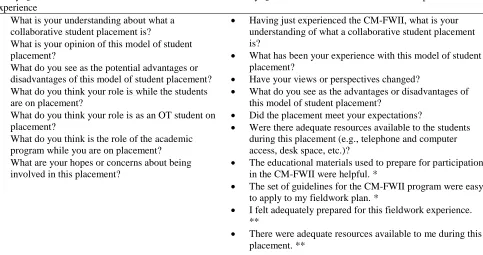
Pre and postsurvey instruments developed by Rodger et al. (2009) for a similar study conducted in the United Kingdom were used with permission granted by the corresponding authors. The Survey for Students Pre-placement and the Survey for Supervisors Pre-placement includes 10 open-ended questions that address the participant’s understanding of the collaborative supervision models, the advantages and disadvantages of these models, the perceived tasks and roles and hopes, and the concerns about participation in the model (Rodger et al., 2009) (see Table 1). One week before the
fieldwork was scheduled to begin, the instruments were administered via individual, semi-structured, face-to-face interviews. This was followed by the preparatory education session.
The Survey for Students Post-placement and the Survey for Supervisors Post-placement included two parts. Part 1 was primarily open-ended questions that examined the participants’ perceptions, their change in knowledge resulting from the experience, what they perceived to be the advantages and disadvantages of the model, and the availability of resources (Rodger et al., 2009) (see Table 1). The final question in Part 1 was created for the CM-FWII program to determine student and FWEd
satisfaction with the educational preparation materials and resources provided throughout the fieldwork experience. The two-part question was positively worded for rating on a Likert agreement scale where 1 indicated strongly disagree, 2 indicated disagree, 3 indicated undecided, 4 indicated agree, and 5 indicated strongly agree. Part 2included 13 positively worded statements that measured participant satisfaction with the model through the same 5-point Likert agreement scale (Rodger et al., 2009). The instruments were administered 1 week post fieldwork experience through individual, semi-structured, face-to-face interviews. The participants completed and submitted Part 2at the postplacement
interview.
Table 1
Pre and Postplacement Questions Survey Questions asked Before the Fieldwork Experience
Survey Questions asked After the Fieldwork Experience
What is your understanding about what a collaborative student placement is?
What is your opinion of this model of student placement?
What do you see as the potential advantages or disadvantages of this model of student placement? What do you think your role is while the students
are on placement?
What do you think your role is as an OT student on placement?
What do you think is the role of the academic program while you are on placement? What are your hopes or concerns about being
involved in this placement?
Having just experienced the CM-FWII, what is your understanding of what a collaborative student placement is?
What has been your experience with this model of student placement?
Have your views or perspectives changed?
What do you see as the advantages or disadvantages of this model of student placement?
Did the placement meet your expectations?
Were there adequate resources available to the students during this placement (e.g., telephone and computer access, desk space, etc.)?
The educational materials used to prepare for participation in the CM-FWII were helpful. *
The set of guidelines for the CM-FWII program were easy to apply to my fieldwork plan. *
I felt adequately prepared for this fieldwork experience. **
There were adequate resources available to me during this placement. **
Note. Survey questions were adapted and used with permission from the original authors (Roger et al., 2009). *Statements presented to FWEds for rating on a 5-point Likert agreement scale. **Statements presented to students for rating on a 5-point Likert agreement scale.
Data Analysis
To answer Question 1 (what change in knowledge did the students and FWEds experience?), a content analysis of student and FWEd responses to open-ended questions was performed using an a priori coding method. A priori content analysis was adopted as a method to promote a systematic replicable design for others to use, in addition to providing the ability to sift through an enormous
4 https://scholarworks.wmich.edu/ojot/vol6/iss3/14
amount of text in a systematic manner (Stemler, 2001). The process involved reviewing the literature on collaborative models of fieldwork education to identify major components and then categorizing those components for analysis of the participant interview data. The six categories supporting collaborative models included benefits, advantages, disadvantages, academic educator role, fieldwork educator role, and student role. Each of the six categories was further defined by essential elements, totaling 39 items (see Appendix B). To evaluate student and FWEd acquisition of this knowledge, transcript content was reviewed and coded using the 39 elements. Before and after program frequency distributions were calculated to measure the change in knowledge of the established items.
For Question 2 (what is the students’ and the FWEds’ level of satisfaction with their experience after completion of the CM-FWII?), the frequency of the 13 positively worded statements about the fieldwork experience rated agree or strongly agree were calculated for each of the participant’s responses using the 5-point Likert agreement scale. Lower numbers indicated less satisfaction.
For Question 3 (what is the level of satisfaction with the CM-FWII preparatory educational materials for the students and the FWEds?), the students and FWEds responded to a two-part question using a 5-point Likert agreement scale. The students rated their satisfaction with preparation and resources available throughout the fieldwork experience. The FWEds rated their satisfaction with educational materials and the ease of application of the CM-FWII guidelines into their current fieldwork program.
Qualitative data from the interviews was further analyzed and coded to identify emerging themes related to student and FWEd perceptions of the model. Themes were compared to the current literature supporting the collaborative model.
Results
Four FWEds and eight students participated in the program. Two of the FWEds were from pediatric settings and two were from adult practice settings. The FWEds had a range of experience from 2 to 17 years. All four of the FWEds supervised Level II fieldwork students using a traditional 1:1 model of supervision prior to participation in the CM-FWII. The four students assigned to the pediatric settings were in the final semester of the academic program and the four students assigned to the adult settings had completed 1 year in the program. Two students were assigned to each FWEd.
Question 1: Upon Completion of the CM-FWII, what Change in Knowledge did the Students and the FWEds Experience?
Before the education session and participation in the CM-FWII, student identification of the 39 essential elements of the collaborative supervision model ranged from 9 (23%) to 21 (54 %). After completing the fieldwork experience, student identification of the 39 essential elements ranged from 16 (41%) to 33 (84%). All of the students demonstrated an increase in knowledge, with Student 4 showing the greatest increase from 11 (28%) before participation in the program to 32 (82%) after participation (see Figure 1).
The FWEds’ identification of the 39 essential elements before participation ranged from eight (21%) to 19 (49%). After completing the fieldwork experience, the FWEds’ identification of the 39 essential elements ranged from 26 (67%) to 32 (82%). The greatest knowledge increase occurred with FWEd 4, who identified eight (21%) items before participation in the program and 31 (79%) items after participation (see Figure 2).
Figure 1. The students’ knowledge of the 39 essential elements of the collaborative model before and after implementation.
Figure 2. The FWEds’ knowledge of the 39 essential elements of the collaborative model before and after implementation.
Question 2: What is the Students’ and the FWEds’ Level of Satisfaction with their Experiences after Completion of the CM-FWII?
The responses from the student participant group were similar. Five of the students agreed or strongly agreed with 13 (100%) of the statements, one student agreed or strongly agreed with 12 (92%) of the statements, two of the students agreed or strongly agreed with 11 (85%) of the statements and three (25%) of the statements, respectively. The responses were also similar across the FWEd participant group. Three of the FWEd participants agreed or strongly agreed with 12 (92%) of the statements and one FWEd agreed or strongly agreed with 13 (100%) of the statements.
Question 3:What is the Level of Satisfaction with the CM-FWII Preparatory Educational Materials for the Students and the FWEds?
Seven of the students agreed or strongly agreed with the two-part question, indicating that they felt adequately prepared and that adequate resources were available to them for the fieldwork
experience. One student was undecided about the adequacy of her preparation and disagreed that the resources provided throughout the fieldwork experience were adequate.
51 54
41
28 23
31 31 36
79 84 56 82 51 41 79 79 0% 10% 20% 30% 40% 50% 60% 70% 80% 90%
1 2 3 4 5 6 7 8
Kn o wl e d ge o
f 39 E
sse n ti al E le me n ts (% ) Student Participant Pre Post 36 49 46 21 69 82 67 79 0% 10% 20% 30% 40% 50% 60% 70% 80% 90%
1 2 3 4
Kn o wl e d ge o
f 39 E
sse n ti al E le me n ts (%)
Fieldwork Educator Participant
Pre Post
6 https://scholarworks.wmich.edu/ojot/vol6/iss3/14
TheFWEds indicated a positive perception of the education and preparation materials. All four of the FWEds either agreed or strongly agreed that the education materials and guidelines were helpful and easy to implement into their fieldwork program.
Thematic Analysis
Key themes that arose from the evaluation of the CM-FWII program were (a) socialization, (b) caseloadand its relationship to independence, (c) relationships, (d) workspace, (e) self-confidence and clinical competence, and (f) communication and teamwork.
Socialization. The student participants were grateful for the opportunity to participate in the CM-FWII program. Although most of the students indicated high satisfaction after the experience, comments at postplacement interviews showed the students’ heightened expectation of the traditional 1:1 model of fieldwork supervision. Student 8 stated, “I wouldn’t like that I kind of got trapped into being with another student because that is how it would feel if I didn’t know ahead of time.” Student 7 expressed initial concern about the model:
I definitely think there was skepticism when I first found out . . . . I wanted the most out of the fieldwork experience and the first thought is now there are two people fighting for one person’s attention. I don’t want to be put on the back burner . . . fall behind because I’m not getting enough of that time with my supervisor.
Caseload and its relationship to independence. Thestudents on a collaborative model will share clients with their peer and manage an individual caseload. Two of the students expressed frustration in dealing with what they perceived to be an inadequate caseload. This appeared on the satisfaction survey and during responses to open-ended questions. One student comment is clearly articulated as feeling less independent because of caseload experience in the CM-FWII: “It got a little repetitive and I never really got to feel what it felt like to have my own caseload, you know, as an occupational therapist, because we always had a shared a caseload” (Student 1). Student 5 expressed similar concerns:
One of the primary issues was the caseload. I feel like if I could have kept more busy [sic] with stuff other than copying and paper filing I would have been a little more content, little less stressed and frustrated. But it just wasn’t the case. The caseload was really small and then sharing made it harder.
Strategies were provided to the FWEds to combat potential caseload challenges. One FWEd took the liberty to apply those strategies and eliminated the caseload barrier, and one student expressed gratitude for the FWEd’s efforts:
Sometimes there wasn’t enough clients, but our supervisor brainstormed and split us up in two, each of us having our own independent days with a COTA instead of both us being with her all at once. I enjoyed having that independent timealone. (Student 4)
Relationships. Four of the student participantswere from the same cohort and had become close friends both in and out of the academic setting. Three of the students in this group indicated that their friendship impacted the flow of the peer relationship, as noted in the comment below:
I think maybe the comfort between us sometimes was a bad thing because it allowed my peer to snap at me a little more because we were friends. Someone else might not be so comfortable being able to do that. (Student 4)
Workspace. Workspace is typically a fixed element. There are only so many computers
available for documentation and so much desk space to accommodate multiple individuals. In addition,
the noise level in the therapy space is elevated in a collaborative model and can disrupt the colloquial nature in a department. FWEd 2 acknowledged workspace burdens: “The meetings we go to are in small rooms, so showing up with three people to represent you was a little too much.” FWEd 4 also expressed concerns about workspace limitations:
The challenge of workspace . . . . We had two students at one computer. I wouldn’t go and crowd a computer where two students are sitting, because now you have a three-person
conversation and the therapist next to you is documenting, trying to concentrate and write . . . . Three people are jibber jabbering in their ear.
Self-confidence and clinical competence. This theme was well-supported by the students and FWEds. FWEd 2 stated, “They really developed that independent problem solving, more so [be]cause they had each otherto talk to. Also, I think it helped in their confidence.” This sentiment was reinforced by FWEd 1: “We went off the model due to the student’s independence level, they ended up ahead of schedule.” FWEd 3 agreed: “I would say the highlight initially is increased confidence with the students teaming, team building, professional development, peer relationship, increased independence initially, self-confidence increased with a peer.” The students had similar responses:
“I loved having another student there,we have somebody to talk about everything right there on site. You really get a good grasp on information” (Student 4).
“[The experience] made me feel more confidentin asking questions that I had in my head” (Student 2).
“We helped each other become more independent quicker, we had evaluations down pat in like week 2 or 3” (Student 3).
“Highlights, I think picking up the caseload so quickly, picking up the documentation so quickly” (Student 4).
Communication and teamwork. Many of the students expressed gratitude for having the student peer with whom to communicate and share ideas. The following comment depicts the level of importance placed on communication and teamwork:
So, it really requires a good line of communication between peer and I [sic]. I need to know what she understood . . . so I can continue with that and pick up right where she left off, and she can do the same for me.(Student 7)
The FWEds recognized the benefits of the collaboration inherent in the CM-FWII. FWEd 4 stated: In terms of treatment planning, it made it nice because they both knew all of the kids even if they were on different caseloads. They were able to step in if the child was having a behavior or one was not getting anywhere in terms of treatment. The session was kind of at a halt. The other student would jump in and say, “hey, why don’t we try this.” A lot of collaboration.
Discussion
The results of the program evaluation suggest that there are both advantages and disadvantages of the CM-FWII program. The program fostered an increase in knowledge and understanding of
collaborative supervision models for the students and FWEds. As indicated by the themes that emerged in this study, the students andFWEdsindicated that self-confidence and clinical competence were achieved much earlier than expected with the presence of a peer. The FWEds reported satisfaction with the students’ lack of dependency due to peer support and peer interactions. The students consistently identified the value and appreciation of having another student with whom to share the experience, and all but one student commented on the enhanced learning that took place as a result of the peer
8 https://scholarworks.wmich.edu/ojot/vol6/iss3/14
relationship. One student identified the value of the mutual peer support associated with the critical conditions and mortality rate of the patients in the setting. She felt the death and dying aspect would have impeded her progress, noting the overall desensitization of mortality issues among the staff members working long-term in the practice setting. She commented on the mutual assumption of the role of supporter that took place with the peer relationship.
These findings are consistent with the literature regarding collaborative models. For instance, Martin et al. (2004) and Moore, Morris, Crouch, and Martin (2003) reported the 2:1 and 3:1 models offered students more support through their ability to rely on their peer. The peer support factor enhanced learning, and the authors suggested that when students feel confident they achieve greater benefit from the learning experience. Rindflesch et al. (2009) cited the concept of positive peer pressure as impacting student professional development. These authors suggested student groups achieved a much higher level of professional development than predicted: “positive peer pressure—exerted from one’s peer to perform and achieve, even if the pressure is never clearly articulated into words—may be a larger contributor” (p. 137). Finally, Baldry Currens and Bithell (2003) reported that peer discussion assists students in clarifying thoughts and confirming ideas. Affirmation received by one’s peer
increased confidence and added depth to their understanding and clinical reasoning, thus prompting the construction of new knowledge. In addition, more open communication and teamwork skills are facilitated through student-to-student interactions, including the sharing of materials, space, caseload, and other related activities (Bartholomai & Fitzgerald, 2007; Martin et al., 2004; O’Connor et al., 2012). Implications for Fieldwork Education
The implementation of the CM-FWII program did not occur without challenges and
unanticipated events that fostered positive changes in the fieldwork education process. For instance, education and preparation for the FWEds and students was anticipated; however, the socialization of the students to the collaborative model was not. The students were less supportive of a fieldwork placement with a peer, indicating concern about sharing the attention of the FWEd and receiving an experience inferior to the traditional 1:1 model. This finding substantiates the need for early identification of and preparation for collaborative supervision models. Academic fieldwork coordinators can incorporate discussions regarding the collaborative model and the value of peer learning early on to prepare students for what the model offers, thus minimizing preconceived notions of an inferior experience.
A challenge to the learning experience occurred when the caseload available at a fieldwork site did not support two students. One student (Student 5) was pulled from the CM-FWII program at Week 8 because of an unresolved insufficient caseload for two students. This negatively impacted this students’ perception of the model. O’Connor, Cahill, and McKay (2012) found FWEds and students expressed concern when insufficient clients were available. Preplanning involving staff members in a department sharing their patient load to free them up for other duties might alleviate this concern. In addition, caseload delegation should account for various additional activities, such as structured observations, case study presentations, evidence-based reviews, and other learning opportunities that benefit students and the multidisciplinary staff (Bartholomai & Fitzgerald, 2007; Hanson & Deluliis, 2015). Students tend to feel positive about having a peer initially but want to assert their independence in the later stages of the fieldwork experience (O’Connor et al., 2012). This underscores the importance of student preparation for what a collaborative model offers. This early preparation may foster positive interdependence, a necessary component for collaborative learning, versus competitiveness or
individualism (Ladyshewsky, 2006).
Finally, the challenge of workspace was reported in this study, particularly from the FWEds. Bartholomai and Fitzgerald (2007) identified that having two or more students in the department can limit access to space and other resources, such as phones, computers, and raw materials. This can result in staff dissatisfaction if they perceive the students as infringing on their space. The concept of shared responsibility is cited as a hallmark of the CMFE, indicating the need for the FWEd to prepare the department and/or the multidisciplinary staff for multiple students and to encourage tolerance of space issues and sharing the responsibility for the students. This shared responsibility may also eliminate burnout and enable opportunities for the FWEd to provide individual feedback to the students (Bartholomai & Fitzgerald, 2007; Moore et al., 2003).
Limitations
The findings of this program evaluation should be considered with the following limitations in mind. The primary author is a faculty member of the academic program from which the student
participants were recruited. Although none of the students took courses taught by the author prior to the scheduled fieldwork, the relationship must be taken into consideration as a bias associated with
agreement to participate and the integrity of the interview responses. The program was evaluated with one group of students and FWEds. The structure of the academic and fieldwork program made a comparative study impossible; however, further research is needed to support the effectiveness and benefit of collaborative models for Level II fieldwork. Finally, this program evaluation used a small sample, which limits the generalization of findings to other academic programs.
Recommendations
Recommendations for implementation of the collaborative model include systematically matching student pairs in advance of student placement. The FWEds and students identified their student cohort (or student peer) as highly responsible for the success of this CM-FWII program. Three of the four FWEds claimed they would implement the model again if they were guaranteed students similar to those in this trial model. This supports the academic program institutionalizing a procedure to target students for this model. Inclusion of the multidisciplinary staff in preparation for multiple
students is strongly encouraged. Student satisfaction was higher when supported by the multidisciplinary team (Bartholomai & Fitzgerald, 2007). Preplanning for other OT or OTA
practitioners in the department to share their clients to supplement caseload challenges and potentially shoulder some of the supervision responsibility will continue to be part of the process. This shared responsibility has the added benefit of enabling the primary FWEd time to provide individual feedback to each student and possibly prevent burnout (Bartholomai & Fitzgerald, 2007; O’Conner et al., 2012). Care should be taken to provide adequate education and preparation on the students’ behalf early in their academic program through fieldwork preparation courses to foster a clear understanding of the learning opportunities afforded them with the model.
Conclusion
There is a substantial need for expanding fieldwork options for OT and OTA students. The collaborative model fieldwork experience is a viable approach in which to accomplish this. Although the model may not be appropriate in some practice settings, there is strong support in the literature with emphasis on the benefits of peer learning opportunities and enhanced clinical competence (Baldry Currens & Bithell, 2003; DeClute & Ladyshewsky, 1993; Martin et al., 2004; Moore et al., 2003). The challenge is transforming the strong preference for a traditional 1:1 model of fieldwork education (Cohn & Crist, 1995; Martin et al., 2004; Roberts et al., 2015). These findings highlight the importance of
10 https://scholarworks.wmich.edu/ojot/vol6/iss3/14
advanced planning activities between academic programs and clinical sites to establish an infrastructure design of the collaborative model fieldwork experience (Bartholomai & Fitzgerald, 2007; Dawes & Lambert, 2010; Lekkas et al., 2007; Martin et al., 2004; Moore et al., 2003; O’Connor et al., 2012). It is imperative that university support is sustained throughout the implementation of new models of
fieldwork education.
References
Accreditation Council for Occupational Therapy Education. (2012). 2011 Accreditation council for occupational therapy education (ACOTE®) standards. American Journal of Occupational Therapy, 66(Suppl. 6), S6-S74.
http://doi.org/10.5014/ajot.2012.66S6 American Occupational Therapy Association. (2009).
Occupational therapy fieldwork education: Value and purpose. American Journal of Occupational Therapy, 63(6),821-822.
http://doi.org/10.5014/ajot.63.6.821 American Occupational Therapy Association. (2013).
COE guidelines for an occupational therapy fieldwork experience-Level II. Retrieved from https://www.aota.org/~/media/Corporate/Files/E ducationCareers/Educators/Fieldwork/LevelII/C OE%20Guidelines%20for%20an%20Occupation al%20Therapy%20Fieldwork%20Experience%2 0--%20Level%20II--Final.pdf
American Occupational Therapy Association. (2014a). COE fieldwork capacity and retention survey ad hoc committee: Preliminary results of a national survey on fieldwork capacity.Retrieved from
https://www.aota.org/-/media/Corporate/Files/EducationCareers/Educat
ors/Addendum-3-AFWC-Networking-Session.pdf
American Occupational Therapy Association. (2014b). Recommendations for expanding fieldwork. Retrieved from
https://www.aota.org/Education-Careers/Fieldwork/Supervisor/Expanding.aspx Baldry Currens, J., & Bithell, C.P. (2003). The 2:1
clinical placement model: Perceptions of clinical educators and students. Physiotherapy, 89(4), 204-218. http://doi.org/10.1016/s0031-9406(05)60152-6
Bartholomai, S., & Fitzgerald, C. (2007). The collaborative model of fieldwork education: Implementation of the model in a regional hospital rehabilitation setting. Australian Occupational Therapy Journal, 54(1), S23-S30.
https://doi.org/10.1111/j.1440-1630.2007.00702.x
Baumgartner, L. M. (2012). Mezirow’s theory of transformative learning from 1975 to present. In E. W. Taylor & P. Cranton (Eds.). The handbook of transformative learning: Theory, research, and practice (pp. 99-115). San Fransico: Jossey-Bass.
Casares, G. S., Bradley, K. P., Jaffe, L. E., & Lee, G. P. (2003). Impact of the changing health care environment on fieldwork education: Perception of occupational therapy educators. Journal of Allied Health, 32(4), 246-251.
Cohn, E. S., & Crist, P. (1995). Back to the future: New approaches to fieldwork education. American Journal of Occupational Therapy, 49(2), 103-106. http://doi.org/10.5014/ajot.49.2.103 Costa, D. M. (2007). Clinical supervision in occupational
therapy: A guide for fieldwork and practice.
Bethesda, MD: AOTA Press.
Cranton, P., & Taylor, E. W. (2012). Transformative learning theory: Seeking a more unified theory. In E. W. Taylor & P. Cranton (Eds.). The handbook of transformative learning: Theory, research, and practice (pp. 3-20). San Francisco: Jossey-Bass.
Dawes, J., & Lambert, P. (2010). Practice educators’ experiences of supervising two students on allied health practice-based placements. Journal of Allied Health, 39(1), 20-27.
http://www.ncbi.nlm.nih.gov/pubmed/20217003 DeClute, J., & Ladyshewsky, R. (1993). Enhancing
clinical competence using a collaborative clinical education model. Physical Therapy, 73,683-689. http://doi.org/10.1093/ptj/73.10.683
Evenson, M. E., Roberts, M., Kaldenberg, J., Barnes, M. A., & Ozelie, R. (2015). National survey of fieldwork educators: Implications for occupational therapy education. American Journal of Occupational Therapy, 69, 6912350020p1-6912350020p5.
http://doi.org/10.5014/ajot.2015.019265 Hanson, D. J., & Deluliis, E. D. (2015). The collaborative
model of fieldwork education: A blueprint for group supervision of students. Occupational Therapy in Health Care, 29(2), 223-239. http://doi.org/10.3109/07380577.2015.1011297 Ladyshewsky, R. K. (2006). Building cooperation in peer
coaching relationships: Understanding the relationships between reward structure, learning preparedness, coaching skill and learning engagement. Physiotherapy, 92(1),4-10. http://doi.org/10.1016/j.physio.2005.11.005 Lekkas, P., Larsen, T., Kumar, S., Grimmer, K., Nyland,
L., Chipchase, L., Jull, G., . . . Finch, J. (2007). No model of clinical education for physiotherapy students is superior to another: A systematic review. Australian Journal of Physiotherapy,
53(1), 19-28. http://doi.org/10.1016/s0004-9514(07)70058-2
Martin, M., Morris, J., Moore, A., Sadlo, G., & Crouch, V. (2004). Evaluating practice education models in occupational therapy: Comparing 1:1, 2:1 and 3: 1 placements, British Journal of Occupational Therapy, 67(5), 192-200.
https://doi.org/10.1177/030802260406700502 Mejiuni, O. (2012). International and community-based
transformative learning. In E. W. Taylor & P. Cranton (Eds.). The handbook of transformative learning: Theory, research, and practice (pp. 304-319). San Francisco: Jossey-Bass. Mezirow, J. (1998). On critical reflection. Adult Education Quarterly, 48(3), 185-198.
https://doi.org/10.1177/074171369804800305 Moore, A., Morris, J., Crouch, V., & Martin, M. (2003). Evaluation of physiotherapy clinical education models. Physiotherapy, 89(8), 489-501. http://doi.org/10.1016/s0031-9406(05)60007-7 O’Connor, A., Cahill, M., & McKay, E. A. (2012).
Revisiting 1:1 and 2:1 clinical placement
models: Student and clinical educator
perspectives. AustralianJournal of Occupational Therapy, 59(4), 276-283.
https://doi.org/10.1111/j.1440-1630.2012.01025.x
Rindflesch, A. B., Dunfee, H. J., Cieslak, K. R., Eischen, S. L., Trenary, T., Calley, D. Q., & Heinle, D. K. (2009). Collaborative model of clinical education in physical therapy and occupational therapy at the mayo clinic. Journal of Allied Health, 38(3), 132-142.
Roberts, M. E., & Simon, R. L. (2012, April 9).
Fieldwork challenge 2012. OT Practice, 17(6), 20.
Roberts, M., Evenson, M., Kaldenberg, J., Barnes, M. A., & Ozelie, R. (2015, May 25). Fieldwork education survey: Demand for innovative and creative solutions. OT Practice, 20(9), 15-16. Stemler, S. (2001). An overview of content analysis.
Practical Assessment, Research & Evaluation,
7(17). Retrieved from
http://pareonline.net/getvn.asp?v=7&n=17
12 https://scholarworks.wmich.edu/ojot/vol6/iss3/14
Appendix A
Fieldwork Educator/Student Resource Materials
Fact sheets: Benefits of the collaborative supervision model (uq.edu.au, 2016).
Tips for increasing efficiency using the collaborative model of fieldwork education (uq.edu.au, 2017).
Tips for facilitating collaboration and peer teaching/learning with a CMFE.
Program implementation outline
Student learning objectives
Preparation materials for the CM-FWII
o Complete a self-evaluation of learning style – share with fieldwork educator and peer learner
o Complete student learning contract
o Share your learning goals with each other, look for similarities and differences, and strategize ways to support one another
o Share your learning goals with fieldwork educator during the first week
Sample orientation checklist
Student learning objectives
Other forms: Guided observation forms, treatment planning forms, feedback checklist, sample learning contracts, student/supervisor weekly review forms, Level II fieldwork mid-term feedback form, student evaluation of the fieldwork form (SEFWE), and the AOTA Fieldwork Performance Form (aota.org).
Appendix B
Essential Elements of the CMFE
Definition
Benefits
Advantages
Disadvantage s
Faculty Role
FWEd Role
Student Role
1. Definition of CMFE
2. Peer support / learning 3. Increased collaboration 4. Increased communication 5. Improved self- confidence 6. Improved clinical competence 7. Teamwork
8. Productivity 9. Cost benefits
10. Increased Placements
11. Increased time for planning, administrative & other duties 12. Greater knowledge of student’s individual strengths and
weaknesses
13. Reduced student dependency on FWEd 14. Reduced superficial questions to FWEd
15. Increased clinical productivity for student team & and FWEd 16. Need to learn / prepare new strategies for dealing with two students 17. Decreased time for adequate feedback
18. Student privacy difficult to maintain
19. Potential inadequate case load for two students 20. Decreased time to observe FWEd in practice 21. Differences in student competencies 22. Student competition
23. Develop guidelines for CMFE 24. Collaborate with FWEd
25. Help identify appropriate students for CMFE 26. Prepare students for CMFE
27. Monitor student progress on fieldwork 28. Available for problem solving
29. Facilitate and support effective peer learning 30. More distant supervision
31. Clinical support vs. personal support
32. Structure the experience to facilitate peer learning and peer feedback
33. Plan scheduled group & individual supervision 34. Knowledge of the CMFE
35. Autonomy & Self-directed learning 36. Peer support
37. Manage case load both individual & Share
38. Share ideas, knowledge, skills and interventiontechniques 39. Communicate with other team members
14 https://scholarworks.wmich.edu/ojot/vol6/iss3/14