Vol. 6, No. 2, 2014, 160-169
ISSN: 2279-087X (P), 2279-0888(online) Published on 26 June 2014
www.researchmathsci.org
160
Annals of
Some Adjacent Edge Graceful Graphs
T.Tharmaraj1 and P.B.Sarasija2
1
Department of Mathematics, Udaya School of Engineering Vellamodi, Tamil Nadu, PIN-629204, India, E-mail: [email protected]
2
Department of Mathematics, Noorul Islam University
Kumaracoil, Tamil Nadu, PIN- 629180, India, E-mail: [email protected]
Received 17 June 2014; accepted 22 June 2014
Abstract. Let G(V,E)be a graph with p vertices and q edges. A (p,q) graph )
, (V E
G is said to be an adjacent edge graceful graph if there exists a bijection }
,..., 3 , 2 , 1 { ) (
:E G q
f → such that the induced mapping f * from V(G) by )
( )
(
* =
∑
i i e f u
f over all edges ei incident to adjacent vertices of u is an injection.
The function f is called an adjacent edge graceful labeling of G .In this paper, we prove
the graphs Cm∪Cn(m≥5,n≥5), Pm∪Cn(m≥5,n≥5),
) 2 (
n
C ,mK3 and sunflower
graph SF(n) (n is odd ) are the adjacent edge graceful graphs and we also prove
graphs Bn,n2 , K2 +mK1 and mK2 are not the adjacent edge graceful graphs.
Keywords: adjacent edge graceful graph, adjacent edge graceful labeling. AMS Mathematical Subject Classification (2010): 05C78
1. Introduction
Throughout this paper, by a graph we mean a finite, undirected, simple graph. The vertex set and the edge set of a graph G are denoted by V(G)andE(G) respectively. Let
) , (p q
G be a graph withp=|V(G)| vertices and q=|E(G)| edges. Graph labeling, where the vertices and edges are assigned real values or subsets of a set are subject to certain conditions. A detailed survey of graph labeling can be found in [2].Terms not defined here are used in the sense of Harary in [5].The concept of adjacent edge graceful labeling was first introduced in [18].Some results on adjacent edge graceful labeling of graphs and some non- adjacent edge graceful graphs are discussed in [18].
In this paper, we discussed about adjacent edge graceful labeling for a few more graphs.We use the following definitions in the subsequent sections.
161
mapping f * from V(G) by *( )=
∑
( ) ii e f u
f over all edges ei incident to
adjacent vertices of u is an injection. The function f is called an adjacent edge graceful labeling of G.
Definition 1.2. [2] The bistar graph Bn,n is the graph obtained from two copies of star
n
K1, by joining the vertices of maximum degree by an edge.
Definition 1.3. [2] A sunflower graph SF(n) as the graph obtained by starting with an
n-cycle with consecutive vertices v1,v2,...,vn and creating new vertices w1,w2,...,wn
with wi connected to vi and vi+1 (vn+1 isv1).
Definition 1.4. [15] For a simple connected graph G the square of graph Gis denoted by G2and defined as the graph with the same vertex set as of G and two vertices are adjacent in G2 if they are at a distance 1 or 2 apart in G.
2. Main results
Theorem 2.1. The graph Cm∪Cn(m≥5,n≥5) is an adjacent edge graceful graph.
Proof: Let Cm=u1u2...umu1 and Cn=v1v2... vvn 1 be two cycles.
Let
= −
≤ ≤ =
= −
≤ ≤ =
= ∪
+ +
+ +
n n m i
i i m
m m i
i i n m
v v e n
i v
v e
u u e m i u
u e C C E
1 1
1 1
; 1 1
:
; 1 1
: )
(
Define f :E(Cm∪Cn)→{1,2,3,...,m+n} by
Case (i) (m and n are both odd ) n
m i if i e
f( i)= 1≤ ≤ + . Let f * be the induced vertex labeling of f . In this case the induced vertex labels are as follows: f *(u1)=2m+2 ; f *(u2)=m+6;
3 1
6 4 ) (
* u+2 = i+ if ≤i≤m−
f i ; f *(um)=3m−2 ; f *(v1)=4m+2n+2 ; 6
4 ) (
* v2 = m+n+
f ; f *(vn)=4m+3n−2; 3 1
6 4 4 ) (
* v+2 = m+ i+ if ≤i≤n−
f i .
Case (ii) (m is odd and n is even )
m i if i e
f( i)= 1≤ ≤ ;
2 1
1 2 )
(e m i if i n
f m+i = + − ≤ ≤ ;
2 1 2 2 )
(
2 2 2
n i if i n
m e
f m+n+ i = + + − ≤ ≤ .
In this case the induced vertex labels are as follows: 2
2 ) (
* u1 = m+
f ; f *(u2)=m+6; f *(um)=3m−2; 3
1 6 4 ) (
* u+2 = i+ if ≤i≤m−
f i ;
If n=6, f *(v1)=4m+n+4; f *(v2)=4m+n+5;
3 2 4 ) (
* v3 = m+ n+
162 5
2 4 ) (
* v5 = m+ n+
f ; f *(v6)=4m+2n+1;
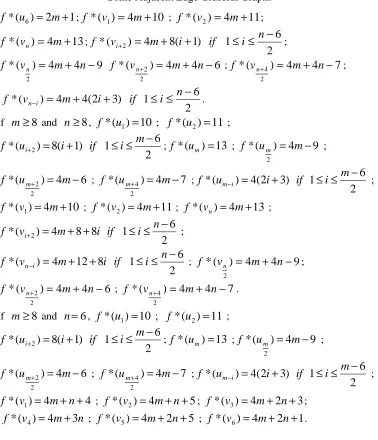
If n≥8 , f *(v1)=4m+10 ; f *(v2)=4m+11 ; f *(vn)=4m+13;
2 6 1
) 1 ( 8 4 ) (
* 2
− ≤ ≤ +
+ =
+
n i if i m v
f i ; *( ) 4 4 9
2
− + = m n v
f n ;
6 4 4 ) ( *
2
2 = + −
+ m n
v
f n ; *( ) 4 4 7
2
4 = + −
+ m n
v
f n ;
2 6 1
) 3 2 ( 4 4 ) (
* v − = m+ i+ if ≤i≤ n−
f n i .
Case (iii) (m is even and n is odd )
2 1 1 2 )
(e i if i m
f i = − ≤ ≤ ;
2 1 2 2 )
(
2 2
m i if i m
e
f m+ i = + − ≤ ≤ ;
n i if i m e
f( m+i)= + 1≤ ≤ .
In this case the induced vertex labels are as follows:
If m=6 , f *(u1)=2m−2; f *(u2)=2m−1; f*(u3)=3m−3; m
u
f*( 4)=3 ; f*(u5)=3m−1; f *(u6)=2m+1;
If m≥8, f *(u1)=10; f*(u2)=11;
2 6 1
) 1 ( 8 ) (
* 2
− ≤ ≤ +
=
+
m i if i u
f i ;
13 ) ( * um =
f ; *( ) 4 9
2
− = m u
f m ; *( ) 4 6
2
2 = −
+ m
u
f m ; *( ) 4 7
2
4 = −
+ m
u
f m ;
2 6 1
) 3 2 ( 4 ) (
* u − = i+ if ≤i≤m−
f m i ; f *(v1)=4m+2n+2;
6 4
) (
* v2 = m+n+
f ; f *(vn)=4m+3n−2; 3 1
6 4 4 ) (
* v+2 = m+ i+ if ≤i≤n−
f i .
Case (iv) (m and n are both even)
2 1 1 2 )
(e i if i m
f i = − ≤ ≤ ;
2 1 2 2 )
(
2 2
m i if i m
e
f m+ i = + − ≤ ≤
2 1
1 2 )
(e m i if i n
f m+i = + − ≤ ≤ ;
2 1
2 2 )
(
2 2 2
n i if i n
m e
f m+n+ i = + + − ≤ ≤ .
In this case the induced vertex labels are as follows:
If m=6 and n=6, f *(u1)=2m−2; f*(u2)=2m−1; f*(u3)=3m−3;
m u
f*( 4)=3 ; f*(u5)=3m−1; f *(u6)=2m+1; f*(v1)=5n+4;
5 5 ) (
* v2 = n+
f ; f *(v3)=6n+3; f *(v4)=7n ; f*(v5)=7n+1; 1
6 ) (
* v6 = n+
f .
If m=6 and n≥8, f *(u1)=2m−2 ; f*(u2)=2m−1;
3 3 ) (
* u3 = m−
163 1
2 ) (
* u6 = m+
f ; f *(v1)=4m+10 ; f *(v2)=4m+11;
13 4 ) (
* v = m+
f n ;
2 6 1
) 1 ( 8 4 ) (
* 2
− ≤ ≤ +
+ =
+
n i if i m v
f i ;
9 4 4 ) ( *
2
− + = m n v
f n *( ) 4 4 6
2
2 = + −
+ m n
v
f n ; *( ) 4 4 7
2
4 = + −
+ m n
v
f n ;
2 6 1
) 3 2 ( 4 4 ) (
* v − = m+ i+ if ≤i≤ n−
f n i .
If m≥8 and n≥8, f*(u1)=10 ; f *(u2)=11 ;
2 6 1
) 1 ( 8 ) (
* 2
− ≤ ≤ +
=
+
m i if i u
f i ; f*(um)=13 ; *( ) 4 9
2
− = m u
f m ;
6 4 ) ( *
2
2 = −
+ m
u
f m ; *( ) 4 7
2
4 = −
+ m
u
f m ;
2 6 1
) 3 2 ( 4 ) (
* u − = i+ if ≤i≤m−
f m i ;
10 4 ) (
* v1 = m+
f ; f*(v2)=4m+11 ; f*(vn)=4m+13 ;
2 6 1
8 8 4 ) (
* v+2 = m+ + i if ≤i≤n−
f i ;
2 6 1
8 12 4 ) (
* v − = m+ + i if ≤i≤n−
f n i ; *( ) 4 4 9
2
− + = m n v
f n ;
6 4 4 ) ( *
2
2 = + −
+ m n
v
f n ; *( ) 4 4 7
2
4 = + −
+ m n
v
f n .
If m≥8 and n=6, f*(u1)=10 ; f *(u2)=11 ;
2 6 1
) 1 ( 8 ) (
* u+2 = i+ if ≤i≤m−
f i ; f*(um)=13 ; *( ) 4 9
2
− = m u
f m ;
6 4 ) ( *
2
2 = −
+ m
u
f m ; *( ) 4 7
2
4 = −
+ m
u
f m ;
2 6 1
) 3 2 ( 4 ) (
* u − = i+ if ≤i≤m−
f m i ;
4 4
) (
* v1 = m+n+
f ; f *(v2)=4m+n+5; f *(v3)=4m+2n+3; n
m v
f*( 4)=4 +3 ; f*(v5)=4m+2n+5 ; f *(v6)=4m+2n+1.
Example 2.2. An adjacent edge graceful labeling of C12∪C10 is shown in the Fig.1.
164
Theorem 2.3. The graph Pm∪Cn(m≥5,n≥5) is an adjacent edge graceful graph.
Proof: Let Pm=u1u2...um be a path and Cn=v1v2... vvn 1 be a cycle .
Let = − ≤ ≤ = − ≤ ≤ = = ∪ − + + + − + n n m i i i m i i i n m v v e n i v v e m i u u e C P E 1 1 1 1 1 ; 1 1 : ; 1 1 : ) (
Define f :E(Pm∪Cn)→{1,2,3,...,m+n−1} by
Case (i) (m and n are both odd ) 1 1
)
(e =i if ≤i≤m+n−
f i .
In this case the induced vertex labels are as follows: 3
) ( * u1 =
f ; f *(u2)=6 ; f *(ui+2)=4i+6 if 1≤i≤m−4; f*(um−1)=3m−6;
3 2 ) (
* u = m−
f m ; f*(v1)=4m+2n−2 ; f *(v2)=4m+n+2 ;
3 3 4 ) (
* v = m+ n−
f n ; f *(vi+2)=4m+4i+2 if 1≤i≤n−3 .
Case (ii) (m is odd and n is even )
1 1
)
(e =i if ≤i≤m−
f i ;
2 1 2 2 ) ( 1 n i if i m e
f m−+i = + − ≤ ≤ ;
2 1 2 1 ) ( 2 2 2 2 n i if i n m e
f m+n− + i = + + − ≤ ≤ .
In this case the induced vertex labels are as follows: 3
) ( * u1 =
f ; f *(u2)=6 ; f *(um−1)=3m−6 ; 4 1 6 4 ) (
* u+2 = i+ if ≤i≤m−
f i ; f *(um)=2m−3.
If n=6 , f *(v1)=4m+n ; f *(v2)=4m+n+1; f *(v3)=4m+n+5;
2 2 4 ) (
* v4 = m+ n+
f ; f*(v5)=4m+2n+1 ; f*(v6)=4m+n+3. If n≥8 , f *(v1)=4m+6 ; f*(v2)=4m+7;
2 6 1 8 4 4 ) ( * 2 − ≤ ≤ + + = + n i if i m v
f i ; *( ) 4 4 13
2
− + = m n v
f n ;
10 4 4 ) ( * 2
2 = + −
+ m n
v
f n ; *( ) 4 4 11
2
4 = + −
+ m n
v
f n ;
2 6 1 8 8 4 4 ) ( * 2 2 4 − ≤ ≤ − − + = + + n i if i n m v
f n i ; f *(vn)=4m+9 .
Case (iii) (m is even and n is odd )
2 1 1 2 )
(e i if i m
f i = − ≤ ≤ ;
2 2 1 2 ) ( 2 2 − ≤ ≤ − = + m i if i m e
f m i ;
n i if i m e
f( m−1+i)= −1+ 1≤ ≤ .
In this case the induced vertex labels are as follows:
If m=6 , f *(u1)=m−2 ; f *(u2)=m+3; f *(u3)=2m+1;
m u
165
If m=8 , f *(u1)=m−4 ; f*(u2)=m+1; f*(u3)=2m; f *(u4)=2m+5 ;
m u
f*( 5)=3 ; f*(u6)=2m+3; f *(u7)=2m+2 f *(u8)=m−2.
If m≥10, f*(u1)=4 ; f *(u2)=9 ;
2 6 1 8 8 ) ( * 2 − ≤ ≤ + = + m i if i u
f i ;
11 4 ) ( * 2 − = m u
f m ; *( ) 4 10
2
2 = −
+ m
u
f m ; *( ) 4 13
2
4 = −
+ m
u
f m ;
2 8 1 8 12 4 ) ( * 2 2 4 − ≤ ≤ − − = + + m i if i m u
f m i ; f *(um−1)=12 ; f*(um)=6
2 2 4 ) (
* v1 = m+ n−
f ; f *(v2)=4m+n+2 ; f *(vn)=4m+3n−6 ; 3 1 2 4 4 ) (
* v+2 = m+ i+ if ≤i≤n−
f i .
Case (iv) (m and n are both even )
2 1 1 2 )
(e i if i m
f i = − ≤ ≤ ;
2 2 1 2 ) ( 2 2 − ≤ ≤ − = + m i if i m e
f m i ;
2 1 2 2 )
(e 1 m i if i n
f m−+i = + − ≤ ≤ ;
2 1 2 1 ) ( 2 2 2 2 n i if i n m e
f m+n− + i = + + − ≤ ≤ .
In this case the induced vertex labels are as follows:
If m=6 , f *(u1)=m−2 ; f *(u2)=m+3; f *(u3)=2m+1;
m u
f*( 4)=2 ; f *(u5)=2m−5; f *(u6)=6.
If m=8 , f *(u1)=m−4 ; f*(u2)=m+1; f*(u3)=2m; f *(u4)=2m+5 ; m
u
f*( 5)=3 ; f*(u6)=2m+3; f *(u7)=2m+2 f *(u8)=m−2.
If m≥10, f*(u1)=4 ; f *(u2)=9 ;
2 6 1 8 8 ) ( * 2 − ≤ ≤ + = + m i if i u
f i ;
11 4 ) ( * 2 − = m u
f m ; *( ) 4 10
2
2 = −
+ m
u
f m ; *( ) 4 13
2
4 = −
+ m
u
f m ;
2 8 1 8 12 4 ) ( * 2 2 4 − ≤ ≤ − − = + + m i if i m u
f m i ; f *(um−1)=12 ; f*(um)=6
If n=6 , f *(v1)=4m+n ; f *(v2)=4m+n+1; f *(v3)=4m+n+5;
2 2 4 ) (
* v4 = m+ n+
f ; f*(v5)=4m+2n+1 ; f*(v6)=4m+n+3. If n≥8 , f *(v1)=4m+6 ; f*(v2)=4m+7;
2 6 1 8 4 4 ) (
* v+2 = m+ + i if ≤i≤n−
f i ; *( ) 4 4 13
2
− + = m n v
f n ;
10 4 4 ) ( * 2
2 = + −
+ m n
v
f n ; *( ) 4 4 11
2
4 = + −
+ m n
v
f n ;
2 6 1 8 8 4 4 ) ( * 2 2 4 − ≤ ≤ − − + = + + n i if i n m v
166
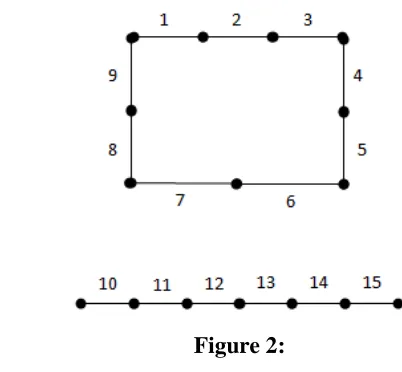
Example 2.4. An adjacent edge graceful labeling of C9∪P7 is shown in the Fig.
2.
Figure 2:
Theorem 2.5. The graph Cn(2) is an adjacent edge graceful graph.
Proof: Let ' w ' be the central vertex of Cn(2).Let {ui :1≤i≤n}be the vertices of
first cycle of Cn(2). Let {vi :1≤i≤n} be the vertices of second cycle of
) 2 (
n C .
Let
= −
≤ ≤ =
= −
≤ ≤ =
=
+ +
+
n n i
i i n
n n i
i i n
v v e n
i v
v e
u u e n
i u
u e C
E
1 2 1
1 1
) 2 (
, 1 1
:
, 1 1
: )
(
Take w=u1=v1 .Define f :E(Cn(2))→{1,2,3,...,2n} by n
i if i e
f( i)= 1≤ ≤ . Let f * be the induced vertex labeling of f .
The induced vertex labels are as follows: f *(u1)=8n+4 ; f *(u2)=4n+7; 1
6 ) (
* u = n−
f n ; f *(ui+2)=4i+6 if 1≤i≤n−3; f *(v2)=6n+7; 1
8 ) (
* v = n−
f n ; f *(vi+2)=4n+4i+6 if 1≤i≤n−3.
Theorem 2.6. The graph K2 +mK1 is not an adjacent edge graceful graph.
Proof: Let G=K2 +mK1. Let V(G)=
{
u,v, wi :1≤i≤m}. Let E(G)={
ei =uwi , em+i =vwi :1≤i≤m;e2m+1 =uv}. Let f be a bijection from E(G) to {1,2,3,...,2m+1}.Let
α
1,α
2,....,α
m,β
1,β
2,....,β
m,α
be the label of edges e1,e2,....,em,em+1,....,e2m+1respectively by f . And f induces that f*:V(G)→{1,2,3,...} by )
( )
(
* =
∑
i i e f u
f over all edges ei incident to adjacent vertices of u. Then
) ( ) ( )
( ) ( )
(
* 2 1
2
1 1
2 1
+ +
= + =
+ +
+
=
∑
∑
mm
m i
i m
m
i i
i f e f e f e f e
w
f =
∑
α
+∑
β
+α
+α
= =
m
i i m
i i
167
=1+2+3+...+(2m+1)+
α
=(m+1)(2m+1)+α
for 1≤i≤m . That is every vertex wi have same vertex labels by f *. Hence f * is not injective.Therefore thegraph K2 +mK1 is not an adjacent edge graceful graph.
Theorem 2.7. The graph mK is not an adjacent edge graceful graph. 2
Proof: Let the vertex set of mK be 2 V =V1∪V2∪...∪Vm where
} , { i1 i2
i v v
V = .Let E(mK2)={ei =vi1vi2 :1≤i≤m }. Let f be a bijection from E(mK2) to {1,2,3,...,m . } And f induces that
,....} 3 , 2 , 1 { ) ( :
* V mK2 →
f by *( )=
∑
( )i i e f u
f over all edges e incident to i
adjacent vertices of u .The vertices vi1 and
2
i
v are incident with same and only
one edge ei.Then f *(vi1)= f *(vi2)= f(ei).That is each vertex pairs (vi1,vi2) have same vertex labels by f *. Hence f * is not injective.
Therefore the graph mK is not an adjacent edge graceful graph. 2
Theorem 2.8. The graph mK3 is an adjacent edge graceful graph.
Proof: Let the vertex set of mK3 be V =V1∪V2∪...∪Vm where }
, , { i1 i2 i3
i v v v
V = .
Let E(mK3)={ei =vi1vi2 ,em+i =vi2vi3 ,e2m+i =vi1vi3 :1≤i≤m}. Define f :E(mK3)→{1,2,3,...,3m} by f(ei)=3i−2 if 1≤i≤m ;
m i if i e
f( m+i)=3 −1 1≤ ≤ ; f(e2m+i)=3i if 1≤i≤m. Let f * be the induced vertex labeling of f .
The induced vertex labels are as follows: f *(vi1)=12i−4 if 1≤i≤m ;
m i if i v
f *( i )=12 −3 1≤ ≤
2
; f *(vi )=12i−5 if 1≤i≤m
3
.
Example 2.9. An adjacent edge graceful labeling of 5K3 is shown in the Fig. 3.
168
Theorem 2.10. The graph Bn.n2 is not an adjacent edge graceful graph.
Proof: Let V(Bn.n2)={ui ,vi : 1≤i≤n+1}.
Let
= ≤
≤ =
=
≤ ≤ =
= =
+ + + +
+ + +
+ +
+
1 1 1 4 1
3 1 2
1 1
2 .
; 1
: ,
1 : ,
) (
n n n n
i i n n i i n
n i i n n i i n
n
v u e n i u
v e v u e
n i v
v e u u e B
E
Let f be a bijection from E(Bn,n2) to {1,2,3,...,4n+1}.
Let
α
1,α
2,....,α
n,α
n+1,....,α
2n,α
2n+1,....,α
3n,α
3n+1,...,α
4n,α
be the label of edges of1 4 1 3 3 1 2 2 1 2
1,e ,....,en,en+,....,e n,e n+ ,....,en,e n+ ,...,e n+
e respectively by f . And f
induces that f*:V(Bn,n2)→{1,2,3,....} by *( )=
∑
( ) ii e f u
f over all edges ei
incident to adjacent vertices of u. Then *( ) ( ) 2 ( 4 1)
4
1
+ =
+
=
∑
nn
i i
i f e f e
u
f =
α
+ + + +
+
+2 3 ... (2 1)
1 n = (2n+1)(4n+1)+
α
for 1≤i≤n.That is every vertex ui have same vertex labels by f *. Hence f * is not injective. Therefore thegraph Bn.n2 is not an adjacent edge graceful graph.
Theorem 2.11. The sunflower graph SF(n) (nisodd) is an adjacent edge graceful graph.
Proof: Let V(SF(n))=
{
vi , wi :1≤i≤n}.Take vn+1 =v1.Let E(SF(n))=
{
ei =vivi+1 , en+i=viwi , e2n+i=vi+1wi :1≤i≤n}. Define f :E(SF(n))→{1,2,3,...,3n} by f(ei)=i if 1≤i≤3n;Let f * be the induced vertex labeling of f . The induced vertex labels are as follows: 6
18 ) (
* v1 = n+
f ; f *(v2)=14n+18 ; f *(vn)=22n−6 ; 3
1 12 18 12 ) (
* v+2 = n+ + i if ≤i≤n−
f i ;f *(w1)=8n+8;
n w
f *( n)=12 ; f *(wi+1)=6n+8+8i if 1≤i≤n−2.
Example 2.12. An adjacent edge graceful labeling of SF(7) is shown in the Fig. 4.
169
REFERENCES
1. L.W.Beineke and S.M.Hegde, Strongly multiplicative graphs, Discuss. Math. Graph Theory, 21 (2001) 63-75.
2. J.A.Gallian, A dynamic survey of graph labeling, The Electronic Journal of Combinatorics, 5(2002), # DS6, 1-144.
3. B.Gayathri and M.Subbiah, Strong edge graceful labelings of some graphs, Bull. Pure Appl. Sci., 27E (2008) 89-98.
4. R.L.Graham and N.J.A.Sloane, On additive bases and harmonious graphs, SIAM J. Alg. Disc. Meth., 1 (4) (1980) 382-404.
5. H.Harary, Graph Theory, Addison-Wesley, Reading, Massachusetts, 1972.
6. Q.Kaung, S.M.Lee, J.Mitchem and A.G.Wang, On edge-graceful unicyclic graphs, Congr. Numer., 61 (1988) 65-74.
7. N.Khan and M.Pal, Cordial labelling of Cactus Graphs, Advanced Modeling and Optimization, 15 (2013) 85-101.
8. N.Khan and M.Pal, Adjacent vertex distinguishing edge colouring of cactus graphs, International Journal of Engineering and Innovative Technology, 4(3) (2013) 62-71.
9. S.M.Lee, A conjecture on edge-graceful trees, Scientia, 3 (1989) 45-47. 10. Z.Liang and Z.Bai, On the odd harmonious graphs with applications, J. Appl.
Math. Comput., 29 (2009) 105-116.
11. S.Lo, On edge-graceful labelings of graphs, Congr. Numer., 50 (1985) 231-41.
12. M.Pal and G.P.Bhattacharjee, An optimal parallel algorithm to color an interval graph, Parallel Processing Letters, 6(4) (1996) 439-449.
13. N.Khan, M.Paland A.Pal, (2,1)-total labelling of cactus graphs, Journal of
Information and Computing Science, 5(4) (2010) 243-260.
14. N.Khan, M. Pal and A. Pal, L(0, 1)-labelling of cactus graphs, Communications and
Network, 4 (2012), 18-29.
15. S.Paul, M.Pal and A.Pal, An efficient algorithm to solve L(0,1)-labelling problem on interval graphs, Advanced Modeling and Optimization, 15 (2013) 31-43.
16. S.Paul, M. Pal and A.Pal, L(2,1)-labeling of permutation and bipartite permutation graphs, Mathematics in Computer Science, DOI 10.1007/s11786-014-0180-2.
17. S.S.Sandhya, S.Somasundaram and R.Ponraj, Harmonic mean labeling of some cycle related graphs, Int. Journal of Math. Analysis, 6(40) (2012) 1997-2005.