ISSN: 2333-5823 (Print), 2333-5831 (Online) Copyright © The Author(s). 2014. All Rights Reserved. Published by American Research Institute for Policy Development DOI: 10.15640/ppar.v2n3a2 URL: http://dx.doi.org/ 10.15640/ppar.v2n3a2
Implementation of an E-Government Plan in the Peruvian Public Sector: a Case Study
Manuel Tupia1, Moisés Villena2 & Mariuxi Bruzza3
Abstract
Like most companies since late 20th, the government institutions have made use of information technology (IT) as a support to their core business processes. Many have embarked on programs to provide value to the citizens through the use of IT, allowing bringing services that these institutions provide. In this context, that one of the main tools for achieving the digital approach to the city: electronic government (e-government). E-government can be understood as the digital interaction between the government and its various branches, central and local governments, and citizens. By implementing e-government, Central Government redefines how can interact with the community, closer to citizens and providing services that give them value through the extensive use of IT. According Peruvian regulation, since 2011 all government institutions must have a e-government plan aligned to interests of its stakeholders: mainly citizens, private organizations and other government agencies. A case of successful implementation of e-government plan in a Peruvian Ministry, which includes both definition and establishment, is presented in this paper.
Keywords: e-government; Implementation; IT Services; Value Services; Regulation
1. Introduction
Since 2002, Peruvian regulation tries to modernize the state in its different levels, organizations and procedures with the intention of improving public administration (Peruvian Congress, 2002).
1MSc, Phd, CISA, CISM, CRISC. Pontificia Universidad Católica del Perú. Department of Engeenering,
AvenidaUniversitaria 1801, San Miguel, Lima, Peru, Phone — (511) 6262000 ext 4826, Email — [email protected]
2MSc, CISA, CISM, CRISC, CGEIT. Pontificia Universidad Católica del Perú. Department of Engeenering,
AvenidaUniversitaria 1801, San Miguel, Lima, Perú, Phone — (511) 6262000 ext 4801, Email — [email protected]
3MSc, Dean. Universidad Laica Eloy Alfaro de Manabí. Facultad de Turismo y Hotelería, Via San Mateo S/N,
As part of this improvement process, is to be included at IT as a strategic element of business, trying to get value services to citizens, local governments, businesses and other public administration.
e-government can assist in process of making public administration more transparent, reliable, responsible and more efficient through the adoption of new strategic patterns (Sel, 2004), where transparency can be an integral part of the governance model responsible (Ruano de la Puente, 2013) and efficiency in the provision of services is based precisely on its orientation towards citizens, decreasing the mistrust in public institutions (Pedroza, 2013).
Application of IT in government organizations following international best practice in governance and management implies a long and complex process (Kim, 2007), where the corporate (and particular) information infrastructure and management frameworks must be able to coexist with the (rest) national information infrastructure and must be aligned with business goals, enhancing their achievement (Gallegos, 2003). Additionally, it should be considered that there are no e-government frameworks that also include IT management, and aligned to several regulations of each country.
It becomes necessary, procure governance frameworks or models that have a holistic nature and allow not only the implementation of e-government and IT governance, but also allow their leadership and management over time. The results of the implementation of electronic services using such frameworks should aim to improve the quality and availability of public services and the degree of citizen participation in decision-making processes to ultimately improve communication between the government and its citizens.
In this paper is presented a case study on a Peruvian Ministry. The contents of the e-government plan for ministry are designed and then implemented.
2. Principal Concepts
e-governmentis a process: in fact a set of processes that will enable the digital
interaction between government, parliament, central and local governments and citizens through the implementation of several IT-services. The State must redefine the way it interacts with the community, closer to citizens and implicating them in the process of government (Iovan&Daian, 2013). To Shan (2011) is the transformation of the public sector in terms of its internal and external relationships through IT operations. In (Nengomasha, Mchombu, &Ngulube, 2010) e-government is indicatedas one of the key elements in the decentralization process, and a way to increase the efficiency and effectiveness of regional and local administration. It is the responsibility of senior management which sets the direction for institutional development through the use of new technologies aligned to the strategic objectives focusing on services to citizens are delivered(Piattini&Del Peso, 2010).
A complementary concept is IT-government. According to ITMSF UK (2012), consists of a general framework of structures, processes and relational mechanisms that establish both management and IT objectives so that they are aligned to business objectives and contribute to their achievement by providing value to stakeholders. It acts as a complementary element of the e-government.
3. Background of the Problem
Peruvian government regulators have developed over the years, documents and standards for use of Information Technology and Telecommunications, as a recommendation for reducing digital GAP and ensure efficient processes and resource management in the institution.
The Ministry4is aimed to providing services to citizens by ensuring the protection and conservation of the national patrimony; this includes the diffusion and management of internal processes and external ministry.
For this reason, the Ministry (adopting these e-government standars) seeks to improve both technical aspects and access and development services provided to citizens, considering as major sources to technological infrastructure and Internet. However, the implementation process will not be easy.
One should bear in mind the resistance to change, availability of resources and budget to bridge the digital divide within the institution. The Ministry is currently part of a group of new ministries, which has absorbed other organizations covering the functions of national cultural diffusion, specially the National Institute of Culture.
To develop and implement a Plan of Electronic Government, according to its definition and detailed above, strengthening the user experience of the services of the institution or information and cultural aspects of national interest are expected.
With this premise, Senior Management in conjunction with the various divisions of the Ministry shall apply this concept iteratively, for new projects and plans that allow the user to have a cutting edge experience, quality and safety for a service. However, the institution must ensure that each project is aligned with the Institutional Strategic Plan, Strategic Plan for Information Technology and Institutional Operating Plan.
According to the reality of the ministry of culture, projects can apply principles of the following models ():
Oriented to citizen: Develop and improve service delivery channels given information.
Oriented to Ministry (inner nature): Projects aimed at improving internal nature or improve the infrastructure requirements of its resources.
Oriented to regulatory compliance: Responding to the legislative requests of the Peruvian State.
To take all opportunities of e-government within the ministry and facilitate citizens' access to public services, it is recommended to use IT for the implementation of this plan with the following characteristics:
High-availability IT
Safe and innovative
Aligned to the strategic plans of the institution
Easy to use (usability criteria).
The Ministry should cover all of Peru and shall establish and maintain decentralized directorates of movable and immovable cultural property and its preservation, for all Peruvians have access to them and aware of their importance and multiculturalism of the country.
Here comes the digital GAP as indicated on the complexity of providing technology resources and training to more than 17 million people of different languages and cultures which is more complicated from the point of view that has to ensure the right of these peoples that may or may not be completely different socioeconomic levels and is therefore not easy access to internet facilities.
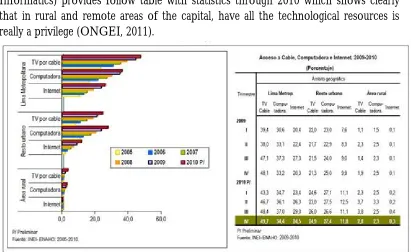
To support the claim, ONGEI (National Office of e-Government and Informatics) provides follow table with statistics through 2010 which shows clearly that in rural and remote areas of the capital, have all the technological resources is really a privilege (ONGEI, 2011).
4. Purpose of the Study
The purpose of the study was to define a general framework for e-government plan for the Ministry and define the portfolio of related projects to implement the plan. The time horizon was defined from 2014 to 2017.
5. Proposed Structure of E-Government Plan
The following structure for the Strategic Plan for e-government was proposed:
Status of the current situation and diagnosis: in this section both the current state of the institution in general and the current state of the technology infrastructure and information security are described. GAP analysis is included.
Mission, vision and objectives: both the overall goal and specific objectives.
Declaration of principles: gathers a list of structural principles and organizational culture that must be implemented (previously) and require commitment, to implement e-government from the plan that is being developed.
SWOT Analysis: Both focused in internal and external factors.
Critical success factors: critical to the implementation of e-government.
Key strategies: guiding lines that emerge from the SWOT analysis and seek to exploit the opportunities identified, mitigate threats and risks as well as strengthen weaknesses in terms of the management of IT services.
Plan of Action, including resources, budget, a list of indicators of management (KGI, KPI), the portfolio of projects to be executed and a map with targets for implementation indicators.
Mechanisms for monitoring, securing and monitoring
Conclusions and recommendations
6. Case Study
Following, we present details from each proposed element of e-government plan.
6.1 Status of the Current Situation and Diagnosis
Each of the procedures is supported by tools or technological solutions, which support the development of the process for internal and external benefit. Due to this technological advancement, the organization is in need of provide support and go implementing new projects and measures for process optimization delivered.
These internal procedures affect the attention that is currently provided to the public, so it requires prioritization in implementing processes and aligning IT services provided to the goals of the Ministry related to cultural heritage.
At the time of the study, each of the managers said the main limitations for the performance of its functions and activities in an efficient and productive manner that may affect or infringe in the regulatory or institutional compliance.
According to survey information from meetings and interviews, we found that the guidelines are not implemented the law on protection of personal data (used in Peru since 2013) and is under development, the information security management system (ISMS).
Some basic logic controls for the development of activities within each process were verified, including physically checked: document storage and archiving, access permissions to various areas of Ministry. Especially those that host a large number of cultural heritage.These mostly related to those processes to citizens.
On the side of the logical security, feature logic-level controls access to certain web information portals and information systems, which have not been subject to evaluation to determine exhausted its exact effectiveness.
6.2 Mission, Vision and Objectives
The mission of the E-Government Plan is: to provide a unified technology direction and transverse processes of all the internal and external organization for the benefit of citizens and strengthening the Ministry, ensuring the protection of information dissemination and access to knowledge sources in relation to the tangible and intangible cultural heritage.
The Vision of Electronic Government Plan is: to be the pioneer in the use of technology to promote the appreciation and protection of cultural heritage, the development of cultural industries and cultural creation and promoting public access to culture and inclusion social.
The overall objective is to provide direction for a technological infrastructure through projects and plans that enable citizens are benefiting from agile, safe and quality services using digital tools and media.
The specific objectives were identified:
Conduct a process reengineering citizens who are focused and evaluate projects necessary for improvement.
Improve technological infrastructure gradually aligning to standards that later, if required, are certifiable.
Strengthen the relationship between the citizen and the Ministry through projects and services that facilitate the procedures that may be requested.
Provide all kinds of cultural information to all citizens through mass distribution channels.
Use the Internet as the main channel to reach to citizens according to each region of Peru.
6.3 Declaration of Principles
They work requirements so that the Ministry must first meet the implementation process:
Top management is responsible for the implementation of e-Government in the Ministry transversely.
It must continually counter the effects of change and resistance within the entire institution to employ older digital resources and the significant change or not within the processes.
Reduce obstacles created by the digital divide by providing nationwide access channels according to the geographic distribution of our country.
Implement the Plan of e-government gradually update and maintain it according to the guidelines that apply to the Ministry at the national level.
6.4 SWOT Analysis
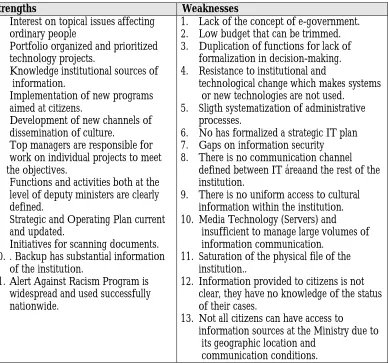
The Strengths, Weaknesses, Opportunities y Threats Analysis has two approachs, ionternal and external factors. Following tables show both analyses:
Table 1: SWOT Matrix Internal Factors
Strengths Weaknesses
1. Interest on topical issues affecting ordinary people
2. Portfolio organized and prioritized technology projects.
3. Knowledge institutional sources of information.
4. Implementation of new programs aimed at citizens.
5. Development of new channels of dissemination of culture.
6. Top managers are responsible for work on individual projects to meet the objectives.
7. Functions and activities both at the level of deputy ministers are clearly defined.
8. Strategic and Operating Plan current and updated.
9. Initiatives for scanning documents. 10. . Backup has substantial information
of the institution.
11. Alert Against Racism Program is widespread and used successfully nationwide.
1. Lack of the concept of e-government. 2. Low budget that can be trimmed. 3. Duplication of functions for lack of
formalization in decision-making. 4. Resistance to institutional and
technological change which makes systems or new technologies are not used.
5. Sligth systematization of administrative processes.
6. No has formalized a strategic IT plan 7. Gaps on information security 8. There is no communication channel
defined between IT áreaand the rest of the institution.
9. There is no uniform access to cultural information within the institution. 10. Media Technology (Servers) and
insufficient to manage large volumes of information communication.
11. Saturation of the physical file of the institution..
12. Information provided to citizens is not clear, they have no knowledge of the status of their cases.
13. Not all citizens can have access to information sources at the Ministry due to its geographic location and
Table 2: SWOT Analysis – External Factors
Opportunities Threats
1. Interest from external organizations for investment and project
implementation.
2. Joint programs with external organizations.
3. Transparency Portal updated 4. Intercultural programs are worked
together with external sources. 5. Support the Peruvian state in
cultural activities.
6. Promotion of culture nationwide. 7. World Heritage Sites generate influx
of domestic and international tourism.
8. Good relations with national and international external institutions. 9. Peru ranks as a great source of
culture both movable and immovable property as
manifestations of culture (Intangible Assets)
10. Diversity of languages and ethnic groups to preserve, defend and disclose to the world.
1.External investment sources are not constant and can be removed according to the image of the institution or the national government. 2.National government influences the overall
image of the Ministry (not independent) 3.Changes of the ministerial cabinet can produce
drastic changes.
4.Disclosure of Information by agents external to the institution.
5.Observations constant external agencies requires drastic changes in procedures. 6.External Sources marks us as one of the most
racist countries.
7.External regulations related to information and technology have not been fully implemented in the institution.
6.5 Critical Success Factors
The critical success factors for this plan were defined like this:
Alignment with institutional plans: Implementation of plans such as the Institutional Strategic and Operational Plan and Strategic Plan currently in force. It is a success factor because it is the culture and the importance of alignment to state standards that require the development of these plans is recognized institutions.
Prioritization of projects: Technologicalproject implementation and others in the evaluation process but which have already been referred to, thereby achieve automation (level of technology) process will be more streamlined.
Organizational Culture: Development of organizational culture in which citizen participation in the services and activities provided by the Ministry.
6.6 Key Strategies
From the SWOT analysis, the following strategies are posed:
E1 Communication strategy: Conduct training programs and to disseminate all kinds of information within the institution and for each direction so that all share in the institutional achievements or actions to correct.
E2 Change strategy: Conduct a continuing program of resistance to change that is going to engage progressively updated and high addresses to monitor and verify that the gaps are consistent with and that resistance is overcome..
E3 Difussion strategy: Engage the organization and its agencies with which it shares the work and projects to diffusion of cultural heritage, cultural industries and sources of multiculturalism in our country.
E4 Promotion strategy: Promote programs and services provided by the Ministry investing in campaigns and building spaces granted by the republic to reach more Peruvians and let them know the culture and functions of the institution.
E5: Design management systems so that it can preserve and ensure that personal information and review within the institution is not disseminated, modified and interrupted implying keep track within the institutional framework.
E6: Design strategies for the continuity of the functions and activities provided by the Ministry from the point of view of strategic technical and operational institution.
E7: Decentralize Ministry offices arround the country allowing all processes can be provided and monitored from anywhere in the country, saving time and expense by the ministry and managed.
E8: Develop an approach to project management, which involves planning and define a range for each period of the Strategic Plan of e-Government and consequently phased implementation according to validated criteria for prioritizing
6.7 Plan de Acción
We recommended a plan of action, based on the regulation. This plan consists of indicators for each of the specific objectives and an application schema mapped to their respective projects (portfolio) and aligned to the Institutional Strategic Plan (ONGEI, 2011).
The list of KPI includes:
Conduct a process reengineering citizens who are focused and evaluate projects necessary for improvement.
Improve technological infrastructure gradually aligning to standards that later, if required, are certifiable.
Strengthen the relationship between the citizen and the Ministry through projects and services that facilitate the procedures that may be requested.
Provide all kinds of cultural information to all citizens through mass distribution channels.
Use the Internet as the main channel to reach to citizens according to each region of Peru.
According to this plan of action, the following portfolio of projects is proposed for period 2014-2017.
6.7.2 Priorization and impact level of IT Portfolio
The e-government plan should bring a portfolio of projects related to the services they provide to citizens, other projects related to the technological platform and some internal, and finally some of regulatory nature (to enable the Ministry to comply with its regulations ) that will impact on the community. The prioritization criteria for the implementation of projects in the portfolio were proposed:
1. Project aligned directly to an institutional critical strategic objective
2. Project helps improve technical infrastructure in order to meet the requirements of citizens
3. Project enables compliance with legal / regulatory requirement
4. Project that allows to maintain and strengthen the reputation of the Ministry 5. Project that allows providing solution to temporary internal problems that may
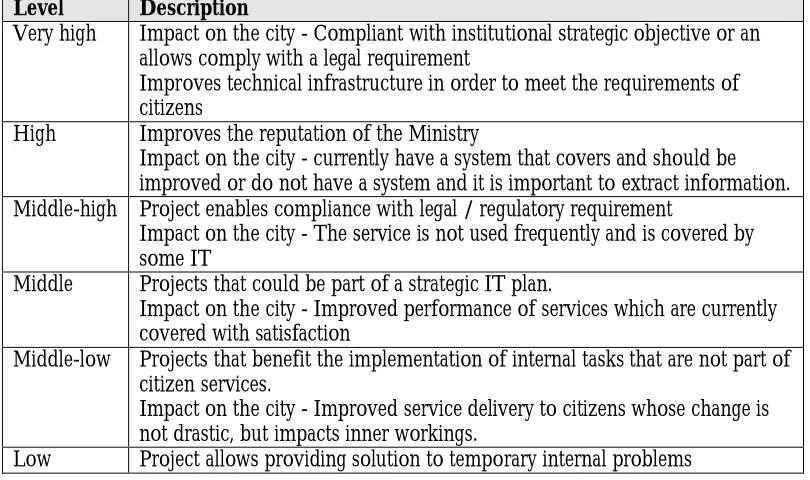
See in the next table, levels of impact:
Table 3: Impact level of IT Projects
Level Description
Very high Impact on the city - Compliant with institutional strategic objective or an allows comply with a legal requirement
Improves technical infrastructure in order to meet the requirements of citizens
High Improves the reputation of the Ministry
Impact on the city - currently have a system that covers and should be improved or do not have a system and it is important to extract information. Middle-high Project enables compliance with legal / regulatory requirement
Impact on the city - The service is not used frequently and is covered by some IT
Middle Projects that could be part of a strategic IT plan.
Impact on the city - Improved performance of services which are currently covered with satisfaction
Middle-low Projects that benefit the implementation of internal tasks that are not part of citizen services.
Impact on the city - Improved service delivery to citizens whose change is not drastic, but impacts inner workings.
Low Project allows providing solution to temporary internal problems
6.7.3 Projects in IT Portfolio
In the following table, we present an extract of the proposed projects, its impact and concise description5:
Table 4: Extract of IT Portfolio
Project mame Level impact Description
1. Evaluate and restructure Trasnparency Web Portal
Very high
Standardize and formalize the transparency portal provided to citizens so this is unique, is available and store information integrated in the national interest and the national regulatory compliance by taking into account only if applicable, that determines by
ONGEI. 2. Implement service
catalog for Ministry (not IT service but public services)
Very high
Complement and update the sites of the web directions within the ministry
3. Implement the One-Stop Payments Service
Very high
Implement a system that allows digital recording of standardized forms and typified by each of the business processes to serve the public, so as to avoid the paperwork accompanying to the file
4. Implement tracking system dossiers
Very high
Implement a monitoring and alert records to enable the status of the process or service requested by entering a web address
5. Improve the web portal " Alert Against Racism"
Very high
Attend allegations of racism and protect citizens against these acts through programs and channels 6. Implement the online
payment system
Very high
Implement a digital payments so that citizens can make all payment process using a credit card from the comfort of your home is possible to automate the process and save time and resources
7. Improve INFOARTES web site
Very high
Assess the current web InfoArtes and implement functionalities related to the spread of industries and cultural events as well as general aspects or corporate videos that show information about workshops and events
8. Management, standardization and digitization of historical patrimony property certificates
Very high
Implement a system or interface to standardize on a single digital format and granting of certificates
9. Digitization of cultural books and cultural information sources
Very high
Gather important information sources, scan and
place them at the disposal of the citizen as completely free e
10. Digitization of export licenses for pieces that are not part of the cultural and historical patrimony
Very high
Implement an interface to allow the reception of a virtual form and allow digitally and deliver
11. Implement management system archeological monitoring plan Very high
Implementing a multi-use application in each regional direction is suggested, verifying the current status of the project and responsibles
12. Improving the cinematic institution website
High Improve the current website to make it a
powerful broadcast channel seventh Peruvian art, recording and provided details of each of the different national productions, inviting participation event and especially the annual film competitions in Peru
13. Implement a system of management of cultural heritage property
High Implement a mobile - web system that allows to record, monitor geo-referencing and immovable cultural heritage assets of historical and
archaeological and is available to citizens to inform and initiate through an awareness campaign for conservation.
14.Implementing mobile application for registering complaints against racism
High Implement a mobile application that allows contact with the current website so "Alert Against Racism" that the loading of the current web is optimized and allows flexible management of complaints of discriminatory acts.
15. Complement the TV web channel provided by the institution
High Migrate the existing infrastructure of web server channel to higher capacity, which allows video playback and streaming video, concerts or cultural features, real-time
16. Implement application of reported crimes against cultural property
High Implement a web and mobile application for citizens to register complaints about the various crimes against property and connect to internal systems to improve monitoring and preventing the exit of parts have been stolen.
17. Implement a registration system for collection and use of information rate reader
High Implement an information system that allows authors to register and share nationwide database of used books nationwide national programs which could include reading books by international authors 18.Systematization of the
qualification process and rating sponsored cultural events
6.8 Monitoring E-Government Plan
Respect to monitoring plan of the proposed plan is recommended Perform a quarterly assessment to all parts containing the monitoring plan so that the strategies proposed to counter the weaknesses and threats that are shown in the SWOT analysis is made.
Update progressively document and verify:
Achieve objectives, mission and vision plan.
Verify the implementation of project portfolio according to the roadmap (Road Map implementation6) raised. Make adjustments due to changing factors considered.
Increase of strengths and opportunities within the Ministry, because of the new services offered supported by a new technology platform.
Changes in procedures or new services that are citizen-oriented. Update and propose projects to align with the strategic plan.
Make comparisons and analysis to determine and ensure that the Strategic Plan for e-government in fact is under the guidelines of the institutional strategic plan, institutional operating plan and strategic plan for information technology.
7. Monitoring E-Government Plan
It can be concluded according to the current assessment of technology within the Ministry that the goals of innovation in the short, medium and long-term concern. However, must be worked in line with the corporate strategic plan and other plans for issues of internal and external diffusion.
We also conclude that the services currently provided to the citizen does not have a substantial technological support and depend on manual activities, which can not be easily modified due to resistance to change.
It is concluded that the lack of a communication plan affects the services provided and that from the technical point of view, not all addresses are aware of any changes or new systems that optimize and response times to citizen the subject.
We conclude that not have business continuity strategies why could difficult the implementation and changes in the existing infrastructure and services that should be taken 24/7 can not guarantee availability of any changes within the infrastructure or data migration.
Finally it is concluded that the services provided to citizens to not use a technological support and / or violate the regulations to which the Ministry of Culture is subject, would eventually affect the image of the institution and the affected can risk your information and process it can be very slow despite a low level of complexity.
References
Gallegos, F. (2003). IT Governance: IT Audit Role. ISACA Publishing, 4, 14-18.
Iovan, S., &Daian, G. I. (2013).Impact of Cloud Computing on Electroni Government.Fiability& Durability / FiabilitatesiDurabilitate, (1), 71-77.
ISACA (2014).CGEIT (Certified in the Governance of Enterprise IT) Review Manual, ISACA Publishing.
Kim, C.-K.(2007). A Cross-national Analysis of Global E-government. Public Organization Review, 7(4), 317-329.
Nengomasha C., Mchombu K., &Ngulube P. (2010).Electronic Government Initiatives in the Public Service of Namibia. African Journal of Library, Archives and Information Science, 20(2), 125-137.
ONGEI (2011). Resolución Ministerial N° 61-2011-PCM.National Office of e-Government and Informatics, Lima.
Pedroza, R. E. C. (2013). Progress On Electronic Government Implemented In Venezuela Period 2011-2012. RevistaNegotium. 8(24), 19-54.
Peruvian Congress.(2002). Ley N° 27658 Marco de Modernización de la Gestión del Estado, DiarioOficial “El Peruano”, Lima.
Piattini M, Del Peso E. (2010). AuditoríaInformática.Unenfoquepráctico. Alfaomega, Madrid. ITSMF UK (2012).ITIL® Foundation Handbook.The Stationery Office and IT Service
Management Forum Publishing, London.
Ruano de la Fuente, J. M. (2013). E-Government Strategies in Spanish Local Governments. Local Government Studies, 41, 1-21.
Sel, M. (2004).Corporate Governance.Information Systems Control Journal. ISACA Publishing, 4, 1-4