P
age
41
Phase of Globalisation – Definition or Process or State?
Agnieszka Rzepka
Assistant Professor, Department of Management, Lublin University of Technology.
ABSTRACT:
Globalisation is a multidimensional process which is present in many spheres and which is defined in many ways: it has developed with different degrees of intensity since the end of the 19th century and took on a particular importance in the closing decades of the 20th century. Globalisation creates both opportunities and threats for its participants. One of the tendencies that has been getting stronger in the world for at least a quarter of a century is a progressive socio-economic differentiation and the splitting of the world into two separate blocks: the world of poverty and the world of riches. The social structure is undergoing changes. The distances between the individual segments of the market and those who are left outside the market are growing. The benefits from economic growth are not being spread equally.
Keywords: knowledge-based economy, globalisation, information society, definition of
globalisation, global economy,
I. INTRODUCTION
The richest people are quickly racing ahead and, at the same time, the relative poverty of the unemployed and some of the employed is growing, even in conditions when macroeconomic indicators are favourable and when firms are in good economic condition. The differentiation in income is generating deep social and cultural divisions. It is necessary to stress here that differentiation in income has always existed and, as an economic phenomenon, is nothing bad. However, objections may be made to its current size and the constant tendencies in this respect which have been around for several decades. The problem of the growth in economic stratification is not an autonomous phenomenon that results from different attitudes, life choices, talents, skills and the determination of individuals, but is increasingly a distributive effect of globalisation. Seemingly far removed from everyday matters of ordinary people, the global forces and processes affect their economic situation and social status.
II. DEFINITIONS OF GLOBALISATION
P
age
4
2
following conclusion: elements of a single worldwide economic body are being born as a result of the globalisation process. These elements are connected up by many links, not all of which are immediately apparent. This means that both detailed economic analysis and looking at the phenomenon from a different perspective (an anthropological, a sociological or even a philosophical perspective) is becoming essential. At the same time, economic analysis currently still seems to be the most important of them.
A direction like this seems to be confirmed by Szymański (2004, p.18), for whom the question of liberalisation of capital flow is the 'avantgarde' of the whole globalisation process. In relation to this, in his opinion, the relationship between capital creation (savings) and the domestic use of capital (investment) is weakening. I=S, the basic equation concerning domestic macroeconomics, is losing its significance. However, if we look at global business macroeconomics, we can see that it is gaining significance at the same time. From a country's point of view, it is getting easier to use savings from global reserves; while on the other hand, there is no guarantee that its own savings will not be transferred to other countries. In effect, countries are not forced to adapt their policies in order to put money away, but, on the other hand, domestic savings cannot be treated as a solid basis for investments made in them.
While on the subject of liberalisation, it is worth adding, and at the same time highlighting, the opinion of Professor Joseph Stiglitz, a Nobel Prize laureate, former advisor to the President of the United States and former Chief Economist at the World Bank. In 2002, he wrote that the liberal theory of the unseen hand and self-regulation was a myth {according to Gałek[13, p.55-56]. Moreover, the latest achievements in the theory of economics had shown that the more imperfect information was and the more incomplete the market was, the more the working of the unseen hand was imperfect to the highest degree Stiglitz[26, pp.78-79].
Moving on to the definition of globalisation from an economic point of view, Bhagwati[4, p. 3] states that it consists of the integration of national economies in the direction of an international trade-based economy, direct foreign investment, short-term capital flows, the international flow of workers and people in general, as well as the flow of technology. Kołodko, who interprets globalisation as a historical process of liberalisation and integration of goods, capital and labour markets (which have up until now functioned independently of each other to a certain extent) into one global market,), writes in the same vein. Flejterski understands the term globalisation as referring to international relationships between economies. According to Gniewek [15, p. 95] these relationships are based on ever-broadening trade links, as well as the flow of capital, technology and information). For Gregor&Stawiszyński[17, p.29] three prerequisites lie at the base of globalisation, which manifests itself as a tightening of international economic interdependencies and the expansion of transnational corporations. The first is scientific and technical progress (in particular, new information and communication technologies). The second is the liberalisation of conditions for the development of international trade. The third is investment made by foreign financial markets.
P
age
43
According to Miczyńska-Kowalska[20, p.30] every civilisation is characterised by a different model of functioning of society and the economy:
‘Changing the civilisational model forces out the models that have been in place until that time. Not only the models of the economy as a whole, but also those of management, investing, trade, education, work, employment, consumption and even those of governments and families, which quickly stop being up-to-date. Most of the methods of communicating, production and trade-related transactions become transformed’
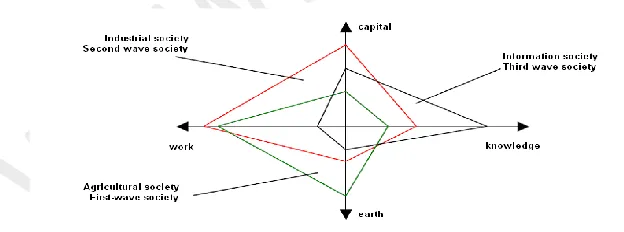
These models have been analysed by Toffler [28, pp. 10-15], who distinguished between three stages, or waves, of socio-economic development. The first of these was the agricultural society, the second was the industrial society, while the third is the information (post-industrial) society (see figure 1)
Source: Toffler 1999, p.12.
Socio-economic development in its particular stages is presented in figure 2, including the use of reserves possessed by contemporary society.
In the post-industrial society, the distribution and processing of information have become the basis of creating national capital and a source of income for a considerable portion of citizens.
IV. THE KNOWLEDGE-BASED ECONOMY
P
age
44
According to Antras et al [2] there is wide ongoing debate among economists on the questions concerning the knowledge-based economy. This is confirmed by, among other things, new theories of economic growth, which are a relatively new expression of economic policy, described by Antonelli[1]. Pangsy-Kania[22, p. 147] suggests that these theories present knowledge as the main source of growth, in which human capital and organisational capital play a fundamental role. This indicates that the processes of globalisation and internationalisation and the development of Information and Communication Technology (ICT) that accompanies them are making knowledge the most important factor in economic development.
The evolution of the knowledge-based economy is firstly causing an increase of pressure on people to educate themselves. Secondly, it is leading to the exposure of the role ofwhat is known as intellectual capital and emphasising an analytical approach. Thirdly, as Bounfor[5, p.4] indicates, it is underlining the fundamental importance of investments and their influence on GDP.
In order to understand the concept of the knowledge-based economy, it is first of all necessary to explain what knowledge is. In literature on the subject, a categorisation has been accepted according to which four phases of storing knowledge may be distinguished. Data make up the basic unit of information. However, the term knowledge is defined as a structured and interpreted collection of information. In turn, the skills of using, modifying and creating knowledge are determined by wisdom.
data---> information ---> knowledge ---> wisdom
Witulska[21, pp. 143 – 153] noted a widely-found lack of differentiation between knowledge and skills. In the literature concerning the knowledge-based economy and knowledge management, it is accepted that information is a type of knowledge, in particular silent, hidden (tacit)
knowledge because knowledge is not solely identified with knowing facts (know-what).
According to the World Bank, the economy is becoming a knowledge-based economy, while the main factor in the process of economic development is the continual use and creation of
Figure 1. The Share of Reserves in Economic Development
P
age
45
knowledge. A knowledge-based economy uses knowledge as the main motor of economic growth. In an economy like that, knowledge is effectively absorbed, created, passed on and used to speed up economic growth. A.K. Koźmiński has formulated the following microeconomic definition: ‘A knowledge-based economy is an economy in which many businesses are active and base their competitive advantage on knowledge’.
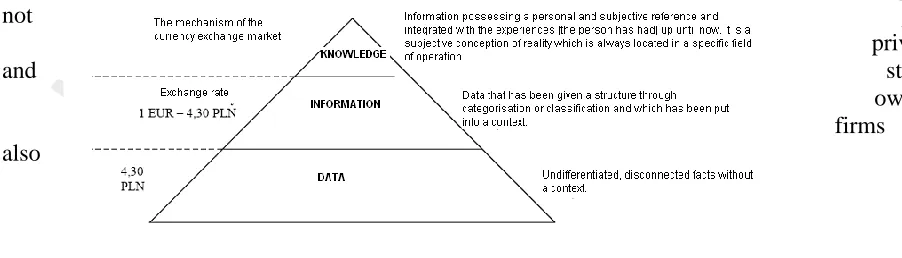
With regard to the functioning of the concepts of the information-based economy and the knowledge-based economy, it is worth distinguishing these concepts. They are defined and presented in figure 3.
Definitions of data, information and knowledge are to the right of the triangle in figure3, while examples of their use are to the left-hand side. The price 4.30 PLN [zlotys] is a piece of data. If this price is quoted in the context of an exchange rate, for example, in relation to 1 EUR then it becomes information. If this information is in turn used as an illustration of the mechanism defining the workings of the currency exchange market then we are dealing with knowledge.
Knowledge and innovation have always been important for economic growth and gain an even greater importance in the knowledge-based economy. Knowledge understood in the traditional manner is rational, based on objective facts and precisely expressed with the help of formal language. This type of knowledge can be generalised about and this is how theories are created. In this sense, knowledge is understood to be a science. It is presented in scientific institutions and publications. It is disseminated in schools and places of higher education. It may also be used in the form of new technologies and practices. It is explicit knowledge that is available to all.
Competition in the knowledge-based economy relies on the speed of creating innovative ideas not only concerning products and services but also business processes (innovative relations between people and technology),organisational models (innovative connections between the structure of an organisation and its management system) and the environment in which organisations function (innovative connections between business, science and politics). Achieving success in the knowledge-based economy demands radical changes in ways of managing
not just
private
and
state-owned firms but also
Figure 2. The hierarchy of knowledge
P
age
46
coordination at the levels of branches of industry, as well as regions and countries.
While talking about the knowledge-based economy, it is necessary to present the factors that have led to it coming about. According to Ciborowski [8, pp. 175- 200], writers most commonly refer to the heuristic conception of Schumpeter’s innovation waves which concerned inventions which were breakthroughs and their introduction into common use. As I have written, the first wave started in about 1785 and lasted 60 years. The second lasted 55 years, the third 50 years, the fourth 40 years and the fifth (the current one which is based on digital networks, programming and the new media) is to last 30 years, until the year 2020. Therefore, innovation waves are getting shorter and shorter.
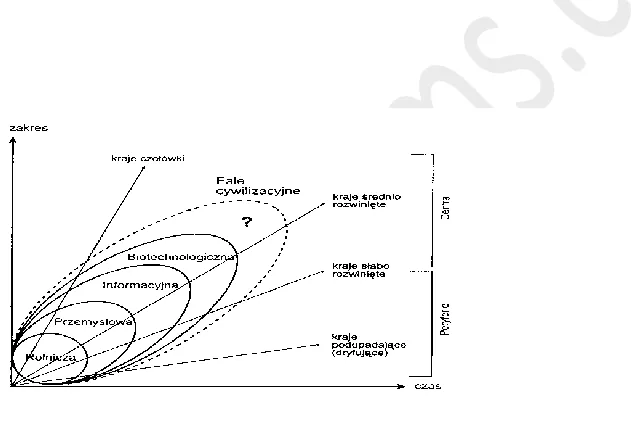
When attempting to create a graphic presentation of the development of innovation, it is worth showing, afterZacher[29], that it should be shown in the context of the development of civilisation and thus the civilisational transformation of countries and societies. This can be presented using the Zacher-Targowski model.
y=range, x=time; leading countries, countries which are developed to an average level, countries which are poorly-developed, countries which are impoverished (drifting). Civilisational waves: agricultural, industrial, information-based,biotechnological, Centra=Centres, Peryferie=Peripheries
Source: Own work on the basis of L.W. Zacher’s 2005.
Figure 4 illustrates the nature and direction of civilisational changes. The angle of the gradient of the ‘development vectors’ of specific types (groups) of countries (highly-developed countries, countries which are developed to an average level, countries which are poorly-developed and countries which are impoverished) is varied, dividing the world into centres and peripheries. [It is worth adding that in Zacher’s work, there is a different categorisation of countries than the
P
age
47
World Bank’s classification of coutries as being highly-developed and developing. Zacher divides countries into the following categories: highly-developed countries; countries which are developed to an average level; countries which are poorly-developed and countries which are impoverished. However, both of these categorisations have a similar nature. Both of these categorisations include the same countries within their frameworks]. The figure shows that successive civilisational waves form on a historical basis. The relationships of successive civilisational waves with development are also different, as are the forces and the effectiveness of their influence in specific groups of countries Baldi, Brunak [3]. The model of these relationships shown in the figure illustrates their general, abstract dependencies, in other words, their independence from differentiation with respect to different types of country.
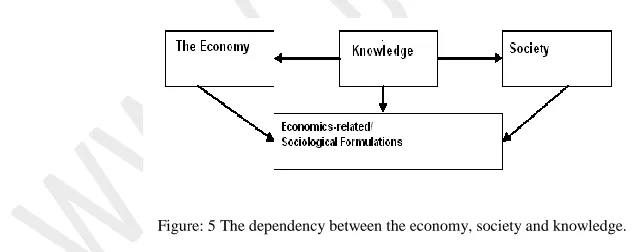
When talking about the knowledge-based economy, it is worth looking at Castells’s research [6, p. 124]. He points to the policy carried out by developed countries which is currently focussed on education and technology. These states, in the view of Misa [21, p. 96] have dominated the societies of these countries in a special way. However, it is necessary to note that knowledge is not merely a synonym of the commercialisation of education and technology or the use of ICT. Knowledge should be considered more widely, in order to increase the scope of general interest, and not only be limited to the technocratic sphere. This is also why, referring to the views of Castells and Misa and writers cited earlier, I think there are conspicuous dependencies between the economy, knowledge and society. We may formulate these dependencies in the socio-economic sphere (see figure 5).
New technologies are the driving force of the new economy analysed here. However, on no account must we leave the effects of the interaction between them and society out of our reflections. Reciprocal tensions are the result of the multidirectional influence that new technologies exert on individuals and their surroundings, for instance, in the economic, organisational, legal spheres and also the ecological and political spheres.
The current state of globalisation, as well as the knowledge-based economy and the information society: they are appearing at the same time, but have different origins and different paradigms. Globalisation covers almost the entire global economy (however, it does so to different degrees), while only a small proportion of people participate in the knowledge-based economy. In particular, globalisation’s basic elements and institutions are characterisedby a long period of continuity, whereas the knowledge-based economy is creating a new type of institutions and is especially creating a new social structure, one that is more egalitarian (at least within the sphere
Figure: 5 The dependency between the economy, society and knowledge.
Source: own work
P
age
48
of education, but also in that of living standards). It is also creating the basis for a new cultural system. Globalisation and the knowledge-based economy do not preclude each other and even strongly support each other in a certain group of countries. However, for most countries today and for most of the world’s population, the knowledge-based economy and post-modern civilisation constitute the distant future, independently of the opportunities to use some of its technical components.
V. SUMMARY
At the moment, two processes are intertwining: these are globalisation and the knowledge-based economy. Globalisation concerns everyone (to a greater or lesser degree), whereas the number of countries embraced by processes related to the knowledge-based economy may be estimated as being between ten and fifteen and their population does not exceed 12 to 13% of the global population. In spite of this, these two processes are causing the shaping of a new social structuralisation which is enabling the appearance of creative innovation groups that are capable of creating the basis of a new civilisation (the post-industrial civilisation), as well as a new system of institutions and cultural changes. While in the agrarian civilisation the soil was the main factor of growth and durable capital was the main factor of growth in the industrial civilisation, the main factor of growth in the post-industrial civilisation is human resources capital. It is recognised that the following are the main carriers of the knowledge-based economy: science; highly technical industries; services related to the information society; intensive services; knowledge and education. Consequently, the new civilisation demands the widening and lengthening of the societal educational process and, above all, changes to the educational model to make it move in the direction of developing creativity, that is, individual and collective entrepreneurship. It is therefore worth noting that the new civilisation can only be imitative and helped by imports to a certain degree
From the above arises the fact that, on the one hand, the creation of the knowledge-based economy and the knowledge society needs time (at least one generation). On the other hand, it is possible to state that the knowledge society is a much wider concept than the information society and even the IT society (which are often associated with the knowledge society). The interchangeable use of the terms ‘information’ and ‘IT’ brings with it misunderstanding of the nature of these terms because it identifies a specific technology for spreading information with information itself. Moreover, while information is an important element of knowledge, it is not the only one. In the knowledge economy and knowledge society, the role of those employed with a level of education that is below average and of physical capital (the material resources of factors of production, natural resources and financial resources) decreases. On the other hand, the roles of factors like technology (knowledge that has accumulated in a defined form and is possible to sell), human resources capital, social capital and intellectual capital increases.
P
age
49
are ceasing to be decision-making centres, whereas firms (which are often international) and international organisations are becoming them. Living conditions are changing. The civilisational advance of many social groups and nations is happening. However, despite rapid development and progress, hunger and poverty still prevail in different parts of the world.
The current phase of globalisation, the knowledge-based economy and the information society are characterising the modern world (at least parts of it). Globalisation covers practically the entire global economy to varying degrees [31]. However, only a small, most highly-developed proportion of the global community has a share in the knowledge-based economy. Globalisation is a long-term phenomenon, while the knowledge-based economy is characterised by quick changes and transformations. The knowledge-based society is creating new types of institutions and is carrying out the structuralisation of society, making it more egalitarian, at least within the field of education and also with regard to living standards. It is also creating the basis of a new cultural system. Not only do globalisation and the knowledge-based economy not preclude each other, but they even strongly support each other in a certain group of countries. However, for most countries today and for most of the world’s population, the knowledge-based economy is an unattainable ideal and a goal whose realisation is possible in the distant future, independently of the possibility of using some of its technical benefits here and now.
REFERENCES
i Antonelli, C 1998, ‘Localized Technological Change, New Information Technology and the Knowledge-Based Economy: The European Evidence’, Journal of Evolutionary Economics, Vol.8, Issue 2.
ii Antras, P, Garciano, L, Rossi-Hansberg, EA 2005, Offshoring in a Knowledge Economy, Harvard Institute of Economic Research Discussion Paper, No 2067.
iii Baldi, P & Brunak, S 2001 (ed.), Bioinformatics. The Machine Learning Approach, Massachusetts Institute of Technology, Cambridge-London.
iv Bhagwati, J 2004, In Defence of Globalization, Oxford University Press, New York.
v Bounfor, A 2005, ‘Modeling Intangibles: Transaction Regimes versus Community Regimes’ in A Bounfor & L Edvinsson (ed.) Intellectual Capital for Communities: Nations, Regions, and Cities, Elsevier Butterworth-Heinemann, Amsterdam-Boston.
vi Castells, M (2000), The Rise of Network Society, Blackwell Publishing, Malden, Oxford – Carlton.
vii Clark, I 1999, Globalization and International Relations Theory, Oxford.
P
age
50
in Transition Countries: Selected Issues, University College London - School of Slavonic and East European Studies, London.
ix Cooper, RN 2005, A Half-Century of Development, Center of International Development at Harvard University, Working Paper No. 118, March 2005.
x Dicken, P 1998, Global Shift: Transforming the Worid Economy, The Guilford Press, New York, London.
xi Galar, R ‘Evolutionary Dynamic of Population States’, Proc. IEEE Congr. Evol. Comput., Seoul, Korea, p. 2.
xii Pool, R, Esnayra, J 2003, Bioinformatic: Converting Data to Knowledge, National Academy Press, Washington D.C.
xiiiGałek, G 2004, ‘An Attempt to Define Changes in the External Conditioning of Polish Economic Policy at the Dawn of the 21st Century’,Economics, issue nr. 10, Department of Economic Sciences at Warsaw University Printing Press, Warsaw, pp.55-56.
xivGilarek, K 2003, Nation States and Globalisation - Dynamics of the Appearance of a New Order, Toruń.
xv Gniewek, J 2003, ‘Strategic Management in the Cooperative Banks Sector in Poland and the Process of Globalisation’, in L Pawłowicz & R Wierzba (ed.), Banking in Relation to Globalisation Processes, Gdańsk Banking Academy at the Market Economy Research Institute, CeDeWu Ltd, Warsaw.
xviGoldberg, I 2004, Poland and the Knowledge-Based Economy: Towards Poland’s Competitiveness in the European Union, The World Bank, Washington D.C., 2004.
xvii Gregor, B & Stawiszyński, M 2002, e-Commerce, Brant Publishing House, Bydgoszcz & Łódź.
xviii Grossman, GM & Helpman, E, 1990, ‘Trade, Innovation and Growth, The American Economic Review, Vol. 80, No. 2., pp. 87 – 92.
xixLaurie, B & Rondle, M 2006, Identity Management as a Cybersecurity Case Study, The Berkman Center for Internet & Society at Harvard Law School, Research Publication No. 01.
xx Miczyńska-Kowalska, M 2003, ‘Virtual Trading Organisations in Theory and in Practice’ in M Morawski (ed.), The Management of Knowledge and Information in the Network Society, Volume II, Wyd. Wałbrzyskiej Wyższej Szkoły Zarządzania i Przedsiębiorczości, Wałbrzych.
P
age
51
xxii Pangsy-Kania, S 2006, ‘The International Transfer of Technologies as well as Scientific and Technical Knowledge’, in E Oziewicz (ed.), Transformations in the Modern Global Economy, Warsaw.
xxiii Scholte, JA 2001, ‘The Globalization of World Politics’, in J Baylis & S Smith (ed.), The Globalization of World Politics: An Introduction to International Relations, New York.
xxiv Sobczak, J in European Communication Order in the Process of Globalisation and Dilemmas of the Information Society {currently being published}.
xxvStammers, N 1999, ‘Social Movements and the Challenge to Power’, in M Shaw (ed.), Politics in a Globalized World, London, p.73.
xxvi Stiglitz, JE 2004, Globalization, PWN Academic Printing Press, Warsaw.
xxvii Szymański, W 2004, The Transactions and Contradictions of Globalisation: An Introduction to Economics in the Era of Globalisation, The Difin Advice and Information Centre, Warsaw.
xxviii Toffler, A 1999, The Building of a New Civilisation, Zysk i S-ka, Warsaw.
xxix Zacher, LW 2005, ‘The Emergence of the Information-Based Society (New Components, Structures, Mechanisms, Characteristics)’, Problemy zarządzania [Management Problems], nr 1.
xxxGlobalization: Prospects for a Paradigm Shift, in M Shaw (ed.), Politics in a Globalized World, London, p.9