Volume 2, Issue 10, October 2013
Page 254
ABSTRACT
Traditional Economic Load Dispatch deals with minimizing generation cost while maintaining set of equality and inequality constraints. On the other hand, the fossil fuel plants pollutes environment by emitting some toxic gases. Thus conventional minimum cost operation cannot be the only basis for generation dispatch; emission minimization must also be taken care of. Power system must be operated in such a way that both real and reactive powers are optimized simultaneously. Real powers loss should be optimized to provide better voltage profile as well as to reduce system losses. Thus the objective problem can be seen as minimization of real power loss over the transmission lines. Now a days large integrated power system are being operated under heavily stressed conditions which imposes threat to voltage stability. Voltage collapse occurs when a very low voltage profile or collapses. All these four objectives are to be met for efficient operation and control. The results of all the four objectives are conflicting and no commensurable. Hence an efficient control which meets all the specified objectives is required.
In this project an attempt has been made to optimize each objective individually using Particle Swarm Optimization. The so developed algorithm for Optimization of each objective is tested on IEEE 30 bus system. In this work a method has been proposed to solve multiobjective optimization method using fuzzy decision satisfaction method while the objectives are minimized individually using Particle Swarm Optimization. Simulation results of IEEE 30 bus network are presented to show the effectiveness of the proposed method.
Keywords: PSO, Economic Load Dispatch, Voltage Stability.
1.INTRODUCTION
Optimal power flow (OPF) is a static non-linear programming problem which optimises a certain objective function while satisfying a set of physical and operational constraints imposed by equipment and network limitations.It is also a large-scale static optimisation problem with both continuous and discrete control variables. Many mathematical techniques such as quadratic programming , linear programming, non-linear programming and the interior point method have been applied to solve the OPF problem. All the above mathematical techniques have some drawbacks such as being trapped in local optima or they are suitable for considering a specific objective function in the OPF problem. These shortcomings can be overcome if evolutionary methods are utilised to solve the OPF problem. Particle swarm optimisation (PSO) is one of the known optimisation algorithms that has been used to solve complicated problems. Also, it is a strong and accurate algorithm that cans find high-quality solutions for complicated problems such as the OPF. However, the traditional PSO is often trapped in local optima and converges to the optimal value in a long time. In order to avoid these problems and increase the efficiency of the PSO algorithm, this study uses a chaos concept to tune the inertia weight (v) and a self-adaptive approach for adjusting the learning factors (C1 and C2) of the PSO algorithm. These parameters (v, C1 a n d C2) play an important role in the PSO convergence property. In other words, the performance of the PSO algorithm greatly depends on these parameters. Also for increasing the search ability, a new mutation is applied in the proposed algorithm. The used mutation increases the diversity of the generated population and causes to escape from local optima during the optimisation process the thermal power houses release sulphur oxides (SOx), nitrogen oxides (NOx) and carbon dioxides into the atmosphere. The passage of the US Clean Air Act amendments of 1990 forces the utilities to modify their operation strategies for generating electrical power not only at a minimum generation cost but also with minimum pollution level. There are a lot of solutions proposed in the literature for reducing the emission. The short-term and applicable solution for the emission problem is an environmental dispatch that needs no additional equipments, therefore this method is applied for emission reduction.
Since electrical business enters a deregulated environment, power companies try their best to operate with economic efficiency. Loss reduction is an effective method to decrease the generation cost, also active power transmission loss is considered as an objective function. By decreasing the loss in power systems, the total generation and consequently generation cost are reduced which increase social welfare. The stability of power systems is an important task that the power system operator should keep at an acceptable level. One of the important branches related to the stability in power systems is voltage stability. So, during previous years a great number of approaches have been considered for satisfying the voltage stability. Therefore beside economic and environmental issues in this study, the voltage stability
Fuzzified Multiobjective PSO For Optimising
The Cost, Emission, Losses With Voltage
Stability Constraints
Naveen Kumar.G1, K.Srikanth2
1
M.Tech 2nd year, Power systems engineering, EEE,VR Siddhartha engineering college, Vijayawada, India
2
Volume 2, Issue 10, October 2013
Page 255
is considered as an objective function, in this regard the Voltage Stability Index (VSI) is optimised to increase the secure operation of the power system.There are several techniques that have been considered in the literature to solve multi-objective problems. One of these methods is reducing the multi-objective problem into a single objective problem by considering one objective as a target and others as a constraint. Another strategy is combining all objective functions into one objective function. The above strategies have some weak points such as the limitation of the available choices and their priori selection need of weights for each objective function. Besides the above drawbacks, finding just one solution for the multi-objective problem is known as the most important weak point of these strategies. Over the past few years, the studies on evolutionary algorithms have revealed that these methods can be efficiently used for solving the multi- objective optimisation problem, some of these algorithms are multi-objective evolutionary algorithm, strength Pareto evolutionary algorithm (SPEA), non-dominating sorting genetic algorithm (NSGA) and multi-objective PSO algorithm . Since these algorithms are population- based techniques, multiple Pareto-optimal solutions can be found in one program run.
Since the objectives are in conflict with each other in multi- objectives problems, it is usual to obtain a set of solutions instead of one. In this study, the proposed improved PSO (IPSO) algorithm is implemented in order to extract the non-dominated solutions. In this regard, this study utilizes an external repository to save all non-non-dominated solutions during the evolutionary process, and a fuzzy decision- making method is applied to sort these solutions according to their importance. Power system decision makers can select the desired solution between them by applying the fuzzy decision-making method to the Pareto-optimal solution. Finally, to authenticate the obtained Pareto-optimal solutions, three criterions involving generational distance (GD) , spacing (SP) and diversity metric are used. The 30-bus IEEE test system is presented to illustrate the efficiency of the proposed method.
2. Problem formulation and constraints
2.1 Generation cost objective
The generation cost function can be mathematically stated as follows
where F1(X ) is the total fuel cost ($/h), ai , bi , ci are fuel cost coefficients of the ith unit, Pgi is the real power generation of the ith unit, Vgi is the voltage magnitude of the ith generator, TAPi is the tap of the ith transformer, Qci is the reactive power of the ith compensator capacitor, Ngen is the total number of generation units, Ntran is the number of tap transformer and Ncap is the number of the compensation capacitor.
2.2 Emission objective
The emission function can be presented as the sum of all types of emissions considered, such as NOx , SOx , thermal emission, etc. In the present study, two important types of emission gases are taken into account. The amount of NOx and SOx emission is given as a function of generator output that is the sum of a quadratic and exponential function as follows
(8)
Where F2(X ) is the total emission (ton/h), γi , βi , αi are the emission coefficients of the ith unit
2.3 Transmission loss
The power flow solution gives all bus voltage magnitudes and angles then, the active power loss in transmission line can be computed as follows.
(3)
]
,...
,
[
1 2 ( 1) 1 ( 1)
gen
gen X N
N g g
g
g
P
P
P
P
(4)
]
,...
,
[
1 2 1gen
gen XN
gN g
g
g
V
V
V
V
(5)
]
,...
,
[
1 2 1tran tran XN N
TAP
TAP
TAP
TAP
(6)
]
,....
,
[
2 11
Qc
Qc
Ncap XNcapQc
Qc
(7)
))
1
(
(
N
tranN
capN
genN
genn
ton/h )
( 2
1
2
i gi
i gi
ii
P
P
F
Ngen
(1)
$/h
)
(
)
(
1 2 1
gen N i i gi i gii
P
b
P
c
a
X
F
(2)
]
,
,
,
[
P
gV
gTAP
Q
c 1XnX
9 )] cos(2 [ 2 2 1
3 i j i j i j MW
k k
V
V
V
V
Volume 2, Issue 10, October 2013
Page 256
L
Where F3(X ) is the total transmission loss (MW), Nline is the number of transmission lines, di and dj are the bus voltage angles at the two ends of the kth line, Vi and Vj are bus voltage amplitudes at the two ends of the kth line and gk is the conductance of the kth line.
2.4 Voltage stability enhancement index
The static voltage stability margin can be measured by the minimal L index which is described as follows
Matrix (F) is computed by
Where are sub matrices of the Y bus matrix.
The network equations in terms of the node admittance matrix can be simply written as
For computing the VSI value, it is necessary to cluster all nodes into two categories that involve load buses and generator buses as follows
(13)
(14)
The above equation can be written after adding the diagonal elements of IL m a tr ix into the YLL matrix as follows
(15)
From (15), it is clear that all load bus voltages can be calculated by using the generator bus voltages. According to th e superposition principle, the voltage V k in a load bus k can be calculated by
(16)
(17)
The L indices for the given load condition are computed for all load buses and the maximum of L indices shows that the system t e n d s t o w a r d s the voltage c o l l a p s e . For s t a b l e situations, the condition 0 ≤ Lj ≤ 1 must not be violated for any of the nodes j. Hence, a global indicator L that describes the stability of the whole system is given by
(18)
2.5 Constraints
There are various equality and inequality cinstraints 2.5.1 E q u a l i t y constraints:
The OPF equality constraints reflect the physics of the power systems. Equality constraints are expressed in the following equations
Where I=1,2….
n
bus and θij= θi – θJ voltage angle of two ending buses of an arbitrary branch and nbus is expressed asthe number of the buses. It is worthwhile to note that all generator outputs except slack generator are generated randomly in their limits. Furthermore output of slack generator puts in its limit according to figure 1.The mechanism of handling the equality constraint related to the equality of generation level with load level plus loss is shown in figure 1.It is noticeable that whenever each output of generator is set to its maximum or minimum level the related velocity of the control vector for the next iteration is declined. In this regard, a negative value is added to the current velocity in order to change the direction of aforementioned element that is output power of the generator. 2.5.2 Inequality Constraints
The inequality constraints of the OPF reflect the limits on physical devices in the power system as well as the limits ]
[ ] [YLL YLG
g L GG GL LG LL G LV
V
Y
Y
Y
Y
I
I
g LG L LLL
Y
V
Y
V
I
0
'
L LG gLL
V
Y
V
Y
Kg i k N i LG LL K
L Y Y V
V gen
, 1 1
gen N i i k LG LLj Y Y
L 1 , 1 (19) ) sin cos ( 1
bus n j ij ij ij ij j i di gii P P VV G B
P
(20)
)
sin
cos
(
1
bus n j ij ij ij ij j i gi gii
Q
Q
V
V
G
B
Q
(10) ,..., 1 1 1 n j N
N
V
V
F
L
gen j i i ji j gen
(11)
]
[
]
[
]
[
1 LG LLY
Y
F
(12)
bus bus bus
Y
V
I
24 X LJ
Volume 2, Issue 10, October 2013
Page 257
created to ensure system security. They are presented in the following inequalities(21) (22) (23) (24) (25) (26)
Where NL is the number of load bus and Pij is the power that flows between bus i and bus j. Vimaxand Vimin voltages
are, respectively, the maximum and minimum valid voltages for each bus. Pijmax is the maximum power flow through the branch. Pgimax and Pgimin are the maximum and minimum active power values of the ith bus, respectively. Qgimaxand Qgimin are the maximum and minimum reactive power values of the ith bus.
In this study, the penalty factor method is utilized for handling the inequality constraints. In this regard, each control vector which violates constraints will be fined by these penalty factors therefore in the next step this control vector will be deleted automatically.
3. PARTICLE SWARM OPTIMIZATION
3.1BACKGROUND:ARTIFICIALLIFE
The term "Artificial Life" (A-Life) is used to describe research into human-made systems that possess some of the essential properties of life. A-Life includes two-folded research topic:
1. A-Life studies how computational techniques can help when studying biological phenomena 2. A-Life studies how biological techniques can help out with computational problems.
The PSO focus on the second topic. Actually, there are already lots of computational techniques inspired by biological systems. For example, artificial neural network is a simplified model of human brain; genetic algorithm is inspired by the human evolution.
There are two popular swarm inspired methods in computational intelligence areas: Ant colony optimization (ACO) and particle swarm optimization (PSO). ACO was inspired by the behaviors of ants and has many successful applications in discrete optimization problems.
The particle swarm concept originated as a simulation of simplified social system. The original intent was to graphically simulate the choreography of bird of a bird block or fish school. However, it was found that particle swarm model can be used as an optimizer.
3.2 PSO OPERATION
PSO is inspired by social system, more specifically, the collective behaviors of simple individuals interacting with their environment and each other. PSO simulates the behaviors of bird flocking. This implies that each particle has a memory, which allows it to remember the best position on the feasible search space that it has ever visited. This value is commonly called Pbest. Another best value that is tracked by the particle swarm optimizer is the best value obtained so far by any particle in the neighborhood of the particle. This location is commonly called gbest. The basic concept behind the PSO technique consists of changing the velocity (or accelerating) of each particle toward its Pbest and the gbest positions at each time step. This means that each particle tries to modify its current position and velocity according to the distance between its current position and Pbest, and the distance between its current position and gbest.
The modification can be represented by the concept of velocity. Velocity of each agent can be modified by the following equation.
1 1
k i k i k
i S V
S (3.2) gen
gi gi
gi
P
P
i
N
P
min
max
1
,
2
,...
gen gi
gi
gi
Q
Q
i
N
Q
min
max
1
,
2
,...
L i
i
i V V i N
V min max 1,2,... max ij ij P P cap ci ci
ci Q Q i N
Q min max 1,2,...
tran i
i T T i N
Tmin max 1,2,...
3.1
Volume 2, Issue 10, October 2013
Page 258
Where1
k i
V : Velocity of particle
i
at iteration k+1 ki
V : Velocity of particle
i
at iteration k1
k i S
: Position of particle
i
at iteration k+1k i
S : Velocity of particle
i
at iteration k1
C : Constant weighing factor related to Pbest 2
C : Constant weighing factor related to gbest
1 ()
rand : Random number between 0 and 1
2 ()
rand : Random number between 0 and 1
i
pbest: pbest Position of particle i
gbest: gbest Position of the swarm
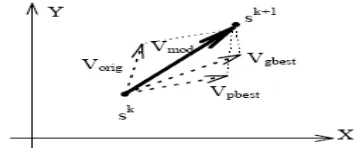
Expressions (3.1) and (3.2) describe the velocity and position update, respectively. Expression (3.1) calculates a new velocity for each particle based on the particle's previous velocity, the particle's location at which the best fitness has been achieved so far, and the population global location at which the best fitness has been achieved so far.
Fig 3.1.Concept of modification of a searching point.
k
S Current Position
1
k
S Modified Position
orig
V Current Velocity
mod
V Modified Velocity
pbest
V Velocity base on Pbest gbest
V Velocity based on Pbest
3.3 THE ALGORITHM
PSO is initialized with a group of random particles (solutions) and then searches for optima by updating generations. In every iteration, each particle is updated by following two "best" values. When a particle takes part of the population as its topological neighbors, the best value is a local best and is called lbest.
After finding the two best values, the particle updates its velocity and positions with following equations (3.3) and (3.4).
v[]=v[] + c1*rand( )*( pbest[] - present[] ) + c2*rand( )*( gbest[] - present[] )
(
3
.
3
)
Present [] = present [] + v[]
(
3
.
4
)
where, v[] is the particle velocity, present[] is the current particle (solution). pbest[] and gbest[] are defined as stated before. rand ( ) is a random number between (0,1). c1, c2 are learning factors. Usually c1= c2 = 2.
The pseudo code of the procedure is as follows: For each particle
Initialize particle End
Do
For each particle Calculate fitness value
If the fitness value is better than the best fitness value (pbest) in history Set current value as the new pbest
End
Volume 2, Issue 10, October 2013
Page 259
For each particleCalculate particle velocity according equation (3.3) Update particle position according equation (3.4) End
While maximum iterations or minimum error criteria is not attained
Particles' velocities on each dimension are clamped to a maximum velocity Vmax. If the sum of accelerations would cause the velocity on that dimension to exceed Vmax, which is a parameter specified by the user. Then the velocity on that dimension is limited to Vmax.
Particles' velocities on each dimension are clamped to a maximum velocity Vmax. If the sum of accelerations would cause the velocity on that dimension to exceed Vmax, which is a parameter specified by the user. Then the velocity on that dimension is limited to Vmax.
3.4 PSO PARAMETER CONTROL
There are two key steps when applying PSO to optimization problems: 1. The representation of the solution and
2. The fitness function.
There are not many parameter need to be tuned in PSO. Here is a list of the parameters and their typical values. a)The number of particles
b)Dimension of particles c)Learning factors d)The stop condition
4. FUZZIFIED PSO FOR MULTIOBJECTIVE PROBLEMPROBLEM FORMULATION
Each particle consists of power generations of all units excluding slack bus voltages, taps and shunts encoded in it. The size of each particle is equal to sum of active power generations, no of voltages excluding slack bus, number of voltage, taps, and shunts.Assuming the decision maker (DM) has imprecise or fuzzy goals of satisfying each of the objectives, the multiobjective problem can be formulated as a fuzzy satisfaction maximization problem which is basically a min-max problem. [23] Our task over here is to determine the compromise solution for all the four optimization sub problems. Our goal is to minimize G(X) = compromised solution of {G1(X1), G2 (X2), G3(X3), G4(X4)} [24]
While satisfying the set of constraints AX <B.
Let F1 (Xi) be the fuel cost in $/hr for ith control vector.
F2 (Xi) be the losses in P.U for ith control vector
F3 (Xi) be the Stability index for ith control vector
F4 (Xi) be the Emission release in kg/hr for i th
control vector
Let the individual optimal control vectors for the sub problems be X1*, X2*, X3*, X4* respectively. We have to find out a
global optimal control vector X *such that
* * * * *
1 2 3 4
* * * * *
2 1 3 4
* * * * *
3 1 2 4
* * * * *
4 1 2 3
1 X 1 X 1 (X , X , X )
2 X 2 X 3 (X , X , X )
3 X 3 X 3 (X , X , X )
4 X 4 X 4 (X , X , X )
F F F
F F F
F F F
F F F
The imprecise or fuzzy goal of the DM for each of the objective functions is quantified by defining their corresponding membership functions µi as a strictly monotonically decreasing function with respect to the objective function f where i=1 to 4. In case of a minimization problem,
µi=0 or tends to zero, if fi > fimax
and
µi = 1 or tends to 1, if fi < fimin .
i imax max
i i
i max min imin i imax
i i
i imin
0 F > F
F -F
μ = F F F
F -F
1 F < F
Volume 2, Issue 10, October 2013
Page 260
Using Eq. (4.3) the membership functions can be formulated asMembership function for Fuel cost
1 1max max
1 1
1 max min 1min 1 1max
1 1
1 1min 0 F >F
F -F (X)
μ = F F F
F -F
1 F <F
Where F1max=max {F1(X1
*
), F1(X2 *
), F1(X3 *
), F1(X4 *
)} F1min=min {F1(X1
*
), F1(X2 *
), F1(X3 *
), F1(X4 *
)}
Membership function for Losses
2 2m ax m ax
2 2
2 m ax m i n 2 m in 2 2 m ax
2 2
2 2m i n 0 F > F
F -F (X )
μ = F F F
F -F
1 F < F
Where F2max = max {F2(X1
*
), F2(X2 *
), F2(X3 *
), F2(X4 *
)} F2min=min{F2(X1
*
),F2(X2 *
),F2(X3 *
),F2(X4 *
)}
Membership function for stability Index
3 3 m a x m a x
3 3
3 m a x m in 3 m in 3 3 m ax
3 3
3 3 m in 0 F > F
F -F (X )
μ = F F F
F -F
1 F < F
Where F3max = max {F3(X1
*
), F3(X2 *
), F3(X3 *
), F3(X4 *
)} F3min = min {F3(X1
*
), F3(X2 *
), F3(X3 *
), F3(X4 *
)}
Membership function for Emission release
4 4 m a x m a x
4 4
4 m a x m in 4 m in 4 4 m a x
4 4
4 4 m in 0 F > F
F -F (X )
μ = F F F
F -F
1 F < F
Where F4max = max {F4(X1
*
), F4(X2 *
), F4(X3 *
), F4(X4 *
)} F4min = min {F4(X1
*
), F4(X2 *
), F4(X3 *
), F4(X4 *
)}
The maximum degree of overall satisfaction can be achieved by maximizing a scalar λ, which is the intersection of the
four fuzzy membership functions.
Therefore objective function is maximization of λ = max (µ1, µ2, µ3, µ4). Where λ varies from 0 to 1.
4. 1Application of the PSO to the multi-objective OPF
To apply the PSO algorithm to solve the proposed problem, the following algorithm should be applied PROPOSED ALGORITHM
The proposed solution strategy for the multi objective problem is shown in the following algorithm 1. Read the system data.
2. Read the values of fixed cost, loss, index, emission for each sub problems. 3. Form Ybus matrix and FLG matrix for L index calculation.
4. Form B1 sub matrix. Decompose B1 by Cholesky decomposition. 5. Randomly initialize population and velocities.
6. Set Pbest=0 and itercount=1. 7. Set particle count=1
8. Decode the particle. Decoded particle gives the values of power generations, voltage, magnitudes, tap values and shunts.
9. Form the Ybus and B2 sub matrix. Decompose B2 by Cholesky decomposition
4
.
3
4
.
4
4
.
5
Volume 2, Issue 10, October 2013
Page 261
10. Run FDC load flow and compute loss.11. Compute emission cost, fixed cost, and index values.
12. Fuzzify fuel cost, loss, emission and index obtained in step (11) using equations from eq (7.4 to 7.7).
13. Calculate the evaluation value of each individual in the population using Eq. (7.8). Compare each individual’s evaluation value with its Pbest . If the evaluation value of each individual is better than the previous Pbest, the
current value is set to be Pbest.
14. Increment individual count by 1. If count < population size go to step (8). 15. The best evaluation value among the Pbests is denoted as gbest.
16. Modify the member velocity V of each individual according to
a. vik+1 =k*( w* vik + c1*rand1*(pbesti - xi) + c2*rand2*(gbesti - xi))
b. xi k+1
= xi + vi k+1
17. Modify the member position of each individual Pi according to
Pi (k+1) =Pi(k)+Vi(k+1)
Pi (k+1) must satisfy the constraints.
18. Increment iteration count by 1.If the number of iterations reaches the maximum, Then go to Step 19, otherwise, go to Step 7
19. The individual that generates the latest gbest, is the required control vector for the final trade off solution. Print
the results
5. SIMULATION AND NUMERICAL RESULTS
To validate the performance of the proposed method, this method is tested on the IEEE 30-bus test system. The 30-bus IEEE test system has 41 transmission lines, six generators and four transformers (T6 – 9 , T6 – 10 , T4 – 12 and T27 – 28). The
lower and upper voltage magnitudes and transformer tap limits are considered between 0.9 and 1.1pu. The parameters required for implementation of the proposed PSO algorithm are adjusted by 100 times running of this algorithm. The importance of this act is having compromise between accuracy and run time which is a necessity feature of the evolutionary algorithms, the simulations are carried out for two different cases categorised as cases I and II as follows.
Case I: All objective functions are optimised individually. Case II: Objectives are optimised simultaneously.
Case I: Initially, each objective function is considered individually in order to explore the extreme points of the trade-off curve and assess F min and F max(which are the best and worst result of the ith objective function while it is optimised as a single objective), these values are needed to normalise objective functions in multi-objective optimisation process.
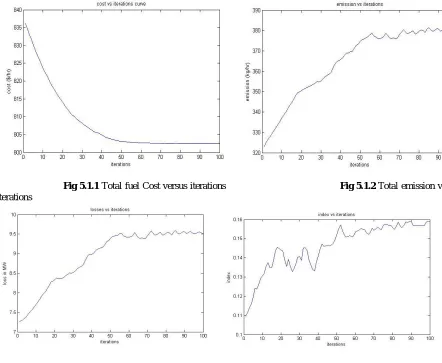
5.1 Generation cost optimization Using PSO
The PSO parameters used in this case study are: No of particles 60, learning factors c1=2.05, c2=2.05, weight factor
w=1.2, constriction factor K=0.7925. Maximum number of iterations=100.
Results for IEEE 30 bus system
Cost ($/hr) Emission (kg/hr) Losses MW Stability Index
801.5539 379.5345 9.51 0.1588
Best generation cost for different algorithms
FGA [17] PSO
Volume 2, Issue 10, October 2013
Page 262
Fig 5.1.1 Total fuel Cost versus iterations Fig 5.1.2 Total emission versus iterationsFig 5.1.3 Total losses versus iterations Fig 5.1.4 Stability Index versus iterations
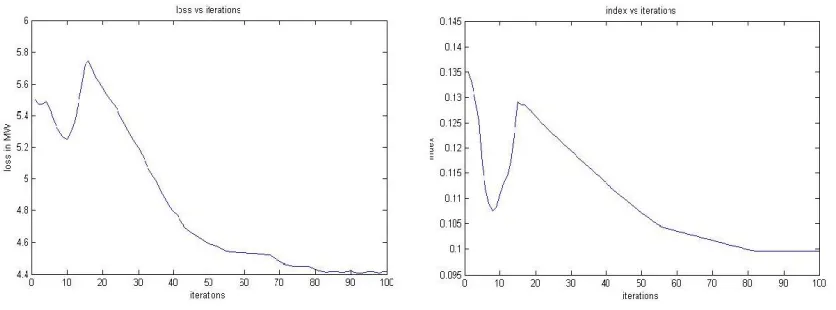
5.2 Emission optimization Using PSO
The PSO parameters used in this case study are: No of particles 60, learning factors c1=2.05, c2=2.05, weight factor
w=1.2, constriction factor K=0.7925. Maximum number of iterations=100.
Results for IEEE 30 bus system
Cost ($/hr) Emission (kg/hr) Losses MW Stability Index
946.9830 229.1311 4.4179 0.0996
Volume 2, Issue 10, October 2013
Page 263
Fig 5.2.3 Total losses versus iterations Fig 5.2.4 Total losses versus iterations
5.3 Power Loss Optimization Using PSO Results
The PSO parameters used in this case study are: No of particles 60, learning factors c1=2.05, c2=2.05, weight factor
w=1.2, constriction factor K=0.7925. Maximum number of iterations = 100 the settings of PSO control parameters are maximum generation=100
Results for IEEE 30 bus system
Cost ($/hr) Emission (kg/hr) Losses MW Stability Index
967.3872 229.7822 3.3424 0.0864
Best transmission loss for different algorithms GA [18] PSO
Vg (1) – 1.05
Vg (2) 1.03 1.0338
Vg (5) 1.00 1.0058
Vg (8) 1.00 1.0230
Vg (11) 1.02 1.0913
Vg (13) 1.04 1.0883
T6 – 9 , pu 1.00 0.9000
T6 – 10 , pu 1.01 0.9625
T4 – 12 , pu 1.00 0.9375
T27 – 28 , pu 1.04 1.0750
powerloss, MW 5.3513 3.3424
Volume 2, Issue 10, October 2013
Page 264
Fig 5.3.3 Total emission versus iterations Fig 5.3.4 Stability Index versus iterations
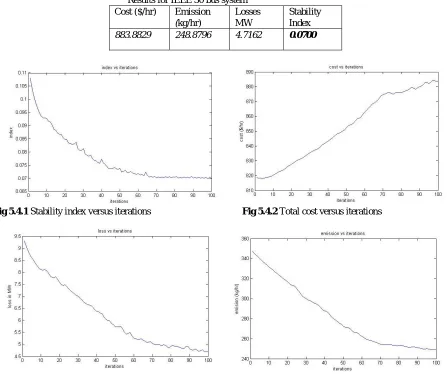
5.4 Voltage Stability Improvement Using PSO Results
The lower voltage magnitude limits at all buses are 0.95 p.u. and the upper limits are 1.1 for all the PV buses and 1.05 p.u. for all the PQ buses and the reference bus. The lower and upper limits of the transformer tapings are 0.9 and 1.1 p.u. respectively. The settings of PSO control parameters are maximum generation=100, no of particles 60, learning factors c1=2.05, c2=2.05, weight factor w=1.2, constriction factor K=0.7925.
Results for IEEE 30 bus system Cost ($/hr) Emission
(kg/hr)
Losses MW
Stability Index
883.8829 248.8796 4.7162 0.0700
Fig 5.4.1 Stability index versus iterations Fig 5.4.2 Total cost versus iterations
Fig 5.4.3 Total losses versus iterations Fig 5.4.4 Total emission release versus iterations
Volume 2, Issue 10, October 2013
Page 265
5.5 Fuzzified PSO for Multiobjective Problem Results
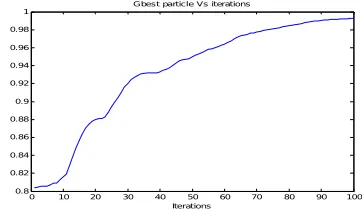
In this problem all the above four objective functions are optimized simultaneously by using fuzzified particle swarm optimization. The respective results of all above four objectives are fuzzified by using the respective formulae and from those results the pbest and gbest values are modified and as a result four objective functions simultaneously optimized.25 independent runs are made for each sub problem and the best values of four factors considered aminimum value of each sub problem over 25 independent runs are determined. These values for all sub problems are given in below table.
Results of various sub problems Final trade off solution for IEEE 30 bus system
Fig 5.5.1 Total losses versus iterations Fig 5.5.2 Total losses versus iterations
Fig 5.5.3 Total losses versus iterations Fig 5.5.4 Total losses versus iterations Optimizat
ion Problem
Fuel Cost ($/hr)
Losses ( MW )
stability index
Emision
(kg/hr)
Fuel cost minimizatio
n sub
problem results
801.5539 9.51 0.1588 379.534 5
Losses minimizatio
n sub
problem results
967.3872 3.3424 0.0864 229.782
2
Stability Index minimizatio
n sub
problem
883.8829 4.7162 0.0700 248.879
6
Emission minimizatio
n sub
problem
946.2708 4.4179 0.0996 229.131
1
Final trade off solution
Volume 2, Issue 10, October 2013
Page 266
0 10 20 30 40 50 60 70 80 90 100
0.8 0.82 0.84 0.86 0.88 0.9 0.92 0.94 0.96 0.98
1 Gbest part icle Vs it erat ions
Iterat ions
G
b
e
s
t
Figure 5.5.5Gbest particle (λ) Vs Iteration
6. Conclusion
In this work an approach to solve multiobjective problem which aims at minimizing fuel cost, real power loss, emission release and improving stability index of the system simultaneously has been proposed. Several system constraints (namely limits on generator real and reactive powers output, limits on bus voltage magnitude and angles) are taken care off. We have successfully implemented Particle Swarm Optimization solution for optimal power flow problem.The cost minimization is taken as objective function and the algorithm has been tested on IEEE 30 bus system. An attempt has been made to determine the optimum dispatch of generators, when emission release is taken as objective. The algorithm has been tested on IEEE 30 bus. Real power loss optimization is taken as another objective and the algorithm has been developed for minimizing the total system losses using PSO. Improving stability index of the system is taken as another independent objective and this improvement is done using PSO. Thus all the four objectives are solved individually and the results from these individual optimizations are fuzzified and final trade off solution is thus obtained. In this work basic assumption made is that the decision maker (DM) has imprecise or fuzzy goals of satisfying each of the objectives, the multiobjective problem is thus formulated as a fuzzy satisfaction maximization problem which is basically a min-max problem.
Our proposed approach satisfactorily finds global optimal solution within a small number of iterations. The algorithm is fast and can be applied online. The multiobjective problem is handled using the fuzzy decision satisfaction maximization technique which is an efficient technique to obtain trade off solution in multiobjective problems. But as the evolutionary methods PSO also has the drawback of not converging to exactly same value all the times due to stochastic nature. But in this case PSO has almost returned the same value for most of the cases.
REFERENCE
[1] E.H.Chowdhury, Saifur Rahrnan, “A Review of Recent Advances in Economic Dispatch”, IEEE Trans. on Power Syst., Vol. 5, No. 4, pp 1248- 1259, November 1990.
[2] J. Kennedy and R.Eberhart, “Particle swarm optimization,” in Proc. IEEE Int. Conf. Neural Networks (ICNN’95), vol. IV, Perth, Australia, pp1942-1948, 1995.
[3] Jong-Bae Park, Ki-Song Lee, Joong-Rin Shin, Kwang Y. Lee, “A Particle Swarm Optimization for Economic Dispatch with Non-smooth Cost Functions”, IEEE Trans. on Power Syst., Vol. 20, No.1, pp 34- 42, February 2005. [4] Zwe-Lee Gaing, “Particle Swarm Optimization to Solving the Economic Dispatch Considering the Generator
Constraints”, IEEE Tans. on Power Syst., Vol 18, No. 3, pp 1187- 1195, Aug. 2003.
[5] J.H.Talaq,F.El-Hawary,andM.E.El-Hawary, “A Summary of Environmental/Economic Dispatch algorithms,” IEEE Trans. Power Syst., vol. 9, pp. 1508–1516, Aug. 1994.
[6] A. Immanuel Selva Kumar, K. Dhanushkodi, J. Jaya Kumar, C. Kumar Charlie Paul,“Particle Swarm Optimization Solution to Emission and Economic Dispatch Problem”,
[7] IEEE TENCON 2003.
[8] Wu Q.H. and Ma J. T.(1995) ‘Power system optimal reactive power dispatch using Evolutionary programming ‘IEEE Trans on Power Systems
[9] Bhagwan Das, Patvardhan C. (2003) ‘A New Hybrid Evolutionary Strategy for Reactive Power Dispatch’, Electric Power Research, Vol.65. pp.83-90.
[10] Papiya Dutta , A.K.Sinha- IIT Kharagpur Professor, “Environmental Economic Dispatch constrained by voltage stability using PSO “Electrical Engineering, IIT Kharagpur-IEEE 2006
[11] Hirotaka Yoshida Kenichi Kawata, Yoshikazu Fukuyama Yosuke Nakanishi “A Particle Swarm Optimization For Reactive Power And Voltage Control Considering Voltage Stability” IEEE International Conference on Intelligent System Applications to Power Systems (ISAP'99),Rio de Janeiro, April 4-8, 1999
[12] Wen Zhang, Yutian Liu, Senior Member, IEEE “Reactive Power Optimization Based on PSO in a Practical Power System”
Volume 2, Issue 10, October 2013
Page 267
[14] “Fast Calculation of Voltage Stability Index”PA L6f T SmedG Andersson, Transactions on Power Systems, Vol. 7, No.1 February 1992
[15] M.A. Abido, A novel multiobjective evolutionary algorithm for environmental/economic power dispatch, Electric Power Syst. Res. 65 (2003) 71–81.
[16] Y.H. Song, G.S. Wang, P.V. Wang, A.T. Johns, “Environmental/economic dispatch using fuzzy logic controlled genetic algorithms”, IEE Proceedings of Generation, Transmission, Distribution, vol. 144, no. 4, 1997, pp.377–382. [17] Saini, A., Chaturvedi, D.K., Saxena, A.K.: ‘Optimal power flow solution: a GA-fuzzy system approach’,
Int.l J. Emerging Electr. Power Syst., 2006, 5, (2), pp. 1 – 21