ISSN: 2374-2208(Print), 2374-2194(Online) Copyright © The Author(s). 2015. All Rights Reserved. Published by American Research Institute for Policy Development DOI: 10.15640/jibe.v3n1a4 URL: http://dx.doi.org/10.15640/ jibe.v3n1a4
A Panel Vector Autoregression Analysis of Sudden Stops and Banking Crises
Chiratus Ratanamaneichat
1& Samuel M. Schreyer
2Abstract
Recent empirical literature on sudden stops and banking crises suggests the interaction of these crises is particularly harmful to the real economy. Despite this, very little empirical research has been undertaken to decipher the interplay between these crises. This paper contributes to this literature by applying a panel vector autoregression to examine how these crises interact via domestic credit, capital flows, and output growth. This research finds evidence supporting the view that sudden stops occurring with banking crises are more harmful than sudden stops occurring by themselves. It also finds that during the joint occurrences of these crises domestic credit increases during the onset of a sudden stop, but this expansion in credit results in an adverse impact on output growth. This result is consistent with the hypothesis that the financial intermediaries are unable to allocate credit efficiently hence why the interaction of sudden stops and banking crises is above and beyond their individual effects.
Keywords: capital flows, sudden stops, banking crisis, vector autoregression
1.
Introduction
A rich body of literature analyzing the economic costs associated with a sharp cessation of capital inflows— termed sudden stops in the literature—has grown steadily since these events were associated with the collapse of a variety of emerging markets in the late 1990s. In particular, attention has focused on how these episodes channel through, and independently of, the banking sector. Mounting evidence suggests the adverse effects of sudden stops manifest themselves through a distressed banking sector via a misallocation of credit. The implications of this finding are important for emerging markets: it is not the opening of financial markets, and hence the susceptibility to sudden stops, per se that risk painful contractions in the business cycle, but rather the opening of financial markets concomitantly with an unsound domestic banking sector.
Despite the important connection between the banking crises and sudden stops, little is known how these crises interact. This stems in part from the methodology used in the literature to estimate the impact of these crises on the real economy. This methodology involves measuring crises with dummy variables and then regressing these dummies on real GDP growth. Regression methods employed often involve controlling for the endogeneity of crises using instrumental variables, as well as eliminating the bias which results when the dependent variable is specified autoregressively. While this approach is useful in obtaining estimates of the impacts these crises have on the economy, information regarding the nature of the interaction is limited to a point estimate describing the net effect of the interaction on the economy.
1
Kasem Bundit University, Research Center, 1761 Patanakarn Road, Suan Luang, Bangkok 10250, Thailand. 2
To shed greater light on how sudden stops interact with banking crises we apply an unbalanced panel vector autoregression (VAR). Our paper contributes to this literature in two important ways. First, by using a VAR on panel data we are able to consider the complex inter-relationships among the crises themselves, as well as with the real economy, while allowing for unobserved heterogeneity across countries (i.e., fixed effects). Second, the effect of a shock precipitated by either a banking crisis or a sudden stop can be isolated to each variable in the VAR system by analyzing orthogonalized impulse response functions, thus providing insight into the dynamics between crises and the real economy.
The paper proceeds as follows: section 2 reviews the literature; section 3 describes the methodology and taxonomies employed in this paper; section 4 discusses the results of the VAR estimates and corresponding impulse responses; and section 5 concludes.
2. Review of the Literature
For brevity, we refer the reader to Hutchinson and Noy (2005) and Joyce and Nabar (2010) for comprehensive surveys of the empirical literature involved with estimating the costs of sudden stops and banking crises. However, in these surveys there are no studies to our knowledge directly examining the dynamics between these two crisis types using vector autoregression analysis (VAR)—this point forms the basis of the current paper. There have been, however, several studies employing VAR analysis in a manner similar to what we endeavor.
A VAR is a multivariate simultaneous equation system where each variable in the system is regressed on a finite number of lags of all variables jointly considered. An advantageous feature of this method is that it treats all variables in its system as endogenous variables. Thus, it is suitable to adopt this model for observing relationships where one is not sure whether variables are exogenous. Feedback effects between variables are observable since coefficients are obtained for each lagged variable in the system regressed on each variable. Additionally, a VAR allows one to trace of the effect of a shock to variable on another by examination of the impulse response functions.
This model has been often used with time series data over the past couple decades. Recently, however, the VAR model has gained prominence in a panel data setting. By merging traditional fixed effect regressions with the time series VAR, this method allows the benefits of the VAR described above to be applied to multiple cross-sections. Additionally, a panel VAR eliminates the country-specific effects which can generate the endogeneity problem of lagged values of the dependent variable and result in omitted variable bias.
An early paper to apply a panel VAR to a topic related to this paper is Lee and Chinn (1998). The article studies the impact of money and productivity shocks on current accounts and real exchange rates for seven major industrialized countries spanning 1979Q2 to 1996Q1. The Blanchard-Quah decomposition is employed not only to avoid the ordering problem, but also to avoid assuming a particular macroeconomic paradigm of assuming the degree of exogenous and endogenous for the system variables. The short-run movements of the endogenous variables can depend both on the dynamics of the exogenous variables and the unspecified intrinsic dynamics of the model. Lee and Chinn (1998) perform a lag-length test using Akaike information criterion (AIC) and Schwartz Bayesian criterion (SBC). These measures are calculated to find a reasonable approximation to the infinite-order VAR. The paper finds empirical results that are consistent with the sticky price intertemporal model by Obstfeld and Rogoff (1995). Permanent productivity shocks have large long term effects on the real exchange rate, relatively small effects on the current account, while money shocks have large effects on the current account and exchange rate in the short run, but neither variable in the long run.
He finds that there is an asymmetric response across sudden stop and tranquil times. Terada-Hagiwara also compares the sudden stops between those that happened during the 1980s debt crises and those that happened in the 1990s, making the case that sudden stops have become more prominent in explaining the real exchange rate disturbances.
Powell et al. (2002) examines the determinants, consequences, and inter-relationships among capital inflows and outflows while controlling for the interaction between them. The variables include capital inflows, private capital outflows, real exchange rate, GDP growth and fiscal balance. With these five variables, the authors perform a panel VAR regression for all developing countries from 1980-1999. In addition, they also split poor countries out and examine if there is any difference in the results. To eliminate the country-specific effect, the Helmert procedure is applied. The analysis employs employ the one-period lagged regressors as instruments and estimate the coefficients by system GMM. Fixed effects are removed by subtracting the mean values of variables calculated annually across countries. To depict the impulse response functions, Monte Carlo simulation is used to generate the standard error bands. They find evidence of vicious and virtuous cycles: lower inflows/higher outflows of capital lead to lower growth and, among other effects, result in a higher fiscal deficit, which feeds back to lower inflows/higher outflows. Powell et al. conclude it is particularly important for developing countries to maintain prudent policies, and especially adequate fiscal discipline, to avoid vicious and reinforce virtuous cycles.
Love and Zicchino (2002) use firm-level panel data from 36 countries to study the dynamic relationship between firms’ financial conditions and investment.
They split the sample into two groups: high financial development countries and low financial development countries using median value as the criterion. Their methodology is the same as Powell et al. (2002). They find that the impact of the financial factors on investment is significantly larger in countries with less developed financial systems. Thus, the accumulation of capital will be less efficient in countries that are less financially developed, ultimately, leading to slower economic growth.
Leblebbicioglu (2005) employs a panel VAR model to observe how the dynamical behavior of consumption and output differ between financially developed and underdeveloped countries in response greater financial openness. The author uses annual data for 76 countries from 1980-2001, and classifies these countries into two groups based on their level of financial development. The VAR system has five variables: consumption, GDP, real exchange rate, terms of trade and gross private capital flows. She first investigates the time series properties of the data by running unit root tests and transforming the non-stationary series into log levels. The time specific effects and country-specific fixed effects are eliminated by the mean values of variables similar manner as in Powell et al. (2002) and first differencing, respectively. A Cholesky decomposition is applied, allowing the VAR system to recover its structural form. The VAR coefficients and the impulse response functions are estimated followed Powell et al. (2002) and Love and Zicchino (2002). The main result of this paper is that in the financially developed countries, consumption decreases in reaction to an increase in financial integration, while the consumption in the developing countries increases in reaction to a similar one. This is a gauge of the different consumption-saving behavior in these two group countries. This also highlights the importance of the level of financial development in the financial integration debate.
3. Methodology
We begin by considering a sample of 30 emerging-market countries from 1980Q1 to 2005Q4. The time period chosen was guided by data availability and the need to avoid capital flow movements in world markets involved with the Great Recession of 2007-09 from distorting the analysis. The sample of countries used in this paper corresponds to related papers by Joyce and Nabar (2010) and Hutchinson and Noy (2005).3
3 The full sample of countries are Argentina, Brazil, Chile, China, Colombia, Costa Rica, Cyprus, Czech Republic, Egypt,
Our main sudden stop definition is taken from Guidotti, Sturzenegger, and Villar (2004) where a sudden stop occurs whenever the reduction in net capital flows is at least one standard deviation below its country-specific mean, and the reduction in net capital flows is at least 5% of GDP. Net capital flows are measured using the financial account (FA), and the standard deviation and mean are country-specific. Annual dates for banking crises are taken from Caprio, et al. (2006) and Demirguc-Kunt and Detragiache (2005). Due to a lack of higher frequency data, we assume the onset of all crises begins in the first quarter. While this assumption is less than ideal, our analysis is concerned with the window of time surrounding the onset of such crises and, as such, may allow a bit more flexibility in dating the precise start of a given crisis. Our crisis window is defined as the time period from one year before, and two years after, the onset of a crisis.
Three sub-samples are distinguished: the first and second samples are composed of crisis periods when a banking crisis occurs independently of a sudden stop, and vice versa; the third sample is when both crises occur concurrently which is defined when the two crises occur in the same period or within 1-year lag/lead of each other. Separating the data in this manner enables comparison of the interactions of each crisis and the real economy with the interactions occurring when both crises occur jointly.
The reduced form of the panel VAR model used in this paper is:
it t i it
it
L
u
0(
)
(1)where
itis the vector of endogenous variables containing domestic credit (CREDITit), financial account (FAit) and real GDP growth (RGDPit);
i is a vector of country-specific effects independent of time;
t is atime-specific shock common to all countries;
u
it is the vector of structural shocks; and (L) is the matrix polynomial in the lag operator of order 3. This lag order is based on lag-length tests based on the Akaike information criterion (AIC) and Schwartz Bayesian criterion (SBC). These criteria change little between lags 1 and 3, after which there is substantial deterioration of these criteria. Although criteria for the 2nd order lag is better than with 3 lags, we opt for the latter since studies using annual data have found statistical significance for the interaction of sudden stops and banking crises at a 1-year period (e.g., Hutchinson and Noy, 2005).Table 1: Data Definitions
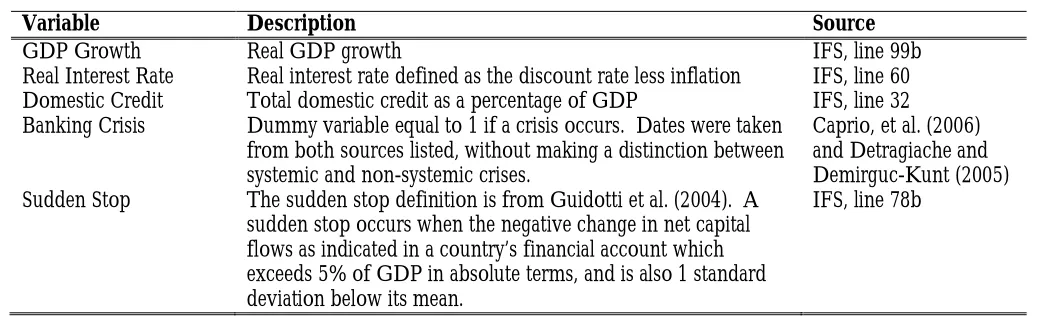
Variable Description Source
GDP Growth Real GDP growth IFS, line 99b
Real Interest Rate Real interest rate defined as the discount rate less inflation IFS, line 60 Domestic Credit Total domestic credit as a percentage of GDP IFS, line 32 Banking Crisis Dummy variable equal to 1 if a crisis occurs. Dates were taken
from both sources listed, without making a distinction between systemic and non-systemic crises.
Caprio, et al. (2006) and Detragiache and Demirguc-Kunt (2005) Sudden Stop The sudden stop definition is from Guidotti et al. (2004). A
sudden stop occurs when the negative change in net capital flows as indicated in a country’s financial account which exceeds 5% of GDP in absolute terms, and is also 1 standard deviation below its mean.
IFS, line 78b
The next step is to transform the structural model in equation (1) by subtracting the mean values of each variable calculated across all countries for each year. This transformation removes time-specific effects, taking the form:
it i it
it
L
u
~
~
~
)
(
~
0
(2)where the tildes represent variables in deviation form. Next, country-specific effects are eliminated because they are correlated with lagged dependent variables which results in dynamic panel bias (see Nickel, 1981). This is done by taking the first difference of equation (2):
it it
it
L
u
~
~
)
(
~
0
(3)Equation (3) can be estimated using ordinary least square (OLS). The OLS uses lagged regressors as instruments to estimate the coefficients. The matrices of the impulse response functions are constructed from the estimated VAR coefficients. The standard errors of the impulse response functions are obtained from Monte Carlo simulations with 500 iterations.
4. Results
Our sample and methodology yields a total of 58 sudden stops and 54 banking crises. Note that if there is a sudden stop following another one in the previous year, it is counted as the same event. The joint occurrence of sudden stops and banking crises is defined as when they occur in the same period or within 1-year lag/lead of each other, which yields 24 such episodes.
We begin examining the data by performing Granger causality tests with 3 lags for each of the three sub-samples: (i) banking crises occurring without sudden stops; (ii) sudden stops occurring without banking crises; and (iii) the joint occurrence of banking crises and sudden stops.4 There are no statistically significant relationships in terms of Granger causality during the periods of banking crises when sudden stops do not occur. However, for sudden stops occurring by themselves the tests suggest that RGDP at time t Granger causes FA the following period during the sudden stops. This finding is expected since foreign investors consider output growth as a leading indicator of economic health. Put differently, a downturn in output growth under the right circumstances can precipitate a sudden stop. The tests for Granger causality during the joint occurrence of sudden stops and banking crises reveal more dynamics. Changes in both CREDIT and FA tend to precede (i.e., Granger cause) RGDP. The direction of Granger causality between RGDP and these variables is not, however, symmetric—suggesting that most jointly occurring banking crises and sudden stops are not preceded by adverse changes in the real economy.
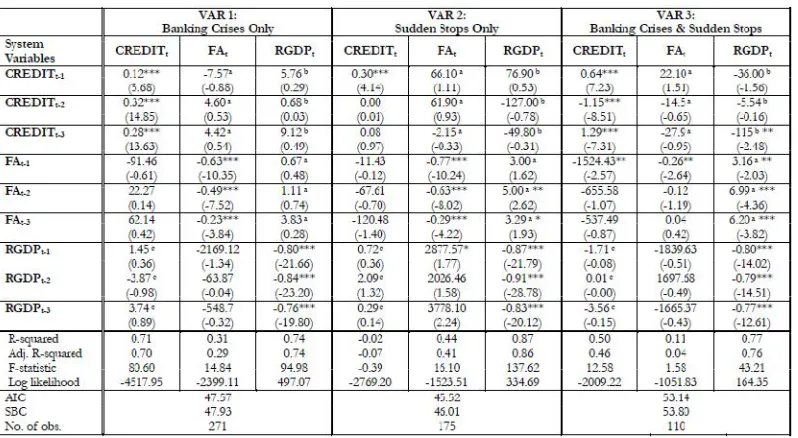
The Granger causality test is only a test of precedence and neglects, among other things, the inter-relationships between the endogenous variables. To incorporate these inter-inter-relationships into the analysis, we next estimate a panel vector autoregression model for each of the sub-samples. The panel vector autoregression estimates are shown in Table 2 where the columns under VAR 1 represent estimates when banking crises occur by themselves, the columns under VAR 2 are estimates when sudden stops occur by themselves, and the columns under VAR 3 are estimates when sudden stops and banking crises occur jointly. We report the estimates of the coefficients of the system given in equation (3) where the fixed effects and the country-specific effects have been removed As shown in Table 2 under VAR 1, the persistence of CREDIT, FA, and RGDP are the dominating factors when banking crises occur in the absence of sudden stops. The interaction between CREDIT and the FA is statistically insignificant, which is expected since no sudden stop is occurring. What is less expected, however, is that lagged CREDIT appears to not play a role in RGDP at time t.
In contrast, VAR 2 in Table 2 shows the impact of the lagged FA on RGDP at time t to be statistically significant during sudden stop episodes. The effect of FA takes about two quarters to manifest itself on output growth and remains significant for at least one year. This is expected since, during sudden stop episodes without banking crises, the decrease in financial account (i.e., decrease in the supply of foreign funds for domestic investment) leads to a fall in real output growth. Considering FA as the regressor in VAR 2, only RGDP lagged one quarter shows any statistical significance. This underscores the general view that sudden stops are, as the name suggests, sudden in nature and tend not to be preceded by deteriorating output growth.
Finally, VAR 3 in Table 2 shows equation (3) estimated when both crises occur jointly. RGDP is impacted through both the financial account channel and the domestic credit channel. The magnitude of the impact from financial account channel on output loss is about twice of that during the sudden stops alone, confirming that sudden stops occurring with banking crises are particularly harmful to the real economy. Furthermore, the effect of lagged FA on RGDP occurs one period sooner than when sudden stops occur independent of banking crises, and this effect is sustained for at least one year. VAR 3 also shows CREDIT is negatively associated with FA in the previous quarter. In the context of jointly occurring crises, the interpretation is that CREDIT increases following a reduction in a country’s financial account. This is likely indicative of the heightened need for liquidity by financial intermediaries following the onset of a sudden stop crisis. The liquidity, however, is not allocated efficiently, and as the VAR 3 regression shows, increased CREDIT adversely affects RGDP. In summary, the evidence from Table 2 suggests that the adverse effects of sudden stops on output growth are especially deleterious when the domestic credit channel is not functioning efficiently.
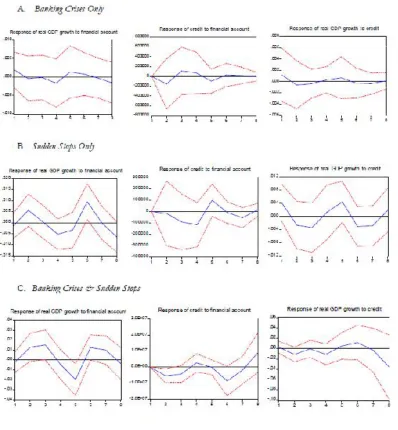
Table 3 provides a set of impulse response functions for each of the three subsamples (i.e., rows A, B, and C).
Impulse response graphs depict the current and future response of a given variable to a one-standard deviation increase (also described as a shock) in one of the system’s error terms.5 Each row in Table 3 shows (i) the response of RGDP to a FA shock; (ii) the response of CREDIT to a FA shock; and (iii) the response of RGDP to a CREDIT shock. First consider the effect of RGDP to a FA shock for each of the subsamples. Unsurprisingly, RGDP has a muted response to FA shocks when sudden stop crises are not occurring (i.e., row A). In contrast, a negative shock to FA results in lower RGDP in rows B and C, but this relationship is greatest in duration and magnitude for the joint occurrence of banking crises and sudden stops. This point is consistent with previous studies which found sudden stops occurring jointly with banking crises have result in greater output loss than sudden stops occurring by themselves. CREDIT increases in response to a negative FA shock for each of the three subsamples shown in Table 3. As mentioned above, this is likely indicative of greater domestic liquidity being supplied to the private sector as foreign capital is withdrawn.
5 The interpretation of the impulse responses rests partly on the assumption that the VAR errors are uncorrelated. In some
The magnitude of CREDIT’s response to a negative FA shock is greatest when banking crises and sudden stops occur jointly. The last impulse graph shown in each row of Table 3 shows RGDP’s response to a shock in domestic credit. RGDP decreases in response to a positive CREDIT shock for each of the three subsamples. However, the magnitude of the RGDP response is smallest when banking crises occur in isolation, and largest when banking crises occur with sudden stops.
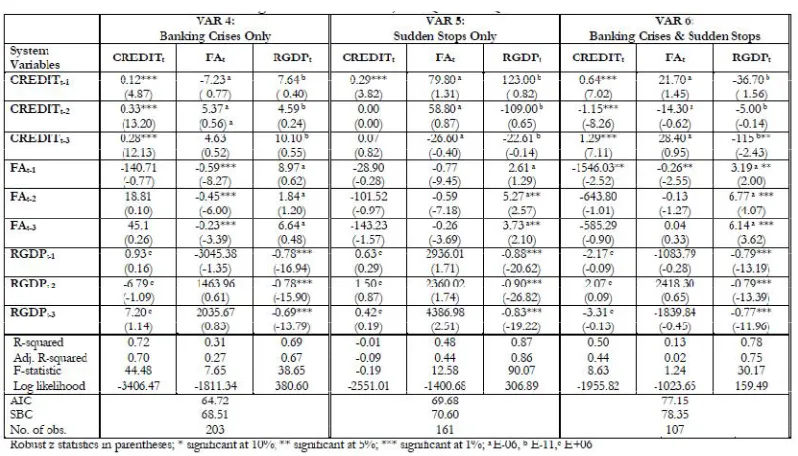
The joint occurrence of sudden stops and banking crises has the potential to present some unattractive tradeoffs to a central bank: increase interest rates to stem capital outflow or decrease interest rates to provide liquidity to the domestic financial sector. Given this possibility, we test the robustness of our panel vector autoregression estimates in Table 2 by adding the real interest rate as a system variable.6 The results are shown in Table 4 and reveal that the inclusion of the real interest rate has little effect on the results.
Similar to what was seen previously, VAR 6 of Table 4 reveals a statistically significant and negative relationship between the one-quarter lagged FA and CREDIT only when sudden stops occur jointly with banking crises—domestic credit increases to fill the liquidity vacuum left in the sudden stop’s wake. But the increase in domestic credit is translated into lower RGDP, which is precisely the same dynamic observed when the real interest rate was not included as a system variable.
Table 2: Panel VAR Estimates, 1980Q1 – 2005Q4
Robust z statistics in parentheses; * significant at 10%; ** significant at 5%; *** significant at 1%; a E-06, b E-11,c E+06
6 We also test robustness by restricting the sample to exclude the Asian Financial Crisis, as well as by including M2 growth,
Table 3: Impulse Response Functions, 1980Q1 – 2005Q47
7 The solid line represents the response of a given variable to a Cholesky one-standard deviation shock. Dotted lines represent
Table 4: Panel VAR Estimates Including Real Interest Rates, 1980Q1 – 2005Q48
5. Conclusion
The primary goal of this paper is to observe the interrelationships between output growth, domestic credit, and capital flows during a window of time surrounding banking crises, sudden stops, and their joint occurrences. Unlike previous studies concerning banking crises and sudden stops, we accomplish this by modeling the interrelationships as a panel VAR. Using a sample of developing economies over the past several decades, we find evidence that sudden stops tend to be followed by an increase in domestic credit as countries attempt to restore liquidity to their financial systems. Yet it is the increased domestic credit which is associated with subsequent losses in output growth. We test the robustness of these findings by adding the real interest rate to the VAR models. The inclusion of the interest rate is important as some central banks may be, or can be, more aggressive in changing rates during periods of economic turmoil. The results remain largely the same as before, thus giving additional support to the paper’s main findings. These findings support the idea that credit misallocation is a primary culprit as to why sudden stops are especially harmful to economic growth when occurring jointly with banking crises.
International capital flows carry with them many economic benefits, but also the possibility that these flows can reverse course and do so quite abruptly. Recent decades have witnessed several prominent sudden stops that were associated with sharp drops in output loss. As researchers continue to study how and why these events manifest themselves, the findings presented here underscore the problems of moral hazard and adverse selection that can plague the ability of financial intermediaries from efficiently allocating resources.
6. References
Arellano, M., & Bover, O. (1995). Another look at the instrumental variable estimation of error component models. Journal of Econometrics, 68(1), 29-51.
Bernanke, B., & Gertler, M. (1990). Financial fragility and economic performance. Quarterly Journal of Economics, 105(1), 87-114.
Bernanke, B., Gertler, M., & Gilchrist, S. (1996). The financial accelerator and the flight to quality. Review of Economics and Statistics, 78(1), 1-15.
8 For brevity, the estimations involving the real interest are excluded from the table. The fundamental purpose for their
Boyd, J. H., Kwak, S., & Smith, B. (2005). The real output losses associated with modern banking crises. Journal of Money, Credit, and Banking, 37(6), 977-999.
Caprio, G., Klingebiel, D., Laeven, L., & Noguera G. (2005). Banking crisis database. In P. Honohan & L. Laeven (Eds.), Systemic Financial Crises. Cambridge, MA: Cambridge University Press.
Detragiache, E., & Demirguc-Kunt, A. (2005). Cross-country empirical studies of systemic bank distress: A survey. IMF Working Papers, 5(96), International Monetary Fund.
Eichengreen, B., & Arteta, C. (2000). Banking crises in emerging markets: Presumptions and evidence. Center for International and Development Economics Research (CIDER) Working Papers,115, University of California at Berkeley.
Enders, W. (1995). Applied Econometric Time-Series. New York: John Wiley and Sons.
Guidotti, P. E., Sturzenegger, F., & Villar, A. (2004). On the consequences of sudden stops. Economia., 4(2), 171-214.
Hutchison, M., & Noy, I. (2005). How bad are twins? Output costs of currency and banking crises. Journal of Money, Credit, and Banking, 37(4), 725-752.
Joyce, J. P., & Nabar, M. (2010). Sudden stops, banking crises and investment collapses in emerging markets. Journal of Development Economics, 90(2), 314-322.
Kiyotaki, N., & Moore, J. (1997). Credit chains. Journal of Political Economy, 105(21), 211-248.
Leblebicioglu, A. (2005). Essays on financial integration and growth. Boston College, Ph. D. Dissertation.
Lee, J. & Chinn, M. D. (1998). The current account and the real exchange rate: A structural VAR analysis of major currencies. National Bureau of Economic Research Working Paper 6495, Cambridge, M.A.
Love, I., & Zicchino, L. (2002). Financial development and dynamic investment behavior: Evidence from panel vector autoregression. Policy Research Working Paper Series 2913, The World Bank.
Obstfeld, M., & Rogoff, K. (1995). The mirage of fixed exchange rates. National Bureau of Economic Research, Working Paper 5191, Cambridge, M.A.
Powell A., Ratha D., & Mohapatra S. (2002). Capital inflows and outflows: Measurements, determinants, consequences. Centro de Investigacion en Finanzas, Working Paper 7, Universidad Torcuato Di Tella, Buenos Aires.
Sims, C. A. (1980). Macroeconomics and reality. Econometrica, 48(1), 1-48.