The Thirty-Third AAAI Conference on Artificial Intelligence (AAAI-19)
Partial Multi-Label Learning by Low-Rank and Sparse Decomposition
Lijuan Sun, Songhe Feng,
∗Tao Wang, Congyan Lang, Yi Jin
School of Computer and Information Technology, Beijing Jiaotong University{17112082, shfeng, twang, cylang, yjin}@bjtu.edu.cn
Abstract
Multi-Label Learning (MLL) aims to learn from the traing data where each example is represented by a straingle in-stance while associated with a set of candidate labels. Most existing MLL methods are typically designed to handle the problem of missing labels. However, in many real-world sce-narios, the labeling information for multi-label data is always redundant , which can not be solved by classical MLL meth-ods, thus a novelPartial Multi-label Learning(PML) frame-work is proposed to cope with such problem, i.e. removing the the noisy labels from the multi-label sets. In this paper, in order to further improve the denoising capability of PML framework, we utilize the low-rank and sparse decomposi-tion scheme and propose a novelPartial Multi-label Learn-ing by Low-Rank and Sparse decomposition(PML-LRS) ap-proach. Specifically, we first reformulate the observed label set into a label matrix, and then decompose it into a ground-truth label matrix and an irrelevant label matrix, where the former is constrained to be low rank and the latter is assumed to be sparse. Next, we utilize the feature mapping matrix to explore the label correlations and meanwhile constrain the feature mapping matrix to be low rank to prevent the pro-posed method from being overfitting. Finally, we obtain the ground-truth labels via minimizing the label loss, where the Augmented Lagrange Multiplier (ALM) algorithm is incor-porated to solve the optimization problem. Enormous experi-mental results demonstrate that PML-LRS can achieve supe-rior or competitive performance against other state-of-the-art methods.
Introduction
As a popular machine learning framework, Multi-Label Learning (MLL) aims to learn a robust classification model from the training data, where each instance is associated with a set of labels instead of a single label (Zhang and Zhou 2014). In recent years, such framework has been widely used in many real-world scenarios, such as image anno-tation (Sanden and Zhang 2011), web mining (Tang, Ra-jan, and Narayanan 2009), information retrieval (Gopal and Yang 2010), etc.
Typically multi-label learning methods usually require complete labeling information for training examples (Zhang
∗
corresponding author
Copyright c2019, Association for the Advancement of Artificial Intelligence (www.aaai.org). All rights reserved.
Figure 1: An example of partial multi-label learning.
and Zhou 2014), i.e., each training instance has been pre-cisely annotated with all of its relevant labels. However, in many real-world applications, precise labeling is too scarce to obtain, which makes it infeasible to learn a robust multi-label classifier. Thus, many state-of-the-art studies are de-signed to handle the problem that the label matrix has miss-ing entries, includmiss-ing treatmiss-ing missmiss-ing labels as negative la-bels directly (Wu et al. 2015) (Sun, Zhang, and Zhou 2010) (Bucak, Jin, and Jain 2011), employing matrix completion technique to fill in missing labels (Goldberg et al. 2010) (Cabral et al. 2011), etc. Recently, as the annotation crowd-sourcing increasingly becomes popular, redundant labeling information gradually appears in these multi-label data, i.e. annotators may roughly assign each instance with a set of candidate labels, which include both related labels and un-related labels. For example, as we observed in Figure 1, the image is partially labeled by noisy annotators. Among the candidate labels,mountain,lake,grass,sky,house, andtree
are ground-truth labels while clouds,boat, and peopleare irrelevant labels.
ob-tain the feature prototype for acquiring the label confidence values, which may reduce the effectiveness of the learning model. Therefore, an intuitive strategy to cope with the PML problem is disambiguation, i.e. how to identify the ground-truth labels from the candidate labels. However, once the irrelevant labels are excessively redundant, such identifica-tion work is rather challenging or even impossible. Fortu-nately, in real-word scenarios, the irrelevant labels are usu-ally sparse among the observed labels, which makes the dis-ambiguation work become possible and easy to implement.
Based on the above consideration, in this paper, we pro-pose Partial Multi-label Learning by Low-Rank and Sparse decomposition(PML-LRS) method, which enables simultaneously capturing the ground-truth label matrix from the observed label matrix and learning the prediction model via low-rank and sparse decomposition scheme. Specifically, we firstly introduce`1-norm regularization to constrain the redundant label matrix by assuming that the irrelevant la-bels are sparse. Secondly, a trace norm regularization is in-troduced to capture the dependence among ground-truth la-bels. Thirdly, by making full use of the label correlations, the feature mapping matrix is constrained via trace norm regu-larization. Finally, the desired partial multi-label prediction model is learned by adopting Augmented Lagrange Multi-plier (ALM) method. Compared with previous PML algo-rithm, our method can remove the irrelevant labels and avoid the negative effect of noisy labels, which makes our method become more robust and applicable in real applications. Ex-tensive experimental results on real-world data sets validate the effectiveness of our model against other competitive al-gorithms.
Related Work
Multi-Label Learning with Label Correlation
A significant amount of literatures on multi-label learning has been proposed in recent years, which can be roughly categorized into three groups based on the degree of la-bel correlations (Zhang and Zhou 2014). For the first-order strategy, many approaches tackle the multi-label learning problem in a label-by-label style but they ignore the label correlations (Zhang and Zhou 2007). For the second-order strategy, most algorithms tackle multi-label learning prob-lem by considering pairwise label correlations (F¨urnkranz et al. 2008). For the high-order strategy, some methods tackle multi-label learning problem by considering high-order cor-relations among label subsets or all the classes (Ji et al. 2010) (Tsoumakas, Katakis, and Vlahavas 2011).
Weakly Supervised Multi-label Learning
In the literature of multi-label learning, most state-of-the-art methods are designed to handle missing labels, which can be roughly divided into the following four categorizes: (1) The first way is to treat the missing labels as negative labels and bring the label bias into the objective function (Chen et al. 2008). However, their performances will greatly decrease when massive ground-truth positive labels are ini-tialized as negative labels. (2) The second way is to trans-form the missing labels filling as a Matrix Completion (MC)
problem (Goldberg et al. 2010) (Cabral et al. 2011), which is often based on the low-rank assumption of the whole label matrix. Recently, (Xu, Tao, and Xu 2016) simultaneously in-corporates the sparse constraint and low-rank decomposition into the same framework to solve the multi-label learning problem. (3) The third way is to treat the missing labels as latent variables and embed them into a probabilistic model, such as Bayesian networks (Vasisht et al. 2014) and Con-ditional Restricted Boltzmann Machines (CR-BM). (4) The last way is to treat missing labels as the three states (Wu et al. 2014), i.e. positive labels +1, negative labels -1 and missing labels 0, to avoid the label bias.
Partial Label Learning
Partial Label Learning (PLL) deals with the problem where each training example is associated with a set of candidate labels, among which only one is correct. (Cour, Sapp, and Taskar 2011) (Zhang, Yu, and Tang 2017). An intuitive strat-egy to deal with such problem is disambiguation, i.e., trying to recover the ground-truth label from the candidate label set. One way towards disambiguation is to assume certain parametric modelF(x, y;θ)where the ground-truth label is first regarded as the latent variable and then refined in an iteration manner (Liu and Dietterich 2012) (Zhang and Yu 2015). Another disambiguation strategy is to assume that each candidate label has equal contribution to the learning model and then it makes prediction for unseen examples by averaging their modeling outputs (Cour, Sapp, and Taskar 2011). Compared to partial label learning, PML problem is much more challenging because the number of correct labels in the candidate set is unknown, which makes disambigua-tion difficult and inapplicable.
Proposed Method
In this section, we will first introduce the notations of our method, and then present the details of the proposed frame-work which combines the low-rank and sparse decomposi-tion scheme for partial multi-label learning. Furthermore, an optimization algorithm will also be described in detail.
Notations
Our method takes two matrices as input : the instance matrix
X= [x1,x2, . . . ,xn]∈Rd×n, wheredis the dimension of
the feature vector andnis the number of training instances. And we define the Y = [y1,y2, . . . ,yk]> ∈ {0,1}k×n
to represent the label assignments for the corresponding la-beled examples, wherekis the number of labels. The values in this matrix are within{0,1}, i.e., if instancejis annotated with labelyi,yij = 1; otherwise,yij = 0.
The Regularization Framework
Our goal are to use the instance matrix X and the ob-served label matrixYfor training a new PML model and to predict the labels from these redundant labels. For thei-th label, the goal is to learn a linear functionfiwherewiis the
model parameter. Here we restrict the prediction functionfi
to linear functions for simplicity, i.e.,fi(X) = w>i X.
De-fineW= [w1,w2, . . . ,wk]>∈Rk×dto denote the model
parameters for all labels. Following the traditional machine learning discipline, a general multi-label learning model can be learned by solving the following problem:
min
W
η
2kY−WXk 2
F+Φ(W) (1)
where Φ(W) represents a regularization function of W which is used to control the model complexity. Note that there exists the well-known label correlations among differ-ent labels in multi-label learning, so we assume that the fea-ture mapping matrixWis linearly dependent to effectively capture such label correlations, which leadsWto be low-rank and the optimization problem is defined as:
min
W
η
2kY−WXk 2
F+γrank(W) (2)
The above optimization problem (2) is difficult to solve due to the discrete nature of the rank function. Following recent advances on rank minimization, one popular approach is to replace the rank function by the trace norm (or nuclear norm). Using this relaxation, Eq. (2) is rewritten as follows:
min
W
η
2kY−WXk 2
F+γkWk∗ (3)
wherek k∗ denotes the sum of the singular values of the
matrix.
However, there is a situation of labels redundancy in real life, i.e., annotators may roughly assign each instance a set of candidate labels, which includes both related labels and some unrelated labels.
To deal with this problem, we assume that the irrelevant labels are sparse among observed candidate labels. The ba-sic idea of our method is to capture the accurate label matrix and irrelevant label matrix from the observed candidate label matrix by utilizing the idea of low-rank and sparse decom-position. Specifically, we assume that the irrelevant labels are sparse and introduce an`1-norm regularization to con-strain the redundant label matrix. In order to make full use of the ground-truth label information to compute the prediction model, a trace norm regularization is introduced to capture the dependence among ground-truth labels. So the observed label matrixYcan be decomposed into a sparse matrixQ and a low-rank matrixP, which can be represented as fol-lows:
min
P,Qrank(P) +βkQk0, s.t.Y=P+Q (4) As aforementioned, Eq. (4) is cumbersome to solve be-cause the rank and cardinality operators are discontinuous and non-convex. Therefore, these operators are respectively relaxed to their convex surrogates: the nuclear norm and the
`1-norm. Using this relaxation, Eq. (4) is rewritten as fol-lows:
min
P,QkPk∗+βkQk1, s.t.Y=P+Q (5)
By combining Eq. (5) and Eq. (3) together, the final ob-jective function for the proposed partial multi-label learning model can be formulated as follows:
min
P,Q,W
η
2kP−WXk 2
F+kPk∗+βkQk1+γkWk∗
s.t.Y=P+Q
(6)
whereη,γ andβ are trade-off parameters to keep the bal-ance of the model. From the above objective function, we can see that the predictive function is robust to inaccurately labeled instances.
Optimization
The problem (6) is convex and can be optimized efficiently. We first convert it into the following equivalent problem:
min
P,Q,W,J,T
η
2kT−WXk 2
F+kPk∗+βkQk1+γkJk∗
s.t.Y=P+Q, W=J, P=T
(7)
The optimization problem (7) can be solved with the ALM (Zhang et al. 2017), which minimizes the following augmented Lagrange function:
min
P,Q,W,J,T
η
2kT−WXk 2
F +kPk∗+βkQk1+γkJk∗
+<Y1,Y−P−Q>+
µ1
2 kY−P−Qk 2
F
+<Y2,W−J>+
µ2
2 kW−Jk 2
F
+<Y3,P−T>+
µ3
2 kP−Tk 2
F
(8) whereY1 ∈Rd×n,Y2 ∈ Rd×n andY3 ∈Rd×nare La-grange multiplier matrices, andµ1,µ2andµ3are the penalty
parameters. According to the LADMAP method (Lin, Liu, and Su 2011), Eq. (8) can be rewritten as:
min
P,Q,W,J,T
η
2kT−WXk 2
F +kPk∗+βkQk1
+γkJk∗+
µ1
2 kY−P−Q+
Y1
µ1
k2
F
+µ2
2 kW−J+
Y2
µ2
k2
F+
µ3
2 kP−T+
Y3
µ3
k2
F
(9)
For each of the five matricesP,Q,W,J,Tto be solved in particularly Eq. (9), the cost function is convex if the re-maining four matrices are kept fixed. Eq. (9) can be solved iteratively via the following subproblems:
1. When keeping P, Q,J, T fixed, we obtain the fol-lowing equation forWby taking the derivative of Eq. (9), denoted by LRS-1,
min
W
η
2kT−WXk 2
F+
µ2
2 kW−J+
Y2
µ2
k2
F (10)
which is an ordinary least squares regression problem, whose solution is,
2. WhenP,Q,W,Tare fixed, optimizing Eq. (9) with respect toJis equivalent to the following problem, denoted by LRS-2,
min
J γkJk∗+
µ2
2kW−J+ Y2
µ2
k2
F (12)
The objective in Eq. (12) can be expressed equivalently as follows:
min
J 1
2kJ−(W+ Y2
µ2
)k2
F +
γ
µ2
kJk∗ (13)
It turns out that the minimization of the objective in Eq. (13) can be solved by first computing the singular value decom-position (SVD) ofW+Y2/µ2and then applying some soft-thresholding on the singular values.
3. FixingW,J,T, solve (9) forPandQby the following problem, denoted by LRS-3,
min
P,QkPk∗+βkQk1
+µ1
2 kY−P−Q+
Y1
µ1
k2
F
+µ3
2 kP−T+
Y3
µ3
k2F
(14)
which is a slight variation of the low-rank representation problem (Liu, Lin, and Yu 2010), and the linear ADM so-lution is,
Pk+1=D1/βp(P
K−FK
P/βp) (15)
Qk+1=Sβ/µ1(Y−P+Y1/µ1) (16)
whereDis the singular value thresholding (Cai and Shen 2010),Sis the shrinkage operator (Zhang et al. 2012),βP =
(µ1+µ2)τP/2,τP > ρ(ITI) is the proximal parameter,
ρ(ITI)denotes the spectral radius ofρ(ITI), andFk Pis the derivative byPkfor the second and third terms in Eq. (14),
FKP =µ1(P−Y+Q) +µ3(P−T) +Y3−Y1 (17)
4. WithP,Q,W,Jfixed, the computation ofTis inde-pendent, we obtain the following optimization problem for Tby taking the derivative of Eq. (9), denoted by LRS-4,
min
T
η
2kT−WXk 2
F+
µ3
2 kP−T+
Y3
µ3
k2F (18)
which is also an ordinary least squares problem, to which the solution is,
T= (ηWX+µ3P+Y3)(ηId+µ3Id)−1 (19)
Finally, the Lagrange multiplier matrices Y1, Y2, Y3 and regularization terms µ1, µ2, µ3 are updated based on
LADM,
Y1k+1=Y1k+µ1k+1(Y−P−Q)
Y2k+1=Y2k+µk2+1(W−J)
Y3k+1=Y3k+µk3+1(P−T)
µk1+1= min(µmax, ρµk1)
µk2+1= min(µmax, ρµk2)
µk3+1= min(µmax, ρµk3)
(20)
whereρis a positive scalar.
The entire optimization procedure will be terminated whenW,PandQare all small. Despite the algorithm does not guarantee a global optimum, we found that it performs well in our experiments.
Computation Complexity Analysis
In the iterations of the proposed method, the computational costs are mainly matrix inversion and SVD. For the sample matrix X ∈ Rd×n and the label matrix Y ∈ {0,1}k×n, computation complexity of full SVD is O(dk2)(d > k).
Each iteration of LRS-3 mainly includes SVD. Then the whole computational complexity for LRS-3 isO(t1∗dk2)
andt1 is the iteration number of 3. Similar to
LRS-3, the whole computation complexity for LRS-2 isO(t1 ∗
dk2). LRS-1 and LRS-4 contain iterations of matrix inverse, whose complexity is same as O(t1 ∗d3). Hence, the total
complexity for PML-LRS isO(T∗(t1∗dk2+t1∗d3)).
Experiments
In this section, we first describe our experimental setup, in-cluding the benchmark data sets, comparing algorithms, and evaluation metrics. Then we present three sets of experi-ments to verify the effectiveness of the proposed PML-LRS approach, where the first experiment reports the detailed ex-perimental results of six comparing algorithms on the data sets respectively, the second experiment use Friedman test (Demˇsar 2006) as the statistical test to analyze the relative performance among the comparing algorithms, and the third experiment evaluates the parameters sensitivity of the pro-posed algorithm.
Data sets
We perform experiments on six data sets. These data sets spanned a broad range of applications:corel5k for image annotation,CAL500 andemotionsfor music classification, genbase for protein classification, medical for text cate-gorization and delicious for web categorization. Ten-fold cross-validation is performed on the benchmark data sets, where the mean metric value, as well as standard deviation, are recorded for each comparing algorithm. Specifically, we illustrate the number of instances, number of classes and do-main for each data set in Table 1.
Experimental Setup
Evaluation Metrics: In this paper, five widely-used multi-label metrics are employed for performance evaluation, in-cluding ranking loss, hamming loss, one error, coverage, and average precision. These evaluation metrics consider the performance of multi-label predictor from various as-pects, whose values all vary between [0,1]. Concrete metric definitions can be found in (Zhang and Zhou 2014). For the
one error, coverage and ranking lossandhamming loss, the smaller the values the better the performance. For the av-erage precisionmetrics, the larger the values, the better the performance.
Table 1: Characteristics of the multi-label experimental data sets.
Data set Instance Dim Class Labels Domain emotions (Trohidis et al.2008) 593 72 6 music CAL500 (Turnbull et al.2008) 500 68 174 music genbase (Diplaris et al.2005) 662 1186 27 biology
medical(Pestian et al.2007) 978 1449 45 text corel5k(Duygulu et al.2002) 5000 499 374 images delicious(Tsoumakas et al.2008) 14000 500 983 text
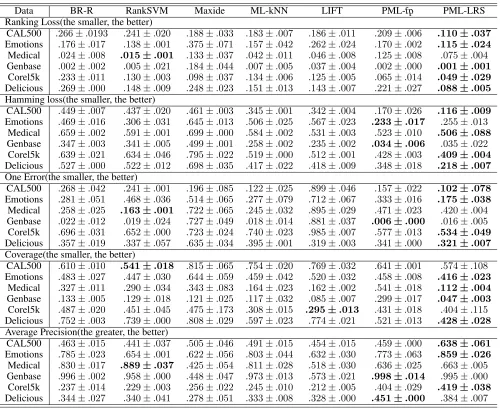
Table 2: Comparison of PML-LRS with state-of-the-art multi-label learning approaches on five evaluation criteria. The best performance is bolded.
Data BR-R RankSVM Maxide ML-kNN LIFT PML-fp PML-LRS
Ranking Loss(the smaller, the better)
CAL500 .266±.0193 .241±.020 .188±.033 .183±.007 .186±.011 .209±.006 .110±.037 Emotions .176±.017 .138±.001 .375±.071 .157±.042 .262±.024 .170±.002 .115±.024 Medical .024±.008 .015±.001 .133±.037 .042±.011 .046±.008 .125±.008 .075±.004
Genbase .002±.002 .005±.021 .184±.044 .007±.005 .037±.004 .002±.000 .001±.001 Corel5k .233±.011 .130±.003 .098±.037 .134±.006 .125±.005 .065±.014 .049±.029 Delicious .269±.000 .148±.009 .248±.023 .151±.013 .143±.007 .221±.027 .088±.005 Hamming loss(the smaller, the better)
CAL500 .449±.007 .437±.020 .461±.003 .345±.001 .342±.004 .170±.026 .116±.009 Emotions .469±.016 .306±.031 .645±.013 .506±.025 .567±.023 .233±.017 .255±.013
Medical .659±.002 .591±.001 .699±.000 .584±.002 .531±.003 .523±.010 .506±.088 Genbase .347±.003 .341±.005 .499±.001 .258±.002 .235±.002 .034±.006 .035±.022
Corel5k .639±.021 .634±.046 .795±.022 .519±.000 .512±.001 .428±.003 .409±.004 Delicious .527±.000 .522±.012 .698±.035 .417±.022 .418±.009 .348±.018 .218±.007 One Error(the smaller, the better)
CAL500 .268±.042 .241±.001 .196±.085 .122±.025 .899±.046 .157±.022 .102±.078 Emotions .281±.051 .468±.036 .514±.065 .277±.079 .712±.067 .333±.016 .175±.038 Medical .258±.025 .163±.001 .722±.065 .245±.032 .895±.029 .471±.023 .420±.004
Genbase .022±.012 .019±.024 .727±.049 .018±.014 .881±.037 .006±.000 .016±.005
Corel5k .696±.031 .652±.000 .723±.024 .740±.023 .985±.007 .577±.013 .534±.049 Delicious .357±.019 .337±.057 .635±.034 .395±.001 .319±.003 .341±.000 .321±.007 Coverage(the smaller, the better)
CAL500 .610±.010 .541±.018 .815±.065 .754±.020 .769±.032 .641±.001 .574±.108
Emotions .483±.027 .447±.030 .644±.059 .459±.042 .520±.032 .458±.008 .416±.023 Medical .327±.011 .290±.034 .343±.083 .164±.023 .162±.002 .541±.018 .112±.004 Genbase .133±.005 .129±.018 .121±.025 .117±.032 .085±.007 .299±.017 .047±.003 Corel5k .487±.020 .451±.045 .475±.173 .308±.015 .295±.013 .431±.018 .404±.115
Delicious .752±.003 .739±.000 .808±.029 .597±.023 .774±.021 .521±.013 .428±.028 Average Precision(the greater, the better)
CAL500 .463±.015 .441±.037 .505±.046 .491±.015 .454±.015 .459±.000 .638±.061 Emotions .785±.023 .654±.001 .622±.056 .803±.044 .632±.030 .773±.063 .859±.026 Medical .830±.017 .889±.037 .425±.054 .811±.028 .518±.030 .636±.025 .663±.005
Genbase .996±.002 .958±.000 .448±.047 .973±.013 .573±.021 .998±.014 .995±.000
(a) Ranking Loss (b) Hamming loss (c) One Error
(d) Coverage (e) Average Precision
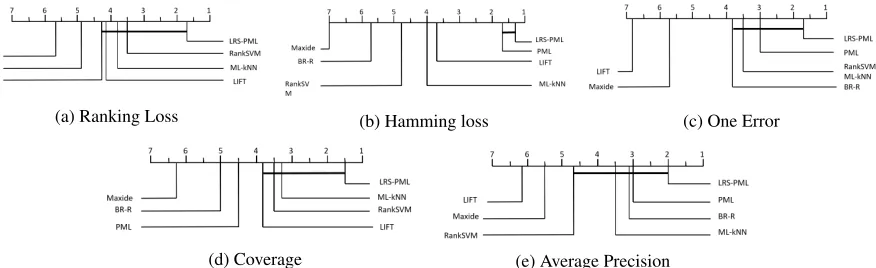
Figure 2: Comparison of PML-LRS (control algorithm) against six comparing algorithms with the Bonferroni-Dunn test. Al-gorithms not connected with PML-LRS in the CD diagram are considered to have a significantly different performance from the control algorithm (CD=3.2308 at 0.05 significance level).
for comparison. For the comparing algorithms, parameter configurations are adopted by the suggestions in the respec-tive literatures.
• Binary Reference Model based on RBF Kernel (BR-R) (Boutell et al. 2004). This is a first-order base-line approach which decomposes the multi-label learning problem into independent binary classification problems, whereas the label correlation is not taken into considera-tion.
• Ranking Support Vector Machine (RankSVM) (Elisseeff and Weston 2002). The basic idea of this algorithm is to adapt maximum margin strategy to deal with multi-label data, where a set of linear classifiers are optimized to min-imize the empirical ranking loss and enabled to handle nonlinear cases with kernel tricks.
• Matrix Completion using Side Information (Maxide)(Xu, Jin, and Zhou 2013). It is a matrix completion based ap-proach for transductive multi-label learning by exploiting side information matrices.
• Multi-Label k-Nearest Neighbor (ML-kNN) (Zhang and Zhou 2007). A nearest neighbor based multi-label classifi-cation method. The number of nearest neighbors is chosen by cross-validation. ML-kNN is a very popular baseline in the multi-label learning literature due to its simplicity. • Multi-Label Learning with Label Specific Features (LIFT)
(Zhang and Wu 2015). In contrast to existing multi-label learning methods which focus on exploiting label corre-lations, it tries to exploit label-specific features for multi-label learning.
• Partial Multi-Label Learning (PML-fp) (Xie and Huang 2018). It is a recently proposed partial multi-label learn-ing solution. It introduces confidence value to evaluate the probability of being the ground-truth label for each can-didate label, and alternatively optimize the classification model and the confidence values to solve the PML prob-lem. (Xie and Huang 2018) offers two options to further exploit either the local structure of the feature space or the label correlations. Here, we choose PML-fp as a compar-ison algorithm.
Table 3: Friedman statisticsFF in terms of each evaluation
metric and the critical value at 0.05 significance level ( # comparing algorithmsk= 7,#data sets N = 6).
Evaluation metric FF critical value
Ranking Loss 5.6779
Hamming Loss 2.5398
One Error 8.2020 2.4205
Coverage 4.7622
Average Precision 4.5459
To create partial multi-label assignments for the training data, for each sample xi, we randomly add the irrelevant
noisy labels ofxi witha% number of ground-truth labels,
and we vary the a% in the range{5%,10%,50%,100%}. To examine the performance of the proposed algorithm, we performed experiments with all possible percentages of the noisy labels. PML-LRS is compared with other methods on each data set with respect to each criterion. Statistical sig-nificance is examined with the Friedman test at 95% signifi-cance level. But considering the page limit, we cannot report all results with every possible percentage of the noisy labels. Instead, we report the detailed results for a more robust noisy label percentage, i.e., the number of irrelevant noisy labels is identical to the number of labeled relevant labels.
Performance Comparison
Table 2 reports the detailed experimental results of six com-paring algorithms, where the best performance among the comparing algorithms is shown in boldface. When compared with other methods, our algorithm shows significant supe-riority. Among the six compared multi-label approaches, PML-fp shows some superiority, and achieves the best per-formance of 3 criteria on genbase. RankSVM shows the best performance of 3 criteria onmedical.
Meanwhile, Friedman test (Demˇsar 2006) is used as the statistical test to analyze the relative performance among the comparing methods in this paper. Table 3 summarizes the Friedman statistics FF and the corresponding critical
10-3 10-2 10-1 100
0 0.1 0.2 0.3 0.4 0.5 0.6 0.7 0.8 0.9 1
Performance
One Error Coverage Averge Precision Ranking Loss Hamming Loss
(a) performance curve withγchanges
10-3 10-2 10-1 100
0 0.1 0.2 0.3 0.4 0.5 0.6 0.7 0.8 0.9 1
Performance
One Error Coverage Averge Precision Ranking Loss Hamming Loss
(b) performance curve withβchanges
10-3 10-2 10-1 100
0 0.1 0.2 0.3 0.4 0.5 0.6 0.7 0.8 0.9 1
Performance
One Error Coverage Averge Precision Ranking Loss Hamming Loss
(c) performance curve withηchanges
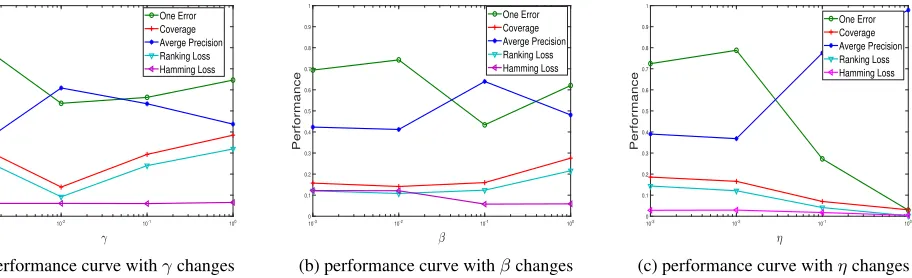
Figure 3: Results of PML-LRS with varying value of trade-off parameters.
the null hypothesis of indistinguishable performance among the comparing algorithms is rejected at the 0.05 significance level.
Therefore, the post-hoc Bonferroni-Dunn test (Demˇsar 2006) (Zhang, Zhong, and Zhang 2018) is employed to show the relative performance among the comparing algorithms. Here, PML-LRS is treated as the control algorithm whose average rank difference against the comparing algorithm is calibrated with the critical difference (CD). Accordingly, PML-LRS is deemed to have a significantly different per-formance to one comparing algorithm if their average ranks differ by at least one CD (CD=3.2308 in this paper:# com-paring algorithmsk= 7,#data sets N = 6). Figure 2 illus-trates the CD diagrams (Demˇsar 2006) on each evaluation metric, where the average rank of each comparing algorithm is marked along the axis (lower ranks to the right). In each subfigure, any comparing algorithms whose average rank is within one CD to that of PML-LRS is interconnected to each other with a thick line.
Overall, the following observations can be made based on the above experimental results:
• On six data sets (Table 2) across all evaluation metrics, PML-LRS ranks 1st in 66.7% cases and ranks 2nd in 16.7% cases.
• It is noteworthy that PML-LRS achieves optimal (lowest) average rank in terms of all evaluation metrics except av-erage precision. Furthermore, no algorithm significantly outperforms PML-LRS across all evaluation metrics.
• PML-LRS significantly outperforms Maxide and BR-R in terms of all evaluation metrics. PML-fpalso significantly outperforms other methods in the evaluation metrics of
hamming loss, one error, and average precisionon gen-baseanddelicious.
• One exception is on the data set medical, where RankSVM outperforms our methods over 3 criteria. This is probably because there are too few training examples to acquire the structure information.
• PML-LRS is comparable to PML-fpin terms ofhamming loss, one error, average precisionand significantly outper-forms PML-fp on all the other cases.
Parameter Analysis
At last, we study the influences of the three parameters,γ,
β andη for the proposed method on the medical data set. Our experiment is accomplished by using the grid search method which conducts the parameter analysis by varying three parameters simultaneously. The experimental results are shown in Figure 3 which are measured by the five eval-uation metrics. It can be seen that how the performance of our algorithm varies as these parameters change. Therefore we should safely set them in a wide range in practice. From this figure, we can notice that better performances are gained whenγ= 0.01,β= 0.1, andη= 1.
Conclusion
In this paper, we presented a novel approach to address the partial multi-label learning problem in a principled manner. The key to solve the partial multi-label learning problem is identifying the ground-truth labels from the redundant la-bel matrix. The proposed algorithm attempted to utilize the idea of low-rank and sparse decomposition to capture the ground-truth label matrix and irrelevant label matrix from the observed candidate label matrix while training the pdiction model simultaneously. Extensive experimental re-sults demonstrated that our approach is effective and out-performs other baseline methods on several data sets.
Acknowledgments
This work was supported in part by the National Natural Science Foundation of China (Nos. 61872032, 61673048, 61472028, 61502026, 61872035), in part by the Beijing Natural Science Foundation (No. 4162048), in part by the Fundamental Research Funds for the Central universities (2017JBZ108), and the Joint Research Fund for the Ministry of Education of China and China Mobile (MCM20170201).
References
Boutell, M.; Luo, J.; Shen, X.; and Brown, C. 2004. Learn-ing multi-label scene classification. Pattern Recognition
Bucak, S.; Jin, R.; and Jain, A. 2011. Multi-label learning with incomplete class assignments. InIEEE Conference on Computer Vision and Pattern Recognition, 2801–2808. Cabral, R. S.; Torre, F.; Costeira, J.; and Bernardino, A. 2011. Matrix completion for multi-label image classifica-tion. In Advances in Neural Information Processing Sys-tems, 190–198.
Cai, J.and Cand`es, E., and Shen, Z. 2010. A singular value thresholding algorithm for matrix completion. SIAM Jour-nal on Optimization20(4):1956–1982.
Chen, G.; Song, Y.; Wang, F.; and Zhang, C. 2008. Semi-supervised multi-label learning by solving a sylvester equa-tion. InSIAM International Conference on Data Mining,, 410–419.
Cour, T.; Sapp, B.; and Taskar, B. 2011. Learning from partial labels. Journal of Machine Learning Research
12(5):1501–1536.
Demˇsar, J. 2006. Statistical comparisons of classifiers over multiple data sets. Journal of Machine Learning Research
7(1):1–30.
Elisseeff, A., and Weston, J. 2002. A kernel method for multi-labelled classification. InAdvances in Neural Infor-mation Processing Systems, 681–687.
F¨urnkranz, J.; H¨ullermeier, E.; Menc´ıa, E.; and Brinker, K. 2008. Multilabel classification via calibrated label ranking.
Machine learning73(2):133–153.
Goldberg, A.; Recht, B.; Xu, J.; Nowak, R.; and Zhu, X. 2010. Transduction with matrix completion: Three birds with one stone. In Advances in Neural Information Pro-cessing Systems, 757–765.
Gopal, S., and Yang, Y. 2010. Multilabel classification with meta-level features. InACM SIGIR Conference on Research and Development in Information Retrieval, 315–322.
Ji, S.; Tang, L.; Yu, S.; and Ye, J. 2010. A shared-subspace learning framework for multi-label classification. ACM Transactions on Knowledge Discovery from Data4(2):1–29.
Lin, Z.; Liu, R.; and Su, Z. 2011. Linearized alternating direction method with adaptive penalty for low-rank repre-sentation. In Advances in Neural Information Processing Systems, 612–620.
Liu, L., and Dietterich, T. 2012. A conditional multinomial mixture model for superset label learning. InAdvances in Neural Information Processing Systems, 548–556.
Liu, G.; Lin, Z.; and Yu, Y. 2010. Robust subspace segmen-tation by low-rank represensegmen-tation. InInternational Confer-ence on Machine Learning, 663–670.
Sanden, C., and Zhang, J. 2011. Enhancing multi-label music genre classification through ensemble techniques. In
ACM SIGIR Conference on Research and Development in Information Retrieval, 705–714.
Sun, Y.; Zhang, Y.; and Zhou, Z. 2010. Multi-label learning with weak label. InAAAI Conference on Artificial Intelli-gence, 593–598.
Tang, L.; Rajan, S.; and Narayanan, V. 2009. Large scale
multi-label classification via metalabeler. InInternational Conference on World Wide Web, 211–220.
Tsoumakas, G.; Katakis, I.; and Vlahavas, I. 2011. Random k-labelsets for multilabel classification. IEEE Transactions on Knowledge and Data Engineering23(7):1079–1089. Vasisht, D.; Damianou, A.; Varma, M.; and Kapoor, A. 2014. Active learning for sparse bayesian multilabel classifi-cation. InSIGKDD International Conference on Knowledge Discovery and Data Mining, 472–481.
Wu, B.; Liu, Z.; Wang, S.; Hu, B.; and Ji, Q. 2014. Multi-label learning with missing Multi-labels. InInternational Confer-ence on Pattern Recognition, 1964–1968.
Wu, F.; Wang, Z.; Zhang, Z.; Yang, Y.; Luo, J.; Zhu, W.; and Zhuang, Y. 2015. Weakly semi-supervised deep learning for multi-label image annotation.IEEE Transactions on Big Data1(3):109–122.
Xie, M., and Huang, S. 2018. Partial multi-label learning. InAAAI Conference on Artificial Intelligence, 4303–4309. Xu, M.; Jin, R.; and Zhou, Z. 2013. Speedup matrix comple-tion with side informacomple-tion: Applicacomple-tion to multi-label learn-ing. InAdvances in Neural Information Processing Systems, 2301–2309.
Xu, C.; Tao, D.; and Xu, . 2016. Robust extreme multi-label learning. InSIGKDD International Conference on Knowl-edge Discovery and Data Mining, 1275–1284.
Zhang, M., and Wu, L. 2015. Lift: Multi-label learning with label-specific features. IEEE Transactions on Pattern Analysis and Machine Intelligence37(1):107–120.
Zhang, M., and Yu, F. 2015. Solving the partial label learn-ing problem: An instance-based approach. InInternational Joint Conference on Artificial Intelligence, 4048–4054. Zhang, M., and Zhou, Z. 2007. Ml-knn: A lazy learn-ing approach to multi-label learnlearn-ing. Pattern Recognition
40(7):2038–2048.
Zhang, M., and Zhou, Z. 2014. A review on multi-label learning algorithms. IEEE Transactions on Knowledge and Data Engineering26(8):1819–1837.
Zhang, X.; Ma, Y.; Lin, Z.; Gao, H.; Zhuang, L.; and Yu, N. 2012. Non-negative low rank and sparse graph for semi-supervised learning. InIEEE Conference on Computer Vi-sion and Pattern Recognition, 2328–2335.
Zhang, Y.; Shi, D.; Gao, J.; and Cheng, D. 2017. Low-rank-sparse subspace representation for robust regression. In
IEEE Conference on Computer Vision and Pattern Recogni-tion, 7445–7454.
Zhang, M.; Yu, F.; and Tang, C. 2017. Disambiguation-free partial label learning.IEEE Transactions on Knowledge and Data Engineering29(10):2155–2167.
Zhang, Q.; Zhong, Y.; and Zhang, M. 2018. Feature-induced labeling information enrichment for multi-label learning. In