AFS: An Attention-Based Mechanism for Supervised Feature Selection
Ning Gui,
1Danni Ge,
2Ziyin Hu
21
School of Software, Central South University, China, [email protected]
2
School of Informatics, Zhejiang Sci-Tech University, China, [email protected], [email protected]
Abstract
As an effective data preprocessing step, feature selection has shown its effectiveness to prepare high-dimensional da-ta for many machine learning da-tasks. The proliferation of high di-mension and huge volume big data, however, has brought major challenges, e.g. computation complexity and stability on noisy data, upon existing feature-selection tech-niques. This paper introduces a novel neural network-based feature selection architecture, dubbed Attention-based Fea-ture Selec-tion (AFS). AFS consists of two detachable mod-ules: an at-tention module for feature weight generation and a learning module for the problem modeling. The attention module for-mulates correlation problem among features and supervision target into a binary classification problem, sup-ported by a shallow attention net for each feature. Feature weights are generated based on the distribution of respective feature selec-tion patterns adjusted by backpropagation dur-ing the traindur-ing process. The detachable structure allows ex-isting off-the-shelf models to be directly reused, which al-lows for much less training time, demands for the training data and requirements for expertise. A hybrid initialization method is also introduced to boost the selection accuracy for datasets without enough samples for feature weight genera-tion. Experimental results show that AFS achieves the best accuracy and stability in comparison to several state-of-art feature selection algorithms upon both MNIST, noisy MNIST and several datasets with small samples.
Introduction
With the rapid advancement of Internet of Things and in-dustrial automation systems, enterprises and industries are collecting and accumulating data with unparalleled speed and volume (Yin et al. 2014). The large amount of data makes the data-driven modeling approach in many do-mains desirable with the automatic knowledge discovery. In order to extract useful information from huge amounts of otherwise meaningless data, one important machine-learning technique is feature selection (FS), which directly applies a subset of relevant features for the learning tasks. Those irrelevant, redundant and noisy features in respect to
Copyright © 2019, Association for the Advancement of Artificial Intelli-gence (www.aaai.org). All rights reserved.
the supervision target are ignored. The simplified feature set often results in a more accurate model which is much easier to understand. Many different methods have been proposed and effectively used for various tasks.
In the era of big data, however, most off-the-shelf fea-ture selection methods suffer major problems: varying from the computation scalability to the stability. For in-stance, many existing algorithms demand the whole dataset loaded into the memory before calculation, which becomes infeasible when data scales to terabytes. Furthermore, those datasets normally contain a lot of noisy/outlier sam-ples. It is observed that many well-known feature selection algorithms suffer from the low stability problem after small data perturbation is introduced in the training set (Alelyani et al. 2011). Our experience on one industrial dataset with 16K features and 6M records validates this conclusion as many existing solutions are incapable, slow or unstable upon this set. As pointed out in their review paper(Bolón-Canedo et al. 2015): “it is evident that feature selection researchers need to adapt challenges posed by the explo-sion of big data.”
features and supervision target into a binary classification problem, supported by a shallow attention net for each fea-ture. This architecture is able to generate attention weights for both classification and regression feature selection problems. The main contributions of our work are as fol-lows.
A novel attention-based supervised feature selection architecture: the architecture consists of an attention-based feature weight generation module and a learning module. The detachable design allows different modules to be individually trained or initialized.
An attention-based feature weight generation mech-anism: this mechanism innovatively formulates the fea-ture weight generation problem into a feafea-ture selection pattern problem solvable with attention mechanism.
A model reuse mechanism for computation optimiza-tion: is proposed that can directly reuse existing models to effectively reduce the computation complexity in generating feature weights.
A hybrid initialization method for small datasets: is proposed to integrate existing feature selection methods for weight initialization. This design extends AFS’s us-age to small datasets in which AFS might not have enough data for feature weight generation.
A set of experiments are designed on both Large-dimensionality Small-instance dataset (denoted as L/S da-taset) and Medium/large-dimensionality Large-instance dataset (short for M/L dataset). The highest feature selec-tion accuracy and moderate computaselec-tion overhead, com-pared with existing baseline algorithms, have been ob-served on both the MNIST dataset and the challenging noisy MNIST (n-MNIST). The proposed model reuse mechanism can compute the attention weights about 10 times faster with similar accuracy. The hybrid initiation method can also boost the classification accuracy from 1.09% to 6.61% upon the Relief and Fisher Score methods on two tested L/S datasets. To the best of our knowledge, AFS is the first attention-based neural network solution for general supervised feature selection tasks.
Related Work
This section first reviews the state-of-the-art supervised feature selection works. Then researches in the attention mechanism domain are illustrated.
Feature Selection methods
The supervised feature selection methods are normally categorized as wrapper, filter, and embedded methods (Bengio et al. 2003; Gui et al. 2017).
The wrapper methods rely on the predictive accuracy of a predefined learning algorithm to evaluate the quality of
selected features. They generally suffer the problem of high computation complexity (Tang et al. 2014). The filter methods separate feature selection from learning algo-rithms and only rely on the measures of the general charac-teristics of the training data to evaluate the feature weights. Different feature selection algorithms exploit various types of criteria to define the relevance of features: e.g. similari-ty-based methods, e.g. SPEC (Zhao and Liu, 2007) and Fisher score (Duda et al. 2012), feature discriminative ca-pability, e.g. ReliefF (Robnik-Šikonja and Kononenko, 2003), information-theory based methods, e.g. mRmR (Peng et al. 2005) and statistics-based methods ,e.g. T-Score (Shumway, 1987). The embedded methods depend on the interactions with the learning algorithm and evaluate feature sets according to the interactions. Normally, appro-priate regularizations are added to make the certain feature weights as small as possible to facilitate convergence, e.g. FS with l2,1-Norm (Liu et al. 2009).
In order to handle the computation complexity of big da-ta, limited deep-neural-network based methods have been proposed. Li et al. (2015) proposed a deep feature selection (DFS) by adding a sparse one-to-one linear layer. As the network weights are directly used as the feature weights, it cannot handle situations where inputs have outliers or noise. Towards this end, Roy et al. (2015) use the activa-tion potentials contributed by each of the individual input dimensions, as the metric for feature selection. However, this work relies on the specific DNN structure and the ReLU activation function which might not be so suitable in many learning tasks.
Recent trends of feature selection methods are more fo-cused on data with specific structures, e.g. distributive fairness (Grgic-Hlaca et al. 2018), multi-source data (Liu et al. 2016) or streaming data (Zhang et al. 2015). However, we argued, their work still largely relies on the advances of feature selection methods on conventional data.
Attention in Neural Network
The attention mechanism is a method that takes arguments, and a context and returns a vector supposed to be the summary of the arguments, focusing on information linked to the context. It has been successfully used first in visual image domain and then extended to various fields, e.g. language translation and audio processing tasks. Normally, the attention-based methods are applied to data with specif-ic structures, e.g. spatial, temporal or mixture of spatial and temporal structures.
it is possible to regress salient regions with a CNN. Jader-berg et al. (2015) proposed the spatial transformer net-works by using bilinear interpolation to smoothly crop the activations in each region. In order to acquire POI in the image, Laskar et al. (2017) maintain all features within the salient region but weakens the values of the background region.
For inputs with a temporal structure (i.e. language, vid-eo), the attention mechanism is used to obtain the relation-ship between current inputs and previous inputs, by Recur-rent Neural Networks such as RNN or LSTM. For example, Yao et al. (2015) use the LSTM to extract latent represen-tation of video. Ma et al. (2017) use the RNN to encode the Patient HER data which consist of sequences of visits over time. One peculiar trait of temporal data is the correlations can be furthered divided into two levels: local attention for localized correlation and global attention for more remote correlation. In order to integrate different correlation, the hierarchical structure is adopted (Tong et al. 2017).
Those above discussed researches normally provide do-main-specific attention-based solutions for data with a cer-tain structure. However, in many feature selection tasks, the data structure is not so obvious or is hard to obtain. In this paper, we focus on the feature selection for conven-tional data without any pre-knowledge.
AFS Architecture
In this section, the overall architecture of AFS is illustrated and analyzed. Two extensions, namely the model reuse mechanism and the hybrid initialization are introduced.
Notation
This paper presents matrix as uppercase character (e.g. A), and vector as lowercase (e.g. a). For example, a dataset is presented by a matrix { } , where is the number of samples, and
is the number of features. is used to denote the trans-pose of matrix . Each sample is denoted by a column vec-tor , each feature is denoted by row vector ,andthe k-th feature of is denoted by . is associated with the label . For multi-class task, presents the label belongs to j-th class.
Architectural design
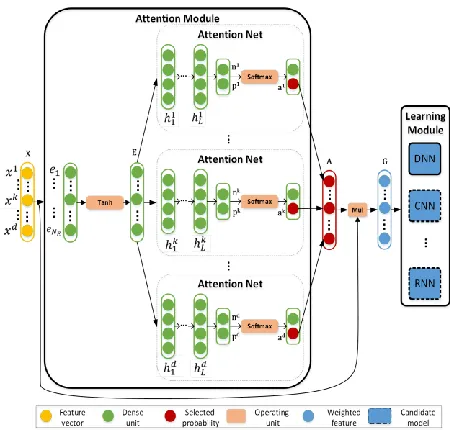
Similar to the embedded methods, our proposed AFS ar-chitecture embeds feature selection with learner construc-tion process. As shown in the Figure1, AFS consists of two major modules, namely, the attention module and the
learning module. The attention module is on the upper part of AFS and is responsible for computing the weights for all features. As shown in this figure, the attention ule is the core of the whole framework. The learning
mod-ule aims to find the optimal correlation between the weighted features and the supervision target by solving the optimization problem. It connects the supervision target and features by the back propagation mechanism, and con-tinuously corrects the feature weights during the training process. The attention module and the learning module, together build the correlation that best describes the degree of relevance of the target and features.
AFS is designed with a loosely coupled structure. Both the attention module and the learning module can be indi-vidually customized to match a specific task, especially for the learning module. Currently, deep learning communities have generated thousands of off-the-shelf models which can be directly reused by AFS as the learning module. The parameters of the attention module can then be generated with much lower computation overhead. In addition, for L/S datasets, AFS might not have enough samples to train the network. In order to solve this problem, a hybrid initial-ization method is proposed which uses existing feature selection algorithms to initialize the weights of the atten-tion module.
Attention Module
In order to represent the correlation between the features and the supervision target, we convert the correlation prob-lem into a binary classification probprob-lem: for a specific su-pervision label, whether a feature should be selected. Then, the feature weights are generated according to the distribu-tion of the feature selecdistribu-tion pattern.
Firstly, a dense network is used to extract the intrinsic relationship (denoted as ) among the raw input and eliminate certain noise or outliers.
(1) Figure 1. The detachable architecture of AFS, with an attention
where and are the parameters to be learned. The introduced dense network compresses the original feature domain into a vector with a smaller size (adjustable according to specific problems), while keeps the major part of the information. As the size of is nor-mally much smaller than the size of features, certain re-dundant features will be discarded during this process. The design also reduces impacts from individual noises. The units of the dense neural network could be adjusted according to respective tasks. Here, the dense network is chosen as no structural assumption of the inputs are made. For structural data, it can be replaced with other types of neural networks. The nonlinear function is adopt-ed as it retains both positive and negative values. There-fore, it can preserves important information during the ex-traction of .
Secondly, by using the extracted as input, each feature is assigned with a shallow neural network to determine its probability of selection, namely attention net. In this net, we do not directly use the typical soft attention mech-anism in which softmax action is used to generate weighted arithmetic mean of all the feature values. This action will result in relatively small weights for most fea-tures, and only a very small number of features with rela-tively large weights. It is good for feature division while suffers the loss of details on the whole feature sets. Fur-thermore, when there are outliers or noise in the data, some extraneous features might also erroneously be given a cer-tain big weight.
In this paper, a different soft-attention mechanism is proposed. Due to the binary classification (se-lect/unselected), each attention unit in the attention layer generate two values: for the k-th feature, represent selected/unselected values respectively, calculated with Eq. (2) and (3):
(2) (3) where is the output of -th hidden layer in the k-th at-tention net. are the parameters of and are the parameters of to be learned. Due to the fact that and might be quite close. The softmax is then used to generate differentiable results to statistically boost the dif-ference between selection and un-selection, with each pos-sibility is in the range (0, 1).Here, we only focus on as it generates the probability of being selected as attention feature as follows:
( ) (4)
Those shallow attention nets generate attention trix { } .According to the attention matrix, the weight of k-th feature is calcu-lated with ∑ . Note that the parameters of attention module are summarized as .
Discussion: Compared with the embedded feature selec-tion method, the attenselec-tion module has more obvious ad-vantages: 1) the feature weights are generated by the fea-ture selection pattern, produced via separated attention networks, rather than coefficient values adjusted only by backpropagation. The intrinsic relationship between the features can be more comprehensively considered by the neural network ; 2) the feature weights are always limited to a value between 0 and 1, which can accelerate training convergence. Furthermore, the softmax design is a fully differentiable deterministic mechanism that is easy to train with backpropagation. 3) redundant features are removed with the joined work from both E and the learning module. Due to the smaller size of E certain information of redun-dant features will be discarded. Then, the attention net cor-responding those discarded features might not have enough information and generates a low feature weight for these features. Thereby, the output of the redundant features can be further suppressed. Of course, which redundant features are to discard is highly random.
Learning module
By using the pair-wised multiplication to contact the feature vectors and , we obtain the weighted features as follows:
(5) The process of constantly adjusting the A is equivalent to making a trade-off between selecting and un-selecting. In order to generate an attention matrix , the learning module runs with backpropagation by solving the objection function as follows:
[ ( ) ] (6) where 〈 〉 and R(∙) is often an L2-norm that helps to speed up the optimization process and prevent overfit-ting. Here, λ controls the strength of regularization. The loss function depends on the type of prediction tasks. For classification tasks, the cross entropy loss functions are usually used. For regression tasks, the mean-square error (MSE) is normally used. Note that is a neural net-work with parameters .
For a specific learning problem, AFS can use a network structure that best fits for the particular task. Currently supported network structures include: e.g. deep neural networks (DNN), convolutional neural networks (CNN), and Recurrent Neural Network (RNN).
Learning model reuse mechanism
Using the trained model, the saved model weights are in-itialized to the model parameters portion of AFS, called
AFS-R. Since the parameters in the learning module are already converged, only a few tunes are needed. There are 2 ways to train the AFS-R: fine-tuning the both attention module and learning module (denoted as AFS-R-GlobalTune) or fixing the learning module and only train the attention module (denoted as AFS-R-LocalTune). The first way is to train the attention module and the learning module at the same time. The second way is to fix the learning module and only train the attention module.
A hybrid initialization method
Since the AFS benchmark trainer is a neural network, its performance highly depends on the number of samples in the dataset. Thus, a small number of samples might not be able to generate enough propagation to tune the whole neural network. In order to extend the usability of AFS on small datasets, a hybrid initialization method is proposed by reusing certain feature selection method’s results as the initial feature weights.
This hybrid initialization method can be divided into three major steps: 1) Generating the feature weights with a certain feature method. Since it might have value ranges other than the possibility range [0,1], Min-Max normalization is used to normalize ; 2) Pre-training the attention module. In this step, each sample is tagged with
instead of the original label. We only train the
atten-tion module using the constructed dataset. Note that the objective function of this part is Eq. (7). To optimize the objective function, we employ adaptive moment estimation (Adam) for optimizing the attention module; 3) Training the AFS with the normal training process. Note that in this process, the objective function of this part is Eq. (6) instead of Eq. (7).
The second step in this algorithm is a regression task which aims to initialize the attention matrix to match
.Therefore, the objective function adopts the MSE as
loss function as follows:
∑ ( ) (7)
Experiments
In this section, we will conduct experiments to answer the following research questions:
Q1 Does AFS1 outperform state-of-the-art feature se-lection methods?
Q2 How much computational complexity can be re-duced by reusing existing models?
Q3 How to use the existing feature selection method
1 Source code at https://github.com/upup123/AAAI-2019-AFS.
combined with AFS to improve the feature selection performance upon L/S datasets?
Experiment Settings
Datasets. The datasets used for experiments are summa-rized in Table 1. The MNIST dataset2 consists of grey-scale thumbnails, 28 x 28 pixels, of handwritten digits 0 to 9. The n-MNIST dataset3 consists of three MNIST variants with: 1) white Gaussian noise (denoted as n-MNIST-AWGN); 2) motion blur (denoted as n-MNIST-MB); 3) a combination of additive reduced contrast and white Gauss-ian noise (denoted as n-MNIST-RCAWGN). These da-tasets are selected due to the facts that MNIST has been intensively investigated and the n-MNIST dataset provides a good foundation for feature selection stability evaluation. The Lung_discrete and Isolet4 are L/S datasets.
Evaluation Protocols: The feature weights are obtained through the training data, and then they are sorted, and a certain number of features are selected as a feature subset in descending order. The accuracy of the feature subset on the test set is used as the performance metric. For L/S da-tasets, 3 times 3 fold cross-validation is adopted to provide a fair comparison.
Baselines. After the evaluation of the computational cost of existing feature selection methods on M/L datasets. RFS (Robust Feature Selection) (Nieet al. 2010) and Trace ratio criterion (Nie et al. 2008) are discarded as their execution time on MNIST exceeds15 hours. The performance of AFS is compared with the following feature selection methods. Unless explicitly stated, implementations of those algo-rithms are from the scikit-feature selection repositoryError!
Bookmark not defined..
Filter-Based Methods:
Fisher Score (He et al. 2006) selects features according to their similarities.
ReliefF(Kononenko, 1994) selects features by finding the near-hit and near-miss instances using the l1-norm.
Embedded methods:
FS_l21 (Feature selection with l2,1-norm) (Liu et al.
2009) uses l2,1-norm regularization which is convex similarly to l1-norm regularization.
RF (Random Forest), a tree-based feature selection method provided by scikit-learn package.
2 http://yann.lecun.com/exdb/mnist/ 3 http://csc.lsu.edu/~saikat/n-mnist/ 4 http://featureselection.asu.edu
Datasets Type Classes Samples Features
MNIST M/L 10 70000 784
n-MNIST-AWGN M/L 10 70000 784
n-MNIST-MB M/L 10 70000 784
n-MNIST-RCAWGN M/L 10 70000 784
Lung_discrete L/S 7 73 325
Isolet L/S 26 1560 617
Roy et al. (2015): a DNN-based feature selection meth-od, reproduced according to the paper.
Parameter Settings. Model parameters are initialized with truncated normal distribution with a mean of 0 and stand-ard deviation of 0.1. The model is optimized by Adam, with batch size 100. The weight of regularizer is 0.0001. For the solution of AFS and Roy, the training step is both set to 3000 as they both begin to converge.
Experiments on MNIST variants (Q1)
In order to have a fair comparison towards MNIST and its variants, the performance of major stream of classifiers are tested, with respect to the modeling accuracy.
Classifier Selection
Five different classifiers are tested: Decision Tree (DT), Gaussian Naïve Bayes (GNB), Random forest (RF), linear Support Vector Machine (SVM) and Neural Network (NN, here one hidden layer with 500 neurons is used). The re-sults are shown in Figure 3. As SVM needs more than 2 hours for one round of experiment, its results are discard-ed. As shown in this figure, NN achieve the best modeling accuracy in all four datasets. NN achieves about 98% max-imum modeling accuracy in the MNIST, much better than others. It also has the most stable performance. For all four datasets, NN achieves more than 94% maximum accuracy.
Figure 3: Comparisons among different classifiers
In contrast, RF achieves goods results in the MNIST and n-MNIST-MB datasets while comparably poor results in the other two. Furthermore, GNB reaches max accuracy when K is 155 rather than around 295 in MNIST. Those classifi-ers are incapable for fair comparisons. Thus, NN is chosen as the default classifier and the comparisons of accuracy are based on the modeling results of the NN classifier.
Experiment Results
The feature weights from different methods are sorted ac-cording to the numerical value (including positive and
a) MNIST b) n-MNIST-AWGN
c) n-MNIST-MB
d) n-MNIST-RCAWGN
negative values, wherein negative values do not indicate negative correlation), respectively select the first K features after sorting, put them into the benchmark classifier, and fit with train data. For all these methods, we report the aver-age results in terms of classification accuracy.
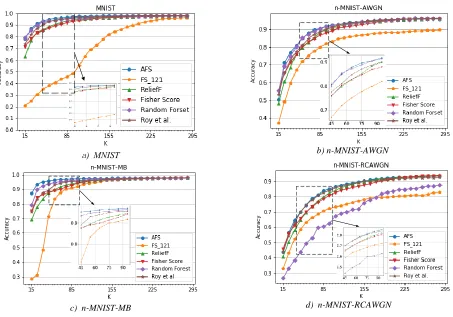
Figure 2 shows the modeling accuracy from different feature selection methods, with respect to MNIST and its variants. From both Figure 2 and Table 2, we can observe that:
1) AFS achieves the best accuracy on all four datasets and on almost all feature selection ranges. It significantly outperforms the compared methods. As shown in Table 2, AFS archives about to 3%~9% absolute accuracy improvements towards Fisher score and ReliefF meth-ods. For the RF and Roy et al. solutions, AFS still maintains clear advantages over MNIST, AWGN and MB. For the n-MNIST-RCAWGN dataset, Roy et al. and AFS achieve com-parative similar performance, with AFS leading Roy method for about 0.8%.
2) AFS achieves the best feature selection stability with respect to different types of noise. As shown in both Figure 2b, 2c and 2d, no matter what kind of noise is in-troduced, AFS exhibits almost consistent good perfor-mance. The solution of Roy achieves good average ac-curacy on the n-MNIST-RCAWGN dataset, while not as good performance on the other three datasets. The same happens to the RF method, which is quite sensi-tive to the reduced contrast noise and suffers almost the lowest accuracy on the n-MNIST-RCAWGN dataset. The two well-accepted ReliefF and Fisher Score have comparably stable performance. However, their accura-cy is not so well.
3) As shown in Table 2, AFS outperforms other five methods significantly when the number of selected fea-tures is within the range of 15 to 85. This result shows that AFS has the most accurate feature weight ordering which is an important advantage for many modeling processes.
Feature weight Visualization
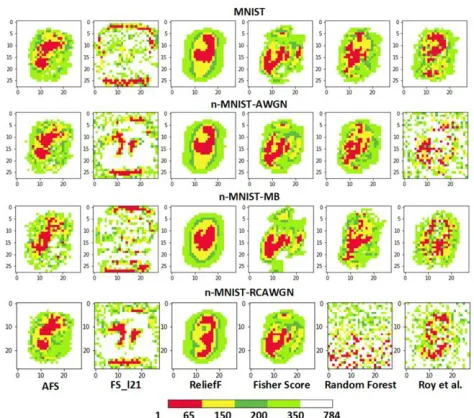
In order to further explore the reason why different meth-ods display significant performance variations, the distri-bution map of the top selected features towards MNIST and its variants are shown in Figure 4.
Figure 4 shows that many top65 features selected by FS-121 are on the edge of the image, while the handwritten digits are almost located in the center. It explains the poor performance of FS-121. For the RF and Roy, they display totally different feature distribution patterns towards differ-ent datasets. It shows that they are to some extdiffer-ent impacted by the introduced noise. RF responses poorly to the re-duced contrast noise. Roy fails to capture the features in the lower part of images in the MNIST dataset which is important for many handwritten digits, e.g. 5, 6, 8. It ex-plains Roy’s poor performance on MNIST dataset. The
relatively stable Fisher score and ReliefF, like the AFS method, focus on the central area of the image. As the fea-ture selection scale increases, from top65 to top350, the selected area of the image gradually from top65 to top350, the selected area of the image gradually expands to the periphery. The TOP65 feature selection area of AFS is divided into two areas, which accurately represents the structure of handwritten digits. Meanwhile, the distribution of TOP65 of ReliefF and Fisher are too concentrated to identify most important features.
Methods MNIST
n-MNIST-AWGN n-
MNIST-MB
n-MNIST-RCAWGN
AFS 91.65
34.81 84.28 84.65 90.54 88.83
79.00 94.78 69.08
FS_l21 64.64 66.34 56.90
ReliefF 73.60 85.67 64.24
Fisher Score 75.19 87.02 65.76
RF 78.86 91.99 45.53
Roy et al. 76.29 88.91 68.28
Table 2. Average Accuracy (top15~top85 features), methods have the most significant accuracy improvement within this range
Computational complexity
In Table 3, the computation overheads of different feature selection methods are illustrated.
Methods MNIST
n-MNIST-AWGN
n-MNIST-MB
n-MNIST-RCAWGN
AFS(3000) 218 201 190 199
FS_121 491 25 68 27
ReliefF 8557 7867 8159 7927
Fisher Score 586 509 517 527
RF 8 23 14 23
Roy et al. 10 11 11 12
Table 3. Comparisons of the computation overhead (seconds) Figure 4. Feature distribution map of five FS methods: dots with
The overhead is measured with the execution time for the feature weight generation process. Results show that AFS has moderate computation complexity. For the train-ing with 3000 steps, it takes about 190 to 218s for the fea-ture weight generation. The statistics-based methods, Fisher Score and ReliefF suffer the high computation cost. However, they are by no means the worst algorithms in terms of computation overhead as several algorithms, e.g. RFS and trace-ratio fail to calculate results on this dataset within 15 hours. RF and Roy et al methods have very low computation overheads as they are embedded solutions and have fewer parameters to be tuned than AFS.
Model reuse (Q2)
To evaluate the contribution of reusing existing models to reduce computation complexity, we directly use a DNN model that archives 98.4% classification accuracy on the MNIST test set (with 30000 training steps and 84s training time) as the learning model. Both AFS-R-GlobalTune and AFS-R-LocalTune strategies are tested.
Methods steps Times(s) Top K features selected K=25 K=35 K=65 K=95 AFS 3000 218 87.05 90.91 95.84 97.06
AFS-R-GlobalTune
10 21 63.68 73.03 89.01 92.94 40 25 82.09 88.02 94.50 95.76
AFS-R-LocalTune 10 40 19 23 72.33 76.59 81.52 93.37 94.89 85.21 91.17 95.40
Table 4 Accuracy of reuse strategies, K is feature selected.
As seen in Table 4, when the tuning step is small (e.g. 10), the AFS-R-LocalTune solution normally achieves better accuracy than the AFS-R-GlobalTune as it has much fewer parameters to be tuned. When the tuning step in-creases, AFS-R-GlobalTune gradually achieves better ac-curacy. After 40 steps, it outpaces the AFS-R-LocalTune solution with much higher accuracy in all compared fea-tures sets, as the reused model has been better trained. Its results are quite close to those of AFS (3000) . However, the computation overhead of AFS-R-GlobalTune-40 is about 25s, about 11.5% used by AFS (3000). For the same step, the global tune takes a little more time than the local tune solution as it has more parameters to be tuned.
Performance on L/S datasets (Q3)
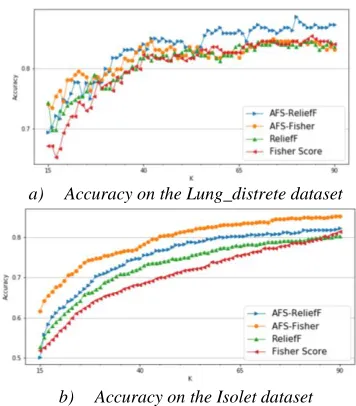
According to the hybrid initialization method, Fisher score and ReliefF are used as the base for initialization. These extended AFS are denoted as Fisher and AFS-ReliefF. Figure 5a and 5b show the experimental results on two L/S datasets. The SVM-linear classifier, with normally good performance on L/S datasets, is adopted.
As shown in Figure 5a, in Lung_discrete, AFS-Fisher achieves 81.81% average accuracy, 1.09% above its peer. AFS-ReliefF achieves 83.17% average accuracy, 1.73% above ReliefF. In Isolet, as shown in Figure 5b, AFS-ReliefF achieves 75.51% average accuracy, about 1.77% accuracy improvement than ReliefF. AFS-Fisher achieves the
a) Accuracy on the Lung_distrete dataset
b) Accuracy on the Isolet dataset
Figure 5. Accuracy with(out) the hybrid initialization meth-ods, SVM-linear as classifier
highest average accuracy 79.38%, well above other solu-tions. It shows that the hybrid initialization method can significantly improve existing feature selection algo-rithms’ accuracy. Furthermore, one observation is that a higher sample/feature ratio might help the hybrid initiali-zation method to achieve a higher performance improve-ment, as the case on Isolet v.s. Lung_discrete.
Conclusion
In this paper, a novel feature selection architecture is intro-duced that extends the attention mechanism to the general feature selection tasks. Specifically, by formulating the feature selection problem into a binary classification prob-lem for each feature, we are able to identify each feature’ weight according to its feature selection pattern. This ar-chitecture is designed to be detachable and allow either the attention module or the learning module to be trained indi-vidually. Thus, the reuse of learning model and the hybrid initialization become possible. Experiment results show that AFS can achieve the best feature selection accuracy on several different datasets. Results also demonstrate that AFS achieves the best feature selection stability in re-sponse to several different noises introduced in the n-MNIST variants. In future work, we aim to develop more domain-optimized solutions for specific structural data. We are also working on the structure optimization to reduce its computation cost on ultra-high dimensional datasets.
Acknowledgments
References
Alelyani, S.; Liu, H.; and Wang, L. 2011. The effect of the characteristics of the dataset on the selection stability. In: 2011 23rd IEEE International Conference on Tools with Artificial Intelligence. IEEE: pp: 970-977.
Bengio Y.; Delalleau O.; Le Roux N.; Paiement JF.; Vincent P.; Ouimet M. 2006. Spectral Dimensionality Reduction. In: Guyon I., Nikravesh M., Gunn S., Zadeh L.A. (eds) Feature Extraction. Studies in Fuzziness and Soft Computing, vol 207. Springer, Berlin, Heidelberg
Bolón-Canedo, V.; Sánchez-Maroño, N.; and Alonso-Betanzos, A. 2015. Recent advances and emerging challenges of feature selection in the context of big data. Knowledge-Based Systems, 86: 33-45.
Duda, R.O.; P.E. Hart; and D.G. Stork., 2012. Pattern classification. John Wiley & Sons.
Erhan, D.; Szegedy, C.; Toshev, A.; and Anguelov, D. 2014. Scalable object detection using deep neural networks. In: Proceedings of the IEEE Conference on Computer Vision and Pattern Recognition. pp: 2147-2154.
Girshick, R.; Donahue, J.; Darrell, T.; and Malik, J. 2014. Rich feature hierarchies for accurate object detection and semantic segmentation. In: Proceedings of the IEEE conference on computer vision and pattern recognition. pp: 580-587.
Grgić-Hlača, N.; Zafar, M. B.; Gummadi, K. P.; and Weller, A. 2018. Beyond distributive fairness in algorithmic decision making: Feature selection for procedurally fair learning. In: Proceedings of the Thirty-Second AAAI Conference on Artificial Intelligence, New Orleans, Louisiana, USA.
Gui, J.; Sun, Z.; Ji, S.; Tao, D.; and Tan, T. 2017. Feature selection based on structured sparsity: A comprehensive study. IEEE transactions on neural networks and learning systems, 28(7): 1490-1507.
He, X.; Cai, D.; and Niyogi, P. 2006. Laplacian score for feature selection. In: Advances in neural information processing systems. pp: 507-514.
Jaderberg, M.; Simonyan, K.; and Zisserman, A. 2015. Spatial transformer networks. In: Advances in neural information processing systems. pp: 2017-2025.
Kononenko, I. 1994. Estimating attributes: Analysis and extensions of relief. In: European conference on machine learning. Springer: pp: 171-182.
Laskar, Z., and Kannala, J. 2017. Context aware query image representation for particular object retrieval. In: Scandinavian Conference on Image Analysis. Springer: pp: 88-99.
Li, Y.; Chen, C. Y.; and Wasserman, W. W. 2015. Deep feature selection: Theory and application to identify enhancers and promoters. In: International Conference on Research in Computational Molecular Biology. Springer: pp: 205-217. Liu, H.; Mao, H.; and Fu, Y. 2016. Robust multi-view feature selection. In: Data Mining (ICDM), 2016 IEEE 16th International Conference on. IEEE: pp: 281-290.
Liu, J.; Ji, S.; and Ye, J. 2009. Multi-task feature learning via efficient l 2, 1-norm minimization. In: Proceedings of the twenty-fifth conference on uncertainty in artificial intelligence. AUAI Press: pp: 339-348.
Ma, F.; Chitta, R.; Zhou, J.; You, Q.; Sun, T.; and Gao, J. 2017. Dipole: Diagnosis prediction in healthcare via attention-based bidirectional recurrent neural networks. In: Proceedings of the
23rd ACM SIGKDD International Conference on Knowledge Discovery and Data Mining. ACM: pp: 1903-1911.
Nie, F.; Huang, H.; Cai, X.; and Ding, C. H. 2010. Efficient and robust feature selection via joint ℓ2, 1-norms minimization. In: Advances in neural information processing systems. pp: 1813-1821.
Nie, F.; Xiang, S.; Jia, Y.; Zhang, C.; and Yan, S. 2008. Trace ratio criterion for feature selection. In: AAAI. pp: 671-676. Peng, H.; Long, F.; and Ding, C. 2005. Feature selection based on mutual information criteria of max-dependency, max-relevance, and min-redundancy. IEEE Transactions on pattern analysis and machine intelligence, 27(8): 1226-1238.
Robnik-Šikonja, M. and I. Kononenko. 2003. Theoretical and empirical analysis of relieff and rrelieff. Machine learning, 53(1-2): 23-69.
Roy, D.; Murty, K. S. R.; and Mohan, C. K. 2015. Feature selection using deep neural networks. In: Neural Networks (IJCNN), 2015 International Joint Conference on. IEEE: pp: 1-6. Shumway, R. H. 1987. Statistics and data analysis in geology. Taylor & Francis.
Tang, J.; Alelyani, S.; and Liu, H. 2014. Feature selection for classification: A review. Data classification: Algorithms and applications: 37.
Tong, B.; Klinkigt, M.; Iwayama, M.; Yanase, T.; Kobayashi, Y.; Sahu, A.; and Vennelakanti, R. 2017. Learning to generate rock descriptions from multivariate well logs with hierarchical attention. In: Proceedings of the 23rd ACM SIGKDD International Conference on Knowledge Discovery and Data Mining. ACM: pp: 2031-2040.
Wang, Q.; Zhang, J.; Song, S.; and Zhang, Z. 2014. Attentional neural network: Feature selection using cognitive feedback. In: Advances in Neural Information Processing Systems. pp: 2033-2041.
Xu, K.; Ba, J.; Kiros, R.; Cho, K.; Courville, A.; Salakhudinov, R.; and Bengio, Y. 2015. Show, attend and tell: Neural image caption generation with visual attention. Computer Science: 2048-2057.
Yao, L.; Torabi, A.; Cho, K.; Ballas, N.; Pal, C.; Larochelle, H.; and Courville, A. 2015. Describing videos by exploiting temporal structure. In: Proceedings of the IEEE international conference on computer vision. pp: 4507-4515.
Yin, S.; Ding, S. X.; Xie, X.; and Luo, H. 2014. A review on basic data-driven approaches for industrial process monitoring. IEEE Transactions on Industrial Electronics, 61(11): 6418-6428. Yin, W.; Schütze, H.; Xiang, B.; and Zhou, B. 2015. Abcnn: Attention-based convolutional neural network for modeling sentence pairs. arXiv preprint arXiv:1512.05193.
Zhang, Q.; Zhang, P.; Long, G.; Ding, W.; Zhang, C.; and Wu, X. 2015. Towards mining trapezoidal data streams. In: Data Mining (ICDM), 2015 IEEE International Conference on. IEEE: pp: 1111-1116.
Zhao, L.; Hu, Q.; aand Wang, W. 2015. Heterogeneous feature selection with multi-modal deep neural networks and sparse group lasso. IEEE Transactions on Multimedia, 17(11): 1936-1948.