The Thirty-Third AAAI Conference on Artificial Intelligence (AAAI-19)
Graph CNNs with Motif and Variable
Temporal Block for Skeleton-Based Action Recognition
Yu-Hui Wen,
1,2Lin Gao,
1∗Hongbo Fu,
3Fang-Lue Zhang,
4Shihong Xia
1,2∗1Beijing Key Laboratory of Mobile Computing and Pervasive Device, Institute of Computing Technology, Chinese Academy of Sciences
2University of Chinese Academy of Sciences 3School of Creative Media, City University of Hong Kong
4School of Engineering and Computer Science, Victoria University of Wellington {wenyuhui,gaolin,xsh}@ict.ac.cn, [email protected], [email protected]
Abstract
Hierarchical structure and different semantic roles of joints in human skeleton convey important information for action recognition. Conventional graph convolution methods for modeling skeleton structure consider only physically connected neighbors of each joint, and the joints of the same type, thus failing to capture high-order information. In this work, we propose a novel model with motif-based graph convolution to encode hierarchical spatial structure, and a variable temporal dense block to exploit local temporal information over different ranges of human skeleton sequences. More-over, we employ a non-local block to capture global de-pendencies of temporal domain in an attention mecha-nism. Our model achieves improvements over the state-of-the-art methods on two large-scale datasets.
1 Introduction
With the swell in popularity of real-time human motion es-timation technologies, skeletal human motion data have be-come widely and cheaply available. Due to the demand of semantic descriptions of human motion data for the applica-tions like medical monitoring, robot/human interaction, and action analysis for sports and security, researchers have paid more attention to skeletal human action recognition. Skele-ton sequences are a kind of compact representation for hu-man motion data, which can significantly reduce computa-tional redundancy on semantic analysis. Compared to hu-man action analysis from raw RGB or RGB-D video se-quences, recognition on skeleton has much better perfor-mance when the background of a scene is complex (Ke et al. 2017; Kim and Reiter 2017; Zhang et al. 2017).
Conventional deep learning based methods usually struc-ture a skeleton sequence by a time series of 2D or 3D joint coordinates or pseudo-images, which are then sent into re-current neural networks (RNNs) or convolutional neural net-works (CNNs) to predict action labels (Kim and Reiter 2017; Liu, Liu, and Chen 2017; Li et al. 2017; Song et al. 2017; Zhang et al. 2017). In fact, it is more natural to describe a skeleton as a graph with human body joints as nodes
∗Corresponding Author
Copyright c2019, Association for the Advancement of Artificial Intelligence (www.aaai.org). All rights reserved.
and bones as edges. Thus, in recent works, graph convolu-tional networks (GCNs), which generalize CNN from im-ages to graphs of arbitrary structures, have been successfully adopted to model the skeleton data (Yan, Xiong, and Lin 2018; Tang et al. 2018). A spatial-temporal graph is firstly constructed to model the physical connection of joints and temporal edges between corresponding joints in consecu-tive frames (Yan, Xiong, and Lin 2018). Recently, GCNs are combined with progressive reinforcement learning to select key frames of the whole video for extracting more represen-tative graph sequences to feed GCNs (Tang et al. 2018).
Human body completes an action with the cooperation of various parts. The cues for understanding human actions not only lie in the relationship between spatially connected joints, but also exist in the potential dependency of discon-nected joints. For example, our hands and head are physi-cally disconnected, but their relationship is useful for recog-nizing the action “touch head”. An extrinsic dependency has been introduced (Tang et al. 2018) for disconnected joints, but they take the relationship between all pair-wise discon-nected joints with equal importance.
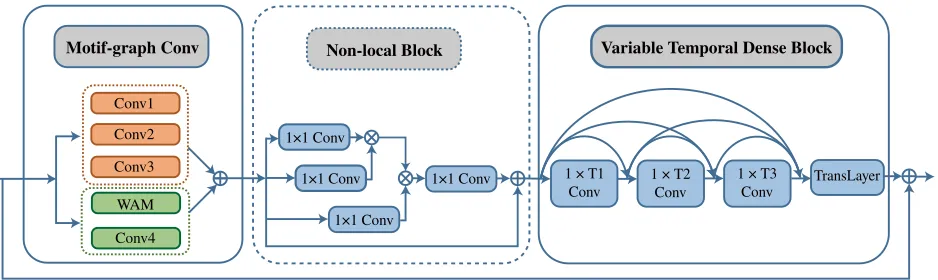
We propose a novel deep architecture for skeletal hu-man action recognition by better modelling the spatial and temporal features of human actions. The basic structure is a spatial-temporal module (STM) which contains motif-based GCNs with variable temporal dense block (VTDB), as shown in Fig. 1. The motif-based graph convolution can model the dependency of physically connected and discon-nected joints simultaneously, thus resulting in a more ef-fective extraction of high-order spatial information. For the temporal modeling, VTDB is used to encode short-, mid-and long-range local information. In addition, we employ the recent non-local neural network module (Wang et al. 2018) to compute a representative sequence. This non-local block in our network is able to capture whole-range depen-dencies in an attention mechanism to enhance the ability for extracting global temporal features.
1×1 Conv
1×1 Conv
1×1 Conv
1×1 Conv 1 × T1
Conv 1 × T2Conv 1 × T3Conv TransLayer
Non-local Block Variable Temporal Dense Block
Motif-graph Conv
Conv1 Conv2
Conv3
WAM
Conv4
Figure 1: The architecture of the proposed spatial-temporal module (STM). It contains a motif-based graph convolution sub-module for modeling spatial information, where a weighted adjacency matrix (WAM) is used for modeling action-specific spatial structure. Variable temporal dense block (VTDB) is used to encode temporal features from different ranges (T1,T2and T3). TransLayer represents the transition layer in VTDB. A residual connection is applied on each STM. The non-local block is used only in the last stage of our network to reduce computation, so it is shown in a dotted line block.⊕denotes element-wise sum, and⊗denotes matrix multiplication.
connection and disconnection in human skeleton. 2) We pro-pose VTDB with different kernel sizes in a dense block to capture local temporal structure over different ranges. A non-local enhanced block is incorporated into our network for constructing global dependencies in the temporal do-main. 3) We propose a novel sub-structure with the combina-tion of motif-GCNs and VTDB as a spatial-temporal module to model skeleton sequences.
We evaluate our model on two large-scale action recog-nition datasets, and the proposed model achieves improve-ments over previous state-of-the-art methods. Our code will be publicly available.
2 Related Work
Skeleton-based Action Recognition. With reliable skele-ton data extracted by robust pose estimation algorithms from depth sensors (Shotton et al. 2011) or a single RGB cam-era (Cao et al. 2017; Xiu et al. 2018), skeleton-based ac-tion recogniac-tion draws more and more attenac-tion from re-searchers. Deep learning has been widely used in model-ing the spatial and temporal patterns of skeleton sequences in this field. Many methods use RNNs due to its advan-tage for learning long-term sequence data (Song et al. 2017; Zhang et al. 2017). Spatio-temporal graph which models the relationship of human body components (spine, arm and leg) has also been introduced into RNNs (Jain et al. 2016), but it should be more effective to model the hu-man parts in a finer way with every joint into the graph. CNNs has shown its superiority to RNNs owing to the par-allelization over every element in a sequence and simpler training process. Skeleton sequences are manually trans-formed into images (Liu, Liu, and Chen 2017) to feed into CNNs (Li et al. 2017), which obtain promising per-formance in action recognition. Nevertheless, GCNs have shown more promising results (Yan, Xiong, and Lin 2018; Tang et al. 2018), because the images used by CNNs cannot fully describe the topology structure of skeletons.
Conven-tional GCNs for human skeleton consider only physical con-nection between joints. The extrinsic dependency, referring to physically disconnected joints, which is presented with equal importance has been adopted (Tang et al. 2018). How-ever, we take the distance between pair-wise disconnected joints into consideration to define their relationship, because close disconnected joints present significant importance for recognizing actions.
Graph Convolution. Generalizing convolutions to graph structure is achieving an increasing interest. The principles of constructing GCNs on graphs are generally categorized as spatial and spectral approaches. Spatial approaches re-quire data preprocessing to define convolution directly on the graph nodes and their neighbors (Duvenaud et al. 2015; Atwood and Towsley 2016; Hamilton, Ying, and Leskovec 2017). Spectral approaches perform graph convolution in frequency domain (Henaff, Bruna, and LeCun 2015; Deffer-rard, Bresson, and Vandergheynst 2016; Kipf and Welling 2016). The Laplacian eigenbasis that transforms a graph from spatial to spectral domain should be computed and is unique for each graph structure, resulting in potentially large computation cost, non-spatially localized filters and re-striction to homogeneous input. An approximation of spec-tral filtering is proposed by means of a Chebyshev ex-pansion of graph Laplacian, removing intense computation and yielding spatially localized filters (Defferrard, Bresson, and Vandergheynst 2016). The idea is further simplified by limiting the filters to operate on 1-neighbor around each node (Kipf and Welling 2016). Considering high-order in-formation in the structure of human skeleton, our network is constructed by introducing the motif notation (Sankar, Zhang, and Chang 2017) to model each joint in a skele-ton with features extracted from semantically relevant joints, such as parent, child and disconnected joints.
Conv1
Conv2
Conv3
WAM
Conv4
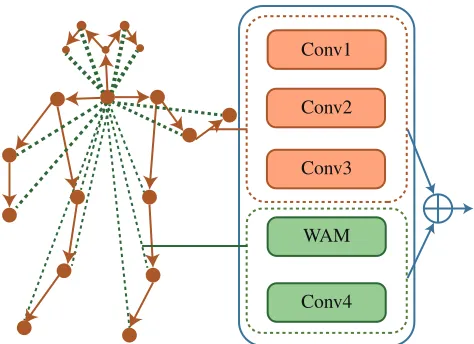
Figure 2: Spatial graph of a skeleton (on the left) and motif-based graph convolution block (on the right). In the graph, solid dots denote the body joints, while edges reflect the physical connection and disconnection with solid and dot-ted lines respectively. Arrows show the direction from parent nodes to child nodes. For simplicity, we only show discon-nected relationship between the neck joint and other joints while all pair-wise dependency of joints are considered.⊕ denotes element-wise sum.
et al. 2015; Carreira and Zisserman 2017) is the most in-tuitive. Nevertheless, separating a 3D convolution into spa-tial and temporal components yields improvements in per-formance (Tran et al. 2018). This idea can also be intro-duced into 2D convolution for skeleton sequence as input. Although most works extract features by only considering fixed temporal kernel depths, temporal transition layer that integrates feature maps of variable temporal depths has been proposed for 3D convolution (Diba et al. 2018). Recently, non-local neural networks have been constructed for action recognition. In a non-local operation, the response at a po-sition is computed as a weighted sum of the features at all positions in the feature maps. When the set of positions are time points, the non-local block can be used for our skeleton sequence. We incorporate variable temporal and non-local operations into our model to extract more effective local and global temporal features.
3 Approach
Human skeleton is conventionally considered as an artic-ulated system composed of joints and rigid bones, imply-ing a graph structure with the joints as nodes and bones as edges. GCNs can be used to learn the spatial relation-ship between joints. Specifically, we construct motif-based GCNs (Sankar, Zhang, and Chang 2017) to learn the high-order spatial structure, which can not only model the depen-dency of physically connected and disconnected joints but also the directed structure in the human skeleton. Then, we concatenate feature maps of spatial context in sequence and feed them into VTDB. The aim of VTDB is to make use of feature maps extracted at different local temporal windows
over shorter and longer time ranges. Moreover, we incorpo-rate a non-local block for global dependencies in the tempo-ral domain to enhance the feature representation.
3.1 Motif-based Graph Convolution
For joints and possible relationship between each pair of joints, we construct a graph G(X,A) with a node set X and an adjacency matrixA for the edges. In X, there are N nodes containing 2D or 3D joint coordinates.Aencodes the relationship between each pair of nodes.
Conventional graph-based convolution for human skele-ton considers only physical connection between joints (Yan, Xiong, and Lin 2018). Although extrinsic dependency has been adopted (Tang et al. 2018), it only builds relationship between disconnected joints with a weighted adjacency ma-trix (WAM) that treats pair-wise extrinsic dependency be-tween joints equally. However, the relevance bebe-tween dis-connected joints is different. For example, relative posi-tions of left hand and left shoulder should be more rele-vant than left hand and right foot in most actions. There-for, a reasonable way to measure the possible degree of relevance is to take spatial distance between each pair of nodes into consideration. We use the Euclidean distance between disconnected joints to define WAM for model-ing action-specific spatial structure. Furthermore, we adopt motif-GCNs (Sankar, Zhang, and Chang 2017) to effectively capture high-order structural information.
A motif (or metagraph) has been traditionally defined as a pattern of connections among different node types (Ben-son, Gleich, and Leskovec 2016; Fang et al. 2016). Here, we build a two-motif structure to model the physical connection and disconnection of joints in a human skeleton, and its ar-chitecture is illustrated in Fig. 2. The first motifM1encodes physically connected joints using the immediate neighbor-ing relationship (Kipf and Wellneighbor-ing 2016). We define three semantic roles (KM1 = 3) to the immediate neighbors of
each joint: the joint itself, the joint’s parent node and child node, which inherently lie in a directed graph. In this way, we get a hierarchical structure of human body parts in a mo-tion. The second motif M2 is used to encode the possible relationship between disconnected joints. We define one se-mantic dependency (KM2 = 1) to represent the underlying
relationship. Additionally, we define WAM for disconnected joints by assigning larger weights to joints with shorter dis-tance, since they are more important for action recognition. In detail,αi,jin WAM for the extrinsic relationship of node iand nodejis defined asαi,j = maxe−e(i, j), whereeis a matrix representing the average euclidean distance between pair-wise nodes in a sequence. Finally, WAM is normalized to reduce the bias introduced by highly connected nodes.
For inputXt∈RN×Dat frametwithNnodes andD di-mension coordinates, inspired by previous approaches (Kipf and Welling 2016; Sankar, Zhang, and Chang 2017), we im-plement the motif-based graph convolution for each motif M with the following formula:
ZtM = KM
X
k=1 (DM
whereKM matricesAMk define the motif-adjacency tensor AM that encodes the unique semantic roles of nodes for all instances of motifM in a graphG.Dis a diagonal degree matrix withDM
kii = PN
j=1A M kij. W
M
k is a tensor of filter parameters for node typekin motifM, andZM
t is the output of the motif. If we use only a motif with one semantic role, our motif-based GCNs reduce to traditional GCNs (Kipf and Welling 2016).
3.2 Variable Temporal Dense Block
For a video withF frames, we can first build a spatial graph with joints and edges in each frame, and then add edges for the same joints between neighboring frames to form a spatial-temporal graph (Yan, Xiong, and Lin 2018). Instead of directly applying graph-based convolution on the spatial-temporal graph, we use separate spatial and spatial-temporal sub-modules because it is easier to learn with spatio-temporal decomposition methods (Tran et al. 2018). For each graph att-th frame, we first feed it into motif-GCNs implemented as Eq. 1 and then concatenate the outputZtin time axis to obtain a 3D tensor, which can be sent into VTDB (Fig. 1) for action recognition.
In VTDB, instead of using only one temporal window size, we use three different time ranges (T1, T2 and T3) to capture more informative temporal features from shorter and longer terms. We utilize consecutive convolution layers which are densely concatenated (Huang et al. 2017), because dense blocks are parameter-efficient and have dense knowl-edge propagation. Thus, the feature of a skeleton sequence can be extracted with stacked STMs as shown in Fig. 3.
Dense Connectivity. In a dense block, thel-th layer is di-rectly connected to all preceding layers and the outputhlof the composite functionHlis denoted as:
hl=Hl([h0, h1, ..., hl−1]) (2)
where[h0, h1, ..., hl−1]denotes the concatenation of all pre-ceding feature-maps andHl(·) is a composite function of BN-RELU-Conv operations (Huang et al. 2017). Each dense block in our network has three layers to model different local temporal ranges, and we use different kernels of size1×T1, 1×T2and1×T3for the convolution operations in the layers, respectively.
Growth Rate. If the features extracted byHlhasd chan-nels, we should getd0+d×(l−1)input feature-maps for the l-th layer, whered0 is the input channels. The hyper-parameterdis referred to as the “growth rate”. The growth rate can be relatively small. Specifically, we set the growth rate of each dense block according to the number of output channels of each STM.
Transition Layer. The transition layer here is used for controlling the output channels of VTDB and facilitating down-sampling when it is necessary. A transition layer con-sists of a batch normalization layer, a RELU layer, and a 1×1convolutional layer.
skeleton sequence
basic STM
3rd: basic STM
3rd: basic STM 3rd: basic STM
2nd: basic STM
Pyramid Pooling
FC
Softmax
Output Channel: 64 Output Size: F × N
Output Channel: 128 Output Size: F/2 × N
Output Channel: 256 Output Size: F/4 × N
1st: basic STM 1st: basic STM
1st: non-local STM
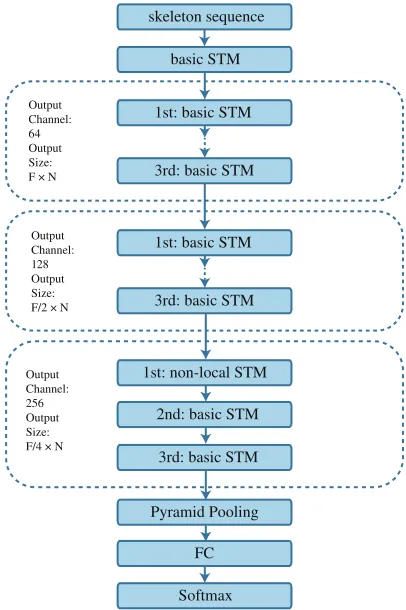
Figure 3: The architecture of our proposed motif-based graph convolution network, which is composed of multi-ple spatial-temporal modules (STMs). The non-local STM is used before the last two STMs to further expand the tem-poral dependency.
3.3 Non-local Block for Temporal Attention
In a full skeleton sequence, every frame has different impor-tance for modeling the temporal information. We thus use a non-local block (Wang et al. 2018), which can relate dif-ferent time points of a sequence in order to compute a rep-resentation of the sequence in an attention mechanism. The features extracted by motif-GCNs are denoted as Zi=1...T, whose dimension isT ×N ×C, are fed into the non-local block. The non-local operation computes the dependency at a time point directly by attending at any other point in a se-quence as:
Yi= 1 C(Z)
X
∀j
f(Zi, Zj)g(Zj) (3)
where Zi and Zj denote the features extracted by spatial convolution at timeiandj.C(Z)is used for normalization whileg(·)is the unary function that computes the represen-tation ofZj. The pair-wise functionf defines the relation-ship with embedded Gaussian (Wang et al. 2018) as:
f(Zi, Zj) =eθ(Zi)
Tφ(Z
whereθ(·)andφ(·) are the feature embedding operations withθ(Zi) = WθZi andφ(Zj) = WφZj. The non-local operation is finally wrapped into a non-local block as:
Oi=WoYi+Zi (5)
whereYiis the output signal of the non-local operation given in Eq. 3. A residual connection is used in a non-local block and pairwise computation in the non-local operation can be done by matrix multiplication (Wang et al. 2018), as shown in Fig. 1.
The non-local operation computes the response at a time point by considering the features at all temporal positions, so it is able to enlarge the receptive field from a local range to the entire sequence. In this way, we use a non-local block for temporal attention to get a more effective representation of the temporal domain.
4 Experiments
We conduct experiments on two large-scale datasets to eval-uate our proposed method, which outperforms the state-of-the-art methods on both datasets.
4.1 Network Architecture
Our network is composed of 10 layers of STM, which mod-els spatial information with motif-based GCNs and tempo-ral information with VTDB. Before feeding input skeleton data into our network, we use a batch normalization layer to normalize the data. The output channel numbers of STM layers are illustrated in Fig. 3. In more detail, we use sep-arate spatial and temporal sub-modules to learn the skele-ton sequence. To reduce computation, we set a smaller num-ber of the output channels of motif graph convolution than that of STM in each layer. Then, the feature maps extracted by the spatial module are sent into the temporal sub-module in which the number of output channels is the same as the setting of STM. A residual connection is applied to each STM (Fig. 1).
The first motif in our 2-motif GCNs is implemented by performing three standard1×12D convolution operations and multiplying the resulting tensor with a motif-adjacency matrix. In particular, we add a mask in the spatial convolu-tion of each layer to enhance the performance (Yan, Xiong, and Lin 2018). The second motif that encodes the depen-dency between physically disconnected joints has 1 seman-tic role, and we use another1×12D convolution. Different from the way to model the relationship of connected joints, we use a weighted adjacency matrix in the second motif.
In VTDB, we set different kernel sizes for the 3 layers of a dense block. The growth rate of VTDB at each layer of STM is decided by the number of output channels. Moreover, we insert a non-local block which uses a sub-sampling strategy to reduce computation as suggested (Wang et al. 2018) be-fore VTDB at the 8-th STM. Strides are set to 2 at the 4-th and 7-th layers of STM for spatial sub-sampling. A pyramid pooling (He et al. 2014) is performed on the resulting feature map, which is then fed to a Softmax classifier.
4.2 Dataset and Experiment Settings
Kinetics-M. Deepmind Kinetics (Kay et al. 2017) is an action video dataset that contains around 300,000 clips in 400 classes sourced from YouTube, and each clip lasts about 10 seconds. The dataset provides only raw video clips with-out skeleton data. The 2D coordinates of 18 joints (Fig. 2) have been estimated on each frame of clips (Yan, Xiong, and Lin 2018) with the realtime Openpose toolbox (Cao et al. 2017). For multi-person clips, 2 people are selected based on the average joint confidence. The dataset has been released for research purposes. However, it contains many action classes which require recognizing relationship be-tween the actors and complicated scenes. The works focus-ing on skeleton-based action recognition would be inferior to video-based methods on this dataset, but a subset of 30 ac-tion classes strongly related with body moac-tions can make the performance gap smaller (Yan, Xiong, and Lin 2018). We use the subset named as “Kinetics-M” here to evaluate our model with top-1 and top-5 classification accuracy as recom-mended (Kay et al. 2017). The dataset provides a training set of 25,000 clips and a validation set of 1,500 clips. The training set is used to train our models, and we report the ac-curacies on the validation set. Kinetics-M dataset is captured in unconstrained environments. Achieving improvements on it can verify that out model is able to extract more effective features from noisy data.
NTU-RGB+D. NTU-RGB+D is the largest dataset with annotated 3D joint coordinates for the human action recog-nition task (Shahroudy et al. 2016). This dataset whose data captured in constrained lab environments are more stable. It contains more than 56,000 sequences in 60 action classes. These clips are captured from 40 volunteers in a lab en-vironment, where 3 camera views are recorded simultane-ously from different perspectives. The provided annotations are given in the camera coordinate system. There are 25 major joints for each subject in a skeleton sequences and each sequence is guaranteed to have at most 2 subjects. The authors of this dataset recommend two benchmarks: 1) cross-subject (CS) benchmark with 40,320 and 16,560 clips for training and evaluation, respectively. In this setting, the training set comes from one subset of 20 subjects and a model is validated on sequences from the remaining 20 subjects; 2) cross-view (CV) benchmark with 37,920 clips for training and 18,960 for evaluation. Training samples in this setting come from the camera views 2 and 3, and the evaluation samples are all from the camera view 1. We fol-low the conventional settings and report our results on both recommended benchmarks to compare with previous state-of-the-art methods.
Top-1 Top-5
uni-GCNs 76.4% 94.0%
motif-GCNs 82.5% 95.7%
motif-GCNs + VTDB 83.3% 95.9% motif-GCNs + non-local block 83.2% 95.6% motif-GCNs + non-local VTDB 84.2% 96.1%
Table 1: Ablation study on Kinetics-M dataset. The meaning of each setting is explained in Sec. 4.3.
IC GR Top-1
OC/4 OC/4 82.9% OC/2 OC/4 83.3% OC/2 OC/2 83.5%
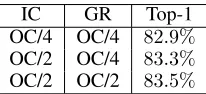
Table 2: The accuracies of the network with different num-bers of input channels (IC) and growth-rate (GR) in VTDB. IC and GR are decided by the number of output chan-nels (OC) of spatial-temporal module at each layer.
to 32 according to available GPU memory for training on NTU-RGB+D dataset (without data augmentation).
4.3 Ablation Study
To analyze the necessity of each proposed component, we perform a series of detailed experiments on Kinetics-M dataset.
Motif-based Graph Convolution. We utilize the uni-labeling strategy in GCNs (Yan, Xiong, and Lin 2018) as our baseline, named as uni-GCNs here, because it approx-imates the propagation rule of traditional GCNs (Kipf and Welling 2016), which can be seen as using only 1 motif with 1 semantic role. We compare the performance of uni-GCNs with that of motif-GCNs in modeling spatial information of human skeleton. Temporal convolution is implemented with traditional1×12D convolution. As shown in Table 1, motif-GCNs outperform uni-motif-GCNs by large margin. The result verifies that motif-GCNs improve the performance of con-ventional GCNs through proper modeling underlying high-order structure in human skeletons.
Variable Temporal Dense Block. We evaluate the neces-sity of another important component VTDB in our network. As shown in Table 1, VTDB shows superiority over tradi-tional temporal convolution. The result justifies the impor-tance of extracting local temporal information from short-, mid- and long-range terms. In addition, we have done a se-ries of tests to achieve better configuration for VTDB, as shown in Table 2. We set the number of input channels (IC) and growth-rate (GR) with respect to the number of out-put channels (OC) of each STM. It is obvious that VTDB can perform better as IC and GR increase. IC is in coin-cidence with the number of output channels of the spatial module. When IC increases, the features extracted by the spatial module are more informative. The contribution of GR is primarily due to growth in model capacity of dense block (Huang et al. 2017). We set IC and GR (IC = OC/2,
Top-1 Top-5 TConv (Kim and Reiter 2017) 70.8% 92.5% STGCN (Yan, Xiong, and Lin 2018) 79.7% 94.2% motif-GCNs+non-local VTDB 84.2% 96.1%
Table 3: Skeleton-based action recognition performance on kinetics-M dataset in terms of top-1 and top-5 accuracies.
CS CV
PA-LSTM (Shahroudy et al. 2016) 62.9% 70.3% ST-LSTM (Liu et al. 2016) 69.2% 77.7% 2S RNN (Wang and Wang 2017) 71.3% 79.5% TConv (Kim and Reiter 2017) 74.3% 83.1% Clips+CNN+MTLN (Ke et al. 2017) 79.6% 84.8% VI (Liu, Liu, and Chen 2017) 80.0% 87.2% STGCN (Yan, Xiong, and Lin 2018) 81.5% 88.3% LSTM-CNN (Li et al. 2017) 82.9% 90.1% DPRL (Tang et al. 2018) 83.5% 89.8% motif-GCNs+non-local VTDB 84.2% 90.2%
Table 4: Skeleton-based action recognition performance on NTU-RGB+D dataset. The accuracies are reported on both the cross-subject (CS) and cross-view (CV) benchmarks.
GR=OC/4 by default) considering both computation com-plexity and accuracy.
Non-local Block. Table 1 shows the necessity of using a non-local block for modeling global temporal information. We use only one non-local block in our network before tradi-tional temporal convolution or VTDB. The recognition rate can be further improved by fusing the VTDB and non-local block. The results indicate that it is necessary to model both local and global dependencies in the temporal domain.
4.4 Comparison with State of the Arts
We demonstrate the effectiveness of our model on two large-scale datasets and compare with state-of-the-art methods.
On kinetics-M dataset, we compare with TConv (Kim and Reiter 2017) and STGCN (Yan, Xiong, and Lin 2018) in terms of top-1 and top-5 accuracies for skeleton-based ac-tion recogniac-tion. Our model outperforms the previous spatial and temporal convolution methods on this dataset as shown in Table 3.
We compare our final model with the state-of-the-art methods on NTU-RGB+D dataset. As shown in Table 4, we report both CS and CV top-1 classification accuracies following the standard practice in literature (Shahroudy et al. 2016). Our model outperforms the state-of-the-art ap-proaches on this dataset without data augmentation as used in previous literatures (Ke et al. 2017; Kim and Reiter 2017; Yan, Xiong, and Lin 2018).
4.5 Discussions
Belly Dancing
Throwing Discus
Figure 4: The response magnitude of all the joints (red dots) in a motion sequence in the last layer of uni-GCNs (the first row) and our model (the second row). Uni-GCNs give the wrong label “Belly Dancing”, while our model recognizes the motion “Throwing Discus” correctly. The video sequence is selected from a clip of Kinetics-M dataset with an interval of 20 frames.
GR. Particularly, there is no sign of performance degraga-tion or overfitting. By tuning the hyper-parameters, further gains in accuracy may be obtained. We show the superiority of our model compared to uni-GCNs intuitively in Fig. 4. Uni-GCNs mislead “throwing discus” as “belly dancing”, because our model gets more reasonable response at joints and gives the right label to the action by adopting the possi-ble dependencies of physically disconnected joints and the hierarchical structure in the skeleton. Recently, there is a trend to use multi-streams of data to raise the performance of action recognition. Although we focus on skeleton-based data in this work, our model can also provide complemen-tary information to RGB and optical flow models to raise the performance.
5 Conclusion
In this paper, we have presented a new motif-based graph convolution network with variable temporal dense block ar-chitecture for skeleton-based action recognition. The net-work constructs a set of spatial-temporal modules to model skeleton sequences. Motif-GCNs effectively fuse informa-tion from different semantic roles of physically connected and disconnected joints to learn high-order features. Our proposed model achieves improvements over the state-of-the-art methods on two challenging large-scale datasets.
6 Acknowledgments
This work was supported by Beijing Natural Science Foun-dation (No. L182052 and No. L182016), National Nat-ural Science Foundation of China (No. 61772499, No. 61872440, No. 61828204 and No. 61502453), Young Elite Scientists Sponsorship Program by CAST (No.
2017QNRC001), CCF-Tencent Open Fund, Huawei HIRP Open Fund (No. HO2018085141), SenseTime Research Fund, New Zealand National Science Challenge 10-Robotics Spearhead Project (Callaghan Innovation: CRS-S6-2017), the Centre for Applied Computing and Interac-tive Media (ACIM) of School of CreaInterac-tive Media, Strategic Research Grant (No. 7005176) from the City University of Hong Kong and NVIDIA Corporation with the GPU dona-tion.
References
Atwood, J., and Towsley, D. 2016. Diffusion-convolutional neural networks. InNIPS, 1993–2001.
Benson, A. R.; Gleich, D. F.; and Leskovec, J. 2016. Higher-order organization of complex networks. Science163–166. Cao, Z.; Simon, T.; Wei, S.-E.; and Sheikh, Y. 2017. Re-altime multi-person 2d pose estimation using part affinity fields. InCVPR, 1302–1310.
Carreira, J., and Zisserman, A. 2017. Quo vadis, action recognition? a new model and the kinetics dataset. InCVPR, 4724–4733.
Defferrard, M.; Bresson, X.; and Vandergheynst, P. 2016. Convolutional neural networks on graphs with fast localized spectral filtering. InNIPS, 3837–3845.
Diba, A.; Fayyaz, M.; Sharma, V.; Karami, A. H.; Arzani, M. M.; Yousefzadeh, R.; and Gool, L. V. 2018. Temporal 3d convnets using temporal transition layer. InCVPR Work-shops, 1117–1121.
fingerprints. InAdvances in Neural Information Processing Systems, 2224–2232.
Fang, Y.; Lin, W.; Zheng, V. W.; Wu, M.; Chang, K. C.-C.; and Li, X.-L. 2016. Semantic proximity search on graphs with metagraph-based learning. InICDE, 277–288. Hamilton, W. L.; Ying, Z.; and Leskovec, J. 2017. Induc-tive representation learning on large graphs. InNIPS, 1025– 1035.
He, K.; Zhang, X.; Ren, S.; and Sun, J. 2014. Spatial pyramid pooling in deep convolutional networks for visual recognition. InECCV, 346–361.
Henaff, M.; Bruna, J.; and LeCun, Y. 2015. Deep convo-lutional networks on graph-structured data. arXiv preprint arXiv:1506.05163.
Huang, G.; Liu, Z.; van der Maaten, L.; and Weinberger, K. Q. 2017. Densely connected convolutional networks. InCVPR, 2261–2269.
Jain, A.; Zamir, A. R.; Savarese, S.; and Saxena, A. 2016. Structural-rnn: Deep learning on spatio-temporal graphs. In CVPR, 5308–5317.
Kay, W.; Carreira, J.; Simonyan, K.; Zhang, B.; Hillier, C.; Vijayanarasimhan, S.; Viola, F.; Green, T.; Back, T.; Natsev, P.; Suleyman, M.; and Zisserman, A. 2017. The kinetics hu-man action video dataset.arXiv preprint arXiv:1705.06950. Ke, Q.; Bennamoun, M.; An, S.; Sohel, F. A.; and Boussa¨ıd, F. 2017. A new representation of skeleton sequences for 3d action recognition. InCVPR, 4570–4579.
Kim, T. S., and Reiter, A. 2017. Interpretable 3d human action analysis with temporal convolutional networks. In CVPR Workshops, 1623–1631.
Kipf, T. N., and Welling, M. 2016. Semi-supervised classi-fication with graph convolutional networks. arXiv preprint arXiv:1609.02907.
Li, B.; Dai, Y.; Cheng, X.; Chen, H.; Lin, Y.; and He, M. 2017. Skeleton based action recognition using translation-scale invariant image mapping and multi-translation-scale deep cnn. In ICME Workshops, 601–604.
Liu, J.; Shahroudy, A.; Xu, D.; and Wang, G. 2016. Spatio-temporal lstm with trust gates for 3d human action recogni-tion. InECCV, 816–833.
Liu, M.; Liu, H.; and Chen, C. 2017. Enhanced skeleton visualization for view invariant human action recognition. Pattern Recognition68:346–362.
Ng, J. Y.-H.; Hausknecht, M. J.; Vijayanarasimhan, S.; Vinyals, O.; Monga, R.; and Toderici, G. 2015. Beyond short snippets: Deep networks for video classification. In CVPR, 4694–4702.
Sankar, A.; Zhang, X.; and Chang, K. C.-C. 2017. Motif-based convolutional neural network on graphs. arXiv preprint arXiv:1711.05697.
Shahroudy, A.; Liu, J.; Ng, T.-T.; and Wang, G. 2016. Ntu rgb+d: A large scale dataset for 3d human activity analysis. InCVPR, 1010–1019.
Shotton, J.; Fitzgibbon, A. W.; Cook, M.; Sharp, T.; Finoc-chio, M.; Moore, R.; Kipman, A.; and Blake, A. 2011.
Real-time human pose recognition in parts from single depth im-ages. InCVPR, 1297–1304.
Song, S.; Lan, C.; Xing, J.; Zeng, W.; and Liu, J. 2017. An end-to-end spatio-temporal attention model for human action recognition from skeleton data. InAAAI, 4263–4270. Tang, Y.; Tian, Y.; Lu, J.; Li, P.; and Zhou, J. 2018. Deep progressive reinforcement learning for skeleton-based ac-tion recogniac-tion. InCVPR, 5323–5332.
Tran, D.; Bourdev, L. D.; Fergus, R.; Torresani, L.; and Paluri, M. 2015. Learning spatiotemporal features with 3d convolutional networks. InICCV, 4489–4497.
Tran, D.; Wang, H.; Torresani, L.; Ray, J.; LeCun, Y.; and Paluri, M. 2018. A closer look at spatiotemporal convolu-tions for action recognition. InCVPR, 6450–6459.
Wang, H., and Wang, L. 2017. Modeling temporal dynam-ics and spatial configurations of actions using two-stream recurrent neural networks. InCVPR, 3633–3642.
Wang, X.; Girshick, R. B.; Gupta, A.; and He, K. 2018. Non-local neural networks. InCVPR, 7794–7803.
Xiu, Y.; Li, J.; Wang, H.; Fang, Y.; and Lu, C. 2018. Pose flow: Efficient online pose tracking. InBMVC, 53.
Yan, S.; Xiong, Y.; and Lin, D. 2018. Spatial temporal graph convolutional networks for skeleton-based action recogni-tion. InAAAI, 7444–7452.