www.ijpes.com
International Journal of Psychology and Educational
Studies
Predictors of Self-Esteem in Physical Education: Self-Determination
Perspective
Emre Karaday
1, Gökçe
Erturan İlker
21Teacher ofPhysical education, 2Pamukkale University, Faculty of Sport Sciences, Turkey
ARTICLE INFO ABSTRACT
Article History: Received 14.02.2018 Received in revised form 26.02.2018
Accepted 03.03.2018 Available online 01.05.2018
This study aimed to explore the relationship between basic psychological needs, motivational regulations, and self-esteem in Turkish high school physical education environment. Nine hundred and fifty seven high school students (505 girls, 452 boys) were applied the questionnaire pack in physical education lessons. Students’ general self-esteem, basic psychological needs and motivational regulations toward physical education were assessed. Hierarchical multiple regression analysis results revealed that Turkish high school students’ autonomy, competence, and relatedness need satisfaction in physical education positively predicted students’ global self-esteem. Physical education teachers were recommended to consider creating need supportive lesson environment for adolescents to enhance their optimal psychological functioning and well-being.
© 2018 IJPES. All rights reserved
Keywords:1
motivational regulation, basic psychological needs; adolescents; well-being
1. Introduction
Physical education (PE) has a great potential to promote youth physical activity because it comprises all individuals from childhood to adolescence. To support participation in PE and to provide healthy physical activity through PE students’ motivational elements should be considered (Hagger et al., 2005).
A widely used contemporary theory to understand students’ motivation in PE is Self-Determination Theory (SDT; Deci & Ryan, 1985). Research in PE context adopted this theory to facilitate our understanding of students’ motivated behaviours and their cognitive, affective, and behavioural consequences. Although SDT is relevant across cultures, related outcomes are considered to be varied as a function of age and cultural background.
SDT identifies three forms of motivational regulations which are considered as a continuum from higher to lower levels of self-determined motivation. Intrinsic motivation is revealed when a person is motivated to participate in activity for fun or challenge required in the behaviour. In contrast extrinsic motivation is separated into four categories which vary in their relative degree of self-determination. External regulation can be defined as participating in activity because of external pressure, threat or punishment; introjected regulation is participating in activity because of internal pressure, guilt or shame; identified regulation is participating in activity because of believing in its importance and utility, and integrated regulation is participating in activity because of finding it congruent with personal goals and values. Lastly, in the situations people have neither intrinsic nor extrinsic motivation, they have amotivation. Amotivation is the belief that in activity is not important or not provides desired outcomes. In this self-determination continuum intrinsic, integrated, and identified regulations are self-determined, introjected regulation, external regulation, and amotivation are non self-determined form of motivation (Deci & Ryan, 2000).
2Corresponding author’s address: Pamukkale University, Faculty of Sport Sciences, Kınıklı Campus, Denizli
Telephone: 0258 296 1285 e-mail: [email protected] http://dx.doi.org/10.17220/ijpes.2018.02.005
© 2014International Journal of Psychology and Educational Studies (IJPES) is supported by Educational Researches and Publications Association (ERPA)
SDT suggests that motivational regulations can be affected by contextual factors, such as teachers’ teaching styles. These factors can influence students’ motivation and engagement in learning environment by supporting or thwarting their basic psychological needs, namely need for autonomy, competence and relatedness. Autonomy need refers to a feeling the origin of the behaviours and feeling congruence between an activity and one’s values; competence need is to experience sense of effectiveness in producing desired outcomes and relatedness need is feeling connected to significant others or feeling belonging to a social environment (Deci & Ryan, 1985; 2000). Hein and Caune (2014) argued that autonomy need satisfaction and self-determined motivation in PE facilitates the students to feel physically well which causes them to put more effort on physical activities and involve in physical exercise during their free time, which is the main objective of PE.
According to Vallerand (1997)’s hierarchical model various types of motivation had a meditational role between basic psychological needs and cognitive, behavioural, and psychological outputs. Past research has explored the aforementioned sequence in PE context (e.g., Ntoumanis, 2001; 2005; Standage, Duda, & Ntoumanis, 2003). Adaptive outcomes are derived from self-determined types of motivation (i.e., intrinsic motivation and identified regulation), oppositely maladaptive outcomes are resulted from low and non-self-determined types of motivation (i.e., external regulation, and amotivation).
Global self-esteem is one of the important outcomes that effects the quality of education due to its impact on psychological well-being (Deci & Ryan, 1995). Because when a person is not concerned about his self-esteem, the worth of the self is not an issue thus optimal well-being is more likely to be provided (Ryan & Brown, 2003). According to Ryan and Brown (2003) the absence of self-esteem is expected to be a sign of psychological need deficiencies and when these needs are thwarted self-esteem is damaged. In other words, because they are missing a sense of love, people with low self-esteem, don’t feel worthy, authenticity, or effectiveness. Existing literature has proved that self-esteem is linked with academic strivings and academic performance (Baumeister, Campbell, Krueger & Vohs, 2003). Indeed, Bowles (1999) argued that self-esteem is a result, not a cause, of success in school. PE context in particular, offers students activities, exercises and tasks to judge their own performance and compare with their counterparts’. Thus, PE entails social comparison which evokes self-esteem through self-evaluation process (O’Rourke, Smith, Smoll, & Cumming, 2012). Researchers have suggested that PE can enhance academic performance by improving self-esteem (Hills, 1998).
There have been contradictory research findings related to changes of self-esteem along with the students’ age. Some have manifested that self-esteem declines with age (e.g. McMullin & Cairney, 2004; Orth, Trzesniewski & Robins, 2010), while others have showed that younger people have lower self-esteem (e.g. Brent Donnellan et al., 2012). On the other hand, researches related to gender effect on self-esteem have had similar results. Namely, men have higher self-esteem than women at not only adolescence period (McMullin & Cairney, 2004; Moksnes & Espnes, 2013; Sipos et al, 2015) but also during adulthood in different cultures (Bleidorn, Arslan, Denissen, Rentfrow, Gebauer, Potter & Gosling, 2015).
Although self-esteem and self-determined motivation have been linked in different studies (e.g., Kalaja, Jaakkola, Watt, Liukkonen & Ommundsen, 2009; Kernis, Paradise, Whitaker, Wheatman & Goldman, 2000; Mabekoje & Okubanjo, 2009; ), students’ self-esteem and their motivation in PE have received little research attention (e.g., Hein & Caune, 2014; Hein & Hagger, 2007; Koka, 2014; Standage & Gillison, 2007). However, manifesting the link between these variables helps us to understand which motivational agents effect students’ global self-esteem in PE.
On the other hand, no study has been done to explain the predictors and consequences of motivational regulations in Turkish PE context. High school PE in Turkey is compulsory which is hypothesized to enhance students’ amotivation (Ntoumanis, 2005). Therefore, drawing from SDT and past research evidence, this study aimed to explore the relationship between basic psychological needs, motivational regulations, and self-esteem in Turkish high school PE environment.
In line with the past research (Hein & Hagger, 2007) we hypothesized that students’ basic psychological needs
satisfaction, intrinsic motivation and identified regulation would predict their self-esteem positively, while
extrinsic regulation and amotivation would explain self-esteem negatively. Along with existing literature (McMullin & Cairney, 2004) age and gender were also hypothesized to be the significant predictors of
students’ self-esteem.
2. Methods
This research has quantitative, cross-sectional design.
2.1. Participants. Nine hundred and fifty seven high school students (505 girls, 452 boys) participated
voluntarily to the study. The participants (MAge = 16.27 ± 1.13) were attending eight different public high
schools located in the central district of Denizli. Table 1 shows the distribution of participants by gender and grade level.
Table 1. The distribution of participants by gender and grade level
Grade Level
1 2 3 4 Total
Girl 188 107 131 79 505
Boy 149 98 116 89 452
Total 337 205 247 168 957
2.2. Procedure. Prior to data collection permissions from Ministry of Education and Ethics Committee were
obtained. The students were requested to anonymously respond to a questionnaire pack before or during their scheduled PE classes by the researchers. The participants were explained that there were no right or wrong answers, emphasizing that they do so as personally and honestly as possible, they could withdraw from the study at anytime without any negative consequences and their answers will not share with their teachers or parents. The questionnaire pack took approximately 20 minutes to complete.
2.3. Measures
2.3.1.Basic psychological need satisfaction.Need Satisfaction Scale was developed by Deci and Ryan (1991) and adapted into Turkish by Bacanlı and Cihangir-Çankaya (2003). Confirmatory factor analysis results of the scale were; RMSEA= 0.07, GFI= 0.86, AGFI= 0.82, CFI= 0.82, NNFI= 0.80 (Cihangir Çankaya, 2009). The scale consists of 21 items and three subscales, namely autonomy (six items), competence (six items), and relatedness (nine items). It is 7-point Likert scale (1 = not at all true of me; 7 = very true of me). The scale showed adequate validity and reliability for both the total scale and the subscales with Turkish sample (Bacanlı & Cihangir-Çankaya, 2003). Example item for autonomy subscale is “I feel that I have freedom to decide how I live my life”), for competence subscale is “Recently I have learnt new and interesting skills”) and relatedness subscale is “I get on well with the people around me”.
2.3.2. Motivational regulations.The Situational Motivation Scale was developed by Guay et al. (2000) and adapted into Turkish by Kazak Çetinkalp (2010). Confirmatory factor analysis results of the scale for the Turkish PE environment were; RMSEA= 0.06, χ²/sd= 2.06, GFI= 0.92, AGFI= 0.89, NFI= 0.94; NNFI= 0.96, CFI= 0.97 (Daşdan Ada, Aşçı, Kazak Çetinkalp, & Altıparmak, 2012). Participants of the study responded the 7-point Likert type (1 = not at all true of me; 7 = very true of me) scale under the stem “Why do you participate PE classes?”. It has 16 items and four subscales, namely intrinsic motivation (e.g., “Because I feel good when I am in PE class”), identified regulation (e.g., “Because I believe that PE classes are important for me”), extrinsic regulation (e.g., “Because I feel that I have to attend that class”) and amotivation (e.g., “I attend this class but I am not sure whether attending is a good thing”). The scale was found to be valid and reliable within Turkish sample (Kazak Çetinkalp, 2010).
self-evaluation. Scale was translated into Turkish by Çuhadaroğlu (1986). Confirmatory factor analysis results of the scale were; RMSEA = .07, GFI = .94, AGFI = .89, CFI = .95 (Yılmaz & Bilgiç, 2009).Answers were scored using a four point Likert scale: Strongly disagree=1, disagree=2, Agree=3, and strongly agree=4. Short form of
the scale consists of 10 (Five items are positive and five items are negative) items (e.g., “On the whole, I was
satisfied with myself”). Positive items are coded from 1 to 4 and negative items are coded reverse (i.e. 4 to 1).
Total score for the scale is created by summing the responses, with higher scores indicating greater self-esteem.
2.4. Data Analysis. Initially, the data was screened; univariate and multivariate outliers were detected and
removed from the data set. Univariate outliers were detected by using standard z-score (±3.29) and multivariate outliers were identified through Mahalanobis distance with p< .001 (Tabachnick & Fidell, 2007). Descriptive statistics for all variables were computed and Cronbach’s alpha reliability coefficients were calculated to assess the internal reliability of the subscales. Pearson correlation analysis was performed to examine the correlations among all the variables used in the study.
The hierarchical multiple regression analysis was employed to test whether basic psychological needs and different motivational regulations in high school PE lesson could predict students’ self-esteem. Self-esteem was the dependant variable while age and gender were entered in the first step, motivational regulations were entered in the second step and basic psychological needs were entered in the third step of the analysis. The assumptions associated with hierarchical multiple regression analysis (i.e., normality, linearity and homoscedasticity) were examined.
3. Results
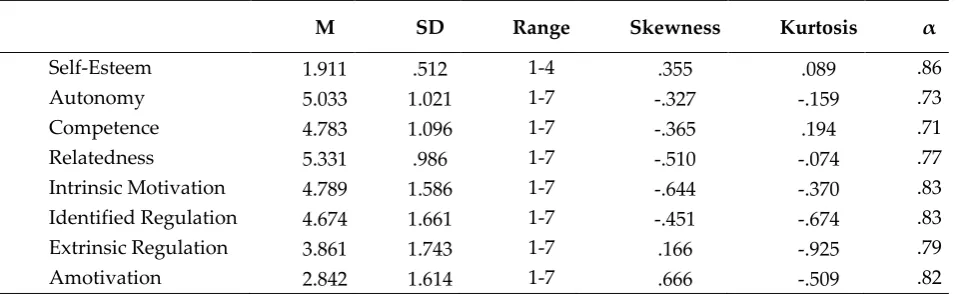
3.1. Preliminary Analyses. Means, standard deviations, Skewness, Kurtosis, and Cronbach’s alphas for the
variables were calculated which are provided in Table 2.
Table 2. Descriptive characteristics of participants
M SD Range Skewness Kurtosis α
Self-Esteem 1.911 .512 1-4 .355 .089 .86
Autonomy 5.033 1.021 1-7 -.327 -.159 .73
Competence 4.783 1.096 1-7 -.365 .194 .71
Relatedness 5.331 .986 1-7 -.510 -.074 .77
Intrinsic Motivation 4.789 1.586 1-7 -.644 -.370 .83
Identified Regulation 4.674 1.661 1-7 -.451 -.674 .83
Extrinsic Regulation 3.861 1.743 1-7 .166 -.925 .79
Amotivation 2.842 1.614 1-7 .666 -.509 .82
N = 957
Participants’ intrinsic motivation and relatedness need satisfaction in PE were higher than other motivation types and basic needs. The skewness and kurtosis values showed that the data were distributed normally. Cronbach’s alpha coefficients indicated that the scales used in the study demonstrated acceptable internal reliability (i.e., a≥ 0.70).
3.2. Correlations among variables.Pearson’s product moment correlation analysis applied the variables of
the study. As shown in Table 3, bivariate correlations suggest that extrinsic regulation and amotivation were negatively correlated with all other variables while other motivation types and all three basic needs were positively correlated with each other.
Table 3. Bivariate correlations among study variables
1 2 3 4 5 6 7
1.Self-Esteem -
2.Autonomy .521* -
3.Competence .691* .565* -
4.Relatedness .502* .529* .591* -
5.Intrinsic Motivation .158* .116* .204* .206* -
6.Identified Regulation .193* .155* .232* .179* .825* -
7.Extrinsic Regulation -.131* -.117* -.172* -.103* -.476* -.499* - 8.Amotivation -.247* -.239* -.287* -.242* -.563* -.596* .616* *p<0.01
3.3. Hierarchical multiple regression analysis. Prior to the analysis linearity, multicollinearity, and
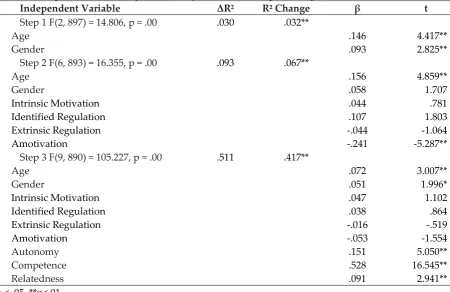
homoscedasticity assumptions were checked and all those assumptions were found to fully meet for analysis. Each variable in the data set was normally distributed (Table 2) and the relationships between pairs of variables are linear. The Durbin-Watson value was 1.892 which falls within the acceptable range from 1 to 3 (Field, 2009) meaning that the analysis satisfies the assumption of independence of errors. As multicollinearity indicatives tolerance values were above 0.1 (0.58-0.99) and variance inflation factor (VIF) were greater than 1(1.01- 1.87; Field, 2009).
Table 4. Multiple hierarchical regression analysis for variables predicting self-esteem
Independent Variable ΔR2 R2 Change β t
Step 1 F(2, 897) = 14.806, p = .00 .030 .032**
Age .146 4.417**
Gender .093 2.825**
Step 2 F(6, 893) = 16.355, p = .00 .093 .067**
Age .156 4.859**
Gender .058 1.707
Intrinsic Motivation .044 .781
Identified Regulation .107 1.803
Extrinsic Regulation -.044 -1.064
Amotivation -.241 -5.287**
Step 3 F(9, 890) = 105.227, p = .00 .511 .417**
Age .072 3.007**
Gender .051 1.996*
Intrinsic Motivation .047 1.102
Identified Regulation .038 .864
Extrinsic Regulation -.016 -.519
Amotivation -.053 -1.554
Autonomy .151 5.050**
Competence .528 16.545**
Relatedness .091 2.941**
*p < .05, **p<.01
4. Discussion
This study aimed to analyze whether basic psychological needs and different motivational regulations in high school PE context could predict students’ general self-esteem. In accordance with SDT, intrinsic motivation and identified regulation were positively correlated with all three basic psychological needs; oppositely external regulation and amotivation were negatively correlated with them. In line with the previous studies (e.g., Deci & Ryan, 2000; Ntoumanis, 2001; Standage, et al., 2006; Taylor, et al, 2010) self-esteem was positively correlated with intrinsic motivation, identified regulation and all three basic needs, while negatively correlated with extrinsic regulation and amotivation.
Despite the numbers of studies testing the model including satisfaction of basic psychological needs, motivational regulations and different indices of well-being (e.g Deci, et al., 1981; Levesque, et al., 2004; Ryan & Grolnick, 1986), no studies have tested the same model in Turkish PE environment, consequently current research has contributed to the existing literature. In line with our hypothesis and the past study results, (Deci, et al., 1981; Ryan & Grolnick, 1986) hierarchical multiple regression analysis results proved that the students’
age, gender, autonomy, competence, and relatedness need satisfaction in PE positively predicted students’ global self-esteem. These findings supported the tenets of SDT in PE context with Turkish adolescent sample. Consistent with our results, Levesque et al. (2004) used composite autonomy index for intrinsic motivation, identified regulation, introjected regulation and extrinsic motivation and found that autonomous motivation and perceived competence were related with life satisfaction and self-esteem as components of well-being. If an environment offer people choice, feeling of success and quality socialization instead of pressure and control people can satisfy all three needs and eventually higher quality behaviour and greater psychological well-being are obtained (Deci & Ryan, 2000). Mabekoje and Okubanjo (2009)’s study indicated that the combination of the satisfaction of all three needs enhanced adolescents' self-esteem. However in the current study, competence was found to be the strongest predictor (β=.528) of self- esteem compared with autonomy and relatedness need satisfaction. It was an expectable result because perceived competence has a central importance in PE context (Feltz, 1988). Adolescents show their skills in front of their peers which cause social comparison and if they are not satisfied with their physical capacity, they tend to be less motivated to participate in physical activities (Maiano, et al., 2004). Moreover, students’ whohave high competence need satisfaction showed more effort in PE and intendedto be more physically active (Ntoumanis, 2001). Also the study by Sheldon et al. (1996) emphasized the importance of competence and autonomy needs for well-being. Oppositely Mabekoje and Okubanjo (2009) and Hein and Hagger (2007) stated that satisfaction of autonomy needs contributed most significantly to adolescents' self-esteem.
It was hypothesized that intrinsic motivation and identified regulation would predict adolescents’ self-esteem positively, while extrinsic regulation and amotivation would explain self-esteem negatively. Although intrinsic motivation and identified regulation were significantly positively correlated with the self-esteem, opposite with our hypothesis they were found not to contribute significantly to the prediction of students’ self-esteem. As Cowan and Taylor (2015) discussed, forestalled internalization of the self-determined motivation may have detrimental effects despite of short term benefits on one’s self-esteem. Hidden potential opposite effects in these divergent mechanisms should be considered in future research. Unlike our result, Deci et al. (1981) found a positive significant relationship between student's intrinsic motivation and self-esteem. Similarly, 11-week period “soccer and education program” participants’ identified regulation was positively predicted their self-esteem (Cowan & Taylor, 2015). Consistent with our hypothesis amotivation was found to be the significant negative predictor of self-esteem.
Introjected regulation is adopted when a person choose to do an action in order to enhance or maintain self-esteem and the feeling of worth (Ryan & Deci, 2000). The natural connection between self-self-esteem and introjected regulation due to its nature has been known. However introjected and integrated regulation types of extrinsic motivation were not assessed with Situational Motivation Scale therefore were not included to the present study. Future research should consider using a scale that embraces all the motivational regulations. Second limitation relates to the cross-sectional nature of the research design which prevents causal inferences. Future research may be planned as longitudinal to see the within-person variance in basic psychological needs and different types of motivational regulations in a school year, so that the effects of motivational agents on self-esteem can be analyzed more in depth.
Despite these limitations, the results of the study are interesting and have important practical implications. PE teachers should consider creating psychological need supportive environment in their lessons. Knowing that
the competence need satisfaction was the strongest predictor of self-esteem, PE teachers should organize the structure of the lesson to allow all the students, regardless of their physical skill, to experience the success to increase students’ perceived competence during the lessons. Besides it is important to employ self-referenced criteria for the exercises and drills in the lesson in order to emphasize effort and personal improvement. Educational psychologists may consider the study results and guide adolescents to attend PE and other physical activity environments. By encouraging adolescents to participate a well-organized PE actively can foster their self-esteem.
References
Bacanlı, H., & Cihangir-Çankaya, Z. (2003). İhtiyaç doyumu ölçeği uyarlama çalışması[Adaptation study of need satisfaction scale].In Proceedings of 7th National Psychological Counselling and Guidance Congress.
Malatya, İnönü Üniversitesi. Ankara: Pegem A Yayıncılık.
Baumeister, R. F., Campbell, J. D., Krueger, J. I., Vohs, K. D. (2003). Does high self-esteem cause better performance, interpersonal success, happiness, or healthier lifestyles? Psychological Science In The Public Interest, 4(1), 1-44.
Bleidorn, W., Arslan, R. C., Denissen, J. J. A., Rentfrow, P. J., Gebauer, J. E., Potter, J., & Gosling, S. D. (2015, December 21). Age and Gender Differences in Self-Esteem—A Cross-Cultural Window. Journal of Personality and Social Psychology, 111(3), 396-410. doi:10.1037/pspp0000078
Brown, J. D. (1998). The self. New York: McGraw-Hill
Cihangir Çankaya, Z. (2009). Özerklik desteği, temel psikolojik ihtiyaçların doyumu ve öznel iyi olma: öz-belirleme kuramı [Autonomy support, basic psychological need satisfaction and subjective well-being: Self-determination theory]. Turkish Psychological Counseling and Guidance Journal, 4(31), 23-31.
Cowan, D. T. & Taylor, I. M. (2015). The importance of disaggregating within-person changes and individual differences among internalized motives, self-esteem and self-efficacy. Motivation and Emotion, 39(4), 489-497.
Çuhadaroğlu, F. (1986). Adolesanlarda benlik saygısı. [Self-Esteem in adolescents]. (Unpublished master’s thesis, Hacettepe University).
Daşdan Ada, E.N, Aşçı, F.H., Kazak Çetinkalp, F.Z., & Altıparmak, M.E. (2012). Durumsal güdülenme ölçeği’nin (DGÖ) beden eğitimi ders ortamı için geçerlik ve güvenirliği [Validity and reliability of situational motivation scale for physical education class environment]. Spormetre Beden Eğitimi ve Spor Bilimleri Dergisi, 10(1), 7-12.
Deci, E.L., & Ryan, R.M. (1985). Intrinsic motivation and self-determination in human behaviour. New York: Plenium Press.
Deci, E.L., & Ryan, R.M. (1991). A motivational approach to self: Integration in personality. In R. A. Dienstbier (Ed.), Nebraska symposium on motivation, 1990, “Perspectives on motivation” (pp. 237–288). Lincoln: University of Nebraska Press.
Deci, E.L., & Ryan, R.M. (1995). Human autonomy: the basis for true self-esteem. In M. Kernis (Ed.), Efficacy, agency, and self-esteem (pp. 31–49). New York: Plenum.
Deci, E.L., & Ryan, R.M. (2000). The "what" and "why" of goal pursuits: Human needs and the self-determination of behavior. Psychological Inquiry,11(4), 227-268.
Brent Donnellan, M., Kenny, D.A., Trzesniewski, K.H., Lucas, R.E., Conger, R.D. (2012). Using trait-state models to evaluate the longitudinal consistency of global self-esteem from adolescence to adulthood.
Journal of Research in Personality, 46(6), 634–45. doi: 10.1016/j.jrp.2012.07.005
Bowles, T. (1999). Focusing on time orientation to explain adolescent self concept and academic achievement: Part II. Testing a model. Journal of AppliedHealth Behaviour, 1, 1–8.
Feltz, D.L. (1988). Self-confidence and sports performance. Exercise and Sport Sciences Reviews,16,423–458.
Field, A. (2009). Discovering statistics using SPSS (3rd ed.). Los Angeles: Sage.
Hagger, M. S., Chatzisarantis, N. L. D., Barkoukis, V., Wang, C. K. J., & Baranowski, J. (2005). Perceived autonomy support in physical education and leisure-time physical activity: A cross-cultural evaluation of the trans-contextual model. Journal of Educational Psychology, 97, 287-301.
Hein, V., & Caune, A. (2014). Relationships between perceived teacher's autonomy support, effort and physical self-esteem. Kinesiology, 46, 44 - 52.
Hein, V., & Hagger, M. S. (2007). Global self-esteem, goal achievement orientations, and self-determined behavioural regulations in a physical education setting. Journal of sports sciences, 25(2), 149-159. doi:10.1080/02640410600598315
Hills, A. (1998). Scholastic and intellectual development and sport. In K. M. Chan, L. Micheli (Ed.), Sports and children (pp. 76-90). Champaign, Ill: Human Kinetics.
Kalaja, S., Jaakkola, T., Watt, A., Liukkonen, J., & Ommundsen, Y. (2009). The associations between seventh grade Finnish students’ motivational climate, perceived competence, self-determined motivation, and fundamental movement skills. European Physical Education Review,15(3), 315-335.
Kazak Çetinkalp, F.Z. (2010). Durumsal güdülenme ölçeği (situational motivation scale SIMS)’nin Türkçe versiyonunun psikometrik özellikleri [Psychometric properties of the Turkish version of the situational motivation scale – SIMS]. Türkiye Klinikleri Spor Bilimleri Dergisi, 2(2), 86-94.
Kernis, M.H., Paradise, A.W., Whitaker, D.J., Wheatman, S.R., & Goldman, B.N. (2000). Master of one’s psychological domain? Not likely if one’s self-esteem is unstable. Personality and Social Psychology Bulletin,26, 1297 – 1305.
Koka, A. (2014). The relative roles of teachers and peers on students' motivation in physical education and its relationship to self-esteem and health-related quality of life. International Journal of Sport Psychology,
45(3), 187-213.
Levesque, C., Zuehlke, A.N., Stanek, L.R., & Ryan, R.M. (2004). Autonomy and competence in German and American university students: A comparative study based on self-determination theory. Journal of Educational Psychology, 96(1), 68–84. doi: 10.1037/0022-0663.96.1.6
Mabekoje, S.O., & Okubanjo, O.O. (2009). Psychological needs satisfaction and adolescent students’ self-esteem. African Journal of Research in Personnel and Counselling Psychology,1(1), 74-81.
Maiano, C., Ninot, G., & Bilard, J. (2004). Age and gender effects on global esteem and physical self-perception in adolescents. European Physical Education Review, 10(1), 53 – 69.
McMullin, J.A. & Cairney,J. (2004). Self-esteem and the intersection of age, class, and gender. Journal of Aging Studies, 18, 75–90. doi:10.1016/j.jaging.2003.09.006
Moksnes, U. K., Espnes, G. A. (2013).Self-esteem and life satisfaction in adolescents—gender and age as potential moderators. Quality of LifeResearch, 22(10), 2921–2928. doi: 10.1007/s11136-013-0427-4
Ntoumanis, N. (2001). A self-determination approach to the understanding of motivation in physical education. British Journal Educational Psychology,71, 225-242.
Ntoumanis, N. (2005). A prospective study of participation in optional school physical education using a self-determination theory framework. Journal of Educational Psychology, 97, 444 – 453. doi:10.1037/0022-0663.97.3.444
O’Rourke, D.J., Smith, R.E., Smoll, F.L., & Cumming, S.P. (2012). Parent-initiated motivational climate, self-esteem, and autonomous motivation in young athletes: Testing propositions from achievement goal and self-determination theories. Child Development Research, 1-9. doi:10.1155/2012/393914
Orth, U., Trzesniewski, K. H. & Robins, R. W. (2010). Self-esteem development from young adulthood to old age: A cohort-sequential longitudinal study. Journal ofPersonality and Social Psychology, 98(4), 645– 658. doi:10.1037/a0018769
Rosenberg, M. (1965). Society and adolescent self-image. Princeton; NJ: Princeton University.
Ryan, R.M., & Brown, K.W. (2003). Why we don’t need self-esteem: On fundamental needs, contingent love, and mindfulness. Psychology Inquiry, 14(1), 27–82.
Ryan, R.M., & Deci, E.L. (2000). Intrinsic and extrinsic motivations: Classic definitions and new directions.
Contemporary Educational Psychology,25, 54–67.
Ryan, R.M., & Grolnick, W.S. (1986). Origins and pawns in the classroom: Self-report and projective assessments of individual differences in children's perceptions. Journal Personal Social Psychology,50, 550-558.
Sheldon, K.M., Ryan, R.M., & Reis, H.T. (1996). What makes for a good day? Competence and autonomy in the day and in the person. Personality and Social Psychology Bulletin,22, 1270–1279.
Sipos, E., Jeges, S, & Akos, T. (2015). Sport, sense of coherence, and self-esteem among 16 and 17-year-olds.
European Journal of Mental Health, 10(1), 62-78.
Standage, M., Duda, J.L., & Ntoumanis, N. (2003). A model of contextual motivation in physical education: Using constructs from self-determination and achievement goal theories to predict physical activity intentions. Journal of Educational Psychology, 1, 97–110. doi:10.1037/0022-0663.95.1.97
Standage, M., Duda, J.L., & Ntoumanis, N. (2006). Students’ motivational processes and their relationship to teacher ratings in school physical education: A self-determination theory approach. Research Quarterly Exercise and Sport, 77(1), 100-110. doi:10.1080/02701367.2006.10599336
Standage, M., & Gillison, F. (2007). Students’ motivational responses toward school physical education and their relationship to general self-esteem and health-related quality of life. Psychology of Sport and Exercise,
8, 704-721. doi:10.1016/j.psychsport.2006.12.004
Tabachnick, B., & Fidell, L. (2007). Using multivariate statistics (5th ed.), New York: Pearson Educational Inc. Taylor, I.M., Ntoumanis, N., Standage, M., & Spray, C. M. (2010). Motivational predictors of physical education
students’ effort, exercise intentions, and leisure-time physical activity: A multilevel linear growth analysis. Journal of Sport and Exercise Psychology,32, 99-120.
Vallerand, R.J. (1997). Toward a hierarchical model of intrinsic and extrinsic motivation. In M. Zanna (Ed.), Advances in experimental social psychology (pp. 271-360). New York: Academic Press.