The Thirty-Third AAAI Conference on Artificial Intelligence (AAAI-19)
Collective Online Learning of Gaussian Processes in Massive Multi-Agent Systems
Trong Nghia Hoang,
1,∗Quang Minh Hoang,
2,∗Kian Hsiang Low,
3Jonathan How
41MIT-IBM Watson AI Lab,2Carnegie Mellon University
3National University of Singapore,4Massachusetts Institute of Technology
[email protected], [email protected], [email protected], [email protected]
Abstract
This paper presents a novel Collective Online Learning of Gaussian Processes(COOL-GP) framework for enabling a massive number of GP inference agents to simultaneously perform (a) efficient online updates of their GP models using their local streaming data with varying correlation structures and (b) decentralized fusion of their resulting online GP mod-els with different learned hyperparameter settings and induc-ing inputs. To realize this, we exploit the notion of a common encoding structure to encapsulate the local streaming data gathered by any GP inference agent into summary statistics based on our proposed representation, which is amenable to both an efficient online update via an importance sampling trick as well as multi-agent model fusion via decentralized message passing that can exploit sparse connectivity among agents for improving efficiency and enhance the robustness of our framework against transmission loss. We provide a rigorous theoretical analysis of the approximation loss aris-ing from our proposed representation to achieve efficient on-line updates and model fusion. Empirical evaluations show that COOL-GP is highly effective in model fusion, resilient to information disparity between agents, robust to transmis-sion loss, and can scale to thousands of agents.
1
Introduction
Distributed Gaussian process (GP) models (Chen et al. 2013; Deisenroth and Ng 2015; Gal, van der Wilk, and Ras-mussen 2014; Hoang, Hoang, and Low 2016; Liu et al. 2018; Low et al. 2015b) are conventionally designed with a server-client paradigm where a server distributes the computational load among parallel machines (i.e., client nodes) to achieve scalability to big data. This paradigm can potentially allow the richness and expressive power of GP models (Rasmussen and Williams 2006) (Section 2) to be exploited by multi-ple predictive inference agents for distributed inference of the complex latent behavior underlying all their local data. Such a prospect has inspired the recent development of dis-tributed GP fusion algorithms (Allamraju and Chowdhary 2017; Chen, Low, and Tan 2013; Chen et al. 2012; 2015; Ouyang and Low 2018): Essentially, the “client” agents en-capsulate their own local data into memory-efficient sum-mary statistics based on acommonset offixed/knownGP
hy-∗
T. N. Hoang and Q. M. Hoang contribute equally.
Copyright c2019, Association for the Advancement of Artificial Intelligence (www.aaai.org). All rights reserved.
perparameter settings andinducing inputsand communicate them to some “server” agent(s) to be fused into globally con-sistent summary statistics that are sent back to the “client” agents for GP predictive inference. These distributed GP fu-sion algorithms inherit the advantage of being adjustably lightweight by restricting the number of inducing inputs (hence the size of the local and global summary statistics) to fit the agents’ limited computational and communication capabilities at the expense of predictive accuracy.
However, such algorithms fall short of achieving the truly decentralized GP fusion necessary for scaling up to a mas-sive number of agents grounded in the real world (e.g., traf-fic sensing, modeling, and prediction by autonomous ve-hicles cruising in urban road networks (Chen et al. 2015; Low et al. 2015a; Hoang et al. 2014; Min and Wynter 2011; Ouyang et al. 2014; Wang and Papageorgiou 2005; Work et al. 2010), distributed inference on a network of IoTs, surveillance cameras and mobile devices/robots (Kang and Larkin 2016; Natarajan et al. 2014; Hoang et al. 2018b; Zhang et al. 2016)) due to the following critical issues: (a) An obvious limitation is the single point(s) of failure with the server agent(s) whose computational and communica-tion capabilities must be superior and robust (e.g., against transmission loss); (b) different GP inference agents are likely to gather data of varying behaviors and correlation structure from possibly separate localities of the input do-main (e.g., spatiotemporal) and would therefore incur con-siderable information loss due to summarization based on a common set of fixed/known GP hyperparameter settings and inducing inputs, especially when the inducing inputs are few and far from the data (in the correlation sense); and (c) like distributed GP models, distributed GP fusion algorithms im-plicitly assume a one-time processing of a fixed set of data and would hence repeat the entire fusion process involving all local data gathered by the agents whenever new batches of streaming data arrive, which is prohibitively expensive. To overcome these limitations, this paper presents a novel
key technical challenge here lies in designing a representa-tion of the summary statistics for the streaming data gathered by any GP inference agent, which can be both updated and fused efficiently with that for another agent based on pos-sibly different hyperparameter settings and inducing inputs. To realize this, we exploit the notion of a common encoding structure to encapsulate the local streaming data gathered by any GP inference agent into summary statistics based on our proposed representation, which is amenable to both an effi-cient online update via an importance sampling trick as well as multi-agent model fusion via decentralized message pass-ing that can exploit sparse connectivity among agents for im-proving efficiency and enhance the robustness of our frame-work against transmission loss (Section 3). We provide a rig-orous theoretical analysis of the approximation loss arising from our proposed representation to achieve efficient online updates and model fusion in Section 3.1. Finally, we em-pirically evaluate the performance of COOL-GP on an ex-tensive benchmark comprising both synthetic and real-world datasets with thousands of agents (Section 3.1).
2
Background and Notations
The Gaussian process (GP) model (Rasmussen and Williams 2006) is a rich class of Bayesian nonparametric models that can represent the complex latent behavior under-lying the data. Formally, letX ⊆Rddenote an input domain
andf : X → Rdenote a random latent function mapping eachd-dimensional input feature vectorx∈ X to a random latent outputf(x) ∈ Rand its noisy measurementy(x) , f(x) + (x)where (x) ∼ N(0, σ2η) with noise variance
σ2
η. Let{f(x)}x∈X denote a GP, that is, for any finite subset
of inputsD ⊆ X, the corresponding column vector of ran-dom outputsfD,[f(x)]>x∈Dfollow a multivariate Gaussian
distribution with mean vector [m(x)]>x∈D and covariance matrix KDD , [kff(x,x0)]x,x0∈D induced, respectively,
from user-specifiedpriormeanm(x) , E[f(x)](assumed 0 for notational simplicity) and covariance kff(x,x0) , cov[f(x),f(x0)]for allx,x0 ∈ X, the latter of which defines the correlation structure offvia a kernel parameterized byθ. Supposing a vector of noisy measurementsyD ,[y(x)]>x∈D
is available for some set of training inputs D ⊆ X, the GP posterior/predictive belief of f(x∗) for any test input x∗ ∈ X remains a Gaussian withposteriormeanµ(x∗), k>
∗(KDD+σ2ηI)−1yDand varianceσ2(x∗),kff(x∗,x∗)− k>
∗(KDD+ση2I)−1k∗wherek∗ ,[kff(x∗,x)]>x∈X. A GP
predictive belief over input domain X can thus be repre-sented byh(KDD+ση2I)−1yD,(KDD+ση2I)−1, θi, albeit
inefficiently due to the inverse ofKDD+σ2Ithat incurs
cu-bic time and quadratic memory in the size of training data. To improve its efficiency, a number of sparse GP mod-els (Hoang, Hoang, and Low 2016; Low et al. 2015b; Qui˜nonero-Candela and Rasmussen 2005; Snelson and Ghahramani 2007; Titsias 2009; Titsias and L´azaro-Gredilla 2013) exploiting the notion ofinducing variableshave been proposed to reduce the incurred time and memory to be linear in the data size. Among them is the notable work of Titsias and L´azaro-Gredilla (2013) that introduced a
vari-ational Bayesian sparse GP model capable of learning both the posterior beliefs of inducing variables and hyperpa-rameters and hence the predictive belief by marginalizing them out. Specifically, let Z ⊆ Rd denote an input
do-main and u : Z → R denote a random latent function mapping each d-dimensional input feature vectorz ∈ Z
to a random latent output u(z) ∈ R. Let {u(z)}z∈Z
de-note astandardGP with zero prior mean and prior covari-ance kuu(z,z0) , cov[u(z),u(z0)] for all z,z0 ∈ Z de-fined by a special squared exponential kernel kuu(z,z0) ,
exp(−0.5(z−z0)>(z−z0))such that its signal variance and
length-scales are set to unity. Supposingf(x) = σsu(z = Wx),{f(x)}x∈X is a GP with prior covariancekff(x,x0) = σ2sexp(−0.5(x−x0)>W>W(x−x0))for all x,x0 ∈ X
parameterized by signal varianceσ2
sand a projection matrix Wfromx∈ X toz∈ Z, and cross covariancekfu(x,z),
cov[f(x),u(z)] = σsexp(−0.5(Wx−z)>(Wx−z)) for
allx∈ X andz∈ Z.
Efficiency is then achieved by exploiting a vectoruI = [u(z)]>z∈I of latent inducing output variables for some small set I ⊂ Z of inducing inputs (i.e., |I| |D|) to construct summary statistics for training data
hD,yDi. Specifically, to efficiently compute the
poste-rior/predictive belief of f(x∗) for any test input x∗ ∈
X given yD via marginalization, it involves
approximat-ing p(uI,W|yD) by a variational distribution q(uI,W)
which is in turn optimized by minimizing the Kullback-Leibler distance DKL(q(fD,uI,W),p(fD,uI,W|yD))
between q(fD,uI,W) , p(fD|uI,W)q(uI,W) and p(fD,uI,W|yD) or, equivalently, maximizing the
varia-tional lower bound:
L(q),Eq[log p(yD|fD)]−DKL(q(uI,W)kp(uI,W)).
(1) By further factorizing the priorp(uI,W) = p(uI)p(W)
such that p(uI) , N(uI|0,KII) with KII , [kuu(z,z0)]z,z0∈I andp(W)is a product of standard
nor-mal factors, the following optinor-mal variational distribu-tion results: q(W) = Qd
i=1
Qd
j=1N(wij|µij, σij2)where
W , [wij]i,j=1,...,d and the variational parameters θ ,
{µij, σij}i,j=1,...,d (along with the other hyperparameters
such as the signal and noise variancesσs2 andσ2η) are
op-timized via gradient ascent ofL(q). Givenq(W),σ2
s, and
σ2
η,q(uI)is also a Gaussian whose mean vectormand
co-variance matrixScan be analytically derived as
m,KII(σ2ηKII+CII)−1CIDyD, S,σ2ηKII(ση2KII+CII)−1KII
(2)
whereCII , Eq(W)[KIDKDI],CID , Eq(W)[KID], KDI , [kfu(x,z)]x∈D,z∈I, and KID , K>DI. Then, (2)
yields summary statistics hm,S, θi (i.e., for training data hD,yDi) to efficiently represent p(uI,W|yD) ≈ q(uI,W) = q(uI)q(W)and hence the predictive belief
overXsince it incurs linear time & memory in the data size. Remark 1LetU , {W−1z}z∈I ⊂ X. That is, every
in-ducing inputz∈ Ican be mapped to a corresponding input
has an effect of optimizing the distribution ofmapped induc-ing inputsU in the original input domainX.
Consider the problem of an input domainX (e.g., urban road network) beingpersistentlysampled by a massive sys-tem of GP inference agents, each of whom is gathering a continuous stream of data with a possibly different corre-lation structure from some locality of X to train its own GP or sparse GP model (Hoang, Hoang, and Low 2016; Low et al. 2015b; Qui˜nonero-Candela and Rasmussen 2005; Snelson and Ghahramani 2007; Titsias 2009; Titsias and L´azaro-Gredilla 2013) for predictive inference. Such GP models are, however, prohibitively costly to be directly de-ployed for fusion of streaming data between agents. This is likewise true for the existing distributed GP models and GP fusion algorithms which also suffer from other critical limitations discussed in Section 1. How then can a mas-sive system of GP inference agents effectively and scalably fuse their local streaming data with possibly varying cor-relation structures? In the next section, we will tackle this challenge by proposing aCollective Online Learning of GPs
(COOL-GP) framework that exploits a common encoding structure (specifically, inducing inputsI residing in the in-put domainZ of the standard GP) to encapsulate the local streaming data gathered by any GP inference agent into sum-mary statistics based on our proposed representation, which is amenable to both an efficient online update as well as model fusion between a massive number of agents.
3
Collective Online Learning of Gaussian
Processes (COOL-GP)
On first thought, one may straightaway consider endowing each agent with an existing online/stochastic variant of a GP or sparse GP model (Bui, Nguyen, and Turner 2017; Cheng and Boots 2016; Csat´o and Opper 2002; Hensman, Fusi, and Lawrence 2013; Hoang, Hoang, and Low 2015; Xu et al. 2014; Hoang, Hoang, and Low 2017) for training with streaming data scalably. However, such online/stochastic variants are not naturally amenable to model fusion be-tween agents, especially when their GP models are updated to different hyperparameter settings due to their streaming data with possibly varying correlation structures. Some have in fact assumed known hyperparameter settings instead of learning them online. We will now show how the natural pa-rameterization ofq(uI)(2) can be exploited for deriving (a)
its efficient online update with streaming data via an impor-tance sampling trick (Section 3.1) in order to accommodate an online update of the hyperparameters (Section 3.1) and in turn (b) a decentralized message passing algorithm to per-form online GP model fusion between a massive number of agents via the common encodingI(Sections 3.1 and 3.1).
3.1
Online Update of
q(u
I)
Let R , [R? R◦] , [S−1 S−1m] denote the
nat-ural parameters of q(uI). Then, (2) can be
reparame-terized in terms of R to reveal an additive decompos-ability over a stream of disjoint batches of training data
hD1,yD1i, . . . ,hDN,yDNiwhere the set of training inputs
D , SN
n=1Dn such that Dn ∩ Dn0 = ∅ for all n, n0 =
1, . . . , N. It follows from (2) that (Hoang et al. 2018a)
R?=K−II1+ N X
n=1
En? , En? , 1
σ2
η
K−II1CnIIK−II1
R◦= N X
n=1
En◦ , En◦ , 1
σ2
η
K−II1CIDnyDn
(3)
where CnII , Eq(W)[KIDnKDnI]. Supposing q(W) is
fixed, (3) reveals an efficient online update ofq(uI)as each
update incurs linear time in the size |Dn| of a data batch
only. Specifically, letRn−1
, [Rn−1
? Rn◦−1]denote the
natural parameters ofq(uI)after being updated by a stream
of n −1 data batches hD1,yD1i, . . . ,hDn−1,yDn−1i
re-ceived previously andEn
,[En
? En◦]denote the summary
statistics for an incoming data batchhDn,yDni. It follows
directly from (3) that
Rn=Rn−1+En. (4)
Updating Rn−1 toRn (4) is efficient as it only requires evaluating En which incurs linear time in the size |D
n|
of the incoming data batch. However, if q(W)is also up-dated by every incoming data batch, then C1
II, . . . ,C n−1
II
and CID1, . . . ,CIDn−1 have to be recomputed with
re-spect to the updatedq(W)and hence incur linear time in the size of the accumulating data batches, which becomes prohibitively expensive when data streams in at a high ve-locity. To sidestep the inefficiency from such recomputa-tions, we exploit an importance sampling trick to approxi-mateCn
II ≈ CbnII andCIDn ≈ CbIDn withM i.i.d.
sam-plesW1, . . . ,WM drawn from the priorp(W):
b Cn
II , 1
M
M X
m=1
q(Wm)
p(Wm)
KmIDnKmDnI,
b CIDn ,
1
M
M X
m=1
q(Wm)
p(Wm) KmIDn
(5)
where KmIDn and KmDnI denote, respectively, KIDn and KDnI parameterized by sample Wm. Using (5), we can
then approximateEn ≈ b En
,[Ebn? Ebn◦]where
b En? , 1
σ2
η
KII−1CbnIIKII−1, Ebn◦ , 1
σ2
η
K−II1CbIDnyDn. (6)
Finally, the online update of q(uI) in (4) can be
approx-imated by Rbn = Rbn−1 +Ebn. To see why this is
effi-cient, since W1, . . . ,WM can be generated a priori, the Km
IDnKmDnIandKmIDnyDnterms form= 1, . . . , Min (5)
and (6) can be computed only once inO(M|Dn|)time (by
treating |I| as a constant) for every incoming data batch
hDn,yDniand cached for use in recomputing Eb
n (6)
ef-ficiently in O(M) time whenever q(W) is updated by each subsequent incoming data batch. As a result, the update toRbN after receiving the incoming data batchhDN,yDNi
will incur a total ofO(M N+M|DN|)time due to
recom-putingRbN−1 =P
N−1
n=1 Ebnand evaluatingEbN. As will be
Mguarantees an arbitrarily small approximation loss, which is made possible by our choices ofCbnIIandCbIDnin (5) that
are unbiased estimates ofCn
IIandCIDn.
Online Update of
q(W)
Naively, the online update ofq(W)can be achieved via gra-dient ascent θ ← θ +∂L(q)/∂θ. This is however ineffi-cient as the exact gradient∂L(q)/∂θneeds to be recomputed with respect to the accumulating data batches and the up-datedq(uI). To overcome this issue, we first derive an
addi-tive decomposability of the variational lower boundL(q)(1) over disjoint batches of datahD1,yD1i, . . . ,hDN0,yD
N0i,
as shown in (Hoang et al. 2018a):
L(q) =PN0
n=1LDn(q)−DKL(q(uI,W)kp(uI,W))
withLDn(q), Eq(uI,W)[Ep(fDn|uI,W)[log p(yDn|fDn)]].
Suppose that an agent has received a stream of data batches sampled in a uniformly random order from the training data with the most recent incoming data batch denoted by
hD∗,yD∗i. Using onlyhD∗,yD∗i, we can construct an
un-biased stochastic gradient∂L(q)b /∂θofL(q):
∂L(q)b
∂θ =N
0∂LD∗(q)
∂θ − ∂
∂θDKL(q(uI,W)kp(uI,W))
which satisfiesEhD∗,yD∗i[∂bL(q)/∂θ] = ∂L(q)/∂θ(Hoang
et al. 2018a) and its evaluation incurs linear time in the size |D∗| of the data batch instead of that of the
accumu-lating data batches. The resulting stochastic gradient ascent is guaranteed to converge to a local optimum given an appro-priate schedule of learning rates (Robbins and Monro 1951). Note that the signal and noise variance hyperparameters can be updated in a similar manner by stochastic gradient ascent. Remark 2Though the stochastic gradient∂bL(q)/∂θis
eval-uated using onlyhD∗,yD∗i, it depends on the natural
param-eters of the updatedq(uI)that are summary statistics for the
stream of data batches received previously (Section 3.1).
Model Fusion between Pairwise Agents
In this subsection, we will describe a novel model fu-sion mechanism between pairwise agents to exchange and fuse their online sparse GP models of possibly different
learned hyperparameter settings (Sections 3.1 and 3.1). Then, we will generalize such a mechanism for online GP model fusion between a massive number of agents in Sec-tion 3.1. Suppose that two agentsaandbhave performed on-line updates of their corresponding variational distributions
qa(uI,Wa) = qa(uI)qa(Wa) ≈ p(uI,Wa|yDa) and qb(uI,Wb) = qb(uI)qb(Wb) ≈ p(uI,Wb|yDb) with
their respective streaming data hDa,yDai and hDb,yDbi
(Sections 3.1 and 3.1). SinceWaandWbwill be
marginal-ized out for predictive inference, we can focus on approxi-matingp(uI|yDa,yDb)directly. To achieve this, note that
p(uI|yDa,yDb)∝
p(uI|yDa)p(uI|yDb) p(uI)
≈qa(uI)qb(uI)
p(uI)
(7)
where the first step is derived in (Hoang et al. 2018a). (7) implies that p(uI|yDa,yDb) can be
ap-proximated by fusing the summary statistics (i.e., for
hDa,yDai and hDb,yDbi) that represent qa(uI) and qb(uI):qab(uI)∝qa(uI)qb(uI)/p(uI). Specifically, let qa(uI) = N(uI|ma,Sa)andqb(uI) = N(uI|mb,Sb)
where the parametersma,mb,Sa, andSbare computed
us-ing (2). Then, it can be derived (Hoang et al. 2018a) that
qab(uI) =N(uI|mab,Sab)where
Sab,(S−a1+S −1
b −K
−1
II)−
1,
mab,Sab(S−a1ma+S−b1mb).
(8)
Let Rab, Ra, Rb, andR0 denote the natural parameters ofqab(uI),qa(uI),qb(uI), andp(uI), respectively
(Sec-tion 3.1). It follows that (8) can be rewritten concisely as
Rab=Ra+Rb−R0. (9) In practice, since maintaining the exact natural parameters
Ra andRbis inefficient for their respective online updates
ofqa(uI)andqb(uI), we instead use their efficient
coun-terpartsRbaandRbb(Section 3.1) to approximateRabby
b
Rab=Rba+Rbb−R0. (10) The time incurred by this fusion (10) depends only on the constant number|I|of inducing inputs and is thus indepen-dent of the total size|Da|+|Db|of the streaming data.
Remark 3Thoughqa(Wa)andqb(Wb)are not explicitly
fused, they will be updated, respectively, by agents aand busing the fusedqab(uI), as explained in Remark2. This
consequently improves their distributions of mapped induc-ing inputs in the original input domainX (Remark1), which in turn reduces information loss arising from encapsulating their streaming data into summary statistics (Section 3.1) for fusion (10) via the common encoding structureI.
Decentralized Message Passing for Multi-Agent
Model Fusion
This subsection generalizes the model fusion mechanism in (10) to that beyond two agents. Specifically, consider a massive system ofAGP inference agents, each of whom has performed an online update of qa(uI) ≈ p(uI|yDa)with
streaming datahDa,yDaito obtain the exact natural
param-eters Ra for a = 1, . . . , A (Section 3.1). It can be shown
(Hoang et al. 2018a) that the exact natural parametersRF
of their fusedqF(uI)≈p(uI|yD1, . . . ,yDA)is
RF=PAa=1Ra−(A−1)R0. (11) Naively,RF(11) can be approximated by
b
RF=PAa=1Rba−(A−1)R0 (12)
using Rba obtained from the efficient online update of
qa(uI)by agenta for a = 1, . . . , A (Section 3.1).
ocean phenomena) where the agents have limited commu-nication range (Chen et al. 2015; Ouyang and Low 2018) while the latter introduces a single point of failure (Sec-tion 1). To circumvent these issues, we will describe a de-centralized message passing algorithm to compute (12) that allows agents to exchange their summary statistics as mes-sages among one another within their communication range. LetMtab+1denote the message that agentasends to agent b (i.e., within its communication range) in iterationt+ 1, which fuses the summary statistics of agentawith that re-ceived from the other agents in the previoustiterations of transmission. This must not include the summary statistics of agent b to avoid aggregating duplicates of information. Thus,Mtab+1 essentially fuses the summary statistics of all agents (except that of agent b) whose messages can reach agentawithintiterations of direct transmission.
As such, Mtab+1 can be recursively computed by aggre-gating only messages received from those agents within the communication range of agenta(except that of agentb) in the previous iterationt:
Mtab+1=Rba+Pk∈N(a)\{b}(Mtka−R0)
whereN(a) denotes the set of agents in the communica-tion range of agentaand the subtraction ofR0fromMtka
prevents aggregating multiple copies of the natural param-etersR0of the priorp(uI), which has already been fused
intoRba. In iterationt = 0, the message only contains the
summary statistics of agenta (i.e.,M0ab = Rba) since no
message from other agents can reach agentain0iteration of transmission. Upon convergence in iterationt = tmax1, every agentacan aggregate the received messages to yield the same globally consistent summary statistics:
b
RF=Rba+Pk∈N(a)(M
tmax
ka −R0)
where the repeated subtraction ofR0fromMtkamaxis to pre-vent aggregating multiple copies ofR0intoRbF.
Theoretical Analysis
In this section, we will prove that the approximate globally consistent summary statistics RbF is theoretically
guaran-teed to be arbitrarily close to the exact counterpartRFwith
high confidence (Theorem 1). In particular, we are interested to bound the approximation loss ofRbF relative to RF in
terms of the numbersM of samples of projection matrices drawn from the priorp(W)(Section 3.1),Aof agents, and
|I|of inducing inputs. To do this, we will first probabilisti-cally bound the approximation loss ofRbarelative toRafor
any agentadue to our choice of approximate representation that results from our importance sampling trick to achieve efficient online update ofqa(uI)(Section 3.1):
1
For a tree-topology network, our message passing algorithm converges to the exact optimum aftertmaxiterations wheretmaxis the tree’s diameter. The agents can run a decentralized minimum spanning tree algorithm to eliminate redundant connections with high latency to guarantee that their connection topology is a tree.
Lemma 1 (Representation Loss) Given > 0 and δ ∈
(0,1),kRa−Rbak ≤ with probability of at least1−δ
by settingM ,O((|I|2/2) log(|I|/δ)).
Its proof is in (Hoang et al. 2018a). Using Lemma 1, we can now bound the approximation loss ofRbFrelative toRFdue
to multi-agent model fusion (Section 3.1):
Theorem 1 (Fusion Loss) Given > 0 and δ ∈ (0,1),
kRF−RbFk ≤with probability of at least1−δby setting
M ,O((|I|2A2/2) log(|I|A/δ)). Its proof is in (Hoang et al. 2018a).
Remark 4The above results imply that both the represen-tation and fusion losses can be guaranteed to be arbitrarily small with high probability by choosing a sufficiently large numberMof samples of projection matrices drawn from the priorp(W)(Section 3.1). Theorem 1 also indicates that the required numberM of samples has to grow quadratically in the numbersAof agents and|I|of inducing inputs in order to guarantee the same fusion quality at the expense of the time efficiency of the online updates ofqa(uI)by agents
a= 1, . . . , A(Section 3.1).
Experiments and Discussion
This section empirically evaluates the fusion performance of our COOL-GP framework, its resilience to information dis-parity between agents, and robustness to transmission loss on both synthetic and real-world experimental domains: (a) The SYNTHETIC domain features two streaming datasets generated byf(x),u(Wx)andf0(x),u(W0x)
with the respective projection matricesW andW0 where the common random functionu(z)is sampled from a stan-dard GP (Section 2). Each streaming dataset of size 8000
comprises200batches of6-dimensional data of size40. A separate test data of size4000is generated fromfandf0. (b) The AIRLINE domain (Hensman, Fusi, and Lawrence 2013; Hoang, Hoang, and Low 2015) features an air trans-portation delay phenomenon that generates streaming data of size 600000 comprising 30000 batches of 20 observa-tions each. Each observation has a8-dimensional input fea-ture vector containing the information log of a commercial flight and a corresponding output recording its time delay (min). The system comprises1000agents, each of whom is evaluated using a separate test data of size10000.
(c) The AIMPEAK domain (Hoang, Hoang, and Low 2016) features a traffic phenomenon which took place over an ur-ban road network comprising 775 road segments. 10000
data batches are then generated from the traffic phenomenon and streamed in random order to a system of 100 GP in-ference agents. Each observation has a5-dimensional input feature vector and a corresponding output of the traffic speed (km/h). The predictive performance of each agent is then evaluated using a separate test data of size2000.
5 10 15 20 25 30 35 40 No. data batches (per agent) 17 18 19 Av e. RMSE Pre-Fusion Post-Fusion
5 10 15 20 25 30 35 40 No. data batches (per agent) 17 18 19 Av e. RMSE Pre-Fusion Post-Fusion
(a)|I|= 50 &M = 5 (b)|I|= 50 &M = 10
5 10 15 20 25 30 35 40 No. data batches (per agent) 17 18 19 Av e. RMSE Pre-Fusion Post-Fusion
5 10 15 20 25 30 35 40 No. data batches (per agent) 17 18 19 Av e. RMSE Pre-Fusion Post-Fusion
(c)|I|= 100 &M = 5 (d)|I|= 100 &M = 10
5 10 15 20 25 30 35 40 No. data batches (per agent) 17 18 19 Av e. RMSE Pre-Fusion Post-Fusion
5 10 15 20 25 30 35 40
No. data batches (per agent)
17 18 19 Av e. RMSE Pre-Fusion Post-Fusion
(e)|I|= 150 &M = 5 (f)|I|= 150 &M = 10
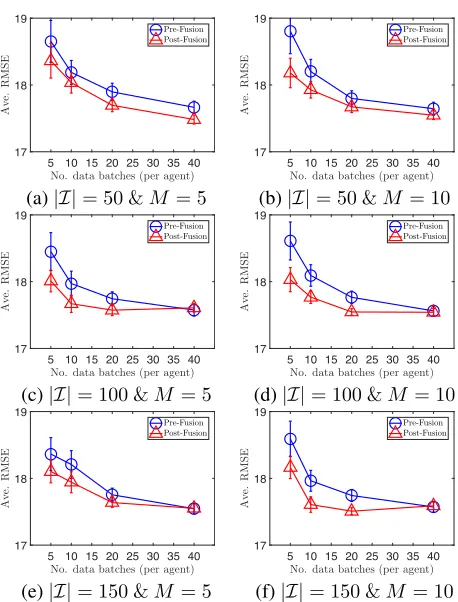
Figure 1: Graphs of averaged pre- and post-fusion perfor-mance vs. the no. of data batches dispatched to2agents with varying numbers|I|of andM.
to demonstrate the fusion performance of our COOL-GP framework in such distributed streaming data settings.
Fig. 1 reports the results of our COOL-GP framework in a collective online learning scenario where two agents fuse their online sparse GP models of two correlated, synthetic phenomena to improve their averaged performance on test instances from their input localities. Fig. 2 further reports the performance of COOL-GP in a real-world traffic monitoring application deployed on a large, decentralized network con-sisting of100agents. Both of these cases demonstrate the ef-fectiveness of COOL-GP fusion on the averaged predictive accuracy vs. varying numbers of streamed data batches for different numbers|I|of inducing inputs andM of projec-tion matrix samples (Secprojec-tion 3.1). Across all configuraprojec-tions, a consistent pattern can be observed: (a) post-fusion predic-tions exhibit significant performance gain as compared to pre-fusion predictions, and (b) the performance gap gradu-ally reduces with more gathered data, which suggests a di-minishing marginal gain of model fusion.
Fig. 3a demonstrates the computational benefit of COOL-GP (100agents, 30data batches per agent) by comparing the total of its averaged incurred time (per agent) against the running time of DTC and PITC (Qui˜nonero-Candela and Rasmussen 2005), which correspond to the sequential ver-sions ofdDTC anddPITC. The result shows that for6000
data points, DTC and PITC incur445and1145seconds
re-5 10 15 20 25 30
No. data batches (per agent) 14 16 18 20 22 24 Av e. RMSE (km/h) Pre-Fusion Post-Fusion
5 10 15 20 25 30
No. data batches (per agent)
14 16 18 20 22 24 Av e. RMSE (km/h) Pre-Fusion Post-Fusion
(a)|I|= 50 &M = 5 (b)|I|= 50 &M = 20
5 10 15 20 25 30
No. data batches (per agent) 14 16 18 20 22 24 Av e. RMSE (km/h) Pre-Fusion Post-Fusion
5 10 15 20 25 30 No. data batches (per agent) 14 16 18 20 22 24 Av e. RMSE (km/h) Pre-Fusion Post-Fusion
(c)|I|= 100 &M = 5 (d)|I|= 100 &M = 20
5 10 15 20 25 30
No. data batches (per agent) 14 16 18 20 22 24 Av e. RMSE (km/h) Pre-Fusion Post-Fusion
5 10 15 20 25 30
No. data batches (per agent) 14 16 18 20 22 24 Av e. RMSE (km/h) Pre-Fusion Post-Fusion
(e)|I|= 200 &M = 5 (f)|I|= 200 &M = 20
Figure 2: Graphs of averaged pre- and post-fusion perfor-mance vs. no. of data batches of100agents gathering data from the same traffic phenomenon with varying|I|andM.
spectively. On the other hand, COOL-GP’s averaged pro-cessing time per agent is 13 seconds, which is 34.23and
88.07times faster than DTC and PITC, respectively. Fig. 3b further shows that the predictive performance and process-ing time (per agent) of COOL-GP, respectively, increases and decreases with more participating agents.
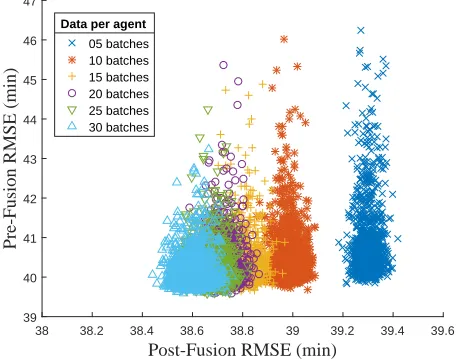
Fig. 4 visualizes a comprehensive collection of individual performance profiles of 1000 agents in the AIRLINE do-main; each profile is represented by a pair of pre- and post-fusion RMSEs. The result shows that with more gathered data, clusters of performance profiles (i.e., each cluster is visualized by a colored point cloud) gradually migrate to-wards regions with superior pre- and post-fusion accuracy. The migration distance, however, reduces rapidly in later stages of data gathering, which is consistent with the previ-ous observation on the diminishing return of model fusion. Interestingly, it can also be observed that within each cluster, the performance profiles exhibit high variance for pre-fusion and low variance for post-fusion performance, which sug-gests that agents are able to achieve post-fusion consensus within small range of variation (i.e., fusion stability).
2000 3000 4000 5000 6000 Total no. data points
100
101
102
103
104
P
ro
ce
ss
in
g
ti
m
e
(s
ec
) COOL-GP
DTC PITC
25 50 100
No. agents 10
15
RMSE (km/h)
0 10 20 30
Time (sec)
Performance Processing Time
(a) (b)
Figure 3: Graphs of (a) processing time vs. total no. of data points of DTC, PITC and COOL-GP; and (b) RMSE vs. no. of agents (25, 50 and100) of COOL-GP (30 batches per agent andM = 20) tested on AIMPEAK dataset.
38 38.2 38.4 38.6 38.8 39 39.2 39.4 39.6
Post-Fusion RMSE (min)
39 40 41 42 43 44 45 46 47
Pre-Fusion RMSE (min)
05 batches 10 batches 15 batches 20 batches 25 batches 30 batches
Data per agent
Figure 4: Graphs of individual performance profiles (pre-vs. post-fusion RMSE) of a1000-agent system collectively learning using our COOL-GP framework in the AIRLINE domain (Hensman, Fusi, and Lawrence 2013).
as expected whereas A2 still exhibits gain in performance as it receives more data. With fusion, however, the perfor-mance of A1is brought close to that of A2and far exceeds its original accuracy. More interestingly, it can be observed that the performance of A2also marginally improves upon fusion with a conservative A1who never gathers new data to update its model. This demonstrates that COOL-GP greatly benefits agents with lesser learning capabilities and, at the same time, mildly improves the performance of those with better capabilities (i.e., resilience to information disparity).
Finally, in the traffic domain (i.e., AIMPEAK), we present another interesting case study that features a collective on-line learning scenario among 100 agents where each mes-sage transmission (or local statistics in the cases of dis-tributed GPs such as dDTC (Gal, van der Wilk, and Ras-mussen 2014) anddPITC (Hoang, Hoang, and Low 2016)) may not reach its destination with a certain probability. The averaged post-fusion performance are plotted against the rate of transmission loss to demonstrate the robustness of COOL-GP to transmission loss. Fig. 5b shows that as trans-mission losses occur more frequently, the averaged
perfor-5 10 15 20 25 30
No.Nof streaming data batches
14 15 16 17 18 19
RMSE
(km/h)
Post-Fusion (A1) Post-Fusion (A2) Pre-Fusion (A1) Pre-Fusion (A2)
0 0.1 0.2 0.3 0.4 0.5
Rate of Transmission Loss
12 14 16 18 20
RMSE
(km/h)
COOL-GP
dDTC
dPITC
(a) (b)
Figure 5: Graphs of (a) pre- and post-fusion individual per-formance of two agents with different learning capabilities, and (b) post-fusion performance of COOL-GP in compari-son to those of state-of-the-art distributed GPs (e.g.,dDTC anddPITC) vs. rate of transmission loss in AIMPEAK.
mance of COOL-GP agents degrades more gracefully than those of the state-of-the-art2 distributeddDTC anddPITC frameworks which employ a central server to coordinate the communications between agents. This is expected since both dDTC anddPITC require every agent to successfully trans-mit its summary statistics directly to a single master server. Failing to achieve this immediately leads to irrecoverable in-formation loss. In contrast, COOL-GP allows each agent to exchange its summary statistics with multiple agents within its communication range (Section 3.1), thus lowering the risk of losing information.
Conclusion
This paper describes a novel COOL-GP framework for en-abling a massive number of agents to simultaneously per-form (a) efficient online updates of their GP models using their local streaming data with varying correlation struc-tures and (b) decentralized fusion of their resulting online GP models with different learned hyperparameters and in-ducing inputs. We exploit the notion of a common encod-ing structure to encapsulate the local streamencod-ing data gath-ered by any GP inference agent into summary statistics, which is amenable to both efficient online update as well as multi-agent model fusion that exploits sparse connectiv-ity among agents for improving efficiency and enhance the robustness of our framework against transmission loss (Sec-tion 3). We also provide a rigorous theoretical analysis of the approximation loss arising from our proposed representation to achieve efficient online updates and model fusion (Sec-tion 3.1). Empirical evalua(Sec-tions on real-world datasets show that our framework performs efficiently on various settings and can scale to thousands of agents (Section 3.1).
Acknowledgments. This research was funded in part by the Army Research Laboratory and was accomplished under Cooperative Agreement Number W911NF-17-2-0181 and by ONR under the BRC N00014-17-1-2072. It was also sup-ported in part by Singapore Ministry of Education Academic Research Fund Tier2, MOE2016-T2-2-156.
2
References
Allamraju, R., and Chowdhary, G. 2017. Communication ef-ficient decentralized Gaussian process fusion for multi-UAS path planning. InProc. ACC.
Bui, T. D.; Nguyen, C. V.; and Turner, R. E. 2017. Streaming sparse Gaussian process approximations. InProc. NIPS. Chen, J.; Low, K. H.; Tan, C. K.-Y.; Oran, A.; Jaillet, P.; Dolan, J. M.; and Sukhatme, G. S. 2012. Decentralized data fusion and active sensing with mobile sensors for modeling and predicting spatiotemporal traffic phenomena. InProc. UAI, 163–173.
Chen, J.; Cao, N.; Low, K. H.; Ouyang, R.; Tan, C. K.-Y.; and Jaillet, P. 2013. Parallel Gaussian process regression with low-rank covariance matrix approximations. InProc. UAI, 152–161.
Chen, J.; Low, K. H.; Jaillet, P.; and Yao, Y. 2015. Gaussian process decentralized data fusion and active sensing for spa-tiotemporal traffic modeling and prediction in mobility-on-demand systems.IEEE Transactions on Automation Science and Engineering12(3):901–921.
Chen, J.; Low, K. H.; and Tan, C. K.-Y. 2013. Gaussian process-based decentralized data fusion and active sensing for mobility-on-demand system. InProc. RSS.
Cheng, C.-A., and Boots, B. 2016. Incremental variational sparse Gaussian process regression. InProc. NIPS.
Csat´o, L., and Opper, M. 2002. Sparse online Gaussian processes.Neural Computation14(3):641–669.
Deisenroth, M. P., and Ng, J. W. 2015. Distributed Gaussian processes. InProc. ICML.
Gal, Y.; van der Wilk, M.; and Rasmussen, C. 2014. Dis-tributed variational inference in sparse Gaussian process re-gression and latent variable models. InProc. NIPS.
Hensman, J.; Fusi, N.; and Lawrence, N. D. 2013. Gaussian processes for big data. InProc. UAI, 282–290.
Hoang, T. N.; Low, K. H.; Jaillet, P.; and Kankanhalli, M. 2014. Nonmyopic-Bayes-optimal active learning of Gaus-sian processes. InProc. ICML, 739–747.
Hoang, T. N.; Hoang, Q. M.; Low, K. H.; and How, J. P. 2018a. Collective online learning of Gaussian processes in massive multi-agent systems. arXiv:1805.09266.
Hoang, T. N.; Xiao, Y.; Sivakumar, K.; Amato, C.; and How, J. 2018b. Near-optimal adversarial policy switching for decentralized asynchronous multi-agent systems. In Proc. ICRA.
Hoang, T. N.; Hoang, Q. M.; and Low, K. H. 2015. A unifying framework of anytime sparse Gaussian process re-gression models with stochastic variational inference for big data. InProc. ICML, 569–578.
Hoang, T. N.; Hoang, Q. M.; and Low, K. H. 2016. A dis-tributed variational inference framework for unifying par-allel sparse Gaussian process regression models. In Proc. ICML, 382–391.
Hoang, Q. M.; Hoang, T. N.; and Low, K. H. 2017. A gener-alized stochastic variational Bayesian hyperparameter
learn-ing framework for sparse spectrum Gaussian process regres-sion. InProc. AAAI, 2007–2014.
Kang, J. J., and Larkin, H. 2016. Inference of personal sensors in internet of things. International Journal of Infor-mation, Communication Technology and Applications2:1. Liu, H.; Cai, J.; Wang, Y.; and Ong, Y.-S. 2018. Gener-alized robust Bayesian committee machine for large-scale Gaussian process regression. InProc. ICML.
Low, K. H.; Chen, J.; Hoang, T. N.; Xu, N.; and Jaillet, P. 2015a. Recent advances in scaling up Gaussian process pre-dictive models for large spatiotemporal data. In Proc. Dy-DESS, 167–181.
Low, K. H.; Yu, J.; Chen, J.; and Jaillet, P. 2015b. Parallel Gaussian process regression for big data: Low-rank repre-sentation meets Markov approximation. InProc. AAAI. Min, W., and Wynter, L. 2011. Real-time road traffic pre-diction with spatio-temporal correlations. Transport. Res. C-Emer.19(4):606–616.
Natarajan, P.; Hoang, T. N.; Wong, Y.; Low, K. H.; and Kankanhalli, M. S. 2014. Scalable decision-theoretic co-ordination and control for real-time active multi-camera surveillance. InProc. ICDSC, 115–120.
Ouyang, R., and Low, K. H. 2018. Gaussian process de-centralized data fusion meets transfer learning in large-scale distributed cooperative perception. InProc. AAAI.
Ouyang, R.; Low, K. H.; Chen, J.; and Jaillet, P. 2014. Multi-robot active sensing of non-stationary Gaussian process-based environmental phenomena. InProc. AAMAS. Qui˜nonero-Candela, J., and Rasmussen, C. E. 2005. A uni-fying view of sparse approximate Gaussian process regres-sion.Journal of Machine Learning Research6:1939–1959. Rasmussen, C. E., and Williams, C. K. I. 2006. Gaussian Processes for Machine Learning. MIT Press.
Robbins, H., and Monro, S. 1951. A stochastic approxima-tion method.Ann. Math. Statist.22(3):400–407.
Snelson, E. L., and Ghahramani, Z. 2007. Local and global sparse Gaussian process approximation. InProc. AISTATS. Titsias, M. K., and L´azaro-Gredilla, M. 2013. Variational inference for Mahalanobis distance metrics in Gaussian pro-cess regression. InProc. NIPS.
Titsias, M. K. 2009. Variational learning of inducing vari-ables in sparse Gaussian processes. InProc. AISTATS. Wang, Y., and Papageorgiou, M. 2005. Real-time freeway traffic state estimation based on extended Kalman filter: a general approach. Transport. Res. B-Meth.39(2):141–167. Work, D. B.; Blandin, S.; Tossavainen, O.; Piccoli, B.; and Bayen, A. 2010. A traffic model for velocity data assimila-tion. AMRX2010(1):1–35.
Xu, N.; Low, K. H.; Chen, J.; Lim, K. K.; and ¨Ozg¨ul, E. B. 2014. GP-Localize: Persistent mobile robot localization us-ing online sparse Gaussian process observation model. In
Proc. AAAI, 2585–2592.