ISSN: 2008-6822 (electronic) http://www.ijnaa.com
EQUILIBRIUM PROBLEMS AND FIXED POINT PROBLEMS FOR NONSPREADING-TYPE MAPPINGS IN HILBERT SPACE
URAILUK SINGTHONG1AND SUTHEP SUANTAI2∗
Abstract. In this paper by using the idea of mean convergence, we introduce an iterative scheme for finding a common element of the set of solutions of an equilibrium problem and the fixed points set of a nonspreading-type mappings in Hilbert space. A strong convergence theorem of the proposed iterative scheme is established under some control conditions. The main result of this paper extend the results obtained by Osilike and Isiogugu (Nonlinear Analysis 74 (2011) 1814-1822) and Kurokawa and Takahashi (Nonlinear Analysis 73 (2010) 1562-1568). We also give an example and numerical results are also given.
1. Introduction
Let C be a nonempty closed convex subset of a real Hilbert spaced H. Then a mapping T : C → C is said to be nonexpansive if kT x−T yk ≤ kx−yk for all
x, y ∈C. A mapping F is said to be f irmly nonexpansive if
kF x−F yk2 ≤ hx−y, F x−F yi
for allx, y ∈C; see, for instance, Browder [3], Goebel and Kirk [6]. It is also known that a firmly nonexpansive mapping F is deduced from an equilibrium problem in a Hilbert space as follows: Let C be a nonempty closed convex subset of H. Let f
be a bifunction fromC×C toR satisfying (A1)f(x, x) = 0, ∀x∈C;
(A2)f is monotone, i.e.f(x, y) +f(y, x)≤0, ∀x, y ∈C; (A3)∀x, y, z ∈C, limt→0+f(tz+ (1−t)x, y)≤f(x, y);
(A4)∀x∈C, y 7→f(x, y) is convex and lower semicontinuous.
We know the following theorem; see, for instance, [2, 5].
Theorem 1.1. Let C be a nonempty closed convex subset of a real Hilbert spaced H and let f be a bifunction from C×C to R satisfying (A1)−(A4). Let r >0 and x∈H, Then, there exists z ∈C such that
f(z, y) + 1
rhy−z, z−xi ≥0 f or all y ∈C. (1.1)
Date:Received: April 2011; Revised: June 2011. 2000Mathematics Subject Classification. 47H09, 47H10.
Key words and phrases. k-strictly pseudononspreading mappings; nonspreading mappings; fixed points; strong convergence; equilibrium problem; Hilbert spaces.
∗: Corresponding author.
Further, for anyr >0 andx∈H, defineTr :H →C byz =Trx. Then,Tris firmly
nonexpansive, i.e.,
kTrx−Tryk2 ≤ hx−y, Trx−Tryi, ∀x, y ∈H.
On the other hand, a mapping T :C →C is said to be quasi−nonexpansiveif
F(T)6=∅and
kT x−qk ≤ kx−qk
for all x ∈ C and q ∈ F(T), where F(T) is the set of fixed points of T. If T is a nonspreading mapping from C into itself and the set F(T) is nonempty, then T
is nonexpansive. Further, we know that the set of fixed points of a quasi-nonexpansive mapping is closed and convex; see [10]. Then we can define the metric projection ofH ontoF(T).
In 2010, Kohsaka and Takahashi [11, 12] introduced the following nonlinear map-ping: Let E be a smooth, strictly convex and reflexive Banach space, let j be the duality mapping of E and let C be a nonempty closed convex subset of E. Then, a mapping T :C→C nonspreading is said to be if
φ(T x, T y) +φ(T y, T x)≤φ(T x, y) +φ(T y, x)
for allx, y ∈C, whereφ(x, y) =kxk2−2hx, j(y)i+kyk2, ∀x, y ∈E.They considered
the class of nonspreading mappings to study the resolvents of a maximal monotone operators in the Banach space. In the case whenE is a Hilbert space, we know that
φ(x, y) = kx−yk2 for all x, y ∈ E. So, a nonspreading mapping T : C → C in a
Hilbert spaceH is defined as follows:
2kT x−T yk2 ≤ kT x−yk2+kT y−xk2 (1.2)
for all x, y ∈C. Iemoto and Takahashi [8] prove that T :C →C is nonspreading if and only if
kT x−T yk2 ≤ kx−yk2+ 2hx−T x, y−T yi (1.3)
for allx, y ∈C. We also know that a nonspreading mapping is deduced from a firmly nonexpansive mapping; see [9, 11,17]. A strong convergence theorem of the hybrid type for nonspreading mappings have been proved by Matsushita and Takahashi [14].
By using an idea of mean ergodic theorem of Baillon’s type, Kurokawa and Taka-hashi [13] introduced two iterative schemes for finding a fixed point of a nonspreading mapping. Weak and strong convergence theorems of the proposed iterative schemes in Hilbert spaces are proved under some control conditions.
Later in 2010, Osilike and Isiogugu [16] introduce a new class of nonspreading-type of mappings which is more general than the class studied in Kurokawa and Takahashi [13] in Hilbert spaces. By using the idea of mean convergence, they proved a weak mean convergence theorem of Baillons type similar to the ones obtained in [13] for the class of nonspreading-type mappings. Furthermore, using an idea of mean convergence, they also proved a strong convergence theorem similar to the one obtained in [13].
2. Preliminaries and lemmas
Throughout this paper, we denote by H a real Hilbert space with inner product
h·,·i and norm k · k. We also denote by N the set of natural numbers. In a Hilbert space, it is known that
Lemma 2.1. [16] Let H be a real Hilbert space. Then the following well known results hold:
(1) ktx+ (1−t)yk2 =tkxk2+ (1−t)kyk2−t(1−t)kx−yk2, for all x, y ∈H and for all t ∈[0,1].
(2) kx+yk2 ≤ kxk2+ 2hy, x+yi for all x, y ∈H.
(3) If {xn}∞n=1 is a sequence in H which converges weakly to z ∈H then
lim sup
n→∞
kxn−yk2 = lim sup n→∞
(kxn−zk2+kz−yk2), ∀y ∈H.
LetC be a closed convex subset ofH and letT be a mapping ofC into itself. We denote by F(T) the set of all fixed points of T, that is, F(T) = {z ∈ C :T z =z}. We denote the strong convergence and the weak convergence of {xn} to x ∈ H by xn → x. We can define the metric projection of H onto C: For each x ∈H, there
exists a unique point z ∈C such that
kx−zk=min{kx−yk:y∈C}
For every point x ∈ H, such that a point z denoted by PC(x) and P is called the metric projectionof H ontoC. It is known that
hx−PCx, y−PCxi ≤0, ∀y∈C
for each x∈H and y∈C; see [18] for more details.
Lemma 2.2. [19] LetC be nonempty closed convex subset of a real Hilbert space H. Let PC : H →C be the metric projection of H onto C. Let {xn}∞n=1 be sequence in C and let kxn+1−uk ≤ kxn−uk for alluin C. Then{PCxn}∞n=1 converges strongly.
The following lemma was also given in [5]
Lemma 2.3. [5] Let C be a nonempty closed convex subset of a Hilbert space H and f : C×C → R satisfy (A1)−(A4). For r > 0 and x ∈ H, define a mapping Tr :H →C as follows:
Tr(x) ={z ∈C :f(z, y) +
1
rhy−z, z−xi ≥0, ∀y∈C} f or all x∈H. (2.1) Then the following hold:
(1) Tr is is single-valued;
(2) Tr is firmly nonexpansive, i.e., for all x, y ∈H,
kTr(x)−Tr(y)k2 ≤ hTr(x)−Tr(y), x−yi; (3) F(Tr) = EP(f);
(4) EP(f) is closed and convex.
Lemma 2.4. [1, 20] Let {an}∞n=1 be a sequence of non-negative real numbers satis-fying the condition
an+1 ≤(1−αn)an+αnβn, n≥0, where {αn}∞n=1 and {βn}∞n=1 are real sequences such that
(i) {αn}∞n=1 ⊂[0,1] and P∞
(ii) lim supn→∞βn≤0. Then limn→∞an= 0.
Let H be a real Hilbert space. Following the terminology of Browder-Petryshyn [4], we say that a mappingT :D(T)⊆H :→H isk−strictly pseudononspreading
if there existsk ∈[0,1) such that
kT x−T yk2 ≤ kx−yk2+kkx−T x−(y−T y)k2+ 2hx−T x, y−T yi, (2.2)
for all x, y ∈ D(T). Clearly every nonspreading mapping is k-strictly psedonon-spreading. The class of k-strictly pseudononspreading mapping is more general than the class of nonspreading mappings (see example [16]).
Observe that if T is k-strictly pseudononspreading and F(T) 6= ∅, then for all
x∈D(T) and for all p∈F(T) we have
kT x−pk2 ≤ kx−pk2+kkx−T xk2. (2.3)
Thus every k-strictly pseudononspreading map with a nonempty fixed point set
F(T) is demicontractive (see example [7], [15]).
Lemma 2.5. [16] LetC be nonempty closed convex subset of a real Hilbert space H. and let T :C → C be k-strictly pseudononspreading mapping. If F(T)6=∅, then it is closed and convex.
Lemma 2.6. [16] Let C be nonempty closed convex subset of a real Hilbert space H. and let T : C → C be k-strictly pseudononspreading mapping. Then (I−T) is demiclosed at 0.
3. Main Results
We first prove a strong convergence theorem.
Theorem 3.1. Let C be a nonempty closed convex subset of of a real Hilbert space. Let f be a bifunction from C ×C to R satisfying (A1)-(A2) and let T : C → C be a k-strictly pseudononspreading mapping with a nonempty fixed point set and F(T)T
EP(f)6=∅. Letβ ∈[k,1)and letTβ :=βI+ (1−β)T. Let{αn}∞n=1 ⊂[0,1)
and {rn}∞n=1 ⊂(0,∞) satisfying the conditions:
lim
n→∞αn = 0, ∞ X
n=1
αn =∞ and lim inf
n→∞ rn >0.
Let u ∈ C and let {xn}∞n=1, {un}∞n=1 and {zn}∞n=1 be sequence in C generated from an arbitrary x1 ∈C by
f(un, y) + rn1 hy−un, un−zni ≥0, ∀y∈C, xn+1 =αnu+ (1−αn)un, n≥1,
zn= 1n Pn−1
m=0Tβmxn, n≥1.
(3.1)
Then{xn}∞n=1,{un}n=1∞ and{zn}∞n=1 converge strongly toPF(T)T
EP(f)u, wherePF(T)T
EP(f) : H →F(T)T
EP(f) is the metric projection of H ontoF(T)T
Proof. LetTβx:=βx+(1−β)T x. It is clear thatF(Tβ) = F(T) and for allx, y ∈C,
we have
kTβx−Tβyk2 = kβ(x−y) + (1−β)(T x−T y)k2
= βkx−yk2+ (1−β)kT x−T yk2−β(1−β)kx−T x−(y−T y)k2
≤ βkx−yk2−β(1−β)kx−T x−(y−T y)k2
+(1−β)kx−yk2+kkx−T x−(y−T y)k2+ 2hx−T x, y−T yi
= kx−yk2−β(1−β)kx−T x−(y−T y)k2
+k(1−β)kx−T x−(y−T y)k2+ 2(1−β)hx−T x, y−T yi
= kx−yk2−(1−β)(β−k)kx−T x−(y−T y)k2
+2(1−β)hx−T x, y−T yi
≤ kx−yk2+ 2(1−β)hx−T x, y−T yi
= kx−yk2+ 2
(1−β)hx−Tβx, y−Tβyi. (3.2)
Letp∈F(T)T
EP(f). Then from un =Trnxn, using (3.2) we obtain
kzn−pk = k
1
n n−1 X
m=0
Tβmxn−pk
≤ 1
n n−1 X
m=0
kTβmxn−pk ≤
1
n n−1 X
m=0
kxn−pk|=kxn−pk. (3.3)
Thus
kxn+1−pk = kαnu+ (1−αn)un−pk
= kαnu+ (1−αn)Trnzn−pk
≤ αnku−pk+ (1−αn)kTrnzn−pk
≤ αnku−pk+ (1−αn)kzn−pk
≤ αnku−pk+ (1−αn)kxn−pk. (3.4)
By (3.4) and induction, we can conclude that for all n∈N
kxn−pk ≤max{ku−pk,kx1 −pk}.
This implies that {xn} and {zn} are bounded. Since kTβnun−pk ≤ kun−pk and
kun−pk=kTrnzn−pk ≤ kzn−pk ≤ kxn−pk, we have that {Tβnun} and {un} are
also bounded.
Observe that since{un} is bounded and limn→∞αn = 0, we obtain
kxn+1−unk = kαnu+ (1−αn)un−unk
= αnku−unk →0 as n → ∞. (3.5)
Put Ω := F(T)T
EP(f). We may assume without loss of generality that there exists a subsequence {xnj} of {xn}such that
lim sup
n→∞
hu−PΩu, xn−PΩui= lim
j→∞hu−PΩu, xnj −PΩui,
unj * w as j → ∞. Next we will show that w ∈ F(T). Using (3.2) we obtain for
allm = 0,1,2, ..., n−1 and for arbitrary y∈C
kTβm+1xn−Tβyk2 = kTβ(Tβmxn)−Tβyk2
≤ kTβmxn−yk2+
2 1−βhT
m
β xn−Tβm+1xn, y −Tβyi
= kTβmxn−Tβy+Tβy−yk2+
2 1−βhT
m
β xn−Tβm+1xn, y−Tβyi
= kTβmxn−Tβyk2+kTβy−yk2+ 2hTβmxn−Tβy, Tβy−yi
+ 2
1−βhT m
β xn−Tβm+1xn, y−Tβyi. (3.6)
Summing (3.6) from m = 0 ton−1 and dividing by n we obtain
1
nkT n
βxn−Tβyk2 ≤
1
nkxn−Tβyk 2+kT
βy−yk2+ 2hzn−Tβy, Tβy−yi
+ 2
n(1−β)hxn−T
n
βxn, y−Tβyi. (3.7)
Replacing n by nj in (3.7) we obtain
1
nj
kTβnjxnj −Tβyk2 ≤
1
nj
kxnj−Tβyk2+kTβy−yk2+ 2hznj −Tβy, Tβy−yi
2
nj(1−β)
hxnj −T nj
β xnj, y−Tβyi. (3.8)
Since {xn} and {Tβnxn}are bounded, letting j → ∞ in (3.8) yields
0 ≤ kTβy−yk2+ 2hw−Tβy, Tβy−yi. (3.9)
Since y∈C was arbitrary, if we set y=w in (3.9) we obtain
0 ≤ kTβw−wk2−2kTβw−wk2,
from which it follows that w∈F(Tβ) = F(T).
Since PΩ :H →Ω is the metric projection, we have
lim
j→∞hu−PΩu, xnj−PΩui=hu−PΩu, w−PΩui ≤0.
Hence we have lim supn→∞hu−PΩu, xn−PΩui ≤0. Using Lemma2.1(ii) and (3.3)
we have
kxn+1−PΩuk2 = kαnu+ (1−αn)un−PΩuk2
= kαnu+ (1−αn)Trnzn−PΩuk2
= kαnu−αnPΩu+ (1−αn)Trnzn−(1−αn)PΩuk2
= kαn(u−PΩu) + (1−αn)(Trnzn−PΩu)k2
≤ (1−αn)2kTrnzn−PΩuk2+ 2αnhu−PΩu, xn+1−PΩui
≤ (1−αn)2kzn−PΩuk2+ 2αnhu−PΩu, xn+1−PΩui ≤ (1−αn)2kxn−PΩuk2+ 2αnhu−PΩu, xn+1−PΩui.
Since αn →0, P∞
n=1αn=∞ and lim supn→∞hu−PΩu, xn+1−PΩui ≤0, it follows
from Lemma 2.4 that limn→∞kxn−PΩuk= 0.
0≤ kun−PΩuk ≤ kun−xn+1k+kxn+1−PΩuk →0 as n → ∞.
Hence limn→∞kun−PΩuk= 0.
Since kxn − PΩuk → 0, we have kxn+1 −xnk → 0. In sequence, we show that
kzn−unk →0, as n→ ∞. For p∈F(T) T
EP(f), we have
kzn−pk2 = kTrnzn−Trnpk2 ≤ hTrnzn−Trnp, zn−pi
= hun−p, zn−pi
= 1
2(kun−pk
2+kz
n−pk2− kzn−unk2) (3.11)
and hence kun−pk2 ≤ kzn−pk2− kzn−unk2.
Therefore, from the convexity of k · k2, we have
kxn+1−pk2 = kαnu+ (1−αn)un−pk2
= kαnu+ (1−αn)Trnzn−pk2
≤ αnku−pk2+ (1−αn)kTrnzn−pk2
≤ αnku−pk2+ (1−αn)kun−pk2
≤ αnku−pk2+ (1−αn)(kzn−pk2− kzn−unk2)
≤ αnku−pk2+ (1−αn)(kxn−pk2− kzn−unk2)
≤ αnku−pk2+kxn−pk2−(1−αn)kxn−unk2
and hence
(1−αn)kzn−unk2 ≤ αnku−pk2+kxn−pk2 − kxn+1−pk2
≤ αnku−pk2+kxn+1−xnk(kxn−pk+kxn+1−pk).
So, we havekzn−unk →0, andkzn−PΩuk ≤ kzn−unk+kun−PΩuk →0 as n→ ∞.
This impliesunj →wasj → ∞. Finally, we prove thatw∈EP(f).Byun=Trnzn,
we have
f(un, y) +
1
rn
hy−un, un−zni ≥0, ∀y∈C.
From (A2), we also have 1
rnhy−un, un−zni ≥f(y, un), ∀y∈C,
and hence
hy−unj,
unj −znj
rnj i ≥f(y, unj), ∀y∈C.
Since unjr−znj
nj →0 andunj * w, from (A4) we have 0≥f(y, w) for ally ∈C. For t
with 0< t≤ 1 and y∈C, let yt =ty+ (1−t)w. Since y∈ C and w∈C, we have yt ∈C and hence f(yt, w)≤0. So, from (A1) and (A4) we have
0 = f(yt, yt)
≤ tf(yt, y) + (1−t)f(yt, w)
and hence 0 ≤ f(yt, y). From (A3), we have 0 ≤ f(w, y) for all y ∈ C and hence w∈EP(F). Therefore w∈F(T)T
EP(f).
If f(x, y) = 0, ∀(x, y) ∈ C ×C, we have that un = zn for all n ∈ N. Hence the
following Corollary is directly obtained by Theorem 3.1
Corollary 3.2. ([16], Theorem 3.2) Let C be a nonempty closed convex subset of of a real Hilbert space. Let f be a bifunction from C×C to R satisfying (A1)-(A2) and let T : C → C be a k-strictly pseudononspreading mapping with a nonempty fixed point set and F(T)T
EP(f)6=∅. Let β ∈ [k,1) and let Tβ :=βI+ (1−β)T. Let {αn}∞n=1 ⊂[0,1) satisfying the conditions:
lim
n→∞αn = 0, and ∞ X
n=1
αn=∞
and let {xn}∞
n=1 and {zn}∞n=1 be sequences in C generated from an arbitrary x1 ∈C by
(
xn+1 =αnu+ (1−αn)zn, n≥1,
zn= 1nPn−1m=0Tβmxn, n ≥1, (3.12)
Then {xn}∞n=1 and {zn}∞n=1 converge strongly to PF(T)T
EP(f)u, where PF(T)T
EP(f) : H →F(T)T
EP(f) is the metric projection of H ontoF(T)T
EP(f).
Remark 3.3. If T is nonspreading, then T is 0-strictly pseudononspreading. By putting β = 0, then T0 = T. By Theorem 3.1, we obtain the result of Kurokawa
and Takahashi ([13], Theorem 4.1).
4. Example and numerical results
In this section, we give examples and numerical results for our main theorem.
Example 4.1. LetT : [−9,3]→[−9,3] be define by
T x=
x, [-9, 0);
−3x, [0, 3].
LetH =R and C = [−9,3], and let f(x, y) =y2+xy−2x2. Find ˆx∈[−9,3] such
that
F(ˆx, y) + 1
rhy−x,ˆ xˆ−zi ≥0, ∀y∈[−9,3].
Solution. To see that T is k−strictly pseudononspreading, if x, y ∈[−9,0), then
|T x−T y|2 =|x−y|2+k|x−T x−(y−T y)|2+ 2hx−T x, y−T yi ∀k ∈[0,1),
since |T x−T y|2 =|x−y|2, and k|x−T x−(y−T y)|2 = 2hx−T x, y−T yi= 0.
For allx, y ∈[0,3], we have|T x−T y|2 = 9|x−y|2,|x−T x−(y−T y)|2 = 16|x−y|2
and 2hx−T x, y−T yi= 32xy ≥0. Thus
|T x−T y|2 = 9|x−y|2 =|x−y|2+1
2|x−T x−(y−T y)|
2
≤ |x−y|2+ 1
2|x−T x−(y−T y)|
Finally for allx∈[−9,0), y ∈[0,3] we have|T x−T y|2 =|x+ 3y|2 =x2+ 6xy+ 9y2,
2hx−T x, y−T yi= 0, and 12|x−T x−(y−T y)|2 = 8y2. Hence
|x−y|2+1
2|x−T x−(y−T y)|
2
+ 2hx−T x, y−T yi
=x2−2xy+ 9y2
=x2+ 6xy+ 9y2 −8xy
≥x2 + 6xy+ 9y2 (since−8xy ≥0)
= (x+ 3y)2 =|x+ 3y|2 =|T x−T y|2.
Hence, for all x, y ∈[−9,3], we obtain
|T x−T y|2 ≤ |x−y|2+1
2|x−T x−(y−T y)|
2+ 2hx−T x, y−T yi.
ThusT is 12−strictly pseudononspreading, observe that F(T) = [−9,0].We observe that if x= 1, y= 0,
|T x−T y|2 = 9|x−y|2 = 9>1 =|x−y|2+ 2hx−T x, y−T yi
So T is not nonspreading. For r > 0 and z ∈ [−9,3], by Lemma 2.3, there exists
x∈[−9,3] such that for each y∈[−9,3]
f(x, y) + 1
rhy−x, x−zi ≥0
⇔y2+xy−2x2+1
r(y−x)(x−z)≥0
⇔ry2+rxy−2rx2+xy−x2−yz+xz ≥0
⇔ry2+ (rx+x−z)y−(2rx2+x2−xz)≥0.
PutG(y) =ry2+ (rx+x−z)y−(2rx2+x2−xz). Then G is a quadratic function
of y with coefficient a = r, b = rx +x−z and c = −(2rx2 +x2 −xz). We next
compute the discriminant ∆ of G as follows:
∆ =b2−4ac
= (rx+x−z)2+ 4r(2rx2+x2−xz)
=z2−2(rx+x)z+ (rx+x)2+ 8rx2+ 4rx2−4rxz
=z2−2rxz−2xz+r2x2+ 2rx2+x2+ 8r2x2+ 4rx2−4rxz
=z2−6rxz−2xz+ 9r2x2+ 6rx2+x2
=z2−2(3rx+x) + (9r2+ 6r+ 1)x2
= [z−(3r+ 1)x]2
We know that G(y)≥0 for ally ∈[−9,3]. If it has most one solution in [−9,3], so ∆≤0 and hence z = 3rx+x. Now we have x=Trz = 3r+1z .
Since Tβ :=βI+ (1−β)T, we obtain
Tβx=
Let{xn}∞n=1 be the sequence generated by x1 =x∈[−9,3] and
f(un, y) + rn1hy−un, un−zni ≥0, ∀y∈C, xn+1 =αnu+ (1−αn)un, n≥1,
zn = n1 Pn−1
m=0T m
β xn, n≥1,
(4.1)
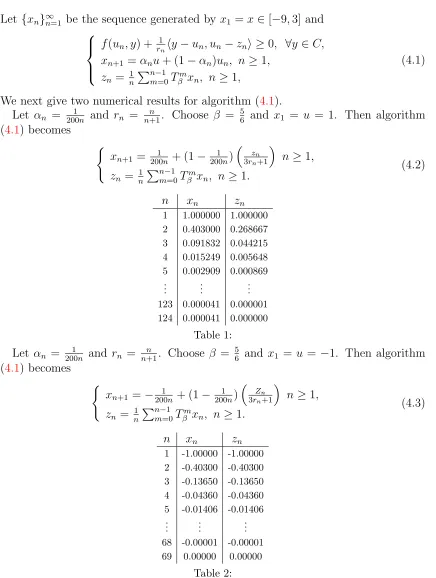
We next give two numerical results for algorithm (4.1).
Let αn = 200n1 and rn = n+1n . Choose β = 56 and x1 = u = 1. Then algorithm
(4.1) becomes
(
xn+1 = 200n1 + (1−200n1 )
zn 3rn+1
n≥1,
zn= 1n Pn−1
m=0T m
β xn, n≥1.
(4.2)
n xn zn
1 1.000000 1.000000 2 0.403000 0.268667 3 0.091832 0.044215 4 0.015249 0.005648 5 0.002909 0.000869 ..
. ... ...
123 0.000041 0.000001 124 0.000041 0.000000
Table 1:
Let αn = 200n1 and rn = n+1n . Choose β = 56 and x1 = u = −1. Then algorithm
(4.1) becomes
(
xn+1 =−200n1 + (1−200n1 )
Zn 3rn+1
n≥1,
zn= n1Pn−1m=0Tβmxn, n≥1.
(4.3)
n xn zn
1 -1.00000 -1.00000 2 -0.40300 -0.40300 3 -0.13650 -0.13650 4 -0.04360 -0.04360 5 -0.01406 -0.01406
..
. ... ...
68 -0.00001 -0.00001 69 0.00000 0.00000
Table 2:
Conclusion.Table 1 and Table 2 show that the sequence{xn}and{zn}converge to 0 which solves both the equilibrium problem off and the fixed point problem of T. On the other hand, using Lemma2.3 (3) , we can check thatF(Tr) =EP(f) ={0}.
References
1. K. Aoyama, Y. Kimura, W. Takahashi, M. Toyada, Approximation of common fixed points of a countable family of nonexpansive mappings in a Banach space, Nonlinear Anal. 67 (2007) 2350–2360.2.4
2. E. Blum and W. Oettli, From optimization and variational inequalities to equilibrium problems, The Mathematics Student. 63, no.1-4 (1994) 123–145.1
3. F.E. Browder, Convergence theorems for sequences of nonlinear operators in Banach spaces, Math. Z. 100 (1967) 201–225.1
4. F.E. Browder, W.V.Petryshyn, Construction of fixed points of nonlinear mappings in a Hilbert spaces, J. Math. Anal. Appl. 20 (1967) 197–228.2
5. P.L. Combettes, S.A. Hirstoaga, Equilibrium programming in Hilbert spaces, J.Nonlinear Convex Anal. 6 (2005) 117–136.1,2,2.3
6. K. Goebel, W.A. Kirk, Topics in Metric Fixed Point Theory, Cambridge University Press, Cambridge, 1990.1
7. T.L. Hicks and J.R. Kubicek, On the Mann Iterative Process in Hilbert Spaces, J. Math. Anal. Appl. 59 (1997) 498–504.2
8. S. Iemmoto and W. Takahashi, Approximating common fixed points of nonexpansive mappings and nonspreading mappings in a Hilbert space, Nonlinear Anal. 71 (2009) 2080–2089.1
9. T. Igarashi, W. Takahashi, K. Tanaka, Weak convergence theorems for nonspreading mappings and equilibrium problems, in S. Akashi, W. Takahashi, T. Tanaka (Eds), Nonlinear Analysis and Optimization, Yokohama (2009) 75–85.1
10. S. Itoh, W. Takahashi, The common fixed point theory of singlevalued mappings and multivalued mappings, Pacific J. Math. 79 (1978) 493–508.1
11. F. Kohsaka and W. Takahashi, Fixed point theorems for a class of nonlinear mappings relate to maximal monotone operators in Banach spaces, Arch. Math. (Basel) 91 (2008) 166–177.1,1
12. F. Kohsaka and W. Takahashi, Existence and approximation of fixed points of firmly nonexpansive-type mappings in Banach spaces, Siam J. Optim. 19 (2008) 824–835.1
13. F. Kohsaka and W. Takahashi, weak and strong convergence theorems for nonspreading mappings in Hilbert spaces, Nonlinear Anal. 70 (2010) 3110–3118.1,3.3
14. S. Matsushita and W. Takahashi, Weak and strong convergence theorems for relatively nonexpansive mappings in Banach space, Fixed Point Theory Appl. (2004) 37–47.1
15. S.A. Naimpally and K.L. Singh, Extensions of some fixed point theorems of Rhoades, J. Math. Anal. Appl. 96 (1983) 437–446.2
16. M.O. Osilike and F.O. Isiogugu, Weak and strong convergence theorems for nonspreading-type mappings in Hilbert space, Nonlinear Anal. 125 (2010) 3641–3645.
1,2.1,2,2.5, 2.6,3.2
17. W. Takahashi, Fixed point theorems for new nonlinear mappings in a Hilbert space, J. Nonlinear Anal. 11 (2010) 79-88.1
18. W. Takahashi, Nonlinear Functional Analysis, Yokohama Publishers, Yokohama, 2009.
2
19. W. Takahashi and M. Toyoda, Weak convergence theorems for nonexpansive mappings and monotone mappings, J. Optim. Theorey Appl. 118 (2003) 417–428.2.2
20. H.K. Xu, Iterative algorithm for nonlinear operators, J. London. Math. Soc. 2 (2002) 240–2562.4
1
Department of Mathematics, Faculty of Science, Chiang Mai University, Chiang Mai 50200, Thailand
E-mail address: L [email protected]
2
Department of Mathematics, Faculty of Science, Chiang Mai University, Chiang Mai 50200, Thailand