Advanced Ceramics Progress
J o u r n a l H o m e p a g e : w w w . a c e r p . i r
The Comparison of MgO and TiO
2Additives Role on Sintering Behavior and
Microstructures of Reaction-Sintered Alumina-Zirconia-Mullite Composite
S. Abdolazizi*a, R. Naghizadehb, S. Baghshahic
aDepartment of Ceramic, Science and Research Branch, Islamic Azad University, Tehran, Iran
bDepartment of Materials Science and Engineering, Iran University of Science and Technology, Tehran, Iran cDepartment of Engineering and Technology, Imam Khomeini International University, Qazvin, Iran
P A P E R I N F O
Paper history:
Received 21 February 2015
Accepted in revised form 01 November 2015
Keywords:
Alumina-Zirconia-Mullite Composite
MgO TiO2
A B S T R A C T
Alumina-Mullite-Zirconia ceramic composites were prepared by reaction sintering of alumina, zircon mixture and the sintering aids of magnesia and titania at temperatures of 1400 and 1600 ºC for 2 hours. The development of different phases and microstructures of the composites were analysed to assess the relative influence of the additives on the formation of alumina-zirconia-mullite composite. Bulk density, phase combination, and microstructure of the sintered samples were examined by Archimedes method, X-ray diffraction (XRD) and scanning electron microscope (SEM), respectively. The results of the study revealed the successful formation of the alumina-mullite-zirconia composite by the reaction sintering method at temperature of 1600ºC. By the same token, the sample containing 6 wt.% of sintering aid shows improvement in density.
1. INTRODUCTION1
Alumina-mullite-zirconia (AMZ) composites are important groups of refractory materials which are widely used in glass technology as a refractory lining in different zones like walls of furnaces, feeder sections, spouts, tubes, stirrers, ducts, rotor segments, mantle blocks and orifice rings [1].AMZ refractory composites have better corrosion resistance, mechanical properties and thermal shock resistance compare to pure alumina or mullite ceramics as well as alumina/mullite or zirconia/mullite composites.
In AMZ composites, corundum (alumina), mullite, zirconia (tetragonal and/or monoclinic phase) and minor amount of glassy phase are tailored in a way that improve thermo-mechanical and corrosion resistance properties of composites. Corundum with high refractoriness and hardness, mullite with high creep resistance good thermal shock resistance, and zirconia with high toughness and good corrosion resistance form excellent combined properties to AMZ products [2,3,4]. AMZ refractory composites are produced by different routes such as fused cast and reaction sintering of different raw materials such as zircon (ZrSiO4) and
1*Corresponding Author’s Email: [email protected] (S.
Abdolazizi)
alumina (Al2O3). To respond to sintering methods, during firing at high temperature, zircon was decomposed to tetragonal ZrO2 and amorphous SiO2 and then silica reacted with alumina and established mullite which can play an important role in AMZ composites sintering [3,4].
During the process of cooling sintering with the temperature, around 1050°C, tetragonal ZrO2 is transferred to monoclinic form and induced micro cracks in the composites. In the presence of additives like TiO2 in AMZ composition, some of the tetragonal ZrO2 remained as a semi-stabilized phase in composites at room temperature. During the application of these composites in the environment with high thermal or mechanical stresses, the transformation of remained tetragonal to monoclinic has been occurred and it toughened the composites inhibiting crack propagation [5, 6].
The effect of TiO2 or MgO on two component ceramic-ceramic composites such as mullite-ZrO2 in some areas such as sintering, properties and stability of tetragonal ZrO2 were investigated by some researchers [7,8 ]. However in this study, the effects of TiO2 or/and MgO on the microstructure, mechanical properties and sintering behavior of Al2O3-mullite-zirconia composites are investigated.
2. EXPERIMENTAL PROCEDURES
To prepare the alumina-mullite-zirconia composite, α-Al2O3 (d50=63 μm and purity>99.5%), zircon (d50=5 μm and purity>99%) were used as the main raw materials, and MgCO3 (d50=3 μm and purity>99.5%) and TiO2 (d50=2 μm and purity>99% and rutile form) were employed as sintering aids.
Point A in Figure 1. indicates the location of additives without sintering aid tested in this research. As it is observed, this point is located within the composition triangle of alumina, zirconia and mullite; therefore, after firing the final phases would be alumina-zirconia-mullite as well as equilibrium state. The arrow in the figure indicates the cooling path for the selected composition. After reaching the common boundary of Al2O3 and mullite, the mentioned cooling path moves on this line toward Point E (eutectic transformation point), which will constitute the end point for cooling of this compound.
Considering the phase diagram of Al2O3-ZrO2-SiO2 and equation (1), the original materials were portioned in such a way that the final composite contain, by weight, 60% Al2O3, 25% mullite and 15% ZrO2 phases. The previous studies on alumina-zirconia-mullite composites and the reaction sintering of alumina and zirconia had reported better sintering ability and properties of this composite in the above range [9,10,11].
2ZrSiO + (3 + x)Al O → xAl O + 2ZrO + 3Al O . 2SiO
(1)
Figure 1. Chemical composition and cooling path of the selected compound in Al2O3-ZrO2-SiO2 phase diagram.
To prepare the composite, first, the powders of the original raw materials, including alumina and zircon and 5 wt.% of PVA solution along with different amounts of sintering aids, (2, 4 and 6 wt.%) were completely homogenized by means of a fast, one- hour mill . After drying and pressing the samples under a uniaxial pressure of 100 MPa, they were sintered at temperatures of 1400 and 1600 ºC for 2 hours and at a heating rate of 10ºC/min.
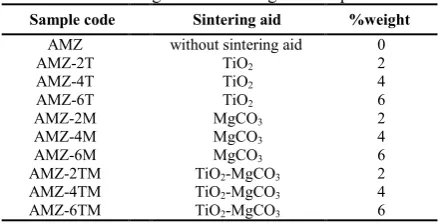
In order to identify the samples, they were labeled by the code AMZ-nX, where A, M and Z denote the alumina, mullite and zirconia, respectively, X indicates sintering aid and ‘n’ is its weight percentage in the mixture. Table 1. shows the different labels of the composite samples.
TABLE 1. Batch design of the investigated samples
%weight
Sintering aid
Sample code
0 without sintering aid
AMZ
2
TiO2
AMZ-2T
4
TiO2
AMZ-4T
6
TiO2
AMZ-6T
2
MgCO3
AMZ-2M
4
MgCO3
AMZ-4M
6
MgCO3
AMZ-6M
2
TiO2-MgCO3
AMZ-2TM
4
TiO2-MgCO3
AMZ-4TM
6
TiO2-MgCO3
AMZ-6TM
To determine the densities of samples, the Archimedes method was used based on the ASTM-C20 standard. The X-ray diffraction (XRD) method was employed to identify the formed phases. XRD patterns were acquired by means of D-500 X-ray diffraction-meter device, which used CuKα beam with a wavelength of 0.1542 nm. The microscopic examinations of samples were carried out by a Scanning Electron Microscope (SEM Cambridge Stereoscan model).
3. RESULT AND DISCUSSION
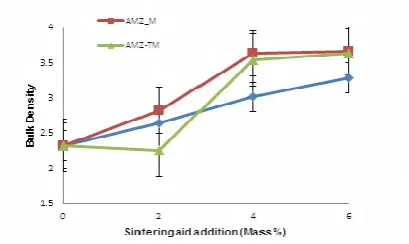
Bulk density of the samples sintered at 1600ºC is presented in Figure 2. According to this figure, in AMZ-M and AAMZ-MZ-T samples with 2% of sintering aid, the bulk densities showed an ascending trend; however, the bulk density of the AMZ-TM sample decreased a little. Two points should be mentioned regarding the bulk density and porosity of the samples; first, the sintering process, which leads to the increasing in bulk density and the reduction of porosity and second, the decomposition of zircon and formation of mullite which can cause expansion and reduction in density. Therefore, by adding 2% sintering aid to the mixture, sintering process becomes dominant in the AMZ-M and AMZ-T composites and the increase of bulk density is mostly due to the reduction of porosity. However, in the AMZ-TM sample, the formation of mullite, which has a lower density in comparison to the original constituent materials, is dominant. Thus, a reduction of density is observed. Subsequently, by increasing the amount of sintering aid in the mixture, the densities of all three samples (AMZ-M, AMZ-T and AMZ-TM) have increased.
reduction whereas for the sample that contains that titania additive, the whole weight range has the same effect on sintering.
Figure 2. Changes of the bulk density versus sintering aid with the amount and after firing at 1600°C/2h.
Figure 3. shows the X-ray diffraction patterns of the AMZ-2M samples sintered at temperatures of 1400 and 1600ºC. As it is observed, at 1400ºC, mullite has not been established yet and the sample only contains alumina and zircon. Numerous weak peaks of zirconia indicate that zircon starts to decompose. Of course, decomposition is not yet complete, and zircon peaks can still be seen clearly. The decomposition temperature of zircon is above 1600ºC, but we can see that the presence of Al2O3 has stimulated the decomposition of zircon at temperature of 1400ºC [5]. Also, the other products of zircon decomposition (SiO2) was not observed at this temperature, which could indicate the formation of the amorphous SiO2 phase [12, 13] or the onset of its reaction with alumina to form mullite [14]. Young et al. reported the start of mullite formation at temperature 1450ºC (this temperature is higher than the temperature obtained by thermodynamic estimations) [9]. The XRD pattern of the sample obtained at 1600 ºC lacks the characteristic peak of zircon (2θ = 20º); thus, it can be stated that the zircon phase has decomposed to a large extent so that it cannot be detected by the X-ray and as a result of SiO2 reaction with alumina, mullite has formed [15]. The major crystalline phases at this temperature are alumina, mullite and zirconia.
ZrO2 initially forms as a tetragonal phase (t-ZrO2), after decomposition of the zircon (ZrSiO4) to ZrO2 and amorphous SiO2. At high temperature amorphous SiO2 reacts with alumina and establishes mullite. During cooling, a large quantity of tetragonal zirconia is converted to monoclinic type. It has become well established that the ZrO2 phase conversion is affected by the size of particles and that the larger particles promote the conversion of t-ZrO2→ m-ZrO2 during cooling. In sintering reaction, ZrO2 grains grow as the temperature rises, and during cooling at room temperature the larger ZrO2 grains convert to the m-ZrO2 phase more easily [9].
The absence of mullite concurrent with the formation of ZrO2 in the sample sintered at 1400ºC shows that the nucleation rate of ZrO2 is higher than that of mullite; although, the amount and viscosity of the glassy phase can influence the nucleation and crystallization of mullite and ZrO2. By increasing the temperature to 1600°C and decreasing the viscosity of SiO2, the nucleation and growth of mullite accelerate [16]. According to the reports of Aksel et al. [17], the radial decomposition of zircon starts from its surface and continues to the grain center, which speeds up the crystallization of zirconia and the formation of amorphous silica.
Figure 3. X-Ray diffraction patterns of the AMZ-2M sample sintered 1400 and 1600 ºC
Figure 4. illustrates the X-ray diffraction patterns of the AMZ-M samples with 2 wt. % and 6 wt. % Magnesia sintering aid after firing at 1600ºC for 2 hours. Alumina has formed as the main phase. Mullite, and monoclinic and tetragonal zirconia can be similarly seen in both samples. Considering the reports of Benedetti et al [18], which claim that the existing peaks at 2θ = 28.4º and 2θ = 30.19º specify monoclinic zirconia and tetragonal zirconia, respectively, it can be stated that all the samples have these two phases; of course, the number of tetragonal zirconia peaks and their intensities are less than those of the monoclinic zirconia peaks [18]. Many research works have recently concluded that the presence of MgO additive in the zirconia/mullite ceramic composites not only stabilizes the tetragonal zirconia phase, but, as a sintering aid, it also helps the formation of mullite grains [16].
The XRD pattern of the AMZ-6T sample in Figure 5. shows a similar pattern to that of the AMZ-2T. The lack of zircon and silica (crystobalite and/or tridimite) peaks in both samples is indicative of the complete decomposition of zircon and the reaction of SiO2 with alumina and thus the formation of mullite, with different peaks of mullite in the AMZ-6T composite are intensive.
two samples. As it is observed, the TiO2 sintering aid, like MgO, has been able to stabilize the zirconia [19].
Figure 4. X-Ray diffraction patterns of the AMZ-M samples after sintering at 1600 ºC for 2 hours.
Figure 5. X-Ray diffraction pattern of AMZ-T sample after sintering at 1600ºC for 2 hours.
Figure 6. X-Ray diffraction pattern of the AMZ-TM sample after sintering at 1600ºC for 2 hours.
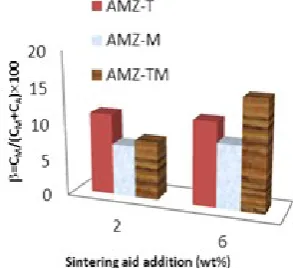
To examine the formation of the mullite phase more accurately, a relativistic and comparative method was employed. In this approach, by measuring the areas under the main peaks of the mullite phase (210) and alumina phase (113), by using formula (2) [20 and 21] the relative concentration of the mullite phase was measured. In this formula, CM and CA denote the estimated concentrations of mullite and alumina, respectively, and parameterβ indicates the degree of the mullite reaction and formation progress.
β= ´100 (2) The obtained results are illustrated in Figure 7. It can be
seen that the combined effect of magnesia and titania sintering aids is greater than the sole effect of magnesia or titania by itself. At 2 and 6 wt.% adding sintering aids, the AMZ-T and AMZ-TM samples, respectively, have much greater mullite concentrations than the other samples.
Figure 7. Relative changes of mullite concentration with different types and amounts of sintering aids.
The higher portion of mullite in these samples is probably due to the fact that, in addition to the issues of solid solution and increased diffusion, the additives of MgO and TiO2 together produce more melt in the sample (considering the phase diagram of MgO-TiO2 in Figure 8.) in which more alumina is dissolved and thus more mullite is precipitated.
Figure 8. Phase diagram of MgO-TiO2[22]
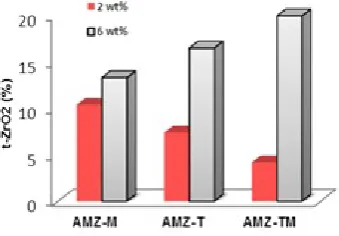
The XRD patterns of the samples show, to some extent, the increase in tetragonal zirconia stabilized in the composite by increasing the sintering aid from 2 to 6 wt. %. To verify these observations, the polymorph method of Garvie-Nicholson, in view of Eq. 3, was used [23]. In this equation, It (111) is the peak intensity of plane (111) of the tetragonal zirconia, Im (111) is the peak intensity of plane (111) of the monoclinic zirconia and It (111) is the peak intensity of plane (111) of the tetragonal zirconia.
Xt =
( )
( ) ( ) ( ) (3)
sintering aids; and the highest increase can be seen in the composite that contains the mixed sintering aids. Of course, this trend is reversed at lower amounts of sintering aids, and the composite made by adding the mixed sintering aids produced the lowest amount of tetragonal zirconia.
It can be established that the ZrO2 particles, released from the decomposition of zircon, immediately crystallize as tetragonal zirconia phase, through nucleation and growth, and this phase converts to a monoclinic structure at low temperatures [24]. One of the characteristics of the reaction sintering method used in the preparation of these composites is the semi-stable phase of tetragonal zirconia that exists at ambient temperature [25]. The stability of this phase at low temperature may be justified as such that some zirconia particles are entrapped inside the mullite grains during the crystallization of mullite and, due to the low diffusion coefficient of mullite, these particles are not able to grow; in other words, their dimensions remain smaller than the critical limit necessary for converting them to monoclinic zirconia particles [25-26].
Figure.9. Amounts of t-ZrO2 estimated by the polymorph
method in different composites.
Bochet al. [27] calculated the amounts of mullite and alumina in the alumina-mullite composite by the ratio of peak intensities, according to the relation IA(113)/[IA(113)+IM(210)]; where IA was the peak intensity of plane (113) of alumina located at 2θ = 43.36º and IM was the peak intensity of plane (210) of mullite situated at 2θ = 26.27º. Similar work was done by Mitra et al. [11,19]on the alumina-zirconia-mullite composite to obtain the share of each phase of alumina, zirconia (monoclinic + tetragonal) and mullite. They also used the mentioned characteristic peak intensities for this purpose. On this basis, the percentages of mullite and alumina phases, different composite samples have been determined and sketched in Figure 10. As it is observed, the increase in the amount of sintering aids in all the samples facilitated the formation of mullite. In this regard, the AMZ-6TM sample has the highest percentage of mullite and the AMZ-2TM sample has the highest percentage of alumina.
Figure 10. Percentages of mullite and alumina phases present in different composites.
The sizes of the AMZ composite crystallites are listed in Table 2. As it is observed, despite the high sintering temperature and due to the presence of the sintering aids, all the crystallites that form the composite have nanometer sizes. If the sintering aids can be present at grain boundaries, they can retard the size and growth rate of the crystallites by reducing the movement of the grain boundaries.
TABLE 2. Sizes of crystallites in composites with different types and amounts of sintering aids
Monoclinic phase alumina crystallite (nm) mullite crystalli te (nm) Sample zirconia crystallite (nm) Tetragon al phase 51.02 34.75 84.43 22.49 AMZ-2M 74.17 53.03 97.09 34.07 AMZ-6M 54.86 37.98 70.35 22.34 AMZ-2T 80.10 42.53 84.42 40.99 AMZ-6T 45.26 36.62 70.35 33.08 AMZ-2TM 53.40 48.32 84.42 34.08 AMZ-6TM
Figure 11. shows the SEM images of the fracture cross sections of different AMZ samples taken after the completion of polishing operation. Some Pores could be observed in these samples, especially in samples containing 2 wt. % sintering aid; which of course, by increasing the amount of sintering aid and completing the decomposition of zircon, the amount of porosity is reduced and more uniform microstructures are obtained. As the above figure illustrates, the samples containing 2 wt. % sintering aids display nonuniformity in microstructure aid above present of porosity due to low sintering potential of compositions.
Figure 11. SEM (BSE) images of (a) AMZ-2T, (b) AMZ-6T, (c) AMZ-2TM and (d) AMZ-6TM
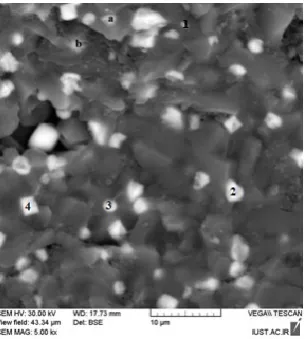
In the structure of the AMZ-6M sample, like in the other composites with 6 wt. % weight sintering aid portions, a smooth surface is not observed; this could be for the type and amount of the formed amorphous phase. Also, various types of zirconia particles in these composites can be classified as follows: inter-grain zirconia particles (Figure 12.(2)); and intra-grain zirconia particles (Figure 12.(1)) which can be divided into two groups of zirconia particles within Alumina grains (Figure 12.(1a)) and zirconia particles within mullite grains (Figure 12.(1b)). Also, in terms of shape, these particles can be placed in two classes of almost-round zirconia (Figure 12.(3)) and more square like zirconia particles with cleavage planes (Figure 12.(4)).
Figure 12. Zirconia classification in the AMZ-6M composite; (1) Intra-grain zirconia particles ((a) inside alumina grains, (b) inside mullite grains), (2) Inter-grain zirconia particles, (3) Round-shape zirconia, (4) Square-shape zirconia.
That part of the zirconia existed in the composite specimen is in tetragonal form. These particles have more round shapes and smaller sizes, and probably the compressive force exerted by the matrix has caused them to remain in tetragonal shape. The square shapes and larger sizes of these particles could be due to their conversion to the monoclinic phase [26].
In view of the SEM images, the average diameter of zirconia grains and also the diameter range of these particles are listed in Table 3. It is observed that in all the examined samples, the increment in the amount of sintering aids has led to the reduction of the average diameter of zirconia grains.
TABLE 3. Range and average size of zirconia particles
Range particle size of zirconia (μm)
Mean particle size of zirconia (μm)
Sample
0.71-4.31
2.22 ±0.75
AMZ-2M
0.8-3.93
2.14±0.48
AMZ-6M
0.54-6.81
3.48±1.12
AMZ-2T
0.43-5.20
2.82±1.07
AMZ-6T
0.71-5.36
2.87±1.14
AMZ-2TM
0.54-4.29
2.07±0.87
AMZ-6TM
4. CONCLUSIONS
This investigation has led to the following conclusions: 1) By increasing the amount of all three sintering aid additives (MgO, TiO2, MgO+TiO2) in the samples from 2 to 6 wt. %, the reactions were improved and the density of the samples and the final quantity of mullite in them were increased.
2) The tests showed that, as expected, the decomposition of zircon is facilitated in the presence of alumina and it occurs at lower temperature.
3) Due to the mechanism involved in the reaction sintering method, a part of the zirconia phase remains in a semi-stable tetragonal form.
4) By increasing the amount of sintering aids, the average diameters of zirconia grains are decreased.
REFERENCES
1. Aksel, C., "The microstructural features of an alumina–mullite–
zirconia refractory material corroded by molten glass", Ceramics international, Vol. 29, No. 3 , (2003), 305-309
2. Ewais, E.M.M., Besisa, D.H.A., Zaki, Z.I. and Kandil,
A.E.H.T., "Tailoring of functionally graded
zirconia-mullite/alumina ceramic", Journal of the European Ceramic
Society, Vol. 32, No. 8, (2012), 1561-1573.
3. Aksel, C., "The influence of zircon on the mechanical properties
and thermal shock behaviour of slip-cast alumina–mullite
refractories", Materials Letters, Vol. 57, No. 4, (2002),
992-997.
4. Zhao, S.-K., Huang, Y., Wang, C-A., Huang, X-X. and Cuo,
J-K., "Sinterability of ZrSiO4/α-Al2O3 mixed powders", Ceramics
International, Vol. 29, No. 1, (2003), 49-53.
5. Mazzei, A.C. and Rodrigues, J.A., "Alumina-mullite-zirconia
and mechanical behaviour", Journal of Materials Science, Vol. 35, No. 11, (2000), 2807-2814.
6. Ebadzadeh, T. and Ghasemi, E., "Effect of TiO2 addition on the
stability of t-ZrO2 in mullite–ZrO2 composites prepared from
various starting materials", Ceramics International, Vol. 28,
No. 4, (2002), 447-450.
7. Mao, M.F. and Figuiredo, M.O., "Behaviour of titanium in
mullite-zirconia composites", Material Science and
Engineering, Vol. 109, (1989), 61-68.
8. Zhao, S.-k., Huang, Y., Wang, C.-A., Huang, X.-X. and Cuo,
J-K., "Mullite formation from reaction sintering of ZrSiO4
/α-Al2O3 mixtures", Materials Letters, Vol. 57, No. 11, (2003),
1716-1722.
9. Orange, G., Fantozzi, G., Cambier, F., leblud, C., Anseau, M.R.
and leriche, A., "High temperature mechanical properties of reaction-sintered mullite/zirconia and mullite/alumina/zirconia
composites", Journal of Materials Science, Vol. 20, No. 7,
(1985), 2533-2540.
10. Jang, H.M., Cho, S.M. and Kim, K.T.,
"Alumina-mullite-zirconia composites", Journal of Materials Science, Vol. 31,
No. 19, (1996), 5083-5092.
11. Nagarajan, V.S. and Rao, K.J., "Crystallization studies of ZrO2−
SiO2 composite gels", Journal of Materials Science, Vol. 24,
No. 6, (1989), 2140-2146.
12. Wang, S.-W., Huang, X.-X. and Guo, J.-K., "Mechanical
properties and microstructure of ZrO2–SiO2 composite",
Journal of Materials Science, Vol. 32, No. 1, (1997), 197-201. 13. Ma, B-Y., Li, Y., Cui, S.-G. and Zhai, Y.-C., "Preparation and
sintering properties of zirconia-mullite-corundum composites using fly ash and zircon." Transactions of Nonferrous Metals Society of China, Vol. 20, No. 12, (2010), 2331-2335.
14. Carbajal, G.I.V., Galicia, J.L.R., Angeles, J.C.R., Cuevas, J.L. and Chavarria, C.H.G., "Microstructure and mechanical behavior of alumina–zirconia–mullite refractory materials", Ceramics International, Vol. 38, No. 2, (2012), 1617-1625. 15. Wahsh, M.M.S., Khattab, R.M. and Awaad, M.,
"Thermo-mechanical properties of mullite/zirconia reinforced alumina ceramic composites", Materials & Design, Vol. 41, (2012), 31-36.
16. Aksel, C., "Mechanical properties and thermal shock behaviour of alumina–mullite–zirconia and alumina–mullite refractory materials by slip casting", Ceramics International, Vol. 9, No. 3, (2003), 311-316.
17. Benedetti, A., Fagherazzi, G. and Pinna, F., "Preparation and structural characterization of ultrafine zirconia powders", Journal of the American Ceramic Society, Vol. 72, No. 3, (1989), 467-469.
18. Mitra, B.L., Biswas, N.C. and Aggarwal, P.S., "Thermal and hydrothermal properties and microstructure of zirconia-alumina-mullite", Materials Letters, Vol. 14, No. 1, (1992), 50-54.
19. Pena, P., Miranzo, P., Moya, J.S. and Aza, S.D., "Multicomponent toughened ceramic materials obtained by reaction sintering", Journal of Materials Science, Vol. 20, No. 6, (1985), 2011-2022.
20. Ebadzadeh, T., "Porous mullite – ZrO2 composites from
reaction sintering of zircon and aluminum", Ceramics
International, Vol. 31, No. 8, (2005), 1091-1095.
21. Baudin, C., Cambier, F. and Delaey, L., "Fractographic study of the alumina and zirconia particles embedded in mullite prepared
by reaction sintering", Journal of Materials Science, Vol. 21,
No. 11, (1986), 4024-4028.
22. Garvie, R.C. and Nicholson, P.S., "Phase analysis in zirconia systems," Journal of the American Ceramic Society, Vol. 55, No. 6, (1972), 303-305.
23. Ebadzadeh, T., "Reaction sintering of multicomponent mixtures
for producing ceramics containing zirconia", Journal of the
European Ceramic Society, Vol. 20, No. 6, (2000), 725-729.
24. Herold, P.G. and Smothers, W.J., "Solid‐state Equilibrium
Relations in the System MgO‐Al2O3‐SiO2‐ZrO2", Journal of
the American Ceramic Society, Vol. 37, No. 8, (1954), 351-353.
25. Heuer, A.H., Claussen, N., Kriven, W.M. and Ruhle, M., "Stability of tetragonal ZrO2 particles in ceramic matrices",
Journal of the American Ceramic Society, Vol. 65, No. 12, (1982), 642-650.