Research Paper: Impact of SHOFER Computer Game
on Visual-Motor Coordination in Children With Hearing
Impairments
Zahra Norouzi Tabrizi Nejad1 , Rita Rezaee2* , Seyed Alireza Derakhshanrad3 , Ali Mohammad Hadianfard4
1. Department of Health Information Technology, School of Management and Medical Information Sciences, Shiraz University of Medical Sciences, Shiraz, Iran.
2. Health Human Resources Research Center, Shiraz University of Medical Sciences, Shiraz, Iran.
3. Department of Occupational Therapy, School of Rehabilitation Sciences, Shiraz University of Medical Sciences, Shiraz, Iran.
4. Department of Health Information Technology, School of Allied Medical Sciences, Ahvaz Jundishapur University of Medical Sciences, Ahvaz, Iran.
* Corresponding Author:
Rita Rezaee, PhD.
Address: Health Human Resources Research Center, Shiraz University of Medical Sciences, Shiraz, Iran.
Tel: +98 (917) 3177435
E-mail: [email protected]
Objectives: The current study aimed at investigating the impact of SHOFER computer game on visual-motor coordination in children with hearing impairments.
Methods: The current pre-test, post-test experimental study was conducted in Ahvaz, Iran in 2018. Sixteen preschool children with hearing impairment were randomly assigned into two groups of experimental (n=8) and control (n=8). The experimental group subjects played the SHOFER computer game (driving/racing genre) two 45-minute sessions per week for a five consecutive weeks, but the control group did not receive any intervention. Before and after the intervention, visual perception and attention, as visual-motor coordination components, were measured by the advanced Frostig test of visual perception and continuous performance test in both groups. Using SPSS version 21, the performance of the two groups was compared by running the Mann-Whitney and Wilcoxon tests.
Results: The analysis of findings with the effect size indicator showed that the computer game increased attention and spatial perception in the experimental group. However, no significant difference was found between the groups, except in the sub-test of figure-ground perception. Discussion: The present study showed that commercial computer games can be used to improve visual-motor coordination of children with hearing impairments.
A B S T R A C T
Article info:
Received: 23 Sep 2018
Accepted:15 Jan 2019
Available Online: 01 June 2019
Keywords:
Attention, Visual motor coordination, Video games
Citation Norouzi Tabrizi Nejad Z, Rezaee R, Derakhshanrad SA, Hadianfard AM. Impact of SHOFER Computer Game on Visual-Motor Coordination in Children With Hearing Impairments. Iranian Rehabilitation Journal. 2019; 17(2):149-156. http:// dx.doi.org/10.32598/irj.17.2.149
: http://dx.doi.org/10.32598/irj.17.2.149 Use your device to scan
Highlights
● SHOFER computer game might be useful in improving visual-motor coordination of children with hearing impair-ments.
● The impact of SHOFER game on visual-motor coordination could be due to the game characteristics including speed, variety of objects to follow, and the emphasis on environmental processing.
Plain Language Summary
Recently, there came a wave of interest in using computer/video games as a valuable, ecologically valid, and cost-ef-fective treatment tool known appealing to children. It is reported that the incorporation of these games in rehabilitation can offer children meaningful experiences in such a way as to bring them visual-motor-related benefits. Since hearing impairment is associated with motor incoordination, it was hypothesized in the present study that using a computer game would provide children with hearing impairment the opportunity to improve their visual-motor coordination. As a result, in the current study, the authors applied a computer game called SHOFER with driving/racing genre to exam-ine its effectiveness on visual-motor coordination of a sample of children with hearing impairments.
1. Introduction
ore than 5% of the world’s population, or about 466 million people, have some kinds of hearing impairments, of those 34 million are children [1]. Children with hearing problems are at risk of motor problems [2]. Motor performance deficits in such children can lead to motor incoordination, especially with regard to performing complex motor tasks [3]. Visual-motor incoor-dination is such a motor problem in preschool and primary school children with hearing impairments that can lead to detrimental effect on learning sign language, which is the
communication language of the deaf [4-6].
Vision is used to guide body movements. Accordingly, visual-motor coordination refers to the ability to control
hand movements by visual guide [7]. The prerequisites
for this ability are components including visual percep-tion and visual attenpercep-tion. This ability plays an important role in the precise and accurate performance of the
indi-vidual’s daily activities such as closing the buttons [8,9].
In recent years, there is an increasing interest in using computer or video games for the healthcare promotion pur-poses. Therapeutic results vary depending on the type of games used and characteristics of the intervention groups. Computer games such as computer shooting and driving/ racing games require attention and rapidity in control and reaction to the game. Those games are reported to have significant impacts on visual-motor skills [10]. The driving game also is effective in improving sustained attention, con-sciousness, and working memory skills through the need
for quick response and vehicle control in the middle of a
road [11,12]. Other advantages include the ability to solve
problems and the development of social and spatial
capa-bilities [13-15]. Studies conducted to evaluate the effects of
such games on various aspects of health suggest using them as an exciting therapeutic activity that utilizes motivational
capabilities [16].
Although extensive research are performed to show the feasibility of computer games as an independent peutic tool or as an indirect treatment by making
thera-peutic goals more attractive [16], very few studies on
children with hearing impairment showed the effective-ness of such games. Therefore, the current study aimed at evaluating the implication of a computer game to im-prove visual-motor coordination in children with hearing impairment. The computer game was used in the current study design since it is believed that children with hear-ing impairments are visually-dependent, so it might be possible that computer games, with so many visual-mo-tor-related features, are appealing to those children; thus, can improve some aspects of their visual-motor
coordi-nation [17]. More specifically, the study examined the
effectiveness of SHOFER computer game with driving/ racing genre on visual-motor coordination of a sample of children with hearing impairments.
2. Methods
Study setting and participants
The current pre-test, post-test experimental study was conducted to investigate the impact of a computer game
on visual-motor coordination. Convenience sampling was performed among the students of a special school serving students with hearing impairments. There were 17 students in total, but one of them was not included due to the lack of participation in pretest. Sixteen sub-jects were divided into two experimental and control groups (n=8 in each group). Inclusion criteria were as follows: 1. Being in preschool student; 2. Not having the experience of playing the SHOFER prior to the study; 3. Having severe or deep hearing impairments.
Intervention (SHOFER computer game)
SHOFER is a racing and driving game, compatible with Iranian culture due to the Iranian environment and cars used in this game. SHOFER is designed by the Ira-nian company, Zhouri Maang and has a release confir-mation from Steam Company [18]. This game is appro-priate for three-year-old children and above according to the Entertainment Software Rating Association (ESRA) that evaluates games in terms of violence, fear, and other
harmful contents [19]. SHOFER can be played
individu-ally and has different degrees of difficulty (from easy to hard level).
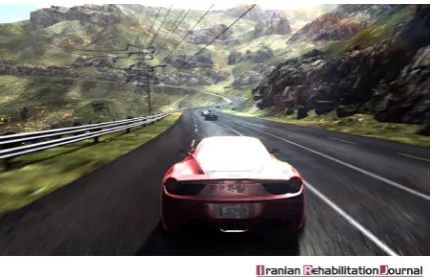
The player can enter into more difficult stages after gaining success at primary stages. One of the features of SHOFER is the continuous competition with other cars, a process in which the player never gets too far behind or far ahead of other cars, in order to keep the competi-tion exciting. Also, after winning the races, new cars are awarded to the player, which can be considered effective in the game’s attractiveness. The player must control the car among other vehicles, to win the competition [18]. See Figure 1 for a screenshot of this game.
In a review study of articles employed serious games in rehabilitation of children with sensory-motor im-pairments, the usual duration of interventions was four weeks (ranged three to twelve weeks) with the average
frequency of three sessions per week (ranged one to five sessions per week), with an average time of 60 minutes
per session (ranged 15 to 90 minutes) [15]. Therefore,
according to the school’s conditions and the children’s educational period, the experimental group played the computer game for five weeks/two 45-minute sessions per week, two-by-two on two separate laptops. During the intervention, the researcher directly monitored each player’s playtime. Missing sessions were compensated as soon as possible. The control group did not receive any intervention and only were used for comparison.
Research instruments
In order to assess visual-motor abilities, two common tests including the Frostig test and Continuous Perfor-mance Test (CPT) were used. The Frostig developmen-tal test of visual perception is a paper-based test that includes five subtests for measuring the eye-motor co-ordination, and perception of Figure-ground, form con-stancy, position in space, and spatial relationships [20]. The test-retest reliability for the mean total score and subtests ranged 0.69 to 0.98. The split-half method for the mean total score and subtests showed the coefficients between 0.78 and 0.89 [21].
CPT is a computer-based test. In this test, visual stimuli are presented for a short time on a computer screen, and the subject must respond to the target stimulus by press-ing one of the keyboard keys. There are 150 Persian characters or figures as stimuli in the test, of which 30 stimuli are considered as the target stimulus. CPT is used to measure attention and impulsive behaviors. The vari-ables obtained by the employment of this test were the number of correct answers, the number of non-response to the target stimulus, and the number of responses to the non-target stimulus. Test-retest reliability was 0.93 and its validity was confirmed via the criterion validity by comparing the normal and attention-deficit/hyperactivity disorder groups [22].
Procedure
In the current study, the participants were randomly as-signed to two groups using the permuted-block random-ization with four individuals in each block; the control (n=8) and intervention (n=8) groups. First, the score of visual perception in both groups was measured using the Frostig developmental test of visual perception by an oc-cupational therapist, and under the researcher’s supervi-sion in each group. Then, the score of sustained attention was measured for each subject individually using a com-puterized continuous performance test by the researcher.
At different times, the researcher focused on learning the sign language and how to communicate with children having hearing impairments by attending school classes. The game model and how to use the joystick were taught individually to each member of the experimental group for 15 to 30 minutes, according to the learning ability of each child.
In order to prevent children from communicating and affecting each other, the game was conducted in a sepa-rate room with the presence of the researcher. To ensure that the control group did not play the game, the game was only installed on the researcher’s laptops. At first,
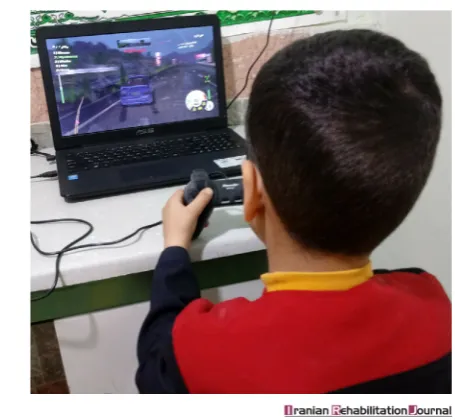
an easy level was offered to the children. Children could attempt as long as they passed the easier steps of the
game (Figure 2). Depending on the subjects’ ability and
the amount of success they achieved during the 10 ses-sions, the game level was enhanced from easy to hard. Children’s feedback on the offered game was recorded by the researcher.
At the end of the 10th session, the completion of the
in-tervention, visual perception and the sustained attention of both experimental and control groups were evaluated using the Frostig developmental test of visual perception and CPT, and the pretest-posttest results were compared for each subject. The overall results of both groups were compared to examine the effect of the intervention.
Data analysis
The Mann-Whitney nonparametric tests were used for intergroup comparisons, and the Wilcoxon for the intra-group comparisons. Due to the small sample size, Co-hen’s effect size index (CoCo-hen’s d) was used to examine the clinical effect of the intervention [23].
3. Results
The experimental group consisted of five male and three female subjects with the mean age of seven years and 10 months and the control group included four male and four female subjects with the mean age of seven years and nine months. There was no significant differ-ence in age between the two groups. Comparison of the
Table 1. Comparison of post-test scores of the two groups
Effect Size
P
Post-Test (Mean±SD)
Test
Control
Case
0.48 0.36
16.75±3.99 18.88±4.79
Eye-motor coordination
0.45 0.42
11.25±7.14 13.88±4.12
Figure-ground
0.06 0.95
7.75±4.52 7.5±3.2
Form constancy
0.13 0.78
3.88±1.72 4.13±2.03
Position in space
0.95 0.13
4±2.44 5.75±0.88
Spatial relationships
0.37 0.87
12.75±11.6 9.38±5.15
Error in providing response
0.55 0.31
8.63±6.25 5.88±3.18
Deleted response
0.50 0.46
128.63±16.39 134.75±5.52
Correct response
mean scores of the experimental and control groups in the pre-test with the Mann-Whitney nonparametric test indicated that no difference between the groups in the visual perception and attention score before the interven-tion.
The tests were repeated after the completion of interven-tion; however, the 0.95 Cohen’s d in the 5th subtest revealed a significant effect of the intervention on the ability to under-stand spatial relationships in the experimental group com-pared with the control group after the intervention. Based
on the Cohen’s d effect size measure, which is capable of detecting the clinical impact of interventions in very little or very large sample sizes, the effects of 0.2>, 0.2-0.49, 0.5-0.79, and >0.8 showed an insignificant, low, medium, and high effects. Accordingly, the more average impact of intervention on attention and concentration was observed in the experimental group, compared with the control group by the number of fewer eliminated responses and the more
correct answers (Table 1).
Table 2. Comparison of pre- and post-test scores in the control group
P
Control (Mean±SD)
Test
Post-Test Pre-Test
0.16 16.75±3.99
13.75±5 Eye-motor coordination
0.19 11.25±7.14
9.5±6.78 Figure-ground
0.16 7.75±4.52
6.25±5.49 Form constancy
0.91 3.88±1.72
4±2.07 Position in space
0.18 4±2.44
3.63±2.44 Spatial relationships
0.48 12.75±11.64
16.13±16.09 Error in providing response
0.44 8.63±6.25
10.88±9.89 Deleted response
0.26 128.63±16.39
123±22.86 Correct response
Table 3. Pre- and post-test scores in the experimental group
Effect Size
P
Examination
Test Mean±SD
Post-Test Pre-Test
0.36 0.52
18.88±4.79 17.5±2.26
Eye-motor coordination
0.46 0.03
13.88±4.12 12±3.92
Figure-ground
1.06 0.10
7.5±3.2 4.5±2.39
Form constancy
0.53 0.19
4.13±2.03 5±1.06
Position in space
0.17 0.91
5.75±0.88 5.5±1.77
Spatial relationships
0.65 0.04
9.38±5.15 6±5.18
Error in providing response
0.37 0.67
5.88±3.18 7.88±6.83
Deleted response
0.15 0.72
134.75±5.52 136.13±11.65
Comparison of pretest and post-test scores in the control group using the nonparametric Wilcoxon test showed no significant difference between the pretest and
post-test scores (Table 2).
However, in the intervention group, results of the Wil-coxon test showed a significant difference between the pretest and post-test scores of the intervention group in the subtest of figure-ground perception. Cohen’s d effect size measure also showed that the intervention had a modest impact on the perception of position in space and the significant impact on the form constancy perception
of the experimental group (Table 3).
4. Discussion
The current study was the first investigation on the ef-fectiveness of a computer game on the improvement of visual-motor coordination in children with hearing im-pairments. The short-term impact of SHOFER game was investigated in the current study and it was found that this game may affect some elements of motor coordina-tion. Despite the lack of a significant difference among the results, clinical evidence (Cohen’s d effect size) sug-gested that the SHOFER game may cause visual-motor coordination improved through enhancing perception of position in space and the form constancy in the experi-mental group.
The game also had a significant impact on the ability to perceive the spatial relationships in the experimental group compared with the control group. These results are in line with those of previous studies that showed
the effectiveness of computer games [13-15]. The type
of cognitive and perceptual skills required for playing action, driving, maze, and puzzle genres can influence
cognitive skills and spatial perception [24]. Spatial
per-ception, as part of visual perper-ception, is the ability to navigate in the environment and identify the right, left, front, back, and top directions, and understand the status
of objects surrounding [20,25].
The lack of significant results can be attributed to the genre of the computer game used for the current study. Driving is a popular and playable genre due to easy gameplay, recognizable goals, and a fewer number of elements that should be controlled. However, these fea-tures make this genre easier compared to more complex genres such as action that have less opportunity for tech-nical play performance that might reduce the impact of
SHOFER game [26].
The impact of racing genre on visual skills could be due to the game speed, the number of objects to fol-low, and the emphasis on environmental processing. In general, it can be concluded that the type and genre of computer games, targets, and characters defined in the
game make considerable differences in their effect [27].
Selecting the considered objects, the pursuit of multiple objects, and the complex three-dimensional environ-ment are the effective characters in computer games affecting attention, which in turn, can affect the visual-motor skill. Additionally, the need for coordination to achieve goals and navigate can be of other influential characters of these games on visual-motor performance
and spatial recognition [24].
SHOFER game with Iranian roads and cars, in the first place, was well-received by the experimental group and the reality of the game environment can be cited as its attractiveness. However, lack of exciting characters and the monotonous rhythm of driving a car on the road diminished its initial attractiveness. On the other hand, one of the features of the SHOFER game was the indigenous music as the background music that the experimental group was deprived of hearing it. Xiaoqing declared that the existence of the background music increases the sense of immersion and the realiza-tion of the game experience that ultimately leads to the attractiveness and maintenance of the player’s constant attention to the game [28].
The experimental group expressed the concepts of “win” and “victory in the race” and the need for prog-ress in order to get a new car by shaking head and hands and using the sign language. Despite encountering the game for the first time, few children in the experimental group had played the game only in trial and error mode. These children were negligent and bored in the study, and their teacher said that they usually had poor concen-tration in the classroom. However, most subjects in the experimental group showed planning behaviors during the game. They got upset and angry about their failure, and each time they spoke with the sign language “I un-derstand” or “I win this time”. It is likely that planning ability could be promoted as a training-based
perfor-mance in the game for the studied students [29].
on some aspects of visual-motor coordination, further research in needed to prove these findings. The impact of SHOFER game was also evaluated immediately after the end of the intervention and was not followed. It is therefore recommended that similar studies with follow-up strategies and larger sample sizes be performed.
5. Conclusion
Overall, results of the current study showed that SHOFER computer game could be effective on enhanc-ing different aspects of the visual-motor coordination. Thus, therapists can advise this commercial game for their clients with hearing problems. Additionally, the acceptability of a computer game among children with hearing impairment can help them to develop their po-tential for learning.
Ethical Considerations
Compliance with ethical guidelines
The current article was extracted from the master’s the-sis of Zahra Norouzi Tabrizi Nejad majored in the field of health information technology of Shiraz University of Medi-cal Sciences (Code: 1396-01-07-15379). All participants were allowed to quit the study at any stage. The school di-rector and teachers and the children’s parents were informed that participation in the study was voluntary and the study would not cause any harm to the children. The study pro-tocol was registered with the Iranian Registry of Clinical Trials (IRCT20140618018150N3). Parent informed consent in the current study was approved by the local Ethics Com-mittee of Shiraz University of Medical Sciences (IR.SUMS. REC.1396.178). In addition, the confidentiality and privacy of information was preserved throughout the steps of the study. A moral assurance was also given to the Department of Exceptional Education in Ahvaz to provide them with a copy of the results.
Funding
The research was funded by the Vice-Chancellor of Science and Technology Affairs of Shiraz University of Medical Sciences, Iran.
Authors' contributions
Conceptualization: Zahra Norouzi Tabrizi Nejad; Methodology: All authors; Investigation, writing origi-nal draft: Zahra Norouzi Tabrizi Nejad, Seyed Alireza Derakhshanrad; Writing-review and editing: All authors; Funding acquisition: Rita Rezaee; Supervision; Rita
Rezaee, Seyed Alireza Derakhshanrad, Ali Mohammad Hadianfard; Project administration: All authors.
Conflict of interest
The authors declared no conflict of interest.
Acknowledgments
The authors are grateful to the honest cooperation of the director and teachers of the exceptional school and all the children that participated in the study.
References
[1] World Health Organization (WHO). Deafness and hearing loss [Internet]. 2018 [updated 15 March 2018]. Available from: http://www.who.int/mediacentre/factsheets/fs300/en/
[2] McPhillips M. Motor difficulties and mental health in chil
-dren who are deaf. Developmental Medicine & Child Neu-rology. 2015; 57(10):893-4. [DOI:10.1111/dmcn.12831] [PMID]
[3] Fellinger MJ, Holzinger D, Aigner M, Beitel C, Fellinger J. Motor performance and correlates of mental health in chil-dren who are deaf or hard of hearing. Developmental Medi-cine & Child Neurology. 2015; 57(10):942-7. [DOI:10.1111/ dmcn.12814] [PMID]
[4] Wiegersma P, Velde AV. Motor development of deaf children. Journal of child Psychology and Psychiatry. 1983; 24(1):103-11. [DOI:10.1111/j.1469-7610.1983.tb00107.x] [PMID]
[5] Hanson GH, Hancock BB, Kopra LL. Relationships among audiological status, linguistic skills, visual-motor perception, and academic achievement of deaf children. Austin: Univer-sity of Texas at Austin; 1969.
[6] Shojaie R. [The analysis of visual/motional skill in hearing-impaired children (Persian)]. Journal of Exceptional Educa-tion. 2012; 3(111):67-72.
[7] Buckner MK. Eye hand coordination [Internet]. 2018 [Up-dated 22 September 2018]. Available from: http://therapy-streetforkids.com/EyeHandCoord.html
[8] Roux Tl. Visual motor integration [Internet]. 2018 [Updated 29 August 2018]. Available from: https://www.ot-mom-learning-activities.com/visual-motor-integration.html
[9] Kid Sense. Visual Perception [Internet]. 2018 [Updated 22 No-vember 2018]. Available from: https://childdevelopment.com. au/areas-of-concern/fine-motor-skills/visual-perception/
[10] Green CS, Bavelier D. Action-video-game experience alters the spatial resolution of vision. Psychological Science. 2007;
18(1):88-94. [DOI:10.1111/j.1467-9280.2007.01853.x] [PMID] [PMCID]
[12] Anguera JA, Boccanfuso J, Rintoul JL, Al-Hashimi O, Faraji F, Janowich J, et al. Video game training enhances cogni-tive control in older adults. Nature. 2013; 501(7465):97-101. [DOI:10.1038/nature12486] [PMID] [PMCID]
[13] Kovess-Masfety V, Keyes K, Hamilton A, Hanson G, Bitfoi A, Golitz D, et al. Is time spent playing video games associated with mental health, cognitive and social skills in young children? So-cial Psychiatry and Psychiatric Epidemiology. 2016; 51(3):349-57. [DOI:10.1007/s00127-016-1179-6] [PMID] [PMCID]
[14] Griffiths M. Video games and health. British Medical Jour -nal. 2005; 331(7509):122-3. [DOI:10.1136/bmj.331.7509.122] [PMID] [PMCID]
[15] Sandlund M, McDonough S, Häger‐Ross C. Interactive computer play in rehabilitation of children with sensorimo-tor disorders: a systematic review. Developmental Medicine & Child Neurology. 2009; 51(3):173-9. [DOI:10.1111/j.1469-8749.2008.03184.x] [PMID]
[16] Mader S, Natkin S, Levieux G. How to analyse therapeutic games: The player/game/therapy model. International Con-ference on Entertainment Computing. Berlin: Springer; 2012. [DOI:10.1007/978-3-642-33542-6_17]
[17] Cano S, Collazos CA, Aristizábal LF, Gonzalez CS, Moreira F. Towards a methodology for user experience assessment of serious games with children with cochlear implants. Telem-atics and InformTelem-atics. 2018; 35(4):993-1004. [DOI:10.1016/j. tele.2017.09.011]
[18] SHOFER race driver: STEAM [Internrt]. 2015 [Updated 22 September 2015]. Available from: http://store.steampow-ered.com/app/367700/SHOFER_Race_Driver/
[19] Iran Computer & Video Games Foundation. SHOFER. Tehran: Iran Computer & Video Games Foundation; 2015.
[20] Frostig M, Lefever W, Whittlesey J. Frostig developmental test of visual perception, diagnosis and treatment [Persian]. Tehran: Farvardin; 1996.
[21] Noughabi R, Dortaj F. [Standardization, validity, and re-liability of frostig developmental test of visual perception among first and second grade elementary school students in Tehran (Persian)]. Journal of Applied Psychology. 2007; 1(3):253-68.
[22] Hadyanfar H, Najjarian B, Shokrkon H, Mehrabi M. [Con-struction of Persian version of continuous performance test (Persian)]. Journal of Psychology. 2000; 4(4):388-404.
[23] Cohen J. Statistical power analysis for the behavioral sci-ences. Cambridge, Massachusetts: Academic Press; 1977.
[24] Spence I, Feng J. Video games and spatial cognition. Review of General Psychology. 2010; 14(2):92-104. [DOI:10.1037/a0019491]
[25] Asliazad M, Abedi A, Iarmohammadian A. [The effective-ness of spatial relations perception training on the mathematics performance of boy students with math learning disability (Per-sian)]. Psychology of Exceptional Individuals. 2015; 5(17):113-31.
[26] Araujo TB, Silveira FR, Souza DL, Strey YT, Flores CD, Web-ster RS. Impact of video game genre on surgical skills develop-ment: A feasibility study. The Journal of Surgical Research. 2016; 201(1):235-43. [DOI:10.1016/j.jss.2015.07.035] [PMID]
[27] Rosas R, Nussbaum M, Cumsille P, Marianov V, Correa M, Flores P, et al. Beyond nintendo: Design and assessment of
educational video games for first and second grade students. Computers & Education. 2003; 40(1):71-94. [DOI:10.1016/ S0360-1315(02)00099-4]
[28] Per X, Zhang J. The influence of strategy video game and its background music on cognitive control. EC Psychol-ogy and Psychiatry. 2017; 2(1):15-25. [DOI:10.15761/MHAR.1000125]