ISSN (Online): 2348 – 3539
Primitive Node Localization of Security Games Through
Verifiable Mutlilateration Techniques
T.Sukumar
1, G. Prabhakaran
21PG Scholar, Department of Computer Science Engineering, E.G.S. pillay Engineering College,
Nagapattinam.
2Assistant Professor, Department of Computer Science Engineering, E.G.S. pillay Engineering
College, Nagapattinam.
Abstract: A wireless sensor network (WSN) of spatially distributed autonomous sensors to monitor physical or environmental conditions and to cooperatively pass their data through the network to a main location. In this paper, we resort to non-cooperative game theory to deal with the problem of secure localization where a set of verifiers and a number of independent malicious nodes are present. The assumption of independence between malicious nodes will allow us to adopt a two-player game, where the first player (defender) employs a number of verifiers to do VM computations and the second player (attacker) controls a single malicious node. This paper provides two main original contributions. First, we find the minimum number of verifiers needed for assuring a given upper bound over the error the attacker might induce. Second, we introduce a probabilistic approach according which each node is associated with a probability to be malicious. This can be useful to determine the reputation of the nodes. We model this situation as an extensive-form game with uncertainty and we provide an algorithm to find the best strategies of the two players. (ABS)
Keywords: Wireless Sensor Network, Virtual Machine (VM), Security, Probabilistic Approach.
Reference to this paper should be made as follows: T.Sukumar1, G. Prabhakaran2 (2015) „Primitive Node Localization of Security Games Through Verifiable Mutlilateration Techniques‟, International Journal of Inventions in Computer Science and Engineering, Volume 2 Issue 3 2015.
1 Introduction
The localization plays a crucial role in most wireless sensor network applications such as environment monitoring and vehicle tracking. Location can also be used to improve routing and saving power and to develop applications where services are location dependent. However, the installation of GPS receivers is often unfeasible for its costs, while the positions of sensor nodes are not necessarily known beforehand. In fact, nodes are often deployed randomly or they even move, and one of the challenges is computing localization at time of operations. Location awareness is important for wireless sensor networks since many applications such as environment monitoring, vehicle tracking and mapping depend on knowing the locations of sensor nodes. In addition, location-based routing protocols can save significant energy by eliminating the need for route discovery and improve caching behavior for applications where requests may be location dependent. Security can also been enhanced by location awareness. In many situations, wireless sensor nodes are expected to be deployed in an ad-hoc fashion. With adhoc deployment however, one cannot accurately predict or plan a-priori the location of each sensor. Based on
represented by the narrowband model for each frequency bin. This allows a direct optimization for the source location(s) under the assumption of Gaussian noise instead of the two-step optimization that involves the relative time delay estimation. The difficulty in obtaining relative time delays in the case of multiple sources is well known, and by avoiding this step, the proposed approach can then estimate multiple source locations. This multichip capability waives the line-of-sight to beacons requirement making fine-grained localization possible while requiring very few beacon nodes. Position estimates are obtained by setting up a global non-linear optimization problem and solving it using iterative least squares. Collaborative Multilateration is presented in two computation models, centralized and distributed. These can be used in a wide variety of network setups from fully centralized where all the computation takes place at a base station, to locally centralize (i.e. computation takes place at a set of cluster heads) to fully distributed where computation takes place at every node.
II. Related Work
“Wireless sensor networks: a survey”, this paper describes the concept of sensor networks which has been made viable by the convergence of micro electro- mechanical systems technology, wireless communications and digital electronics. First, the sensing tasks and the potential sensor networks applications are explored, and a review of factors influencing the design of sensor networks is provided [1]. Then, the communication architecture for sensor networks is outlined, and the algorithms and protocols developed for each layer in the literature are explored. “Localization for Mobile Sensor Networks”, many sensor network applications require location awareness, but it is often too expensive to include a GPS receiver in a sensor network node. Hence, localization schemes for sensor networks typically use a small number of seed nodes that know their location and protocols whereby other nodes estimate their location from the messages they receive. Several such localization techniques have been proposed, but none of them consider mobile nodes and seeds [2]. Although mobility would appear to make localization more difficult, in this paper we introduce the sequential Monte Carlo Localization method and argue that it can exploit mobility to improve the accuracy and precision of localization. Our approach does not require additional hardware on the nodes and works even when the movement of seeds and nodes is uncontrollable. We analyze the properties of our technique and report experimental results from simulations. Our scheme outperforms the best known static localization schemes under a wide range of conditions.
“GPS-less Low Cost Outdoor Localization for Very Small Devices”, [3]Incrementing the physical world through large networks of wireless sensor nodes, particularly for applications like environmental monitoring of water and soil, requires that these nodes be very small, light, undeterred and unobtrusive. The problem of localization,
i.e., determining where a given node is physically located in a network is a challenging one, and yet extremely crucial for many of these applications. Practical considerations such as the small size, form factor, cost and power constraints of nodes preclude the reliance on GPS (Global Positioning System) on all nodes in these networks [4]. The review localization techniques and evaluate the effectiveness of a very simple connectivity-metric method for localization in outdoor environments that makes use of the inherent radio-frequency (RF) communications capabilities of these devices. A fixed number of reference points in the network with overlapping regions of coverage transmit periodic beacon signals. Nodes use a simple connectivity metric that is more robust to environmental vagaries, to infer proximity to a given subset of these reference points. Nodes localize themselves to the centroid of their proximate reference points. The accuracy of localization is then dependent on the separation distance between two adjacent reference points and the transmission range of these reference points [6]. Initial experimental results show that the accuracy for 90% of our data points is within one-third of the separation distance. However future work is needed to extend the technique to more cluttered environments. “Acoustic Source Localization and Beam forming: Theory and Practice”, we consider the theoretical and practical aspects of locating acoustic sources using an array of microphones. A maximum likelihood (ML) direct localization is obtained when the sound source is near the array, while in the far-field case, we demonstrate the localization via the cross bearing from several widely separated arrays [9]. In addition, large range estimation error results when the source signal is unknown, but such unknown parameter does not have much impact on angle estimation. Much experimentally measured acoustic data was used to verify the projected algorithms.
III. Proposed System
35
A.
Location Verification Algorithm
A probabilistic approach to location verification in dense and random WSNs, Probabilistic Location Verification (PLV) algorithm, is proposed. PLV leverages the probabilistic dependence of the number of hops a broadcast packet traverses to reach a destination and the Euclidean distance between the source and the destination.
Fig 1 Proposed Of Block Diagram
Figure1 shows the proposed novel system architecture. The aim of this paper is to provide a find the minimum number of verifiers needed for assuring a given upper bound over the error the attacker might induce. Second, we introduce a probabilistic approach according which each node is associated with a probability to be malicious. A small number of verifier nodes calculate the likelihood that a broadcast packet that contains the geographic location of a node is received over a number of hops recorded in the packet Annotations of individual verifiers are combined to determine the plausibility of the location claim, a number between zero and one. It is the level of confidence that the claimed location results in the observed number of hops from the claimant source to all verifiers. The plausibility can be compared against a threshold to validate the claimed location. The non-binary property of plausibility also enables the use of multiple levels of trust in the claimed location for the purposes of this analysis, it is assumed that the verifiers are secure and cannot be compromised. It is also assumed that the malicious nodes possess the same properties as regular sensor nodes, i.e., they have the same processing power and same communication hardware. In other words, a malicious node is assumed
to be an equivalent version of a compromised sensor node. The location verification is always initiated by a claimant node and only involves broadcasting the location information of the claimant node throughout the network. The broadcast packets should contain the hop count in addition to the claimed location information. The approach is used for both verification procedures and also during broadcasting: A node receiving a broadcast packet only rebroadcasts a packet if it has the lowest hop count of the same information received so far. To protect the integrity of the packets, we only assume simple encryption capabilities of sensor nodes.
B.
Node pattern
The coordinates of unknown nodes given the positions of some given landmark nodes known as anchor nodes whose positions are known. The position of an unknown node U is computed by geometric inference based on the distances between the anchor nodes and the node itself. However,
the distance is not measured directly; instead, it is derived by knowing the speed of the transmission signal, and by measuring the time needed to get an answer to a beacon message sent to user nodes.
C.
Amusement Theory
The interaction between independent malicious nodes and verifiers as a no cooperative game. For the sake of presentation, we restrict our attention to a game played between a group of verifiers and a single malicious node. Handling multiple independent nodes would call for simple extensions and scaling of the model we present here. We will provide some insights along this direction in the following sections. In the game we consider, the malicious node acts to masquerade itself as an unknown node while the verifiers try to face the malicious node at best. We describe the game by referring to its extensive form, i.e., players act by alternating their moves, thus the game can be represented by a game tree in which the vertices are decision points of the players and the edges are the actions available to a player at a given decision point.
D.
Verifiers Disposition
also the range of the expected utility for all the possible equilibrium by finding the Nash equilibrium maximizing the expected utility of the malicious node and that minimizing it using Verifiers.
E.
Detecting malevolent Activity
According to that, the malicious node should pretend to be in one of three possible positions. However, if no malicious nodes can appear in every position of the monitored area with a given probability distribution, excluded for degenerate probability distributions, the probability with which a no malicious node will appear in the positions that the malicious node must pretend according to this is zero. Therefore, the verifiers, once the positions of all the nodes have been observed, can mark the node in the position prescribed by this as malicious. As a result, the malicious node could be concerned in changing its strategy, randomizing over a number of different positions, to masquerade its position as the position of a no malicious node. To evaluate the node reputation in the same network with different positions, that node can be marked as a malicious node. Finally, detect the malicious node in the network with the help of verifiers.
IV. Result And Discussion
The result are replicate verifiers are supposed to be placed to diminish the utmost error the attacker might induce if the defender accepted also unknown positions and which be the best pair of positions (where concrete and counterfeit positions differ the most) for the cruel node. Following, we begin a probabilistic approach according which each node is associated with a prospect to be nasty. We discussed new methods to make certain the bound count and comfortable integrity will also be investigate to reduce the computational weigh down on sensor and verifier nodes To protect the integrity of computational The packets, we only assume simple encryption capabilities of sensor nodes. The vulnerability of one- and two-verifier cases is clearly visible, as their performance decreases sharply when the number of malicious nodes increases beyond On the other hand, the three- and four-verifier cases show higher resilience and their performance starts decreasing sharply only at malicious nodes.
A.
Implementation Methodology
The transmit packet should contain the bound count in adding together to the claimed location information. The come within reach of is used for both substantiation procedures and also during broadcasting: A node receiving a broadcast packet only re-broadcasts a packet if it has the lowest bound reckoning of the same information received so far. To look after the
integrity of the packets, we only assume undemanding encryption capabilities of sensor nodes. The liability of one- and twoverifier cases is clearly visible, as their show decrease sharply when the quantity of malicious nodes increase beyond we consider, the malicious node acts to masquerade itself as an unknown node while the verifiers try to face the malicious node at best. We describe the game by referring to its extensive form, i.e., players act by alternating their moves, thus the game can be represented by a game tree in which the vertices are decision points of the players and the edges are the actions available to a player at a given decision point. On the other hand, the three- and four-verifier cases demonstrate higher resilience and their presentation starts declining sharply only at malicious nodes. To appraise the node repute in the same complex with different position, that node can be marked as a malicious node. Finally, detect the malevolent node in the system with the help of verifiers.
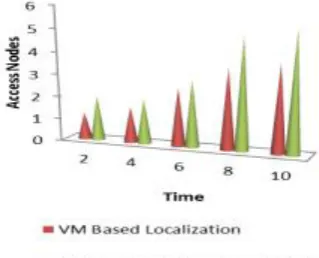
Fig 2 Relationship of Different Methods
The Graph1 shows comparison of results twisted by various nodes and it shows clearly that the planned method produces to verifiers of malicious nodes of minimum or maximum in sequence transferred in mugger and defender to support the packets from problastic algorithm containing recognition of malware sensor nodes.
V. Conclusion
37
extensive-form game with uncertainty and we provide an algorithm to find the best strategies of the two players. In our future work, the PLV algorithm will be improved to counter wormhole attacks and cooperative attacks of multiple malicious nodes. New methods to ensure the hop count and content integrity will also be investigated to reduce the burden on sensor and verifier nodes.
References
[1] I.F. Akyildiz, W. Su, Y. Sankarasubramaniam, and E. Cayirci, “A Survey on Wireless Sensor Network,” IEEE Comm. Magazine, vol. 40, no. 8, pp. 102-114, Aug. 2002.
[2] P. Baronti, P. Pillai, V.W.C. Chook, S. Chessa, A. Gotta, and H. Yim-Fun, “Wireless Sensor Networks: A Survey on the State of the Art and the 802.15.4 and Zigbee Standards,” Computer Comm., vol. 30, no. 7, pp. 1655-1695, 2007.
[3] L. Hu and D. Evans, “Localization for Mobile Sensor Networks,” Proc. ACM MobiCom, pp. 45- 57, 2004.
[4] N. Bulusu, J. Heidemann, and D. Estrin, “GPS-Less Low-Cost Outdoor Localization for Very Small Devices,” IEEE Personal Comm., vol. 7, no. 5, pp. 28-34, Oct. 2000.
[5] S.Capkun, M. Hamdi, and J.-P. Hubaux, “GPS-Free Positioning in Mobile Ad-Hoc Networks,” Cluster Computing, vol. 5, no. 2, pp. 157-167, 2002.
[6] J. Chen, K. Yao, and R. Hudson, “Source Localization and Beam forming,” IEEE Signal Processing Magazine, vol. 19, no. 2, pp. 30-39, Mar. 2002.
[7] L. Doherty, K. Pister, and L.E. Ghaoui, “Convex Position Estimation in WSNs,” Proc. IEEE INFOCOM, pp. 1655-1663, 2001.
[8] T. He, C. Huang, B.M. Blum, J.A. Stankovic, and T.F. Abdelzaher, “Range-Free Localization Schemes for Large Scale Sensor Networks,” Proc. ACM MobiCom, pp. 81-95, 2003.
[9] D. Niculescu and B. Nath, “Ad Hoc Positioning System (APS),” Proc. IEEE Global Telecomm. Conf. (GlobeCom ‟01), pp. 2926-2931, 2001.
[10] V. Ramadurai and M. Sichitiu, “Localization in Wireless Sensor Networks: A Probabilistic Approach,” Proc. Int‟l Conf. Wireless Networks (ICWN ‟03), pp. 275-281, 2003.
[11] A.Savvides, H. Park, and M.B. Srivastava, “The Bits and Flops of the N-Hop Multilateration Primitive for Node Localization Problems,” Proc. First ACM Int‟l Workshop Wireless Sensor Networks and Applications (WSNA ‟02), pp. 112-121, 2002.
[12] S.Capkun and J. Hubaux, “Secure Positioning in Wireless Networks,” IEEE J. Selected Area Comm., vol. 24, no. 2, pp. 221- 232, Feb. 2006.
[13] Y. Shoham and K. Leyton-Brown, Multiagent Systems: Algorithmic, Game-Theoretic, and Logical Foundations. Cambridge Univ. Press, 2009.
[14] N. Gatti, M. Monga, and S. Sicari, “Localization Security in Wireless Sensor Networks as a Non-Cooperative Game,” Proc. IEEE Int‟l Congress Ultra Modern Telecomm. And Control Systems and Workshops (ICUMT ‟10), pp. 295-300, 2010.