29 Available online at www.ijiere.com
International Journal of Innovative and Emerging
Research in Engineering
e-ISSN: 2394 - 3343 p-ISSN: 2394 - 5494
Cloud Computing an Emerging Paradigm for IT Service
Management
S. Ramacharan
IT Department. G.Narayanamma Institute of Techology and Sciences Hyderabad, Telangana,India.
ABSTRACT:
The novel era of computing is termed as Cloud Computing that permits the consumer to access the cloud services dynamically over Internet anywhere and anytime needed. It’s an evolving standard centered on ideas derived from consumer internet services that are boundless or flexible resources. Cloud comprises of data and resources whereas the cloud services comprise the delivery of software, infrastructure, applications, and storage over the Internet. Begins with virtualization along with service management as technical foundations later related to infrastructure and platform services focus on evolving programming models for the cloud and checking the traditional programming models with applications life-cycle.
Keywords: Cloud Computing, Cloud Infrastructure, Private Cloud, Public Cloud, SaaS, PaaS, ITSM.
I. INTRODUCTION
As stated by NIST [1], Cloud computing is delineated as a model for enabling prevalent, appropriate, when required network access to a communal computing resource pool that can be quickly delivered as well as released with nominal supervision or service provider collaboration. Cloud model endorses five vital characteristic such as on-demand self-service, rapid elasticity, measured service, comprehensive network access, resource sharing. Three service models which comprises Cloud SaaS, Cloud PaaS as well as Cloud IaaS. Four deployment models comprises public clouds, private clouds, community clouds, hybrid clouds.
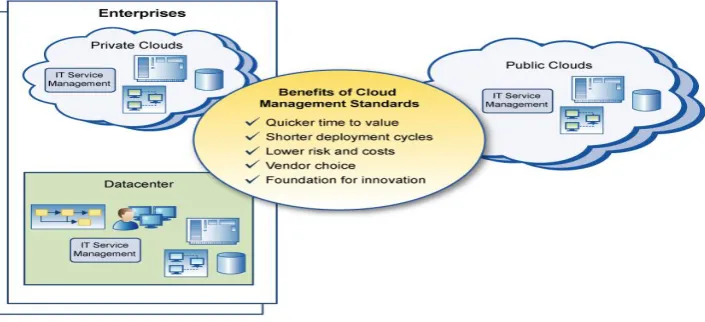
Figure 1:Scope and Benefits of DMTF Open Cloud Standards
The figure 1 shows the scope and benefits of open cloud standards. Four major cloud computing characteristics are identified which includes
1. Virtualization denotes to the abstraction of higher functioning stages from the workings of the subordinate stages.
2. Utility model where services are payable by stable charges, in Cloud Computing[5] the charge are computed dynamically based on quantity of resources consumption by the customers.
30 In addition to this other characteristic are On-demand, Quality of Service (QOS) / Service Level Agreement (SLA), User friendliness, Security, Multitenancy / Resource sharing, Interoperability, Standards, Fault tolerance, Load
Balancing, Internet centric.
II. BASIC CLOUD ARCHITECTURE
Cloud computing is evolving as a significant model for providing valuable, IT-enabled business services. It is a model that permits as well as supports both a precise style of business model and a detailed kind of consumer practice. Cloud computing applications, data and IT resources are accessible to customers over self-service portals. Requested services are supplied clearly over the network. “Cloud,” is a word frequently called provides economies of scale as well as flexible sourcing choices to the business.
Figure 2: Architecture of the Cloud
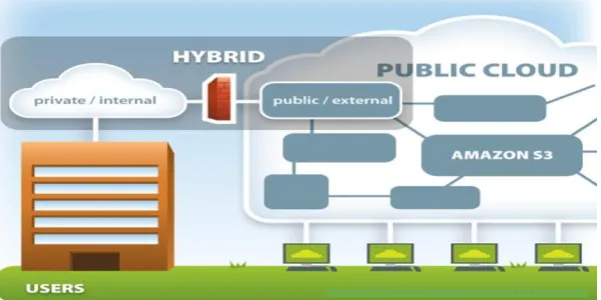
The Architecture of the cloud is shown in Figure 2 it represents Cloud Architecture into two section as service models as well as Deployment models.
The Deployment models includes private cloud. Public Cloud and Hybrid Cloud
Private Cloud: An internal cloud is known as private cloud which is built based on the resource owned by an organization for its consumers as well as for the company internal users. Each and every services are distributed within the organization’s firewall generally the private cloud owner does not share resources with any other business organizations, so multitenancy is not an issue. The main emphasis of private cloud is on operational excellence as well as expansion of resource utilization. Public cloud: In Public cloud every IT activities as well as functions are delivered “as a service” through the Internet from exterior suppliers based on resources not possessed by the user. Public clouds, also known by external or open clouds which allows user to access technology-enabled services without expertise knowledge [2] or command over the technology infrastructure [6] that supports them. The CIO as well as IT must address the Service Integrator role.
Hybrid cloud: Both Open or External service delivery methods as well as closed or internal service delivery methods are effortlessly unified. Rules and strategies are recognized by the associating organizations based on issues such as security requirements, criticality and fundamental architecture so that actions and tasks are assigned to traditional IT as suitable to external or internal clouds. Similar to public cloud in Hybrid Cloud the Service Integrator role is vital for constructive collaboration amongst all parties involved in the cloud.
31 Table 1: Capabilities of Cloud Type Service management
Cloud Type Service Management Capabilities
Private Cloud Virtual infrastructure
Operational support Services
Service mix (IaaS, PaaS, SaaS and PaaS
Cost
Operational excellence
Public Cloud Entitlement
Standard services and self service
Security and privacy
Demand-driven service capacity forecasting
Price
Business support Services
Sourcing and contracts
Customer satisfaction
Hybrid Cloud Change and configuration management
Service flows/unit of work completion
Disaster recovery
Cost allocation
End-to-end performance
Communications
Partner and supplier relationships
The Service Models includes IaaS, SaaS and PaaS A. Infrastructure-as-a-Service (IaaS):
Infrastructure[6]-as-a-Serviceoffers the principal of the Cloud service [4]. It sits straightly on upper of the hardware layer and delivers low-level services. Unravelling Cloud IaaS services from classical hardware hosting services which permits dynamic resizing, splitting and allocation of resources depending on user needs without the user’s awareness. These virtual mechanisms are autonomous of the underlying Hardware and can be moved and copied to allow flexibility and stability. The IaaS layer is available to the customers through underlying networks.
B. Platform-as-a-Service (PaaS):
The Platform-as-a-Service sits on top of Infrastructure[6] as- a-Service in the SPI model. It creates a unified software platform over the Web for developing, testing, deploying and hosting user-friendly web applications for application developers. It adds consolidation features, middleware, and other deployment capability services to the IaaS. It eradicates the necessity for direct contact between supplier and consumer as well as hides the complexity of the underlying hardware layer. The novel variation of PaaS, Open Platform-as-a-Service offers no constraint on choice of development software and avoids the possibility of lock-in.
C. Software-as-a-Service (SaaS):
The Software-as—Service is one of the commonly renowned loud Computing layers. SaaS deals with built-in business applications which in turn allows the users on a pay-as-you-go model to run applications remotely from the cloud. It is generally constructed on the top of either internal or External IaaS as well as PaaS settings by employing the obtainable flexibility. SaaS is centered on Application Service Providers (ASPs) which is related with two modes of SaaS specifically Simple Multi-tenancy as well as Fine Grain Multi-tenancy. In case of simple multi-tenancy, individual consumer has their private resources isolated from other consumers. In fine grain multi-tenancy, all resources are communal excluding consumer data as well as access capabilities. . The enormously scaled Software-as-a-Service retains the cost per user precisely a smaller amount by permitting millions of consumers to customize the identical service at the similar time. This diverges from the classical software licensing, where the consumer has to pay excessive licensing price up-front.
III. STAKEHOLDERS ON CLOUD SERVICE MANAGEMENT
32 Figure 4: Various Stakeholders in Cloud Computing
Cloud infrastructure providers
Cloud service providers
Cloud consumers
Application developers
Generally, they are responsible for the maintenance of Hardware and Software on which cloud computing is achieved basically function at the back-end. They are the suppliers of the abilities of Infrastructure-as-a-Service layer. The main patrons of the Cloud infrastructure providers are big companies as well as Cloud service [4] providers.
Cloud service providers
They utilize the potentials extended by the infrastructure [6] providers. They deliver the front-end of Cloud Computing [5][7][8] such as communication, collaboration and business services which correlated to the Software-as-a-Service and Platform-as-a-Service architecture layers.
Cloud Consumers
Cloud consumer group has been categorized into end users and application developers. End users
They are normally use services provided by the lower-level providers, all the services are accessed through web browser over the internet in SaaS and pay based on usage manner. They may be distinctive consumers or business enterprise users. Application developers
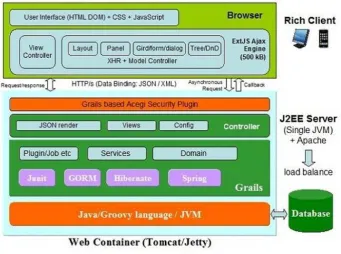
Application developers uses the abilities obtainable by the IaaS and the PaaS layers to design as well as build software that will be consumed by the consumers. Figure 5 shows complete Cloud service [4] management [9] architecture from application developers’ perception.
Figure 5: Basic Cloud Service Management
IV. INFORMATION TECHNOLOGY SERVICE MANAGEMENT (ITSM)
Services subsidize economies of any nation, outstanding transition from classical agricultural as well as manufacturing economies to service-based economies. Generally, Services are more in need of Information and Communication Technologies (ICT), the competence and efficacy of supplying these subsidiary Information Technology (IT) services has become progressively significant. ICT organizations are aware of this so there is an amplified interest in the standards and certifications concerning to management [9] of services in the current years. Comparatively slight academic research has been piloted in services in over-all as well as in information Technology Services management (ITSM) precisely without be effected the augmented interest inside the industries in modern years.
33 Figure 6: Services and products
Elements of IT Services
There are three elements of IT services are
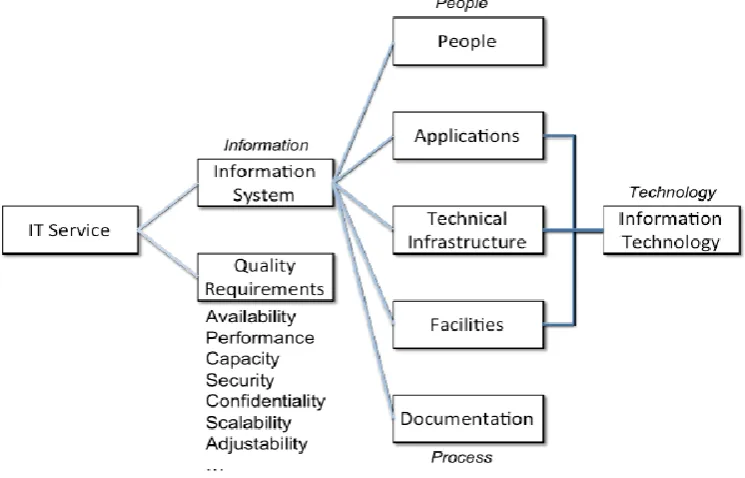
Information Systems (IS): Information System is further divided into people, process and technology as shown in the figure 7
A. Support: Support functions are essential to keep the information systems running to meet the agreed quality constraints.
B. Quality Specifications: The quality of IT services is usually defined by the critical characteristics set by customer expectations as shown in the figure 7.
FIGURE 7: BREAKDOWN OF THE COMPONENTS OF AN IT SERVICE
REFERENCES
[1] IT Governance Institute (2011): Global status report on the governance of enterprise IT (Geit) - 2011.
http://www.isaca.org/Knowledge-Center/Research/Documents/Global-Status-Report GEIT-10Jan2011-Research.pdf, accessed at 23.04.2012.
[2] Gupta, R.; Prasad, K.H.; Luan, L.; Rosu, D.; Ward, C. (2009): Multi-dimensional knowledge integration for efficient incident management in a service cloud. Paper presented at the IEEE International Conference on Service Computing, pp. 57-64.
[3] www.axelos.com/IT-Service-Management-ITIL
[4] www.ca.com/us/intellicenter/ca-cloud-service-management.aspx
[5] Barrie Sosinsky et al., “Cloud Computing Bible”, Wiley India, 2011.
[6] Shixing Yan, Bu Sung Lee, Guopeng Zhao, Ding Ma, Peer Mohamed, “Infrastructure Management of Hybrid Cloud for Enterprise Users”, 978-1-4577-1811-3/11, IEEE 2011
[7] Nick Antonopoulos, Lee Gillam, “Cloud Computing – Principles, Systems and Applications”, Springer-Verlag London Limited, 2010, e-ISBN 978-1-84996-241-4