6 Available online at www.ijiere.com
International Journal of Innovative and Emerging
Research in Engineering
e-ISSN: 2394 – 3343 p-ISSN: 2394 – 5494
Non-Linear Analysis Of R.C Shear wall At Different Location
In Multi-storied Building
Khushbu Thakkar
1, Prutha Vyas
21Post graduate student, 2Assistant professor, Navarachana University, Bhyli, Vadodara [email protected] , [email protected]
ABSTRACT:
The immense loss of life and properties has occurred due to failure of structures by earthquake. Pushover Analysis is able to present the structure behavior caused by different type of loads during earthquake. Analysis of G+ 15 structures with different location of Shear wall and structure is analyzed by comparing seismic parameters, pushover curve and performance point by the effect of earthquake with the help of pushover analysis. Study of the building frame is designed as per IS 456:2000 and IS 1893:2002. Pushover analysis of the building frame is carried out by using structural analysis and design software ETABS.
Keywords: Non-linear static analysis, Reinforced concrete frame, Pushover Analysis, target displacement, pushover curve
I. INTRODUCTION
Because of the earthquake occurrence the seismic analysis and design of structures is required. An Earthquake is the shaking of surface of the Earth, resulting from the sudden release of energy from the earth’s lithosphere that create seismic waves. The earthquake is one of the natural hazards that have possible to cause greatest damages. It causes the building to collapse or damage by acting laterally on building, hence causing severe damage to human life and buildings. When structures are subjected to strong earthquake ground motions, they exhibit inelastic behaviours, which cannot be accessed using an elastic analysis. A non-linear analysis evaluates the seismic performance of structure considering the post-elastic behaviour is needed, to predict the weakness of the structures, and their survivability under severe earthquake motion. There are various non-linear analysis methods to estimate the maximum inelastic displacement demand of the structure is proposed. The idea of non-linear static analysis known as pushover analysis and non-linear dynamic analysis known as time history analysis are presented in this study.
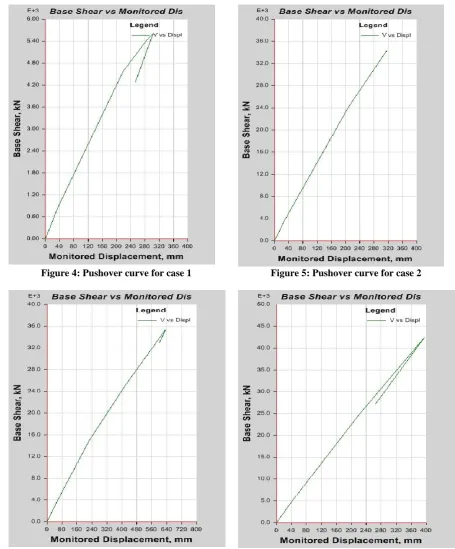
Pushover is a static-nonlinear analysis method where a structure is subjected to gravity loading and a monotonic displacement-controlled lateral load pattern which continuously increases through elastic and inelastic behaviour until an critical condition is reached [2]. Lateral load may represent the range of base shear induced by earthquake loading, and its configuration may be proportional to the distribution of mass along building height, mode shapes, or another practical means.
II. PARAMETRIC STUDY
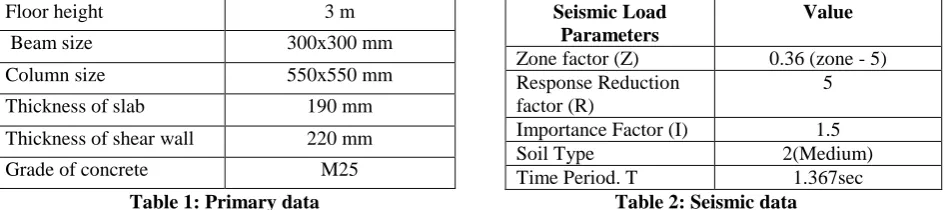
G+15 RC building considered with shear wall having different position to understand the suitable position of shear wall. For linear static and non-linear static Analysis, Analysis and design of building is carried out using ETABS. Primary data of building is given in table 1 and seismic data are given in table 2.
Floor height 3 m
Beam size 300x300 mm
Column size 550x550 mm
Thickness of slab 190 mm
Thickness of shear wall 220 mm
Grade of concrete M25
Seismic Load Parameters
Value
Zone factor (Z) 0.36 (zone - 5) Response Reduction
factor (R)
5
Importance Factor (I) 1.5
Soil Type 2(Medium)
Time Period. T 1.367sec
7
III. RESULT AND CONCLUSION
Analysis is carried out using ETABS software in terms of deflection; story drift and story shear force for four different case as shown in figure.
Case 1: Without Shear wall [6] Case 2 : Shear wall at corner [6]
8
A. RESULT OF LINEAR STATIC ANALYSIS
Figure 1: Story Displacement v/s No of Story
Figure 2: Story Drift v/s No of Story
Figure 3: Story Shear
0 2 4 6 8 10 12 14 16
0 10 20 30 40 50 60 70
STORE Y N O DISPLACEMENT (mm)
DISPLACEMENT
without S.W S.W at corner S.W at center of sides S.W at core
0 2 4 6 8 10 12 14 16
0 0.0005 0.001 0.0015 0.002
STORE Y N O DRIFT
DRIFT
without S.W S.W at corner S.W at Center of sides S.W at core
0 0.5 1 1.5 B ase sh e ar Case Name
BASE SHEAR
9 B. RESULT OF NON-LINEAR STATIC ANALYSIS
Figure 4: Pushover curve for case 1 Figure 5: Pushover curve for case 2
10 C. PERFORMANCE POINT RESULT
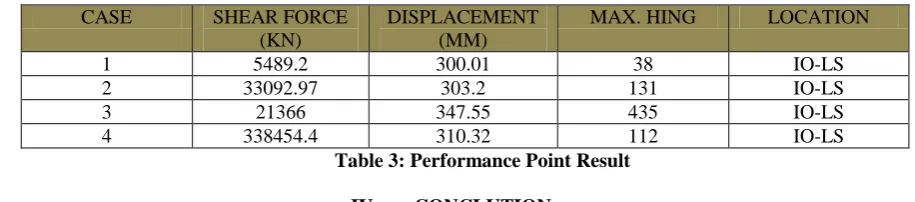
CASE SHEAR FORCE
(KN)
DISPLACEMENT (MM)
MAX. HING LOCATION
1 5489.2 300.01 38 IO-LS
2 33092.97 303.2 131 IO-LS
3 21366 347.55 435 IO-LS
4 338454.4 310.32 112 IO-LS
Table 3: Performance Point Result
IV. CONCLUTION
A. As per the displacement graph of the building, the location of shear wall the corner and core of the structure is more effective as compared to the other location.
B. It is concluded that shear wall is more effective when located at exterior periphery of building then interior core. Deflection and drift is reduced for case 2 than case 4.
C. Base shear is lesser for the building without shear wall than building with shear wall because of the dead load of the building. In case 2 base shear is less as compared to the other cases so it is more flexible.
D. From the results obtained, the level of performance is between the IO-LS so, this means that the building does not require retrofitting.
E. The hinge formed in the results obtained after analysis of various buildings is mostly found on the beam section i.e. it follows strong column weak beam theory.
F. Considering all these above discussions made on analysis, it is finally said that the shear wall is located at exterior periphery of the building is more effective in linear and non-linear static analysis i.e Pushover analysis as compare to the other location of shear wall buildings.
REFRENCES
[1] Shahzad Jamil sardar and Umesh N Karadi., “Effect of change in shear wall location on storey drift of multi-storied building subjected to lateral loads“.
[2] Rafiqullslam , “Basics of Nonlinear Pushover Analysis”
[3] Mehmet Inel*, Hayri Baytan Ozmen., “Effects of plastic hinge properties in nonlinear analysis of reinforced concrete buildings”.
[4] Ghobarah, Ahemd.“Performance-based design in earthquake engineering: state of development.” Engineering Structure 23.8(2001):878-884
[5] Mohammad, Azaz and Anshul R. Nikhle. “Pushover Analysis on G+10 Reinforced Concrete Structure for Zone II and III Ad Per IS 1893(2002)”. International research journal of engineering and technology (IRJET) volume:02 issue: 05| AUG-2015: 2395-0056
[6] Vijit Sahu ,Dr. G.P. Khare, Mr. Dushyant Kumar Sahu , “Behaviour of multistorey building with different shear wall arrangements with and without central cross shear wall”. International research journal of engineering and technology (IRJET) volume : 05 issue:01| JAN 2018
[7] A S Patil and P D Kumbhar., “Time History analysis of Multi-storey RCC Buildings for different seismic intensities
[8] M. Ajmal, M.K. Rahman and M.H. Baluch., “Nonlinear Static Pushover Analysis of a Shear Wall Building in Madinah”