JACOBSTHAL FAMILY MODULO m
Y. YAZLIK1, N. YILMAZ2, N. TASKARA2, K. USLU2, §
Abstract. In this study, we investigate sets of remainder of the Jacobsthal and Jacobsthal-Lucas numbers modulomfor some positive integersm. Also some properties related to these sets and a new method to calculate the length of period modulomis given. Keywords: Jacobsthal numbers, Jacobsthal-Lucas numbers, modulo, period. AMS Subject Classification: 11B39, 11B50
1. Introduction
Jacobsthal and Jacobsthal Lucas numbers have been used by scientists for their fun-damental theory and their applications. For interesting applications of these numbers in computer science and nature, one can see the citations in [1,3,6,7]. For instance, in com-puter science, they have been used conditional instructions to change the flow of execution of a program by using Jacobsthal numbers. The properties of these numbers are first sum-marized by Horadam. As a reminder for the rest of this paper, the well-known Jacobsthal and Jacobsthal Lucas numberstJnu8n0 and tjnu8n0 are defined by recurrence relations Jn 2 Jn 1 2Jn, pJ00, J11q (1)
jn 2 jn 1 2jn, p j0 2, j11q (2) respectively. The equations in (1) and (2) are the second order linear difference equation and their characteristic equation follows
r2r 2. (3)
The equation in (3) has two real roots asr1 2 andr2 1. It means that the following relations hold for the numbersr1,r2:
r1 r21, r1r2 3, r1r2 2 (4)
The Binet formulas of these numbers are given as follows
Jn
1 3p2
n p1qnq, j
n2n p1qn. (5)
There are many of study on modulo in literature. Authors developed some methods to find the length of period related to Fibonacci numbers modulo m, although there is no known formula for length of period [4,8,9]. Guo and Koch, in [5], studied the Fibonacci
1
Nevsehir Haci Bektas Veli University, Faculty of Science and Art, Department of Mathematics, Nevsehir, Turkey.
e-mail: [email protected];
2 Selcuk University, Science Faculty, Department of Mathematics, Konya, Turkey.
e-mail: [email protected], [email protected], [email protected]; § Manuscript received: January 29, 2014; Accepted: September 21, 2015.
TWMS Journal of Applied and Engineering Mathematics Vol.6, No.1; cI¸sık University, Department of Mathematics, 2016; all rights reserved.
sequence modnfor some positive integer n. Also, some properties of the length of period fork-Fibonacci sequences modulom,are presented in [2].
In this paper, we mainly focus on the lengths of period of Jacobsthal tJnu8n0 and
Jacobsthal Lucas tjnu8n0 sequences modulo m and obtain a formula to find the lengths of period taking modulom for some positive integerm. We also investigate the relations among lengths of period for these numbers.
2. Main Results
LetLpJ, mqandlpj, mqdenote the length of the period ofJnpmod mqandjnpmod mq,
respectively. Suppose that the periods of sequences tJnu8n0 and tjnu8n0 have one or more zeros. In this case, the set of elements between two consecutive zeros including the first zero, but not the second one is called a chain.
There isn’t directly specific formula to compute the length of period of Jacobsthal and Jacobsthal-Lucas numbers. However, in this study, we obtain the identities which are find the length of period for some specific cases.
Now, let us first consider the following lemma which will be needed later in this section.
Lemma 2.1. The following properties are hold:
a): Assume thatm is odd prime number andiPZ .ThenL J, miLpJ, mqmi1,
b): Forgcdpa, bq 1, LpJ, a.bq lcmpLpJ, aq, LpJ, bqq.
Similarly, properties of Lemma 2.1 are hold for Jacobsthal Lucas numbers.
Theorem 2.1. For m¥3, the following identities are hold: a): LpJ, mq LpJ,2mq,
b): lpj, mq lpj,2mq.
Proof. a) We proceed by induction on m. Since LpJ,3q LpJ,6q 6, the result is true for m3.Assume that the result is true for k, that is, LpJ, kq LpJ,2kq. We show that LpJ, k 1q LpJ,2k 2q. If k is even, then k 1 is odd and we have LpJ,2pk 1qq lcmpLpJ,2q, LpJ, k 1qq LpJ, k 1q.If k is odd, then k 1 is even. Thus, k 12nt, such that n¥1, tis odd and,tand nare not 1 at the same time. We first observe that if m ¡ 1,then LpJ,2mq 2 because 3Ji 2i p1qi p1qi 1 p1qi 3 3Ji 2pmod 2mq for eachi¥2m.Hence if t 1, thenLpJ,2pk 1qq L J,2n 1 LpJ,2nq LpJ, k 1q. Now suppose
that t¡1.Then
LpJ,2pk 1qq lcmL J,2n 1t
lcm L J,2n 1, LpJ, tq
lcmpLpJ,2nq, LpJ, tqq
LpJ,2ntq LpJ, k 1q as required.
b) The proof is similar to part (a).
By considering above theorem, we give the following results.
Corollary 2.1. For the special value ofm in Theorem 2.1, it is obvious that the following results hold:
b): Forp ¡2 and i PN, L J, p.r1i
LpJ, pq, l j, p.ri1 lpj, pq, where r1 is root
of characteristic equation of (1).
Theorem 2.2. Let r1 and r2 be roots of characteristic equation of (1) and
Ln
J,pr1 r2qi L
J, L
J, ..., L
J,pr1 r2qi
. For i, nPZ ,we have
Ln
J,pr1 r2qi L
J,pr1 r2qi .
Proof. By induction on n, for n 1, it is obvious. For n 2, from Lemma 2.1, L
J,pr1 r2qi LpJ,pr1 r2q.pr1 r2qi1q LpJ,3q.3i16.3i12.pr1 r2qi. If it is taken the length of period for every sides, thenL
J, L
J,pr1 r2qi
L
J,2.pr1 r2qi .By considering Theorem 2.1, it is obtained
L
J, L
J,pr1 r2qi
L
J,pr1 r2qi (6)
and the relation holds. Suppose that the relation is true for anym¤n. That is, Lm
J,pr1 r2qi L
J,pr1 r2qi . (7)
Then, we have
Lm 1
J,pr1 r2qi L
J, LmpJ,pr1 r2qiq . Taking into account (6) and (7), we obtain
Lm 1
J,pr1 r2qi L
J,pr1 r2qi , as required.
Theorem 2.3. Assume that m is odd andiPZ . The following statements are hold: a) Form¡Ji,
JLpJ,mq1 m 1
2 modpmq, JLpJ,mq 0 modpmq, JLpJ,mq i Jimodpmq.
b) Form¡ji,
jlpj,mq1 m1
2 modpmq jlpj,mq 2 modpmq jlpj,mq i jimodpmq
Proof. a) Firstly, by using iteration method, we can write
JLpJ,3q1 J5 3 1
2 modp3q
JLpJ,5q1 J3 5 1
2 modp5q
JLpJ,7q1 J5 7 1
2 modp7q.
Finally, from well-known Convolution product for Jacobsthal numbers (i.e. Jn m
JnJm 1 2Jn1Jm), we have
JLpJ,mq iJi JLpJ,mqJi 1 2JLpJ,mq1JiJi
JLpJ,mqJi 1 Ji 2JLpJ,mq11
. From above two properties, we obtain
JLpJ,mq iJi mJimodpmq
0 modpmq.
b) The proof can be seen easily in a similar manner with (a).
Let us consider the remainders of the first two chains of the sequences tJm mod Jru
andtjm mod jru:
0, J1, J2, . . . , Jr2, Jr1,0, a1, a2, . . . , aJr1, (8)
0, j1, j2, . . . , jr2, jr1,0, b1, b2, . . . , bjr1. (9)
The following theorem give us relations betweenai pi1,2, ..., Jr1qin (8) and Jacob-sthal and betweenbi pi1,2, ..., jr1qin (9) and Jacobsthal Lucas numbers.
Theorem 2.4. The following identities are hold:
a) ai
"
Ji, r is even
JrJi, r is odd , f ori=1,2,...,Jr1,
b) bi
"
jrji 2p1qi, r is even
ji2p1qi, r is odd , f ori=1,2,...,jr1.
Proof. In here, we will prove (a) since (b) can be thought in the same manner with it.
a): We use the principle of finite induction on m to prove. There are two cases of subscriptr.
r is even case: By considering (5), for m 1, a1 remainder
Jr 1
Jr remainder
Jr 2Jr1
Jr remainder
2Jr1
Jr 1 J1. As the usual next step of inductions, let us
assume that it is true for all positive integersm. That is, am remainder
Jr m
Jr Jm.
Therefore, we have to show that is true form 1. am 1remainder
Jr m 1
Jr remainder
Jr m 2Jr m1
Jr remainder
Jr m
Jr 2.remainder
Jr m1
Jr Jm 2Jm1 Jm 1which
ends up the induction.
r is odd case: This case can be seen easily in a similar manner.
By considering (8), (9) and above theorem, we obtain the relations between indices of Jacobsthal (Jacobsthal Lucas) numbers and length of period of Jacobsthal (Jacobsthal Lucas) numbers.
Corollary 2.2. For m¡2, the following identities are hold: a): LpJ, Jmq
"
2m, m is odd
m, m is even , b): lpj, jmq 2m.
Corollary 2.3. Assume that p is prime number such that p6k 1 for kPZ . Then,
we have
LpJ, mq
$ & %
lpj, mq, 3m lpj, mq, 3|m and p|m 3lpj, mq, 3|m andpm
.
3. Numerical Examples
Taking into account the derived expressions for m and n, one can see the effectiveness of the above results.
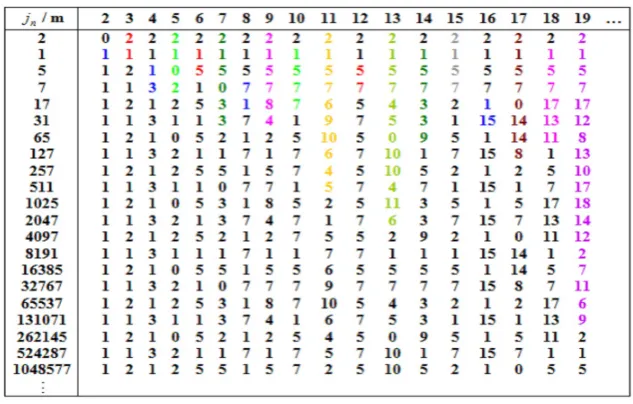
Figure 1. Sets of remainder of Jacobsthal numbers for modulom
In Figure 1 and Figure 2, sets of remainder of Jacobsthal and Jacobsthal Lucas numbers for modulo m can be seen, respectively. Also the length of period for these numbers is illustrated for some values ofn.
For example, in Figure 1, for n 5 and m 11,we have the remainders for modulo 11 ast0,1,1,3,5,0,10,10,8,6, uand the length of period of J5 asLpJ, J5q 10. Also, remainders of chain are a1 J5J1 10, a2 10, a38, a4 6 in Theorem 2.4.
In Figure 2, for n 4 and m 17, we have the remainders for modulo 17 as
t2,1,5,7,0,14,14,8, u and the length of period of j4 asLpj, j4q 8. Also, remainders of chain areb1 j4j1 2p1q114, b2 14, b38, b4 2, b5 1, b6 5, b77 in Theorem 2.4.
References
[1] Djordjevic,G.B., (2007), Mixed convolutions of the Jacobsthal type, Applied Mathematics and Com-putation 186, pp. 646-651.
[2] Falcon,F. and Plaza,A., (2009), k-Fibonacci sequences modulo m, Chaos, Solitons and Fractals 41, pp. 497-504.
[3] Frey,D.D. and Sellers,J.A., (2000), Jacobsthal numbers and alternating sign matrices, Journal of Integer Sequences 3, article 00.2.3.
[4] Fulton,J.D. and Morris,W.L., (1969/1970), On arithmetical functions related to the Fibonacci numbers, Acta Arithmetica 16, pp. 105-110.
[5] Guo,C. and Koch,A., (2009), Bounds for Fibonacci period growth, Involve A Journal of Mathematics 2.
[6] Horadam,A.F., (1996), Jacobsthal representation numbers, Fibonacci Quarterly 34, pp. 40-54. [7] Koshy,T., (2001), Fibonacci and Lucas Numbers with Applications, John Wiley and Sons Inc, NY. [8] Renault,M., (1996), Properties of the Fibonacci sequence under various moduli, Master’s thesis, Wake
Forest University.
[9] Wall,D.D., (1960), Fibonacci series modulo m, Amer. Math. Monthly 67, pp. 525-532.
Yasin YAZLIKis now an Assoc. Prof. in Department of Mathematics at Nevsehir Haci Bektas Veli University; Nevsehir (Turkey). He obtained his M.Sc. (2009) and Ph.D. (2013) degree from Selcuk University. His research interests include matrix theory, number sequences and difference equations. He has published articles journals releated these subjects.
Necati TASKARAis now an Assoc. Prof. in Department of Mathematics at Selcuk University, Konya-TURKEY. He obtained his M.sc. (1993) and Ph.D. (1997) degree from Selcuk University. His research interests include number sequences and difference equations. He has published articles jour-nals releated these subjects.