Int. J. IndustrialMathematics (ISSN 2008-5621) Vol. 7, No. 3, 2015 Article ID IJIM-00628, 7 pages
Research Article
A general approach to linguistic approximation and its application in
frame of fuzzy logic deduction
Rasoul Saneifard ∗, Rahim Saneifard †‡
————————————————————————————————–
Abstract
This paper deals with one problem that needs to be addressed in the emerging field known under the name computing with perceptions. It is the problem of describing, approximately, a given fuzzy set in natural language. This problem has lately been referred to as the problem of retranslation. An approaches to dealing with the retranslation problem is discussed in the paper, that is based on a pre-defined set of linguistic terms and the associated fuzzy sets. The retranslation problem is discussed in terms of two criteria validity and informativeness.
Keywords: Fuzzy sets; Regular Function; Defuzzification; Informativeness; Validity.
—————————————————————————————————–
1
Introduction
T
hthe second half of the 20th century openede emergence of computer technology in many new possibilities for machines. These possibilities have been discussed in various contexts quite extensively in the literature. One aspect of considerable interest has been a com-parison of existing and prospective capabilities of machines with those of human beings. An overall observation at this time is that the range of machine capabilities has visibly expanded over the years, from numerical computation to symbol manipulation, processing of visual data, learning from experience, etc. Moreover, machines have become superior to humans in some specific capabilities, such as large-scale processing of numerical data, massive combinatorial searches of various kinds, complex symbol manipulation,∗Department of Engineering Technology, Texas South-ern University, Houston, Texas, USA.
†Corresponding author. [email protected] ‡Department of Applied Mathematics, Urmia Branch, Islamic Azad University, Urmia, Iran.
or sophisticated graphics. Some important new areas have emerged due to these machine capabilities, such as fractal geometry, cellular automata or evolutionary computing. In spite of the impressive advances of machines, they are still not able to match some capabilities of human beings. Perhaps the most exemplary of them are the remarkable and very complex perceptual abilities of the human mind, which allow humans to use perceptions in purposeful ways to perform complex tasks. Although current machines are not capable of reasoning and acting on the basis of perceptions, a feasible research program for developing this capability was recently proposed by Zadeh [17]. The crux of this program is to approximate perceptions by statements in natural language and, then, to use fuzzy logic to represent these statements and deal with them as needed. This approach to developing perception-based machines is referred to in the literature as computing with words, which is a name suggested also by Zadeh [16]. Approximating statements in natural language by propositions in fuzzy logic may be viewed
as a translation from natural language to a formalized language. Alternatively, it may be viewed as a linguistic approximation of the first kind. As is well known, this translation (or approximation) is strongly context dependent. Once it is accomplished in the context of a given application, all available resources of fuzzy logic in the broad sense can be utilized to emulate the ordinary (commonsense) human reasoning that pertains to the application (Yager et al. [15], Bezdek et al. [3]).
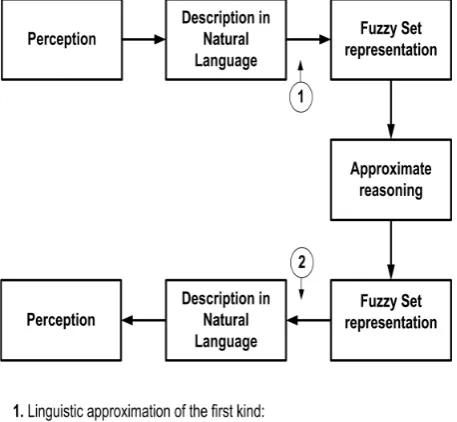
It is quite obvious that any relevant background knowledge should also be utilized in the reason-ing Regardless of the nature of the reasonreason-ing process, its consequents are fuzzy propositions, each of which involves one or more fuzzy sets. In order to connect these fuzzy propositions to perceptions (i.e. to convey appropriate perceptions), we need to approximate them by statements in natural language. This means, in turn, that we need to express each of the fuzzy sets involved by a linguistic expression in natural language that has an understandable meaning in the given context. These issues pertain to the second kind of linguistic approximation, which may conveniently be called a retranslation. The whole process of perception-based reasoning, whose core is computing with words, is illus-trated in a simplified way in Figure 1. The two kinds of linguistic approximation translation and retranslation are identified in the figure by labels 1 and 2, respectively.
While the problem of translation has been extensively studied and discussed in the liter-ature, the problem of retranslation is far less developed. Prior to the late 1990s, this problem had been recognized only by a few authors, among them Eshragh and Mamdani [7] and Novak [10]. More recently, the problem has been addressed more substantially by Dvorak [6], Yager [14], Delgado et al. [5], Saneifard [11,12,13], Ezzati et al [8].
The paper is organized as follows. In Section 2, we introduce relevant concepts and notation. In this Section, we discuss the main issues involved in dealing with the problem of retranslation. Subsections 2.1 is application to fundamentally approach to retranslation. Our conclusions are covered in Section3.
Figure 1: Perception-based reasoning.
2
Basic Definitions and
Nota-tions
In this paper, we assume that the reader is famil-iar with basics of fuzzy set theory and fuzzy logic in the broad sense. For the sake of completeness, we introduce in this section only those concepts that are relevant to our discussion of the retrans-lation problem. We denote all fuzzy sets in this paper by capital letters.
Classical sets are viewed as special fuzzy sets, called crisp sets, and are thus denoted by cap-ital letters as well. For the sake of simplicity, we consider only numerical linguistic variables whose states are expressed by normal and convex fuzzy sets that are defined on some given closed interval, X = [x1, x2], of real numbers. These
fuzzy sets, usually referred to as fuzzy intervals, are viewed as concave functions from X to [0,1] whose maxima are 1.
Definition 2.1 [10]. For any fuzzy interval A : X → [0,1], its α-cut, Aα, is for each α ∈ [0,1] the closed interval as follows:
Aα={x∈X|A(x)≥α}.
inter-val, A, the canonical form is as follows,
A(x) =
aL(x) when x∈[a, b), 1 when x∈[b, c], aR(x) when x∈(c, d],
0 otherwise .
(2.1)
wherex∈X= [x1, x2]anda, b, c, dare real
num-bers in X such that a≤b≤ c≤d, aL is a con-tinuous and increasing function from aL(a) = 0 to aL(b) = 1, and aR is a continuous decreasing function from aR(c) = 1 toaR(d) = 0.
For each value α ∈ [0,1], theα-cut of A, Aα, is a closed interval of real numbers defined by the formula
Aα = [aαL, aαR], (2.2)
where aαL and aαR are the inverse functions of aL and aR, respectively. The crisp sets
supp(A) ={x∈X|A(x)>0},
core(A) ={x∈X|A(x) = 1},
are called, respectively, a support ofAand a core of A. Clearly, supp(A) = (a, d) and core(A) = [b, c].
Definition 2.3 [9]. A function f : [0,1]→[0,1] symmetric around 12, i.e. f(12 −α) = f(12 +α) for all α ∈ [0,12], which reaches its minimum in
1
2, is called the bi-symmetrical weighted function.
Moreover, the bi-symmetrical weighted function is called regular if
(1) f(12) = 0,
(2) f(0) =f(1) = 1,
(3) ∫01f(α)dα= 12.
In most examples in this paper, we use trape-zoidal fuzzy intervals, T, in which aL and aR are linear functions. That is, aL(x) = ((xb−−aa)) and
aR(x) = ((dd−−xc)). Then, for eachα∈(0,1],
Tα = [a+ (b−a)α, d−(d−c)α]. (2.3)
Every trapezoidal fuzzy interval T is thus uniquely characterized via the quadruple
T =⟨a, b, c, d⟩.
A special case in which b = c, which is called a triangular fuzzy interval, is also employed in this
paper.
An important concept for dealing with the problem of retranslation is the degree of subsec-tion, s(A ⊆ B), of fuzzy set A in fuzzy set B (both defined on the same interval X), which is expressed by the formula [17],
s(A⊆B) = ∫
Xmin∫{A(x), B(x)}dx
XA(x)dx
. (2.4)
The minimum operator in this formula represents the standard intersection of fuzzy sets. As is well known, this is the only intersection of fuzzy sets that is cutworthy in the sense that
(A∩B)α =Aα∩Bα,
holds for all α∈[0,1]. [2]
To deal with the retranslation problem, we also need to measure the non-specificity and fuzziness of the fuzzy sets involved.
Definition 2.4 For any given normal and con-vex fuzzy set A, We define a well-justified mea-sure of non-specificity, N S, as follows:
N S(A) = ∫ 1
0
f(α)Log2[1 +Lm(Aα)]2dα. (2.5)
Were f : [0,1]→[0,1] is a bi-symmetrical (regu-lar) weighted function [9].
One can, of course, propose many regular bi-symmetrical weighted functions and hence ob-tain different bi-symmetrical weighted distances. Further on we will consider mainly a following function
f(α) = {
1−2α when α∈[0,12],
2α−1 when α∈[12,1]. (2.6)
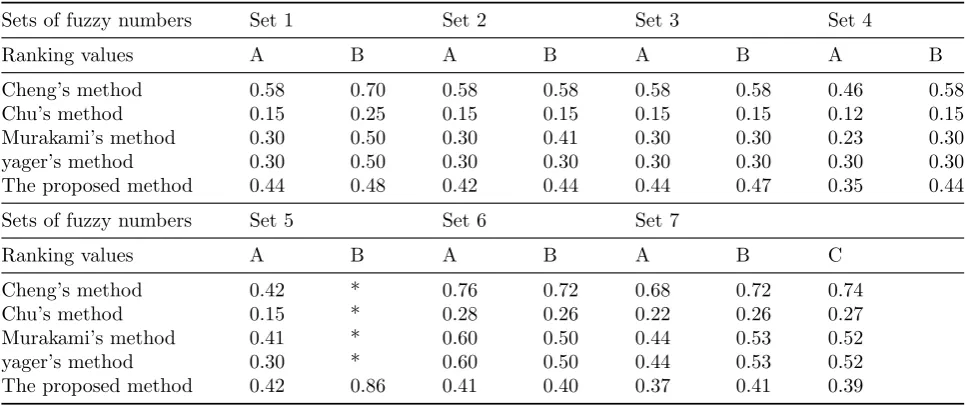
Table 1: Comparison results for skin friction co-efficient (1 +1γ)f′′(0) in the casek0= 0, S= 0 andM = 0.5.
Sets of fuzzy numbers Set 1 Set 2 Set 3 Set 4
Ranking values A B A B A B A B
Cheng’s method 0.58 0.70 0.58 0.58 0.58 0.58 0.46 0.58 Chu’s method 0.15 0.25 0.15 0.15 0.15 0.15 0.12 0.15 Murakami’s method 0.30 0.50 0.30 0.41 0.30 0.30 0.23 0.30 yager’s method 0.30 0.50 0.30 0.30 0.30 0.30 0.30 0.30 The proposed method 0.44 0.48 0.42 0.44 0.44 0.47 0.35 0.44 Sets of fuzzy numbers Set 5 Set 6 Set 7
Ranking values A B A B A B C
Cheng’s method 0.42 * 0.76 0.72 0.68 0.72 0.74 Chu’s method 0.15 * 0.28 0.26 0.22 0.26 0.27 Murakami’s method 0.41 * 0.60 0.50 0.44 0.53 0.52 yager’s method 0.30 * 0.60 0.50 0.44 0.53 0.52 The proposed method 0.42 0.86 0.41 0.40 0.37 0.41 0.39
Definition 2.5 Given a convex fuzzy set A, its fuzziness, f(A), can be measured by the overlap ofAand its complement. Using standard operations of complementation and intersection of fuzzy sets, we have
f(A) = ∫
X
min{A(x),1−A(x)}dx. (2.7)
Clearly, f(A) = 0 if and only if A is a crisp (classical) set, and the maximum degree of fuzzi-ness is obtained for the unique fuzzy set in which A(x) = 1−A(x) = 0.5 for all x∈X.
Two criteria that are considered in this paper as essential are validity and informativeness.
Definition 2.6 The degree of validity of choos-ing a standard fuzzy interval F that has a linguistic interpretation to represent a given convex fuzzy set G, v(F | G), as the degree to which G is contained in F define as follows,
v(F |G) = ∫
Xmin∫{G(x), F(x)}dx
XG(x)dx
. (2.8)
For any pair of standard fuzzy intervals, F1 and
F2, that compete for representing a given fuzzy
set G, clearly, if v(F1 |G)≥v(F2|G) then F1 is
preferable toF2 according to validity.
Definition 2.7 The degree of informativeness of F, i(F), is concerned, it is define it as the normalized reduction of non-specificity with respect to the non-specificity ofX as follows:
i(F) = 1− N S(F) Log2[1 +Lm(X)]
. (2.9)
Clearly, if i(F1) ≥ i(F2) then F1 is preferable to
F2 according to informativeness.
Example 2.1 Let G is a fuzzy number with membership function as follows that X = [−10,10],
G(x) =
x
2 when x∈[0,2),
2.4−0.7x when x∈[2,3), 0.3 when x∈[3,4), 1.5−0.3x when x∈[4,5),
0 otherwise.
(2.10)
Clearly
Gα= {
[2α,(15−10α)/3], when α∈(0,0.3], [2α,(24−10α)/3], when α∈(0.3,1]. (2.11) There is
N S(G) = ∫ 0.3
0
αLog2[1 + (15−16α)/3]2dα
+ ∫ 1
0.3
αLog2[1 + (24−24α)]2dα
and
i(G) = 1− N S(G) Log2(21)
= 0.4008
2.1 Using Ranking Method In Fuzzy Multi-criteria Decision Making Based on An FN-IOWA Operator
Chen and Chen [4] proposed a method to han-dle fuzzy multi-criteria decision making problems based on fuzzy number induced ordered weighted averaging (FN-IOWA)operator and applied the algorithm to a human selection problem. In this section, we use the same example illustrated in Chen and Chen (2003) to show the efficiency of the proposed ranking method. For more detailed information about the FN-IOWA operator, (see R. R. Yager 1998, R. R. Yager and D. P. Filev 1999, Chen and Chen 2003). Here we just pay attention to the fuzzy ranking step in the final decision making process.
A new manager will be recruited among three candidates, X,Y and Z. The final scores, which can be obtained by an FN-IOWA operator, are fuzzy numbers and are listed as follows:
SX = (0.2501,0.7727,2.2501), SY = (0.0667,0.5000,1.8750), SZ = (0.1667,0.6592,2.2500).
By applying the degree of informativeness of X, Y and Z, the index regular of each alternative can be obtained as follows:
i(X) = 0.0988, i(Y) = 0.0160, i(Z) = 0.1250.
We can see that their ranking order Z > X > Y. Therefore, CandidateZ is more suitable than CandidateX, and CandidateX is more suitable than Candidate Y. The result are the same as the one presented in Chen and Chen [4].
Example 2.2 In the following, we use seven sets of generalized trapezoidal fuzzy numbers adopted from [1,11] to compare the proposed fuzzy ranking method with some other existing ranking meth-ods. The eight sets of fuzzy numbers are shown in Fig. 2. A comparison of the ranking results of the proposed method with the existing methods is described as follows:
1. From Sets I (I = 1,· · ·,7), , of Fig. 2, we can see that the fuzzy numbers A and B are different fuzzy numbers, where the ranking order is A ≺ B. From Table 1, we can see that the proposed method and the methods presented in Table1 get the correct results.
2. In [8], the authors point out that the ranking order of Set 7, is A ≺ B ≺ C, however from Table 1, we can see that the methods presented in [4] and [18] get incorrect ranking results.
1 1
0.1 0.3 0.5 0.7
A B
Set 1: A=(0.1,0.3,0.3,0.5), B=(0.3,0.5,0.5,0.7)
0.1 0.3 0.5
A
Set 3: A=(0.1,0.3,0.3,0.5), B=(0.2,0.3,0.3,0.4)
0.1 0.2 0.3 0.4 0.5
1
1
0.8
A B
A
B
0.3
0.1 0.5
Set 4: A=(0.1,0.3,0.3,0.5), B=(0.1,0.3,0.3,0.5)
Set 5: A=(0.1,0.2,0.4,0.5), B=(1.0,1.0,1.0,1.0)
0.1 0.3 0.5
1
B
A
1.0 0.1 0.3 0.50.6 0.8 1.0
1 A B
Set 6: A=(0.3,0.5,0.5,1.0), B=(0.1,0.6,0.6,0.8)
0.1 0.4 0.5
B
A
0.8
0 0.2 0.60.7 0.9
1
A
C Set 7:
A=(0.0,0.4,0.6,0.8) B=(0.2,0.5,0.5,0.9) C=(0.1,0.6,0.7,0.8)
Set 2: A=(0.1,0.2,0.4,0.5), B=(0.1,0.3,0.3,0.5)
Figure 2: Seven sets of fuzzy numbers.
3
Conclusion
informativeness of fuzzy numbers with any kinds of membership functions.
References
[1] S. Abbasbandy, B. Asady,The nearest trape-zoidal fuzzy number to a fuzzy quantity, Ap-plied Mathematics and Computation 156 (2004) 381 - 386.
[2] M. S. Kandelousi, Effect of spatially vari-able magnetic field on ferrofluid flow and heat transfer considering constant heat flux boundary condition, European Physical Journal Plus 129 (2014) 248.
[3] J. C. Bezdek, D. Dubois, and H. Prade (Eds.). Fuzzy Sets in Approximate Rea-soning and Information Systems, Boston: Kluwer, 1999.
[4] S. J. Chen and S. M. Chen, A new method for handling multi criteria fuzzy decision-making problems using FN-IOWA opera-tors., cybernetics and systems 34 (2003) 109 - 137.
[5] M. Delgado, O. Duarte and I. Requena, An arithmetic approach for the computing with words paradigm, Int. J. Intell. Syst. 21 (2006) 121-142.
[6] A. Dvorak, On linguistic approximation in the frame of fuzzy logic deduction, Soft Com-put. 3 (1990) 111-115.
[7] E. Eshragh and E. H. Mamdani, A general approach to linguistic approximation, Int. J. Man-Machine studies 11 (1979) 501-519.
[8] R. Ezzati and R. Saneifard,A new approach for ranking of fuzzy numbers with continu-ous weighted quasi-arithmetic means, Math-ematical Sciences 4 (2010) 143 - 158.
[9] P. Grzegorzewski and E. Mrowka, Trape-zoidal approximations of fuzzy numbers, Fuzzy Sets Syst. 153 (2005) 115-135.
[10] V. Novak, Fuzzy Sets and Their Applica-tions, Philadelphia: Adam Hilger, 1989.
[11] R. Saneifard, Ranking L-R fuzzy numbers with weightd averaging based on levels, Inter-national Journal of Industrial Mathematics 2 (2009) 163-173.
[12] R. Saneifard, T. Allahviranloo, F. Hossein-zadeh and N. Mikaeilvand, Euclidean rank-ing DMU’s with fuzzy data in dea, Applied Mathematical Sciences 60 (2007) 2989-2998.
[13] R. Saneifard,A method for defuzzification by weighted distance , International Journal of Industrial Mathematics 3 (2009) 209-217.
[14] R. R. Yager, On the retranslation process in Zadehs paradigm of computing with words, IEEE Trans. Syst. Man Cybern. B. 34 (2004) 1184-1195.
[15] R. R. Yager, S. Ovchinnikov, R. M. Tong, and H. T. Nguyen (Eds.). Fuzzy Sets and Applications-Selected Papers by L. A. Zadeh, New York, NY: John Wiley, 1987.
[16] L. A. Zadeh, Fuzzy logic = computing with words, IEEE Trans. Fuzzy Syst. 4 (1996) 103-111.
[17] L. A. Zadeh, From computing with numbers to computing with words from manipulation of measurements to manipulation of percep-tions, IEEE Trans. Circuits Syst. I Fundam. Theory Appl. 45 (1999) 105-119.
[18] T. C. Chu, Ranking fuzzy number with an area between the centroid point and original point, Comput Math Appl. 43 (2002) 111-117.
the Engineering Technology Division of the 2010 Conference on Industry and Education Collaboration (CIEC), a division of ASEE. He has been actively involved in policy development at TSU in revising of the Faculty Manual. He has authored numerous refereed papers that have been published in distinguished professional journals such as Institute of Electrical and Electronics Engineers Transactions (IEEE), and ASEEs Journal of Engineering Technology. He is a senior member of IEEE, and member of ASEE, Tau Alpha Pi, Faculty Advisor for Sigma Lambda Beta, and is the founder of Students Mentoring Students Association (SMSA). His research interests include fuzzy logic, electric power systems analysis, electric machinery, and power distribution.