www.astesj.com
Special Issue on Multidisciplinary Sciences and Engineering
ISSN: 2415-6698
Stream Cipher by Reed-Solomon Codes
Tao Wu*1,2, Ruomei Wang11School of Data and Computer Science, Sun Yat-Sen University, Guangzhou 510006, P.R. China 2Shenzhen Research Institute of Sun Yat-Sen University, Shenzhen 518057, P.R. China
A R T I C L E I N F O A B S T R A C T
Article history:
Received: 04 May, 2018 Accepted: 07 July, 2018 Online: 14 July, 2018 Keywords:
Stream cipher Reed-Solomon code Public-key cryptography
Stream cipher can be used in constrained environments to provide infor-mation security and reduce energy expense at data transmission. In this paper, it is shown that Reed-Solomon (RS) code can be used to imple-ment stream cipher, which is widely used for error corrections of data in transmission and storages. The proposed stream cipher combine the keys with the messages, and conceals the cipher within the erroneous RS code. Then at the receiving part the cipher can be checked out by RS decoding, leaving the information unchanged. There are several advantages with this scheme: First, compared with the usual stream cipher including two engines, only one engine is required, making the synchronization of the stream cipher and messages easily. In the situation, the stream cipher and the messages are held as a whole while the alignment of stream cipher is not needed. Thus the usual power consumptions for synchronization and key generation at the receiving part can be saved. Second, the stream cipher increases the security level by adding the difficulty of decoding a random linear RS code, which stores the key streams like public key cryptography. Since the RS encoding and decoding modules are already included in many computer systems or devices, the new scheme may be implemented by reconfiguration rather than extra hardware units. Com-pared with generalized RS code for code-based public-key cryptography like McEliece system, it uses systematic encoding instead of nonsystem-atic encoding, which decreases the power overhead. Unlike the encryption by public keys and decryption by private keys of McEliece system, it en-crypts messages by private keys from stream cipher and deen-crypts texts by public keys implemented in the RS decoder.
1
Introduction
Stream cipher by Reed-Solomon (RS) code this work intends to implement encryption by encoding if nec-essary [1]. As the encoding-encryption paradigm has been used in the standard for mobile telephony GSM [2, 3], it has received much attention so far. RS code has been widely used in communications and storage systems to correct errors, which can also be used to-gether with BCH code to ensure data integrity [4]. The idea of using RS code as a carriage for stream cipher comes from the observation of RS code for code-based cryptography, where it is found that the errors are in-tentionally inserted and recovered with much compu-tation and energy [5, 6]. In fact, the code-based peudo
random generator and its security can be considered to achieve stream cipher [7]. In [8], the generalized RS code is used to reduces the density of a transform matrix and improves weakly secure data exchange.
Stream cipher belongs to symmetric cryptography and can be built by many devices, such as linear and nonlinear feedback shift registers. For example, the Rakaposhi stream cipher consists of a 128-bit nonlin-ear feedback shift register, a 192-bit dynamic linnonlin-ear feedback shift register, and a nonlinear filter function [9]. Ubiquitous environments demands security, speed and power consciousness in processing huge amount of multimedia data [10], in which stream cipher can be used. Stream cipher is an engine that generates bit streams to mix the message. At the sending part, the
*Tao Wu, Shenzhen Institute of Industry-University-Research, Sun Yat-Sen University, email: [email protected]
plain text is confused with one bit stream, while at the receiving part, the cipher text is processed with the same bit stream again to recover the message. The stream cipher is like a determined peudo-random dis-crete function, of which the security can be analyzed by the generating mechanism of the cipher. A stream cipher can be marked by a key stream (K) and the ini-tialization vector (IV), while the adversary may recover all the secret bits ofK after observing many related (K, IV) pairs [9].
Usually, an one-way function and multiple steps are devised to safeguard the key generations or initial-ization processes, let bit XOR as the only operation to encrypt the message. By contrast, people also seek approaches to implement more secure code by public key cryptography. Code based cryptography [11] with Goppa codes [12] or MDPC codes [13], for example, can be applied to realize McEliece system . Meanwhile, generalized RS code can also be used to implement asymmetric cryptography [6], which brings out short keys compared with that obtained by Goppa code.
In this work, a stream cipher with RS code is pro-posed, in which the messages are encoded as RS code-words. This idea comes from its similarity to the con-figured logic with a DSP unit in FPGA. At the receiving part, the plaintexts and cipher are recovered from RS codes. The contributions of this paper include:
• a mechanism to include stream cipher in RS en-coding and deen-coding, which is able to cover the message in a simple way.
• a review of related work about stream cipher of different schemes.
• a hardware implementation of stream cipher along by RS code.
The remaining parts of this paper is organized as follows: Sect. 2 is a review of RS encoding and decod-ing; Sect. 3 briefly introduces the related work with stream cipher and code-based cryptography; Sect. 4 discusses the stream cipher along with RS code; then the hardware implementation and comparison of the stream cipher are given in Sect. 5; the last section con-cludes this paper.
2
RS Code
RS code is widely used for error corrections. The encod-ing can be either implemented by polynomial division with shift registers, or it can be performed by mul-tiplying the generating matrix [14]. Suppose the RS code is defined overGF(2m) with ncode bits and k
information bits. Message sequence (uk−1, . . . , u1, u0) is equivalent to
u(X) =u0·Xk
−1
+u1·Xk
−2
+· · ·+uk−1. (1)
Let the parity check code be (v0, v1, . . . , vn−k−1), with v(X) =Xn−ku(X) modg(X), then the code polynomial
yields
c(X) =Xn−ku(X) +v0·Xn −k−1
+v1·Xn −k−2
+· · ·+vn−k−1,
(2) whereu(X) =k
−1
P
i=0
ui·Xk−1−i,n−k= 2t, andtis the
max-imum number of error corrections. Then the encoded symbols will read (vn−k−1, . . . , v0, uk−1, . . . , u0), with vi andui being symbols inGF(2m).
Suppose the code generator is expressed asg(X) = 2t
Q
i=1
(X−αi) =g0+g1X+· · ·+g2t−1X2t−1+X2t. Then
g0 = 2t
Q
i=1
αi, g1=− 2t
P
i=1 16j62t
Q
j,i
αj. For 26i62t−1, the
generator polynomial can be computed in Galois field recursively. In Matlab, the generator polynomial can be computed directly by functionrsgenpoly.
Once the generator is calculated, the generator ma-trix can be obtained. Taken= 255,k= 223,t= 16, and
m= 8, then the generating matrix can be computed in Matlab as follows:
n= 255; k= 223; t= 16; m= 8;
tvc= zeros(1, 33);
tvc= [ 45 216 239 24 253 104 27 ...
40 107 50 163 210 227 134 ...
224 158 119 13 158 1 238 ...
164 82 43 15 232 246 142 ...
50 189 29 232 1];
gvc= gf(tvc, m);
dv= gf(zeros(k, n- k)); qv= gf(0, m);
gpc= fliplr(gvc); for i= 0: 1: k-1
tmpv= gf([1, zeros(1, n- k+ i)], m); [Q, R]= deconv(tmpv, gpc);
length1= length(R );
indx= find(R˜=gf(0, m), 1, ’first’); dv(i+1, n- k- length1+ indx: n- k) = R(indx: length1);
end
gtx= gf(zeros(k, n), m); % gtx is the generating matrix gtx(:, 1: n-k)= fliplr(dv);
gtx(:, n- k+ 1: n)= gf(eye(k, k), m);
The encoding of RS code can be computed as modular division in the polynomial field [14]. Let
b(X) =Xn−ku(X) modg(X), thenb(X) +Xn−ku(X) can be divided byg(X) and become a RS code polynomial. The symbolu0 with the lowest index is usually pro-cessed as the symbol with the highest weight for con-venience.
3(t
3(t
3(t
3(t
3(t
3(t
3(
Zh j
Zh j
Zth j
kjm
kjm kjm kjm kjm kjm kjm kjm
Ȝtj
įj
įtj
Ȗj
șj
įtj
įtj
įtj įtj įtj
įtj įt-j įtj įt+j įt-j įtj
Ȗj Ȗj Ȗj Ȗj Ȗj Ȗj
Ȗj
ștj ștj ștj ștj ștj ștj
Ȝj Ȝj
įtj
Figure 1: System architecture to solve error location polynomial [16, 1].
computed according to [15]:
Si=r(αi) = n−1 X
j=0
rj·αi
·j
, (3)
whererj∈GF(2m), 16i62t.
The error polynomial can be obtained by the im-proved inversion-less Berlekamp-Massey algorithm [16]. The resulting error polynomial reads
σ(X) =
e
X
i=0
λiXi, (4)
whereν6t.λi is used to calculate the error locations.
The error values are
Yi =
z2tΩ(h)(z)
σ0 (z)
z=X
−1 i ,
=
z2t·e
−1
P
i=0
ω(ih)·zi
Pk=1,...,d2ee
i=2k−1 λi·zi−1
z=X
−1
i , (5)
whereΩ(h)(z) =e
−1
P
i=0
ω(ih)(z)·zi, the symbolhdenotes the
higher partial products fromz2ttoz2t+e−1, andeis the number of error locations.
The system architecture of RS decoding [16, 1] is shown in Fig. 2. First, the original passages through processing elements are replaced by direct connections of signals. Second, the control logics are totaly inte-grated into the last processing element for simplicity. The signalk(j)mis the sign bit of the integerk(j), where
mdenotes them-th bit. The coefficients fromλttoλ0 come out of from PEtto PE 2t, while the coefficients fromω(th−)1toω
(h)
0 are produced from PE 2t+ 1 to PE 3t. Among the processing elements, there exists ma-trix products. Typically, the matrix multiplica-tion [αm, αm+1, . . . , α2m−2]T =Q·[1, α, . . . , αm−1
]T, the
GF(2m) can be computed according to C = A·B =
(L+QT ·U)·Bproposed in [17]. In Matlab, the
ma-trixQinGF(28) can be obtained in the following:
Tx= zeros(m-1, m);
Ty1= zeros(m, m);
vf0= [1, 0, 1, 1, 1, 0, 0, 0];
Ty(:, 1: m-1)= [zeros(1, m-1); eye(m-1)]; Ty(:, m)= vf0.’;
Ty1= Tyˆm;
Ty1= mod(Ty1, 2); Tx= Ty1(:, 1: m-1).’; Q= Tx;
The Chien search circuit is composed oft multipli-ers inGF(2m) and a few adders. It is used to find out the error locations by a full search ifλi ,0.
3
Related Work
The popular stream cipher consists of two key stream generators, as is shown in Fig. 2 [18, 19]. The plaintexts are masked by the keys on the left, and then decrypted by the same stream on the right. The symbol ‘IV’ de-notes initialization vector.
.H\VWUHDP JHQHUDWRU
K
,9
SODLQWH[WELWV
.H\VWUHDP JHQHUDWRU
K
,9
FLSKHUWH[WELWV SODLQWH[WELWV
Figure 2: Traditional stream cipher by two key genera-tors.
A random number generator (RNG) can be imple-mented by the linear feedback shift register (LFSR)[20] that generates peudo-random numbers for stream ci-pher, as is shown in Fig. 3. In practise the RNG can also be constructed by other digital or analog circuits.
;
;
;
;
A light-weight and energy-friendly stream cipher is proposed for wireless sensor network (WSN) in [18]. The paper suggests use the linear combination of per-vious packets to generate the peudo-random key bits in a stream cipher, where a mixed protocol is advanced and public key is used to achieve data privacy [18].
Joint encoding and encryption by LDPC codes and RS codes for public key cryptography is a tradeoff between security and reliable communication [5, 22, 6]. New scrambling and permutating matrices for McEliece system with RS codes are proposed in [6] to enhance security. In [2] the wire-tap encoding and the error correction encoding are concatenated to enhance security. And in [3], a generator matrix, an invertible matrix, and gamma generator are used to produce the ciphertexts.
A provable secure stream cipher based syndrome decoding problem is presented in [7], which uses reg-ular words to speed the system up and quasi-cyclic codes to reduce memory requirements. The results seem to be based on quasi-cyclic BCH codes.
4
Proposed Approach
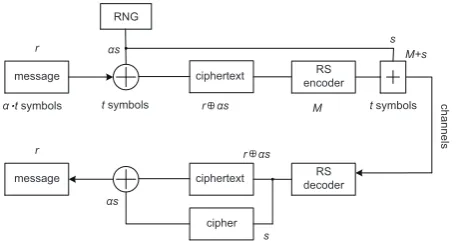
Now suppose the message piece isrand the random numberssare combined or XORed, then one can en-code (r⊕α·s), whereαis the multiple ofsor au×v
ma-trix withu=s/w,v=r/wandwis the width of a sym-bol. Next, one piece of the symbolssis inserted by addi-tion modulo 2m, and the new message readsr0
=M+s. At the other terminal, by RS decoding one can recover
sas well as (r+αs). Finally, ther= (r+αs)−αscan
be restored. The whole process is shown in Fig. 4. Es-pecially, the insertion of errors avoids zero bytes by changing them as nonzero bytes within random num-bers.
PHVVDJH
r Įs
tV\PEROV
ĮtV\PEROV
FLSKHUWH[W HQFRGHU56
FLSKHUWH[W r Įs
s
tV\PEROV
M 51*
56 GHFRGHU
M+s
FK
DQ
QH
OV
FLSKHU s PHVVDJH
r
Įs
r Įs
Figure 4: Stream cipher by RS code.
First, the security of a code-based system can be seemed as a public-key security problem, while the usual stream cipher is a symmetric cryptosystem. The proposed mechanism embeds the stream cipher along Reed-Solomon codes looking like a public-key cryp-tography: considering the key streams as private keys for encoding, and looking at the RS code parameters as the public key to decrypt the ciphertexts.
The security of the proposed scheme may also be improved by the application of shortened codes. In
this way, then-symbol codewords are replaced by a (n−δ)-symbol codewords. Take the wireless
communi-cation for example, the sender and receiver share the same hardware units, i.e., stream engines, encoders and decoders. Then, the stream cipher with the sender can be seen as private keys to encrypt the messages. The choices of (1) whether a subfield subcode is chosen (2) whether a shortened code is chosen (3) whether the same decoder exists can be used as the public keys. If the decoder exists and the other two parameters are rightly chosen, then the stream cipher can be separated from the message bits by RS decoding.
In detail, one can use subcode or shortened code to decrease the error rate or improve the security of the system, as is shown in Fig. 5. The subfield sub-code overGF(ps) have the same lengthnbut is smaller than its parent code [23] with the word width, which is compressed fromdsmlog
2petodslog2pe. In fact, the lengthnof a subfield subcode may be larger than the size of a subfield, but is constrained its parent field size. Notice that the parity check symbols keep about double word size of other code symbols in Fig. 5.
5HJXODUFRGHZRUGV
6KRUWHQHGFRGHZRUGV 6XEFRGH
Figure 5: Stream cipher by subcode or shortened RS codes.
Secondly, the proposed scheme reduce the hard-ware cost and complexity by reusing the encoder for encryption and recovering the key streams by the de-coder. Therefore, the task of aligning the stream en-gines to time sequence becomes unnecessary. As the number of stream cipher engines decreases from 2 to 1, it reduces the continuous power consumption much. On the one hand, it reduces the hardware units by a half; on the other hand, the renewal frequency of the stream cipher engine can be lowered down. Also, it is not easy to align the messages to real time, but it is feasible to align the messages at code sequence. The oscillator frequency may vary from time to time, while the stream cipher engines requires accurate alignments. The existence of time delay in mobile phones proves the validity of code alignment.
00000000h: 31 30 38 3D 33 5E 33 2A 32 5E 32 0D 0A 0D 0A ; 108=3^3*2^2...
VHFUHWGDWDDVVWUHDPFLSKHU
PHVVDJH
PHVVDJHHQFU\SWHGE\VWUHDPFLSKHU
00000000h: 54 48 65 20 57 61 74 65 72 20 4D 61 72 67 69 6E ; THe Water Margin 00000010h: 20 74 65 6C 6C 73 20 74 68 65 20 73 74 6F 72 79 ; tells the story 00000020h: 20 6F 66 20 72 65 62 65 6C 6C 69 6F 6E 20 61 6E ; of rebellion an 00000030h: 64 20 73 74 72 75 67 67 6C 65 20 6F 66 20 73 6B ; d struggle of sk 00000040h: 69 6C 6C 65 64 2C 20 62 72 75 74 65 2C 20 6F 72 ; illed, brute, or 00000050h: 20 62 72 61 76 65 20 6D 65 6E 20 69 6E 20 61 63 ; brave men in ac 00000060h: 69 65 6E 74 20 43 68 69 6E 61 2E 20 54 68 65 79 ; ient China. They 00000070h: 20 61 72 65 20 6E 61 6D 65 64 20 4A 69 61 6E 67 ; are named Jiang 00000080h: 20 53 6F 6E 67 2C 20 4A 75 6E 79 69 20 4C 75 2C ; Song, Junyi Lu, 00000090h: 20 53 68 65 6E 67 20 47 6F 6E 67 73 75 6E 2E 2E ; Sheng Gongsun.. 000000a0h: 2E 0D 0A 0D 0A 0D 0A ; ...
00000000h: 65 78 5d 1d 64 3f 47 4f 40 7e 7f 6c 78 6a 63 6e ; ex]d?GO@~lxjcn 00000010h: 11 44 5d 51 5f 2d 13 5e 5a 3b 12 7e 7e 62 78 79 ; !D]Q_-!^Z;!~~bxy
Ă Ă
Figure 6: Hiding information as stream cipher in RS codes.
Table 1: Advantages of Proposed Stream Cipher Compared to Other Schemes Reference Function Implement Topology ENC/DEC
Symmetry
Reuse for ECC
No. of RNG Randomness Code
This work Stream data Hardware 1-to-N Not full Yes 1 Not strictly RS
[10] Stream data Hardware 1-to-1 Symmetric No 2 Required No
[7] Stream data Software 1-to-1 Symmetric No 2 Required
Quasi-cyclic
[8] Exchange
data
Software N-to-N Not No 0 - GRS
combines their functions.
Thirdly, it may be applicable to transmit extra data through the key streams and therefore increase the throughput of inserted codewords. For example, the (255,223,16) RS code has 223 information sym-bols. If the encoder are used for stream cipher, then 16 symbols of information can be added to the code-word secretly. The information rate is increased from 223/255 = 0.87 to 239/255 = 0.94. As is shown in Fig. 6, it is able to mix information with secret data in the proposed codes.
5
Comparison
The comparisons of this work compared with peer works are shown in Tab. 1. It should be noticed that the proposed scheme is not full symmetric, for which the cipher is decoded through the public-key. The archi-tecture is implemented in a topology of 1-to-N, with
N being any natural numbers including 1. IfN = 1, then there are two parties to communicate with each other; or else it can be used in a network. By con-trast, the stream cipher is usually supposed to follow 1-to-1 topology. While the encoding and decoding ar-chitectures in our work are non-symmetric, the whole stream cipher engine can be made nearly symmetric by integrating an encoder and decoder together. More-over, this work needs only 1 random number generator while other stream ciphers requires 2 toN random number generators, since the key stream is embedded
in the data stream in this work.
The weakly secure data exchange problem with generalized Reed-Solomon code is discussed in [8], in which data exchange between multiple parts rather than two parts are considered.
Also, in the proposal the random number gener-ator is not that strictly required and pseudo random numbers can be used, while other works pay much attention to the random number generator itself, ow-ing to different mechanism for stream ciphers. While traditional stream cipher uses continuous random bits, this work applies data structures of codewords to sep-arate data. The references [8, 7] also uses GRS codes and quasi-cyclic codes to encode data and bring out randomness.
The architecture and hardware implementation re-sults with [10] is demonstrated in Tab. 1 and Tab. 2. It uses a hardware common key cryptography named RAC for stream cipher, where the random numbers are used as addresses to relocate the data bits. The random numbers are generated by the recipient as addresses to resort the received ciphertext. Assuming the stream cipher engine in [10] works in a pipeline, then it is able to encrypt and decrypt 1 byte every clock cycle with throughput up to 3.2 Gps. Nevertheless, considering that the data from the sender or to the recipient should be stored in a RAM for reorganization, so the real de-cryption throughput may be only a half, let alone the time for fetching instructions.
demonstrated by the application of RS code, whereas McEliece systems usually use nonsystematic encoding with an increase of computational efforts byn/(n−k)
times. In addition, if there are demands of error cor-rections for channels, the hardware units may be re-configured and reused at different times.
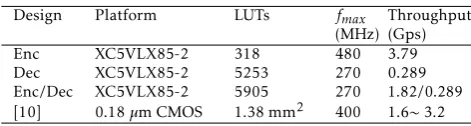
Table 2: Hardware Implementation of Stream Cipher Engine by Reed-Solomon Code.
Design Platform LUTs fmax Throughput
(MHz) (Gps)
Enc XC5VLX85-2 318 480 3.79
Dec XC5VLX85-2 5253 270 0.289
Enc/Dec XC5VLX85-2 5905 270 1.82/0.289
[10] 0.18µm CMOS 1.38 mm2 400 1.6∼3.2
The stream cipher with encoding and decoding by RS codes is described by Matlab for test at first, then it is described by Verilog HDL for hardware implementa-tion. As is shown in Tab. 2, the stream cipher engine is simulated by Modelsim 6.2, synthesized by Synopsys Synplify Pro 2014, and placed and rooted in Xilinx ISE 14.7. The code parameters are chosen as usual in [24], i.e.,
m= 8: number of bits per symbol,
n= 255: number of symbols per codeword,
k= 223: number of message symbols in a codeword,
t= 16: number of corrected errors by symbols. According to the theory and results in [7], the secu-rity level of the cipher in the above table is about80
bits of keys with symmetric cryptography.
In Tab. 2, the RS code supports correcting 16 sym-bols of errors along with 223 symsym-bols of messages. It takes about 3.78µsto correct 2 errors of symbols, and 7.06µsto correct 16 errors of symbols. Its information throughput without parity check bits are 1.59/0.253 Gbit/s respectively for encoding and decoding.
6
Conclusion
Stream cipher is often used for mobile communications between two parties. In general, this paper proposes an easy scheme to implement stream cipher along with the popular RS code, which relies on RS encoding and decoding to cover and uncover the key streams. It is beneficial to easily evaluate the complexity and en-hance the security of communication systems. The proposed cipher is based on the NP-complete problem of decoding a random linear code, which simply con-forms to many solved code-based security issues. The cipher also decreases one key generator and reduces unnecessary power consumption for the synchroniza-tion between parties.
Acknowledgment
The author would like to appreciate the editor and re-viewers for their kind help. This work is supported by Shenzhen postdoctoral base for innovation and
prac-tice and partly by Shenzhen basic research program (No. JCYJ20170307141601162).
References
[1] T. Wu and R. Wang, “Stream cipher by Reed-Solomon code,” inInternational Conference on Information and Communication Technology Convergence (ICTC), 2017, pp. 422–427.
[2] F. E. Oggier and M. J. Mihaljevic, “An information-theoretic analysis of the security of communication systems employing the encoding-encryption paradigm,” arXiv, 2018. [Online]. Available: http://arxiv.org/abs/1008.0968
[3] A. N. Alekseychuk and S. V. Gryshakov, “Secure and practi-cal randomized stream ciphers based on ReedSolomon codes,” Cybernetics and Systems Analysis, vol. 53, no. 2, pp. 262–268, 2017.
[4] S. Lin and J. Daniel J. Costello,Error Control Coding. Upper Saddle River, New Jersey: Pearson Education, Inc., 2004. [5] M. Baldi,QC-LDPC Code-Based Cryptography, ser. Briefs in
Electrical and Computer Engineering. Springer, 2014. [6] M. Baldi, F. Chiaraluce, M. Bianchi, and J. R. D. Schipani,
“En-hanced public key security for the McEliece cryptosystem,” Journal of Cryptology, vol. 29, no. 1, p. 127, January 2016. [7] P. Gaborit, C. Lauradoux, and N. Sendrier, “SYND: a fast
code-based stream cipher with a security reduction,” inIEEE Inter-national Symposium on Information Theory, 2007, pp. 186–190. [8] M. Yan, A. Sprintson, and I. Zelenkoy, “Weakly secure data ex-change with generalized reed solomon codes,” inIEEE Interna-tional Symposium on Information Theory, 2014, pp. 1366–1370. [9] M. Orumiehchiha, J. Pieprzyk, E. Shakour, and R. Steinfeld, “Security evaluation of Rakaposhi stream cipher,” in Interna-tional Conference on Information Security Practice and Experience (ISPEC 2013), ser. Lecture Notes in Computer Science, R. Deng and T. Feng, Eds., vol. 7863. Berlin, Heidelberg: Springer, 2013, pp. 361–371.
[10] M. Fukase, H. Takeda, R. Tenma, K. Noda, Y. Sato, R. Sato, and T. Satot, “Development of a multimedia stream cipher engine,” inInternational Symposium on Intelligent Signal Processing and Communication Systems (ISPACS2006), Tottori, Japan, 2006, pp. 562–565.
[11] H. C. van Tilborg,Fundamentals of cryptology: A Professional Reference and Interactive Tutorial. Boston/Dordrecht/London: Kluwer Academic Publishers, 1999.
[12] T. Eisenbarth, T. Guneysu, S. Heyse, and C. Paar, “Microeliece: Mceliece for embedded devices,” inCHES, ser. LNCS, vol. 5747, 2009, p. 4964.
[13] S. Heyse, I. von Maurich, and T. G ¨uneysu, “Smaller keys for code-based cryptography: QC-MDPC McEliece implementa-tions on embedded devices,” inCHES, ser. LNCS, vol. 8086, 2013, pp. 273–292.
[14] S. Lin and J. Daniel J. Costello,Error Control Coding- Funda-mentals and Applications. New Jersey: Prentice Hall, 1983. [15] B. Sklar, “Reed-solomon codes,” 2001. [Online].
Avail-able: http://ptgmedia.pearsoncmg.com/images/art sklar7 reed-solomon/elementLinks/art sklar7 reed-solomon.pdf [16] D. V. Sarwate and N. R. Shanbhag, “High-speed architectures
for reedsolomon decoders,”IEEE Transactions on VLSI Systems, vol. 9, no. 5, pp. 641–655, October 2001.
[17] A. Reyhani-Masoleh and M. A. Hasan, “Low complexity bit parallel architectures for polynomial basis multiplication over
GF(2m),”IEEE Transactions on Computers, pp. 945–959, 2004. [18] H. Lin, A. J. A., D. Bai, and Y. Liu, “A light-weight stream
ci-pher for wireless sensor networks,” inFuture Wireless Networks and Information Systems, ser. Lecture Notes in Electrical Engi-neering, Y. Zhang, Ed., vol. 143. Berlin, Heidelberg: Springer, 2012, pp. 627–638.
[19] B. Sklar,Digital Communications Fundamentals and Applications. Beijing: Publishing House of Electronics Industry, 2015, in Chinese.
[21] “Linear feedback shift registers in virtex devices,” 1996. [Online]. Available: http://www.xilinx.com/support/ documentation/application notes/xapp052.pdf
[22] M. Esmaeili and T. A. Gulliver, “Joint channel coding-cryptography based on random insertions and deletions in quasi-cyclic-low-density parity check codes,”IET Communica-tions, vol. 9, no. 12, pp. 1555–1560, 2015.
[23] J. I. Hall, http://users.math.msu.edu/users/jhall/classes/ codenotes/Subfields.pdf, Michigan State University, pp. 89– 99, 2012, codes over Subfields.
![Figure 1: System architecture to solve error location polynomial [16, 1].](https://thumb-us.123doks.com/thumbv2/123dok_us/10077344.1994203/3.595.111.480.64.202/figure-system-architecture-to-solve-error-location-polynomial.webp)