Copyright © 2015 by Irnian Occupational Health Association (IOHA) IJOH 7: 105-109, 2015
ORIGINAL ARTICLE
Predicting Correct Body Posture based on Theory of Planned
Behavior in Iranian Operating Room Nurses
BAHAREH ABEDI
1; RABIOLLAH FARMANBAR
1*; SAEED OMIDI
1; MAHDI
JAHANGIR BLOURCHIAN
21Department of Health Education and Promotion, School of Health, Guilan University of Medical Sciences,
Rasht, Iran; 2Department of Occupational Health, School of Health, Guilan University of Medical Sciences, Rasht, Iran.
Received January 25, 2015; Revised May29, 2015; Accepted June17, 2015
This paper is available on-line at http://ijoh.tums.ac.ir
ABSTRACT
Due to the importance of correct posture for preventing musculoskeletal disorders, the purpose of this study was to evaluate Theory of Planned Behavior in Predicting correct Body Posture in operating room nurses.In this cross-sectional study, participants (N=100) were nurses from five hospitals located in northern Iran. Participants completed demographic data and theory of planned behavior construct Questionnaires. In addition, the researcher checked the Body Posture of nurses by Rapid Entire Body Assessment (REBA).The Meanage of nurses was 33.54 yr, (SD=6.51).Multivariate regression showed that attitudes and perceived behavioral control werepredictive of behavioral intention of nurses’readiness to assume correct posture (P<0.001, R2=0.31), nurses who had more positive attitude and more perceived behavioral control were more likely to have intentions towards correct body posture. Furthermore, only behavioral intention is predictive of readiness correct posture among nurses. Nurses who had more behavioral intentionfor correct body posture were more likely to intend to do.The attitudes andperceived behavioral control were predictive of behavioral intentions for correct body posture.Therefore, the design of intervention strategies based on the promotion of attitudes and perceived behavioral control was recommended to nurses.
KEYWORDS:
Theory of planned behavior, Correct body posture, Operating room, Nurses
INTRODUCTION
Work is attributed as an effective factor on social and economic progress in community health [1]. Work is one of the important life experiences which around one thirds of adult's spend time working out [2].
Environmental work conditions can cause many problems such as work-related disorders, which are mainly because of weak health and staff's job training [3].
Lifting, work place mental stresses, unsuitable back and neck positioning andincorrect body positioning. Many pains in the spine are related to heavy lifting jobs [1].
Work-related musculoskeletal disorders
* Corresponding Author: RabiollahFarmanbar Email: [email protected]
after respiratory disorders and headache are the most common causes of visit to the doctor [4]. Some of causes of work-related musculoskeletal disorders are frequent heavy
Predicting Correct Body Posture … ijoh.tums.ac.ir | 106 has the second place after industrial jobs [3].
Among healthcare jobs, nursing has higher back pain risk because of higher physical activities like bending and turning, standing for a long time, heavy lifting and transferring patients. Operating room nurses are exposed to higher rates of back pain affection. Eighty-four percent prevalence of back pain among operating room nurses is reported in Iran [8]. In Holland, theprevalence of back pain was45%, of neck and shoulders 53%, and of foot pain 43% [9]. In Turkey, the prevalence of back pain among operating room technicians was 70% [10]. In Iran, the prevalence of back pain in operating rooms was 60.6% [11]. The prevalence of back pain among operating rooms especially among women was higher compared to other parts, as these two parts have considerable heavy lifting [12]. Nurses, as healthcare personnel in operating rooms do various jobs such as surgery team assistant and surgeon assistant and they are responsible for meetin surgery team's needs [5]. They should check and observe patient's status during surgery [13].
Operating room nurses are faced with unsuitable body conditioning and longtime stand during surgery [14]. Back pain is frequently reported among operating room nurses because of standing for a long time, tedious and active physicalwork. There are several factors considered as possible causes of musculoskeletal disorders and inabilities. The risks of static factors like prolonged inactive body position and retractor compression during surgery and handling factors such as pushing and pulling, workload lifting of patients and lifting of heavy instruments [15] andso on.
Learning about biomechanical factors such as unsuitable or inactive body positioning, heavy dispense and frequent motions can lead to taking control attitudes about body posture in to different spatial organ dispositions, which can prevent musculoskeletal disorders.
Besides the effective role of improved posture on health promotion, stress decrease and work-related discomforts, work effectiveness and job performances are also considered as important factors [7].
Behavioral analysis has better productivity with behavior change model and is one of the common models about posture behavior in theory of planned behavior[16].According to this theory, the most important determinant of individual behavior is its intention, which is affected by perceived behavioral control, subjective norms and attitudes [17]. Intention typically is a result of attitude (both positive and negative estimation from behavior), subjective norms (possible effects of influential people on behavior) and perceived behavioral control (the expected level of behavioral control that people believe they can possibly have). Moreover, perceived behavioral control construct
can directly predict behavior. Conducted studies in Iran were limited to the survey and etiology of the back pain prevalence among nurses.
It seems that there has not been any study about cognitive factors and suitable body conditions for operating room nurses according to the theory of planned behavior. Therefore, considering the importance of correspondence of intervention designs with theory of planned behavior, the purpose of this article was to determine predictive constructions of this theory about correct body posture in operating room nurses.
MATERIALS AND METHODS
Participants and study design: This
cross-sectional study was done on Iranian operating room nurses. Six operating rooms were initially selected among northern Iranian hospitals (N=100)with classified random sampling correspond to sample population of defined operating room ratio.
Inclusion criteria of study lacked back surgery records, non-pregnancy, not having chronic back pain, more than 6 months’ work experience in operating room.Ethical approval for this study was gained from the Research Ethics Committee, at GuilanUniversityMedical Sciences and all of the participants provided informed consent to be involved in the study.
Instruments: Participants completed a
three part questionnaire was used as a measure of data collection: first part included demographic questionnaire (9 items), second part was 34-items questionnaire about theory of planned behavior construct with Lickert scale (10 questions attitude, 11 questions subjective norm, 8questions perceive behavioral control and 5 questions Behavioral).
The scale has demonstrated acceptable validity in Gharlipoor’s study on "Behavioral Factors Related to Musculoskeletal Disorders in Nurses on Theory of Planned Behavior" [3].
In the third part, a REBA measure with special codification for each organ's range of motion wasused as the privilege according to various static, dynamic, rapid changes and unstable status.According to a guide,control researcher determines the risk level of every organ in different stages after score execution for every motion in REBA measure and calculation of total scores (with the range of 1-15). Validity of REBA measure has been established by Saremi in a study conducted among dentists at Shahroud University [18].
Statistical analysis: Data analysis was
RESULT
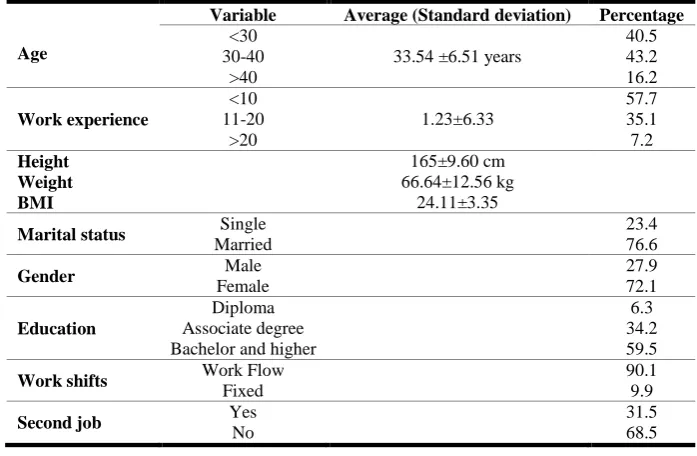
Demographic characteristics of samples are listed in Table 1.Linear regression method was used for predictive power of theory of planned behavior constructs about behavioral intention of correct body posture. As shown in Table 2,the Multivariate regression analysis showed that attitude and perceived behavioral control
arepredictive of behavioral intention of correct body posture among nurses and with higher attitudeand perceived behavioral control, they were more likely to be intended. Subjective norms were not significant in regression modeland nurse's subjective norms were not predictive of behavioral intention for correct body posture.
Table 1.Demographic characteristics of samples
Variable Average (Standard deviation) Percentage
Age
<30 30-40
>40
33.54 ±6.51 years
40.5 43.2 16.2
Work experience
<10 11-20
>20
1.23±6.33
57.7 35.1 7.2
Height 165±9.60 cm
Weight 66.64±12.56 kg
BMI 24.11±3.35
Marital status Single
Married
23.4 76.6
Gender Male
Female
27.9 72.1
Education
Diploma Associate degree Bachelor and higher
6.3 34.2 59.5
Work shifts Work Flow
Fixed
90.1 9.9
Second job Yes
No
31.5 68.5
Totally, a 31% variance shows that attitude and perceived behavioral control
parametersare predictive of behavioral intention for correct body posture among nurses.
Table2. Linear regression method on behavioral intention for correct body posture according tothe theory of planned behavior
Variable B SE Beta P-value
behavioral intention
Attitude 0.469 0.119 0.384 0.000
Subjective norms 0.002 0.083 0.002 0.981
Perceived behavioral control 0.235 0.088 0.251 0.008
Fixed value 1.207 0.376 0.002
Results of regression analysis as shown in Table 3 about the parameters of predictive power of theory of planned behaviourshowed that only behavioural intention was predictive of taking positive correct body among
nurses.Nurseswithhigher behavioural intention were more likely to take correct body positions. Correct body posture was measured usingthe REBA measurement.
Table 3.The predictive power of planned behaviour theory parameters
Variable B SE Beta P-value
correct body posture (REBA)
Attitude -0.041 0.129 -0.039 0.752
Subjective norms 0.139 0.084 0.163 0.101
perceived behavioral control 0.083 0.092 0.102 0.369 behavioural intention -0.195 0.098 -0.225 0.049
Fixed value 1.432 0.4 -- 0.001
DISCUSSION
The purpose of this study was to determine predictive constructions of the theory of
Predicting Correct Body Posture … ijoh.tums.ac.ir | 108 predictive of intentions of correct body position.
Previous studies have supported this finding, for example, in MollaAghaei`s study on predicting the behavioural and safety of drivers consistently attitude and perceived behavioural control, predictive behaviours were secured [9]. In Herclarnia et al., "survey of predictive factories of labourbehaviour for taking correct body position", the perceived behavioural control occupied the second place which is consistent with our results [20].
In a survey of Dehdari on the consumption of fruits among campus female students, attitude and subjective norms predicted the changes in fruit consumption intention [21]. Prediction of university staff for e-learning, attitude and planned behavioural control were the best predictive factors of intention of e-learning, which is consistent without results [22]. Attitude towards behaviour, subjective norm and perceived behavioural control were the most important factors related to nurse's intention for the use of clinical handbooks for healthcare [23]. Perceived behavioural control, subjective norm and attitudes have had direct and significant effect on nurse's intention for following management after they encounter job and generally planned construct argued to have been of 54℅ variance in nurse's intention for following management after encountering jobs [24].
There wasa significant link between constructs of theory of planned behaviour and musculoskeletal disorders among nurses so that people with musculoskeletal history in each organ were compared with people who did not have this problem, had less average levels of attitude, subjective norm, perceived behavioural control and behavioural intention for taking correct body positions at work [3]. There was a direct and significant relationship between subjective norm and perceived behavioural control, and taking correct body posture depends on feedbacks from others, which is not consistent with our study [25]. Perceived behavioural control is an important and effective factor on behaviour when people are not confident about their ability towards certain behaviours; evaluating perceived behavioural control could help to predict these behaviours [26]. The results of this study can be used for planning and creating guidelines for correct body posture for operating room nurses and emphasizingthe enforcement of attitudes and perceived behavioural control among operating room nurses.
There werea number of limitations in this study. First, the study involved nurses from six operating rooms of five hospitals located in Northern Iran and therefore the generalizability of our results may be limited. Future research should replicate this study with nurses from a variety of cultural backgrounds. Second, given the cross-sectional nature of our study design, causality
cannot be inferred. There forlongitudinal and intervention studies should be designed to identify the causal pathways between constructs.
CONCLUSION
It is suggested that interventions be made with the aim of enforcing attitudesand perceived behaviours for the promotion of correct body posture.
ACKNOWLEDGMENTS
We acknowledge all operating room nurses and the entire Staff of the Iranian Northern hospitals for their voluntarism andcooperation.Inaddition,we are indebted to the hospital Heads for their cooperation and coordination, not forgetting the Deputy of Research Affairs-GuilanUniversity of Medical Sciencesfor the financial support. The authors declare no conflict of interests.
REFERENCES
1. Mottaghi M , BasiriMoghadam M,Rohani Z,BasiriMoghadam K,Irani H. The Survey of prevalence of vertebral column pain and some related factors in nurses employed in Gonabad Hospitals. GMUHS Journal 2011; 17(4): 51-57.
2. Khoshbakht M, Baghaie M, Hasavari F, Kazemnejad L ,Blourchian MJ. Evaulation of body postureergonomyic during work in intensive care units nurses during work. Iran J Crit Care Nurs 2013, 5(4):196-203.
3. Imanzad M, Gharlipour Z, Kohpaie A, Mohebi S, Arsang gang S, Sayyarpour M, Gilasi HR, Mashkuri AR, Pahlevani S, Ahmadi SH, Heidari S, Akbari Z. Behavioral Factors Related to Musculoskeletal Disorders in Nurses based on Theory of Planned Behavior. Journal of Nursing and Midwifery2013 ;23(81): 1-11. 4. Rahnama N, BambaeichiE ,RyasatiF , The
Effect of Eight Weeks Corrective Exercise with Ergonomic Intervention on Musculoskeletal Disorders among Loabiran Industry Workers.
Journal of Isfahan Medical School 2010 ;28 (108): 316-326.
5. OmokhodionF ,Ogonnow B E. Prevalence of low back pain among staff in a rural hospital in Nigeria. J Occupl Med 2000; 50(2): 107-110. 6. Saeidi M, Low Back Pain and neck pain in
related to poor posture in hospital female personnel of Fateme-zahra Hospital, Najaf-Abad. Journal of Research in Rehabilitation Sciences 2011;7(3):259-266.
9(1): 66-74.
8. Sheikhzadeh A , Gore C, Zuckerman JD, Nordin M. Perioperating nurses and technicians’ perceptions of ergonomic risk factorsin the surgical environment, J of ApplErgon 2009; 40(5): 833–839.
9. Meijsen P, Knibbe J. J. Prolonged Standing in the OR: A Dutch Research Study. Aorn Journal
2007; 86(3): 399-414.
10.Karahan A, Kav S, Abbasoglu A, Dogan N. Low back pain: prevalence and associated risk factors among hospital staff. J AdvNurs 2009; 65(3): 516–524.
11.Choobineh A, Rajaeefard AR, NeghabM . Perceived demands and musculoskeletal disorders among hospital nurses. Hakim Research Journal 2007; 10(2): 70-75.
12.Sadeghian F, KolalianMoghadam H, Javanmard M, khosravi A, Adel Nia S. Survey of epidemiology of back Pain and its relationship with occupational, personal factors among nursing personnel, Shahrood Hospital. Iranian South Medical Journal 2005; 8: 75-82.
13.Christiana D, Eunice I. The Incidence of Low Back Pain among Theatre Nurses: A Case Study of University of Ilorin and ObafemiAwolowo University Teaching Hospital .International Journal of Nursing Science 2012; 2(3): 23-28.
14.Kant IJ, de Jong LC, Rijssen-Moll M, Borm PJA. A survey of static and dynamic work postures of operating room staff. IJOEH 1992; 63(6): 423-428.
15.Meijsen P, Knibbe JJ. Work-related musculoskeletal disorders of perioperative personnel in the Netherlands. Aorn Journal
2007; 86(2):193-208.
16.Armitage CJ, Arden MA. "Exploring discontinuity patterns in the trans-theoreticalmodel:An application of the theory of planned behavior". Br J Health Psychology. 2002; 7(1) : 89-103.
17.Ahmadi S.V , Taghdisi MH , Nakheei N , Balali F. Effect of educational intervention based on the Theory of Planned Behaviour on the physical activities of Kerman Health Center Staff . J BabolUni Med Sci 2010; 12(2): 62-69 18.Saremi M, Evaluation of Musculoskeletal
disorders in dentists of shaheduniversity. [Online] Available from: URL:http://dbase.irandoc.ac.ir/00668/00668505 .htm.
19.Ashoogh M, Aghamolaei T, Ghanbarnejad A, Tajvar A. Utilizing the theory of planned behavior to Prediction the safety driving behaviors in truck drivers in Bandar Abbas 1392. Journal of Health 2013; 1(3): 5-14. 20.Mohammadi Zeydi I, Hedarnia A, NiknamiSh.
Predicting Factors of WorkerBehavior for Proper WorkingPosture Based on
PlanedBehavior Theory .Journal of DaneshArmaghan 2008; 13(4): 112-122 [InPersian].
21.Dehdari T, Kharghani M, Mansouri T, Saki A.Survey of daily fruit consumption status among girl students who are living in dormitories and its predictors based on the theory of planned behavior constructs .RJM
2013; 20(106):10-19.
22.Bashirian S, Jalilian F, Barati M, Ghafari A. A Study on the Predicting Factors of Intended E-Learning among Faculty Members Based on Theory of Planned Behavior. Journal ofMedical Education Development 2014; 7(15): 10-21. 23.Kortteisto T, Kaila M, Komulainen J,
MäntyrantaT, RissanenP. Intentions to use clinical guidelines: a survey using the theory of planned behaviour. J Implement Sci 2010; 5(51).
24.Ko NY,Yeh SH, Tsayd SL, et all. Intention to comply with post-exposure management among nurses exposed to blood and body fluids in Taiwan: application of the theory of planned behavior. Journal of Hospital Infection 2011; 77(4): 321-326.
25.Mohahammadi-Zeidi I, KhalajM, Mohammadi-Zeidi B .Assessing the readiness of assembly line workers to adopt the upright posture.JQUMS 2012; 15(4): 77-85.
26.Ajzen I. Perceived Behavioral Control, Self‐