R E S E A R C H
Open Access
Assessing the validity and reliability of the
Malagasy version of Oral Impacts on Daily
Performance (OIDP): a cross-sectional study
Noeline Razanamihaja
1,2and Eva Ranivoharilanto
1,3*Abstract
Background:Evaluating health needs includes measures of the impact of state of health on the quality of life. This entails evaluating the psychosocial aspects of health. To achieve this, several tools for measuring the quality of life related to oral health have been developed. However, it is vital to evaluate the psychometric properties of these tools so they can be used in a new context and on a new population. The purpose of this study was to evaluate the reliability and validity of the Malagasy version of a questionnaire for studying the impacts of oral-dental health on daily activities (Oral Impacts on Daily Performance), and analyse the interrelations between the scores obtained and the oral health indicators.
Method:A cross-sectional study was performed for the transcultural adaptation of the Oral Impacts on Daily
Performance questionnaire forward translated and back-translated from English to Malagasy and from Malagasy to English, respectively. The psychometric characteristics of the Malagasy version of the Oral Impacts on Daily Performance were then evaluated in terms of internal reliability, test-retest, and construct, criteria and discriminant validity. Four hundred and six adults responded in face-to-face interviews to the Malagasy version of the Oral Impacts on Daily Performance questionnaire.
Results:Nearly 74% of the participants indicated impacts of their oral health on their performance in their daily lives during the 6 months prior to the survey. The activities most affected were: “smiling”, “eating” and “sleeping and relaxing”. Cronbach’s alpha was 0.87. The construct validity was demonstrated by a significant association between the Oral Impacts on Daily Performance scores and the subjective evaluation of oral health (p<0.001). Discriminant validity was demonstrated by the fact that the Oral Impacts on Daily Performance scores were significantly higher in subjects with more than ten missing teeth, compared to those with fewer than ten missing teeth (p< 0.001).
Conclusion: The Malagasy version of the Oral Impacts on Daily Performance index is a valid and reliable
measure for use in Malagasy adults over 55 years old.
Keywords: Oral Impacts on Daily Performance - OIDP, Malagasy, Prevalence, Reliability, Validity
* Correspondence:[email protected]
1IOSTM, University of Mahajanga, Mahajanga, Madagascar 3Ministry of Public Health, Antananarivo, Madagascar
Full list of author information is available at the end of the article
Background
The measure of health related quality of life has in-creased considerably over the last few decades, and it is currently accepted as an essential element in investiga-tions in oral health, especially to acquire characteristics of a non-clinical nature and felt by the patients. It entails evaluating the psychosocial aspects of health. Indeed, oral health problems can have impacts on the daily ac-tivities of patients. Thus a certain number of tools for measuring the quality of life related to oral health, such as the Oral Health Related Quality of Life (OHRQoL), have been developed [1]. The Oral Impacts on Daily Per-formance (OIDP) is an international socio-dental indica-tor of the quality of life related to oral health, commonly used to evaluate the impacts of oral health conditions on the capacities of individuals to perform daily activities [2]. The OIDP is a generic measurement instrument developed by Adulyanon et al. in 1996 [3] and then adapted in several countries (Greece, United Kingdom, Tanzania, Uganda, Norway, France, Iran, Japan, Spain, Korea, Sweden, Bosnia-Herzegovina, India, Chili, Nigeria,
Croatia) [4–19] where its psychometric properties were
tested and deemed adequate, valid and reliable by cross-sectional studies. OIDP can be used in different age groups of people, in separated or in only one studies. It has been shown to be applicable to elderly people in Tanzania [6] and Bosnia [15], for children and adolescent in France [9], Uganda [7] and Nigeria [18]. A version for children is available, the Child-OIDP (C-OIDP).
Results from rare surveys conducted in Madagascar showed high level of oral diseases within the population, and particularly early tooth loss within adults aged 35 years old and above. Most of time, these oral diseases are left untreated [20]. Total edentelousness prevalence among 65 years old Malagasy people is high compared to that found in some African countries [21].
Like in many countries, Madagascar knew these two past decades the growing ageing populations. In this context and in order to oral health service planning for this age group, the OIDP index is worthy of consider-ation because of its adaptconsider-ation for use in oral health needs assessment.
In Madagascar, there is no such questionnaire vali-dated for use with the adult population, which constitute barriers to the development of this kind of research on population. The OIDP has never been adapted for Madagascar.
Prior to using a new measurement scale in a new con-text and new group of population, it was important to re-evaluate its psychometric properties.
The objectives of this study were to develop and test the reliability and validity of a Malagasy version of the OIDP questionnaire on a sample of Malagasy elderly adults.
Methods
A descriptive cross-sectional study was performed. Ac-cording to statistics, in 2012, nearly 35% of adults in Madagascar were illiterate. Therefore the face-to-face interview method was applied in this study for those respondents unable to complete the questionnaire themselves. The OIDP questionnaire included 8 items, distributed in three dimensions: physical (03 items), psy-chological (03 items) and social (02 items) performance. It evaluated the degree to which the daily life of a person was negatively affected by their state of oral health.
The OIDP posed questions on the difficulties of performing eight daily activities (eating, speaking, tooth-brushing, sleeping, controlling emotions, smiling, work-ing, and appreciating social contacts) related to oral health. The questionnaire was organized in two parts: in the first part, the respondents were asked to list the den-tal problems that they had to cope with during the pre-vious six months. If the respondent expressed an impact on one of these activities, they had to indicate the sever-ity and frequency of the impact by using scores from 1
to 3 for each one. The “impact” was recorded
immedi-ately the subject expressed having had a problem in one of the daily activities mentioned above. If no impact was
perceived, the activity was assigned a“zero”score.
Recruitment of the respondents
The study population was composed of adults aged 55 years old or older. Recruitment was subject to the consent of the subjects to participate in the study.
Were included in the study people aged 55 years and over, with the ability to answer questions directly.
The elderly suffering from language disorder, hearing, mental handicap of depression type or relational difficul-ties were excluded.
The study was performed in the capital city,
Antananarivo and its suburbs.
The validation process consisted of three steps: trans-lation; qualitative validation including all the pre-tests and test-retests; and quantitative validation steps which included different internal and external reliability and validity tests, and construct, criterion and discriminant tests.
Forward translation and back-translation process
preliminary version in Malagasy. The latter was pre-tested on 20 adult subjects. After each interview, a dis-cussion with the respondents was held to check whether the phrasing, vocabulary and method of administering the questionnaire were pertinent and whether difficulties existed in understanding the items. Following this pre-test, minor modifications were made as certain words required dialectic equivalences. The finalised version was then retranslated into English by two new translators in conformity with the forward translation back-translation method [22, 23] to verify whether the Malagasy version correctly expressed the same content as the items of the original questionnaire. Minimal differences in the back-translation were discussed by a committee of experts. Several modifications were made to the wording of the phrases to match Malagasy conceptions and a penulti-mate version of the questionnaire was obtained. This version was then tested and retested 15 days afterwards, with about 60 subjects that did not take part in the pre-test or belong to the final study population, in view to evaluating the reproducibility, stability of the responses and the validity of the content.
Validation of the Malagasy version of the questionnaire
This step involved the participation of 406 adults. Before administering the questionnaire, a clinical examination was performed by two calibrated dentists and the evaluation of oral health was carried out on the basis of indicators recommended by the World Health Organization (WHO) [24]. The aim was to determine the number of natural teeth in the mouth, prosthesis use and requirements, and to describe the state of periodon-tal health.
Data analysis
The data permitted calculating a score for each activity and a global score. The OIDP scores were expressed by the sum of the different performance scores (severity score × frequency score) divided by the maximum pos-sible global score, then multiplied by 100 to obtain a percentage score. The global score could range from 0 to 72; it was then divided by 72 and then multiplied by 100. Thus the final score of the questionnaire varied from 0 to 100. The highest OIDP scores expressed a lower quality of life.
The analysis was performed with the Statistical Pack-age for Social Sciences (SPSS) software, version 18.0 for Windows. The threshold of statistical significance was set at 0.05.
The face validity and content validity were tested dur-ing a pre-test.
The reproducibility of the responses to the Malagasy
version of the OIDP was evaluated during thetest-retest
by Intra-class Correlation Coefficients (ICC) where the
intra-individual and the inter-individual variations di-vided by the total variation were expressed as a ratio be-tween 0 and 1. It is generally accepted that a coefficient at least equal to 0.7 is required to conclude on accept-able test-retest reproducibility.
Evaluation of the validity of the questionnaire
The descriptive analysis of the scores of the items was
carried out first after which the external validity was
evaluated by the strength of the correlation between the
positive measures. Theinternal consistency reliability of
the items was evaluated by calculating Cronbach’s alpha
if the items were eliminated. A coefficient larger than 0.70 indicated acceptable reliability [25].
Since the OIDP scores were not normally distributed,
Kruskal–Wallis and Mann–Whitney nonparametric tests
were used to evaluate the construct validity. As no gold standard was available, it was difficult to establish the criterion validity.
Factor analyses including confirmatory factor analysis was performed based on the three dimensions of OIDP.
It is commonly agreed that tooth loss, in most cases is a consequence of oral diseases, and affects Oral Health-Related Quality of Life (OHRQoL). In this scope, the study was aimed to discriminate groups with reported dental pain in one hand and between subjects having or not more than ten missing and not replaced teeth in other hand.
Results
Four hundred and six people out of the 430 contacted accepted to participate in the study, i.e. a response rate of 94.5%.
The characteristics of the study population are presented in Table 1
The average age was 60.89 years with a standard devi-ation 7.56. There were slightly more women (56.2%) than men. 63.02% of the respondents lived in couples. Slightly more than half of them had stopped their educa-tion at secondary school (51.4%). The prevalence of to-bacco consumption was 21.9%.
Oral health status
Impacts of the state of oral health on the quality of daily life
Table 3 shows that 6 months prior to the survey, psy-chological (46.43%) and physical (45.06%) performance were the areas subject to the greatest impacts of the state of oral health. Nearly 74% of the respondents re-ported at least one impact and the daily activities most
affected were“smiling”,“eating” and“sleeping, relaxing”, for 61.8, 59.8 and 40.0%, respectively. All the other activ-ities were affected at levels between 37 and 39%.
Reliability tests of the Malagasy OIDP
During the test retest, the Malagasy OIDP presented an intra-class correlation coefficient of 0.895 with a
Confi-dence Interval (CI) of 95% (0.878–0.910) atp<0.001. In
this study, we did not find any significant association be-tween the OIDP scores according to (as a function of ) gender and age (p> 0.05).
The inter-item correlation coefficients of the Malagasy
OIDP ranged from r= 0.37 (relation between the
prob-lem of tooth cleaning and eating) atr= 0.67 (relation
be-tween smiling and speaking). There was no negative value (Table 4).
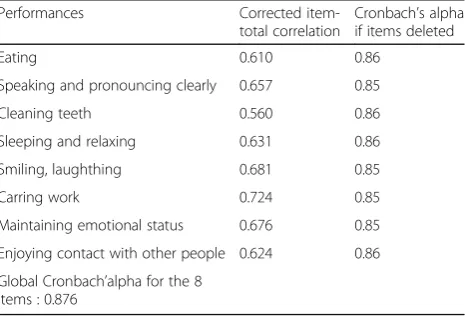
Table 5 shows the results of the internal reliability test with a Cronbach alpha of 0.87. Eliminating the different items did not lead to any increase in this value.
The results of the construct and criterion validation are presented in Table 6. The problems caused by the absence or not of teeth felt by the respondents matched
with the mean scores of the OIDP (p< 0.001).
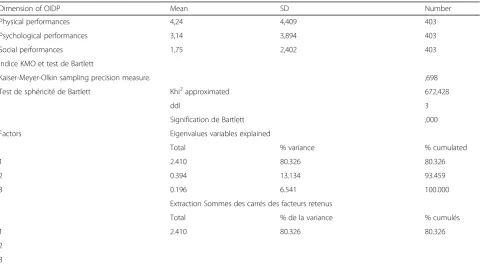
The factor analysis assessment results showed that KMO value, 0.698, was acceptable in the present study. The results showed that the first dimension (physical performances) explained 80.32% of variances (Table 7).
Regarding the criterion validity test, the statistical
sig-nificance (p<0.001) was observed for the comparison of
the OIDP scores between the different categories of self-declared state of oral health (perceived pain, difficulty in eating). As for the construct validity, the scores of
Table 1characteristics of the study population
Characteristics Number Percent
Gender Male 178 43.8
Female 228 56.2
Age group 55–60 years old 285 70.3
61–64 years old 29 13.9
65–70 years old 13 6.2
71 years and older 20 9.8
Social status Living alone 121 30.2
Lives in couple 254 63.02
Education level Never been at school 28 6.9
Unfinished primary school 72 17.8
Unfinished secondary school 66 16.3
A finished secondary school 81 20.0
High school, university 92 22.8
Do not know 9 0.1
Do you smoke Yes 89 21.9
Table 2Percentage distribution of clinical status in malagasy eldery subjects (n= 209)
Clinical state Categories Indices Mean (SD)
Mean teeth number Tooth decay (DT) 3.58 (3.90)
Missing teeth (MT) 11.94 (9.09)
Filled teeth (FT) 0.99 (2.57)
DMFT 16.51 (8.88)
Denture status Both edentulous N(%)
30 (8.9)
Upper edentulous 41 (10.2)
Lower edentulous 23 (5.7)
Number of natural teeth 0 18 (7.7)
1–10 106 (50.7)
11–20 51 (24.4)
21 and more 36 (17.2)
Prosthetics needs reported No need 103 (25.4)
In one jaw 53 (13.2)
In both jaw 246 (61.2)
Perceived dental pain No pain 227 (56.3)
Moderate pain 115 (28.5)
Acute pain 61 (15.1)
Perceived oral health status Healthy 162 (40.2)
Poor oral health 241 (59.8)
Table 3Percentage distribution (percentage of adults affected less than once a month or more) and mean frequency scores (SD) for the eight OIDP items and the OIDP ADD and OIDP SC scores
Affected: YesN(%) Mean (SD)
Physical performances (45.06%)
1. Eating and enjoying food 241 (59.8) 1.93 (2.02)
2. Speaking and pronouncing clearly 152 (37.7) 1.24 (1.85)
3. Cleaning teeth 152 (37.7) 1.07 (1.68)
Psychological performances (46.43%)
4. Sleeping and relaxing 161 (40.0) 1.00 (1.49)
5. Smiling, laughing 154 (61.8) 1.23 (1.81)
6. Maintaing usual emotional status without being irritable
151 (37.5) 0.92 (1.46)
Social performances (37.8%)
7. Carrying out major work or social role 157 (38.9) 0.86 (1.32)
8. Enjoying contact with people 148 (36.7) 0.90 (1.41)
OIDP SC total scores 298 (73.9) 3.27 (2.95)
individuals who perceived needs for prosthetic care were much higher than those who thought they had no need of it (p<0.001).
Discriminant validity
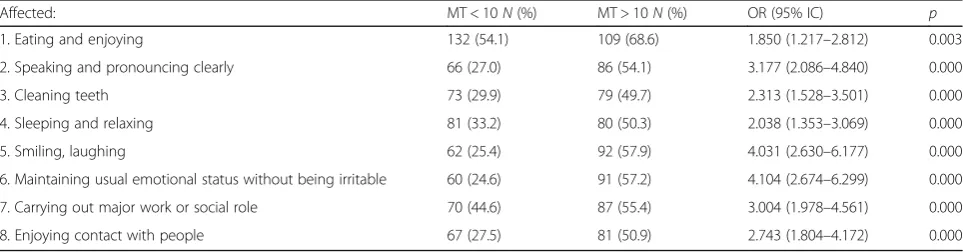
As shown in Table 8 significant differences were found between groups having or not reported dental pain and in Table 9, significant differences were observed between the group with more than 10 missing teeth (MT > 10) and that with MT < 10. The participants with MT > 10
were 4.10 times (2.674–6.299) and 1.85 times (1.217–
2.812) more numerous in reporting emotional, irritabil-ity and eating difficulties than the MT < 10 group.
Discussion
This is the first study to have evaluated oral health qual-ity of life using a Malagasy version of the OIDP ques-tionnaire. The translation did not come up against major difficulties apart from the cultural adjustment of terms. The comparison between the first translation and the back-translation did not reveal differences in content. The validity of the content was also established by ask-ing the participants whether they understood the ques-tions in the questionnaire. The size of the sample was
not calculated but was large enough to validate the ques-tionnaire for which a minimum of between 50 and 100 subjects is recommended by Altman [26] and between 100 and 200 subjects by Stewart A et al. [1].
The prevalence of negative impacts of oral health was high for this study population. Smiling and eating were the activities most affected by negative impacts. The
“eating” item was subject to the greatest impact, as
re-ported for adults in the literature [8, 10, 13, 15, 16, 19] while, the high frequency of difficulties in relaxing and sleeping can be explained by the dental pain described by this study population.
In this study, missing teeth were not replaced despite the fact that two third of the study population presented needs in dental prosthetics, and it was found that caries were also left untreated; the D-T component of the DMFT was 3.58.
Dental health services in developing countries are very limited. Palliative care is not given priority due to its high cost and is often limited to emergency treatment such as the extraction of teeth. Periodontal diseases are frequent [27, 28].
Kaiser recommends values of greater than 0,05 as ac-ceptable. In the present study analysis, the KMO
value is 0,698. Bartlett’s measure shows a highly
ap-propriate p value of 0,000 [29].
As with Ostberg AL et al., 2008, in Swedish, we did not find a significant association between OIDP scores, gender, age group [8], or level of education, contrary to the study by Montero et al., in Spain, where the differ-ences between genders were reported with women being more affected [12]. When evaluating OIDP reliability by the test retest, which focused on the reproducibility of the values of items when the same subjects responded to the questionnaire twice, the coefficient of correlation was acceptable, higher than 0.7 with a CI of 95% not
in-cluding the value 1 andp< 0.001.
All the inter-item correlations were positive, thus dem-onstrating good internal consistency and good homo-geneity of the items. The values were not high enough to suspect redundancy of responses.
Table 4Reliability analysis of OIDP index for Malagasy participants: OIDP items Correlation matrix (1–8)
1 2 3 4 5 6 7 8
1. Eating 1,00
2. Speaking 0.484** 1,00
3. Cleaning teeth 0.370** 0.470** 1,00
4. Sleeping and relaxing 0.489** 0.392** 0.456** 1
5. Smiling, laughing 0.504** 0.673** 0.401** 0.398** 1
6. Maintaining usual emotional status 0.484** 0.499** 0.465** 0.629** 0.487** 1
7. Carrying out major work 0.466** 0.403** 0.424** 0.582** 0.480** 0.666** 1
8. Enjoying contact with people 0.399** 0.450** 0.389** 0.397** 0.555** 0.560** 0.542** 1 **p<0.001
Table 5Analysis of interne coherence of OIDP items: complete correlation of corrected items, Cronbach’s alpha if items deleted. Reliability analysis: Corrected item-total correlations
Performances Corrected
item-total correlation
Cronbach’s alpha if items deleted
Eating 0.610 0.86
Speaking and pronouncing clearly 0.657 0.85
Cleaning teeth 0.560 0.86
Sleeping and relaxing 0.631 0.86
Smiling, laughthing 0.681 0.85
Carring work 0.724 0.85
Maintaining emotional status 0.676 0.85
Enjoying contact with other people 0.624 0.86
With respect to reliability, the Cronbach alpha higher than 0.80 found in this study was the same as that of J. Eric et al. in 2011, and of Lawal et al. in Nigeria in 2013, indicating the good internal consistency of the Malagasy OIDP [15, 18]. Indeed, Nunnaly and Bernstein suggested that an alpha of 0.70 to 0.90 indicates good internal consistency [30] and Terwee et al., proposed values be-tween 0.70 and 0.95 [31].
The alpha value found in this study was even higher
than those of previous studies: Dorri M et al. in Iran,α=
0.79; Naito M et al. in Japan,α= 0.77 and Purohit et al. in
India,α= 0.70 [10, 11, 16].
In line with our observations many authors have tested the internal consistency of the OIDP with the Cronbach alpha, but reserves have been expressed regarding the pertinence of this coefficient which can vary according to the number of items on a scale [25].
The validity of the construct and criteria was evaluated by studying the relation between the OIDP scores and the subjective measures (self-reported dental pain, perceived
Table 6Construct validity and criterion validity of OIDP questionnaire scores in relation with clinical measures on the sample (n= 403)
Variables Categories N(%) Score OIDP percentiles p
Prosthetics needs reported Kruskal Wallis
Khi2= 21.96 [0,0-2,0-2,0] <0.001
No need 103 (23.6) 27.91 [0,0-0,0-1,0] <0.001
on 01 maxillary 53 (13.02) 2.19 [0,0-0,0-0,0] 0.134
on 02 maxillaries 246 (61.00) 34.02 [0,0-1,0-1,0] <0.001
Dental pain reported Mann & Whitney
0.59 (0.739) [0,0-0,0-1,0] <0.001
No pain 227 (56.3) 12.18 (14.35) [0,0-1,0-1,0]
Medium dental pain 115 (28.5) 26.15 (17.92) [0,0-0,0-1,0]
Perceived difficulty to eat Mann & Whitney
0.60 (0.49) <0.001
No difficulty to eat 162 (40.2)
Poor oral health 241 (59.8) [0,0-1,0-1,0]
Table 7Factor analysis (principal component analysis) with VARIMAX rotation
Dimension of OIDP Mean SD Number
Physical performances 4,24 4,409 403
Psychological performances 3,14 3,894 403
Social performances 1,75 2,402 403
Indice KMO et test de Bartlett
Kaiser-Meyer-Olkin sampling precision measure. ,698
Test de sphéricité de Bartlett Khi2approximated 672,428
ddl 3
Signification de Bartlett ,000
Factors Eigenvalues variables explained
Total % variance % cumulated
1 2.410 80.326 80.326
2 0.394 13.134 93.459
3 0.196 6.541 100.000
Extraction Sommes des carrés des facteurs retenus
Total % de la variance % cumulés
1 2.410 80.326 80.326
2
3
need for prosthetic treatment). The method of only taking into account subjective measures without clinical mea-sures was also employed when validating the Greek OIDP [4]. Indeed, some authors have argued that clinical indica-tors measure the state of health whereas studying quality of life requires indicators that evaluate psychosocial as-pects that can only be expressed subjectively. In this study, the relation between OIDP scores and subjective measures was positively significant and in the direction expected. For example, the worse the state of oral health, the higher the mean OIDP scores were. This means that the con-struct validity of the Malagasy OIDP was good. Similarly to all the previous validations carried out in other coun-tries, the results of this study showed that the internal reli-ability test was successful as nearly all the values of the inter-item correlations were above the recommended minimum of 0.20 [25]. The results confirmed the excellent quality of the OIDP for evaluating the impacts of state of oral health on the performance of daily activities.
The Malagasy version of the OIDP for adults was cap-able of distinguishing the impacts of reported dental pain or not between groups and poor dentition between the group with more than 10 missing teeth and that with fewer missing teeth, and the differences were signifi-cantly significant. A higher OIDP score was linked to having 10 or more missing teeth. The same results were
obtained in a study carried out on elderly persons in Sweden [14].
The subjects that complained most of positive impacts effectively corresponded to those identified by the clin-ical examination as having the most absent teeth and this in accordance with the systematic review and meta analysis conducted by Gerritsen et al., which found that subjects with fewer than 10 teeth were twice as likely to
report an impact compared with subjects having 21–32
teeth; subject with 11–20 teeth were 1.5 times more
likely to report an impact. Moreover, the review indi-cates that not only number, but also location and distri-bution of missing teeth affect the severity of OHQoL impairment [32].
Moreover, in this study the F-T component of DMFT showed a nearly null value. The study population had also reported dental pain on the remaining teeth and this is a major problem for these still in activities adults aged 55 to 60 year old which represented two third of the study people.
The limitations of this study concern in particular the problem of seeing the respondents again after they had benefited from treatments to evaluate the reactivity of the questionnaire, by comparing the self-evaluation of the impacts of state of oral health before and after treatment.
Table 8Discriminant validity: percentage of distribution: (%) number and Odds ratio of simple scores of OIDP (SC) according to dental pain
Affected: No Dental painN(%) Dental painN(%) OR (95% IC) p*
1. Eating and enjoying 84 (37.0) 157 (89.2) 14,067 [8.140–24.310] 0.000
2. Speaking and pronouncing clearly 68 (30.0) 84 (47.7) 2.135 [1.417–3.317] 0.000
3. Cleaning teeth 71 (31.3) 81 (46.0) 1.873 [1.246–2.818] 0.002
4. Sleeping and relaxing 36 (15.9) 125 (71.0) 13.004 [8.026–21.089] 0.000
5. Smiling, laughing 63 (27.8) 91 (51.7) 2.787 [1.841–4.218] 0.000
6. Maintaining usual emotional status without being irritable 43 (18.9) 108 (61.4) 6.796 [4.335–10.656] 0.000
7. Carrying out major work or social role 40 (17.6) 117 (66.5) 9.271 [5.834–14.732] 0.000
8. Enjoying contact with people 51 (22.5) 97 (55.1) 4.237 [2.755–6.517] 0.000
Table 9Discriminant validity: percentage of distribution: (%) number and Odds ratio of simple scores of OIDP (SC) according to number of missing teeth (MT)
Affected: MT < 10N(%) MT > 10N(%) OR (95% IC) p
1. Eating and enjoying 132 (54.1) 109 (68.6) 1.850 (1.217–2.812) 0.003
2. Speaking and pronouncing clearly 66 (27.0) 86 (54.1) 3.177 (2.086–4.840) 0.000
3. Cleaning teeth 73 (29.9) 79 (49.7) 2.313 (1.528–3.501) 0.000
4. Sleeping and relaxing 81 (33.2) 80 (50.3) 2.038 (1.353–3.069) 0.000
5. Smiling, laughing 62 (25.4) 92 (57.9) 4.031 (2.630–6.177) 0.000
6. Maintaining usual emotional status without being irritable 60 (24.6) 91 (57.2) 4.104 (2.674–6.299) 0.000
7. Carrying out major work or social role 70 (44.6) 87 (55.4) 3.004 (1.978–4.561) 0.000
Conclusion
The Malagasy version of the OIDP presented satisfactory psychometric properties. It appeared reliable and valid for use on adult and elderly persons in Madagascar. This enables the use of this instrument in future studies to
assess the impact of oral health on Malagasy adults’
quality of life.
Abbreviations
CI:Confidence interval; DMFT: Decayed, missed, filled teeth; DT: Decayed teeth; FT: Filled teeth; ICC: Intra-class correlation coefficients; MT: Missing teeth; OHRQoL: Oral health related quality of life; OIDP: Oral impacts on daily performance; SPSS: Statistical package for social sciences; WHO: World Health Organization
Acknowledgements
I would like to acknowledge the support of Doctoral Department of University of Mahajanga, particularly the Head officer and at the same time my supervisor Noeline Razanamihaja who encouraged me to pursue this topic and spent extra time helping me to achieve a clearer structure. I am also grateful to all the persons who helped us to carry out this work.
Funding
This research is supported with authors’own funds.
Availability of data and materials
Row data in SPSS are available and the OIDP malagasy version used in the study.
Authors’contributions
NR (DDS, MPH, PhD, HDR): Supervisor: substantial contributions to conception and design; revising the article; critically for important intellectual content and final approval of the version to be published. ER (DDS, MPH): Principal researcher, Author: substantial contributions to conception and design; acquisition, analysis and interpretation of data; drafting and revising the article. Both authors read and approved the final manuscript.
Competing interests
The authors declare that they have no competing interests.
Consent for publication
This research was anonymous, for identification, we used number. However, we used the malagasy consent form before interview of each participant.
Ethics approval and consent to participate
Approbation for the research on human subjects was granted by the Ethics Committee of the Ministry of Health. Before the interview, each individual was informed of the aims of the study and their consent to participate in the study was requested.
Author details
1IOSTM, University of Mahajanga, Mahajanga, Madagascar.2University of Paris
Diderot, Paris VII, France.3Ministry of Public Health, Antananarivo,
Madagascar.
Received: 21 September 2016 Accepted: 15 December 2016
References
1. Stewart AL, King AC. Conceptualizing and measuring quality of life in older populations. In: Abeles RP, Gift HC, Ory MG, editors. Aging and quality of life 27–54. New York: Springer Publishing Company; 1994.
2. Adulyanon S, Sheiham A. In: Slade GD, editor. Oral impacts on daily performances. Measuring oral health and quality of life. Chapel Hill: University of North Carolina; 1997. p. 151–60.
3. Adulyanon S, Vourapukjaru J, Sheiham A. Oral impacts affecting daily performance in a low dental disease Thai population. Community Dent Oral Epidemiol. 1996;24:385–9.
4. Tsakos G, Marcenes W, Sheiham A. Evaluation of a modified version of the index of Oral Impacts On Daily Performances (OIDP) in elderly populations in two European countries. Gerodontology. 2001;18(2):121–30.
5. Yusuf H, Gherunpong S, Sheiham A, Tsakos G. Validation of an English version of the Child-OIDP index, an oral health-related quality of life measure for children. Health Qual Life Outcomes. 2006;4:38.
6. Kida IA, Åstrøm AN, Strand GV, Masalu JR, Tsakos G. Psychometric properties and the prevalence, intensity and causes of oral impacts on daily performance (OIDP) in a population of older Tanzanians. Health Qual Life Outcomes. 2006;4:56.
7. Åstrøm AN, Okullo I. Validity and reliability of the Oral Impacts on Daily Performance (OIDP) frequency scale: a cross-sectional study of adolescents in Uganda. BMC Oral Health. 2003;3(1):5.
8. Astrom AN, Haugejorden O, Skaret E, Trovik TA, Klock KS. Oral impacts on daily performance in Norwegian adults: validity, reliability and prevalence estimates. Eur J Oral Sci. 2005;113(4):289–96.
9. Tubert-Jeannin S, Pegon-Machat E, Gremeau-Richard C, Lecuyer MM, Tsakos G. Validation of a French version of the Child-OIDP index. Eur J Oral Sci. 2005;113(5):355–62.
10. Dorri M, Sheiham A, Tsakos G. Validation of a Persian version of the OIDP index. BMC Oral Health. 2007;7:2.
11. Naito M, Suzukamo Y, Ito HO, Nakayama T. Development of a Japanese version of the oral Impacts on daily performance (OIDP) scale: a pilot study. J Oral Sc. 2007;49(4):259–64.
12. Montero J, Bravo M, Albaladejo A. Validation of two complementary oral-health related quality of life indicators (OIDP and OSS 0–10) in two qualitatively distinct samples of the Spanish population. Health Qual Life Outcomes. 2008;6:101. doi:10.1186/1477-7525-6-101.
13. Jung SH, Ryu JI, Tsakos G, Sheiham A. A Korean version of the Oral Impacts on Daily Performances (OIDP) scale in elderly populations: validity, reliability and prevalence. Health Qual Life Outcomes. 2008;6:17.
14. Ostberg AL, Andersson P, Hakeberg M. Cross-cultural adaptation and validation of the Oral Impacts on Daily Performances (OIDP) in Swedish. Swed Dent J. 2008;32(4):187–95.
15. ErićJ, StančićI, SojićLT, JelenkovićPopovac A, Tsakos G. Validity and reliability of the Oral Impacts on Daily Performance (OIDP) scale in the elderly population of Bosnia and Herzegovina. Gerodontology. 2012;29(2): e902–8.
16. Purohit BM, Singh A, Acharya S, Bhat M, Priya H. Assessment and validation of the oral impact on daily performance (OIDP) instrument among adults in Karnataka, South India. Community Dent Health. 2012;29(3):203–8. 17. Vera C, Moreno X, Rivera D. Adaptation and validation of child oral impact
on daily performance index in 11-14-year-old Chilean school children. J Oral Res. 2013;2(3):119–24.
18. Lawal FB, Taiwo JO, Arowojolu MO. Validation of the oral impact on daily performance frequency scale in Ibadan, Nigeria. Afr J Med Med Sci. 2013; 42(3):215–22.
19. Lajnert V, GržićR, Radica N,Šnjaric D,Špalj S. Translation and validation of the Croatian version of the Oral Impacts on Daily Performances (OIDP) scale. Vojnosanit Pregl. 2016;73(9):811–6.
20. Petersen PE, Razanamihaja N. Oral health status of children and adults in Madagascar. Int Dent J. 1996;46:271–6.
21. Petersen PE, Yamamoto T. Improving the oral health of older people: the approach of the WHO Global Oral Health Programme. Community Dent Oral Epidemiol. 2005;33(2):81–92.
22. Beaton DE, Bombardier C, Guillemin F, Ferraz MB. Guidelines for the process of cross-cultural adaptation of self-report measures. Spine (Phila Pa 1976). 2000;25(24):3186–91.
23. Acquadro C, Conway K, Hareendran A, Aaronson N, for the European Regulatory Issues and Quality of Life Assessment (ERIQA) Group. Literature review of methods to translate health-related quality of life questionnaires for use in multinational clinical trials. Value Health. 2008; 11(3):509–21.
24. World Health Organisation. Oral health surveys: basic methods. 5th ed. Geneva: WHO; 2013.
25. Cronbach L. Coefficient alpha and internal structure of tests. Psychometrika. 2006;16:297–333.
26. Altman DG. Practical statistics for medical research. London: Chapman and Hall/CRC Press Book; 1990.
28. Petersen PE. The world oral health report 2003: continuous improvement of oral health in the 21st century–the approach of the WHO global oral health programme. Community Dent Oral Epidemiol. 2003;31 Suppl 1:3–24. 29. Kaiser H. An index of factor simplicity. Psychometrika. 1974;39:31–6. 30. Nunnally JC, Berstein IH. Psychometric theory. New York: McGraw-Hill; 1994. 31. Terwee CB, Bot SDM, de Boer MR, van der Windt DAWM, Knol DL, Dekker J, Bouter LM, de Vet HCW. Quality criteria were proposed for measurement properties of health status questionnaires. J Clin Epidemiol. 2007;60(1):34–42. 32. Gerritsen AE, Allen PF, Witter DJ, Bronkhorst EM, Creugers NH. Tooth loss
and oral health-related quality of life: a systematic review and meta-analysis. Health Qual Life Outcomes. 2010;8:126.
• We accept pre-submission inquiries
• Our selector tool helps you to find the most relevant journal
• We provide round the clock customer support
• Convenient online submission
• Thorough peer review
• Inclusion in PubMed and all major indexing services
• Maximum visibility for your research
Submit your manuscript at www.biomedcentral.com/submit