V.Jeevitha
et al
, International Journal of Computer Science and Mobile Applications,
Vol.3 Issue. 9, September- 2015, pg. 20-28
ISSN: 2321-8363
Secure Data Shared and Stored in Cloud
Using Key-Policy Attribute Based Encryption
V.Jeevitha
1, M.Savitha Devi
21Research Scholar, Don Bosco College, Dharmapuri, [email protected] 2
HOD (Computer Science), Don Bosco College, Dharmapuri, [email protected]
Abstract:
As thumping sensitive data is shared and stored by third-party sites over Internet, the data in these sites will
need to Encrypt. The main drawback of encrypting data is that it can be selectively shared only at a coarse-grained
level (i.e., giving another party your private key). We progress a new cryptosystem for fine-grained sharing of
Re-encrypted data that we call Key-Policy Attribute-Based Encryption (KP-ABE). In our cryptosystem, cipher texts are
labeled with sets of attributes and private keys are associated with access structures that control which cipher texts a
user is able to decrypt. We explain the applicability of our construction to sharing of audit-log information and
broadcast re-encryption with TPA (third Party Auditor). Our analysis supports delegation of private keys which
Subsumes Hierarchical Identity-Based Re-Encryption (HIBR).
Index Terms:
Attribute Based Encryption, fine-grained sharing,
TPA (third Party Auditor)1. INTRODUCTION
Cloud computing is a model for enabling ubiquitous, convenient, and on-demand network access to a
shared pool of Configurable computing resources (e.g., networks, servers, storage, applications, and services) that
can be rapidly Provisioned and released with minimal management effort or service provider interaction . There are
two main Categories of cloud infrastructure: public cloud and private cloud. To take advantage of public clouds,
data owners must upload their data to commercial cloud service providers which are usually considered to be semi
trusted, that Is, honest but curious. That means the cloud service providers will try to find out as much secret
information in the Users’ outsourced data as possible, but they will honestly follow the protocol in general.
Traditional access control Techniques are based on the assumption that the server is in the trusted domain of the data
owner, and therefore an Omniscient reference monitor can be used to enforce access policies against authenticated
users.
V.Jeevitha
et al
, International Journal of Computer Science and Mobile Applications,
Vol.3 Issue. 9, September- 2015, pg. 20-28
ISSN: 2321-8363
preventing sensitive data from unauthorized access. In traditional public key encryption or identity-based encryption
systems encrypted data is targeted for decryption by a single known user. Unfortunately, this functionality lacks the
expressiveness needed for more advanced data sharing. To address these emerging needs, Sahai and Waters [13]
introduced the concept of attribute-based encryption (ABE). Instead of encrypting to individual users, in ABE
system, one can embed an access policy into the cipher text or decryption key.
Thus, data access is self-enforcing from the cryptography, requiring no trusted mediator. ABE can be
viewed as an extension of the notion of identity-based encryption in which user identity is generalized to a set of
descriptive attributes instead of a single string specifying the user identity. Compared with identity-based
encryption, ABE has significant advantage as it achieves flexible one-to-many encryption instead of one-to-one; it is
envisioned as a promising tool for addressing the problem of secure and fine-grained data sharing and decentralized
access control. There are two types of ABE depending on which of private keys or cipher texts that access policies
are associated with. In a key-policy attribute-based encryption (KP-ABE) system, cipher texts are labeled by the
sender with a set of descriptive attributes, while user’s private key is issued by the trusted attribute authority
captures an policy (also called the access structure) that Specifies which type of cipher texts the key can decrypt.
KP-ABE schemes are suitable for structured organizations With rules about who may read particular documents.
Typical applications of KP-ABE include secure forensic Analysis and target broadcast [5].
For example, in a secure forensic analysis system, audit log entries could be Annotated with attributes such
as the name of the user, the date and time of the user action, and the type of data Modified or accessed by the user
action. While a forensic analyst charged with some investigation would be issued a Private key that associated with
a particular access structure. The private key would only open audit log records whose attributes satisfied the access
policy associated with the private key.
The first KP-ABE construction was very expressive in that it allowed the access policies to be expressed by
any monotonic formula over encrypted data. The system was proved selectively secure under the Bilinear Diffie-
Hellman assumption. Later, Wang et al. [6] proposed a KP-ABE scheme where private keys can represent any
Access formula over attributes, including non-monotone ones, by integrating revocation schemes into the Goyal et
al. KP-ABE scheme. In a cipher text-policy attribute-based encryption (CPABE) system, when a sender encrypts a
Message, they specify a specific access policy in terms of access structure over attributes in the cipher text, stating
What kind of receivers will be able to decrypt the cipher text. Users possess sets of attributes and obtain
corresponding secret attribute keys from the attribute authority. Such a user can decrypt a cipher text if his/her
Attributes satisfy the access policy associated with the cipher text. Thus, CP-ABE mechanism is conceptually closer
V.Jeevitha
et al
, International Journal of Computer Science and Mobile Applications,
Vol.3 Issue. 9, September- 2015, pg. 20-28
ISSN: 2321-8363
Attribute-Based Encryption (ABE):
1. System Initialization
2. Key Generation and Distribution by KDCs
3. Encryption by Sender
4. Decryption by Receiver
Attribute-Based Signature Scheme (ABS):
1. System Initialization
2. User Registration
3. KDC Setup
4. Attribute Generation
5. Sign
6. Verify
Privacy Preserving Authenticated Access Control Scheme:
An individual can make a file and store it securely with the cloud. This scheme comprises of utilization of
the two protocols ABE and ABS.
1. Data Storage in Clouds
2. Reading from the Cloud
3. Chatting with the Cloud
4. User Revocation
However, we notice that most of existing identity-based broadcast encryption schemes with constant-size
cipher text do not satisfy the linearity property, and it is not a necessary condition for constructing a KP-ABE
schemes with constant-size cipher text. In this paper, we propose a new KP-ABE construction. In our construction,
the access policy can be expressed as any monotone access structure. Meanwhile, the cipher text size is independent
of the number of cipher text attributes, and the number of bilinear pairing evaluations is reduced to a constant. We
prove that our scheme is semantically secure in the selective-set model based on the general Diffie-Hellman
exponent assumption. The rest of this paper is organized as follows. Some necessary background knowledge about
V.Jeevitha
et al
, International Journal of Computer Science and Mobile Applications,
Vol.3 Issue. 9, September- 2015, pg. 20-28
ISSN: 2321-8363
2. CLOUD STORAGE
Computer owners, finding enough storage area to have all the details they've acquired may be a real
challenge. A lot of people spend money on larger hard drives. Others prefer external storage devices like thumb
drives or compact discs. Desperate computer owners might delete entire folders importance of old files in order to
make space achievable information. However, many opting for to go with a developing trend: cloud storage. Cloud
storage may be a subcategory of cloud computing. Cloud computing systems offer users access never to only
storage, but probably processing power and computer applications installed on an online network. While cloud
storage may appear to be it has something to do with weather fronts and storm systems, it really is the word for
saving data from an off-site storage system maintained by yet another party. Rather than storing information in your
computer's disk drive or other local storage device, it can save it to an online database. The Internet provides the link
between computer and also database.
On top, cloud storage has several advantages over traditional data storage. To illustrate, in case you store
your data even on a cloud storage system, you may get fit it data from any location which includes Internet access.
Does one use have to have an actual storage device or operate the same computer to save and retrieve your
information? With the proper storage system, you could potentially even allow other people to locate the details,
turning an individual project into a collaborative effort.
V.Jeevitha
et al
, International Journal of Computer Science and Mobile Applications,
Vol.3 Issue. 9, September- 2015, pg. 20-28
ISSN: 2321-8363
3. RELATED WORK
Decentralized Access Control with Anonymous Authentication scheme was proposed by Sushmita Ruj et
al.[1]. In this the unknown user is not allowed to access data. ABE was proposed by Sahai and Waters [13]. In ABE,
a user has a set of attributes in addition to its unique ID. There are two classes of ABEs. In key-policy ABE or
KP-ABE (Wang et al. [6]), the sender has an access policy to encrypt data. A writer whose attributes and keys have been
revoked cannot write back stale information. The receiver receives attributes and secret keys from the attribute
authority and is able to decrypt information if it has matching attributes. In Cipher text-policy, CP-ABE ([13]), the
receiver has the access policy in the form of a tree, with attributes as leaves and monotonic access structure with
AND, OR and other threshold gates.
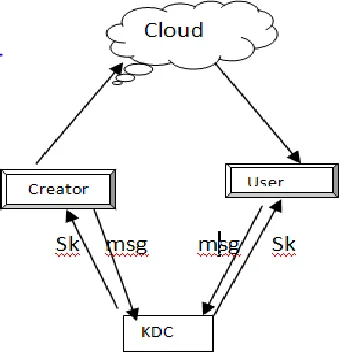
All the approaches take a centralized approach and allow only one KDC, which is a single point of failure
(FIGURE.1). Recently, Lewko and Waters [4] proposed a fully decentralized ABE where users could have zero or more attributes from each authority and did not require a trusted server. In all these cases, decryption at user’s end is
computation intensive. So, this technique might be inefficient when users access using their mobile devices. To get
over this problem, Green et al. proposed to outsource the decryption task to a proxy server, so that the user can
compute with minimum resources (for example, hand held devices). However, the presence of one proxy and one
KDC makes it less robust than decentralized approaches. Both these approaches had no way to authenticate users,
anonymously. Yang et al. presented a modification of [6], authenticate users, who want to remain anonymous while
accessing the cloud. This was also a centralized approach. However, as mentioned earlier in the previous section it is
prone to replay attack.
4. PROPOSED SOLUTION
4.1 Introduction
Our proposed Key-Policy Attribute Based Encryption scheme has described and analyzed in this section
.
According to KP-ABE scheme a user can able to make a file and store it safely in the cloud environment. This
scheme consists of use of the several modules and discussed below .We will first dispute our scheme in details and
then gives a concrete example to show how it works.
Here several attributes are used to provide access to the authorized users in the cloud. The MSG is the
message and the X is the access policy to store the data. The Secret key SK is used to retrieve the data from cloud
server.
To store the data in Cloud,
V.Jeevitha
et al
, International Journal of Computer Science and Mobile Applications,
Vol.3 Issue. 9, September- 2015, pg. 20-28
ISSN: 2321-8363
4.2 Cryptographic Key Assumption
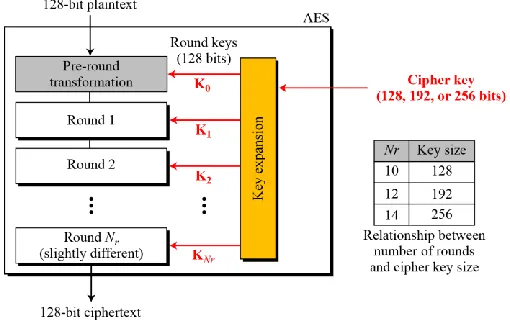
Symmetric-Key Encryption (SKE). These techniques, e.g., AES (Advanced Encryption Standard), are usually
efficient but introduce complexity in EHR systems as additional mechanisms are required to apply access control. In
particular, all healthcare providers use one shared key for encryption and decryption; thus, if the shared key is
compromised, all EHRs are compromised the Public-Key Encryption (PKE). These techniques, e.g., RSA, provide a
secure solution but are not practical for secure EHR storage due to the requirement for an expensive public-key
infrastructure (PKI) to be maintained for distributing and managing public keys and digital certificates for all
healthcare providers.
Figure 2: AES algorithm process flow
4.2.1 Attribute Key Assumption
The group key distribution schemes has recently received a lot of attention from the researchers, as a
method enabling large and dynamic groups of users to establish group keys over unreliable network for secure
multicast communication. Every user, belonging to the group, computes the group key using the message and some
private information. The main property of the scheme is that, if some broadcast message gets lost, then users are still
Capable of recovering the group key for that session. The message they received at the beginning of a previous
Session and the message they will receive at the beginning of a subsequent one, without requesting additional
Transmission from the Group Manager. This approach decreases the workload on the Group Manager and reduces
Network traffic as well as the risk of user exposure through traffic analysis.
4.2.2 Key Distribution
Common group key is frequently updated to ensure secure multicast communication. Group lifetime is
dived into epochs called sessions; single key instance is valid only throughout one session. Group membership can
change between consecutive sessions. At the beginning of session GM distributes a new session key to nodes.
V.Jeevitha
et al
, International Journal of Computer Science and Mobile Applications,
Vol.3 Issue. 9, September- 2015, pg. 20-28
ISSN: 2321-8363
changes and nodes’ behavior. Session key changes have to be performed, with some predefined minimum frequency
to protect the system from cryptanalysis attacks. The choice of session length is a tradeoff between key distributions
Cost in terms of communication and computational overhead, and the required security level.
4.3 Key Issuing Secured Access
Escrow-Free Key Issuing Protocol for CP-ABE the KGC and the data-storing center are involved in the
user key issuing protocol. In the protocol, a user is required to contact the two parties before getting a set of keys.
The KGC is responsible for authenticating a user and issuing attribute keys to him if the user is entitled to the
attributes. The secret key is generated through the secure 2PC protocol between the KGC and the data-storing
center. They engage in the arithmetic secure 2PC protocol with master secret keys of their own, and issue
independent key components to a user. The secure 2PC protocol deters them from knowing each other’s master
secrets so that none of them can generate the whole secret keys of a user alone.
4.4 Security Analysis
Security architecture satisfies the security requirements for authentication, data integrity, and
confidentiality, which follows directly from the employment of the standard cryptographic primitives, namely digital
signature, message authentication code, and encryption, in our system. The fraud can be repudiated only if the client
can provide a different representation he knows of from the trusted authority (TA).
5. IMPLEMENTATION
Its key generation procedure is modified for our purpose of removing escrow. The proposed scheme is then
built on this new CP-ABE variation by further integrating it into the proxy re-encryption protocol for the user
revocation. To handle the fine-grained user revocation, the data storing center must obtain the user access (or
revocation) list for each attribute group which is related to TPA permission generated code, since otherwise
revocation cannot take effect after all. This setting where the data-storing center knows the revocation list does not
violate the security requirements. It is only allowed to re encrypt the cipher texts with authentication and can by no
means obtain any information about the attribute keys of users only accessed by valid users.
This section gives the details and specification of the hardware on which the system is expected to work.
The CloudSim is an advanced tool to simulate the integration of Java coding. The processor will be Dual core 2 GHz
With 2 GB RAM and 120 GB hard disk. The operating system is Windows XP. Java coding is easy to implement
V.Jeevitha
et al
, International Journal of Computer Science and Mobile Applications,
Vol.3 Issue. 9, September- 2015, pg. 20-28
ISSN: 2321-8363
Figure .3 Data Storage in Cloud
6. CONCLUSION
We have presented the Key Policy Attribute Based Encryption scheme, which provides more secure and
fine grained data access control in the system. It will be efficient and scalable to securely manage user data in the
system. For key distribution the KDC is used. It is also helpful to secure data from the unauthorized users and
auditors. The challenging problem is the construction of KP-ABE scheme with constant cipher text size and constant
private key size.As a future work, our aim is to do simulation of proposed method and compare it with existing
solutions for optimality.
REFERENCES
[1]. S. Ruj, M. Stojmenovic, and A. Nayak,” Decentralized Access Control with Anonymous Authentication of Data
Stored in Clouds”, IEEE transactions on Parallel and Distributed Systems, Vol. 25, No. 2, February 2014.
[2] S. Ruj, M. Stojmenovic, and A. Nayak, “Privacy Preserving Access Control with Authentication for Securing Data in Clouds,” Proc.IEEE/ACM Int’l Symp. Cluster, Cloud and Grid Computing, pp. 556-563, 2012.
[3]. Mohamed Nabeel, Member, IEEE, Ning Shang, and Elisa Bertino, Fellow, IEEE,” Privacy Preserving Policy- Based Content Sharing in Public Clouds” IEEE Transactions on Knowledge and Data Engineering, Vol. 25, No. 11,
November 2013.
[4]. A.B. Lewko and B. Waters, “Decentralizing Attribute-Based Encryption,” Proc. Ann. Int’l Conf. Advances in
V.Jeevitha
et al
, International Journal of Computer Science and Mobile Applications,
Vol.3 Issue. 9, September- 2015, pg. 20-28
ISSN: 2321-8363
[5]. S. Kamara and K. Lauter, “Cryptographic Cloud Storage,” Proc.14th Int’l Conf. Financial Cryptography and
Data Security, pp. 136-149, 2010.
[6]. Changji Wang and Jianfa Luo,” An Efficient Key-Policy Attribute-Based Encryption Scheme with Constant Ciphertext Length”, Hindawi Publishing Corporation Mathematical Problems in Engineering, Volume 2013, Article
ID 810969, 7 pages.
[7]. Junbeom Hur and Dong Kun Noh,” Attribute-Based Access Control with Efficient Revocation in Data Outsourcing Systems”, IEEE Transactions on Parallel and Distributed Systems, Vol. 22, No. 7, July 2011.
[8]. Junzuo Lai, Robert H. Deng, Chaowen Guan, and Jian Weng,” Attribute-Based Encryption With Verifiable
Outsourced Decryption”, IEEE Transactions on Information Forensics and Security, Vol. 8, No. 8, August 2013.
[9]. Fuchun Guo, Yi Mu,Willy Susilo,Duncan S. Wong, and Vijay Varadharajan,"CP-ABE With Constant-Size
Keys for Lightweight Devices”, IEEE Transactions on Information Forensics and Security, Vol. 9, No. 5, May 2014. [10].Piotr K. Tysowski and M. Anwarul Hasan,” Hybrid Attribute- and Re-Encryption-Based Key Management for Secure and Scalable Mobile Applications in Clouds,” IEEE Transactions on Cloud Computing, Vol. 1, No. 2,
July-December 2013.
[11]. Ming Li, Shucheng Yu, Yao Zheng, Kui Ren and Wenjing Lou,” Scalable and Secure Sharing of Personal
Health Records in Cloud Computing using Attribute-Based Encryption”, IEEE Transactions on Parallel and
Distributed Systems, Vol. 24, No. 1, January 2013.
[12]. Jin Li, Xinyi Huang, Jingwei Li, Xiaofeng Chen, and Yang Xiang,” Securely Outsourcing Attribute-Based
Encryption with Checkability”, IEEE Transactions on Parallel and Distributed Systems, Vol. 25, No. 8, August
2014.
[13]. John Bethencourt , Amit Sahai and Brent Waters,” Ciphertext-Policy Attribute-Based Encryption”.