COMPUTER SCIENCE & TECHNOLOGY
www.computerscijournal.org
December 2012, Vol. 5, No. (2): Pgs. 189-197 An International Open Free Access, Peer Reviewed Research Journal
Published By: Oriental Scientific Publishing Co., India.
A Genetic Algorithm Scheduling Approach for Virtual
Machine Resources in Cloud Data Centers
ZOHREH ROYAEE
1and MAJID MOHAMMADI
21Department of Science and Research Branch, Islamic Azad university, Kerman, Iran. 2International Center for Science, High Technology and Environmental Sciences,
Shahid Bahonar Kerman University, Kerman, Iran.
(Received: August 04, 2012; Accepted: October 15, 2012)
ABSTRACT
Nowadays, power consumption of data centers has huge impacts on environments. Researchers are seeking to find effective solutions to make data centers reduce power consumption while keep the desired quality of service or service level objectives. Virtual Machine (VM) technology has been widely applied in data center environments due to its seminal features, including reliability, flexibility, and the ease of management.
We present genetic algorithm scheduling approach to reduce data center power consumption, while guarantee the performance from users’ perspective . We use live migration and switching idle nodes to the sleep mode allow Cloud providers to optimize resource usage and reduce energy consumption.We have validated our approach by conducting a performance evaluation study using the CloudSim toolkit. The experimental results show that the proposed algorithm achieves reduced energy consumption in data centers.
Key words: Cloud computing, Virtual machine, Cloudsim, Energy consumption, Genetic algorithm.
INTRODUCTION
Leonard Kleinrock (1969), one of the top scientists of advanced research project agency main net (ARPANET) who was the inter net originator suggested that “ yet, computer webs are in their initial stage but when they developed and got complicated, probably we will observe universal expansion of computer industry, so that like electricity and telephone it was delivered into households and departments. This insight of universal industry competition based on service supply model, predicted huge change of total computation industry in 21 century, so that computer services would be per demand and like
base support that usually applied virtual machine technology for stability and environmental pur poses. To date, the only concer n was establishment of cloud database with high functionality without any energy consideration. In avera1ge, databases use huge energy equal to 25000 household. Most considerable part of consumed electrical energy by computational resources converted to thermal. High temperature resulted in various problems like decrease system confidence and accessibility and decreased machine long life. Amongst, virtualization solutions not only decrease energy expenses in data base infrastructures but also significantly promote proficiency and efficacy of server. Virtualization by virtual machines immigration technique together with merge and parallel load between physical server and execution of 10 applied program or more visual machines on one 86x server, could transfer virtual resources among physical servers gently. This research aimed to deliver a genetic algorithm scheduling approach for virtual machine resources in a cloud data center in order to solve energy problem in cloud computation and environments.
The paper is structured as follows: In the next section, a brief overview is given for the current research on energy-aware mechanisms to cloud computing. Preliminaries and the GA algorithm is. described in Section 3. In Section 4, experimental results and analysis are shown. Finally, conclusion is presented in Section 5.
Related Work
In recent years, energy-aware scheduling of multi-resources has been studied in the field of cloud datacenter, and a large body of research has been conducted into energy-aware scheduling, our brief review of the literature is as follows.
Wei Liu, Hongfeng Li and Feiyan Shi4
(2010) proposed a novel Energy-Performance Balanced Task Duplication based Clustering Scheduling algorithm (EPBTDCS for short) in homogenous clusters which can significantly save energy by judiciously shrinking communication energy consumption when assigning parallel tasks
to computing nodes. Gaurav Dhiman, Giacomo Marchetti and Tajana Rosing5 (2010) presented
vGreen, a multitiered software system for energy-efficient virtual machine management in a clustered virtualized environment. The key idea behind vGreen is linking workload characterization of VMs to Hosts scheduling and power management decisions to achieve better perfor mance, energy efficiency, and power balance in the system. Inigo Goiri, Ferran Juli‘a, Ram´on Nou, Josep Ll. Berral, Jordi Guitart and Jordi Torres3 (2010) presented a dynamic job
scheduling policy for power-aware resource allocation in a virtualized datacenter. Their policy tried to consolidate workloads from separate machines into a smaller number of nodes, while fulfilling the amount of hardware resources needed to preserve the quality of service of each job. This allows turning off the spare servers, thus reducing the overall datacenter power consumption. As a novelty, this policy incorporates all the virtualization overheads in the decision process. Xiaofei Liao, Liting Hu and Hai Jin6 (2010) described the design
and implementation of a novel scheme, called Magnet, that uses live migration of virtual machines to transfer load among the nodes on a multi-layer ring-based overlay. This scheme can reduce the power consumption greatly by regarding all the cluster nodes as a whole based on
virtualization technologies. And, it can be applied to both the homogeneous and heterogeneous servers.Young Choon Lee, Albert Y and Zomaya7 (2010) presented two
Proposed Algorithms
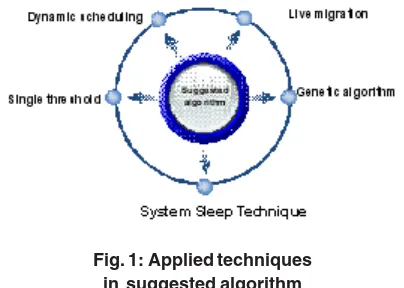
In presented algorithms it was used five techniques: dynamic scheduling , live migration, single threshold,sleep and genetic algorithm
Presented schedule algorithms guaranteed quality of user program execution because it used alive immigration in order to migrate virtual machine. In this type of immigration, executive program of immigrant machine continue its work even during immigration and never stop. Thus, user program continue in its real time and user never notice place displacement and elapsed times.
If it was used common immigration, before immigration all programs stops and it starts again in their destinations, so cause user time elapsed. In the other hand, by turning off the machine all installed programs stopped and again arrayed in play mode. While in alive immigration at the times with immigration instructions and its order and system status in play mode transferred to destination and it continue its work in the destination.
Based on presented algorithms of Mr Buya and his coleagus , its presence in simulators, we selected critical points of 90 and 10 percent toward immigration.
Based on this algorithm , when using a physical machine processor reach more than 90 percent of its capacity, some installed virtual machines on it immigrate alive due to down-up increase of physical machine energy consumption more than 90 percent usage of processors. By doing this, we will decrease energy consumptions.
In the other hand, when using processors reaches lower rate than 20 percent capacity, we decided to immigrate all virtual machines installed on it toward other physical machines and origin physical machines turned off in order to minimum energy consumptions. This id because when physical machines turns on, even if no other machine was on it, it used high initial energy therefore, it set 10 percent so that physical machine dosnt use high energy for low work value. In this algorithm we used genetic optimization algorithm for problem solving:
There are five main functions in genetic algorithm:
´ Initial population() ´ Evaluation function()
Fig. 1: Applied techniques in suggested algorithm
We set variable p in order to demonstrate physical machines in system.
P=(p1,p2,…pn) and n is number of physical machines that here is 800 to compare with other algorithms. Pi indicate unique physical machine that i is the number of that physical machines. In following range 1<= i <=n .we also showed virtual machine on every host by V letter that Vi={v1,v2,…..vm}, that m is number of virtual machines physical server, i is total number of virtual machines that were set 1052.
´ Selection() ´ Crossover()
´ Mutation
In presented algorithm with common modification of genetic algorithm we added sixth function to this trend in order to check work load in servers then in mean time migration took place, and then it reevaluated and a string with minimum energy consumption was selected:
6-overload and under load 7-migration
Initial Population
Above figure is a population string or chromosome. It was produced 200 chromosomes that randomly set vm places on hosts. Every chromosome is a solution that randomly devotes virtual machines on servers.
Therefore, in order to select initial population, it was proposed 200 strings (chromosomes) that each string determined virtual machines on host randomly. Each chromosome
selected with 1052 length. 1052 is the number of virtual machines that we want to devote to 800 hosts. Each gen took some part of 800 servers so that it reached minimum energy consumptions. Then it was supposed each chromosome to be one row array that includes 1052 columns. Each array determined that with machines installed on which established host. Then each array or gen in genetic expression is physical machines number. For example, in first array, its volume is 755, it means that first virtual machine located on 755 server. Each virtual machine might located on just one host at the moment. In other words, every host has limited capacity.
We apply this requirements in initial population produce, in order to settle population appropriately.
We changed iterations over and over and best results devoted to 1000th repletion. Therefore,
each of 200 chromosomes, updated 1000 times. And optimized in gentle algorithm stages (evaluation, combination and mutation).
Evaluation Function
Power (chromosome) £, first assessed hostenergy then total host energy of one commutated strain. Finally, string energy were compared and a string with minimum energy was
selected. In this algorithm, using a table from two articles of two pioneers of cloud computation namely Buyya and Beloglazove, we tried to select evaluation function. In this table that was delivered below, due to two kinds of processors, that were used in cloud databases and it was used this model in simulations. In first column, workload on server expressed by parents and in turn second and third column energy consumption bit processors expressed due to workload.
Therefore, due to this figures and values, when the first type of server turns on but no program plays on it. Its energy consumption reaches 86 watt and in turn, while 10 percent of processor capacity of workload was on it, energy consumption is equal to 89.4 watt. Remaining parts obtained in the same way and at last we observe that when workload of processor is 100%, its energy consumption is 117 watt.
In second processor, same method works. When server is on and unemployment, energy consumption is 93.7watt/hour and when workload of server is 1005 its energy consumption is 135 w/h.
Because both of these servers are two cores, we consider total capacity of both processors.
Due to obtained consumption energy per server workload, it obtained one linear function, because in each of these processors with stable steep, energy consumption increased. So we resulted following formula:
When program goes to first kind of processors, It computed 31+86 percent workload each host, that is consist of consumption energy of machines turn on status plus server emptiness and completion differentiation multiply fullness of first type server.
When program run in on to second type processor, 46.3+93.7 percent workload computation on host, that is energy consumption of machines turn on status plus emptiness and completion differential multiply second type processor fullness percent.
So we noticed that if host workload reach predetermined critical point or not. If host workload is lower than 10 percent capacity, virtual machines transferred on it to other hosts so that the destination servers dose nt reach critical point.
Also, if, host workload reachs 90 percent of its capacity, some virtual machines transferred
from this host to others in order to reach work load to normal status.
Selection
In this section, using evaluation function, chromosomes were studied in each iteration, population considered 100 percent and evaluated each chromosomes and selected 5 minimum from each parent and select it as child directly. Other 95 proceed due to mutation and combination integer trends.
In fact, each population includes 5 parents that have minimum value and 95 of gens obtained from genetic algorithm.
Combination
In order to use combination in this algorithm it was used one point or two points trend.
One point method
This is the common combination approach. In this approach, one point was selected randomly in parent chromosomes and combined with each other. So that, from beginning of first parent to that point, it was heritage first parent gens and heritage from that point to end of second parent point.
Two Points Trend
In this approach, two points randomly selected in parents chromosomes. Then gens among selected points changed in binary form, so
that from beginning of first parent to first point and from first point to end of first percent was heritage among points heritage from second parent.
Table 1: Energy consumption bit processors expressed due to workload
Server 0% 10% 20% 30% 40% 50% 60% 70% 80% 90% 100%
HP Proliant G4 86 89.4 92.6 96 99.5 102 106 108 112 114 117
Monotones Trend
In this trend, some parts of child from parent selected randomly, some parts of second parent was selected. In fact, it was said that n points integer of combination was applied.
Combination Rate
In combination, it was sued probability rate. For example, based on experience, it was suggested 70% rate. In other hand, in each iteration, a random value produced among 1 to 100. If in that iteration, produced values was between 0 to 70integers of combination applied on that string, otherwise, it was goes to next level of algorithm that mutation integer applied.
Mutations
Due to mutation process, it was used hit wise method. In this method, a bit randomly changed in a string.
In this process, it was used 0.05 mutation rate, it means that random value created among 1 to 100. If this value fall into 1 to 50, mutation take place. Otherwise, we go to next step. Because mutation might occur less to lead less modification in our strings. In other words, it was used mutation so that if total optimization point fall out of current research districts, it allows algorithm to study following points. If obtained value of mutation trend was better than current research points, algorithms moves toward it. Otherwise, It search in same area.
Study Of Workload And Immigrations
In next stage it was studied overload and under load in each chromosome. If using host processors was more than 90 percent of its capacity, over load or workload over took place.
If using host processor is lower than 10 percent of its capacity, under load or minimum workload took place.
During overload, high work load causes increased energy and power consumption and this lack of energy has direct effect on costumer payment expenses in order to use cloud services and decrease service level quality and created problems like accessibility and machine long life decrease and decrease system confidence. So it
was decided to based on machine selection algorithm toward immigration MMT, some virtual machines on host immigrated from to other hosts.
In this section, after passing combination and mutation and immigration stages, our strings reach their fine status. Here, evaluated string using target function. A lower consumption string sent for exit as a candidate string.
Simulation Results
We used different study methods of workload and immigrant virtual machines selection to merge in proposed schedule algorithm. Also, it was used one point and two point and scatter and… methods to schedule combination stage and it was used bit methods for schedule mutation stage.
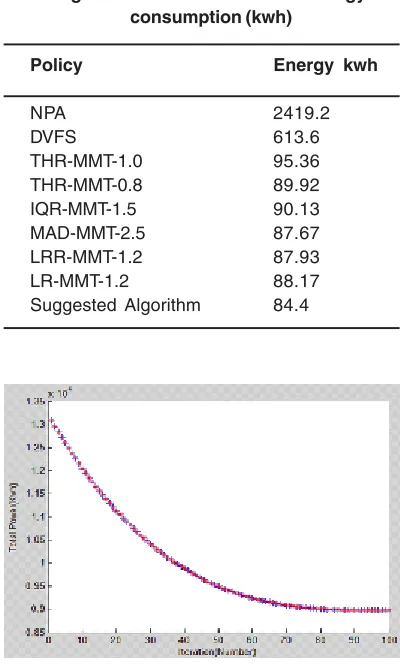
Graph 3: Presented schedule with 100 iteration and one point combination integer
Table 2: Comparison of different algorithms based on servers energy
consumption (kwh)
Policy Energy kwh
NPA 2419.2
DVFS 613.6
THR-MMT-1.0 95.36
THR-MMT-0.8 89.92
IQR-MMT-1.5 90.13
MAD-MMT-2.5 87.67
LRR-MMT-1.2 87.93
LR-MMT-1.2 88.17
Graph 4: Presented schedule with 1000 iteration and scatter combination integer
Graph 5: Comparison of algorithm based on servers energy consumptions (kwh)
Graph 6: Comparison of energy aware algorithm based on servers energy consumptions (kwh)
Finally, best obtained results was achieved after frequent changes in variables due to combination of integer change and iteration number.
Some graphs that have more optimal response rather than other graphs variable changes described in following section:
In 100 iteration and with one point combination integer and bit mutation and delivered selection integer with 100 population. In each iteration, following results were obtained.
As we seen before, energy consumption by this method reached 90 k/h. so, combination integer selected scatter with produced probability value determine points numbers, then combination took place. In fact, we called it point infinite combination.
By change of iteration to 1000, and scatter combination integer, results got better and minimum of energy consumption is equal 84/40 kw/h.
In contrast with other represented methods, supposed methods shows improved energy consumption.
In above graph, we inserted this algorithm to compare totally between energy consumption according to energy-based algorithms and other algorithm. In following algorithm, we just compare energy based algorithms to observe these optimizations critically.
As we seen before, delivered algorithm reached its minimum value 84.40 that is appropriate algorithms among previous ones. As might seen before, this represented algorithm also has lower energy consumption even lower than Mr Buyya and his coleague that was proposed in 2011 (LR-MMT). LR-MMT algorithm works with LR algorithm and additional resource allocation works with MMT algorithm due to critical point study and based on rectangle graph comparison represented below, it was clear that genetic algorithm based represented algorithm rather than previous
mentioned algorithms cause cloud database energy consumption improvement.
CONCLUSION
One of the main and vital issues in cloud computation net fields that absorbed much attention in recent researches of cloud field is energy consumption optimization issue. In this study, we used virtualization method to save database energy and also represented a virtual machines immigration schedule algorithm based on genetic algorithm. In this algorithm, due to application of virtualization technology and virtual machine immigration, we could guaranteed work quality and because of sleep technique and unique interval usage that was merged in genetic algorithm, we save more energy in comparison to other current algorithm and improve energy consumption in cloud databases.
REFERENCES
1. B. Lin, , and P. A. Dinda,” Mixing Batch And Interactive Virtual Machines Using Periodic Real-time Scheduling”. In Proc: the 2005 ACM/IEEE conference on Super-computing, pp:1-8 (2005).
2. R. Raghavendra, P. Ranganathan, V. Talwar, Z. Wang, X. Zhu.” No Power Struggles: Coordinated multi-level power management for the data center”, In proc: Thirteenth International Conference on Architectural Support for Programming Languages and Operating Systems (ASPLOS), pp:48-59 (2008).
3. T. Horvath, T.Abdelzaher, K. Skadron, X. Liu,” Dynamic Voltage Scaling in Multi-tier Web Servers with End-to-end Delay Control”, in proc: IEEE Transactions on Computers (TOC), 56: 444-458 (2007).
4. J. Heo, D. Henriksson, X. Liu, T. Abdelzaher, “Integrating Adaptive Components: An Emerging Challenge in Perfor mance-Adaptive Systems and a Server Farm Case-Study,” in proc:the 28th IEEE Real-Time Systems Symposium (RTSS), pp:61-72 (2007).
5. X. Fan , W.Dietrich Weber, L. Andre Barroso.
“Power provisioning for a warehouse-sized computer”, In proc:The 34th ACM International Symposium on Computer Architecture (2007).
6. L. A.Barroso, U. Holzle,” The Case for Energy-Proportional Computing”, IEEE Computer, 40: 33-37 (2007).
7. S. Nedevschi, L. Popa, G. Iannaccone, S. Ratnasamy, D. Wetherall, “Reducing Network Energy Consumption via Sleeping and Rate-Adaptation”, In Proc:the 5th USENIX Symposium on Networked Systems Design & Implementations (NSDI), pp:323-336 (2008).
8. C.P. Sapuntzakis, R. Chandra, B. Pfaff, J. Chow, M.S. Lam, and M. Rosenblum, “Optimization the Migratin of Vir tual Computers”, In Proc: 5th USENIX Symposium on Operating Systems Design and Implementation (OSDI-02), 11: 377-390 (2002).
Computing, (2007).
10. S. N. Sivanandam and S. N. Deepa, “Introduction to genetic algorithms” , Publisher : Springer, ISBN: 354073189X (2008).
11. A. Gandhi, M. Harchol-Balter, R. Das, C. Lefurgy, “Optimal power allocation in server farms”,in Proc: 11th International Joint Conference on Measurement and Modeling of Computer Systems, pp: 157–168 (2009). 12. Y. Song, H. Wang, Y. Li, B. Feng, Y. Sun, “Multi-Tiered On-Demand resource scheduling for VM-Based data center”, in Proc: 9th IEEE/ ACM International Conference Symposium on Cluster Computing and the Grid(CCGRID) , pp: 148–155 (2009).
13. J. Baliga, R. Ayre, K. Hinton, R.S. “Tucker, Green cloud computing: balancing energy in processing, storage and transport”, in proc: the IEEE, IEEE Press, vol 99 ,pp: 149-167 (2011).
14. S.Zhang, X.Chen and S.Wu, “Analysis and Research of Cloud Computing System Instanse”, in Proc: the Second International Conference on Future Networks, pp:88-92 (2010).