Causal Relationships Among Factors Affecting the Buildability in
Executing Construction Projects in Vietnam
Hai Pham
1,*, Soo-Yong Kim
2, Truong-Van Luu
3, Phu-Son Lam
41
Interdisciplinary Program of Construction Engineering and Management, Pukyong National University, Busan, Korea.
2
Department of Civil Engineering, Pukyong National University, Busan, Korea.
3
Department of Civil Engineering, International University, Ho Chi Minh City, Vietnam.
4
Department of Civil Engineering, Ho Chi Minh City University of Technology, Vietnam.
Received 07 July 2017; received in revised form 10 August 2017; accepted 13 August 2017
Abstract
This paper aims to identify causal relationships among factors affecting the buildability in executing
construction projects in Vietnam. First, through a comprehensive literature review, the study identified a full set of
attributes that affect the buildability of construction projects. Subsequently, through discussions and interviews with
experts, the study determined main attributes affecting the buildability in the context of the construction industry in
Vietnam. After that, a survey questionnaire was developed which was based on identified attributes. The data after
collected, was analysed by Structural Equation Model (SEM) and the expected result from the SEM model is a
structural model. This structural model includes four factors, namely: Design applies advanced machinery, materials
and construction methods; Design uses available resources at local for saving costs; Design applies safe construction
methods; and Design uses prefabricated and typical components. The key finding of the study is to provide insights
into causal relationships among factors affecting the buildability in executing construction projects in Vietnam.
Keywords: buildability, structural equation model, construction projects, Vietnam
1.
Introduction
The construction industry is one of the most developed industries in Vietnam in recent years. There are many projects to
be completed corresponding to the expectation of investors as well as meeting aesthetic and quality requirements. However,
there are also many projects completed with differences to initial designs. Particularly, many projects after completed design
cannot be constructed or have delays in construction schedule, cost overruns due to revisions of drawings to suit practical
requirements.
Currently, there are many methods of project implementation in Vietnam but Design-Bid-Build method is still the most
common method. For this traditional method, design and construction companies usually work separately. Thus a completed
design which cannot match the construction is unavoidable.
Therefore, to finish projects with the high efficiency in terms of aesthetics, ease for construction as designed, limitation of
many revisions, reduction of incurred costs and schedule; design companies need to consider more carefully about the
buildability for each design. To obtain this purpose, this study needs to finish the following two objectives: Identify attributes
that affect the buildability for the process of project implementation in the context of the construction industry in Vietnam; and
Discover causal relationships among constructs affecting the buildability for projects deployment.
2.
Research Methodology
To achieve the study objectives above, firstly a comprehensive literature review is conducted to determine attributes that
affect the buildability for projects deployment in the context of the construction industry in Vietnam. Then, a survey
questionnaire is developed to collect data for the analysis of the study. The questionnaire consists of two parts: the first part
presents the attributes affecting the buildability, the respondents are asked to evaluate the items based on a five-point Likert
scale according to convention: 1 (Strongly disagree ) to 5 (Strongly agree). The second section is designed to collect personal
information of the respondents such as years of work experience as well as positions in projects.
The next step, a Structural Equation Modelling (SEM) is deployed to discover causal relationships that affect the
buildability for implementing projects. The SEM model in this study includes two models: the measurement model and
structural model. The purpose of the measurement model is to evaluate the extent to which observed variables load up their
underlying constructs. The purpose of the structural model is to discover causal relationships among constructs affecting the
buildability.
The fit of both the measurement model and structural model is assessed by several Goodness of Fit (GOF) indices. If the
two models achieve the minimum requirements of these indices, they are considered to be fit into the data of the study and
accepted. Finally, discussion of the result of the SEM model is also shown. The next section summarizes the factors
influencing the buildability to be identified through a literature review and the implementation of the SEM model.
3.
Structural Equation Model (SEM)
3.1. Confirmatory factor analysis (CFA)
In testing measurement scale, the CFA method in Structural Equation Model has many advantages rather than traditional
methods. The reason is that CFA allows the testing of theory structure of measurement scale such as relationship between a
research concept and other concepts without bias due to measurement error. Moreover, CFA can also check convergence value
as well as discriminant value of measurement scale without taking many research steps as traditional methods [10-13].
The model fit is assessed by many Goodness of Fit (GOF) indices as follows:
Chi-square (CMIN).
Chi-square/df (CMIN/df).
Comparative Fit Index (CFI).
Tucker & Lewis Index (TLI).
Root Mean Square Error Approximation (RMSEA).
The model is considered as suitable to data when p-value (Chi-square test) higher than 0.05. However, Chi-square is
dependent on sample size. If a model gets the values of GFI, TLI, and CFI higher than 0.9 [10-13]; CMIN/df lower than 2;
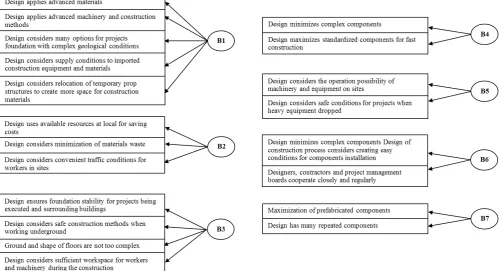
Seven main factors covering attributes for the SEM model are denoted as in Table 1. These attributes are found out based
on previous studies of the authors, such as: [1-9]
Table 1 Factors affecting the buildability
Attributes Factors affecting the buildability Denoted
Design applies advanced materials
Design applies advanced machinery, materials and construction methods B1 Design applies advanced machinery and construction methods
Design considers many options for projects foundation with complex geological conditions
Design considers supply conditions to imported construction equipment and materials
Design considers relocation of temporary prop structures to create more space for construction
Design uses available resources at local for saving costs
Design uses available resources at local
for saving costs B2
Design considers minimization of materials waste
Design considers convenient traffic conditions for workers in sites
Design ensures foundation stability for projects being executed and surrounding buildings
Design applies safe construction
methods B3
Design considers safe construction methods when working underground Ground and shape of floors are not too complex
Design considers sufficient workspace for workers and machinery during the construction
Design minimizes complex components Minimization of complex components
and maximization of standardized components for fast construction
B4 Design maximizes standardized components for fast construction
Design minimizes complex components Design considers safe construction
conditions B5
Design maximizes standardized components for fast construction
Design considers the operation possibility of machinery and equipment on
sites Work coordination and construction
process consideration B6
Design considers safe conditions for projects when heavy equipment dropped Design of construction process considers creating easy conditions for
components installation Design uses prefabricated and typical
components B7
Designers, contractors and project management boards cooperate closely and regularly
The Fig. 1 presents attributes as well as factors affecting the buildability for projects deployment.
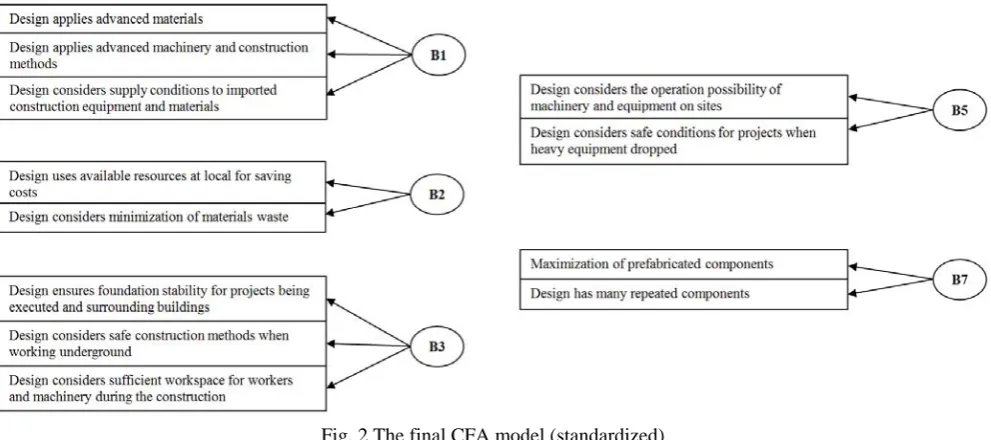
Fig. 2 The final CFA model (standardized)
The final CFA model (Fig. 2) is revised several times by adding errors to observed variables according to modification
indices (MI). After that, variables which have standardized weights lower than 0.5 are eliminated.
Data of the study is evaluated based on Goodness of Fit (GOF) indices: Chi-square/df = 1.53 < 2; CFI = 0.95 > 0.9; GFI
= 0.93 > 0.9; TLI = 0.91 > 0.9; RMSEA = 0.064 < 0.08. Therefore, the final CFA model fits into the data of the study and
accepted.
The standardized weights are higher than 0.5 and the unstandardized weights are also statistically significant (p-value =
0.00), so the factors achieve the convergent validity. The correlation coefficients among the factors in the model are lower than
0.9 thereby the scale achieves discriminant validity.
3.2. The structural model
From the results obtained in the previous analysis of CFA, combining with the consideration of relationships of the main
factors, a structural model (Fig. 3) is proposed to describe the mutual influence of the main factors as follows:
Fig. 3 The structural model among the main factors
The result of the structural model among the main factors: Chi-square/df = 1.64 < 2; CFI = 0.94 > 0.9; GFI = 0.93 > 0.9;
TLI = 0.91 > 0.9; RMSEA = 0.07 < 0.08. Therefore, the structural model among the main factors fits into the data of the study
and accepted.
From the structural model above, it can be concluded that Design applies advanced machinery, materials and construction
traditional structural systems (such as reinforced concrete systems poured at sites) without much attention to advanced
machinery, materials and construction methods. Prefabricated components often have advantages in terms of quality as
produced in factories and prestressed components will meet requirements on the aesthetic. The increase of using advanced
machinery and construction methods also helps to shorten time for construction of prefabricated components.
Design enhancing the application of new materials will also help reduce costs for projects such as using light brick to
make partition will help to reduce loads thereby reducing the volume of foundation and frame systems.
The increase of using lightweight and good quality materials as well as advanced machinery and construction techniques
will improve safe construction methods as designing.
Design using locally available materials to reduce transportation and supply costs will negatively impact on design which
considers use of prefabricated components. Projects which currently use reinforced concrete structures poured in sites under
traditional methods are very popular, thereby local workers are mostly familiar with construction process. In addition,
contractors are also easy to find the supply of locally available materials. This contributes to limitation of using prefabricated
components and advanced construction methods.
4.
Bootstrap Test
To assess the reliability of estimates, in quantitative research methods using sampling method, one sample is usually
divided into two subsamples. The first subsample is used to estimate model parameters, and the second is for reassessment.
Another method is to repeat the study by other samples. Two methods above are generally impractical because structured
methods often require large samples, so this takes more time and cost [14]. In such cases, bootstrap is a suitable method to
replace [15]. Bootstrap is a repeated sampling method with replacement.
The collected sample consists of 132 observations. The sample for bootstrap test consists of 500 observations.
The test result is given in the following table:
Table 2 Error of standardized regression weights
Parameter SE SE-SE Mean Bias SE-Bias CR
B2 B1 0.111 0.004 0.663 -0.009 0.005 -1.80
B3 B1 0.132 0.004 0.475 0.008 0.006 1.33
B7 B1 0.472 0.015 1.074 0.016 0.021 0.76
B7 B2 0.462 0.015 -0.597 -0.032 0.021 -1.52
The result in Table 2 shows that there is no statistically significant difference in parameter values between the collected
sample and the sample for bootstrap test. All CR values are smaller than z = +/- 1.96 of the normal distribution (no statistical
significance at the confidence level 95%). Thus, the estimated parameters of the SEM model are reliable.
5.
Conclusions
In this study, a theoretical model is developed and tested rigorously using data collected through survey questionnaires
covering the factors affecting the buildability for projects deployment in the context of the construction industry in Vietnam.
The SEM method is used to empirically validate this theoretical model to discover causal relationships between constructs.
The result of the SEM model indicates that Design applies advanced machinery, materials and construction methods has
materials will also help reduce costs for projects such as using light brick to make partition will help to reduce loads thereby
reducing the volume of foundation and frame systems. The increase of using lightweight and good quality materials as well as
advanced machinery and construction techniques will improve safe construction methods as designing. Design using locally
available materials to reduce transportation and supply costs will negatively impact on design which considers use of
prefabricated components.
However, there are also some limitations to this study: the SEM model is validated by the data collected from the
respondents working in the construction industry in Vietnam. For this reason, a recommendation made is that there should be
further studies to be carried out to discover causal relationships between constructs affecting the buildability in other regions.
Consequently, similarities and differences will be summarized and compared to this study.
References
[1] P. T. I. Lam, F. W. H. Wong, and A. P. C. Chan, “Contributions of designers to improving buildability and constructability,” Journal of Design Studies, vol. 27, no. 4, pp. 457-479, July 2006.
[2] R. M. Zin, M. Z. A. Majid, and C. Fadhil, “Neural network model for design constructability assessment,” Jurnal Teknologi, vol. 40, pp. 27-40, June 2004.
[3] Code of Practice on Buildable Design, 2013 ed. Singapore, Building and Construction Authority, August 2013. [4] A. M. Jarkas, “An investigation into the influence of buildability factors on productivity of in situ reinforced concrete
construction,” Ph.D. Thesis, University of Dundee, 2005.
[5] E. Saghatforoush, B. Trigunarsyah, and E. G. Too, “Assessment of operability and maintainability success factors in provision of extended constructability principles,” 9th International Congress on Civil Engineering, May 2012. [6] A. M. Jarkas, “The effects of buildability factors on formwork labor productivity of grade beams,” Journal of
Construction Engineering, vol. 25, no. 2, pp. 240-265, August 2010.
[7] A. M. Jarkas, “Buildability factors that influence micro-level formwork labour productivity of beams in building floors,” Journal of Construction in Developing Countries, vol. 16, no. 1, pp. 1-18, 2011.
[8] A. M. Jarkas, “The effects of buildability factors on rebar fixing labour productivity of beamless slabs,”Australasian Journal of Construction Economics and Building, vol. 10, no. 1-2, pp. 16-35, January 2010.
[9] A. Griffith, “A Critical Investigation of Factors Influencing Buildability and Constructability,” Ph.D. Thesis, Heriot-Watt University, UK, 1984.
[10] J. F. H. Jr, W. C. Black, B. J. Babin, and R. E. Anderson, Multivariate data analysis, 7th ed. Person Prentice Hall, NJ, 2010.
[11] J. B. Ullman, “Structural equation modeling: reviewing the basics and moving forward,” Journal of Personality Assessment, vol. 87, no. 1, pp. 35-50, August 2006
[12] R. E. Schumacker and R. G. Lomax, A beginner’s guide to structural equation modeling, 3rd ed., New York, NY, Taylor and Francis Group, 2010.
[13] K. Schermelleh-Engell and H. Moosbrugger, “Evaluating the fit of structural equation models: tests of significance anddescriptive goodness-of-fit measures,” Methods of Psychological ResearchOnline, vol. 8, no. 2, pp. 23-74, May 2003. [14] J. C. Anderson and D. W. Gerbing, “Structural Equation Modeling in Practice: A Review and Recommended Two-Step
Approach,” Psychological Bulletin, vol. 103, no. 3, pp. 411-423, 1988.