2012 Bioenergy Action Plan
Prepared by the Bioenergy Interagency Working Group
Bioenergy
Interagency
Working Group
Julia Levin, Chair, Bioenergy Interagency Working Group
Deputy Secretary, California Natural Resources Agency
Cliff Rechtschaffen
Senior Advisor to Governor Edmund G. Brown
Karen Ross
Secretary, Department of Food and Agriculture
Matthew Rodriquez
Secretary, California Environmental Protection Agency
Mary Nichols
Chair, California Air Resources Board
Mark Ferron
Commissioner, California Public Utilities Commission
Carla Peterman
Commissioner, California Energy Commission
Ken Pimlott
Director, Department of Forestry and Fire Protection
Caroll Mortensen
Director, Department of Resources Recycling and Recovery
Pamela Creedon
Executive Officer, Central Valley Regional Water Quality Control Board
Stephen Kaffka
Director, California Biomass Collaborative
California
Energy
Commission
*DUU\2¶1HLOO
Project Manager Heather Raitt
Assistant Executive Director, Renewables and Climate Change
Tony Gonçalves
Office Manager
Renewable Energy Office
Robert P. Oglesby
Executive Director
DISCLAIMER
This report was prepared by the California Natural Resources Agency and the California Energy Commission with input from the Bioenergy Interagency Working Group. This report was prepared as part of the Bioenergy Action Plan proceeding ± docket # 10-BAP-01 and as a supporting document for the 2012 Integrated Energy Policy Report.
ACKNOWLEDGEMENTS
The authors would like to acknowledge the contributions to this plan from the California Biomass Collaborative which developed much of the material presented in Chapter 1. Thank you for your continued assistance.
Stephen Kaffka, Mark W. Jenner, Doug Wickizer, and Rob B. Williams
The 2012 Bioenergy Action Plan was prepared with contributions from the Bioenergy Interagency Working Group. The authors would like to acknowledge contributions from the following individuals:
Air Resources Board Richard Corey Ryan McCarthy Tung Le
California Energy Commission Otto Tang
Pam Doughman Sandra Fromm Sarah Michael Susan Brown
Public Utilities Commission Cheryl Lee
Eugene Cadenasso Judith Iklé
CAL FIRE Cathy Bleier Bill Snyder CalRecycle Clark Williams Jacques Franco Scott Smithline
California Environmental Protection Agency Meredith Younghein
John Blue
California Regional Water Quality Control Board Robert Crandall
Department of Food and Agriculture Casey Walsh Cady
Jim Houston Sandra Schubert
California Biomass Collaborative Doug Wickizer
Mark Jenner Rob Williams Stephen Kaffka
PREFACE
The 2012 Bioenergy Action Plan outlines strategies, goals, objectives, and actions that California state agencies will take to increase bioenergy development in California. The plan builds upon thȱȂȱ2006 Bioenergy Action Plan and 2011 Bioenergy Action Plan. These plans were
developed with input from the Bioenergy Interagency Working Group, the California Biomass Collaborative and stakeholders and other public comments. An in-‐‑depth status report on
bioenergy development and analysis of the issues are contained within the 2011 Bioenergy Action Plan, which was adopted by the California Energy Commission in March 2011. The 2012
Bioenergy Action Plan updates the strategies, objectives, and state agency actions to reflect Governor Jerry Ȃȱ¢ǰȱ ȱǰȱȱȱȱȱȱ£ȱȱ
state actions not included in 2011 Plan.
ABSTRACT
California has an abundance of biomass residues ȱȱȂȱǰȱǰȱȱȱ
waste streams. Sustainably collected biomass can be used to produce renewable energy, such as transportation fuels, methane, or electricity. Using biomass to produce energy reduces the need for traditional disposal options for biomass such as landfill disposal or burning in place, while reducing dependence on fossil energy sources. The 2012 Bioenergy Action Plan is a coordinated state agency approach to addressing challenges and maximizing opportunities for the
development of bioenergy projects that promote economic development and provide the greatest environmental benefit. The plan outlines state agency actions that: 1) stimulate cost-‐‑
ȱ£ȱȱȱȂȱȱȱȱȱȱȱȃ -‐‑Ȅȱ
biofuels, biogas, and renewable electricity; 2) increase research, development and
demonstration of bioenergy toward commercializing new technologies; 3) streamline the regulatory and permitting processes; and 4) quantify and monetize the benefits of bioenergy.
Keywords: California Energy Commission, Bioenergy Interagency Working Group, bioenergy, biopower, biofuels, biomass, biogas, biomethane, biorefinery, biogenic, Bioenergy Action Plan, renewable; biomass residues
Please use the following citation for this report:
TABLE OF CONTENTS
EXECUTIVE SUMMARY ... 1
STATUS OF BIOENERGY IN CALIFORNIA ... 1
CHALLENGES ... 2
RECOMMENDED ACTIONS ... 2
CHAPTER 1: BENEFITS AND POTENTIAL DEVELOPMENT OF BIOENERGY ... 3
TYPES OF BIOENERGY ... 3
BENEFITS OF BIOMASS USE IN CALIFORNIA ... 4
TECHNICAL POTENTIAL OF BIOMASS ...10
CHAPTER 2: CALIFORN,$¶632/,&,(621%,2ENERGY ...11
RENEWABLE ENERGY POLICIES ...11
CHAPTER 3: ACTION PLAN TO INCREASE USE OF BIOMASS RESIDUES ...17
STRATEGIES TO INCREASE BIOENERGY PRODUCTION AND REDUCE WASTE ...17
GOALS AND OBJECTIVES OF THE 2012BIOENERGY ACTION PLAN ...18
STATE AGENCY ACTIONS ...19
ACRONYMS ...37
LIST OF FIGURES AND TABLES
Figure 1: Estimated Biomass Potential Feedstock ... 10
EXECUTIVE SUMMARY
California has enormous potential to create energy from organic waste materials. Urban,
agricultural and forest wastes that would otherwise go to landfills or be burned can, instead, be used to produce electricity, transportation fuels, combined heat and power, and more.
Expanding bioenergy also creates jobs, provides local energy, enhances energy security, and helps protect public health and safety by reducing waste materials and fire danger.
California has adopted numerous policies to promote bioenergy, but significant barriers to its development remain. The 2011 Bioenergy Action Plan identifies those barriers and recommends actions to address them so that the state can meet its clean energy, waste reduction and climate protection goals. The 2012 Bioenergy Action Plan updates the 2011 Plan and provides a more detailed action plan to achieve the following goals:
x Increase environmentally and economically sustainable energy production from organic waste.
x Encourage development of diverse bioenergy technologies that increase local electricity generation, combined heat and power facilities, renewable natural gas, and renewable liquid fuels for transportation and fuel cell applications.
x Create jobs and stimulate economic development, especially in rural regions of the state.
x Reduce fire danger, improve air and water quality, and reduce waste.
Status of Bioenergy in California
Bioenergy is renewable energy produced from biomass wastes including forest and other wood waste, agriculture and food processing wastes, organic urban waste, waste and emissions from water treatment facilities, landfill gas and other organic waste sources. Biomass waste can be used to generate renewable electricity, liquid fuels and biogas.
Current bioenergy production in California includes:
x 33 biomass plants that generate a combined 600 megawatts of electricity, nearly 2 percent of
Ȃȱȱ¢ȱ¢.
x 11 dairy digesters that produce electricity, combined heat and power, and biogas.
x 500 megawatts of electricity is generated at biogas facilities at wastewater treatment plants and landfills.
x 50 to 100 million gasoline gallon equivalent is produced at in-‐‑state ethanol and biodiesel facilities.
California generates 36 million bone-‐‑dry tons of biomass from the urban, agricultural and forest sectors. Using that resource to produce energy provides numerous benefits. Bioenergy
processes. ¢ȱȱȱȱ ȱȱȱ ȱȱȱȱȂs landfills and bioenergy from agricultural wastes reduces open field burning.
Bioenergy production creates jobs and revenues. In 2010, biopower facilities generated 5,745 gigawatt-‐‑hours of energy, impact worth $575 million and providing about 5,000 direct jobs. As reported by the California Biomass Energy Alliance, the largest share of jobs and economic impact came from existing woody biomass electric facilities which employed 750 people at the facilities and 1,200 to 1,500 in the fuel supply infrastructure. Increasing biopower capacity by 50 percent could provide an additional 2,500 jobs in California and generate an additional $287 million in revenues. Public data is not readily available on the employment and economic impact of existing biofuel facilities. However, biofuels has the potential to add over 1,600 jobs.
Challenges
ȱȱ¢ȱǰȱ¢ȱȱȱ¢ȱŗśȱȱȱȂȱȱ
biomass waste, and production is decreasing. Regulatory and financial incentives for renewable power do not adequately monetize the many benefits of bioenergy, and regulatory barriers compound these challenges. Some incentives for bioenergy have been inconsistent or discontinued while others have failed to account for the additional costs and benefits of biomass. Environmental, waste disposal, public health, and pipeline safety regulations often complicate bioenergy permitting and development and sometimes contradict each other. Access to transmission lines, pipelines and other distribution networks also pose significant challenges to bioenergy development.
Some of these challenges require additional research and demonstration to ensure that
bioenergy production is environmentally and economically sustainable. Other barriers require regulatory changes, including permit streamlining and consolidation, utility procurement requirements, financial incentives that reflect the many benefits of bioenergy, and other changes.
Recommended Actions
ȱȱȂȱ ȱ¢ǰȱ ȱduction, environmental, and public safety goals, the Bioenergy Working Group recommends the following:
x Increase research and development of diverse bioenergy technologies and applications, as well as their costs, benefits, and impacts.
x Continue to develop and make accessible information about the availability of organic wastes and opportunities for bioenergy development.
x Streamline and consolidate permitting of bioenergy facilities and reconcile conflicting regulatory requirements to the extent possible.
x Assess and monetize the economic, energy, safety, environmental, and other benefits of biomass.
&+$37(5
%HQHILWVDQG3RWHQWLDO'HYHORSPHQWRI%LRHQHUJ\
Energy production from biomass can be generated from a variety of feedstocks and processes and has potential for significant growth in California. This chapter discusses the various types of bioenergy, their benefits, and efforts to monetize the environmental and indirect economic benefits. This chapter also provides an assessment of the potential to develop biomass in California.
Types of Bioenergy
Bioenergy is energy converted from biomass or biogas, from sources such as animal waste and plant residues produced on farms and in forests, crops grown specifically to produce energy (energy crops), and urban-‐‑derived food, yard, and other organic waste, as well as energy produced from landfill emissions and gas or waste from water treatment facilities. Bioenergy comes in many forms, including electricity, heat, gas (biogas or biomethane as well as synthetic natural gas1), and liquid transportation fuels. In California, biomass feedstocks (with the
exception of purpose-‐‑grown energy crops) are residues from industrial, agricultural, urban2, forestry, and other processes. Use of biomass residues reduces the amount of waste buried, burned, or otherwise left to decay3 each year.
When used to produce energy, sustainably collected biomass provides a range of economic and
ȱǯȱȱ¡ǰȱ¢ȱȱȱȂȱȱȱȱ¢ȱ ȱȱȱǰȱȱǰȱȱǰȱ ȱ¢ȱȱȂȱ¢ȱ¢ȱȱ
improving energy security. Bioenergy is a flexible energy resource ȱȱȱȱȃȄȱ
generation or locally used renewable transportation fuels applications, which preserves local wealth while stimulating job growth and economic development.
1 Synthetic natural gas is a renewable methane gas produced from thermochemical gasification of biomass with extensive processing and cleaning of the product gas.
2 Urban-‐‑derived biomass may be comingled with unrecyclable components of the municipal solid waste stream. Use of this material may require additional processing to remove contaminants to be an RPS eligible biomass feedstock.
Biopower, electricity generated from organic waste, is a baseload renewable energy resource4 that is available 24 hours a day and, in some applications, can be quickly turned on and off to follow load. Efficiency can be maximized by employing combined heat and power technologies, which provide heat for industrial and other purposes while also producing electricity.
Biogas is a gas produced by converting biomass to a gaseous mixture of carbon dioxide and methane. Biogas can be used directly to produce electricity or can be converted to biomethane by removing carbon dioxide and other impurities. Biomethane can replace fossil sources of natural gas in homes and factories and compressed or liquefied natural gas used in vehicles. Biomethane can also be used to produce renewable hydrogen in fuel cells.
Biofuels such as ethanol, biodiesel, or proposed drop-‐‑in substitute fuels for gasoline or diesel can be used as transportation fuels. For liquid biofuel production in California, agricultural and livestock waste and urban biomass residues are the most likely feedstocks in the short to mid-‐‑ term.
While biomass can be used to produce power, gas, or liquid fuels, the balance between these uses will depend on markets, public policy choices, and development of new technologies. Currently, there is significant unused biomass that can be used to continue transforming
Ȃȱ¢ȱ¢ǯ
Benefits of Biomass Use in California
Bioenergy offers multiple economic and environmental benefits, if biomass is sustainably harvested and converted to energy.5 These benefits include, but are not limited to, locally sourced renewable energy, improved air and water quality and other ecosystem benefits, less waste buried in landfills, ȱ ȱȱȱȂȱȱȱȱ and vulnerability to wildfire. These benefits can produce economic growth and increase
employment, avoid catastrophic wildfires, improve public health, and reduce net greenhouse gas (GHG) emissions.
Many processes that produce bioenergy also produce bioproducts6 that have additional non-‐‑ energy value. For example, anaerobic digesters produce a by-‐‑product that can be used as fertilizers and fiber for animal bedding. Biomass combustion facilities produce fly ash, which is a valuable additive for cement manufacturing. Research is underway to determine if char from low temperature gasification of biomass has value as a soil amendment or carbon sequestration.
4 Biopower and geothermal can provide predictable baseload power, unlike solar and wind. Integrating biomass wȱȱ ȱ¢ȱȱȱȱ ȱȱȱȱȱȂȱ
power grid more feasible.
5 S. R. Kaffka, M.W. Jenner, D. Wickizer, and R.B. Williams. California Biomass Collaborative (www.biomass.ucdavis.edu)
Job Creation and Economic Benefits
Developing renewable energy and fuels in California will create thousands of jobs and build twenty-‐‑first century businesses and energy infrastructure. The use of biomass and production of bioenergy creates and preserves jobs in economically struggling rural and urban
communities. Unique among renewable energy sources, bioenergy production relies on a consistent supply of local feedstocks and requires more labor than other technologies (on a net energy basis).
Renewable energy in general provides more jobs per dollar invested than fossil fuels.7,8 Bioenergy requires jobs for biomass collection and transportation, facility construction and operations, and creates secondary jobs through local and regional economic impacts. Jobs are created in both rural and urban areas, though rural areas where forest and agricultural biomass resources are concentrated will benefit most.9,10 Estimates of the number of bioenergy jobs vary, but range from 3 to 7 per megawatt (MW) installed capacity (includes plant operation and fuel logistics and support jobs).11,12,13
In-‐‑state biopower generated 5,745 gigawatt-‐‑hour (GWh) in 2010, or 2.8 percent of the total power generated in state.14. Direct economic impact, as energy revenue, was about $575 million (assuming an average market price of $0.10 perkilowatt-‐‑hour). By increasing biopower
production by 50 percent and developing Ȃȱin-‐‑state biorefinery industry to produce 1.6 billion gallons of gasoline equivalent (gge) per year, bioenergy revenue and direct jobs are estimated to be $7.6 billion and 9,100 jobs, respectively (Table 1).15
7 Jenkins, B. M. (2005). Biomass in California: Challenges, opportunities, and potential for sustainable management and development, CEC-‐‑500-‐‑2005-‐‑160. California Biomass Collaborative.
8 Kammen, D.M., K. Kapadia and M. Fripp. 2004. Putting renewables to work: how many jobs can the clean energy industry generate? Report of the Renewable and Appropriate Energy Laboratory, University of California, Berkeley, CA
9 Jenkins, B. M. (2005). Op. cit.
10 Domac, J., L.K. Richards, and S. Risovic, Socio-‐‑economic drivers in implementing bioenergy projects. Biomass & Bioenergy, 2005. 28(2): p.97-‐‑106.
11 Kammen, et al., 2004, Op cit; 12 Morris, G. (1999). Op. cit.
13 Thornley, P., J. Rogers, et al. (2008). "ʺQuantification of employment from biomass power plants."ʺ Renewable Energy 33(8): 1922-‐‑1927.
14 2010 California Total System Power. Accessed Nov., 2011:
http://www.energyalmanac.ca.gov/electricity/total_system_power.html
Table 1. Direct Bioenergy Economic Impact Estimates for California (heat energy not included)
Biopower (Million BDT) Feedstock Capacity (MW) (GWh/y)Energy a Direct Jobsb Direct Value (million $)c
Jobs (/Million
BDT)
Value ($/BDT)
Current Biopower 9.63 1,000 5,745 5000 $575 519 $60
Projected Additional
50% Biopower 4.82 500 2,873 2500 $287 519 $60
Total Current and
Projected 14.45 1,500 8,618 7,500 $862 519 $60
Biofuels (Million BDT) Feedstock (Million gge)Capacity d Direct Jobsb Direct Value (million $)c
Jobs (/Million
BDT)
Value ($/BDT)
Projected Potential 18.05 1,676 --- 1,676 $6,704 88 $371
Grand Total 32.50 --- --- 9,176 $7,566
Sources and assumptions:
a. 2010 California Total System Power. Nov., 2011: http://www.energyalmanac.ca.gov/electricity/total_system_power.html b. Biopower: 5 jobs per MW capacity, Biofuels: 1 job per million gge capacity (Urbanchuk, John. 2011.)
c. Assumes $0.10 per kilowatt-hour and $4/gge.
The 1,676 Million gge is derived from the 32.5 Million BDT estimated by Williams et. al. 2008, and subtracting existing rates of feedstock consumption from known biomass power plants and residues. Once the additional 50 percent increase was accounted for, the balance of 18.05 was mathematically converted to gge via ethanol and biodiesel estimates. A factor of 70 gallons of cellulosic ethanol per ton biomass was assumed.
Public Health, Safety and Environmental Benefits
Bioenergy production can provide many benefits to public health and safety, the environment and economy. In many cases, avoiding disposal or treating biomass improves air and water quality and ecosystem health, while improving the economics of public works projects. For example, decomposing biomass releases methane, a potent greenhouse gas, into the
atmosphere. Landfill gas collection systems and biogas conversion technologies reduce these methane emissions and turn the potentially harmful gas into a useful energy resource. Conversion technologies, such as anaerobic digestion, can be used to manage dairy waste (manure and processing wastes) and organic waste either at a stand-‐‑alone facility or integrated as part of a municipal wastewater treatment process. Anaerobic digestion improves regional water quality; reduces methane emissions from manure lagoons, storage ponds and landfills; and minimizes odor. In many cases, treated by-‐‑products of anaerobic digestion can be used as a pathogen-‐‑free soil amendment, which can reduce the need for chemical fertilizers, improve plant growth, reduce soil erosion and nutrient run-‐‑off, alleviate soil compaction, and help soil retain water.
Diverting fats, oils, and grease (FOG) to anaerobic digesters can prevent sewer overflows, which protects water quality and saves money. FOG disposed of through the public sewer system can accumulate and clog pipes and pumps both in the sewer lines as well as in wastewater treatment facilities, while FOG can increase methane production in anaerobic digesters when codigested with other biomass or wastewater.
activities reduce wildfire hazards and mitigate wildfire damage to public health and safety, natural resources, infrastructure, and public and private property. Restoration activities can also make forest ecosystems more resilient to the effects of climate change.
Community-‐‑scale distributed generation facilities using forest biomass residues are important for forest restoration and protection as well as community development. Scaling bioenergy facilities to the ¢Ȃȱresource potential ensures that biomass use is environmentally and economically sustainable. Sustainable development will promote long-‐‑term economic and social stability in rural, economically-‐‑disadvantaged communities by providing construction, plant operation, and in-‐‑forest biomass collection and transportation jobs.
Sustainably grown energy crops and crop residues have the potential to improve farm
profitability and preserve agriculture, reduce overall irrigation or make water-‐‑use more efficient at the farming systems level, and create additional higher value uses for crop residues.
Historically, about five percent of the irrigated land in California (400 to 500 thousand acres) has been used for new or low acreage crops annually and this land has the greatest potential for use for energy feedstocks like winter annual oilseed crops (for biodiesel), sugar beets or sweet sorghum, (ethanol, biogas) and other crops. Other lands that could be used occur in the Imperial Valley of California, dry farmed areas of the coastal mountains, and double cropped areas in some orchards and vineyards, and salt affected areas in the San Joaquin Valley. The most efficient cropping systems in California can produce approximately 1,000 gallons per acre of ethanol or up to 250 gallons per acre of biodiesel. Growing energy-‐‑crops using waste waters or saline drainage waters can help mitigate the environmental problems resulting from traditional disposal options.16 Eventually, algae-‐‑based systems may prove even more
productive; integrating these systems with biorefineries will capture carbon and upgrade waste flows from these biorefineries.
£ȱȱȃ£ȄȱȱȱȱȱȱȱȱǻȱǼȱȱȱ
bioenergy policy initiatives is challenging and, in many areas, requires additional research and quantification. Morris (1999)17 estimated the value of ancillary services provided by biopower in the United States including reducing criteria pollutant and GHG emissions, improving forest and watershed health, increasing employment and economic development, among other benefits.
An area that is important but difficult to monetize is ecosystem services, including watershed protection, habitat creation or preservation, public health, ecosystem health, and climate
regulation.18 Ecosystem services often include metrics for income distribution, and localized pollution effects, sometimes included in the term ȃsocial justice.Ȅ Many of these resources are considered public goods, making economic values difficult to define, measure, and assign. It is also difficult to quantify the value of specific policy actions and the effects of intervention, and therefore, markets have difficulty accounting for and pricing these services.
One area where the benefits of biomass can be quantified is forest based biomass. Fire costs are well-‐‑known and increasing, fuel treatment is a proven strategy to reduce fire risks and impacts, and use of forest wastes in biomass facilities provides multiple benefits. Wildfires pose
increasing risks to human health and safety. Forest fires also cause unproductive loss of biomass, large emissions of criteria pollutants and GHGs, property destruction, adverse public health consequences, and sometimes, permanent loss of ecosystem structure and function. These changes in turn lead to increased soil erosion, sedimentation in dams, declining water quality and quantity, and habitat and species loss.
Fighting massive wildfires is very costly. Since 2005, wildfires have burned more than 900,000 acres per year statewide on average, while over the last two decades, the area burned has been increasing. The California Department of Forestry and Fire Protection (CAL FIRE) spends an estimated $200 million per year on fire suppression. Average property losses due to fires within
ȱȂȱȱ over $100 million annually.19 Fires also threaten transmission lines and other energy infrastructure. In 2007, fires caused more than $43 million in damage to transmission lines and electricity substations in San Diego County.
Wildfire management costs in California (state and federal agencies) averaged approximately $1.2 billion dollars per year from 2006 to 2010. These costs include those for post-‐‑fire landscape mitigation and compensation to landowners for fires related to transmission infrastructure or other public agency responsibilities.20 Climate change projections suggest that wildfire losses will increase.21 Aside from accounting for the costs of wildfire suppression, accurately estimating all the costs of diverse ecosystem functions lost from uncontrolled wildfires is
18 £ǰȱȱȱǯȱǻŘŖŗŗǼǰȱȃ¢ȱȱ¢ȱ-‐‑ȱȱǯȄȱȱřřŚǻŚǼŜŖř-‐‑04. 19 D. Pimlott 2011, CAL FIRE, cited in: Placer County Air Pollution Control District: Opening Comments to October 13, 2011 Renewable Feed in Tariff staff proposal. Rulemaking 11-‐‑05-‐‑005, May 5, 2011; and D. Wickizer, CAL FIRE, personal communication.
20 Placer County Air Pollution Control District: Opening Comments to October 13, 2011 Renewable Feed in Tariff staff proposal. Rulemaking 11-‐‑05-‐‑005, May 5, 2011
21 Bryant, B.P., and Westerling, A. L., 2009. Potential effects of climate change on residential wildfire risk in California; CEC-‐‑500-‐‑2009-‐‑048-‐‑F, http://www.energy.ca.gov/2009publications/CEC-‐‑500-‐‑2009-‐‑048/CEC-‐‑500-‐‑ 2009-‐‑048-‐‑F.PDF; Westerling, A.L., Bryant, B. P., Preisler, H.K., Holmes, T.P., Hidalgo, H.G., Das, T., and Shrestha, S.R., 2009; Climate change, growth, and California wildfire, CEC-‐‑500-‐‑2009-‐‑046-‐‑F,
difficult. Nonetheless, fuel load reduction in at-‐‑risk forests is regarded as a means of minimizing costly and ecologically harmful consequences of intense wildfires.22
Placer County Air Pollution Control District (APCD) recently estimated the economic benefits of generating power using forest biomass in its part of the Sierra Nevada region. They estimate that a modest increase in fuel load reduction that treats an additional 31,000 acres of forestland per year could fuel 50 MW of new local distributed generation facilities and generate up to 372 GWh per year.23 To treat forests in this way, they assume $0.055 per kilowatt-‐‑hour is paid to the power producer (as a wildfire hazard reduction adder) and estimate that the cost to investor-‐‑ owned utility (IOU) ratepayers is $0.15 per month. These values represent a recent attempt to estimate costs and benefits from fuel load reduction and are consistent in part with some earlier estimates. However, the value of ecological or human health, and other benefits from reduced catastrophic wildfires were not estimated in the Placer County APCD study.
Future Efforts to Analyze Benefits from Bioenergy
To support future policy discussions, integrated assessments are needed to quantify the full costs and benefits of biomass use for energy. Performing an integrated assessment may quantify the consequences of new projects and policies, and assess the tradeoffs associated with new biomass uses. Such assessments can inform state and local agencies as they guide new public investments and analyze and permit new bioenergy projects.
Biomass residues from agriculture, forestry and other landscape-‐‑based activities can be used in several and sometimes competing ways. As new policy objectives are developed, there may be increased need for these sectors to provide feedstocks for bioenergy and bioproducts.
Balancing the costs and benefits of bioenergy projects is needed to sustain development. Recent California laws like Assembly Bill 118 (Núñez, Statutes of 2007, Chapter 750) 24 and AB 32 (Núñez and Pavley, Chapter 488, Statutes of 2006) 25 require that sustainability be assessed, including economic costs and benefits, but also non-‐‑monetized benefits and values. In many ways, this is an unprecedented and difficult requirement and calls for creative analytical approaches that cross agency-‐‑specific legal authorities.
22 USFS Southwest Research Station. 2009. Biomass to Energy: Forest management for Wildfire Reduction, Energy Production and Other Benefits. California Energy Commission, PIER program. CEC-‐‑500-‐‑2009-‐‑080, http://www.energy.ca.gov/2009publications/CEC-‐‑500-‐‑2009-‐‑080/index.html
23 Placer County Air Pollution Control District: Opening Comments to October 13, 2011 Renewable Feed in Tariff staff proposal. Rule Making 1105-‐‑005, May 5, 2011.
24 AB 118 directs the California Energy Commission to develop and implement the Alternative and Renewable Fuel and Vehicle Technology Program (Health & Safety Code, Section 44270 et seq).
Technical Potential of Biomass
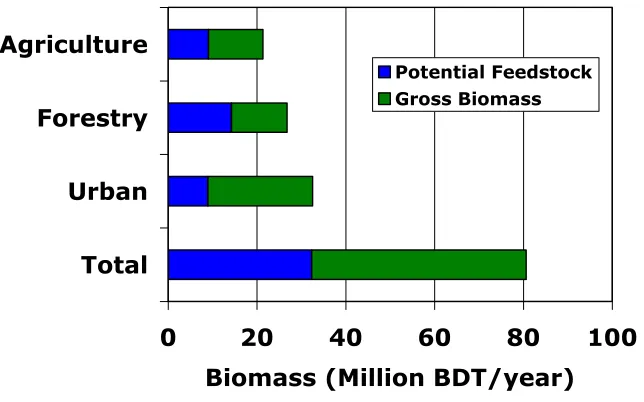
California has a wide range of biomass distributed throughout the state. 26 The primary types are woody biomass from forests and shrub lands, agricultural crops and residues, and the organic fraction of municipal solid wastes and other urban-‐‑derived material (Figure 1).
Figure 1: Estimated Biomass Potential Feedstock
Potential estimated biomass amounts usable for diverse types of energy, compared to total amounts of biomass in California by primary source. (BDT: bone dry tons per year).
Source: Jenkins et al. 2006.
Technically available biomass is estimated to be approximately 36 million bone dry tons per year (BDT/year) in 2010 and 40 million BDT/year in 2020 (not including purpose grown energy crops).27 In 2010, existing solid-‐‑fuel biomass facilities used about 4.5 million bone-‐‑dry tons of biomass residues to generate over 4,300 GWh (less than 15 percent of the resource).
Biogas (or biomethane) captured from the anaerobic decomposition of manure, food processing wastes, landfills, and wastewater treatments plants is also underutilized. For example, only 1 percent of the manure on dairy farms is currently digested, and the current use of food and food processing wastes represents similarly underutilized potential resources.
26 Biomass Energy Use in California: Current Capacity, Unrealized Potential and Environmental Benefits. Steve Kaffka, California Biomass Collaborative, Unpublished Draft Memo to the California Energy
Commission. June 6, 2011.
27 Williams
,
R.B., M. Gildart, and B.M. Jenkins. 2008. An Assessment of Biomass Resources in California, 2007. California Biomass Collaborative Contract 500-‐‑01-‐‑016.0 20 40 60 80 100
Total Urban Forestry Agriculture
&+$37(5&DOLIRUQLD¶V3ROLFLHVRQ%LRHQHUJ\
Bioenergy has an important Ȯ and often unique Ȯ role ȱ¢ȱȱȱȂȱclean energy, waste management, public safety and environmental goals. Although there are many non-‐‑energy policies that govern the management of biomass residues, this chapter focuses primarily on state energy policies.
Renewable Energy Policies
In the electricity sector, biopower contributes ȱȱȂȱ ȱ¢ȱgoals. CalȂȱ
Renewables Portfolio Standard (RPS) requires that utilities increase the ratio of renewable electricity purchased to total electricity sold to a minimum of 20 percent per year from January 1, 2011 to December 31, 2013; 25 percent by December 31, 2016, and 33 percent by December 31, 2020.28
There are four types of bioenergy identified as eligible for the RPS. 1. Biomass Ȯ Technologies that convert eligible biomass to electricity.
2. Digester gas Ȯ biogas and biomethane produced through anaerobic digestion.
3. Landfill gas Ȯ biogas produced in landfills from natural decomposition of organic waste. 4. Municipal Solid Waste29 (MSW), subject to the fuelǦspecific requirements described
below:
a. Solid Waste Combustion Facilities: if the facility is located in Stanislaus County and was operational before September 26, 1996.
b. Solid Waste Conversion Facilities: if the facility uses a two-‐‑step process where in the first step (gasification) a non-‐‑combustion thermal process that consumes no excess oxygen is used to convert MSW into a clean burning gaseous or liquid fuel, and then in the second step this clean-‐‑burning fuel is used to generate electricity. The facility and conversion technology must meet all applicable criteria in accordance with Public Resources Code Section 25741, Subdivision (b)(3).
28 ȱȱȱȱŘśŝŚŖȱȱȱȃȱȱȱȱȱȱȱȱȱȱ
program, to increase the amount of electricity generated from eligible renewable energy resources per year, so that it equals at least 20 percent of total retail sales of electricity in California per year by
ȱřŗǰȱŘŖŗŖǯȄ Passed in the 2011-‐‑2012 Legislative session, Senate Bill X1 2 (Simitian, Chapter 1, Statutes of 2011) ȱȱȱȱȱŘśŝŚŖȱȱǰȱȃȱȱȱȱf the Legislature in establishing this program, to increase the amount of electricity generated from eligible renewable energy resources per year, so that amount equals at least 33 percent of total retail sales of electricity in California per year by DeceȱřŗǰȱŘŖŘŖǯȄ
Governor Jerry Ȃȱȱ¢ȱȱȱȱȱȱȱȱȱ ȱ
capacity by 20,000 MW by 2020, including 12,000 MW of energy located on-‐‑site or close to where energy is consumed (distributed generation) and 8,000 MW of new large-‐‑scale renewable energy. Biopower has the potential to provide between 2,000 and 5,000 MW of the renewable distributed generation ȱȱȱȱ Ȃȱǯȱ
The Low Carbon Fuel Standard (LCFS), adopted by the Air Resources Board in 2009, requires fuel producers to reduce the carbon intensity of transportation fuels used in California by an average of 10 percent by 2020. ¢ȱȱȱȱȂȱȱȱȱȱ the combustion of transportation fuels.
Biomass is expected to play a key role as a feedstock for the production of transportation fuels needed to meet LCFS and the federal Renewable Fuel Standard (RFS2). On a life-‐‑cycle basis, biofuels, such as compressed biomethane and ethanol generated from urban-‐‑biomass resources and purpose-‐‑grown crops, will play an important role in reducing the life-‐‑cycle GHG impact from transportation sector. Advanced ethanol production techniques have the potential to greatly increase the volume and feedstock diversity of ethanol that can be produced from energy stored in cellulose, the main component of plant cell walls and the most common organic compound on earth. Cellulosic feedstocks include woody biomass from dedicated agricultural crops, crop and forest residues, and other urban biomass waste.
As automakers begin to commercialize fuel cell vehicles in the latter half of this decade, biomass and biogas could also provide an important supply for renewable hydrogen, and help meet the requirements under Senate Bill (SB) 1505 (Lowenthal, Chapter 877, Statutes of 2006).30 In
addition, several studies indicate that biofuels will be needed to achieve long-‐‑term energy and climate goals in the transportation sector, especially for aviation, shipping, and heavy-‐‑duty and off-‐‑road vehicles that cannot be easily electrified.31 The Energy Commission is charged with
ȱȱ¢ȱȱȱȱȱȂȱȱȱȱ ¢ȱȱȱȱȱȂȱmate change policies, as contemplated under these policies and AB 118, and as specified in Health and Safety Code section 44272.
Recognizing the benefits and the contribution that bioenergy could make to achieve
Ȃ
renewable energy goals, Governor Schwarzenegger signed Executive Order
S-‐‑06-‐‑06 on April 25, 2006. This order committed California to expanding the sustainable
use of bioenergy by establishing the following targets:
30 SB 1505 requires 33 percent of hydrogen supply to come from eligible renewable resources.
31 For example, see: California Council on Science and Technology (2011) CȂȱ¢ȱture Ȯ The View to 2050, available at (http://www.ccst.us/publications/2011/CEF%20index.phpǼDzȱȂȱȱ
Challenge; or Yang et al (2009) Meeting an 80% Reduction in Greenhouse Gas Emissions from
ȊȱȱȱȱȱȱȱȱŘŖȱȱȱȱ
s within
California by 2010, 40 percent by 2020, and 75 percent by 2050.
ȊȱȱȱȱȱȱŘŖȱȱ
t target for biopower within
state goals for renewable generation for 2010 and continuing through 2020.
In response to the Executive Order, the Bioenergy Interagency Working Group drafted
Bioenergy Action Plans in 2006 and 2011 to meet the goals of the Executive Order.
AB 32 and Bioenergy
The recently adopted cap-‐‑and-‐‑trade regulation by the California Air Resources Board is designed to incent the use of biomass derived fuels over the use of fossil fuels. The cap-‐‑and-‐‑ trade program covers the largest greenhouse gas sources in the state. This includes large stationary sources such as power generation plants and fuel suppliers. Any greenhouse gas emissions associated with the use of biomass fuels that meet specific criteria in the cap-‐‑and-‐‑ trade regulation are exempt from holding a compliance obligation. The cap-‐‑and-‐‑trade program also does not assign a compliance obligation for electricity imports that can be verified to meet the RPS. As the cap declines, the cost for emitting greenhouse gases will increase and regulated entities will have to reduce their greenhouse gas emissions with a compliance obligation or find fuels that are not subject to a compliance obligation. Examples of biomass fuels not subject to a compliance obligation include agricultural waste and wood waste.
The program also includes a compliance offset project protocol that provides an incentive for offset project developers to capture biomethane gas through livestock digester projects and either flare that gas or use it for energy generation. These projects reduce the methane that is directly emitted into the atmosphere as a greenhouse gas and can lower the compliance obligation of a covered entity that uses that biomethane gas.
Waste Diversion Policies
The California Integrated Waste Management Act of 1989 requires that landfills divert 50 percent of all solid waste from landfill disposal or transformation, through source reduction, recycling, and composting. Assembly Bill 341(Chesbro , Statues of 2011, Chapter 476) creates a statewide goal for 75 percent of all solid waste generated to be source reduced, recycled, or composted by the year 2020. Landfill diversion requirements have increased transfer of organic material to composting facilities, and on a much smaller scale, anaerobic digestion facilities. However, biomass still comprises 18 million tons per year of landfill waste, or nearly 60 percent of the material landfilled each year.32 Therefore, achievement of the statewide recycling goal will require significant diversion of organics from landfills and new waste treatment options.
32 Cascadia Consulting Group. 2009. 2008 Waste Characterization Study. California Environmental Protection Agency. and California Department of Resources Recycling and RecoveryȂ Disposal Reporting System (available at:
New bioenergy development can help increase diversion of organic materials from landfills, helping the state achieve a 75 percent diversion of waste from landfills. Waste-‐‑based resources can also improve the environmental impacts of bioenergy as they avoid some of the
sustainability concerns associated with forestry and agricultural feedstocks, such as purpose-‐‑ grown crops.
For example, urban-‐‑derived lumber provides a sustainable source of feedstock for the production of baseload electricity at the State'ʹs biomass facilities. CalRecycle estimates that 4 million tons of urban-‐‑derived lumber is landfilled annually. In addition, the diversion of organic material from landfills can provide a significant reduction in GHG emissions through landfill methane avoidance, alternative energy production, and water conservation.
CalRecycle has developed a number of initiatives and directives that promote the development of bioenergy projects using waste-‐‑based resources such as:
x CalRecycle'ʹs Anaerobic Digestion Initiative Ȯ Encourage the development of anaerobic digestion facilities in California and actions to implement the policy.33
x Strategic Directive 2.3 Ȯ Foster the development of alternative energy and biofuels derived from waste materials after high-‐‑value recyclables have been removed, and continue to play an active role in the Bioenergy Interagency Working Group.34
x Strategic Directive 6.1 Ȯ Reduce the amount of organics in the waste stream by 50 percent by 2020.35
x Strategic Directive 9.2 Ȯ Encourage the development of alternative energy and biofuels.36 Although these policies help advance bioenergy, tȱȂȱȱ ȱȱ
hierarchy does not reference energy recovery. However, some policy discussions have suggested revisions to include placing energy recovery above landfilling in the solid waste management hierarchy. This would provide for energy recovery from post-‐‑recycled urban-‐‑ derived biomass (after the removal of recyclables) prior to landfilling. To do this, revisions to the waste management hierarchy would need to include the establishment of environmental performance-‐‑based standards as well as strict enforcement protocols to ensure the recovery of recyclables, in addition to technology-‐‑neutral emissions standards for energy recovery from post-‐‑recycled urban derived residues.
33 http://www.calrecycle.ca.gov/Actions/PublicNoticeDetail.aspx?id=455&aiid=438 34 http://www.calrecycle.ca.gov/AboutUs/StrategicPlan/2009/SD02.htm.
Protecting Forests for Public Safety, Economic and Environmental Benefits
ȱȱȱȱȱȱȂȱȱȱȱ¢ǰȱȱ
and environmental benefits. As the 2010 Forests and Rangelands Assessment ǻȱȃŘŖŗŖȱ ȄǼȱȱǰȱȃȱȱnds, and urban forests, remain valued assets, critical to the economic, social, and environmental well-‐‑ȱȱǯȄ37 Forests provide income and jobs from the timber industry, tourism and recreation, livestock and more. Forests also provide much oȱȱȂȱ ȱ¢ and important fish and wildlife habitat. Rural and urban forests protect both water and air quality, and provide significant carbon
sequestration.
The Legislature has recognized the importance of managing Ȃȱȱto meet the
ȂȱȱȱǯȱȱȱŘŖŗŖǰȱȱȱȱȱŗśŖŚȱȱȱȱȂȱ
Forest Practices Act to explicitly recognize that ȱȃ¢ȱȱȱȱȱȱȱȱ Ȃȱȱȱ¢ȱȱȱ¡ide from the atmosphere and storing it long term as carbon. . . There is increasing evidence that climate change has and will continue to stress forest ecosystems, which underscores the importance of proactively managing forests so that they can adapt to tȱȱȱȱȱȱȱȱȱ¡ǯȄ
One of the most important means to ensure that forests remain net sequesters of carbon Ȯ and continue to provide their other many benefits Ȯ is fuel treatment to reduce fire risks and impacts. ȱȱŘŖŗŖȱȱȱȱȃ ȱȱȱȱȱȱǰȱȱ
health, infrastructure and other property, and natural resources. . . Addressing wildfire as a
ȱȱȱȱȱȱȱ¢ȱǯȄ The US Forest Service, California
Department of Forestry and Fire, Sierra Nevada Conservancy, California Energy Commission, Placer County and others are working together to identify and promote community-‐‑scale biomass facilities in high fire hazard areas to reduce fire risks while providing local energy and other benefits.
Research and Renewable Energy Programs
For the past 15 years, the Public Goods Charge, a utility surcharge on ratepayers, has been used to fund energy research and development, as well as provide incentives to existing biomass facilities. Although the Legislature did not reauthorize the Public Goods Charge, the California Public Utilities Commission (CPUC) adopted the Electric Program Investment Charge in December 2011 to continue funding for public research and development and renewables programs. In May 2012, the CPUC approved $162 million annually from 2013-‐‑2020, will be administered 80 percent by the California Energy Commission for research, development, and demonstration, and market facilitation, and 20 percent by the utilities in the area of technology demonstration and deployment. In its Final Decision, the CPUC set-‐‑aside a minimum of 20
ȱȱȱ¢ȱȂȱ¢ȱȱȱ¢ȱǰȱ
during the three-‐‑year period of the first investment plan, to fund bioenergy projects. During the
first investment plan cycle, the Energy Commission must budget a minimum of $9 million per year for bioenergy projects in this category. This set-‐‑aside will be reevaluated in subsequent investment plan cycles depending on the results during the 2012-‐‑2014 cycle.
The Energy Policy Act of 2005 and the Energy Independence and Security Act of 2007 provide funds for research and development that should facilitate improvements to the current
cellulose-‐‑to-‐‑ethanol conversion technologies. Both the United States Department of Energy and the United States Department of Agriculture (USDA) offer incentives for bioenergy
&+$37(5
$FWLRQ3ODQWR,QFUHDVH8VHRI%LRPDVV5HVLGXHV
This chapter explores strategies to increase the use of biomass, consistent ȱȱȂȱ
policies on bioenergy. It also identifies goals and objectives for biomass use and provides a roadmap of specific state energy actions to achieve the goals.
Strategies to Increase Bioenergy Production and Reduce Waste
The Bioenergy Interagency Working Group (BIWG) has developed a comprehensive biomass utilization strategy, calling for increased use of biomass residues for electricity generation and production of transportation fuels and other bioproducts. Use of biomass residues complements
Ȃȱ¡ȱ ȱement policies, including reducing, reusing, recycling, and composting.
Although debate continues on the most efficient and beneficial use of biomass, its most
economically and technically viable use in the short-‐‑term will likely be biopower production.38 California should continue to promote near-‐‑term growth in the bioenergy sector with an emphasis on new biomass and biogas projects, while also pursuing long-‐‑term opportunities in the transportation sector. This will encourage beneficial use of the material, waste reduction, and generation of renewable electricity in the near-‐‑term while providing an opportunity to transition to biomethane production in the transportation sector over time.
The following strategies are intended to increase biomass use for energy production:
1. Develop policies and programs to increase sustainable use of biomass residues from the forestry, agricultural, and urban sectors with safeguards to protect and restore
ecosystem health.
2. Increase research, development and demonstration of bioenergy to advance the development of new technologies.
3. Identify and create solutions or remedies to address regulatory, statutory, and utility interconnection challenges that have inhibited the development of distributed or community-‐‑level renewable energy projects and biomethane injection into utility pipelines.
4. Develop market-‐‑based pricing mechanisms for electricity, transportation, and waste management that monetize the benefits that bioenergy provides to local communities and California more broadly.
Goals and Objectives of the
2012 Bioenergy Action Plan
The goals of 2012 Bioenergy Action Plan are to:
x Increase environmentally and economically sustainable energy production from biomass residues, including but not limited to forest-‐‑derived wood waste, agricultural and food processing waste, wastewater, and urban-‐‑derived biomass.
x Increase the use of biomass for local distributed generation, combined heat and power facilities, fuel cells, and renewable transportation fuels.
x Undertake research and demonstration projects and develop funding mechanisms to stimulate deployment of cost-‐‑effective and sustainable bioenergy technologies.
x Stimulate economic development in rural and economically disadvantaged regions of the state.
x Reduce the risks and impacts of wildfires in forested regions.
x Improve air and water quality.
x Increase diversion of biomass from landfills.
x Streamline the permitting process through collaboration with stakeholders and local, regional, state, and federal agencies.
x Reduce emissions of potent GHG emissions such as methane that would otherwise be released into the atmosphere from animal waste and decomposing organic material.
Ȃȱȱ¢ȱȱfocus on developing new and sustainable sources of renewable energy, reducing waste, creating jobs and economic development, reducing fire hazards, reducing GHG emissions, and protecting public health. The 2012 Plan identifies near-‐‑ and long-‐‑term objectives for increasing biomass use. The goal is to achieve the near-‐‑term objectives by December 31, 2013 and the long-‐‑term objectives by 2020.
Near-term objectives
1. Codify legislation and issue formal executive direction regarding increased biomass use through in-‐‑state bioenergy and biofuel development.
2. Facilitate growth of CaliforniaȂ bioenergy industry by making the regulatory and permitting process more efficient for project developers and permitting officials by eliminating redundant and conflicting regulatory actions and requirements, and providing permit guidance and assistance to developers and government officials. 3. Develop front-‐‑end processing standards to ensure that recyclables are removed prior to
bioenergy production. These standards must incorporate safeguards to protect existing recycling systems and markets and allow for growth of those systems, including enforcement to ensure recovery of recyclables.
4. Allocate a significant portion of the Electric Program Investment Charge to fund research, development, and deployment of new and emerging technologies that:
a. Produce biomethane or biogas from biomass residues.
d. Produce energy from dairy, food processing, urban derived and other agricultural wastes.
e. Produce energy from urban organic waste or waste from water treatment facilities.
f. Quantify the benefits and cost of biomass use.
g. Increase the feasibility of collecting and transporting biomass or biogas resources.
5. Allocate funding for research, development, and deployment of advanced conversion technologies needed by 2018 to comply with the LCFS.
Long-Term Objective
The long-‐‑term objective of the 2012 Bioenergy Action Plan is to create a competitive bioenergy market in California, including biopower, biofuels, and biogas.
State Agency Actions
Below is a list identifying actions needed to meet the state bioenergy goals, the lead and
supporting agencies, and the completion date for the action. A summary table of the actions and responsible agencies is provided in the Appendix.
1. Actions to Increase Sustainable Utilization of Biomass
1.1 Increase Bioenergy from Forest Waste to Reduce Fire Hazards
Problem Statement: Strategically placed, community-‐‑scale biomass facilities are important to reduce fire risks, restore forest ecosystem health and provide local energy needs in California. Costs, transmission access and permitting continue to pose
challenges to community-‐‑scale forest biomass, however, and require inter-‐‑agency cooperation to overcome these barriers. State and federal agencies participate in a monthly biomass collaborative to identify and address these barriers, but the
collaborative would be more effective with the additional participation of the CPUC and California Environmental Protection Agency (CalEPA), additional industry
stakeholders, and the utilities.
Action: The Resources Agency, Sierra Nevada Conservancy (SNC), CAL FIRE, Energy Commission and other agencies should continue working with stakeholders and expanding the forest biomass collaborative to identify and promote small-‐‑scale forest biomass projects that reduce fire hazards, restore healthier, more resilient forests, provide renewable energy, and promote rural economic development. The CPUC and CalEPA should also participate in the forest biomass collaborative.
Lead Agency: Natural Resources Agency
Completion Date: December 31, 2013
Action: The CPUC should consider, in consultation with CAL FIRE and other relevant entities, the development of fire-‐‑threat maps that identify areas where there is an elevated risk of catastrophic power-‐‑line fires occurring, and the possible identification on such maps of areas where vegetation biomass should be removed for fire safety purposes. The CPUC should also consider mechanisms to ince