Biogeosciences, 10, 4547–4563, 2013 www.biogeosciences.net/10/4547/2013/ doi:10.5194/bg-10-4547-2013
© Author(s) 2013. CC Attribution 3.0 License.
EGU Journal Logos (RGB)
Advances in
Geosciences
Open Access
Natural Hazards
and Earth System
Sciences
Open Access
Annales
Geophysicae
Open Access
Nonlinear Processes
in Geophysics
Open Access
Atmospheric
Chemistry
and Physics
Open Access
Atmospheric
Chemistry
and Physics
Open Access
Discussions
Atmospheric
Measurement
Techniques
Open Access
Atmospheric
Measurement
Techniques
Open Access
Discussions
Biogeosciences
Open Access Open Access
Biogeosciences
Discussions
Climate
of the Past
Open Access Open Access
Climate
of the Past
Discussions
Earth System
Dynamics
Open Access Open Access
Earth System
Dynamics
Discussions
Geoscientific
Instrumentation
Methods and
Data Systems
Open Access
Geoscientific
Instrumentation
Methods and
Data Systems
Open Access
Discussions
Geoscientific
Model Development
Open Access Open Access
Geoscientific
Model Development
Discussions
Hydrology and
Earth System
Sciences
Open Access
Hydrology and
Earth System
Sciences
Open Access
Discussions
Ocean Science
Open Access Open Access
Ocean Science
DiscussionsSolid Earth
Open Access Open Access
Solid Earth
DiscussionsThe Cryosphere
Open Access Open Access
The Cryosphere
Discussions
Natural Hazards
and Earth System
Sciences
Open Access
Discussions
The importance of different spatial scales in determining structural
and functional characteristics of deep-sea infauna communities
J. Ingels1,2and A. Vanreusel1
1Section Marine Biology, Department Biology, Ghent University, Krijgslaan 281 S8 (WE11), 9000 Gent, Belgium 2Plymouth Marine Laboratory, Prospect Place, West Hoe, Plymouth, PL1 3DH, UK
Correspondence to: J. Ingels ([email protected], [email protected])
Received: 22 October 2012 – Published in Biogeosciences Discuss.: 7 January 2013 Revised: 3 May 2013 – Accepted: 8 May 2013 – Published: 5 July 2013
Abstract. The urge to understand spatial distributions of
species and communities and their causative processes has continuously instigated the development and testing of con-ceptual models in spatial ecology. For the deep sea, there is evidence that structural and functional characteristics of benthic communities are regulated by a multitude of biotic and environmental processes that act in concert on differ-ent spatial scales, but the spatial patterns are poorly under-stood compared to those for terrestrial ecosystems. Deep-sea studies generally focus on very limited scale ranges, thereby impairing our understanding of which spatial scales and as-sociated processes are most important in driving structural and functional diversity of communities. Here, we used an extensive integrated dataset of free-living nematodes from deep-sea sediments to unravel the importance of different spatial scales in determining benthic infauna communities. Multiple-factor multivariate permutational analyses were performed on different sets of community descriptors (struc-ture, structural and functional diversity, standing stock). The different spatial scales investigated cover two margins in the northeast Atlantic, several submarine canyons/channel/slope areas, a bathymetrical range of 700–4300 m, different sam-pling locations at each station, and vertical sediment profiles. The results indicated that the most important spatial scale for structural and functional diversity and standing stock vari-ability is the smallest one; infauna communities changed sub-stantially more with differences between sediment depth lay-ers than with differences associated to larger geographical or bathymetrical scales. Community structure differences were greatest between stations at both margins. Important regulat-ing ecosystem processes and the scale on which they occur are discussed. The results imply that, if we are to improve our
understanding of ecosystem patterns of deep-sea infauna and the relevant processes driving their structure, structural and functional diversity, and standing stock, we must pay partic-ular attention to the small-scale heterogeneity or patchiness and the causative mechanisms acting on that scale.
1 Introduction
investigating such processes (Jumars, 1976). In marine bio-diversity and ecosystem functioning studies, much attention is drawn to the processes themselves and the role played by single-species or limited-species groups (in an auteco-logical approach), rather than applying a synecoauteco-logical ap-proach whereby the community is investigated (Russell et al., 2011). Critical to gaining insights in synecological dy-namics is identifying the scale at which the important pro-cesses occur. The current lack of understanding regarding the importance of scale impairs the advancement of our knowl-edge about biodiversity and ecosystem functioning as well as important underlying processes (Raffaelli and Friedlander, 2012), posing a limitation to further theoretical explorations (Paterson et al., 2012). An obvious step is to identify which spatial scale bears more importance in regulating community characteristics, an approach which has received relatively lit-tle attention in deep-sea scientific literature.
Despite the generally accepted view that processes on var-ious spatial scales are driving different aspects of benthic communities, most of the evidence for the structure and dy-namics of deep-sea communities and their causes originate from regional-scale sampling studies (Levin et al., 2001a), focusing on relatively large spatial scales (10–100 km), or typically on the scale of 0.1–10 km. Unfortunately, the im-portance of micro-scale (cm to m) habitat variability and patchiness in this context has been demonstrated for only a small subset of species or taxa and for a limited number of habitats (Snelgrove and Smith, 2002). Whilst it is criti-cal to choose the appropriate scriti-cale in investigating diversity patterns (Huston, 1999), studies seeking to document the im-portant patterns and underlying processes for deep-sea ben-thic diversity and ecosystem functioning should consider the inherent scalability of patterns and processes and cover the whole spatial range. In addition, we are also confronted with the complexity of the benthic communities themselves. Ben-thic communities can be described in various ways (compo-sition, structure, structural and functional diversity, standing stocks) and these descriptors may be affected differently by the various (a)biotic drivers that exist, and this variability may depend on the spatial scale investigated.
For the benthic meiofauna (32–1000 µm, most abundant group of metazoans on Earth) in the deep sea, it has long been shown that smaller spatial scales (cm) are particularly impor-tant to detecting diversity and distribution patterns (Thistle, 1978; Eckman and Thistle, 1988) and micro-scale variability of biogeochemical conditions and biotic interactions along the vertical sediment profile has been used to explain the structure of meiobenthic assemblages (Thiel, 1983; Jorissen et al., 1995; Soetaert et al., 2002; Braeckman et al., 2011; Ingels et al., 2011a, b). Knowledge on the importance of different spatial scales in shaping benthic patterns is essen-tial in discerning the causative important processes. Without this knowledge, benthic faunal patterns may remain seem-ingly idiosyncratic without any understanding of the drivers of benthic diversity and functioning. In the absence of such
understanding, conceptual models and their quantifications remain meaningless.
Among the deep-sea habitats, Submarine canyons can per-haps be considered as the most heterogenic topographic sys-tems, with great levels of within- and inter-canyon variability across a range of ecologically relevant processes (Tyler et al., 2009; Vetter et al., 2010). Submarine canyons are typified by great habitat heterogeneity, the result of extreme topography, diverse current regimes and substratum types, and detrital funnelling, together exerting a powerful influence on biotic diversity (Levin et al., 2010). At the same time, each canyon is considered unique in its environmental settings, imply-ing great variability between canyon systems and addimply-ing to the heterogeneity observed on across-canyon scales (Harris and Whiteway, 2011; Kiriakoulakis et al., 2011; Shepard and Dill, 1966). These canyon characteristics give support for their use in the present study to investigate the variable ef-fects of scale in structuring deep-sea benthic assemblages.
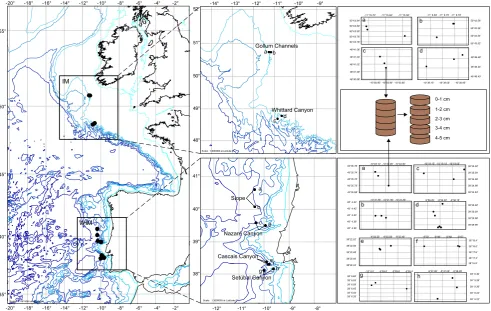
The aim of this study was to investigate the importance of different spatial scales in determining benthic infauna com-munities (community structure, structural and functional di-versity, standing stocks) through different drivers that act on different spatial scales. A combination of four different datasets from deep-sea submarine canyon/slope ecosystems at six different geographic areas in the Northeast (NE) At-lantic were analysed in terms of community structure, struc-tural and functional diversity, and standing stocks on dif-ferent spatial scales, using Nematoda as the most represen-tative benthic component. The different spatial scales cov-ered by the samples were Irish Margin and Western Iberian Margin (ca. 1500 km apart, interregional scale), distance be-tween adjacent canyon/slope areas (50–200 km apart, re-gional scale), water depth (ca. 700, 1000, 3400 and 4300 m, subregional scale), distance between different sampling lo-cations or stations within a canyon (5–50 km apart, macro-scale), distance between cores from independent deploy-ments (1–200 m apart, meso-scale), and vertical sediment depth differences (1–5 cm per cm, micro-scale) (Fig. 1). Given the supposition that the size scale of a group of or-ganisms is important in identifying the structural and func-tional characteristics of their communities, we hypothesise that the sediment-dwelling meiofauna will be largely con-trolled by small-scale, local environmental conditions rather than large-scale differences between canyons, water depths and geographical areas or margins.
2 Material and methods
2.1 Study areas
38° 6.40' 38° 6.45' 38° 6.50' 38° 6.55' 38° 6.60'
-10° 0.0' -9°59.8' -9°59.6' -9°59.4'
38° 9.22' 38° 9.24' 38° 9.26' 38° 9.28' 38° 9.30' -9°37.05' -9°37.00' -9°36.95'
38° 6.35'
35° 40° 45° 50° 55°
-20° -20°
-18° -18°
-16° -16°
-14° -14°
-12° -12°
-10° -10°
-8° -8°
-6° -6°
-4° -4°
-2° -2°
Scale: 1:13619068 at Latitude 0°
50°43.76' 50°43.78' 50°43.80' 50°43.82' 50°43.84'
-11°15.70' -11°15.60' -11°15.50'
50°43.52' 50°43.54' 50°43.56' 50°43.58' -11° 9.80' -11° 9.75' -11° 9.70'
48°40.98' 48°41.00' 48°41.02' 48°41.04' 48°41.06'
-10°50.95' -10°50.90' -10°50.85'
48°46.40' 48°46.44' 48°46.48'
-10°39.15' -10°39.05' -10°38.95'
48° 49° 50° 51°
52° -14° -13° -12° -11° -10° -9°
Scale: 1:3000000 at Latitude 0°
39°34.94' 39°34.96' 39°34.98' 39°35.00' 39°35.02' -10°19.15' -10°19.10' -10°19.05'
39°29.96' 39°29.98' 39°30.00' 39°30.02' -9°56.25' -9°56.20' -9°56.15'
38° 39° 40° 41°
-12° -11° -10° -9° -8°
Scale: 1:3000000 at Latitude 0°
40°35.68' 40°35.70' 40°35.72' 40°35.74'
40°35.76' -10°22.10' -10°22.05' -10°22.00'
40° 4.36' 40° 4.38' 40° 4.40' 40° 4.42'
40° 4.44' -10°21.95' -10°21.90' -10°21.85'
38°22.44' 38°22.46' 38°22.48' 38°22.50'
38°22.52' -9°53.55' -9°53.50' -9°53.45'
38°17.2' 38°17.6' 38°18.0' 38°18.4' -9°50' -9°49' -9°48' -9°47'
38°16.8' IM
WIM
Gollum Channels
Whittard Canyon
Slope
Nazaré Canyon
Cascais Canyon
Setúbal Canyon a
b
c d
e f
g h
a
b
c
d
e f
g h
a b
c d
a b
c d
[image:3.595.53.545.66.377.2]0-1 cm 1-2 cm 2-3 cm 3-4 cm 4-5 cm
Fig. 1. Maps and diagram illustrating the different spatial scales of the sampling design. Left panel shows the geographic scale of the
samples taken at two different margin systems in the northeast Atlantic; IM: Irish Margin, WIM: Western Iberian Margin. Middle panels show distribution of stations at each margin; letters correspond to panels on the right-hand side. Right upper panels show the distribution of the cores taken at IM; (a) Gollum Channels 1000 m; (b) Gollum Channels 700 m; (c) Whittard Canyon 1000 m; (d) Whittard Canyon 700 m. Right lower panels show the distribution of the cores taken at the WIM; (a) slope 3400 m; (b) slope 4300 m; (c) Nazar´e Canyon 4300 m; (d) Nazar´e Canyon 3400 m; (e) Cascais Canyon 4300 m; (f) Cascais Cayon 3400 m; (g) Set´ubal Canyon 4300 m; (h) Set´ubal Canyon 3400 m. Maps created with PanMap; M. Diepenbroek , H. Grobe and R. Sieger (2000) PanMap; http://www.pangaea.de/Software/PanMap.
The IM, situated in the NE Atlantic, is a highly produc-tive system with significant primary production in the sur-face waters, which consequently supplies deep-sea sediments with high levels of organic matter and carbon (Lampitt et al., 1995; Longhurst et al., 1995) compared to other deep-sea ar-eas. This is especially the case for mid-slope depths, which are influenced by additional export from the shelf or upper slope, where sediment organic loads are higher (Lampitt and Antia, 1997). At the Porcupine Seabight and further south along the Meriadzek Terrace, the margin is incised by nu-merous canyons and channels, which provide conduits for the transport of sediment from the shelf to the abyssal plain and over-bank turbidity currents, which deposit on the inter-vening terraces and spurs (Cunningham et al., 2005), but they also accumulate high amounts of sediments and organic mat-ter. In addition, at the IM, cascading of dense water masses down the slope is likely to occur (Ivanov et al., 2004) and may entrain fresh chlorophyll material rapidly down slope, as reported by Hill et al. (1998). At the IM we studied the
transport is dominated by turbidity currents in the head of the canyon, causing mudflows to overspill the canyon walls and lead to deposition of mainly fine sediments in the adja-cent areas.
The WIM comprises a narrow shelf and steep irregular slope, which is cut by various canyons. Hydrodynamic pat-terns in this area are mainly seasonal and are driven by sea-sonally varying winds which regulate the down- and up-welling regimes in winter and summer, respectively (Vitorino et al., 2002; Quaresma et al., 2007). The largest canyon, The Nazar´e Canyon, intersects the entire continental shelf and acts as a temporary sediment trap with intermittent trans-port of sediments and organic matter to the abyssal plain (de Stigter et al., 2007; Masson et al., 2011). Samples were taken at ca. 3400 and 4300 m water depth in the canyon (sediment-laden terrace, and canyon floor, respectively), and at similar depths along the adjacent slope to the north of the canyon (Ingels et al., 2009a). The relatively short Cascais Canyon begins at the shelf edge southwest of the mouth of the Tagus Estuary and extends to the Tagus Abyssal Plain. The Set´ubal Canyon cuts the continental shelf close to the Sado River Es-tuary, and also leads to the Tagus Abyssal Plain. Comparable sedimentation regimes have been observed for both the Cas-cais and Set´ubal canyons, with accumulation of sediment in the upper parts and limited down-canyon transport (de Stigter et al., 2011). Current regimes seem variable in both canyons. Samples in both canyons were taken at ca. 3400 and 4300 m water depth, and more or less along the axes of the canyons (Ingels et al., 2011a).
2.2 Sampling strategy and processing
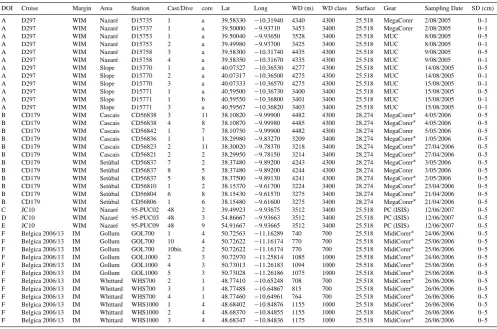
Six datasets (see data references: Ingels et al., 2009b, 2011d, e, f, g, h) from four different deep-sea canyon studies (In-gels et al., 2009a, 2011a, b, c) were merged (totalling 17 273 nematode individuals belonging to 248 different genera) to investigate the important spatial scales of variability in struc-ture, diversity and function of small sediment-dwelling fauna in the deep sea. All the data is publicly available through the Pangaea data depository (www.pangaea.de); DOI codes for data are given in Table 1 and the citations for these datasets are mentioned in the References section. The samples cover two geographically distinct margins (IM, WIM) which lie about 1500 km apart. For each margin, several canyon/slope areas were sampled by means of a coring device (for details on coring devices see Table 1), all producing sediment cores with an intact sediment-water interface and similar cross-surface areas (maximum difference between sample cross-surfaces was ca. 2.7 cm2, Table 1). This allowed comparison between samples irrespective of the sampling technique used. At each of the six canyon/slope areas, cores were taken at two dif-ferent stations (ca. 700 and 1000 m for the IM, and ca. 3400 and 4300 m for the WIM). At each location, a minimum of three independent (repeated deployments of the coring de-vice) cores were taken which lay 1 to 200 m apart. Each
sed-iment core was subsequently split into 1 cm layers down to 5 cm vertical depth, whereby each 1 cm slice was treated in-dependently. On some occasions, only the surface 1 cm of sediment was available for analysis. An overview of the sam-pling design and meta-information on the samples is given in Fig. 1 and Table 1. A total of 162 samples were used for this study.
Nematoda, the most abundant metazoan phylum in the ma-rine environment, was used as a model taxon for the small benthic fauna. Borax-buffered formalin (4 %) sediment sam-ples were used to extract the meiofauna using standard pro-cedures (Heip et al., 1985; 32–1000 µm sieves, LUDOX HS as centrifugation medium) to separate the organisms from the sediment particles. All nematodes were counted and between 100 and 150 individuals were picked out randomly from each 1 cm sample, transferred to glycerine (Seinhorst, 1959) and mounted on slides. All nematodes were identified under a compound microscope (100×magnification) to genus level using Platt and Warwick (1988), taxonomic literature of the Nematode Library at Ghent University, and the NeMys ne-matode database and identification keys (Deprez et al., 2005; nemys.ugent.be). Specimens that could not be identified to the genus level were assigned to the appropriate higher taxon level. All individuals were grouped into four feeding types based on buccal morphology and teeth composition sensu Wieser (1953): selective deposit feeders (1A), non-selective deposit feeders (1B), epistratum feeders (2A), and preda-tors/scavengers or omnivores (2B). This classification was amended with one extra group to account for “chemosyn-thetic” nematodes that lack a mouth and buccal cavity, have a degenerated alimentary canal and live in association with symbiotic micro-organisms (Ingels et al., 2011b). In addi-tion, each nematode individual was assigned a c–p score (score from 1 to 5 reflecting life history with 1 represents colonizer and 5 represents persister; in this context colonizers are regarded as r-strategists, and persisters are regarded to be k-strategists; cf. Bongers (1990) and Bongers et al. (1991)). Length (excluding filiform tails) and maximum width were measured using a Leica DMR compound microscope and Leica LAS 3.3 imaging software; these measurements were used to calculate biomass according to the formula in Table 2.
2.3 Sampling design and data treatment
Table 1. Information on the samples used for this study. WD: water depth; Surface: surface area of the sample; SD: sediment depth.∗
indicates a subcore was taken from a 100 mm-diameter core.
DOI Cruise Margin Area Station Cast/Dive core Lat Long WD (m) WD class Surface Gear Sampling Date SD (cm)
A D297 WIM Nazar´e D15735 1 a 39.58330 −10.31940 4340 4300 25.518 MegaCorer 2/08/2005 0–1 A D297 WIM Nazar´e D15737 1 a 39.50000 −9.93710 3453 3400 25.518 MegaCorer 2/08/2005 0–1 A D297 WIM Nazar´e D15753 1 a 39.50040 −9.93650 3528 3400 25.518 MUC 8/08/2005 0–5 A D297 WIM Nazar´e D15753 2 a 39.49980 −9.93700 3425 3400 25.518 MUC 8/08/2005 0–1 A D297 WIM Nazar´e D15758 3 a 39.58300 −10.31740 4435 4300 25.518 MUC 9/08/2005 0–5 A D297 WIM Nazar´e D15758 4 a 39.58350 −10.31670 4335 4300 25.518 MUC 9/08/2005 0–1 A D297 WIM Slope D15770 1 a 40.07327 −10.36530 4277 4300 25.518 MUC 14/08/2005 0–5 A D297 WIM Slope D15770 2 a 40.07317 −10.36500 4275 4300 25.518 MUC 14/08/2005 0–1 A D297 WIM Slope D15770 3 a 40.07333 −10.36570 4275 4300 25.518 MUC 15/08/2005 0–1 A D297 WIM Slope D15771 1 a 40.59500 −10.36730 3400 3400 25.518 MUC 15/08/2005 0–5 A D297 WIM Slope D15771 1 b 40.59550 −10.36800 3401 3400 25.518 MUC 15/08/2005 0–1 A D297 WIM Slope D15771 3 a 40.59567 −10.36820 3403 3400 25.518 MUC 15/08/2005 0–1 B CD179 WIM Cascais CD56838 3 11 38.10820 −9.99900 4482 4300 28.274 MegaCorer∗ 4/05/2006 0–5 B CD179 WIM Cascais CD56838 4 8 38.10870 −9.99980 4485 4300 28.274 MegaCorer∗ 4/05/2006 0–5 B CD179 WIM Cascais CD56842 1 7 38.10750 −9.99900 4482 4300 28.274 MegaCorer 5/05/2006 0–5 B CD179 WIM Cascais CD56836 1 1 38.29980 −9.83270 3209 3400 28.274 MegaCorer∗ 1/05/2006 0–5 B CD179 WIM Cascais CD56823 2 11 38.30020 −9.78370 3218 3400 28.274 MegaCorer∗ 27/04/2006 0–5 B CD179 WIM Cascais CD56821 2 2 38.29950 −9.78150 3214 3400 28.274 MegaCorer∗ 27/04/2006 0–5 B CD179 WIM Set`ubal CD56837 7 2 38.37480 −9.89200 4243 4300 28.274 MegaCorer∗ 3/05/2006 0–5 B CD179 WIM Set`ubal CD56837 8 5 38.37480 −9.89200 4244 4300 28.274 MegaCorer 3/05/2006 0–5 B CD179 WIM Set`ubal CD56837 5 8 38.37500 −9.89130 4241 4300 28.274 MegaCorer∗ 2/05/2006 0–5 B CD179 WIM Set`ubal CD56810 1 2 38.15370 −9.61700 3224 3400 28.274 MegaCorer∗ 23/04/2006 0–5 B CD179 WIM Set`ubal CD56804 6 8 38.15430 −9.61570 3275 3400 28.274 MegaCorer∗ 21/04/2006 0–5 B CD179 WIM Set`ubal CD56806 1 6 38.15480 −9.61600 3275 3400 28.274 MegaCorer∗ 21/04/2006 0–5 C JC10 WIM Nazar´e 95-PUC02 48 2 39.49923 −9.93675 3512 3400 25.518 PC (ISIS) 12/06/2007 0–5 D JC10 WIM Nazar´e 95-PUC03 48 3 54.86667 −9.93663 3512 3400 25.518 PC (ISIS) 12/06/2007 0–5 E JC10 WIM Nazar´e 95-PUC09 48 9 54.91667 −9.93665 3512 3400 25.518 PC (ISIS) 12/06/2007 0–5 F Belgica 2006/13 IM Gollum GOL700 1 4 50.72563 −11.16289 740 700 25.518 MidiCorer∗ 24/06/2006 0–5 F Belgica 2006/13 IM Gollum GOL700 10 4 50.72622 −11.16174 770 700 25.518 MidiCorer∗ 25/06/2006 0–5 F Belgica 2006/13 IM Gollum GOL700 10bis 2 50.72622 −11.16174 770 700 25.518 MidiCorer∗ 25/06/2006 0–5 F Belgica 2006/13 IM Gollum GOL1000 2 3 50.72970 −11.25814 1085 1000 25.518 MidiCorer∗ 24/06/2006 0–5 F Belgica 2006/13 IM Gollum GOL1000 4 3 50.73013 −11.26183 1094 1000 25.518 MidiCorer∗ 25/06/2006 0–5 F Belgica 2006/13 IM Gollum GOL1000 5 3 50.73028 −11.26186 1075 1000 25.518 MidiCorer∗ 25/06/2006 0–5 F Belgica 2006/13 IM Whittard WHS700 2 1 48.77410 −10.65248 708 700 25.518 MidiCorer∗ 26/06/2006 0–5 F Belgica 2006/13 IM Whittard WHS700 3 1 48.77488 −10.64867 815 700 25.518 MidiCorer∗ 26/06/2006 0–5 F Belgica 2006/13 IM Whittard WHS700 4 1 48.77460 −10.64961 764 700 25.518 MidiCorer∗ 26/06/2006 0–5 F Belgica 2006/13 IM Whittard WHS1000 1 4 48.68402 −10.84876 1155 1000 25.518 MidiCorer∗ 26/06/2006 0–5 F Belgica 2006/13 IM Whittard WHS1000 2 4 48.68370 −10.84855 1155 1000 25.518 MidiCorer∗ 26/06/2006 0–5 F Belgica 2006/13 IM Whittard WHS1000 3 4 48.68347 −10.84836 1175 1000 25.518 MidiCorer∗ 26/06/2006 0–5
Digital Object Identifiers (DOIs) for nematode datasets: A: 10.1594/PANGAEA.776602, B: 10.1594/PANGAEA.776656, C: 10.1594/PANGAEA.777030, D:
10.1594/PANGAEA.777032, E: 10.1594/PANGAEA.777033, F: 10.1594/PANGAEA.776716. Citations to datasets are included in the References section. “0–1” indicates only the surface 1 cm was available for analysis; “0–5” indicates that the sediment slices 0–1, 1–2, 2–3, 3–4, 4–5 cm were individually available for analysis. Megacorer: Corer fitted with 60 mm (internal diameter) plexiglass cores (Ocean Scientific International Ltd), MUC: Barnett-type multicorer fitted with 57 mm (internal diameter) plexiglass cores, PC (ISIS): 57 mm (internal dianeter) push core operated by the Remote Operated Vehicle ISIS (NOCS).
as well as equitability (evenness) of the communities stud-ied (Heip et al., 1998). As functional diversity descriptors, we used trophic diversity (TD) and the maturity index (MI). We used the reciprocal value of TD as defined by Heip et al. (1998), so that higher values correspond with higher trophic complexity, and it was modified for use with the four Wieser (1953) feeding groups and the extra “chemosyn-thetic” guild (Ingels et al., 2011b). The MI was originally defined by Bongers (1990) for soil nematodes, but has been applied to marine nematode communities (Bongers et al., 1991). The MI is a useful descriptor in that it characterises the community in terms of life history and life strategies of its members and has been successfully used to infer vari-ous types of disturbance and subsequent recolonisation pro-cesses. Similarly to TD, MI is based on autecological infor-mation, but it is based on a broader character complex.
We distinguished the four different descriptor groups by means of a 2nd stage MDS and a SIMPROF test on the dif-ferent community descriptors. This procedure allowed us to
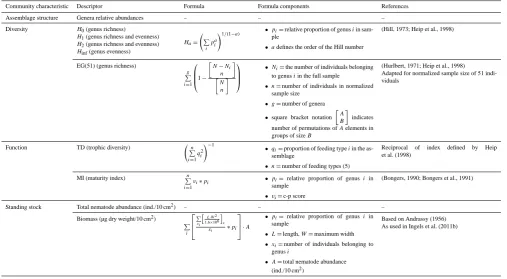
Table 2. Descriptors used to characterise the community, including the formulas used, explanations of the formula components, and
refer-ences.
Community characteristic Descriptor Formula Formula components References
Assemblage structure Genera relative abundances – – –
Diversity H0(genus richness) (Hill, 1973; Heip et al., 1998)
H1(genus richness and evenness) H2(genus richness and evenness) Hinf(genus evenness)
Ha= P i
pia
!1/(1−a) •pi=relative proportion of genusiin sam-ple
•adefines the order of the Hill number
EG(51) (genus richness) (Hurlbert, 1971; Heip et al., 1998)
Adapted for normalized sample size of 51 indi-viduals
g P i=1
1− "
N−Ni n
#
" N
n #
•Ni=the number of individuals belonging to genusiin the full sample •n=number of individuals in normalized
sample size
•g=number of genera
•square bracket notation
A B
indicates
number of permutations ofAelements in groups of sizeB
Function TD (trophic diversity) Reciprocal of index defined by Heip
et al. (1998) n
P i=1 qi2
!−1
•qi=proportion of feeding typeiin the as-semblage
•n=number of feeding types (5)
MI (maturity index) Pn (Bongers, 1990; Bongers et al., 1991)
i=1
vi∗pi •pi=relative proportion of genusi in sample
•vi=c-p score
Standing stock Total nematode abundance (ind./10 cm2) – – –
Biomass (µg dry weight/10 cm2) Based on Andrassy (1956)
As used in Ingels et al. (2011b) P
i
P xi h
L·W2 1.6×10⁶
i x xi ∗pi
·A
•pi=relative proportion of genusi in sample
•L=length,W=maximum width •xi=number of individuals belonging to
genusi
•A=total nematode abundance (ind./10 cm2)
was applied to the sets of standing stock (total abundance, total biomass) and functional diversity descriptors (TD, MI). For the PERMANOVA tests, we used two mixed-model hierarchical designs with three and four factors. For the three-way model, we used the factors: margin (WIM and IM; fixed; about 1500 km apart, interregional scale), area (Ar; random and nested in margin; with levels ‘Whittard’, “Gol-lum”, “Nazar´e”, “Set´ubal”, “Cascais”, “Slope”; 50–200 km apart; regional scale) and water depth (WD; random and nested in Margin; with levels “700 m”, “1000 m”, “3400 m”, “4300 m”; subregional scale). The levels for the factors area and water depth are not replicated for each margin and these factors are therefore nested in the factor margin. The 4-way PERMANOVA model is applied to each margin separately and has the following factors: area (Ar, fixed, with levels “Whittard” and “Gollum” for the IM test, and “Nazar´e”, “Set´ubal”, “Cascais”, and “Slope” for the WIM test; regional scale), water depth (WD, fixed, with levels “700 m” and “1000 m” for the IM test, and “3400 m” and “4300 m” for the WIM test; subregional scale), core (Co, random, identi-fying each core in the dataset to account for variability within the station level; 1–200 m apart on a horizontal scale; meso-scale), and sediment depth (SD, fixed, with levels “0–1”, “1–2”, “2–3”, “3–4”, “4–5”, identifying each 1 cm sediment layer; micro-scale). The interaction between Area and Water Depth accounts for the differences between sampling loca-tions or staloca-tions and is defined as the macro-scale.
ordinations highlight the importance of certain factors and can give a distorted view of what is contained within the data.
3 Results
3.1 3-way PERMANOVA test: interregional, regional and macro-scale
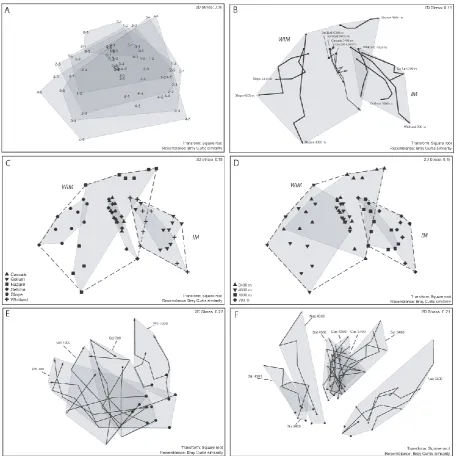
The 3-way PERMANOVA test indicated limited differences between the IM and the WIM (Table 3). Significant dif-ferences on this interregional scale were only found for community structure and structural diversity (p=0.003 andp=0.048, respectively). In this test, community struc-ture differences between stations in each area (19.6 %, Ar (M)×WD (M)) are greater than margin differences (16 %), whilst for structural diversity only differences between mar-gins are significant (15.5 % of variability explained, Table 3). For functional diversity, significant differences were found between areas, explaining 7.7 % of total variability. Only about 16 % of total variability is explained by margin differ-ences for community structure and structural diversity, whilst most of the variability is contained within the residual term as shown by the ECV values in Table 3. The limitations of the 3-way test design imply that variability caused by differences on smaller spatial scales (meso- and macro-scale, or core and sediment depth differences, respectively) is included in the residual term. The relatively low contributions to variabil-ity for most factors is mirrored in the high contributions of the residual term (ECV % between 57.4 and 88.5 % for the different descriptors, Table 3) and hence attributable to the differences occurring at the smaller spatial scales. Neverthe-less, the nMDS plots B, C and D in Fig. 2 illustrate the dif-ferences in Bray–Curtis space between the margins in terms of community structure, with only a small overlap between the planes covered by the samples of each margin. However, the large residual variability and absence of the smaller spa-tial scales in the 3-way test warrants an analysis that includes these scales in the test model, and this is done in the 4-way PERMANOVA for each margin separately.
3.2 4-way PERMANOVA test: regional, macro-, meso- and macro-scale
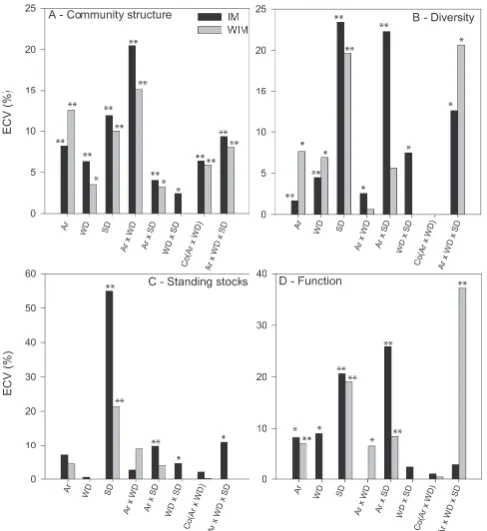
In general, regional-scale differences (between different ar-eas within each margin) were a significant and important cause of community structure variability as indicated by the 4-way PERMANOVA results (Table 3, Fig. 3a). The relative effect sizes on the regional scale were larger for the WIM (12.5 %) than for the IM (8.2 %), which is also illustrated by the differential size of overlap between the grey-shaded margin areas in Fig. 2c, and corroborates the idea that ne-matode community differences between canyons at the WIM are more pronounced compared to the IM. Figure 2c illus-trates the different levels of community variability contained within each area as attested by the ECV values in Fig. 3a and
Table 3. For structural diversity, regional-scale differences were also significant, with much greater variability observed at the WIM (7.6 %) compared to the IM (1.7 %) (Table 3, Fig. 3b). For functional diversity, regional-scale differences were significant but explain only a minor part of total vari-ability, with ECV values of 7.1 % and 8.3 % for the WIM and IM, respectively (Table 3, Fig. 3d). In terms of stand-ing stocks, no significant differences were observed between areas at each margin.
Subregional-scale variability (between water depths) in community structure was the least important of all main factors tested at both margins, and the significant differ-ences between 3400 and 4300 m water depth (WIM, 3.5 %) were smaller than between 700 and 1000 m water depth (IM, 6.3 %) (Table 3, Fig. 3). This can also be seen by the differ-ential overlap of the water depth groups on the nMDS plot of Fig. 2d. In terms of structural diversity, the water depth effect contributed 6.9 % and 4.5 % of total variability for the WIM and IM, respectively (Table 3). Subregional differences in functional diversity were only significant at the IM where they contribute 9.1 % to the total observed variability (Ta-ble 3, Fig. 3d). In terms of standing stocks, no significant differences were observed between areas at each margin.
It is on the macro-scale (between stations) that the largest significant nematode community differences were observed for both margins (Fig. 3c, Table 3), highlighting the pro-nounced differences between communities from different stations. The test results show that these differences were smaller at the WIM (18.4 %) than at the IM (20.5 %). Look-ing at structural diversity, significant station differences were only exhibited at the IM, but the differences were small and explained only 2.6 % of total variability. The stations at the WIM, on the other hand, did not show any differences in terms of structural diversity. In contrast, functional diver-sity differences between stations were only significant for the WIM, but the contribution to total variability was relatively low (6.7 %). No significant differences between stations were found for standing stocks.
Meso-scale community structure differences (between cores at each station) were significant (p <0.01) but rela-tively low compared to the other spatial scales, accounting for only 5.9 % and 6.4 % of total variability at the WIM and IM, respectively (Co(WD×Ar), Table 3, Fig. 3a). The vari-ability attributed to the community structure differences be-tween cores at each station is most likely an indication of patchiness or heterogeneity at each station. For structural and functional diversity, and standing stocks there were no signif-icant differences between independent cores at each station, suggesting these descriptors do not change on this scale and hence within-station heterogeneity is not expressed in struc-tural and functional diversity, and standing stocks.
Fig. 2. Non-metric multidimensional scaling plots of Bray–Curtis similarity matrices based on standardised, square root-transformed genera
abundance data. (A–D) based on averaged data per station (averaged over cores per station for each station (Ar×WD combination). (A)
labels denote sediment depth in cm; grey planes encompass variability for each sediment layer by connecting the outer data points. (B) same
plot as (A), but lines connect consecutive sediment layers within each core (• =0–1 cm,I=4–5 cm with the other sediment layer points
in between connected along the vertical sediment profile); grey planes represent different margins; IM: Irish Margin; WIM: Western Iberian Margin. (C) same as (A), but symbols and grey planes denote the different areas; outer points belonging to the same margin are connected with dashed lines. (D) same as (C), but symbols and grey planes denote different water depths. (E–F) based on unaveraged data whereby
each core is represented seperately. (E) Irish Margin; lines connect consecutive sediment layers within each core (• =0–1 cm,I=4–5 cm
with the other sediment layer points in between connected along the vertical sediment profile); grey planes represent stations. (F) Western
Iberian Margin; lines connect consecutive sediment layers within each core (• =0–1 cm,I=4–5 cm); grey planes represent stations.
to sediment depth differences at the WIM and IM, respec-tively. The micro-scale effect on community structure is clearly illustrated in Bray–Curtis space in Fig. 2a, showing the increasing variability contained within deeper sediment depth layers. The 0–1 cm layers group tightly (smallest grey
Fig. 3. Percentages of estimated components of variation from the
PERMANOVA tests for different descriptor sets. IM: Irish Mar-gin; WIM: Western Iberian MarMar-gin; Ar: area; WD: water depth; SD: sediment depth; Co: core. * indicates significance of the
PER-MANOVA tests atp <0.05; ** indicates significance atp <0.01.
WIM and IM, respectively, Table 3). Looking at the func-tional diversity, it was also the micro-scale that comprised most variability at both margins with sediment depth effect sizes around 20 %. For standing stocks, the only significant differences were found on the micro-scale, with sediment depth differences being more important at the IM than at the WIM (Table 3, Fig. 3c).
For community structure, several double interaction terms and the three-way interaction were significant (Table 3, Fig. 3a), warranting further investigation by means of pair-wise comparisons (Supplement, Appendix B, Table B1). These results indicated that community structure differences on the micro-scale are variable between different areas and water depths for both margins. At the IM, for instance, com-munity structure differences between the different sediment layers are similar for all stations, whilst for the WIM, sedi-ment depth variation changes considerably for different sta-tions. These community structure sediment depth patterns can be observed in Fig. 2B; the lines that connect the differ-ent sedimdiffer-ent layers for each station vary in length and direc-tion depending on the stadirec-tion. Similar observadirec-tions are made at the macro-scale, with community structure differences between stations being more pronounced for the Nazar´e Canyon area compared to the Cascais and Set´ubal canyon areas. In general, significant interactions between two
fac-tors indicate that differences between levels of one factor are differently expressed in the different levels of the other factor and this can be observed in Table A1 for community structure and is exhibited by the patterns in the relevant community structure nMDS plot in Fig. 2.
As for community structure, the significant interaction terms resulting from the structural diversity test indicate that micro-scale differences are variable depending on which area, water depth or station is considered. The reason behind the large Area×Sediment×Depth interaction at the IM lies in the fact that the sediment depth differences in structural di-versity are highly variable in the Gollum and Whittard areas (Figs. 3b, 4a) and this is confirmed by the pairwise compar-ison tests (Supplement, Appendix B, Table B2). The same is true when considering the different water depth levels at the IM. In contrast, structural diversity sediment depth dif-ferences are similar for the different areas and water depths at the WIM (Table 3, Figs. 3b, 4b). The significant three-way interaction (Ar×WD×SD) for both margin tests show that sediment depth differences in structural diversity are differ-ently expressed at the different stations.
The same can be said for the functional diversity results; significant interactions between factors and subsequent pair-wise comparisons (Supplement, Appendix A, Table A3) in-dicate that the sediment depth differences for functional di-versity are variable between different areas at each mar-gin, but this variability is more pronounced at the IM than at the WIM. Hence, functional diversity appears to change more along the vertical profile when the Gollum Channel and Whittard Canyon are compared than when the WIM Margin areas are compared. The three-way interaction was signifi-cant with a high effect size for the WIM, implying that sed-iment depth differences for functional diversity are more or less pronounced depending on the station. This is partially reflected in the significant station differences at the WIM (Ar×WD, Table 3, Fig. 3d).
For the standing stock descriptors, factor interactions were significant at the IM and indicate the variability of the sedi-ment depth effect at different stations, water depths and areas (Table 3; Fig. 3; Supplement, Appendix B, Table B4).
4 Discussion
of different spatial scales and discuss associated processes on deep-sea benthic communities. In support of using nema-todes as representative taxon, we note here that they comprise 90 % or more of the metazoan organisms in the deep sea, they exhibit very high species and genus richness, are sensitive to environmental perturbations and have well-established func-tional traits which have been used successfully in biodiver-sity and ecosystem functioning studies (Danovaro, 2012).
By using submarine canyons – assumed to be the most het-erogeneous environments in the deep marine realm – to test the importance of different spatial scales, we perhaps reduce the possibility that larger scale gradients, such as latitudinal and bathymetrical, attain an important status in driving ben-thic assemblages because local-scale heterogeneity can be the paramount effect in structuring the resident fauna (Rex et al., 1993, 2006; Rex and Etter, 2010). Yet, considering the pervasiveness of canyons along the world’s continental mar-gins (De Leo et al., 2010; Harris and Whiteway, 2011), an important source of heterogeneity may be omitted in stud-ies that exclude canyon ecosystems in assessing spatial-scale importance.
4.1 Interregional, regional and subregional patterns and processes: differences between margins, water depths and canyon areas
Latitudinal (interregional and regional scale) and bathymetri-cal (subregional) gradients in benthic assemblages have been widely recognised in the deep sea (Rex et al., 1993; Rex et al., 2006; Rex and Etter, 2010), including for meiofaunal or-ganisms (Rex et al., 2001; Lambshead et al., 2002; Mok-ievsky and Azovsky, 2002; MokMok-ievsky et al., 2007). These large geographical gradients may represent environmental gradients or contrasts that drive the faunal assemblages. We noticed clear differences in community structure and struc-tural diversity between the IM and WIM, but we cannot rule out that a small component of the observed variability is due to bathymetric differences, since water-depth compar-isons were not the same at each investigated margin. Water depth and latitude (or margin differences) may be inextrica-bly linked because of ocean basin topography, water-mass characteristics, oceanographic currents and fronts, and the role of depth needs to be accounted for when analysing lat-itudinal patterns to avoid confounding the role of the most important scale (Lambshead et al., 2001; Rex et al., 2001). In doing so, Rex et al. (2001) suggested that nematode patterns are predominantly shaped by bathymetrical changes rather than latitudinal differences when comparing only those two variables. The 3-way PERMANOVA results gave no indica-tion of an overall significant water depth effect, but within each margin, our analyses (4-way PERMANOVA) showed that water depth affected community structure and structural diversity, but not standing stocks, whilst nematode functional diversity only differed with water depth at the IM. The ben-thic environment at different margins can be typified by
dif-ferent euphotic productivity regimes, and consequently vari-able phytodetrital influx and quality. Water depth differences may add to the gradient created by variable surface produc-tion through the degradaproduc-tion processes that ensue; deeper sta-tions may receive more degraded organic matter compared to shallower locations, resulting in benthic structure and di-versity differences. The contrast between 700 m and 1000 m stations at the IM in terms of phytodetrital influx and pres-ence of organic matter may be greater than is the case when comparing 3400 and 4300 m depth stations at the WIM, be-cause of the higher down-canyon transport, more rugged to-pography, and greater accumulation rates in the upper re-gions of the canyon/channel systems compared to the deeper parts. The nematode functional diversity differences between water depths at the IM, and the lack of them at the WIM, may be representative for such contrasts – nematode func-tional diversity may have complied with the differences in food arrival. Exacerbating the effect of the here observed wa-ter depth contrast between margins could be the underlying regional differences in euphotic production because the lo-cations that are characterised by different water depths are spread geographically and hence include a horizontal spatial component.
resulting reduced conditions (Ingels et al., 2011b). For the Whittard Canyon and Gollum Channels (IM), the abundance of chemotrophic species (Astomonema southwardorum and
Parabostrichus bathyalis) varied substantially with water
depth (Ingels et al., 2011b; Tchesunov et al., 2012), pos-sibly explaining the subregional or water depth differences observed for community structure and structural and func-tional diversity. These differences have likely contributed to the larger water depth effect-sizes observed for the IM com-pared to the WIM (Fig. 3), since chemotrophic nematode genera are absent from the WIM in the dataset here anal-ysed. Water depth differences may also bear a relation to grain size differences, particularly in canyons where hydro-dynamic flow is able to sort sediment particles efficiently along a water depth gradient. Grain size is known to regu-late benthic diversity (Etter and Grassle, 1992) beyond the effects of water depth and food input (Leduc et al., 2012). Although the effect size of the water depth factor is limited, significant community descriptor differences between water depth levels suggest the existence of regulating mechanisms on the associated subregional scale, but differences were not clear for standing stock descriptors. The lack of significant standing stock differences at the interregional, regional and subregional scales suggest that biomass and abundance pat-terns are likely driven by patchiness and processes on smaller spatial scales within each investigated canyon system.
Turning to the regional spatial scale within each margin separately, we have to appreciate the contrasts posed between different canyon areas. It was shown that the canyon commu-nities differed between different margins in terms of com-munity structure and structural diversity, but variability is also high within each margin. Area differences were signifi-cant for the community structure and the structural and func-tional diversity descriptors (Table 3a, b, c), albeit with sev-eral significant interactions with water depth and sediment depth, implying levels of variability being expressed differ-ently within factor combinations of factor levels. Submarine canyons are arguably the most heterogeneous habitats in the deep sea, displaying remarkable variability in terms of mor-phology, topography, sediment transport processes, hydrody-namic activity, geological structure, size, sinuosity, substra-tum types, position and distance from land and river sys-tems; all characteristics that may be determinative for the type of fauna that resides in canyons. Inter-canyon commu-nity structure and structural diversity differences were more pronounced for the WIM than for the IM, even though the Gollum Channels and Whittard Canyon (IM) appear more diverse in terms of geomorphological structure compared to the canyons and slope area at the WIM. The integration of slope samples in the canyon dataset at the WIM, and the fact that not all WIM canyons are connected to river systems may be the reason for the higher effect size attributed to area dif-ferences at the WIM. This highlights the importance of inter-canyon differences (i.e. regional scale) and processes that act on this scale and their role in regulating benthic
commu-nities, which seems superimposed on the effects associated with continental margin and water depth differences.
4.2 Macro-, meso- and micro-scale patterns and processes: differences between stations, cores and sediment depth layers
The heterogeneity observed between canyon areas extends to the within-canyon comparison between stations (macro-scale, 5–50 km apart), and between the locations of cores sampled at each station (meso-scale, 1–200 m). Highest ef-fect sizes on community descriptors occurred at the macro-and micro-scale, implying that processes that act on the scale of stations and sediment depth layers are determinative for structure, structural and functional diversity, and stand-ing stocks of the resident communities. Differences between cores were minor compared to sediment depth and station differences, suggesting the distances between cores hosted no great faunal variability. Only for the community struc-ture, significant differences were observed between cores, with similar effect sizes as canyon area (regional scale) and water depth (subregional scale) differences. The observed community structure differences between adjacent patches of seafloor at each station suggest that small-scale heterogeneity may be at the basis of niche separation for different genera in this case, with different genera benefiting from different envi-ronmental conditions over small (1–200 m) distances. Struc-tural and functional diversity and standing stocks, on the other hand, are more uniform over these distances, and seem more susceptible to differences over cm-scales.
and species, leading to further fluctuations of community characteristics over small to medium distances (Gallucci et al., 2008a; McClain and Barry, 2010). The within-canyon processes relevant for the meso-scale mentioned here are likely more important than the larger-scale processes in this study judging by the high station variance components, par-ticularly for community structure (Ar×WD, Fig. 3a).
Community structure exhibits greatest differences be-tween stations, but the sediment depth effect is here con-sidered as the most important factor affecting structural and functional diversity and standing stocks and is likely related to numerous processes, environmental and biological, act-ing on the cm- or micro-scale. The micro-scale results pre-sented pertain to the variability observed along the vertical sediment profile, but it is possible that the results bear im-plications which are not limited to the vertical gradients per se and likely representative for small horizontal variations along the deep-sea floor. This could particularly be the case in canyon environments where heterogeneity on very small spatial scales is high. Environmental gradients on the cm-scale are imperative in driving benthic assemblages because they define the suitability of the niches that are exploited by different small-sized benthic taxa, and are influenced by the activities of the taxa themselves (e.g. bioturbation and nu-trient flux generation). Previous studies suggest that the spa-tial dynamics of meiofauna communities are highly localized (e.g. Gallucci et al., 2008b; Fonseca et al., 2010; Guilini et al., 2011), but small-scale patterns of deep-sea meiofauna are still poorly understood (Snelgrove and Smith, 2002). It is be-lieved that like macrofauna organisms, meiofauna species are patchily distributed with patch sizes ranging a few centime-tres to meters (Gallucci et al., 2008b) which accords with our results. Nematodes, for instance, are attracted to patches with high levels of food, but the scale on which food input drives nematode communities varies from local-scale patches to regional-scale phytodetrital input. Fonseca et al. (2010) re-ported that chloroplastic pigments, as an indicator of food availability, may vary most on very small scales (cm), im-plying that these are the results of local variability. In the same study, however, distance between cores – and not sed-iment depth – was one of the more important scales. This is possibly related to the distribution patterns of chloroplas-tic pigment content of the sediments in the Arcchloroplas-tic deep sea. However, the authors also suggested that other (unmeasured) environmental variables are likely the main cause of small-scale fauna variability. The contrast between Arctic deep-sea sediments (Fonseca et al., 2010) and the canyon sediments in the present study may explain the difference in importance of vertical scale in driving communities; whilst Arctic deep-sea sediments are characterised by a surficial layer of phy-todetrital food over larger areas, regulated by strong season-ality, canyon sediments are characterised by different levels of disturbance and temporal dynamics, allowing the burial of organic matter in deeper sediment layers and enhance-ment of microhabitat variability. The strong heterogeneity on
small spatial and short temporal (disturbance-related) scales in canyon sediments may hence add to the contrasting obser-vations.
It is on the micro-scale that also the sediment grain size should be considered as a regulating factor for benthic com-munities. Particle-size diversity is known to positively influ-ence meiofaunal diversity through increased partitioning of food resources based on particle size, and/or greater habi-tat heterogeneity (Leduc et al., 2012 and references therein), which would also result in higher functional complexity of the community (Ingels et al., 2009a, 2011b). In the case of canyons, particle size composition can vary greatly between locations because of variable sediment deposition and hydro-dynamic sorting. Disturbance events such as gravity flows and slumps add to this variability by redistributing the sedi-ments, as does the feeding and burrowing activity of benthic organisms. These processes cause granulometric differences predominantly on very small scales, and suggest that they are important in regulating benthic patterns along the verti-cal sediment depth and horizontal cm-sverti-cale.
Both food availability and strength and frequency of dis-turbance events can be considered in the patch mosaic model, whereby the spatio-temporal mosaic of sediment-dwelling communities is driven by highly localised processes, such as colonisation following disturbance events. This supposi-tion is not limited to the meiofauna, macrofauna also exhibits spatial dispersion patterns driven by the presence of a mosaic of microhabitats in canyon sediments (Lamont et al., 1995). Further evidence for this can be found in the association of meiofauna with biogenic structures, such as foraminifera and sponges (Levin et al., 1986; Hasemann and Soltwedel, 2011) which may provide protection against small distur-bance events and may indirectly increase food availability, thereby attracting a suite of prokaryotic and metazoan organ-isms (Levin and Gooday, 1992) or providing a more com-plex habitat structure (Hasemann and Soltwedel, 2011). In addition, the physically controlled sedimentary environment is modified at the mm- to cm-scale by bioturbation, both hor-izontally and vertically, and is a common feature in many canyons.
nematode genera in response to reduced micro-patches, and a redox layer appearing closer to the sediment surface (Ingels et al., 2011b). This may be why the role of sediment depth is more important at the IM for different community descrip-tors (Fig. 3a–d). In recent years, evidence has emerged that oxygen could be a particularly powerful mediator in creat-ing patches (anoxic micro-environments) and/or small-scale reduced environments, in areas that are not truly chemosyn-thetic (e.g. Van Gaever et al., 2004; Ingels et al., 2011b) with effects on meiobenthic structural and functional diversity as a result.
5 Conclusions
The results of the present study suggest that differences be-tween sediment depth layers on a cm-scale are more im-portant than larger spatial scales in regulating benthic terns. If we are to improve our understanding of these pat-terns and underlying processes that drive sediment-dwelling faunal communities, their structure, diversity and function-ing, we need to focus on the small scales in deep-sea en-vironments, particularly for canyons where heterogeneity is very high. Patchy input and local reworking of phytodetritus and sediments, seafloor microtopography, sediment biogeo-chemistry as well as benthic biogenic processes in the sedi-ment (e.g. bioturbation, biogeochemical processes mediated by fauna and chemical interactions), and disturbance events, are likely the cause of the high variability observed along the vertical micro-scale in the present study and further investi-gations into the causal mechanisms are warranted.
Supplementary material related to this article is available online at: http://www.biogeosciences.net/10/ 4547/2013/bg-10-4547-2013-supplement.zip.
Acknowledgements. This research was partly funded by the Euro-pean HERMES (ECFP6 contract GOCE511234) and HERMIONE projects (EC FP7 Grant no. 26354). JI is currently supported by a Marie Curie Intra-European Fellowship within the 7th European Commission Framework Programme (Grant Agreement FP7-PEOPLE-2011-IEF no. 00879. For fruitful and constructive discussions, the authors acknowledge Paul Tyler and Craig Smith.
Edited by: R. Danovaro
References
Anderson, M. J.: PERMANOVA: Permutational multivariate analy-sis of variance, Department of Statistics, Auckland, 2005.
Anderson, M. J., Gorley, R. N., and Clarke, K. R.: PERMANOVA+
for PRIMER: guide to software and statistical methods, PRIMER-E Ltd, Plymouth, 2008.
Andrassy, I.: The determination of volume and weight of nema-todes, Acta Zoologica (Hungarian Academy of Science), 2, 1–15, 1956.
Benedetti-Cecchi, L.: Variability in abundance of algae and inverte-brates at different spatial scales on rocky sea shores, Mar. Ecol.-Prog. Ser., 215, 79–92, 2001.
Boetius, A., Ferdelman, T., and Lochte, K.: Bacterial activity in sed-iments of the deep Arabian Sea in relation to vertical flux, Deep-Sea Res. Pt. I, 47, 28350–2875, 2000.
Bongers, T.: The maturity index: an ecological measure of envi-ronmental disturbance based on nematode species composition, Oecologia, 83, 14–19, 1990.
Bongers, T., Alkemade, R., and Yeates, G. W.: Interpretation of disturbance-induced maturity decrease in marine nematode as-semblages by means of the maturity index, Mar. Ecol.-Prog. Ser., 76, 135–142, 1991.
Braeckman, U., Provoost, P., Moens, T., Soetaert, K., Middelburg, J. J., Vincx, M., and Vanaverbeke, J.: Biological vs. Physical Mix-ing Effects on Benthic Food Web Dynamics, Plos One 6, e18078, doi:10.1371/journal.pone.0018078, 2011.
Clarke, K. R. and Gorley, R. N.: PRIMER v6: User manual/tutorial, PRIMER-E, Plymouth, UK, 2006.
Clarke, K. R., Somerfield, P. J., Airoldi, L., and Warwick, R. M.: Exploring interactions by second-stage community analyses, J. Exp. Mar. Biol. Ecol., 338, 179–192, 2006.
Connell, J. H.: Diversity in tropical rain forests and coral reefs – high diversity of trees and corals is maintained only in a non-equilibrium state, Science, 199, 1302–1310, 1978.
Cook, A. A., Lambshead, P. J. D., Hawkins, L. E., Mitchell, N., and Levin, L. A.: Nematode abundance at the oxygen minimum zone in the Arabian Sea, Deep-Sea Res. Pt. II, 47, 75–85, 2000. Cunningham, M. J., Hodgson, S., Masson, D. G., and Parson, L. M.:
An evaluation of along- and down-slope sediment transport pro-cesses between Goban Spur and Brenot Spur on the Celtic Mar-gin of the Bay of Biscay, Sediment. Geol., 179, 99–116, 2005. Danovaro, R.: Extending the approaches of biodiversity and
ecosys-tem functioning to the deep ocean, in: Marine Biodiversity and Ecosystem Functioning: Frameworks, methodologies, and inte-gration, edited by: Solan, M., Aspden, R. J., and Paterson, D. M., Oxford University Press, Oxford, 115–126, 2012.
De Leo, F. C., Smith, C. R., Rowden, A. A., Bowden, D. A., and Clark, M. R.: Submarine canyons: hotspots of benthic biomass and productivity in the deep sea, Proc. Roy. Soc. B, 277, 2783– 2792, 2010.
De Leo, F. C., Drazen, J. C., Vetter, E. W., Rowden, A. A., and Smith, C. R.: The effects of submarine canyons and the oxygen minimum zone on deep-sea fish assemblages off Hawaii, Deep-Sea Res. Pt. I, 64, 54–70, 2012.
de Stigter, H. C., Boer, W., Mendes, P., Jesus, C. C., Thomsen, L., van den Bergh, G. D., and van Weering, T. C. E.: Recent sedi-ment transport and deposition in the Nazare Canyon, Portuguese continental margin, Mar. Geol., 246, 144–164, 2007.
de Stigter, H. C., Jesus, C. C. S., Boer, W., Richter, T. O., Costa, A., and van Weering, T. C. E.: Recent sediment transport and de-position in the Lisbon-Set´ubal and Cascais submarine canyons, Portuguese continental margin, Deep-Sea Res. Pt. II, 58, 2321– 2344, 2011.
S., and Vincx, M.: NeMys, World Wide Web electronic publi-cation, nemys.ugent.be, Department of Marine Biology, Ghent University, Ghent, 2005.
Duineveld, G., Lavaleye, M., Berghuis, E., and de Wilde, P.: Activ-ity and composition of the benthic fauna in the Whittard Canyon and the adjacent continental slope (NE Atlantic), Oceanol. Acta, 24, 69–83, 2001.
Eckman, J. E. and Thistle, D.: Small-scale spatial pattern in meiobenthos in the San-Diego Trough, Deep-Sea Res. Pt. A, 35, 1565–1578, 1988.
Etter, R. J. and Grassle, J. F.: Patterns of species diversity in the deep sea as a function of sediment particle size diversity, Nature, 360, 576–578, 1992.
Fletcher, D. J. and Underwood, A. J.: How to cope with negative estimates of components of variance in ecological field studies, J. Exp. Mar. Biol. Ecol., 273, 89–95, 2002.
Fonseca, G., Soltwedel, T., Vanreusel, A., and Lindegarth, M.: Vari-ation in nematode assemblages over multiple spatial scales and environmental conditions in Arctic deep seas, Prog. Oceanogr., 84, 174–184, 2010.
Gallucci, F., Fonseca, G., and Soltwedel, T.: Effects of megafauna exclusion on nematode assemblages at a deep-sea site, Deep-Sea Res. Pt. I, 55, 332–349, 2008a.
Gallucci, F., Moens, T., Vanreusel, A., and Fonseca, G.: Active colonisation of disturbed sediments by deep-sea nematodes: ev-idence for the patch mosaic model, Mar. Ecol.-Prog. Ser., 367, 173–183, 2008b.
Gooday, A. J., Bernhard, J. M., Levin, L. A., and Suhr S. B.: Foraminifera in the Arabian Sea oxygen minimum zone and other oxygen-deficient settings: taxonomic composition, diver-sity, and relation to metazoan faunas, Deep-Sea Res. Pt. II, 47, 25–54, 2000.
Guilini, K., Soltwedel, T., van Oevelen, D., and Vanreusel, A.: Deep-Sea Nematodes Actively Colonise Sediments, Ir-respective of the Presence of a Pulse of Organic Matter: Results from an In-Situ Experiment, Plos One, 6, e18912, doi:10.1371/journal.pone.0018912, 2011.
Harris, P. T. and Whiteway, T.: Global distribution of large subma-rine canyons: Geomorphic differences between active and pas-sive continental margins, Mar. Geol., 285, 69–86, 2011. Hasemann, C. and Soltwedel, T.: Small-Scale Heterogeneity in
Deep-Sea Nematode Communities around Biogenic Structures, Plos One. 6,, e29152, doi:10.1371/journal.pone.0029152, 2011. Heip, C., Vincx, M., and Vranken, G.: The Ecology of Marine
Ne-matodes, Oceanogr. Mar. Biol., 23, 399–489, 1985.
Heip, C., Herman, P., and Soetaert, K.: Indices of Diversity and Evenness, Oceanis, 24, 61–87, 1998.
Hill, A. E., Souza, A. J., Jones, K., Simpson, J. H., Shapiro, G. I., McCandliss, R., Wilson, H., and Leftley, J.: The Malin cascade in winter 1996, J. Mar. Res., 56, 87–106, 1998.
Hill, M. O.: Diversity and evenness: a unifying notation and its con-sequences, Ecology, 54, 427–432, 1973.
Hubbell, S. P.: The unified neutral theory of biodiversity and bio-geography Princeton University Press, Princeton, New Jersey, USA, 2001.
Hurlbert, S. H.: The nonconcept of species diversity: a critique and alternative parameters, Ecology, 52, 577–586, 1971.
Huston, M. A.: Local processes and regional patterns: appropriate scales for understanding variation in the diversity of plants and
animals, Oikos, 86, 393–401, 1999.
Ingels, J., Van Rooij, D., and Vanreusel, A.:. HERMES RV Belgica 2006/13 Biology cruise report (23–29 June 2006): Gollum Chan-nels and Whittard Canyon, Internal publication, RCMG, Ghent University, 2006.
Ingels, J., Kiriakoulakis, K., Wolff, G. A., and Vanreusel, A.: Ne-matode diversity and its relation to quantity and quality of sed-imentary organic matter in the Nazar´e Canyon, Western Iberian Margin, Deep-Sea Res. Pt. I, 56, 1521–1539, 2009a.
Ingels, J., Billett, D. S. M., Kiriakoulakis, K., Wolff, G. A., and Vanreusel, A.: Structural and functional diversity of Nematoda in relation with environmental variables in the Set´ubal and Cas-cais canyons, Western Iberian Margin, Deep-Sea Res. Pt. II, 58, 2354–2368, 2011a.
Ingels, J., Kiriakoulakis, K., Wolff, G. A., and Vanreusel, A.: Ne-matode abundance in sediments obtained during RRS Discov-ery cruise D297. National Oceanography Centre, Southampton, doi:10.1594/PANGAEA.776602, (Dataset), 2009b.
Ingels, J., Billett, D.S.M., Kiriakoulakis, K., Wolff, G.A., and Vanreusel A.: Nematode abundance in sediments obtained dur-ing RRS Charles Darwin cruise CD179, National Oceanog-raphy Centre, Southampton, doi:10.1594/PANGAEA.776656, (Dataset), 2011d.
Ingels, J., Billett, D. S. M., and Vanreusel, A.: Nematode densities from in situ feeding experiments in the Nazare Canyon conducted with sediments from ROV push-core JC10-95-PUC02, Department of Biology, University of Ghent, doi:10.1594/PANGAEA.777030, (Dataset), 2011e.
Ingels, J., Billett, D.S.M., and Vanreusel, A.: Nematode den-sities from in situ feeding experiments in the Nazare Canyon conducted with sediments from ROV push-core JC10-95-PUC03. Department of Biology, University of Ghent, doi:10.1594/PANGAEA.777032, (Dataset), 2011f.
Ingels, J., Billett, D. S. M., and Vanreusel, A.: Nematode densities from in situ feeding experiments in the Nazare Canyon conducted with sediments from ROV push-core JC10-95-PUC09. Department of Biology, University of Ghent, doi:10.1594/PANGAEA.777033, (Dataset), 2011g.
Ingels, J., Tchesunov, A., and Vanreusel, A.: Nematode abun-dance in sediments obtained during the Belgica cruise BG06/13, Gollum Channels and Whittard Canyon. National Oceanog-raphy Centre, Southampton, doi:10.1594/PANGAEA.776716, (Dataset), 2011h.
Ingels, J., Tchesunov, A., and Vanreusel, A.: Meiofauna in the Gol-lum Channels and the Whittard Canyon, Celtic Margin – How lo-cal environmental conditions shape nematode structure and func-tion, Plos One, 6, e20094, doi:10.1371/journal.pone.0020094, 2011b.
Ingels, J., Billett D. S. M., and Vanreusel, A.: An insight into the feeding ecology of deep-sea canyon nematodes – Results from
field observations and the first in-situ13C feeding experiment
in the Nazar´e Canyon, J. Exp. Mar. Biol. Ecol., 396, 185–193, 2011c.
Ivanov, V. V., Shapiro, G. I., Huthnance, J. M., Aleynik, D. L., and Golovin, P. N.: Cascades of dense water around the world ocean, Prog. Oceanogr., 60, 47–98, 2004.
Jumars, P. A.: Deep-sea species diversity – Does it have a charac-teristic scale, J. Mar. Res., 34, 217–246, 1976.
Kiriakoulakis, K., Blackbird, S., Ingels, J., Vanreusel, A., and Wolff, G. A.: Organic geochemistry of submarine canyons: The Por-tuguese Margin, Deep-Sea Res. Pt. II, 58, 2477–2488, 2011. Lambshead, P. J. D., Tietjen, J., Moncrieff, C. B., and Ferrero, T. J.:
North Atlantic latitudinal diversity patterns in deep-sea marine nematode data: a reply to Rex et al., Mari. Ecol.-Prog. Ser., 210, 299–301, 2001.
Lambshead, P. J. D., Brown, C. J., Ferrero, T. J., Mitchell, N. J., Smith, C. R., Hawkins, L. E., and Tietjen, J.: Latitudinal diversity patterns of deep-sea marine nematodes and organic fluxes: a test from the central equatorial Pacific, Mar. Ecol.-Prog. Ser., 236, 129–135, 2002.
Lamont, P. A., Gage, J. D., and Tyler, P. A.: Deep-sea macroben-thic communities at contrasting sites off Portugal, preliminary results: II spatial dispersion, Internationale Revue Der Gesamten Hydrobiologie, 80, 251–265, 1995.
Lampitt, R. S. and Antia, A. N.: Particle flux in deep seas: regional characteristics and temporal variability, Deep-Sea Res. Pt. I, 44, 1377–1403, 1997.
Lampitt, R. S., Raine, R. C. T., Billett, D. S. M., and Rice, A. L.: Material supply to the European continental slope: A budget based on benthic oxygen demand and organic supply, Deep-Sea Res. Pt. I, 42, 1865–1873, 1995.
Leduc, D., Rowden, A. A., Probert, P. K., Pilditch, C. A., Nodder, S. D., Vanreusel, A., Duineveld, G. C. A., and Witbaard, R.: Fur-ther evidence for the effect of particle-size diversity on deep-sea benthic biodiversity, Deep-Sea Res. Pt. I, 63, 164–169, 2012. Levin, L. A.: Oxygen minimum zone benthos: Adaptation and
com-munity response to hypoxia, Oceanogr. Mar. Biol., 41, 1–45, 2003.
Levin, L. A. and Gooday, A. J.: Possible roles for xenophyophores in deep-sea carbon cycling, in: Deep-Sea Food Chains and the Global Carbon Cycle, edited by: Rowe, G. T. and Pariente, V., Kluwer Academic Publishers, the Netherlands, 93–104, 1992. Levin, L. A. and Gooday, A. J.: The deep Atlantic Ocean, in:
Ecosystems of the deep oceans, Ecosystems of the World, edited by: Tyler, P. A., Elsevier, Amsterdam, the Netherlands, 111–178, 2003.
Levin, L. A., Demaster, D. J., McCann, L. D., and Thomas, C. L.: Effects of giant protozoans (Class Xenophyophorea) on deep-seamount benthos, Mar. Ecol.-Prog. Ser., 29, 99–104, 1986. Levin, L. A., Boesch, D. F., Covich, A., Dahm, C., Erseus, C., Ewel,
K. C., Kneib, R. T., Moldenke, A., Palmer, M. A., Snelgrove, P., Strayer, D., and Weslawski, J. M.: The function of marine criti-cal transition zones and the importance of sediment biodiversity, Ecosystems, 4, 430–451, 2001a.
Levin, L. A., Etter, R. J., Rex, M. A., Gooday, A. J., Smith, C. R., Pineda, J., Stuart, C. T., Hessler, R. R., and Pawson, D.: Environ-mental influences on regional deep-sea species diversity, Ann. Rev. Ecol. Syst., 32, 51–93, 2001b.
Levin, L. A., Sibuet, M., Gooday, A. J., Smith, C. R., and Van-reusel, A.: The roles of habitat heterogeneity in generating and maintaining biodiversity on continental margins: an introduction, Mar. Ecol., 31, 1–5, 2010.
Lochte, K. and Turley, C. M.: Bacteria and cyanobacteria associated with phytodetritus in the deep sea, Nature, 333, 67–69, 1988.
Longhurst, A. R.: Ecological geography of the sea, Academic Press, San Diego, 2007.
Longhurst, A., Sathyendranath, S., Platt, T., and Caverhill, C.: An estimate of global primary production in the ocean from satellite radiometer data, J. Plank. Res., 17, 1245–1271, 1995.
Masson, D. G., Huvenne, V. A. I., de Stigter, H. C., Arzola, R. G., and LeBas, T. P.: Sedimentary processes in the middle Nazar´e Canyon, Deep-Sea Res. Pt. II, 58, 2369–2387, 2011.
McClain, C. R. and Barry, J. P.: Habitat heterogeneity, disturbance, and productivity work in concert to regulate biodiversity in deep submarine canyons, Ecology, 91, 964–976, 2010.
McClain, C. R., Stegen, J. C., and Hurlbert, A. H.: Dis-persal, environmental niches and oceanic-scale turnover in deep-sea bivalves, Proc. Roy. Soc. B, 279, 1993–2002, doi:10.1098/rspb.2011.2166, 2011.
Moeseneder, M. M., Smith Jr., K. L., Ruhl, H. A., Jones, D. O. B., Witte, U., and Prosser, J. I.: Temporal and depth-related differ-ences in prokaryotic communities in abyssal sediments associ-ated with particulate organic carbon flux, Deep-Sea Res. Pt. I, 70, 26–35, 2012.
Mokievsky, V. and Azovsky, A.: Re-evaluation of species diversity patterns of free-living marine nematodes, Mar. Ecol.-Prog. Ser., 238, 101–108, 2002.
Mokievsky, V. O., Udalov, A. A., and Azovskii, A. I.: Quantita-tive distribution of meiobenthos in deep-water zones of the World Ocean, Oceanology, 47, 797–813, 2007.
Moodley, L., Chen, G. T., Heip, C., and Vincx, M.: Vertical distri-bution of meiofauna in sediments from contrasting sites in the Adriatic Sea: Clues to the role of abiotic versus biotic control, Ophelia, 53, 203–212, 2000.
Paterson, D. M., Defew, E. C., and Jabour, J.: Ecosystem Func-tion and co-evoluFunc-tion of terminology in marine science and man-agement, in: Marine Biodiversity and Ecosystem Functioning: Frameworks, methodologies, and integration, edited by: Solan, M., Aspden, R. J., and Paterson, D. M., Oxford Univeristy Press, Oxford, 24–33, 2012.
Platt, H. M. and Warwick, R. M.: Freeliving marine nematodes: part II British chromadorids: pictorial key to world genera and notes for the identification of British species, 1988.
Quaresma, L. S., Vitorino, J., Oliveira, A., and da Silva, J.: Evi-dence of sediment resuspension by nonlinear internal waves on the western Portuguese mid-shelf, Mar. Geol., 246, 123–143, 2007.
Raffaelli, D. and Friedlander, A. M.: Biodiversity and ecosystem functioning: an ecosystem-level approach, in: Marine Biodiver-sity and Ecosystem Functioning: Frameworks, methodologies, and integration, edited by: Solan, M., Aspden, R. J., and Pater-son, D. M., Oxford University Press, Oxford, 149–163, 2012. Rex, M. A. and Etter, R. J.: Deep-sea biodiversity: pattern and scale,
Harvard University Pr., Harvard, 2010.
Rex, M. A., Stuart, C. T., Hessler, R. R., Allen, J. A., Sanders, H. L., and Wilson, G. D. F.: Global-Scale Latitudinal Patterns of Species-Diversity in the Deep-Sea Benthos, Nature, 365, 636– 639, 1993.