Biogeosciences, 9, 759–773, 2012 www.biogeosciences.net/9/759/2012/ doi:10.5194/bg-9-759-2012
© Author(s) 2012. CC Attribution 3.0 License.
Biogeosciences
Use of a process-based model for assessing the methane budgets of
global terrestrial ecosystems and evaluation of uncertainty
A. Ito1,2,*and M. Inatomi2
1Center for Global Environmental Research, National Institute for Environmental Studies, Tsukuba, Japan 2Japan Agency for Marine-Earth Science and Technology, Yokohama, Japan
*now at: Tsukuba, Japan
Correspondence to: A. Ito ([email protected])
Received: 1 July 2011 – Published in Biogeosciences Discuss.: 15 July 2011
Revised: 21 December 2011 – Accepted: 31 January 2012 – Published: 15 February 2012
Abstract. We assessed the global terrestrial budget of methane (CH4) by using a process-based biogeochemical
model (VISIT) and inventory data for components of the budget that were not included in the model. Emissions from wetlands, paddy fields, biomass burning, and plants, as well as oxidative consumption by upland soils, were simulated by the model. Emissions from ruminant livestock and termites were evaluated by using an inventory approach. These CH4
flows were estimated for each of the model’s 0.5◦×0.5◦grid cells from 1901 to 2009, while accounting for atmospheric composition, meteorological factors, and land-use changes. Estimation uncertainties were examined through ensemble simulations using different parameterization schemes and in-put data (e.g., different wetland maps and emission factors). From 1996 to 2005, the average global terrestrial CH4budget
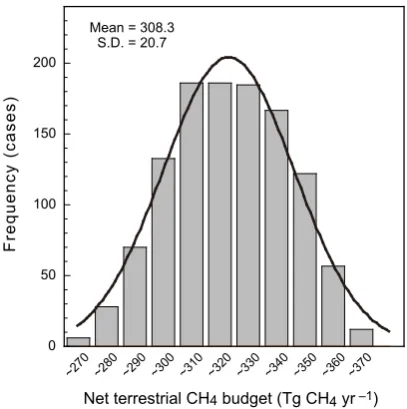
was estimated on the basis of 1152 simulations, and terres-trial ecosystems were found to be a net source of 308.3±
20.7 Tg CH4yr−1. Wetland and livestock ruminant
emis-sions were the primary sources. The results of our simula-tions indicate that sources and sinks are distributed highly heterogeneously over the Earth’s land surface. Seasonal and interannual variability in the terrestrial budget was also as-sessed. The trend of increasing net emission from terrestrial sources and its relationship with temperature variability im-ply that terrestrial CH4feedbacks will play an increasingly
important role as a result of future climatic change.
1 Introduction
Biogeochemical feedbacks within the terrestrial biosphere in response to climatic change occur through the flows of trace gases, and especially greenhouse gases (GHGs, partic-ularly CO2, CH4, and N2O). These exchanges with the
atmo-sphere play a unique role in the Earth–atmoatmo-sphere system,
and have therefore attracted considerable attention (Arneth et al., 2010). After CO2, CH4is the second-most-important
GHG except water vapor in accounting for past increases in atmospheric radiative forcing (IPCC, 2007). Various biogeo-chemical processes control the global CH4budget, including
anthropogenic factors such as emissions from the fossil fuel industry, landfills, livestock ruminants, biomass burning, and rice cultivation. However, because of the complexity and het-erogeneity of CH4-related processes, there remains a wide
range of uncertainty in our understanding of the global CH4
budget and its variability (e.g., Matthews and Fung, 1987; Hein et al., 1997; Bousquet et al., 2006).
Terrestrial ecosystems are key components in the Earth– atmosphere system. In terms of the global CH4 cycle, the
terrestrial ecosystem budget is highly uncertain because (1) sources and sinks are heterogeneously distributed over the land surface, (2) wetlands and animals (i.e., livestock rumi-nants and termites) both produce substantial CH4emissions,
and (1) human impacts have severely altered the biogeo-chemical processes related to atmosphere–ecosystem CH4
exchange. Wetland ecosystems may represent the largest sources of anaerobic CH4 production and emission, but a
consistent value for the total flux from these ecosystems has not been obtained: recent estimates range from 100 to 230 Tg CH4yr−1(IPCC, 2007). Also, aerobic emissions of
CH4from plants (Keppler et al., 2006) may prove to be
sub-stantial sources of CH4; Martinson et al. (2010) discovered
a new source at about 1.2 Tg CH4yr−1from tank bromeliads
in neotropical forests. These newly discovered phenomena and the wide range of estimated values show the immaturity of our understanding of the global CH4budget. In addition,
many observations have indicated that the rate of increase of atmospheric CH4concentrations is temporally variable, with
760 A. Ito and M. Inatomi: Use of a process-based model for assessing the methane budgets
this variability is attributable to changes in terrestrial source and sink strengths may limit our ability to predict changes and discuss options for mitigating future climate change.
Modeling of terrestrial CH4-related processes is also
im-mature, because the production and consumption processes are complicated and occur heterogeneously in space and time. Low concentrations and small fluxes of CH4 make it
difficult to obtain the gas exchange data required for model development and validation. Several empirical models have been developed to evaluate CH4 exchange by wetlands on
the basis of observed data (e.g., Christensen and Cox, 1995; Cao et al., 1996; Walter and Heimann, 2000; Zhang et al., 2002; Zhuang et al., 2004; Petrescu et al., 2010; Ringeval et al., 2010; Tian et al., 2010; Wania et al., 2010; Riley et al., 2011). For example, Wania et al. (2010) developed a mecha-nistic model (LPJ-WHyMe) of CH4emission from northern
peat-lands that included regulatory hydrological processes. Ringeval et al. (2010) assessed climate–CH4feedback by
us-ing a process-based wetland CH4 emission model coupled
with a dynamic vegetation model (ORCHIDEE). However, it is still difficult to mechanistically model the effects of the soil’s chemical and physical environments (e.g., temperature, redox potential) and biological regulation (e.g., substrate lim-itations, microbial functional composition). Many process-based wetland models have adopted a multi-layer approach (which incurs high computational costs), because the water-table depth strongly influences CH4 production and
con-sumption rates. Estimation of CH4budgets in wetlands and
seasonally flooded areas (e.g., inundation during rice cultiva-tion) is important to evaluate CH4emission at broad scales,
but it requires precise topographic and hydrological informa-tion. In addition, it is generally difficult to simulate human-driven processes such as irrigation, drainage, and crop and livestock farming, even on the basis of empirical data. De-velopment and refinement of models that simulate CH4
ex-change are therefore urgent issues in research to elucidate global GHG cycles.
The objectives of our study were (1) to estimate the CH4
budget of terrestrial ecosystems at a global scale by using a process-based model for processes that are reasonably well understood and inventory data for components of the bud-get that were not included in the model, and (2) to discuss the range of estimation uncertainty by using multiple input datasets and calculation (modeling) schemes. We focused on the CH4 budget of terrestrial ecosystem compartments
such as the vegetation, soil, and animals in both natural and human-managed areas. However, we did not consider most other anthropogenic point sources, such as fossil fuel extrac-tion and use, mining, and landfills, because the model that we used focuses on natural and agricultural ecosystems.
2 Data and methods
We evaluated the global CH4 budget of terrestrial
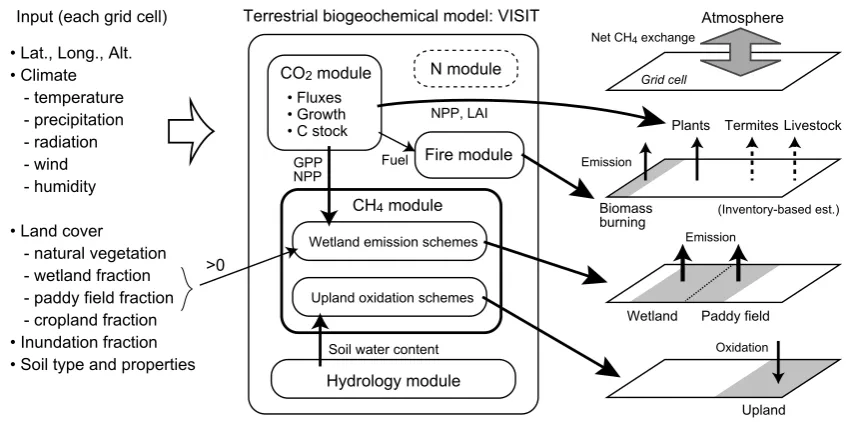
ecosys-tems by using a process-based terrestrial biogeochemical model (VISIT) and inventory data from 1901 to 2009 (Fig. 1). The estimates were performed at a spatial resolution of 0.5◦×0.5◦ latitude and longitude. The terrestrial model simulated CH4 emissions from wetlands and paddy fields,
oxidation by upland soils, emission from biomass burning, termite and livestock emissions, and plant aerobic produc-tion. Estimation uncertainty was assessed by using differ-ent calculation schemes for wetland emissions, upland ox-idation, and plant aerobic production, as well as different emission factor values.
2.1 Description of the VISIT terrestrial biogeochemical model
2.1.1 Model overview
VISIT (the Vegetation Integrative SImulator for Trace gases) is a process-based terrestrial ecosystem model (Inatomi et al., 2010; Ito, 2010). We used VISIT in this study to estimate biogeochemical CH4exchange fluxes (Fig. 1). Because this
model focuses on natural and agricultural ecosystems, we did not simulate anthropogenic (urban and industrial) emis-sions. Processes driven by animals (i.e., by livestock rumi-nant and termite emissions) were not explicitly included in the model; in this study, these fluxes were evaluated sepa-rately by using inventory data (see Sect. 2.2). The model was developed from a simple carbon cycle model (Sim-CYCLE; Ito and Oikawa, 2002), in which atmosphere–ecosystem ex-change of CO2 (photosynthesis, respiration, and
decompo-sition) and intra-ecosystem carbon dynamics (e.g., allocation of photosynthate, litterfall, humus formation) were simulated by using ecophysiological submodels. Carbon dynamics are captured by using a box-flow system, which incorporates the following plant and soil carbon pools (i.e., “boxes”): leaves, stems, roots, litter, and humus. VISIT was developed on the basis of Sim-CYCLE by including a nitrogen cycle scheme and additional trace-gas exchange schemes (i.e., CH4
pro-duction and oxidation, biomass burning, emission of bio-genic volatile organic compounds).
The model has been validated through comparisons with a variety of observational data at different scales. For exam-ple, comparison of the carbon dynamics at 17 sites around the world showed that the model successfully captured the productivity, biomass and soil carbon stocks of ecosystems ranging from tropical rain forests to arctic tundra (Ito and Oikawa, 2002). The net budget of GHGs (CO2, CH4, and
N2O) in deciduous broad-leaved forest was compared with
chamber measurements, and the model was able to capture the observed source/sink patterns (Inatomi et al., 2010). In validation of the estimated CH4emission from inundated
A. Ito and M. Inatomi: Use of a process-based model for assessing the methane budgets 761
Terrestrial biogeochemical model: VISIT
Upland Wetland
Oxidation Emission Emission
Paddy field Biomass
burning
Livestock
(Inventory-based est.)
Termites Plants
Net CH4 exchange
Atmosphere
CO2 module • Fluxes • Growth • C stock
CH4 module
Hydrology module N module
Fire module
GPP NPP
NPP, LAI
Fuel
Soil water content Upland oxidation schemes Wetland emission schemes
Input (each grid cell) • Lat., Long., Alt. • Climate - temperature - precipitation - radiation - wind - humidity
• Land cover - natural vegetation - wetland fraction - paddy field fraction - cropland fraction • Inundation fraction • Soil type and properties
>0
Figure 1 (A. Ito)
[image:3.595.86.510.63.274.2]Grid cell
Fig. 1. Schematic diagram of process used to evaluate the terrestrial CH4budget using the VISIT model.
(Inatomi and Ito, unpublished data) and from natural wet-lands in West Siberia (Sasakawa et al., 2010). Ecosystem-scale carbon budgets were compared with those observed using the eddy-covariance method, mainly at Asian sites, but the results again demonstrated the model’s validity (Ito, 2008, 2010). The model has been applied in various global-scale studies, such as the analysis of interannual variability in CO2budgets (Ito and Oikawa, 2000), off-line future
pro-jections (Ito, 2005), coupling with a climate model (Kato et al., 2009), linkage with remote-sensing data (Hazarika et al., 2005), and climate data evaluation (Saito et al., 2011). 2.1.2 A bulk scheme for evaluating CH4emission from
wetlands and paddy fields
Cao et al. (1996) developed a simple process-based scheme for describing CH4 emission from wetlands, in which the
total (i.e., bulk ecosystem-scale) exchange of CH4 is
eval-uated as the difference between CH4production and
oxida-tion rates. Therefore, the scheme is not intended to simulate fine-scale CH4dynamics such as the vertical profile of soil
CH4 concentration and diffusion, but is instead designed to
evaluate large-scale CH4budgets by using the least possible
amount of data. The CH4production rate (P) is obtained as
follows:
P=DS·FP·f (WTP)·f (TEM) (1)
where DS is the decomposition rate of soil organic matter (simulated in the carbon cycle scheme), FP is the propor-tion of the decomposed organic carbon that is transformed into CH4(a constant average value=0.5), andf(WTP) and
f(TEM) are scalar coefficients that account for regulation by the water table position (WTP) and temperature (TEM). Cao
et al. (1996) used exponential functions to evaluate the en-vironmental effects on CH4production. The CH4oxidation
rate (O) in inundated wetlands is evaluated as follows: O=P·(0.60+0.30· [GPP/GPPmax]) (2)
where GPP is the gross primary production (simulated in the carbon cycle scheme) and GPPmaxis the seasonal
maxi-mum GPP. The parameters derived from VISIT’s carbon cy-cle scheme (DS, GPP, and GPPmax) are updated annually.
2.1.3 A multi-layer scheme for CH4emission from
wetlands and paddy fields
Walter and Heimann (2000) developed a mechanistic scheme for CH4 emission from wetlands. Different CH4
produc-tion and transport processes were explicitly considered in this scheme. Here, belowground processes were simulated by us-ing a one-dimensional multi-layer system, in which the soil from the surface to a depth of 1 m was divided into 50 layers, each 2 cm thick. Temporal and vertical variations in CH4
concentration in the air (CCH4) are expressed by using the
continuity equation: ∂
∂tCCH4(t,z) = −∂
∂tDF(t,z)+EB(t,z)+PT(t,z)+P (t,z)+O (t,z) (3) wheret andzdenote time and depth, respectively, DF is the diffusive flux, EB is the ebullition flux to the atmosphere, PT is the plant-mediated (i.e., through aerenchyma) CH4 flux,
andPandOare CH4production and oxidation, respectively,
at timet and depthz. CH4production (P) is calculated for
762 A. Ito and M. Inatomi: Use of a process-based model for assessing the methane budgets
P (t,z)=P0·forg(z)·fin(t )·f (T )·Q(T (t,z)
−Tmean)/10
10 (4)
where P0 is a rate constant specific to each biome type,
forg(z)andfin(t )represent the effect of substrate availability
from soil organic matter and plant roots, respectively;f (T ) is a step-wise function of the effect of freezing on CH4
pro-duction (i.e.,f (T )=0 at temperatures below freezing, and f (T )=1 at higher temperatures); Q10 is a parameter that
defines the temperature responsiveness of the processes (i.e., the change per 10◦C temperature change); andTmean(in◦C)
is the annual mean temperature. CH4oxidation (O) is
calcu-lated for soil layers above the water table, as follows: O (t,z)= −Vmax·CCH4(t,z)
Km+CCH4(t,z)
Q(T (t,z)−Tmean)/10
10 (5)
whereVmaxis the maximum rate (20 µmol L−1h−1) andKm
is the Michaelis-Menten coefficient (5 µmol L−1). The diffu-sive flux (DF) is calculated by using Fick’s first law: DF(t,z)= −D (z) ∂
∂tCCH4(t,z) (6)
whereDis the diffusion coefficient, which is a function of the soil’s coarse pore fraction. As a boundary condition, CCH4 values at the bottom and top + 4 cm of the soil are
as-sumed to be zero and equal to the atmospheric concentra-tion, respectively. The model assumes that CH4emission by
ebullition (EB) occurs when CCH4 exceeds a threshold.
Be-cause this scheme is applied only to the wetland fraction of a cell in the model, we chose a threshold value for a vege-tated land surface (500 µmol L−1; the model’s default value).
Plant-mediated flux (PT) occurs within the rooting depth, and the model accounts for the vertical distribution of roots and the plant’s growth stage. The total flux (i.e., the summation of DF, EB, and PT) at the land surface represents the net CH4
budget of the atmosphere.
2.1.4 CH4oxidation by upland soils (Potter et al.,
1996): algorithm 1
In this scheme, CH4uptake by soil microbial oxidation (OX)
in upland (i.e., non-saturated) soils is calculated on the basis of Fick’s first law:
OX=D1CCH4
1z (7)
whereDis the diffusivity coefficient and1CCH4/1zis the
CH4concentration gradient as a function of depth in the soil
(z). Diffusivity (D) is a function of the soil temperature and water content:
D=D0·(0.9734+0.0055T )·f (SW) (8)
whereD0is the diffusivity of CH4in air at 5◦C (0.194 cm−2
s−1),T is the soil temperature (◦C), andf(SW) is a scalar coefficient function of soil water content (SW) that accounts for the difference between intra- and inter-aggregate pore
spaces. Volumetric soil water content was simulated in the VISIT hydrology scheme and used to estimate the water vol-umes contained in the intra- and inter-aggregate pore spaces. Originally, Potter et al. (1996) assumed that the CH4
concen-tration gradient was constant, at 0.04 ppmv cm−1, for global applications. In the present study, we multiplied the gradient by the ratio ofCCH4 to the base concentration (1.2 ppmv) to
account for the influence of atmospheric CH4accumulation.
2.1.5 CH4oxidation by upland soils (Ridgwell et al.,
1999): algorithm 2
In this scheme, upland CH4consumption (OX) is also
esti-mated by using Fick’s first law (Eq. 7). However, although diffusivity (D)also varies with temperature (T )and soil wa-ter content (SW), it is adjusted on the basis of the characwa-ter- character-istics of the pore space:
D=D0·(1+0.0055T )· "
TP4/3·
AFP
TP
1.5+3/b#
(9)
whereD0is the diffusivity of CH4in free air, TP is the total
pore volume, AFP is the air-filled pore volume, andb is a parameter specific to the soil texture (Saxton et al., 1986). In this scheme, microbial oxidation activity is also considered by using the following equation:
OX=kd·CCH4(z) (10)
where kd represents oxidation activity and CCH4(z) is the
CH4 concentration in the soil air at depthz. The activity,
kd, is an empirical function:
kd=k0·f (N )·f (SW)·f (T ) (11)
wherek0is the base oxidation rate (0.00087 s−1)andf (N ),
f(SW), andf (T )are coefficients of scalar functions that in-dicate the regulation of oxidation by the nitrogen input in croplands and by soil water and temperature, respectively. In this study, the scheme was separately applied to natu-ral ecosystems (f (N )=1.0) and cropland (f (N )=0.25), and then the estimated fluxes were weighted by the areal fractions of these two types of land use in each cell of the grid. Also in this scheme, the CH4 concentration gradient
was originally assumed by Ridgwell et al. to be constant at 0.04 ppmv cm−1, but we modified the gradient to account for the increase in atmospheric CH4over time.
2.1.6 CH4oxidation by upland soils (Del Grosso et al.,
2000): algorithm 3
Using the US Trace Gas Network dataset, Del Grosso et al. (2000) proposed a general model of CH4consumption in
A. Ito and M. Inatomi: Use of a process-based model for assessing the methane budgets 763
OX=OXmax·f (W,FC)·f (T ,Dopt)·f (Ag,Dopt) (12)
where OXmax is the maximum CH4 oxidation rate (a
func-tion of optimal diffusivity) andf (W, FC),f (T,Dopt), and
f (Ag,Dopt)are scalar coefficients representing the
regula-tion of CH4 oxidation by soil water content (W), the
opti-mum diffusion coefficient (Dopt), and soil temperature (T ).
A second equation is used for deciduous forests:
OX=OXmax·f (WFPS)·f (T ) (13)
where WFPS is the water-filled pore space, which is derived from the soil water content estimated by the VISIT hydrol-ogy scheme and based on soil physical properties (i.e., soil bulk density and solid phase density). This approach as-sumed that OX decreases moderately with increasing WFPS and increases linearly with increasing temperature.
2.1.7 CH4oxidation by upland soils
(Curry, 2007): algorithm 4
Curry (2007) modified the mechanistic scheme of Ridgwell et al. (1999) by introducing an advanced scalar coefficient for the regulation exerted by soil water on microbial oxida-tion activity (i.e.,f(SW) in Eq. 11). In this scheme, the soil regulation coefficient is calculated from the soil water poten-tial, which in turn is calculated from the volumetric soil wa-ter content and is more sensitive under dry conditions (Curry, 2007). Also, the temperature dependence,f (T ), at subzero temperatures was modified on the basis of observations. In this scheme, the effect of atmospheric CH4concentration is
explicitly included on the basis of the assumption that most of the CH4 consumption occurs in the upper soil above a
depth of 10 cm.
2.1.8 Emission from biomass burning
The emission from biomass burning (BB, g CH4m−2yr−1)
is evaluated in the model by using a generic equation devel-oped by Seiler and Crutzen (1980):
BB=BEF·BAF· FL·BE·BF (14)
where BEF is an emission factor that is specific to each gas and biome, BAF is the burnt area fraction (i.e., the propor-tion of each cell that burned in the model), FL is the fuel load (dry-matter storage estimated by the carbon cycle model in VISIT), and BE and BF are the burning efficiency and burned fraction, each of which is a specific parameter for each biome type. We used the BEF values of Andreae and Merlet (2001) and van der Werf et al. (2010) in this analy-sis: 6.8 to 9.0 g CH4 (kg dry matter)−1 for tropical forests
and 2.2 to 2.3 g CH4(kg dry matter)−1for grasslands. BAF
is estimated by using the parameterization by Thonicke et al. (2001):
BAF=s×exp
s−1
0.45·(s−1)3+2.83·(s−1)2+2.96·(s−1)+1.04
(15)
wheres is the fraction of the length of the fire season ex-pressed as a proportion of the total year; this fraction is affected by the fuel load (with a threshold fuel load of >200 g dry-matter m−2 required to sustain combustion) and the fuel moisture content. We derived the fuel load and mois-ture content from the carbon cycle and from hydrological schemes, respectively.
2.1.9 Plant aerobic emission
Methane emission by plants under aerobic conditions (VE) was evaluated by using the emission factor of Keppler et al. (2006) and the up-scaling methods proposed by Kirschbaum et al. (2006).
Leaf-mass-based up-scaling:
VEmass=SL·WL·[DL·VEFsun+(24−DL)VEFdark] (16)
where SL is the growing season length, WL is leaf mass (de-rived from the carbon cycle model in VISIT), and DL is day length. The emission factors for living leaves (VEFsununder
sunny conditions and VEFdark under dark conditions) were
assumed to be 374 and 119 ng (g dry matter)−1h−1, respec-tively (Keppler et al., 2006).
Photosynthesis-based up-scaling: VEphoto=2·
16
12
·NPP
r
1+24−DL
DL ·
VEFdark
VEFsun
(17) where NPP is net primary production (model estimation) and ris a unit conversion coefficient. These two estimates are ex-pected to indicate the range of uncertainty due to the choice of up-scaling methods.
2.2 Inventory-based estimation of CH4emissions
2.2.1 Emissions from livestock ruminants
Emissions from major livestock ruminants (water buffalo, cattle, goats, pigs, and sheep) were estimated on the basis of inventory data for animal density (number per unit area) and specific emission factors (i.e., CH4emission per individual).
The global distribution of livestock was derived from the Gridded Livestock of the World 2007 data (http://www.fao. org/AG/againfo/resources/en/glw/home.html) compiled by the Food and Agriculture Organization (FAO), of the United Nations. These data show the contemporary animal density at a 0.05◦×0.05◦resolution; we assumed that the data
764 A. Ito and M. Inatomi: Use of a process-based model for assessing the methane budgets
0.5◦×0.5◦grids by using the national boundary data in the
Gridded Livestock of the World 2007 dataset. For the HYDE data, 1-yr step values were obtained from the 10-yr step data by means of linear interpolation. Emission factors were de-rived from the work of Crutzen et al. (1986) and Lerner et al. (1988). Note that emission factors were specific to each livestock species but were assumed to be constant for a given species throughout the world. To account for estimation un-certainty, we conducted simulations using the upper- and lower-bound values of the emission factors.
2.2.2 Emissions from termites
CH4 emission from termites, which live in symbiosis with
methanogenic protozoa in their guts, is a non-trivial source from the terrestrial biosphere. We estimated termite CH4
emissions by using the simple up-scaling method of Fung et al. (1991), in which biome-specific termite biomass den-sity and emission factors were assumed. The average termite biomass densities were obtained from the work of Fraser et al. (1986): 5.6 g m−2for tropical forests, 3.0 g m−2for tem-perate forests, 4.5 g m−2for savanna, and 7.8 g m−2for cul-tivated land. We assumed that termites were absent in boreal forests. Emission factors were also obtained from the work of Fraser et al. (1986): they ranged from 1.0 mg CH4
kg-termite−1h−1in deserts to 8.0 mg CH4kg-termite−1h−1in
savannas.
2.3 Global simulation and analyses
The VISIT simulations were conducted by using a 0.5◦×0.5◦grid mesh for the period from 1901 to 2009; we
focus here on the outputs between 1960 and 2005. The simu-lations were driven by time-series data for atmospheric GHG concentrations, climate, and land-use changes. The historical time-series for atmospheric CH4 concentration was derived
from ice-core and ground-based measurements (Etheridge et al., 1998; Robertson et al., 2001); it showed that the aver-age CH4concentration increased from 978 ppbv in 1900 to
1227 ppbv in 1960 and then to 1850 ppbv in 2005. Climate data (air temperature, cloudiness, precipitation, and humid-ity) for each grid cell were derived from the CRU TS3.1 dataset (Mitchell and Jones, 2005). Historical land cover (the fractions of cropland and pasture) was derived from Hurtt et al. (2006), who also provided a matrix of land-use change (e.g., gross conversion from primary forest to cropland). Soil properties (clay/sand composition and bulk density) were de-rived from a global dataset from the International Satellite Land Surface Climatology Project Initiative II (Hall et al., 2006). For each grid cell, a spin-up simulation was con-ducted for 300 to 4000 yr under the atmospheric conditions that existed in 1900, until the simulation reached an equi-librium state for the net carbon budget. Note that dynamic feedback from the terrestrial biogeochemical cycle to the
at-Figure 2 (A. Ito)
(a) Fraction of wetlands
(b) Fraction of paddy fields
180°W 0°
30°S
60°S 30°N 60°N 90°N 0°
30°S
60°S 30°N 60°N 90°N
60°W 60°E
Land fraction
120°E 180°E 120°W
0.0 0.2 0.4 0.6 0.8 1.0
180°W 0°
0°
60°W 60°E 120°E 180°E
[image:6.595.316.543.68.294.2]120°W
Fig. 2. Global maps of the distribution of (a) natural wetlands and (b) paddy fields that were used in the baseline simulation. The
wet-land extent was derived from the Global Lake and Wetwet-land Database (Lehner and D¨oll, 2004), and the paddy field extent was derived from the MODIS-based estimation for Asia (Takeuchi and Yasuoka, 2006; 10◦S to 50◦N, 65◦ to 150◦E) and data by Monfreda et al. (2008) for other areas.
mospheric GHG concentration and climate system was not considered; that is, we conducted an off-line experiment.
Uncertainty in the estimated terrestrial CH4 budget was
evaluated on the basis of alternative calculations by using different assumptions and different estimation schemes.
Two datasets for the distribution of inundated wetlands were used (Fig. 2a): those of Matthews and Fung (1987) and Lehner and D¨oll (2004). When using the former dataset, the annual mean inundation fraction was used. In the lat-ter case, the seasonal change in the inundated fraction was derived from satellite data (SSM/I; Prigent et al., 2007) and combined with the wetland map of Lehner and D¨oll (2004). For conducting long-term simulations, average distributions of inundated wetlands (i.e., no interannual variability) were used throughout the simulation period.
Two datasets of paddy field distribution were used (Fig. 2b): a global map produced by Monfreda et al. (2008) and the Monsoon Asia map produced by the Institute of In-dustrial Sciences, University of Tokyo (Takeuchi and Ya-suoka, 2006). The former is based on statistical inventory data, and the latter is based on MODIS image analysis.
Two schemes of wetland and paddy field CH4 emission
A. Ito and M. Inatomi: Use of a process-based model for assessing the methane budgets 765
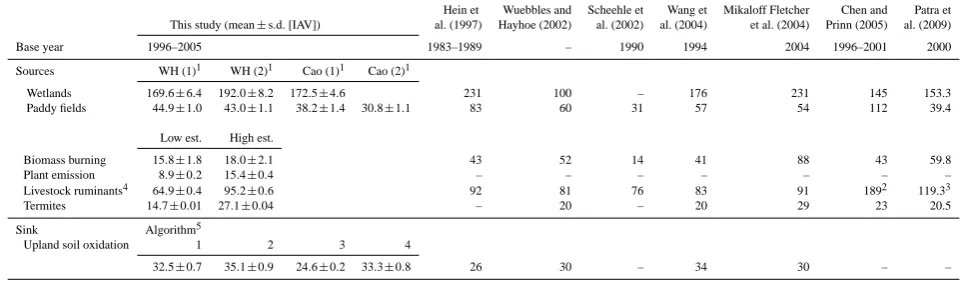
Table 1. Comparison of components of the global CH4budget for terrestrial ecosystem (Tg CH4yr−1)between the different simulations in this study and estimates from previous studies.
Hein et Wuebbles and Scheehle et Wang et Mikaloff Fletcher Chen and Patra et This study (mean±s.d. [IAV]) al. (1997) Hayhoe (2002) al. (2002) al. (2004) et al. (2004) Prinn (2005) al. (2009)
Base year 1996–2005 1983–1989 – 1990 1994 2004 1996–2001 2000
Sources WH (1)1 WH (2)1 Cao (1)1 Cao (2)1
Wetlands 169.6±6.4 192.0±8.2 172.5±4.6 231 100 – 176 231 145 153.3 Paddy fields 44.9±1.0 43.0±1.1 38.2±1.4 30.8±1.1 83 60 31 57 54 112 39.4
Low est. High est.
Biomass burning 15.8±1.8 18.0±2.1 43 52 14 41 88 43 59.8
Plant emission 8.9±0.2 15.4±0.4 – – – – – – –
Livestock ruminants4 64.9±0.4 95.2±0.6 92 81 76 83 91 1892 119.33
Termites 14.7±0.01 27.1±0.04 – 20 – 20 29 23 20.5
Sink Algorithm5
Upland soil oxidation 1 2 3 4
32.5±0.7 35.1±0.9 24.6±0.2 33.3±0.8 26 30 – 34 30 – –
1Using Walter-Heimann and Cao et al. schemes with (1) wetland map by Lehner and D¨oll (2004) and paddy field map by Monfreda et al. (2008) and (2) wetland map by Matthews
and Fung (1987) and Asian paddie field map by Takeuchi and Yasuoka (2006).
2Including emissions from landfills and wastes.
3Including anthropogenic fire emission.
4Estimation on the basis of inventory and geographical map data.
5Algorithm 1: Potter et al. (1996), 2: Ridgwell et al. (1999), 3: Del Grosso et al. (2000), 4: Curry (2007).
resulting in three estimates for paddy fields and four esti-mates for natural wetlands.
Four schemes for CH4oxidation in upland soils were used:
those of Potter et al. (1996), Ridgwell et al. (1999), Del Grosso et al. (2000), and Curry (2007).
Two up-scaling schemes for plant aerobic CH4 emission
by Kirschbaum et al. (2006) were used: a photosynthesis-based scheme and a biomass-photosynthesis-based scheme. In addition, we considered the case of no plant emission (i.e., a third set of estimates), because a general consensus has not yet been reached over the significance of this process (e.g., Bloom et al., 2010).
Two sets of emission factors (i.e., lower-end and higher-end values within the plausible range) from biomass burning were used for each biome.
Two sets of termite density and CH4emission factors
(sim-ilarly, lower-end and higher-end values) were used.
Two sets of livestock emission factors (similarly, lower-end and higher-lower-end values) were used.
On the basis of this summary, we obtained 1152 differ-ent combinations of calculation methods and parameter val-ues for the net terrestrial CH4 budget, assuming that each
flow was independent. We expected that the distribution of the total budget produced by these simulations would reveal the range of estimation uncertainties caused by variability in the base data and evaluation schemes. Note that other po-tentially important sources of uncertainties such as parame-ter values and prognostic inundation estimation were not as-sessed in this study. To facilitate our analysis and discussion, we chose the following “baseline” estimation as the stan-dard for comparison: the CH4 emission scheme of Walter
and Heimann (2000), the oxidation scheme of Curry (2007),
the wetland map by Lehner and D¨oll (2004), and the paddy field map of Monfreda et al. (2008). For other emissions, we chose the average of the lowest and highest emission factors in the baseline estimation.
3 Results and discussion
3.1 Global annual budget
We estimated components of the global terrestrial CH4
bud-get by using the model and inventory data; Table 1 sum-marizes the results. From 1996 to 2005, natural wetlands accounted for the largest terrestrial CH4 source, producing
170 to 192 Tg CH4yr−1 for the range of wetland data and
emission calculation schemes that we considered; these val-ues were within the range of valval-ues estimated in previous studies (Table 1). Paddy fields were also a considerable source, with values ranging from 31 to 45 Tg CH4yr−1. The
paddy field emission was comparable to that in previous stud-ies (Table 1) but slightly higher than a recent inventory-based estimate of 25.6 Tg CH4yr−1 in 2000 (Yan et al.,
2009). Also, our estimates are comparable to a recent es-timate of 34 to 67 Tg CH4yr−1(Neef et al., 2010) that was
constrained on the basis of historical observations of the sta-ble isotope ratio of atmospheric CH4. The estimated CH4
emission from biomass burning, 16 to 18 Tg CH4yr−1, fell
within the range of previous studies, but was close to the lower end of those values. Plant emissions ranged from 9 to 15 Tg CH4yr−1; this is lower than the value estimated by
766 A. Ito and M. Inatomi: Use of a process-based model for assessing the methane budgets
Figure 3 (A. Ito)
Net terrestrial CH4 budget (Tg CH4 yr –1)
Frequency (cases)
~270 ~280 ~290 ~300 ~310 ~320 ~330 ~340 ~350 ~360 ~370 Mean = 308.3
S.D. = 20.7
0 50 100 150 200
Fig. 3. Frequency distribution for the 1152 estimates of terrestrial
CH4budget (= wetland emission [4 estimates] + paddy field emis-sion [3] + ruminant emisemis-sion [2] + termite emisemis-sion [2] + biomass burning emission [2] + plant aerobic emission [3; = 2 estimates + null (no emission)] – oxidation in upland soils [4]) estimated by using different input data and parameterization schemes. Table 1 presents the detailed results of these simulations. The thick black line shows a normal distribution fitted to the data.
terrestrial CH4 source, with values ranging from 65 to
95 Tg CH4yr−1, and that termites were also a considerable
source, with values ranging from 15 to 27 Tg CH4yr−1. Both
sets of values were within the range of previous reports, al-though the lower value for termites was lower than the pre-viously reported values. On the other hand, upland soils were estimated to act as a strong sink, with values rang-ing from 25 to 35 Tg CH4yr−1, depending on the
oxida-tion estimaoxida-tion scheme that was chosen. Again, these val-ues were within the range reported in previous studies. For example, Spahni et al. (2011) estimated global soil CH4
up-take as 28 Tg CH4yr−1using the LPJ-WHyMe model; Riley
et al. (2011) estimated uptake as 31 Tg CH4yr−1using the
CLM4Me model with the model’s default parameters; and Neef et al. (2010) estimated uptake as 28 to 30 Tg CH4yr−1
on the basis of stable isotope analysis.
The estimated global CH4 budget was consistent with
those in previous studies, with intermediate total source and sink values, 340 and 30 Tg CH4yr−1, respectively, obtained
in this study. We plotted a frequency distribution for the esti-mated total CH4budget (Fig. 3): the budget averaged 308.3±
20.7 Tg CH4yr−1(mean ±standard deviation; min. 253 to
max. 359 Tg CH4yr−1), excluding emissions from landfill,
wastes, and wild animals, and anthropogenic combustion. A key uncertainty found in this study is associated with the available wetland and inundation maps, on the basis of esti-mates differed by more than 20 Tg CH4yr−1(Table 1). This
Figure 4 (A. Ito)
0°
30°S
60°S 30°N 60°N 90°N
180°W 120°W 60°W 0° 60°E 120°E 180°E
Emission from wetlands and paddy fields
CH4 emission
[image:8.595.65.269.64.269.2](g CH4 m –2 yr –1) 0.0 2.0 4.0 6.0 8.0
Fig. 4. Global map of the estimated CH4emission from the wet-lands and paddy fields shown in Fig. 2.
difference suggests that it is important to accurately delineate the locations of wetlands so that we can more accurately esti-mate their contribution to global CH4emissions. This finding
is consistent with those of a sensitivity analysis by Petrescu et al. (2010) using four wetland maps. In addition, the exis-tence or absence of plant aerobic CH4emissions affected the
net budget, especially in densely vegetated areas; the mean value of 12.2 Tg CH4yr−1was nearly 4 % of the mean total
budget (Fig. 3). However, the actual range of estimation un-certainty may be even larger, because the present study did not fully explore uncertainties in sensitive parameters val-ues and predicted changes in wetland extent in response to global climate change, which can span a wide range (e.g., Riley et al., 2011). Furthermore, weighting of specific fluxes on the basis of agreement with observational data may refine the estimated probabilistic distribution of the terrestrial CH4
budget.
3.2 Spatial pattern of sources and sinks
As expected from the distribution of wetlands and paddy fields, northern wetlands (e.g., in North America and West Siberia) and Asian paddy fields were strong sources of CH4
with values as high as 8 g CH4m−2yr−1 (Fig. 4). Tropical
wetlands and river flood plains (e.g., Amazonia, the Pantanal, and the Mississippi delta) were also substantial emission sources. High rates of emission from livestock ruminants (to a maximum of around 4 g CH4m−2yr−1)were found in parts
of South Asia, East Asia, Europe, South America, and east Africa, where large numbers of livestock are raised (Fig. 5a). The CH4sources from wetlands and livestock ruminants
ex-hibited high spatial heterogeneity, with certain localized ar-eas representing “hot spots”. Emissions from termites oc-curred mainly in the subtropical areas of Australia, Africa, and South America (Fig. 5b). The maximum estimated area-based emission rate (∼0.5 g CH4m−2yr−1) was low
[image:8.595.310.541.69.192.2]A. Ito and M. Inatomi: Use of a process-based model for assessing the methane budgets 767
Figure 5 (A. Ito)
0°
30°S
60°S 30°N 60°N 90°N
180°W 120°W 60°W 0° 60°E 120°E 180°E
0°
30°S
60°S 30°N 60°N 90°N
180°W 120°W 60°W 0° 60°E 120°E 180°E
(a) Emission from livestock ruminants
(b) Emission from termites
CH4 emission (g CH4 m –2 yr –1)
CH4 emission (g CH4 m –2 yr –1)
0.0 1.0 2.0 3.0 4.0
[image:9.595.52.282.67.325.2]0.0 0.1 0.2 0.3 0.4 0.5
Fig. 5. Global maps of the estimated CH4emission from (a) live-stock ruminants (water buffalo, cattle, goats, pigs, and sheep) and
(b) termites.
In terms of upland soil oxidation, the four schemes es-timated comparable total uptakes (25 to 35 Tg CH4yr−1;
Table 1), but with different spatial distributions. Potter et al.’s (1996) scheme estimated higher oxidation rates in tropi-cal and temperate regions, but with weaker overall geograph-ical contrasts (Fig. 6a). Ridgwell et al.’s (1999) scheme esti-mated higher rates in tropical and subtropical areas, includ-ing in several dry regions (e.g., Middle East, Central Amer-ica, South AmerAmer-ica, and Australia; Fig. 6b). In this case, latitudinal contrasts were stronger. Del Grosso et al.’s (2000) scheme estimated clear contrasts between deciduous forests and other types of ecosystems (Fig. 6c), because it assumed that the thick litter layer at the surfaces of deciduous forests would have higher CH4 oxidation capacity.
Correspond-ingly, arid regions, which typically have a thinner litter layer, showed lower oxidation rates. Curry’s (2007) scheme pro-duced results similar to those of Ridgwell et al. (because it is a revised version of their scheme), but revealed clearer con-trasts between humid and dry ecosystems (Fig. 6d).
3.3 Temporal variability
Seasonal changes in the terrestrial CH4 budget were most
evident at northern latitudes (42◦N to 68◦N; Fig. 7 for the baseline simulation), where a vast area of northern wetland actively emits CH4during the summer growing period. At
lower latitudes, tropical wetlands and paddy fields made these areas a net CH4source throughout the year. At other
latitudes, small net sinks occurred as a result of upland ox-idation, except where emissions from termites and livestock ruminants were significant (Fig. 5).
The global terrestrial CH4 budget and its components
changed from 1900 to the present (Fig. 8 for the baseline sim-ulation). Wetland and paddy field emissions were affected by meteorological conditions, leading to stochastic interannual variability (IAV). Because of expansion of the area covered by paddy fields in Asia, paddy field emissions increased from 24 Tg CH4yr−1in the early 1900s to 45 Tg CH4yr−1in the
2000s. Note that fertilizer applications in paddy fields, which may decrease CH4 emission (Kai et al., 2011), were not
fully accounted for in the present study. Emission from live-stock ruminants increased from 35 Tg CH4yr−1in the early
1900s to 80 Tg CH4yr−1in the 2000s; this inventory-based
estimate contains little stochastic variability because it de-pends on human, rather than environmental, factors. Among livestock, the temporal increment was largely attributable to increased cattle emission, from 22 Tg CH4yr−1in the early
1900s to 60 Tg CH4yr−1in the 2000s. In contrast, emission
from water buffalo peaked at 14 Tg CH4yr−1 in the 1950s
and declined to 8 Tg CH4yr−1in the 2000s. The estimated
termite emission, using either the high or low emission fac-tors, slowly decreased to less than 1 Tg CH4yr−1during the
experimental period as a result of land-use conversion from natural vegetation to cropland or pasture. Plant aerobic emis-sion increased gradually in parallel with increased photosyn-thetic productivity and leaf mass as a result of the CO2
fertil-ization effect. Biomass burning emission showed substantial IAV due to variations in fuel and moisture conditions, but it did not show a clear linear trend. CH4 oxidation by
up-land soils increased, mainly as a result of the increased CH4
gradient between the atmosphere and the soil air space that resulted from using Curry’s (2007) scheme.
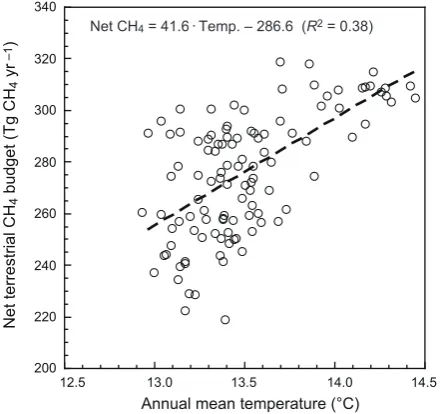
The global relationship between annual mean temperature and terrestrial net CH4exchange (Fig. 9 for the baseline
sim-ulation) showed a significant weak to moderately strong lin-ear relationship (R2=0.38,P <0.01). On the basis of the results of this regression, net terrestrial CH4 emission has
increased at a rate of 41.6 Tg CH4yr−1per 1◦C of
warm-ing, suggesting the existence of a positive biogeochemical feedback in response to climatic warming (and partly in re-sponse to historical land-use change in parallel with temper-ature change). On the basis of the 100-yr Global Warming Potential for CH4(=25; IPCC, 2007), this responsiveness of
the CH4budget corresponded to an increase of 283 Tg C yr−1
in the climate–carbon (CO2) cycle feedback. As implied by
768 A. Ito and M. Inatomi: Use of a process-based model for assessing the methane budgets
Figure 6 (A. Ito)
(b)
0°
30°S
60°S 30°N 60°N 90°N
180°W 120°W 60°W 60°E 120°E 180°E
(a)
(c) (d)
180°W 0° 0°
0° 0°
60°W 60°E 120°E 180°E
120°W
0°
30°S
60°S 30°N 60°N 90°N
180°W 120°W 60°W 60°E 120°E 180°E 180°W 120°W 60°W 60°E 120°E 180°E
Upland CH4 oxidation
[image:10.595.89.506.68.292.2](g CH4 m –2 yr –1) 0.0 0.1 0.2 0.3 0.4 0.5
Fig. 6. Global maps of the estimated rates of CH4oxidation by upland soils using different calculation methods and parameterizations: (a) Potter et al. (1996), (b) Ridgwell et al. (1999), (c) Del Grosso et al. (2000), and (d) Curry (2007). Note that the same data were used for soil water content and temperature in each of the four simulations.
Figure 7 (A. Ito)
-62.5 -57.5 -52.5 -47.5 -42.5 -37.5 -32.5 -27.5 -22.5 -17.5
-12.5-7.5
-2.52.5 7.5 12.5 17.5 22.5 27.5 32.5 37.5 42.5 47.5 52.5 57.5 62.5 67.5 72.5 77.5 82.5 87.5
Latitude (degree)
J F M A M J J A S O N D
Month
Sources [wetland + paddy field+ wildfire] – sinks [upland oxidation]
Net CH4 budget
(Tg CH4 5°-zone mon –1) Sink–3 0 3 6 9 12 Source N
S
Fig. 7. Seasonal and latitudinal distribution of the terrestrial CH4 budget (= wetland emission + paddy field emission + biomass burn-ing emission – upland soil oxidation) in the baseline experiment (1996–2005).
Figure 8 (A. Ito)
Terrestrial CH
4
flux (Tg CH
4
yr
–1)
1901 1911 1921 1931 1941 1951 Year
1961 1971 1981 1991 2001 -50
0 50 100 150 200 250 300 350 400
Upland oxidation Wetland Livestock Termite Paddy field Biomass burning Plant emission
Sources
[image:10.595.310.543.371.530.2]Sinks
Fig. 8. Temporal changes in the estimated terrestrial CH4budget components in the baseline experiment.
4 Conclusions
In this study, we simulated the global terrestrial CH4
bud-get by using the VISIT model, and we accounted for un-certainties among the different estimation and parameter-ization schemes; the result was a mean net emission of 308±21 Tg CH4yr−1. The coefficient of variation (the
stan-dard deviation divided by the mean), 6.7 %, was smaller than that of the global CO2 budget, which equaled 15 %
[image:10.595.52.283.375.599.2]A. Ito and M. Inatomi: Use of a process-based model for assessing the methane budgets 769
Figure 9 (A. Ito)
200 220 240 260 280 300 320 340
12.5 13.0 13.5 14.0 14.5
Annual mean temperature (°C)
Net terrestrial CH
4
budget (Tg CH
4
yr
–1)
[image:11.595.315.542.68.223.2]Net CH4 = 41.6·Temp. – 286.6 (R2 = 0.38)
Fig. 9. Relationship between annual global mean land temperature
and estimated net terrestrial CH4budget in the baseline simulation.
2011). The estimated flows and the total budget were both comparable to the results of previous studies based on inven-tories, biogeochemical models, and atmospheric inversion models (Table 1). The contemporary natural source value of 220 Tg CH4yr−1in our study was comparable to the range
of 145 to 260 Tg CH4yr−1in previous studies (IPCC, 2007).
However, it should be noted that several sources were not ac-counted for in our study, namely emissions from wastes and landfills, mining, wild ruminants, and anthropogenic com-bustion. Modeling these ancillary sources is difficult, so an alternative inventory-based appraisal would be required. In terms of the estimation uncertainty, additional differences among estimates could be produced by using different cli-mate datasets (e.g., Ito and Sasai, 2006).
We simulated the global terrestrial CH4budget to discuss
the unique roles of various components of the terrestrial bio-sphere in determining the global budget. The spatial pattern and temporal variability of the simulated CH4fluxes have
im-plications for efforts to interpret the characteristic variability in these studies. Figure 10 presents the estimated anomaly in the terrestrial CH4 budget (compared with the baseline
simulation in Fig. 8), which represents the deviation of the value in a given year compared with the 1981–2000 average value, and compares this anomaly with the atmospheric CH4
growth rate at the Mauna Loa and South Pole observatories monitored by the US National Oceanic and Atmospheric Ad-ministration (Dlugokencky et al., 1994, 2011). It is apparent that the amplitude of interannual variability in the estimated net terrestrial CH4budget was smaller than that in the
ob-served atmospheric CH4 accumulation, and that the
varia-tions in the terrestrial budget therefore might not fully
ex-Terrestrial anomaly (VISIT estimation)
Terrestrial CH
4
budge
t anomaly (Tg CH
4
yr
–1
)
Atm. CH4 observation
Atm. CH
4 growth rate (ppbv yr
–1
)
Mauna Loa
South Pole
Figure 10 (A. Ito)
Year -40
-20 0 20 40
-20 -15 -10 -5 0 5 10 15 20
1985 1990 1995 2000 2005 2010
Fig. 10. Temporal change in the anomalies (defined as the
devi-ation from the 1981–2000 average value, represented by the hor-izontal line at 0) in the annual global terrestrial CH4 budget es-timated by using the VISIT model and inventory data. Values represent the means and the minimum–maximum range in the 1152 estimates based on the different combinations of input data and different calculation and parameterization schemes. The or-ange and light blue lines show the chor-anges in atmospheric CH4 at the Mauna Loa and South Pole observatories (data from the NOAA/ESRL/GMD dataset; Dlugokencky et al., 1994, 2011). Note: 1 ppbv = 2.123 Tg CH4-C.
plain the decrease in the CH4increment that was observed
from the 1990s to the 2000s (Bousquet et al., 2006; Dlugo-kencky et al., 2011). This suggests that other factors such as temporal variability in inundated areas, chemical reactions in the atmosphere, anthropogenic emissions, and troposphere– stratosphere exchanges may contribute substantially to the temporal variability in the atmospheric CH4 accumulation
rate. For example, Kai et al. (2011) suggested that decreased CH4emission from paddy fields due to fertilizer application
accounted for about half of the slowdown of atmospheric CH4 accumulation. In contrast, Hodson et al. (2011)
sug-gested that repeated El Ni˜no events during this period were a contributing factor to the stabilization of atmospheric CH4,
suggesting that further investigations will be required to es-tablish an overview of the decadal-scale CH4variation. On
the other hand, several anomalies in the estimated terrestrial budget coincided with atmospheric anomalies (e.g., a rapid deceleration in the growth rate of CH4in 1992 and an
accel-eration in 1998), suggesting dominant impacts by the terres-trial biosphere during some periods.
It is difficult to constrain and validate large-scale mod-els because observation-based estimates of CH4 emissions
[image:11.595.57.279.69.276.2]770 A. Ito and M. Inatomi: Use of a process-based model for assessing the methane budgets
the eddy-covariance method (McDermitt et al., 2011). Al-though there remain several methodological difficulties with this method (e.g., correcting for atmospheric stability and ad-vection), this new methodology will enable us to use more data to constrain biogeochemical models and reduce esti-mation uncertainty. In parallel, appropriate up-scaling algo-rithms from a point to a regional scale should be developed, because spatial heterogeneity in CH4-related processes such
as wetland hydrology, animal distribution, and fire regime, should affect broad-scale evaluations of CH4 budget, even
using process-based models.
Furthermore, recent satellite remote-sensing methods may soon permit measurements of atmospheric CH4 at a global
scale. For example, the SCIAMACHY sensor on the EN-VISAT satellite is being used to observe atmospheric trace gases, including CH4, and the data are being used as
in-puts for atmospheric inversion models to estimate surface fluxes (Bergamaschi et al., 2009). More and more satel-lite data will be available to estimate the global CH4
bud-get, including those from Japan’s Greenhouse gas Observing SATellite (GOSAT; Yoshida et al., 2011). In the near future, model-based estimates such as those described in this paper, will be compared with satellite observations for validation. Because the top-down approach observes total surface ex-change, including not only land ecosystem fluxes but also an-thropogenic and freshwater sources (Bastviken et al., 2011), separation pf the overall values into specific components be-comes another issue. Recent progress in measurement of the stable isotope ratios in atmospheric CH4(e.g., Lassey et
al., 2011) and data-model fusion with the goal of optimiz-ing estimates (e.g., Neef et al., 2010; Riley et al., 2011) may allow more precise assessments of each flux. Also, cross-comparison of model-estimated surface fluxes with atmo-spheric transport models (e.g., TransCom-CH4 by Patra et
al., 2011) would effectively reveal the accuracy and uncer-tainty in the present global CH4budget. As more and better
data become available, model studies will become an increas-ingly important tool for analyzing the mechanisms underly-ing the global budget and for predictunderly-ing future budgets under climate change.
Acknowledgements. This study was supported by Grants-in-Aid for Scientific Research (No. 19310017) from the Japan Society for the Promotion of Science and (No. 21114010) from the Ministry of Education, Culture, Sports, Science and Technology.
Edited by: D. Fern´andez Prieto
References
Andreae, M. O. and Merlet, P.: Emission of trace gases and aerosols from biomass burning, Global Biogeochem. Cy., 15, 955–966, 2001.
Arneth, A., Harrison, S. P., Zaehle, S., Tsigaridis, K., Menon, S., Bartlein, P. J., Feichter, J., Korhola, A., Kulmala, M., O’Donnell, D., Schurgers, G., Sorvari, S., and Vesala, T.: Terrestrial bio-geochemical feedbacks in the climate system, Nature Geosci., 3, 525–532, 2010.
Bastviken, D., Tranvik, L. J., Downing, J. A., Crill, P. M., and Enrich-Prast, A.: Freshwater methane emissions offset the conti-nental carbon sink, Science, 331, 50, 2011.
Bergamaschi, P., Frankenberg, C., Meirink, J. F., Krol, M., Vil-lani, M. G., Houweling, S., Dentener, F., Dlugokencky, E. J., Miller, J. B., Gatti, L. V., Engel, A., and Levin, I.: Inverse modeling of global and regional CH4 emissions using SCIA-MACHY satellite retrievals, J. Geophys. Res., 114, D22301, doi:10.1029/2009JD012287, 2009.
Bloom, A. A., Lee-Taylor, J., Madronich, S., Messenger, D. J., Palmer, P. I., Reay, D. S., and McLeod, A. R.: Global methane emission estimates from ultraviolet irradiation of terrestrial plant foliage, New Phytol., 187, 417–425, 2010.
Bousquet, P., Ciais, P., Miller, J. B., Dlugokencky, E. J., Hauglus-taine, D. A., Prigent, C., van der Werf, G. R., Peylin, P., Brunke, E.-G., Carouge, C., Langenfelds, R. L., Lathi`ere, J., Papa, F., Ramonet, M., Schmidt, M., Steele, L. P., Tyler, S. C., and White, J.: Contribution of anthropogenic and natural sources to atmo-spheric methane variability, Nature, 439–443, 2006.
Cao, M., Marshall, S., and Gregson, K.: Global carbon exchange and methane emissions from natural wetlands: Application of a process-based model, J. Geophys. Res., 101, 14399–14414, 1996.
Chen, Y.-H. and Prinn, R. G.: Atmospheric modeling of high-and low-frequency methane observations: Importance of in-terannually varying transport, J. Geophys. Res., 110, D10303, doi:10.1029/2004JD005542, 2005.
Christensen, T. R. and Cox, P.: Response of methane emission from arctic tundra to climatic change: Results from a model simula-tion, Tellus, 47B, 301–309, 1995.
Crutzen, P. J., Aselmann, I., and Seiler, W.: Methane production by domestic animals, wild ruminants, other herbivorous fauna, and humans, Tellus, 38B, 271–284, 1986.
Curry, C. L.: Modeling the soil consumption of atmospheric methane at the global scale, Global Biogeochem. Cy., 21, GB4012, doi:10.1029/2006GB002818, 2007.
Del Grosso, S. J., Parton, W. J., Mosier, A. R., Ojima, D. S., Potter, C. S., Borken, W., Brumme, R., Butterbach-Bahl, K., Crill, P. M., Dobbie, K., and Smith, K. A.: General CH4oxidation model and comparisons of CH4oxidation in natural and managed systems, Global Biogeochem. Cy., 14, 999–1019, 2000.
Dlugokencky, E. J., Masaire, K. A., Lang, P. M., Tans, P. P., Steele, L. P., and Nisbet, E. G.: A dramatic decrease in the growth rate of atmospheric methane in the northern hemisphere during 1992, Geophys. Res. Lett., 21, 45–48, 1994.
Dlugokencky, E. J., Nisbet, E. G., Fisher, R., and Lowry, D.: Global atmospheric methane: budget, changes and dangers, Phil. Trans. Roy. Soc., A369, 2058–2072, 2011.
A. Ito and M. Inatomi: Use of a process-based model for assessing the methane budgets 771
Evidence of anthropogenic emissions and climatic variability, J. Geophys. Res., 103, 15979–15993, 1998.
Fraser, P. J., Rasmussen, R. A., Creffield, J. W., French, J. R., and Khalil, M. A. K.: Termites and global methane – another assess-ment, J. Atmos. Chem., 4, 295–310, 1986.
Fung, I., John, J., Lerner, J., Matthews, E., Prather, M., Steele, L. P., and Fraser, P. J.: Three-dimensional model synthesis of the global methane cycle, J. Geophys. Res., 96, 13033–13065, 1991. Gedney, N., Cox, P. M., and Huntingford, C.: Climate feed-back from wetland methane emissions, Geophys. Res. Lett., 31, L20503, doi:10.1029/2004GL020919, 2004.
Hall, F. G., de Colstoun, E. B., Collatz, G. J., Landis, D., Dirmeyer, P., Betts, A., Huffman, G. J., Bounoua, L., and Meeson, B.: ISLSCP Initiative II global data sets: Surface boundary con-ditions and atmospheric forcings for land-atmosphere studies, J. Geophys. Res., 111, D22S01, doi:10.1029/2006JD007366, 2006.
Hazarika, M., Yasuoka, Y., Ito, A., and Dye, D. G.: Estimation of net primary productivity by integrating remote sensing with an ecosystem model, Remote Sens. Environ., 94, 298–310, 2005. Hein, R., Crutzen, P. J., and Heimann, M.: An inverse modeling
approach to investigate the global atmospheric methane cycle, Global Biogeochem. Cy., 11, 43–76, 1997.
Hodson, E. L., Poulter, B., Zimmermann, N. E., Prigent, C., and Kaplan, J. O.: The El Ni˜no-Southern Oscillation and wet-land methane interannual variability, Geophys. Res. Lett., 38, L08810, doi:10.1029/2011GL046861, 2011.
Hurtt, G. C., Frolking, S., Fearon, M. G., Moore, B., Shevliakova, E., Malyshev, S., Pacala, S. W., and Houghton, R. A.: The un-derpinnings of land-use history: three centuries of global grid-ded land-use transitions, wood-harvest activity, and resulting sec-ondary lands, Global Change Biol., 12, 1–22, 2006.
Inatomi, M., Ito, A., Ishijima, K., and Murayama, S.: Greenhouse gas budget of a cool temperate deciduous broadleaved forest in Japan estimated with a process-based model, Ecosystems, 13, 472–483, 2010.
Intergovernmental Panel on Climate Change (IPCC): Climate Change 2007: The Physical Science Basis, edited by: Solomon, S., Qin, D., Manning, M., Marquis, M., Averyt, K., Tignor, M. M. B., Miller, H. L. J., and Chen, Z., Cambridge University Press, Cambridge, 996 pp., 2007.
Ito, A.: Climate-related uncertainties in projections of the 21st cen-tury terrestrial carbon budget: Off-line model experiments us-ing IPCC greenhouse gas scenarios and AOGCM climate projec-tions, Clim. Dynam., 24, 435–448, 2005.
Ito, A.: The regional carbon budget of East Asia simulated with a terrestrial ecosystem model and validated using AsiaFlux data, Agr. For. Meteorol., 148, 738–747, 2008.
Ito, A.: Evaluation of defoliation impacts of tropical cyclones on the forest carbon budget using flux data and a process-based model, J. Geophys. Res., 115, G04013, doi:10.1029/2010JG001314, 2010.
Ito, A.: A historical meta-analysis of global terrestrial net primary productivity: Are estimates converging?, Global Change Biol., 17, 3161–3175, doi:10.1111/j.1365-2486.2011.02450.x, 2011. Ito, A. and Oikawa, T.: A model analysis of the relationship
be-tween climate perturbations and carbon budget anomalies in global terrestrial ecosystems: 1970–1997, Clim. Res., 15, 161– 183, 2000.
Ito, A. and Oikawa, T.: A simulation model of the carbon cycle in land ecosystems (Sim-CYCLE): A description based on dry-matter production theory and plot-scale validation, Ecol. Model., 151, 147–179, 2002.
Ito, A. and Sasai, T.: A comparison of simulation results from two terrestrial carbon cycle models using three climate datasets, Tel-lus, 58B, 513–522, 2006.
Kai, F. M., Tyler, S. C., Randerson, J. T., and Blake, D. R.: Reduced methane growth rate explained by decreased Northern Hemi-sphere microbial sources, Nature, 476, 194–197, 2011.
Kato, T., Ito, A., and Kawamiya, M.: Multiple temporal scale vari-ability during the twentieth century in global carbon dynamics simulated by a coupled climate-terrestrial carbon cycle model, Clim. Dynam., 32, 901–923, 2009.
Keppler, F., Hamilton, J. T. G., Braß, M., and R¨ockmann, T.: Methane emissions from terrestrial plants under aerobic condi-tions, Nature, 439, 187–191, 2006.
Kirschbaum, M. U. F., Bruhn, D., Etheridge, D. M., Evans, J. R., Farquhar, G. D., Gifford, R. M., Paul, K. I., and Winters, A. J.: A comment on the quantitative significance of aerobic methane release by plants, Func. Plant Biol., 33, 521–530, 2006. Klein Goldewijk, K., Beusen, A., Van Drecht, G., and de Vos,
M.: The HYDE 3.1 spatially explicit database of human-induced global land-use change over the past 12,000 years, Global Ecol. Biogeogr., 20, 73–86, 2011.
Lassey, K. R., Allan, W., and Mikaloff Fletcher, S. E.: Seasonal inter-relationships in atmospheric methane and companionδ13C values: effects of sinks and sources, Tellus, 63B, 287–301, 2011. Lehner, B. and D¨oll, P.: Development and validation of a global database of lakes, reservoirs and wetlands, J. Hydrol., 296, 1–22, 2004.
Lerner, J., Matthews, E., and Fung, I.: Methane emission from an-imals: a global high-resolution data base, Global Biogeochem. Cy., 2, 139–156, 1988.
Martinson, G. O., Werner, F. A., Scherber, C., Conrad, R., Corre, M. D., Flessa, H., Wolf, K., Klose, M., Gradstein, S. R., and Veld-kamp, E.: Methane emission from tank bromeliads in neotropical forests, Nature Geosci., 3, 766–769, 2010.
Matthews, E. and Fung, I.: Methane emission from natural wet-lands: Global distribution, area, and environmental characteris-tics of sources, Global Biogeochem. Cy., 1, 61–86, 1987. McDermitt, D., Burba, G., Xu, L., Anderson, T., Komissarov, A.,
Reinsche, B., Schedlbauer, J., Starr, G., Zona, D., Oechel, W., Oberbauer, S., and Hastings, S.: A new low-power, open-path in-strument for measuring methane flux by eddy covariance, Appl. Phys. B, 102, 391–405, 2011.
Mikaloff Fletcher, S. E., Tans, P. P., Bruhwiler, L. M., Miller, J. B., and Heimann, M.: CH4 sources estimated from atmo-spheric observations of CH4and its13C/12C isotopic ratios: 1. Inverse modeling of source processes, Global Biogeochem. Cy., 18, GB4004, doi:10.1029/2004GB002223, 2004.
Mitchell, T. D. and Jones, P. D.: An improved method of construct-ing a database of monthly climate observations and associated high-resolution grids, Int. J. Climatol., 25, 693–712, 2005. Monfreda, C., Ramankutty, N., and Foley, J. A.: Farming the planet:
772 A. Ito and M. Inatomi: Use of a process-based model for assessing the methane budgets
of the present-day global methane budget, Global Biogeochem. Cy., 24, GB4024, doi:10.1029/2009GB003661, 2010.
O’Connor, F. M., Boucher, O., Gedney, N., Jones, C. D., Folberth, G. A., Coppell, R., Friedlingstein, P., Collins, W. J., Chappel-laz, J., Ridley, J., and Johnson, C. E.: Possible role of wetlands, permafrost, and methane hydrates in the methane cycle under future climate change: a review, Rev. Geophys., 48, RG4005, doi:10.1029/2010RG000326, 2010.
Patra, P. K., Takigawa, M., Ishijima, K., Choi, B.-C., Cunnold, D., Dlugokencky, E. J., Fraser, P., Gomez-Pelaez, A. J., Goo, T.-Y., Kim, J.-S., Krummel, P., Langenfelds, R., Meinhardt, F., Mukai, H., O’Doherty, S., Prinn, R. G., Simmonds, P., Steele, P., Tohjima, Y., Tsuboi, K., Uhse, K., Weiss, R., Worthy, D., and Nakazawa, T.: Growth rate, seasonal, synoptic, diurnal variations and budget of methane in the lower atmosphere, J. Meteorol. Soc. Jpn, 87, 635–663, 2009.
Patra, P. K., Houwelling, S., Krol, M., Bousquet, P., Belikov, D., Bergmann, D., Bian, H., Cameron-Smith, P., Chipperfield, M. P., Corbin, K., Fortems-Cheiney, A., Fraser, A., Gloor, E., Hess, P., Ito, A., Kawa, S. R., Law, R. M., Loh, Z., Maksyutov, S., Meng, L., Palmer, P. I., Prinn, R. G., Rigby, M., Saito, R., and Wilson, C.: TransCom model simulations of CH4and related species: linking transport, surface flux and chemical loss with CH4 vari-ability in the troposphere and lower stratosphere, Atmos. Chem. Phys., 11, 12813–12837, 2011,
http://www.atmos-chem-phys.net/11/12813/2011/.
Petrescu, A. M. R., van Beek, L. P. H., van Huissteden, J., Prigent, C., Sachs, T., Corradai, C. A. R., Parmenter, F. J. W., and Dol-man, A. J.: Modeling regional to global CH4emissions of bo-real and arctic wetlands, Global Biogeochem. Cy., 24, GB4009, doi:10.1029/2009GB003610, 2010.
Potter, C. S., Davidson, E. A., and Verchot, L. V.: Estimation of global biogeochemical controls and seasonality in soil methane consumption, Chemosphere, 32, 2219–2246, 1996.
Prigent, C., Papa, F., Aires, F., Rossow, W. B., and Matthews, E.: Global inundation dynamics inferred from multiple satel-lite observations, 1993–2000, J. Geophys. Res., 112, D12107, doi:10.1029/2006JD007847, 2007.
Ridgwell, A. J., Marshall, S. J., and Gregson, K.: Consumption of atmospheric methane by soils: A process-based model, Global Biogeochem. Cy., 13, 59–70, 1999.
Riley, W. J., Subin, Z. M., Lawrence, D. M., Swenson, S. C., Torn, M. S., Meng, L., Mahowald, N. M., and Hess, P.: Barriers to predicting changes in global terrestrial methane fluxes: analyses using CLM4Me, a methane biogeochemistry model integrated in CESM, Biogeosciences, 8, 1925–1953, doi:10.5194/bg-8-1925-2011, 2011.
Ringeval, B., de Noblet-Ducoudr´e, N., Ciais, P., Bousquet, P., Pri-gent, C., Papa, F., and Rossow, W. B.: An attempt to quantify the impact of changes in wetland extent on methane emissions on the seasonal and interannual time scales, Global Biogeochem. Cy., 24, GB2003, doi:10.1029/2008GB003354, 2010.
Robertson, A., Overpeck, J., Rind, D., Mosley-Thompson, E., Zielinski, G., Lean, J., Koch, D., Penner, J., Tegen, I., and Healy, R.: Hypothesized climate forcing time series for the last 500 years, J. Geophys. Res., 106, 14783–14803, 2001.
Saito, M., Ito, A., and Maksyutov, S.: Evaluation of biases in JRA-25/JCDAS precipitation and their impact on the global terrestrial carbon balance, J. Climate, 24, 4109–4125, 2011.
Sasakawa, M., Ito, A., Machida, T., Tsuda, N., Niwa, Y., Davy-dov, D., Fofonov, A., and Arshinov, M.: Annual variation of methane emissions from forested bogs in West Siberia (2005– 2009): a case of high CH4 and precipitation rate in the sum-mer of 2007, Atmos. Chem. Phys. Discuss., 10, 27759–27776, doi:10.5194/acpd-10-27759-2010, 2010.
Saxton, K. E., Rawls, W. J., Romberger, J. S., and Papendick, R. I.: Estimating generalized soil-water characteristics from texture, Soil Sci. Soc. Am. J., 50, 1031–1036, 1986.
Scheehle, B. R., Irving, W. N., and Kruger, D.: Global anthro-pogenic methane emission, in: Non-CO2 Greenhouse Gases, edited by: Van Ham, J., Baede, A. P., Guicherit, R., and Williams-Jacobse, J., Millpress, Rotterdam, 257–262, 2002. Seiler, W., and Crutzen, P. J.: Estimates of gross and net fluxes of
carbon between the biosphere and the atmosphere from biomass burning, Clim. Change, 2, 207–247, 1980.
Spahni, R., Wania, R., Neef, L., van Weele, M., Pison, I., Bous-quet, P., Frankenberg, C., Foster, P. N., Joos, F., Prentice, I. C., and van Velthoven, P.: Constraining global methane emis-sions and uptake by ecosystems, Biogeosciences, 8, 1643–1665, doi:10.5194/bg-8-1643-2011, 2011.
Takeuchi, W. and Yasuoka, Y.: Spatio-temporal evaluation of a method to map paddy fields fraction coverage, J. Remote. Sens. Soc. Jpn, 26, 146–153, 2006.
Thonicke, K., Venevsky, S., Sitch, S., and Cramer, W.: The role of fire disturbance for global vegetation dynamics: coupling fire into a Dynamic Global Vegetation Model, Global Ecol. Bio-geogr., 10, 661–677, 2001.
Tian, H., Xu, X., Liu, M., Ren, W., Zhang, C., Chen, G., and Lu, C.: Spatial and temporal patterns of CH4 and N2O fluxes in terrestrial ecosystems of North America during 1979–2008: ap-plication of a global biogeochemistry model, Biogeosciences, 7, 2673–2694, doi:10.5194/bg-7-2673-2010, 2010.
van der Werf, G. R., Randerson, J. T., Giglio, L., Collatz, G. J., Mu, M., Kasibhatla, P. S., Morton, D. C., DeFries, R. S., Jin, Y., and van Leeuwen, T. T.: Global fire emissions and the contribution of deforestation, savanna, forest, agricultural, and peat fires (1997– 2009), Atmos. Chem. Phys., 10, 11707–11735, doi:10.5194/acp-10-11707-2010, 2010.
Walter, B. P. and Heimann, M.: A process-based, climate-sensitive model to derive methane emissions from natural wetlands: Ap-plication to five wetlands sites, sensitivity to model parameters, and climate, Global Biogeochem. Cy., 14, 745–765, 2000. Wang, J. S., Logan, J. A., McElroy, M. B., Duncan, B. N.,
Megret-skaia, I. A., and Yantosca, R. M.: A 3-D model analysis of the slowdown and interannual variability in the methane growth rate from 1988 to 1997, Global Biogeochem. Cy., 18, GB3011, doi:10.1029/2003GB002180, 2004.
Wania, R., Ross, I., and Prentice, I. C.: Implementation and evalua-tion of a new methane model within a dynamic global vegetaevalua-tion model: LPJ-WHyMe v1.3.1, Geosci. Model Dev., 3, 565–584, doi:10.5194/gmd-3-565-2010, 2010.
Wuebbles, D. J. and Hayhoe, K.: Atmospheric methane and global change, Earth Sci. Rev., 57, 177–210, 2002.
A. Ito and M. Inatomi: Use of a process-based model for assessing the methane budgets 773
Yoshida, Y., Ota, Y., Eguchi, N., Kikuchi, N., Nobuta, K., Tran, H., Morino, I., and Yokota, T.: Retrieval algorithm for CO2and CH4 column abundances from short-wavelength infrared spectral ob-servations by the Greenhouse gases observing satellite, Atmos. Meas. Tech., 4, 717–734, doi:10.5194/amt-4-717-2011, 2011. Zhang, Y., Li, C., Trettin, C. C., Li, H., and Sun, G.: An
inte-grated model of soil, hydrology, and vegetation for carbon dy-namics in wetland ecosystems, Global Biogeochem. Cy., 16, 1061, doi:10.1029/2001GB001838, 2002.