DATA COMMUNICATION AND
NETWORKING
CEN-222
TOPIC 1
DATA & SIGNAL
WEEK 2 & 3
Chapter 3
Physical Layer and
Media
3.3
To be transmitted, data must be
transformed to electromagnetic signals.
Signal
■ One of the major functions of the physical layer is to move data in the form of electromagnetic signals across a
transmission medium. Whether you are collecting numerical statistics from another computer, sending
3.5
3-1 ANALOG AND DIGITAL
Data can be analog or digital. The term analog data refers to information that is continuous; digital data refers to information that has discrete states. Analog data take on continuous values. Digital data take on discrete values.
▪ Analog and Digital Data
▪ Analog and Digital Signals
▪ Periodic and Nonperiodic Signals
Analog and Digital Data
▪
Data can be analog or digital.
▪
Analog data are continuous and take
continuous values.
▪
Digital data have discrete states and take
3.7
Analog and Digital Signals
•
Signals can be analog or digital.
•
Analog signals can have an infinite number
of values in a range.
•
Digital signals can have only a limited
3.9
3-2 PERIODIC ANALOG SIGNALS
In data communications, we commonly use periodic analog signals and nonperiodic digital signals.
Periodic analog signals can be classified as simple or
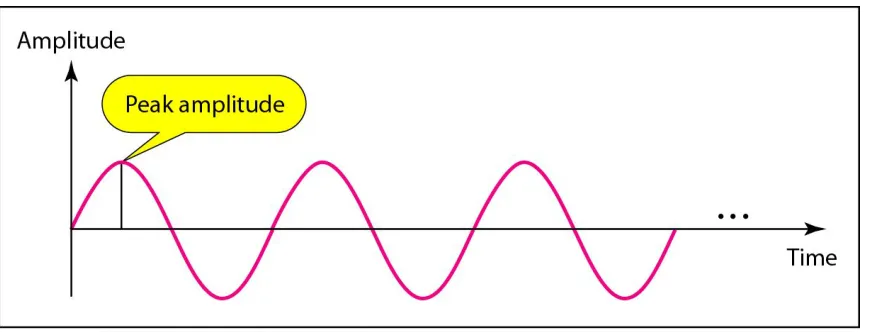
composite. A simple periodic analog signal, a sine wave. A composite periodic analog signal is composed of multiple sine waves.
▪ Sine Wave
▪ Wavelength
▪ Time and Frequency Domain
▪ Composite Signals
▪ Bandwidth
Periodic analog signals and
nonperiodic digital signals.
■ Both analog and digital signals can take one of two forms: periodic or nonperiodic.
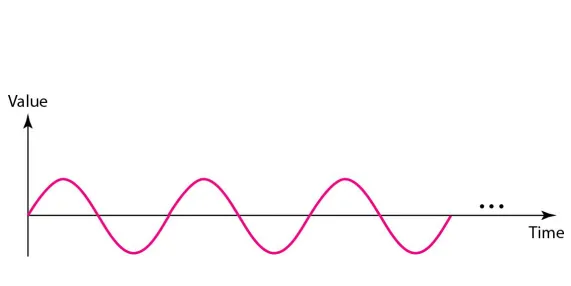
■ A periodic signal completes a pattern within a measurable time frame, called a period, and repeats that pattern over subsequent identical periods. The completion of one full pattern is called a cycle. A nonperiodic signal changes
without exhibiting a pattern or cycle that repeats over time. Both analog and digital signals can be periodic or
nonperiodic. In data communications, we commonly use periodic analog signals (because they need less
3.11
[image:11.720.79.650.127.413.2]Period and Frequency
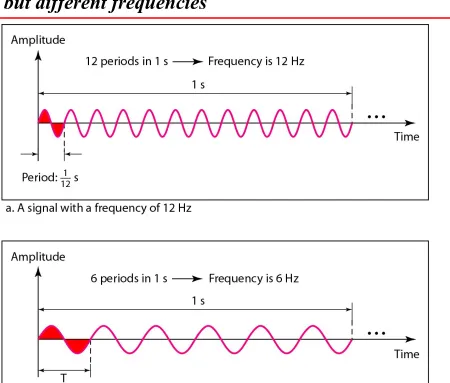
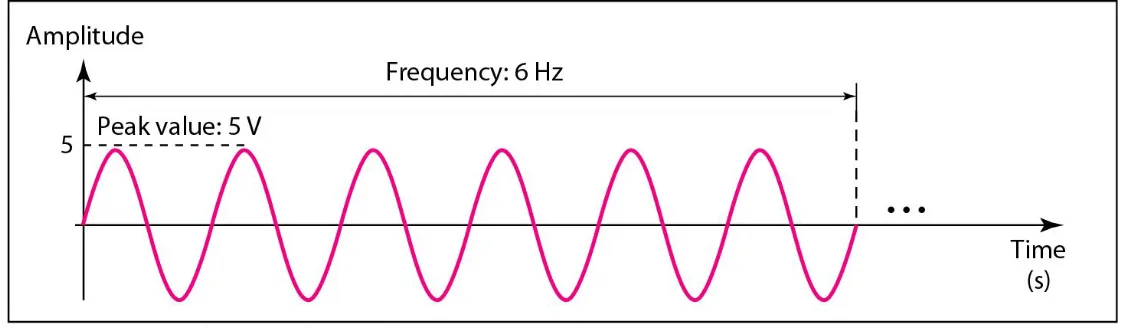
■ Period refers to the amount of time, in seconds, a signal needs to
complete 1 cycle. Frequency refers to the number of periods in I s. Note that period and frequency are just one characteristic defined in two ways. Period is the inverse of frequency, and frequency is the inverse of period, as the following formulas show.
■ f = 1 / T
■ and
T = 1 / f
Frequency and period are the inverse of
each other.
3.15
[image:15.720.147.597.60.443.2]3.17
The power we use at home has a frequency of 60 Hz. The period of this sine wave can be determined as follows:
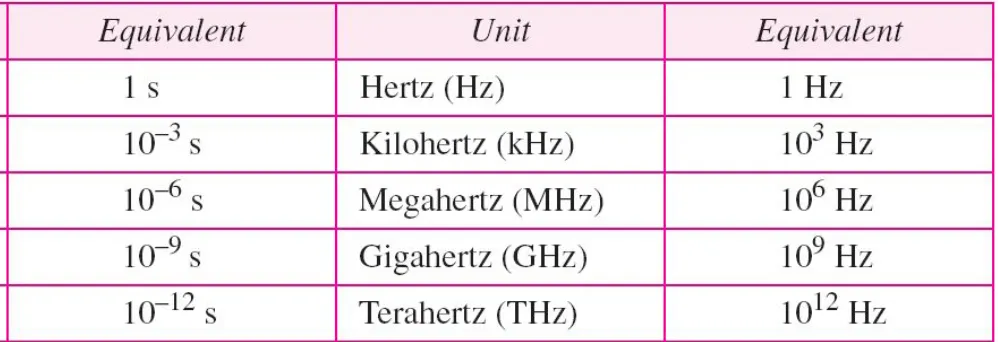
The period of a signal is 100 ms. What is its frequency in kilohertz?
Example 3.2
Solution
3.19
Frequency
•
Frequency is the rate of change with respect
to time.
•
Change in a short span of time means high
frequency.
•
Change over a long span of time means low
If a signal does not change at all, its
frequency is zero.
If a signal changes instantaneously, its
frequency is infinite.
3.21
Phase describes the position of the
waveform relative to time 0.
Phase
■ The term phase describes the position of the waveform relative to time
O. If we think of the wave as something that can be shifted backward or forward along the time axis, phase describes the amount of that shift. It indicates the status of the first cycle.
■ Phase is measured in degrees or radians [360° is 2∏ rad; 1° is 2 ∏ /360
rad, and 1 rad is 360/(2 ∏)]. A phase shift of 360° corresponds to a shift
3.23
[image:23.720.142.569.81.474.2]A sine wave is offset or shift 1/6 cycle with respect to time 0. What is its phase in degrees and radians?
Example 3.3
Solution
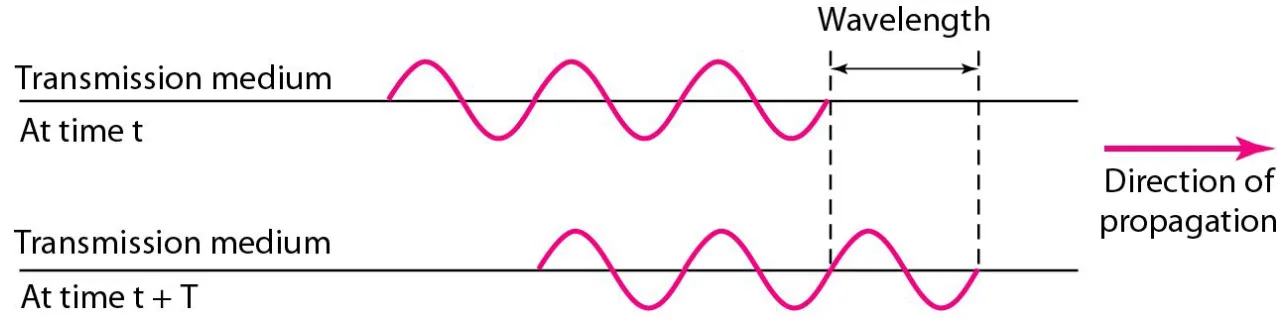
Wavelength
■
Wavelength is another characteristic of a
signal traveling through a transmission
medium. Wavelength binds the period or the
frequency of a simple sine wave to the
propagation speed of the medium (see
Figure 3.6).
■ Wavelength can be calculated if one is given the propagation speed
(the speed of light) and the period of the signal. However, since period and frequency are related to each other, if we represent wavelength by λ , propagation speed by c (speed of light), and frequency by f, we get
■
λ = c / f
■
For example, the wavelength of red light
Time and Frequency Domains
■ A sine wave is comprehensively defined by its amplitude, frequency, and phase.
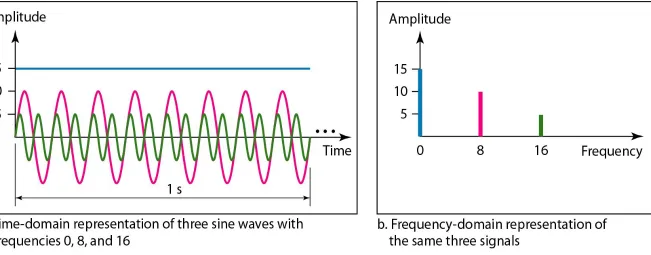
■ The time-domain plot shows changes in signal amplitude with respect to time (it is an amplitude-versus-time plot).
■ To show the relationship between amplitude and
frequency, we can use what is called a frequency-domain plot. A frequency-domain plot is concerned with only the peak value and the frequency.
3.31
The frequency domain is more compact and useful when we are dealing with more than one sine wave. For example, Figure 3.8 shows three sine waves, each with different amplitude and frequency. All can be represented by three spikes in the frequency domain.
3.33
Bandwidth and Signal
Frequency
■
The bandwidth of a composite signal is
the
difference
between the highest and the
■ Figure 3.12 shows the concept of bandwidth. The figure depicts two composite signals, one periodic and the other nonperiodic. The bandwidth of the periodic signal contains all integer frequencies between 1000 and 5000 (1000,
3.35
If a periodic signal is decomposed into five sine waves with frequencies of 100, 300, 500, 700, and 900 Hz, what is its bandwidth? Draw the spectrum, assuming all components have a maximum amplitude of 10 V.
Solution
Let fh be the highest frequency, fl the lowest frequency, and B the bandwidth. Then
Example 3.6
3.37
A periodic signal has a bandwidth of 20 Hz. The highest frequency is 60 Hz. What is the lowest frequency? Draw the spectrum if the signal contains all frequencies of the same amplitude.
Solution
Let fh be the highest frequency, fl the lowest frequency, and B the bandwidth. Then
Example 3.7
3.39
A nonperiodic composite signal has a bandwidth of 200 kHz, with a middle frequency of 140 kHz and peak amplitude of 20 V. The two extreme frequencies have an amplitude of 0. Draw the frequency domain of the signal.
Solution
The lowest frequency must be at 40 kHz and the highest at 240 kHz. Figure 3.15 shows the frequency domain and the bandwidth.
3.41