Chapter 7
Section 7.1:
Monosaccharides
Section 7.2:
Disaccharides
Section 7.3:
Polysaccharides
Section 7.4:
Glycoconjugates
Section 7.5:
The Sugar Code
Carbohydrates
Section 7.1:
Monosaccharides
Figure 7.1 General Formulas for the Aldose and Ketose Forms of
Monosaccharides
Figure 7.2
Glyceraldehyde (an Aldotriose) and
Section 7.1:
Monosaccharides
Monosaccharide
Stereoisomers
Section 7.1:
Monosaccharides
D-Ribose and L-Ribose are
enantiomers;
non-superimposible mirror images
Diastereomers
are
stereoisomers that are not
enantiomers (i.e.,not
mirror-image isomers) (i.e.,
D-ribose
Section 7.1:
Monosaccharides
Diastereomers that differ at a single chiral carbon are epimers (e.g., glucose and D-galactose differ in position of –OH at C-4 and
D-glucose and D-mannose differ in position of
-OH group at C atom #2)
Section 7.1:
Monosaccharides
Section 7.1:
Monosaccharides
The two possible diastereomers that form
because of cyclization are called anomers (α or β)
Figure 7.6
Monosaccharide Structure-
Section 7.1:Chemical reactions of
Monosaccharides
Oxidation
—
monosaccharides may readily
undergo several oxidation reactions in the
presence of metal ions or certain enzymes
Figure 7.12
Oxidation Products of Glucose
Section 7.1: Chemical Reactions of
Monosaccharides
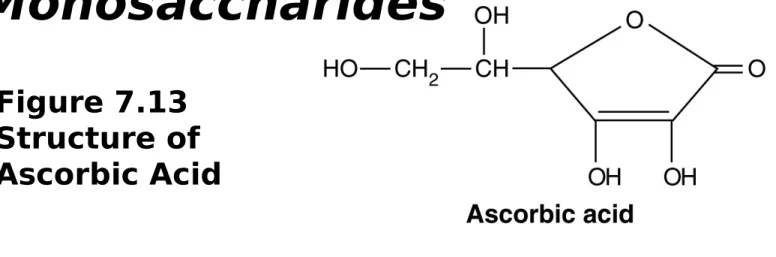
A lactone can be produced if the carbonyl groups
of aldonic or uronic acids react with an OH group in the same molecule
Lactones are readily produced in nature, for
example, L-ascorbic acid (vitamin C)
Vitamin C is a powerful reducing agent that
protects cells from reactive oxygen and nitrogen species
Reduction
—
Sugar alcohols (
alditols
) are
produced by the reduction of aldehyde and ketone
groups of monosaccharides
Sugar alcohols are used in commercial food
processing and in pharmaceuticals (e.g., sorbitol can be used to prevent moisture loss)
Figure 7.15 Structure of D
-Glucitol (Sorbitol)
Esterification
—
free OH groups of carbohydrates
can be converted to esters by reactions with
acids
Esterification often dramatically changes a sugar’s
chemical and physical properties
Section 7.1: Examples of
Monosaccharides
Important Monosaccharides
Glucose (
D-Glucose)
—
originally called
dextrose, it is found in large quantities throughout
the natural world
The primary fuel for living cells
Preferred energy source for brain cells and cells
Fructose (
D-Fructose)
is often referred to as
fruit sugar, because of its high content in fruit
On a per-gram basis, it is twice as sweet as sucrose;
therefore, it is often used as a sweetening agent in processed food
Sperm use fructose as an energy source
Galactose
is necessary to synthesize a variety of
important biomolecules
Important biomolecules include lactose, glycolipids,
phospholipids, proetoglycan, and glycoproteins
Galactosemia is a genetic disorder resulting from
a missing enzyme in galactose metabolism
Monosaccharide Derivatives
Uronic Acids
:
D-Glucuronic acid isused in the liver to improve water solubility to remove waste molecules
Amino Sugars: D-Glucosamine (a) and
D-galactosamine (b) are the most
common and often attached to proteins or lipids
Deoxy Sugars: Form of sugar found in
DNA
Section 7.2:
Disaccharides
Disaccharides
Two monosaccharides linked by a glycosidic
bond
Linkages are named by
a
- or
b
-conformation and
by which carbons are connected (e.g.,
a
(1,4) or
b
(1,4))
Figure 7.27
Section 7.2:
Disaccharides
Disaccharides Continued
Lactose
(
milk sugar
) is the
disaccharide found in milk
One molecule of galactose linked
to one molecule of glucose (b(1,4) linkage)
It is common to have a deficiency
in the enzyme that breaks down lactose (lactase)
Section 7.2:
Disaccharides
Disaccharides Continued
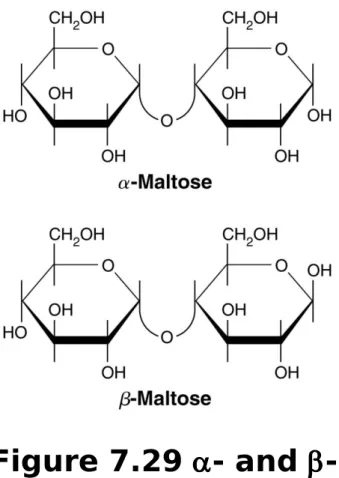
Maltose
(
malt sugar
) is an
intermediate product of
starch hydrolysis
a(1,4) linkage between two molecules of glucose
Does not exist freely in
nature
Section 7.2:
Disaccharides
Disaccharides Continued
Cellobiose
is a degradation
product of cellulose
Cellobiose is composed of two
molecules of glucose linked with a b(1,4) glycosidic bond
Does not exist freely in nature
Section 7.2:
Disaccharides
Disaccharides Continued
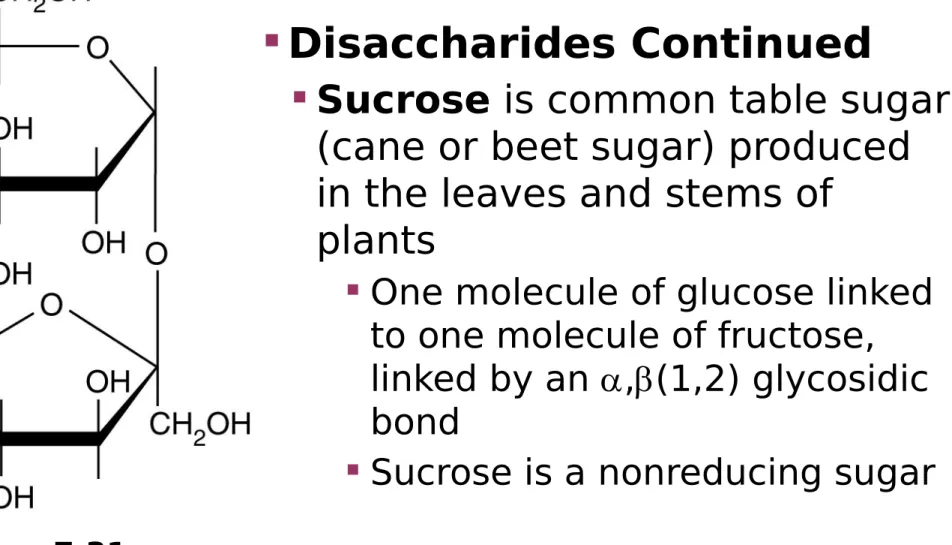
Sucrose
is common table sugar
(cane or beet sugar) produced
in the leaves and stems of
plants
One molecule of glucose linked
to one molecule of fructose,
linked by an a,b(1,2) glycosidic bond
Sucrose is a nonreducing sugar
Section 7.3:
Polysaccharides
Homoglycans
Have one type of monosaccharide and are found in starch,
glycogen, cellulose, and chitin (glucose monomer)
Figure 7.33 Amylose
Starch—the energy reservoir of plant cells and a significant source of carbohydrate in the human diet
Two polysaccharides occur together in starch: amylose and amylopectin
Section 7.3:
Polysaccharides
Figure 7.34 (a)
Section 7.3:
Polysaccharides
Cellulose
is a polymer of D-glucopyranosides
linked by
b
(1,4) glycosidic bonds
It is the most important structural
polysaccharide of plants (most abundant organic
substance on earth)
Figure 7.35 The Disaccharide
Section 7.4:
Glycoconjugates
Glycoconjugates result from
carbohydrates being linked to proteins and lipids
Proteoglycans
Distinguished from other
glycoproteins by their high carbohydrate content
Have roles in organizing
extracellular matrix and are involved in signal transduction
Metabolism of proteoglycans involved in many genetic
Study Objectives
1. Classify monosaccahrides as isomers, and based on number of C atoms
2. Know structures and functions of monosaccharides, disaccharides, and polysaccharides
3. How does glycosidic bond formation happen? Identify compounds based on existing glycosidic bonds