• No results found

DNA Replication ppt

N/A
N/A
Protected

Academic year: 2020

Share "DNA Replication ppt"

Copied!
13
0
0

Loading.... (view fulltext now)

Full text

(1)
(2)

10.4 DNA replication depends on

specific base pairing

DNA replication follows a semiconservative model.

The two DNA strands separate.

Each strand then becomes a template for the assembly of a complementary

strand from a supply of free nucleotides.

(3)

Figure 10.4a-3

A parental molecule of DNA

A T C G A T T A G C A C A T G T G C A C A T G C T A Free nucleotides

The parental strands separate and serve as templates

Two identical daughter molecules of DNA are formed

(4)
(5)

10.5 DNA replication proceeds in

two directions at many sites

simultaneously

Replication of a DNA molecule begins at particular sites called origins

of replication, short stretches of DNA having a specific sequence of nucleotides.

Proteins that initiate DNA replication

attach to the DNA at the origin of replication andseparate the two strands of the double helix.

Replication then proceeds in both directions, creating replication

(6)

Figure 10.5a

Parental DNA

molecule Origin of

replication Parental strandDaughter strand

“Bubble”

Two

daughter DNA

(7)

10.5 DNA replication proceeds in

two directions at many sites

simultaneously

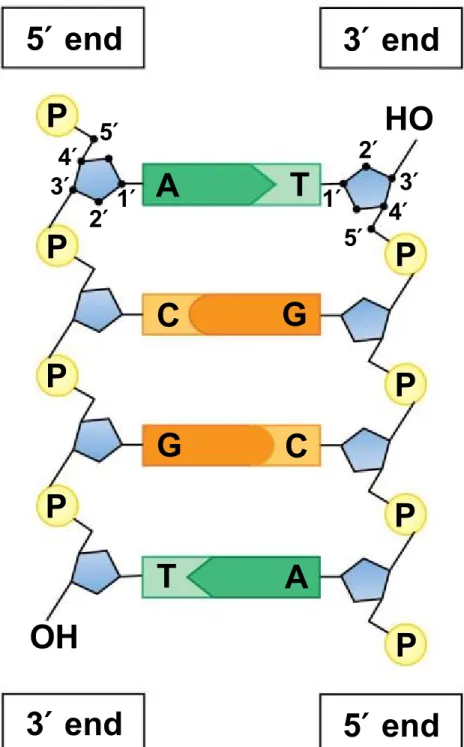
DNA replication occurs in the 5 to 3 direction.

Replication is continuous on the 3 to 5 template.

DNA polymerases add nucleotides only to the 3 end of the strand, never to the 5 end.

Replication is discontinuous on the 5 to 3 template, forming short Okazaki fragments.

An enzyme, called DNA ligase, links (or ligates) the pieces together

(8)

Figure 10.5b 5′ 5′ 1′ 2′ 2′ 4′ 3′ 4′ 3′ P P P P P A T HO C G G C P P P T A OH

5′ end 3′ end

3′ end 5′ end

(9)

Figure 10.5c

Parental DNA

Replication fork

DNA ligase

DNA polymerase

molecule This daughter

strand is synthesized continuously This daughter strand is synthesized in pieces 5′ 3′ 5′ 3′ 3′ 3′ 5′ 5′

(10)
(11)

10.5 DNA replication proceeds in

two directions at many sites

simultaneously

DNA polymerases and DNA ligase also repair DNA damaged by

harmful radiation and toxic chemicals.

DNA replication ensures that all the somatic cells in a multicellular

(12)
(13)

Figure

Figure 10.4a-3 A parental molecule of DNAATCGATTAGC ACATG TG C ACA TG CTAFree nucleotides
Figure 10.4b Parental DNA molecule Daughter strand Parental strand Daughter DNA molecules A TG CAAATTTCGTCGCGT A C G A T A T G CA TGCATGCGCAGCATATGATC
Figure 10.5b 5′ 5′1′2′ 2′ 4′ 3′4′3′P P P PPAT HOCG G C PP PTAOH5′ end 3′ end 3′ end 5′ end1′

References

Related documents

(B) To measure the ability of wild-type or mutant BKRF3 to interact with viral DNA replication-associated proteins, NA cells transfected with 7, 14, or 4 ␮ g of HA-BKRF3

HSV-1 replication proteins, the HSV-1 polymerase UL30, the polymerase accessory protein UL42, and the DNA single- strand DNA binding protein UL29, could cooperate with Rep to

To appropriate the cellular DNA replication machinery, simian virus 40 (SV40) large T antigen (Tag) binds to three different cellular replication proteins, the DNA polymerase a

Proteins from herpes simplex virus (HSV)-infected cells were used to reconstitute DNA synthesis in vitro on a preformed replication fork.. The preformed replication fork consisted of

The viral protein p6, required for 429 DNA replication in vivo (20), stimulates both the initiation and elongation steps of 4)29 DNA replication in vitro (3, 23). When purified

4. The mechanism of replication of 4X174 single-stranded DNA. The mechanism of replication of 4X174. Gene A and A* proteins of 4X174 bind tightly to 4X174 replicative form DNA.

This is composed of three virally encoded proteins: adenovirus DNA polymerase, precursor terminal protein and DNA binding protein, and two cellular proteins nuclear factor I

• There is about about one error in 10 6 nucleotides bases added in DNA replication, repaired by: proofreading, mismatch repair, and excision repair.. DNA