R E S E A R C H A R T I C L E
Open Access
Evaluation of new classifications of N
descriptor in non-small cell lung cancer
(NSCLC) based on the number and the
ratio of metastatic lymph nodes
Konrad Pawe
ł
czyk
*, Marek Marciniak and Piotr B
ł
asiak
Abstract
Background:The aim of the study was to evaluate the prognostic power of new classifications of N descriptor created basing on the number (NLN) and the ratio of metastatic lymph nodes (RLN) in NSCLC compared to the current classification (CLN).
Methods:The data of 529 patients with NSCLC operated with the intention of radical resection, were analyzed. The new categories of N descriptor were created as follows: 1) NLN - median number of metastatic nodes was 3, thus in NLN0 the number of metastatic nodes =0, in NLN1 1-2, in NLN2≥3, 2) RLN - median ratio (number of metastatic lymph nodes to all nodes removed) was 12.4 %, thus in RLN0 the ratio was 0, in RLN1 < 13 %, in RLN2 > 13 %. The prognostic value of each classification was calculated on the basis of hazard ratios defined in multivariate Cox proportional hazard model.
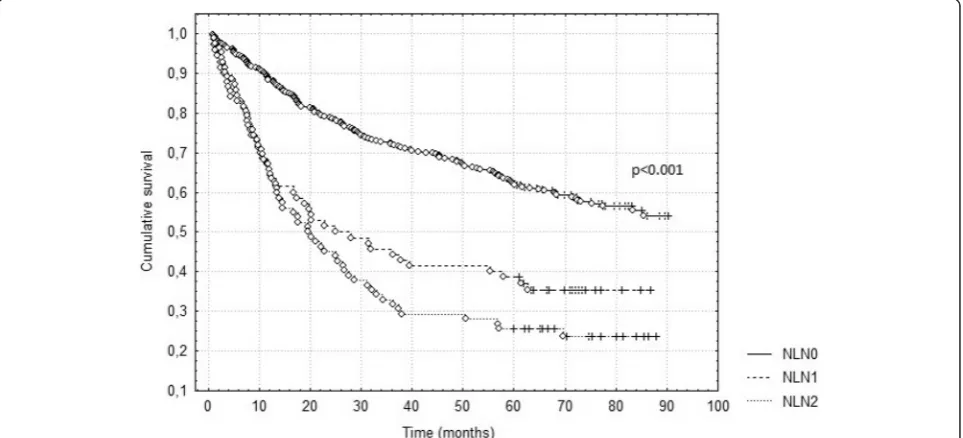
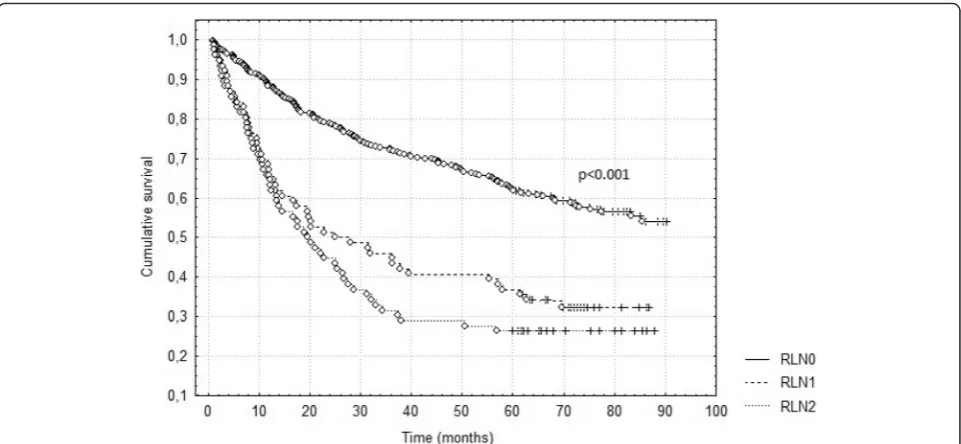
Results:The new classifications of N descriptor turned out to be an independent strong prognostic factor (p<0.001) with a 5-year survival rate NLN0-62 %, NLN1-39 %, NLN2-26 % and RLN0-62 %, RLN1-37 % and RLN2-26 %. For 5-year survival rates in CLN0-62 %, CLN1-42 %, CLN2-24 % (p< 0.001), a higher prognostic value of new classifications was not demonstrated, the hazard ratio amounted to 2.22, 2.08, 2.49 for NLN2, RLN2 and CLN2 respectively.
Conclusion:Despite the significantly high prognostic power, the new classifications cannot be considered superior over CLN. There are some deficiencies in the current classification, therefore further studies on its improvement are needed. Keywords:Metastatic lymph nodes, TNM classification, Non-small cell lung cancer
Background
Despite the high heterogeneity of N descriptor, its classification in NSCLC has remained unchanged since 1987, when the fourth edition of the TNM classification was published [1]. The heterogeneity of N descriptor refers mainly to metastases in mediastinal lymph nodes (N2) where we can identify patients with a single meta-static node within one node station, several metameta-static nodes in one node station, multi-level N2 disease and patients with“bulky disease”. According to many reports, the prognosis in these groups, as well as an approach to a surgical management being a part of multimodality
therapy or disqualification from the operation, may be different [2–4]. The heterogeneity of N descriptor causes that the spread of neoplastic processes to mediastinal lymph nodes, frequently excluding intrapulmonary nodal groups and a pulmonary hilum (skipping metastasis) is unsymmetrical and difficult to predict. According to some reports, the prognosis of patients with N2 but negative N1 is better than of patients with a positive N2 and N1 simultaneously [5]. The classifications of N descriptor in NSCLC appearing successively, however, are based on the location of lymph nodes and assume the sym-metrical spread of the cancer.
Therefore, due to the differences in the prognosis asso-ciated with heterogeneity of N2 descriptor, it should be considered whether to classify lymph nodes in NSCLC * Correspondence:[email protected]
Department of General Thoracic Surgery, Wroclaw Thoracic Surgery Centre, Wroclaw Medical University, Wroclaw, Poland
depending on the number of metastatic nodes or on the ratio of the number of resected nodes to metastatic nodes. A similar assumption has been adopted for instance in staging a colorectal, gastric and breast cancer in which the number of metastatic lymph nodes has been considered one of the elements staging N descriptor [6]. It is also sug-gested that the ratio determining the number of metastatic lymph nodes, particularly relating to a breast, bladder, colorectal cancer may have a significant prognostic value in the classification of N descriptor [7–9].
The aim of the paper is to evaluate the prognostic value of classifications based on the number of meta-static lymph nodes (NLN) and on the ratio of the number of resected nodes to metastatic nodes (RLN) compared to the current classification of N descriptor (CLN) in NSCLC.
Methods
The data of 700 patients with lung cancer subsequently operated with the intention of radical resection, were analyzed. All patients were treated surgically between 1 January 2007 and 1 July 2009 in one, high volume thoracic surgery center. Data for statistical analyzes were obtained from the National Lung Cancer Registry. To eliminate factors which may additionally affect or do affect the prog-nosis, 92 patients after limited resections (wedge resection or segmentectomy), 7 patients with carcinoid tumor, 7 patients with small cell lung cancer, 14 patients with R1 resection, 3 patients with M1 and 13 perioperative deaths were excluded from the study. In addition, 35 patients with removed nodes <6 were excluded because the re-moval of at least 6 nodes is recommended to perform proper staging of N descriptor [10]. Finally, a group of 529 patients remained whose data were further analyzed.
Before taking a decision on a surgical treatment, all the patients had a chest radiography, chest computed tomography (CT), bronchoscopy, abdominal ultrasound and CT/MRI of the central nervous system, in case of neurological symptoms. Positron emission tomography (PET-CT) was performed in case of doubts, before the invasive diagnosis of mediastinal lymph nodes and in case of the diagnosis of mediastinal and peripheral changes in the suspicion of metastases. In case of suspi-cion of metastases to mediastinal lymph nodes during preoperative imaging (>1 cm diameter in a short axis) a videomediastinoscopy or a transtracheal/transbronchial biopsy was performed without ultrasound guidance (TBNA). Endobronchial ultrasound (EBUS) and endo-scopic oesophageal ultrasound (EUS) were not per-formed as there were just introduced into the diagnosis of mediastinal lymphadenopathy. The surgical treatment in the studied group of patients included anatomical re-section of the lung parenchyma (lobectomy, bilobectomy, pneumonectomy) and systematic mediastinal lymph node
dissection with “en bloc” resection of right paratracheal 2R and 4R nodes. Nodes of 4 L, 5, 6, 7, 8, 9, 10 and 11 groups were removed separately. Intrapulmonary nodes of 12 group were removed together with a lobe, then care-fully resected and evaluated by a histopathologist. The mediastinal lymph nodes were resected“en bloc”with the fatty tissue of mediastinum wherever it was possible to avoid defragmentation and were divided on the operating table, then each lymph node was sent for histopathological examination in a separate box. If the lymph node was dis-integrated during harvesting the pieces were sent to evalu-ation in one box as a one lymph node. Pathological staging was evaluated on the basis of the current seventh edition of the TNM, all the stages were revised from the pathology reports and the Polish National Lung Cancer Registry.
The postoperative follow-up included radiological examination every 3 months for the first two years, then every 6 months for 3 next years, and once a year after-wards. Every 6 months, a control chest CT scan was performed. Median follow-up for the entire group was 61 months.
New categories of N descriptor were created in the following manner:
1) the classification based on the number of metastatic lymph nodes (NLN)
Median number of metastatic lymph nodes was 3 (1 to 25). The median enables to create a boundary line between new NLN1 descriptor and NLN2. Thus, in patients with NLN0 descriptor the number of metastatic lymph nodes = 0, with NLN1 the number of metastatic lymph nodes <3 and with NLN2≥3 metastatic nodes.
2) the classification based on the ratio of metastatic lymph nodes (RLN)
The ratio determines the quotient of metastatic lymph nodes to all nodes removed during the operation. The median of the calculated ratios was 12.4 % (2.2 % to 70 %). For patients with a RLN0 descriptor the ratio was 0, for patients with RLN1 < 13 %, for patients with
RLN2 > 13 %.
Results
Patient records including demographic, surgical and pathological data are presented in Table 1. On average, during the operation 23.4 nodes were resected (6 –71). Among 529 patients included in the study, 377 (71.3 %) had no metastases in the resected lymph nodes. Postop-erative chemotherapy was used in 45 patients with N1 descriptor (72 %) and in 56 patients with N2 (62 %), furthermore postoperative radiotherapy was used in 15 patients with N2 descriptor (17 %). Finally 36 patients (23 %) with N1 or N2 disease did not receive adjuvant
therapy mainly because of inadequate performance status after surgery or other contraindications or a refusal of the further treatment.
In 9 patients (1.7 %) a tumor was resected with the chest wall, in 11 patients (2.1 %) bronchial sleeve resection was performed, in 4 (0.7 %) artery sleeve resection, in 11 (2.1 %) wedge resection of another lobe on the same side. Mean greatest dimension of a tumor was 40.6 mm.
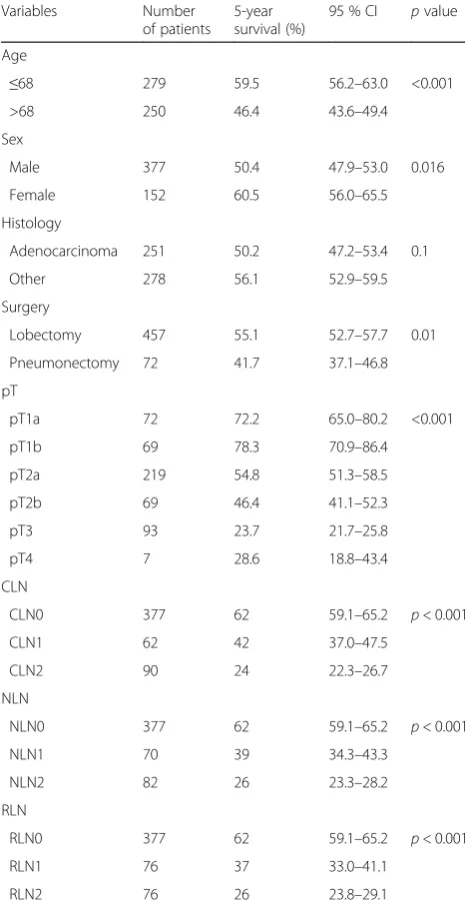
The survival according to the current and suggested nodal classifications is presented in Table 1 and the sur-vival curves according to CLN, NLN and RLN in Figs. 1, 2 and 3. All the studied classifications turned out to have a strong prognostic value (p<0.001). In order to evaluate the prognostic power of each classification, multivariate analysis was performed including all the factors analyzed univariately. Each of the studied nodal classifications was included in the multivariate analysis separately and values of hazard ratios in each analysis were compared. The data presented in Table 2 show that despite the small differences, the hazard ratio of the current N2 de-scriptor is the highest and amounts to 2.49 in compari-son with NLN2 (HR = 2.22) and RLN2 (HR = 2.08). Each of the studied classifications in the multivariate analysis turned out to be a statistically significant prognostic factor but none of the newly studied classifications is su-perior over the current one. In the multivariate analysis it was also found that age (p< 0.001), tumor histology (p= 0.032) and pathological T descriptor (p< 0.001) are strong independent prognostic factors in the evaluation of overall survival of the patients.
Discussion
Metastases to mediastinal lymph nodes are currently in-disputable and one of the strongest prognostic factors in a group of patients treated surgically because of non-small cell lung cancer [11]. Despite the high variability in N2 descriptor including patients with micrometas-tases or“bulky disease”and patients with a single meta-static node or multiple metastases in many nodal stations, the classification of N descriptor has remained unchanged for several editions of TNM. Despite the much better methods of the preoperative evaluation of mediastinal lymph nodes, in approximately 10–14 % of patients N2 disease is still found in a postoperative ma-terial [12, 13]. Moreover, many reports show that the prognosis of operated patients with N2 descriptor may considerably vary in the final histopathological evalu-ation due to the heterogeneity of metastases to medi-astinal lymph nodes [4, 14]. The last modifications of the TNM system in certain malignancies such as colorectal, gastric and breast cancer involving only an anatomical classification of N descriptor incline to the similar approach to the classification of N descriptor in a lung cancer.
Table 1Patient characteristics and survival according to the current and new nodal classifications
Variables Number
of patients 5-year survival (%)
95 % CI pvalue
Age
≤68 279 59.5 56.2–63.0 <0.001
>68 250 46.4 43.6–49.4
Sex
Male 377 50.4 47.9–53.0 0.016
Female 152 60.5 56.0–65.5
Histology
Adenocarcinoma 251 50.2 47.2–53.4 0.1
Other 278 56.1 52.9–59.5
Surgery
Lobectomy 457 55.1 52.7–57.7 0.01
Pneumonectomy 72 41.7 37.1–46.8
pT
pT1a 72 72.2 65.0–80.2 <0.001
pT1b 69 78.3 70.9–86.4
pT2a 219 54.8 51.3–58.5
pT2b 69 46.4 41.1–52.3
pT3 93 23.7 21.7–25.8
pT4 7 28.6 18.8–43.4
CLN
CLN0 377 62 59.1–65.2 p< 0.001
CLN1 62 42 37.0–47.5
CLN2 90 24 22.3–26.7
NLN
NLN0 377 62 59.1–65.2 p< 0.001
NLN1 70 39 34.3–43.3
NLN2 82 26 23.3–28.2
RLN
RLN0 377 62 59.1–65.2 p< 0.001
RLN1 76 37 33.0–41.1
RLN2 76 26 23.8–29.1
CIconfidence interval,CLNcurrent nodal classification,NLNnew classification
based on the number of metastatic lymph nodes,RLNnew classification based
In this study, an effort was made to validate possible changes in the TNM system assuming the importance of the number of metastatic lymph nodes or the ratio of metastatic nodes to removed nodes in staging NSCLC. A homogeneous group of patients was selected, con-secutively operated in a high-volume center, after the anatomical resections of lung parenchyma and the intra-operative removal at least 6 lymph nodes in order to verify the importance of the non-anatomical classifica-tion of N descriptor. The extent of lymph node resecclassifica-tion
raises a lot of discussions, however, there is no doubt that at least a systemic lymph node sampling is needed for staging N descriptor and most authors recommend mediastinal lymphadenectomy [10, 15, 16]. In literature there is no agreement regarding the minimum number of lymph nodes to be removed. It is recommended by ESTS to remove at least six nodes, according to the data compiled from the SEER database 11–16 nodes, according to Doddoli et al. 10 nodes and according to Wu et al. at least 15 nodes [10, 17–19]. In our study during the Fig. 1Survival according to current nodal classification (CLN)
operation 23.4 lymph nodes were removed (10.6 % of patients had less than 11 nodes removed) which seems to be enough to stage N descriptor accurately.
In our study we do not confirm the hypothesis that assumes the better prognostic value of staging N2 de-scriptor based on the number of metastatic nodes or the ratio determining their proportions. While studying a group of patients after systematic lymph node dissection, it was found that the highest hazard ratio of the evalu-ation of N2 descriptor refers to the current classificevalu-ation of N2 descriptor. Despite the small differences between the various classifications, it cannot be stated that adding new elements to the classification of N descriptor in the new 8th edition of TNM will bring prognostic benefits. In the last years, a few studies have been published which
assume that the effect of the number of removed lymph nodes or the ratio determining the number of metastatic nodes on survival is significant and better than the current classification [20–23]. However, these studies relate to long periods of observations mainly from the 80’s and 90’s of the last century, when the approach to preoperative staging, the extent of mediastinal lymphadenectomy, the evaluation of mediastinal nodes, the removal of metastatic lymph nodes from mediastinum (even “bulky disease”), the use of neoadjuvant chemotherapy for metastases to mediastinal lymph nodes were slightly different from that one in the middle of the last decade. Perhaps before we start to look for a better classification of N2 descriptor including its heterogeneity we should consider how to systematize and standardize the removal of lymph nodes in patients treated surgically because sometimes, even in one thoracic surgery center, the extent of lymphadenectomy may vary completely [24]. The studies, in which a higher prognostic value of metastatic nodes has been proved, as-sume the division of N descriptor into several subgroups depending on the ranges into which metastatic lymph nodes were divided [20, 21, 23]. Aiming at a simple method of classification of N descriptor, in our study we tried to determine a dividing line of metastatic nodes de-fined by the median. In our study, the median was 3 meta-static nodes, in a not much bigger population a similar dividing line was defined by Matsuguma (median 2 nodes) [22]. In studies on large populations, the median value is likely to change only a little and will range between 2–3 metastatic nodes. In order to avoid further development of the TNM system with numerous subgroups of N descriptor and making it more complex and less clear, it is justified Fig. 3Survival according to new classification based on the ratio of metastatic lymph nodes (RLN)
Table 2Comparison of hazard ratios of the current and new
nodal classifications included in the multivariate analysis
Variables HR Pvalue
CLN
CLN1 1.49 0.025
CLN2 2.49 <0.001
NLN
NLN1 1.74 0.001
NLN2 2.22 <0.001
RLN
RLN1 1.90 <0.001
RLN2 2.08 <0.001
taking into consideration the value of median in further study on the significance of the number of metastatic lymph nodes. The suggested division of the number of metastatic lymph nodes into groups: 1–3, 4–6, >6 [21], 1–4, 4–14, >14 [23], 1–3, 4–6, 7–9, ≥10 [20] can be found in literature. It seems that even basing on the studies on large populations, it will be difficult to estab-lish several dividing lines of the number of metastatic nodes, as well as, it is currently difficult to define the minimum number of nodes that must be removed to per-form appropriate staging of N descriptor. In addition, re-gardless of the size of nodes in imaging examinations, many of the centers have introduced minimally invasive techniques such as EBUS and EUS to routinely preopera-tive staging of N descriptor. This will probably cause that the chances to diagnose a several or even more metastatic lymph nodes in patients in the postoperative evaluation will be considerably reduced. However, it should be noted that although the prognostic power is weaker than the current one, the new classifications are also a signifi-cant and strong prognostic factor in a surgically treated NSCLC (p<0.001) in the evaluation of both N1 and N2 descriptors. Therefore it seems that we should not erase their significance. The study was currently carried out on a relatively small population which is its limita-tion. Though it is possible that studies on bigger popu-lations will allow to include the ratio or the number of metastatic lymph nodes to the current classification system of N descriptor as its complement but not as a complete substitute.
It should be also taken into account that the current classification of N descriptor based on the location of nodes is used not only in the postoperative but also in the preoperative evaluation as it is easy to evaluate the location of nodes in imaging studies before the planned surgical treatment. When introducing new rules for the classification of N descriptor, there are some discrepancies between clinical and pathological staging of a disease. The complexity and difficulty of the pathological classification of lymph nodes resulting from the heterogeneity of N descriptor cause that in the future neither a location, quantity nor a ratio of metastatic nodes will be important in the decision on the adjuvant treatment. Probably the evaluation of nodes for novel molecular tumor cell markers determines a tumor aggressiveness, a status of N descriptor as well as, whether the patient should be treated after surgery or observed [25, 26]. In each case however, it will be necessary to remove an appropriate number of lymph nodes for pathological diagnostics.
Conclusion
In conclusion, despite the significant prognostic power, it cannot be assumed that new classifications defining N descriptor are superior over the currently one.
Nevertheless, it should be borne in mind that there are some deficiencies in the current classification, there-fore further studies on its improvement are needed, regarding both the planned adjuvant treatment as well as, raising the rank of removing a proper number of lymph nodes to stage a disease appropriately.
Abbreviations
CI:confidence interval; CLN: current nodal classification; HR: hazard ratio; NSCLC: non-small cell lung cancer; NLN: new classification based on the number of metastatic lymph nodes; RLN: new classification based on the ratio of metastatic to resected lymph nodes.
Competing interests
The authors declare that they have no competing interests.
Authors’contributions
KP have made substantial contributions to conception and design of the study, carried out the acquisition and interpretation of data, MM carried out the acquisition of data and have been involved in drafting the manuscript and revising it critically, PB participated in the design of the study and performed the statistical analysis. All authors read and approved the final manuscript.
Disclosure Statement
The authors report that no potential conflicts of interest exist with any companies/organizations whose products or services may be discussed in this article.
Received: 21 November 2015 Accepted: 5 April 2016
References
1. International Union Against Cancer (UICC). In: Hermanek P, Sobin LH, editors. TNM Classification of malignant tumours. 4th ed. Berlin, Heidelberg, New York: Springer Verlag; 1987.
2. Lorent N, De Leyn P, Lievens Y, Verbeken E, Nackaerts K, Dooms C, et al. Long-term survival of surgically staged IIIA-N2 non-small-cell lung cancertreated with surgical combined modality approach: analysis of a 7-year prospective experience. Ann Oncol. 2004;15:1645–53.
3. Detterbeck F. What to do with“Surprise”N2?: intraoperative management of patients with non-small cell lung cancer. J Thorac Oncol. 2008;3:289–302. 4. Decaluwe H, De Leyn P, Vansteenkiste J, Dooms C, Van Raemdonck D,
Nafteux P, et al. Surgical multimodality treatment for baseline resectable stage IIIA-N2 non-small cell lung cancer. Degree of mediastinal lymph node involvement and impact on survival. Eur J Cardiothorac Surg. 2009;36:433–9. 5. Riquet M, Assouad J, Bagan P, Foucault C, Le Pimpec BF, et al. Skip
mediastinal lymph node metastasis and lung cancer: a particular N2 subgroup with a better prognosis. Ann Thorac Surg. 2005;79:225–33. 6. Sobin LH, Gospodarowicz M, Wittekind C, editors. UICC TNM Classification of
malignant tumours. 7th ed. New York: Wiley-Liss; 2009.
7. Vinh-Hung V, Verschraegen C, Promish DI, Cserni G, Van de Steene J, Tai P, et al. Ratios of involved nodes in early breast cancer. Breast Cancer Res. 2004;6:R680–8.
8. Herr HW. Superiority of ratio based lymph node staging for bladder cancer. J Urol. 2003;169:943–5.
9. Peschaud F, Benoist S, Julié C, Beauchet A, Penna C, Rougier P, et al. The ratio of metastatic to examined lymph nodes is a powerful independent prognostic factor in rectal cancer. Ann Surg. 2008;248:1067–73. 10. De Leyn P, Lardinois D, Van Schil P, Rami-Porta R, Passlick B, Zielinski M,
et al. European trends in preoperative and intraoperative nodal staging: ESTS guidelines. J Thorac Oncol. 2007;2:357–61.
11. Osarogiagbon RU. Predicting survival of patients with resectable non-small cell lung cancer: Beyond TNM. J Thorac Dis. 2012;4:214–6.
12. Cho HJ, Kim SR, Kim HR, Han JO, Kim YH, Kim DK, et al. Modern outcome and risk analysis of surgically resected occult N2 non-small cell lung cancer. Ann Thorac Surg. 2014;97:1920–5.
14. Van Meerbeeck JP, Surmont VF. Stage IIIA-N2 NSCLC: a review of its treatment approaches and future developments. Lung Cancer. 2009;65:257–67. 15. Darling GE, Allen MS, Decker PA, Ballman K, Malthaner RA, Inculet RI, et al.
Number of lymph nodes harvested from a mediastinal lymphadenectomy: results of the randomized, prospective American College of Surgeons Oncology Group Z0030 trial. Chest. 2011;139:1124–9.
16. Vielva LR, Jaen MW, Alcácer JA, Cardona MC. State of the art in surgery for early stage NSCLC-does the number of resected lymph nodes matter? Transl Lung Cancer Res. 2014;3:95–9.
17. Ludwig MS, Goodman M, Miller DL, Johnstone PA. Postoperative survival and the number of lymph nodes sampled during resection of node-negative non-small cell lung cancer. Chest. 2005;128:1545–50.
18. Doddoli C, Aragon A, Barlesi F, Chetaille B, Robitail S, Giudicelli R, et al. Does the extent of lymph node dissection influence outcome in patients with stage I non-small-cell lung cancer? Eur J Cardiothorac Surg. 2005;27:680–5. 19. Wu YC, Lin CF, Hsu WH, Huang BS, Huang MH, Wang LS. Long-term results
of pathological stage I non-small cell lung cancer: validation of using the number of totally removed lymph nodes as a staging control. Eur J Cardiothorac Surg. 2003;24:994–1001.
20. Nwogu CE, Groman A, Fahey D, Yendamuri S, Dexter E, Demmy TL, et al. Number of lymph nodes and metastatic lymph node ratio are associated with survival in lung cancer. Ann Thorac Surg. 2012;93:1614–9. 21. Fukui T, Mori S, Yokoi K, Mitsudomi T. Significance of the number of
positive lymph nodes in resected non-small cell lung cancer. J Thorac Oncol. 2006;1:120–5.
22. Matsuguma H, Oki I, Nakahara R, Ohata N, Igarashi S, Mori K, et al. Proposal of new nodal classifications for non-small-cell lung cancer based on the number and ratio of metastatic lymph nodes. Eur J Cardiothorac Surg. 2012; 41:19–24.
23. Lee JG, Lee CY, Park IK, Kim DJ, Park SY, Kim KD, et al. Number of metastatic lymph nodes in resected non-small cell lung cancer predicts patient survival. Ann Thorac Surg. 2008;85:211–5.
24. Osarogiagbon RU, Allen JW, Farooq A, Berry A, O’Brien T. Pathologic lymph node staging practice and stage-predicted survival after resection of lung cancer. Ann Thorac Surg. 2011;91:1486–92.
25. Nordgård O, Singh G, Solberg S, Jørgensen L, Halvorsen AR, Smaaland R, et al. Novel molecular tumor cell markers in regional lymph nodes and blood samples from patients undergoing surgery for non-small cell lung cancer. PLoS One. 2013;8:e62153.
26. Ji HF, Pang D, Fu SB, Jin Y, Yao L, Qi JP, et al. Overexpression of focal adhesion kinase correlates with increased lymph node metastasis and poor prognosis in non-small-cell lung cancer. J Cancer Res Clin Oncol. 2013;139:429–35.
• We accept pre-submission inquiries
• Our selector tool helps you to find the most relevant journal • We provide round the clock customer support
• Convenient online submission • Thorough peer review
• Inclusion in PubMed and all major indexing services • Maximum visibility for your research
Submit your manuscript at www.biomedcentral.com/submit