ISSN 2319 – 5967
Research on AODV Routing Protocol based on
Improved Genetic Algorithm and Ant Colony Algorithm
Hong Tang*, Yanfang Guo*, Han Liao*
*Chongqing Key Lab of Mobile Communications Technology, Chongqing University of Posts and Telecommunications, Chongqing 400065, P. R. China
E-mai: [email protected], [email protected],
Abstract
Aimed at the problems that classical ant colony algorithm is easy to fall into local optimal, this thesis puts forward a new AODV routing protocol based on improved genetic-ant colony algorithms (IGAACA-AODV) by introducing genetic algorithm (GA) to improve ant colony algorithm, and combining with the characteristics of AODV routing protocols in Ad Hoc network. First of all, the proposed algorithm takes advantage of the global quickly searching ability in genetic algorithm to obtain the optimization solution set of path and transforms it to the initial information pheromone distribution of ant colony algorithm. Then, the updating rules of pheromone in ant colony algorithm is improved; both the residual energy of nodes and the link delay in the process of searching path are taken into account synthetically. Finally, a reasonable and effective optimal path in an adaptive selected way is found by using the positive feedback characteristics and the capability of rapid search. Compared with the GA and Ant-AODV and the traditional AODV routing protocol, simulation results show that the new algorithm not only increases the search diversity of the path, but also reduces the average end-to-end delay. Meanwhile, this new algorithm may improve the data packet ratio and prolongs lifetime of network.
Keywords: Ad Hoc network, ant colony algorithm, genetic
algorithm, AODV routing protocol
1. Introduction
Ant colony algorithm (ACA) is a kind of heuristic algorithm which was proposed by Italy scholar Dorigo in 1991[1]. Ants are able to discover the shortest path from their nest to food source and share information with other ants through pheromone [2]. Pheromones maybe change in the environment which can be sensed by ants.
Ad Hoc network is a temporary multi-hop autonomous system which consists of a set of mobile nodes with wireless transmitter and receiver sets, and every node can move freely. Studies show that the principle of ant foraging can be used to solve the routing problem in the network;
however, ACA itself is easy to fall into local solution. Therefore, in order to solve this problem, this plan needs to introduce genetic algorithm [3]. In [4], this paper optimizes routing protocol in Ad Hoc network, mainly by introducing genetic algorithm (GA) to design the process of genetic operation, and using the global searching ability to improve the performance of routing protocol. But there are some shortcomings in the methods. For example [5], genetic algorithm cannot use feedback information of network sufficiently, so this algorithm maybe make massive redundancy iteration, which makes the algorithm accuracy reduced, and convergence speed has become very slow. In [6], the paper combines characteristics of ant colony algorithm to study routing protocol in wireless Ad Hoc network, the main measures are continuously sending "ants" to explore nodes in the network, and finally establishes an effective path to transmit the data packet. But the deficiency is that the ant colony algorithm cannot reach the global optimal, and it is often easy to loop in the local search.
In this paper, the proposed algorithm (IGAACA) firstly changes the design of genetic algorithm to fuse two algorithms effectively; then changes the pheromone update rule of ant colony algorithm and combines with the characteristics of the AODV routing process in Ad Hoc network; finally finds the optimal path for reliable data transmission.
The rest of this paper is structured as follows: we introduce ant colony algorithm and some applied literature researches related to Ad Hoc network in Section 1, and we design the proposed algorithm (IGAACA) in Section 2. Then in Section 3, the flowchart of its implementation is given. The performance analysis of improved protocol is evaluated in Section 4. Finally, we conclude the paper in Section 5.
2. Design of the Improved Genetic-Ant
Colony Algorithm
ISSN 2319 – 5967
algorithm in detail, the main content includes three aspects: one is the design of fitness function in genetic algorithm; two is to improve the pheromone updating rule of ant colony algorithm; three is the design of objective function. In the process, the residual energy of nodes and the factors of path delay are considered, and this scheme uses the optimal solution set from GA to modify the initial pheromone acquisition rules of ACA.
2.1 Improvement Method of Genetic Algorithm
1. Coding. By using natural coding, it is advantageous to crossover and mutation operation in genetic operation.
2. The fitness function. The fitness function uses a delay of the node's residual energy information as a measure of the cost of routing, Definition as shown in the formula 1:
len len c delay
initial remain
delay t t
Q q T T
energy energy e
f
e f T route R route R f
⋅ =
⋅ =
= =
) (
) (
, ) ( ,
) ( )
(
2
cos cos
1
ε ε
(1)
Where ε1 and
ε
2are constant between (0, 1),c
T is a
delay constant,
len
q represents the path length of the
current node,
len
Q is the maximum length for node cache. It
is known that when the fitness value of the individual is optimal, and the routing cost of the path is the least, that is to say, to select the nodes with more residual energy and less delay to participate in the routing.
3. Genetic manipulation. There are selection, crossover and mutation operations [5]. The selection of the individual needs to sort in accordance with the size of the fitness value, and select individuals that own the better fitness value into the next generation; Crossover uses in the adaptive way, which can effectively expand searching space, and is easy to obtain a better solution set; Mutation operation uses the direct inversion method; simultaneously, the individual fitness value which is extremely small will be eliminated. In order to ensure the diversity of population and the search progress of the global optimal solution, thus new individuals are introduced at any time.
2.2 Improvement Strategies of Ant Colony
Algorithm
To improve the shortcomings of ACA, this section mainly consists of three parts: the introduction of genetic algorithm; the design of initial pheromone acquisition rules and the improvement of pheromone update rules.
2.2.1 The Introduction of Genetic Algorithm
It was found that the solution process of these two
algorithms is shown as the v-t curve in the general trend
shown in Figure 1. The improved algorithm makes use of the characteristics of the fast convergence of GA in the early period to make up the defect of the slow convergence of ACA. This way not only makes use of the fast iterative performance of GA in the early stage, but also takes advantage of fast convergence of ACA in the later stage.
Finally the proposed algorithm can realize the
complementary advantages of the two algorithms, which make it relatively good fusion algorithm in time and solving efficiency [7].
tc
ACA
GA V
t Vc
0
Fig1 Solution trend diagram of genetic / ant colony
2.2.2 Initial Pheromone Distribution Rule
The proposed algorithm firstly has an ascending sort about n better paths obtained from GA, and gets a set
) , , 2 , 1
(c n
Pc = , and then converts this set to the initial
information distribution of ants. Design an acquisition rule based on path cost, the design of the conversion rules is expressed as follows:
+ ∈
= else
P j
i C
G ij
, 0
) , ( , )
0
( τ0 τ
τ
(2) Where
0
τ is set by a pheromone constant according to
the specific issues,
G
τ is a value of the equivalent to
pheromone from the conversion of genetic algorithm,
n G=10C
τ ,
n
C is the sequencing of path cost.
2.2.3 The Improvement of Pheromone Update Rules
The proposed algorithm adopts the strategy of combining local update and global update.
1) The adjusting method of pheromone volatile coefficient ρ
The adaptive method is adopted in this improved
algorithm. So ρ has an adaptive adjustment according to
formula 3:
{
t min}
max
t µρ ρ
ρ( )= ( −1), (3)
Where
ρ
minis the smallest ρvalue, µis the pre-setISSN 2319 – 5967
the specific practical issues.
In order to facilitate writing, this paper continues to use
ρ
instead ofρ
( )t in the subsequent chapters.2) The local pheromone update rule
For the antk , when node
i
and nodej
are theadjacent nodes on the same path after t moments, the
pheromone update formula is as follow:
ij k ij m k k ij ij ij ij ij d Q t t t t t t / ) ( ) ( ) ( ) ( ) ( ) 1 ( ) 1 ( 1 1 = ∆ ∆ = ∆ ∆ × + × − = +
∑
= τ τ τ τ ρ τ ρ τ (4)Where Q1 is a constant,
ij
d is the distance between
the two nodes after the ants reach a node.
3) The global pheromone update rule
When the M ants successfully complete a search process, the optimal route with the best objective function
value is chosen to update the pheromone. If node
i
andnode j are the adjacent nodes on the same path, the
pheromone update formula is as follow:
W else j i pass t t L R f Q t t t t t t ij best ij k ij m k k ij ij ij ij ij ij = ∆ + = ∆ ∆ = ∆ ∆ + ∆ × + × − = + ∗ = ∗
∑
τ τ τ τ τ τ ρ τ ρ τ , 0 ) , ( ) 1 , ( , / ) ( ) ( ) ( ) ( ) ( ) ( ) 1 ( ) 1 ( ) ( 2 1 (5) Where 2Q and W are two constants used to adjust the
intensity of pheromone. ∆τij∗ is the residual pheromone
value that the optimal ants leave on the path
(
i
,
j
)
. Lij(best) represents hops that ants pass the optimal path after completing a cycle.2.3 The Design of Objective Function
In the proposed algorithm, we use the minimum hop principle of AODV routing protocol to design the objective function, which is defined as follow:
Lr =Lij =Num hop_ (6)
Where Num_hop is the number of hops from the
source node to the destination node in the path that ants go.
3. Implementation of IGAACA Algorithm
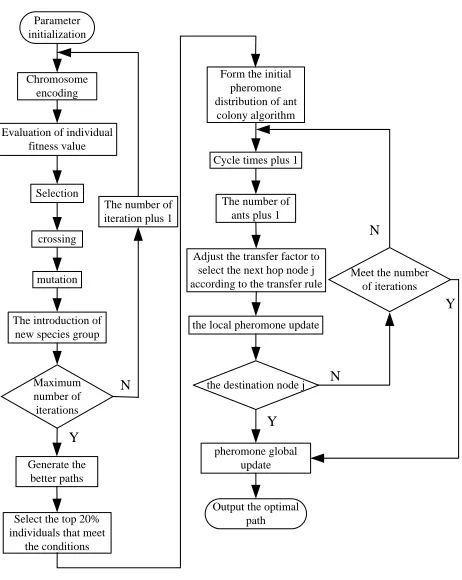
This IGAACA algorithm is mainly mapping AODV routing establishment process to carry on the design. The implementation process of IGAACA algorithm is shown in Figure 2. Maximum number of iterations Chromosome encoding
Evaluation of individual fitness value
Selection
crossing
mutation
The introduction of new species group
N
Y
The number of iteration plus 1
Generate the better paths
Form the initial pheromone distribution of ant colony algorithm
Adjust the transfer factor to select the next hop node j according to the transfer rule
the destination node j
Select the top 20% individuals that meet
the conditions
the local pheromone update
N
pheromone global update
Output the optimal path
Y
Meet the number of iterations
N
Y
Parameter initialization
Cycle times plus 1
The number of ants plus 1
Fig2. Flow chart of IGAACA algorithm
4. Performance Evaluation
To verify the performance of IGAACA routing algorithm, this paper compares the performance between the proposed algorithm and GA [4], Ant [8] and the classic AODV protocol. All the simulation results are the average value of 10 times, the parameters of the simulation and IGAACA algorithm is shown in Table 1.
Table 1 simulation parameters
(a)simulation environment parameters
name value
ISSN 2319 – 5967
scene scale 1500*1500m2
speed of nodes 10m/s
type of packet CBR
MAC 802.11
size of packet 512bytes
flit sending speed 2packet/s
max connections 15
pause time(s) 0,100,200
300,400,500
number of random node 20,40,60,80,100
simulation time 500s
initial energy of node 200J
(b)parameter of IGAACA algorithm
name value
crossover probability of GA pc 0.75
mutation probability of GA pm 0.05
number of genetic iterations NG 100
number of ACA iteration NA 300
number of ants m 50
pheromone volatile factor ρmin 0.2
attenuation coefficient μ 0.95
heuristic factor α=β=1
Constant ε1,ε2 ε1=ε2=1
delay constant Tc 0.005
pheromone constant τ0 10
intensity of pheromone adjustment Q1,Q2,W
Q1=Q2=
W=100
4.1 Simulation results
1. Pause time scheme
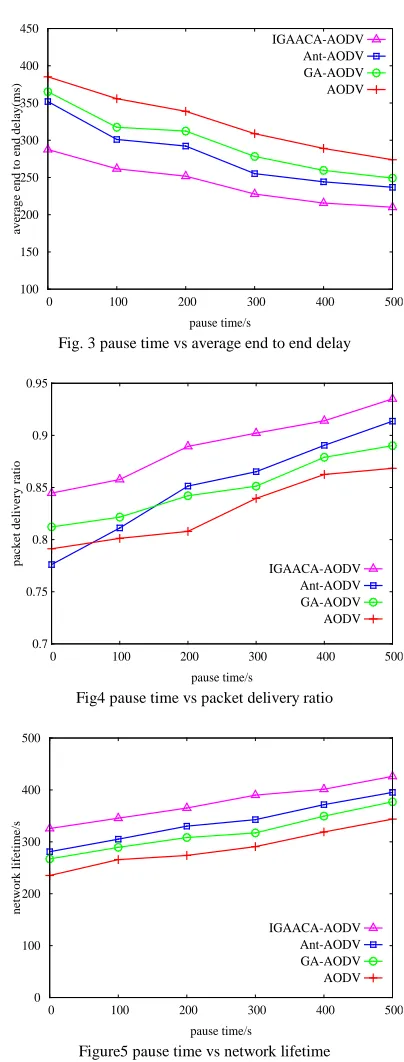
From figure 3 visible, under different pause time, transmission delay of IGAACA-AODV protocol is smaller than the classic AODV protocol and ant AODV, GA-AODV. This is because that IGAACA-AODV routing protocol has the effective advantage complementary of two algorithms, and it can ensure link in steady state, and make it possible to provide optimal path (least hops or at least delay) that the algorithm requires. With the increasing of residence time, the topology of the network becomes smaller and smaller, which indicates that the node is still in a state of rest. IGAACA-AODV protocol can delete optimal node or path information what is not required in a timely manner during route establishment process. Nevertheless, classic AODV protocol can only blindly receive information, and preserve and forward them when needed, which will also produce more delay. Ant-AODV is easy to fall into the local optimal cycle, and result in a longer search time due to the slow convergence rate. So in the dynamic case, the IGAACA-AODV protocol has a
better network performance.
100 150 200 250 300 350 400 450
0 100 200 300 400 500
average end to end delay(ms)
pause time/s
IGAACA-AODV Ant-AODV GA-AODV AODV
Fig. 3 pause time vs average end to end delay
0.7 0.75 0.8 0.85 0.9 0.95
0 100 200 300 400 500
packet delivery ratio
pause time/s
IGAACA-AODV Ant-AODV GA-AODV AODV
Fig4 pause time vs packet delivery ratio
0 100 200 300 400 500
0 100 200 300 400 500
network lifetime/s
pause time/s
IGAACA-AODV Ant-AODV GA-AODV AODV
Figure5 pause time vs network lifetime
ISSN 2319 – 5967
more stable. IGAACA-AODV protocol can constantly update route information in data transmission process, and can be quick to adapt to network changes. According to the transition probability rule, when the using path is interrupt, a path for packet data transmission can be found quickly. It also illustrates the algorithm has high reliability.
As can be seen from figure5, under different pause times, the network lifetime of IGAACA-AODV protocol is better than GA-AODV, Ant-AODV and classic AODV routing protocol. Because compared with GA, Ant and AODV protocol, the IGAACA-AODV protocol introduces the residual energy and the path delay into the path pheromone, and improves the pheromone increment. For the nodes with lower residual energy and delay, the corresponding path will have the lower the pheromone. So in the path selection process, ants probability incline to choose nodes with more residual energy and smaller delay of path. In a certain extent, energy consumption of node can obtain the balance in the network, so that this way can extend the survival time of the network.
2. Number of nodes scheme
0.1 0.15 0.2 0.25 0.3 0.35 0.4
20 30 40 50 60 70 80 90 100
average end to end delay/s
number of nodes
IGAACA-AODV Ant-AODV GA-AODV AODV
Figure6 number of nodes vs average end to end delay
As can be seen from figure6, the average end to end delay is also increased when the number of nodes is increasing in the network. But the average end to end delay of the IGAACA-AODV protocol is smaller than the other three algorithms, and the delay difference is not large enough in the case of fewer nodes. In terms of 60 nodes, average end to end delay of IGAACA-AODV protocol decreased 6.4% by GA-AODV, which dropped 8.5% by Ant-AODV, and decreased 12.3% by the classic AODV protocol. IGAACA-AODV protocol which combines the advantages of two algorithms, because ants will update path information in time and can select the comprehensive advantages of the nodes to form a routing for packet transmission. So these paths have a decreased risk of fracture, the transmission efficiency is improved and delay also has slightly reduced.
0.7 0.75 0.8 0.85 0.9 0.95
20 30 40 50 60 70 80 90 100
packet delivery ratio
number of nodes
IGAACA-AODV Ant-AODV GA-AODV AODV
Figure7 number of nodes vs packet delivery ratio
0 100 200 300 400 500
20 30 40 50 60 70 80 90 100
network lifetime/s
number of nodes
IGAACA-AODV Ant-AODV GA-AODV AODV
Figure8 number of nodes vs network lifetime
As can be seen from figure7, with the increasing number of nodes in the network, the packet delivery ratio of the four has a downward trend, but the overall effect of the IGAACA-AODV is better than the other three. The average packet delivery ratio of IGAACA-AODV protocol remains at 90%, the average number of nodes is less than 60, and under the same conditions, increased 1.9% by the average ratio of GA-AODV, which compared with Ant-AODV increased by 3.34% and the classical Ant-AODV routing protocol increased by about 5.1%. When the number of nodes becomes more and more, the topology of the network is also more complicated, and the probability of path breaking will be increased, however, the improved algorithm has the complementary advantages of these two algorithms and can reduce the possibility of rupture as far as possible. Thus, the gap has also been increased obviously.
ISSN 2319 – 5967
energy information according to the strength of the link information, and sets the objective function about minimum hop count principle to select the optimal path. And the positive feedback information of GA-AODV is not updated in a timely manner, and Ant-AODV could not reach the global solution, which will affect the link information update of network, and make the node resource depletion in advance, and even result in exiting the network, so survival time of the network reduces a lot.
5. Conclusions
The improved algorithm takes advantage of the two methods fully, and considers two factors that the residual energy of node and path delay during the route establishment process, and defines the objective function to select optimal route. Finally, simulation results show that the improved algorithm can effectively reduce the average end to end delay, and improve the packet delivery ratio and prolong the network lifetime in the two schemes.
Acknowledgments
This work was supported in part by the Program for Chang jiang Scholars and Innovative Research Team in
University (IRT1299), Project of CSTC
(CSTC2012jjA40044, CSTC2013yykfA40010) and
special fund of Chongqing key laboratory (CSTC).
References
[1] Dorigo M, Gambardella L M. Ant colonies for the traveling salesman problem [J]. BioSystems, 1997, 43(2): 73-81.
[2] WU Hua-feng, CHEN Xin-qiang. Improved ant colony algorithm based on natural selection strategy for solving TSP problem [J]. Journal on Communications, 2013, 34(4): 165-170.
[3] WAN Xiao-feng, HU Wei.Research on path planning of robot based on improved ant colony algorithm[J]. Computer Engineering and Applications, 2014, 50(18): 63-66.
[4] ZHAN Si-yu, LI Jian-ping. Routing protocol optimization for Ad hoc networks based on genetic algorithm [J]. Journal of Chinese Computer Systems, 2012, 33(1): 24-27.
[5] YUAN Shu, YUAN Dong-hui. The application of AC-GA on multi-sensor multi-target tracking[J]. Acta Electronica Sinica, 2013, 41(3): 609-614.
[6] Kadono D, Izumi T, Ooshita F, et al. An ant colony optimization routing based on robustness for ad hoc networks with GPSs[J]. Ad Hoc Networks, 2010, 8(1): 63-76.
[7] XIONG Zhi-Hui, LI Si-Kun, CHEN Ji-Hua. Hardware/Software partitioning based on dynamic combination of genetic algorithm and ant algorithm [J].JOURNAL OF SOFTWARE, 2005, 16(4): 503-512. [8] REN Jing-an, TU Ya-qing. Implementation of Ad Hoc network routing protocol based on ant colony optimization [J]. Computer Engineering, 2012, 38(21): 114-118.