R E S E A R C H
Open Access
Optimization of technology for dietary fiber
extraction from Maixiansan by response surface
methodology
Hui-qing Lv
1, Changfeng Hu
2, Hai-ping Zhong
1, Hong-bin Zheng
1*and Chengping Wen
2*Abstract
Background:Our study aims to determine whether response surface methodology can optimize the extraction of dietary fiber from Maixiansan.
Methods:A Box–Behnken design was employed to optimize the extraction parameters, includingα-amylase concentration (X1: 0.3–0.5%), enzymolysis time (X2: 30–60 min) and NaOH content (X3: 1.0–5.0%), of dietary fiber from Maixiansan using an enzyme–alkali extraction technique.
Results:The optimal technological conditions were as follows:α-amylase concentration: 0.4%; enzymolysis time: 45 min; NaOH content: 4.0%. Under these conditions, the extraction yield reached 57.14%, which was well consistent with the predicted models with a coefficient of determination (R2) of 0.9818. An evaluation of the anti-inflammatory activity indicated that Maixiansan was able to significantly inhibit dextran sodium sulfate-induced ulcerative colitis in rats by increasing the concentration of short-chain fatty acids (acetate, propionate and butyrate), among which the butyrate content was significantly higher in the Maixiansan group than in the other groups.
Conclusion:Our experiments showed that response surface methodology can optimize the extraction of dietary fiber from Maixiansan. Maixiansan could be explored as an anti-ulcerative colitis agent.
Background
Inflammatory bowel disease includes Crohn’s disease and ulcerative colitis (UC). UC is a chronic inflammatory disorder of the colon characterized by alternating periods of flare-ups and quiescent disease [1]. Dietary fiber is an integral constituent of normal human nutrition and may contribute to a healthy colonic environment [2]. The protective effects of a fiber-rich diet have been attributed to short-chain fatty acids (SCFAs), including acetate, propio-nate and butyrate [3]. SCFAs are the major end products of fiber fermentation in the gastrointestinal tract [4-6]. Our previous study revealed that germinated barley foodstuff (GBF) increased the numbers of eubacteria and bifidobac-teria in experimental rats. Maixiansan, composed of GBF, tuckahoe and Chinese yam, can effectively prevent bloody
diarrhea and mucosal damage, and exerts significant effects on UC [7].
The common approach of an orthogonal test design is usually adopted to optimize the extraction conditions for dietary fiber from Maixiansan (DFM) to achieve higher yield and quality, but the effects of interactions between dif-ferent factors remain unclear. To optimize the processing parameters, response surface methodology (RSM), which is an effective statistical technique for optimizing complex processes, has recently been used to allow more efficient and easier arrangement and interpretation of experiments [8-11], by reducing the number of experimental trials needed to evaluate multiple parameters and their interac-tions [12-14].
This study aims to optimize the extraction parameters (α-amylase concentration, enzymolysis time and NaOH content) of DFM agents using a three-level, three-variable Box–Behnken design (BBD). The BBD is a type of response surface design. It is an independent quadratic design, in that it does not contain an embedded factorial or fractional factorial design [15].
* Correspondence:[email protected];[email protected]
1College of Pharmaceutical Sciences, Zhejiang Chinese Medical University,
Hangzhou 310053, People’s Republic of China
2College of Basic Medical Sciences, Zhejiang Chinese Medical University,
Hangzhou 310053, People’s Republic of China
Materials and methods
Materials
Reagents and apparatus
Maixiansan was prepared by mixing GBF, tuckahoe and Chinese yams (Rhizoma dioscoreae and Dioscorea opposita, from Henan Province, China) in certain proportions (4:2:1:1), followed by grinding with a grinder and passage through a 400-mesh sieve. All of the chemicals used were of reagent grade. Acetic acid (≥ 99.5%), propionic acid (≥99.5%) and butyric acid (≥99.0%) were purchased from Sinopharm Chemical Reagent Co. Ltd. (China). The testing tool was a GC-2010AFAPC gas chromatographic analyzer (Shimadzu, Japan) with an FID detector (Shimadzu, Japan) and an AOC-20i liquid autosampler (Shimadzu, Japan). The analytical column was a DB-FFAP capillary column (30 m × 0.25 mm i.d.; Agilent, USA). A scientific automatic microplate reader (Multiskan Spectrum) was purchased from Thermo Fisher (USA).
Extraction of DFM
Maixiansan (2 g) was soaked in boiled water and hydro-lyzed by α-amylase (Sciencelab, China) until the enzyme was inactive. The treated sample was washed with water and separated by centrifugation at 10,000 × g for 5 min (Eppendorf 5430R: Germany). The residue was dried in a rotary evaporator (RE52A; Shanghai Yarong Biochemistry Instrument Factory, China) to yield dietary fiber. The percentage of dietary fiber (%) was calculated by the weight of the residue.
Optimization of DFM extraction
A BBD with three independent variables was used for the optimization. Theα-amylase concentration (X1), enzymoly-sis time (X2) and NaOH content (X3) were the independent variables selected to optimize the extraction of dietary fiber. The ranges of the independent variables and their levels are presented in Table 1. Each variable had three levels of−1, 0 and 1 representing low, middle and high levels, respec-tively. The extraction yield of DFM (Y) was taken as the response for the combinations of the independent variables shown in Table 2. The experimental runs were randomized to minimize the effects of unexpected variability in the observed responses.
The variables were coded according to the following equation:
Xi¼XiX0
ΔX ð1Þ
where Xiis the (dimensionless) coded value of the vari-able Xi, X0is the value of Xiat the center point andΔX is the step change.
The behavior of the system was explained by the fol-lowing quadratic equation:
Y¼β0þ Xi¼3
i¼1
βiXiþ
X3
i¼1
βiiXi2þ
X2
i¼1
X3
j¼iþ1
βijXiYj ð2Þ
where Y is the estimated response, β0, βi, βii and βijare
the regression coefficients for the intercept, linearity, square and interaction, respectively, and Xi and Xj are the independent variables.
Animals and diets
Forty male Sprague–Dawley rats (145 – 155 g) were purchased from the Center Animal House of Zhejiang Chinese Medical University (China), and randomly divided into four groups of 10 rats as follows: normal group; model group; mesalazine group; and Maixiansan group. The rats were acclimatized to the experimental facility for 1 week and maintained in cages in a specific pathogen-free envi-ronment in an animal facility under standard conditions (50–60% humidity, 12-h/12-h light/dark cycle).
UC was induced by adding 3% dextran sodium sulfate (DSS) (Pharmacia, USA) to the drinking water for 7 days. The normal group was administered clean water and the other three groups were administered 3% DSS solution.
Table 1 BBD and yields of DFM
Levels α-Amylase concentration X1(%)
Enzymolysis time
X2(min)
NaOH content X3(%)
−1 0.3 30 1.0
0 0.4 45 3.0
1 0.5 60 5.0
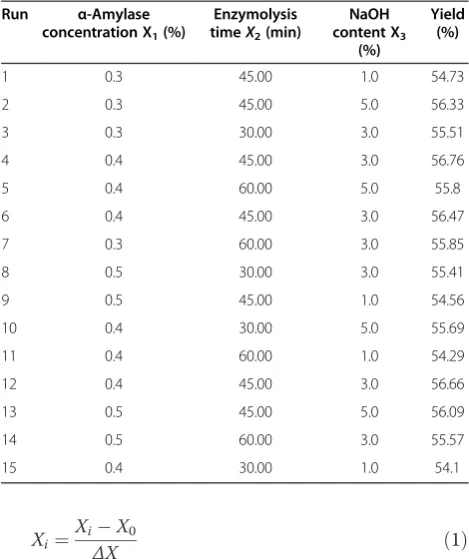
Table 2 RSM and results of the BBD with three independent variables
Run α-Amylase concentration X1(%)
Enzymolysis timeX2(min)
NaOH content X3
(%)
Yield (%)
1 0.3 45.00 1.0 54.73
2 0.3 45.00 5.0 56.33
3 0.3 30.00 3.0 55.51
4 0.4 45.00 3.0 56.76
5 0.4 60.00 5.0 55.8
6 0.4 45.00 3.0 56.47
7 0.3 60.00 3.0 55.85
8 0.5 30.00 3.0 55.41
9 0.5 45.00 1.0 54.56
10 0.4 30.00 5.0 55.69
11 0.4 60.00 1.0 54.29
12 0.4 45.00 3.0 56.66
13 0.5 45.00 5.0 56.09
14 0.5 60.00 3.0 55.57
The solution was prepared every day. After 7 days, the Maixiansan group was fed 10% Maixiansan medicinal pow-der, while the other groups were fed the normal diet (rat diet, complying with GB 14924.3-2001). The rats in the mesalazine group were administered mesalazine for 2 weeks by gastric perfusion. All the procedures were per-formed according to the Animal Care Committee for the Use of Experimental Animals at Zhejiang Chinese Medical University (China).
Fecal SCFA concentrations
Fresh morning rat stools were collected, weighed and stored at 4°C. Approximately 2 g of homoge-nized stool was mixed with 6 mL of sterilized water. After centrifugation at 10,000 × g for 20 min, the fil-tered supernatant was collected and the major SCFAs i.e., acetate, propionate and butyrate, were measured by capillary gas chromatography as previ-ously described [16,17].
Table 3 Regression coefficient estimates for the quadratic polynomial model
Source Degrees of freedom Sum of squares Mean square F value Pvalue
Model 9 9.91 1.10 113.21 < 0.0001
X1 1 0.078 0.078 8.02 0.0366
X2 1 0.080 0.080 8.23 0.0351
X3 1 4.85 4.85 498.88 < 0.0001
X12 1 0.32 0.32 32.76 0.0023
X1*X2 1 0.0081 0.0081 0.83 0.4033
X1*X3 1 0.0012 0.0012 0.13 0.7371
X22 1 2.08 2.08 214.28 < 0.0001
X2*X3 1 0.0016 0.0016 0.16 0.7018
X3 2
1 3.05 3.05 313.54 < 0.0001
Lack of fit 3 0.005225 0.001742 0.08 0.9648
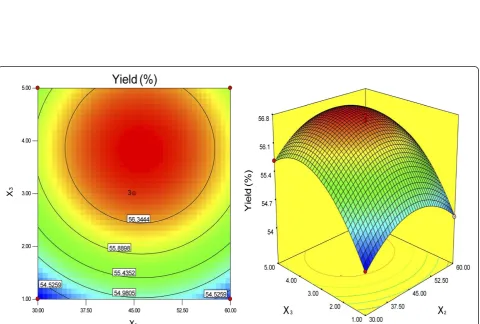
Figure 2Contour plot and response surface plot of Y = f2 (X1, X3) (α-amylase concentration and NaOH content are variable; enzymolysis time is fixed).
Statistical analysis
All of the data were represented as the mean ± standard deviation (SD) of three replicate determinations, with a 1significance level of P < 0.05 for analysis of variance (ANOVA) and processing with SPSS 15.0 software (Cabit, China). Design Expert software trial version 7.0.0 (Stat-Ease, USA) was employed for the regression analysis and graphical optimization.
Results and discussion
Optimization of extraction conditions by the BBD
Statistical analysis and model fitting
The current orthogonal test design in the extraction of polysaccharides mainly focuses on arranging reasonable experiments that can deal with several factors simultan-eously and find optimal factor levels, but cannot give a regression equation for the whole parameter space tested. Response surface optimization establishes a high precision regression equation, and details the interactions between several factors, in a highly efficient time-saving design pattern [15,18]. The values for the independent process variables (X1, X2 and X3) measured and the predicted values for the extraction yields of DFM are shown in Table 2. The yields ranged from 54.1% to 56.76%. The maximum yield of DFM was reached with α-amylase concentration of 0.4%, enzymolysis time of 45 min and
NaOH content of 3%. By applying a multiple regression analysis to the experimental data, the response variable and the test variables can be related by the following polynomial equation:
Y¼56:630:099x1þ0:100x2þ0:78x3 0:045x1x20:018x1x30:020x2x3
0:29x120:75x220:91x32 ð3Þ
where Y is the extraction yield of DFM, ansd X1,X2and X3 are the values for theα-amylase concentration, enzymolysis time and NaOH content, respectively.
The determination coefficient (R2 = 0.9818) was evalu-ated by ANOVA of the quadratic regression model. The adjusted determination coefficient (R2 = 0.9863) also suggested that the model was highly significant. At the same time, the low value (0.18) of the variation coefficient suggested a very high degree of precision and good relia-bility of the experimental values.
P values were used to determine the significance of each coefficient, which indicated the pattern of interactions between the variables. SmallerPvalues indicated increasing significance for the corresponding coefficients. It can be concluded that the linear coefficients (X1,X2and X3) and quadratic term coefficients (X12, X22and X32) were significant, with small P values (P < 0.05) as shown in Table 3 [for example X1, P= 0.0366;X2, P= 0.0351, etc.]. The coeffi-cients for the other terms were not significant (X1*X2,
P= 0.4033; X1*X3,P= 0.7371;X2*X3,P= 0.7018). The full model according to equation (3) was shown in three-dimensional and contour plots to reveal the relationships between the independent and dependent variables. The lack-of-fit F-value (0.08) was not significant relative to the pure error.
The results also showed that NaOH content was the most significant impact factor for the extraction yield of
Table 4 Predicted and experimental values of the responses under the optimum and modified conditions
α-Amylase concentration
(%)
Enzymolysis time (min)
NaOH content
(%)
Yield (%)
Optimum conditions
0.38 45.99 3.86 56.81
(predicted)
Modified conditions
0.4 45 4 57.14 ±
0.052% (actual)
DFM based on the smallest P value (X3, P < 0.0001), while those of the two other parameters were > 0.01 (X1,P= 0.0366;X2,P= 0.0351).
Optimization of the procedure
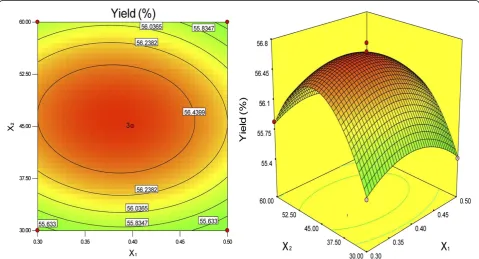
The response surfaces were plotted by Design Expert software to examine the effects of the variables and their interactions on the extraction yields of DFM. The relation-ships between the independent and dependent variables were illustrated by two-dimensional contour plots gener-ated by the model and three-dimensional response surface plots (Figures 1, 2 and 3). These plots showed the effects of two factors on the response at a time when the third va-riable was fixed (0 level). The shapes of the contour plots, elliptical or circular, indicated whether or not the interac-tions between the corresponding variables were significant [19]. An elliptical contour plot meant that the interactions between the variables were significant, while a circular contour plot meant the opposite.
Figure 1 shows that the extraction yield of DFM increased with increasing α-amylase concentration and enzymolysis time from 30 to 45.99 min. However, beyond 45.99 min, the yield of DFM decreased with increasing enzymolysis time. Figure 2 shows that the maximum yields of DFM were achieved when theα-amylase concentration and NaOH content were 0.38% and 3.86%, respectively. Figure 3 shows that the extraction yields of DFM clearly increased with increasing NaOH content from 1% to 3.86%, but decreased when the NaOH content exceeded 3.86%. No significant further improvements and interactions between the variables were observed. Among the three parameters, NaOH content was the most significant factor affecting the extraction yield of DFM, followed by enzymo-lysis time and α-amylase concentration according to the significance of the regression coefficients of the quadratic polynomial model (Table 3) and the gradients of the slopes in the three-dimensional response surface plots (Figures 1, 2 and 3).
According to Figures 1, 2 and 3, the optimal values of the tested variables for a DFM yield of 56.81% can be predicted as follows: α-amylase concentration of 0.38%; enzymolysis time of 45.99 min; and NaOH content of 3.86%. However, considering the operability for actual production, the optimal conditions can be modified as follows:α-amylase concentration of 0.4%; enzymolysis time of 45 min; and NaOH content of 4%.
To validate the adequacy of the model equations, we car-ried out a verification experiment according to the optimal conditions mentioned above. Under these conditions (Table 4), the experimental yield from real experiments was 57.14% (n = 3), and consistent with the predicted value of 56.81%.
Comparison of fecal SCFA concentrations
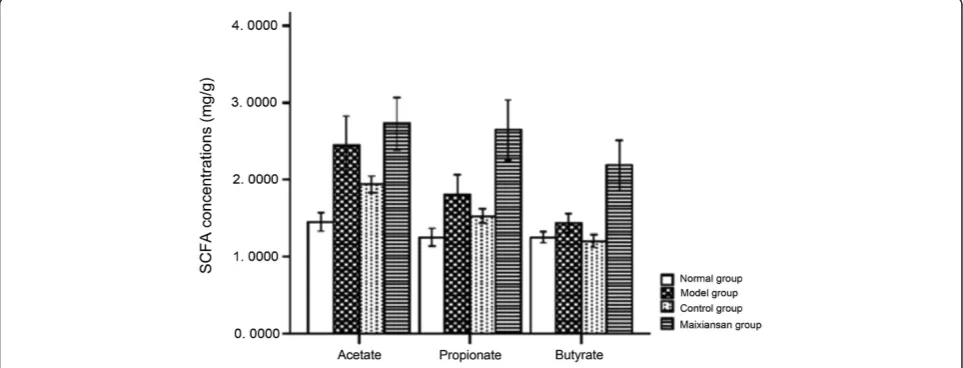
As shown in Figure 4, the SCFA contents in the Maixiansan-treated group contained significantly higher amounts of butyrate than the other groups. The mean butyrate concentration (mean ± SD of 10 rats) was 2.1847±0.4571 mg/g and a significant difference was observed between the Maixiansan-treated group and the control group (P=0.0035). Maixiansan composed of GBF passes through the intestines without being fully digested, and is fermented by the bacteria in the colon to release SCFAs. Butyrate is one of the SCFAs that can be used as a fuel by the cells lining the colon. SCFAs, particularly butyrate, are the major energy source for colonocytes [1,20]. Butyrate also has anti-inflammatory effects in certain states of mucosal inflammation and affects mucosal cell proliferation [21-23].
Conclusion
Our experiments showed that RSM can optimize the extraction of DFM. Maixiansan could be explored as an anti-ulcerative colitis agent.
Abbreviations
UC: Ulcerative colitis; SCFAs: Short-chain fatty acids; GBF: Germinated barley foodstuff; DFM: Dietary fiber from Maixiansan; RSM: Response surface methodology; BBD: Box–Behnken design; DSS: Dextran sodium sulfate; SD: Standard deviation; ANOVA: Analysis of variance.
Competing interests
The authors declare that they have no competing interests.
Authors’contributions
HZ and CW designed the study. HL, CH and HZ performed the experiments, and wrote the manuscript. All authors read and approved the final manuscript.
Acknowledgement
We acknowledge financial support from the Education Government of Zhejiang Province (Grant No. Y200907376), the Zhejiang Provincial Natural Science Foundation of China (Grant No. Y2080917) and the China Postdoctoral Science Foundation (Grant No. 2012M511389).
Author details
1College of Pharmaceutical Sciences, Zhejiang Chinese Medical University,
Hangzhou 310053, People’s Republic of China.2College of Basic Medical
Sciences, Zhejiang Chinese Medical University, Hangzhou 310053, People’s Republic of China.
Received: 12 February 2012 Accepted: 12 December 2012 Published: 29 December 2012
References
1. Hallert C, Björck I, Nyman M, Pousette A, Grännö G, Svensson H:Increasing fecal butyrate in ulcerative colitis patients by diet: controlled pilot study.
Inflamm Bowel Dis2003,9:116–121.
2. Scheppach W, Luehrs H, Melcher R, Gostner A, Schauber J, Kudlich T, Weiler F, Menzel T:Antiinflammatory and anticarcinogenic effects of dietary fibre.Clin Nutr Suppl2004,1:51–58.
4. Säemann MD, Böhmig GA, Österreicher CH, Burtscher H, Parolini O, Diakos C:Anti-inflammatory effects of sodium butyrate on human monocytes: potent inhibition of IL-12 and upregulation of IL-10 production.FASEB J
2000,14:2380–2382.
5. Millard AL, Mertes PM, Ittelet D, Villard F, Jeannesson P, Bernard J:Butyrate affects differentiation, maturation and function of human monocyte-derived dendritic cells and macrophages.Clin Exp Immunol2002,130:245–255. 6. Klampfer L, Huang J, Sasazuki T, Shirasawa S, Augenlicht L:Inhibition of
interferonγsignaling by the short chain fatty acid butyrate.Mol Cancer Res2003,1:858–862.
7. Liu YT, Hu ZF, Zheng HB, Cheng DQ, Pan PL, Zhou FM:Effect of fiber extracted from germinated barley on intestinal microflora of rats with uc (in Chinese).Zhejiang JITCWM2008,18:471–478.
8. Pan WJ, Liao AM, Zhang JG, Dong Z, Wei ZJ:Supercritical carbon dioxide extraction of the oak silkworm (Antheraea pernyi) pupal oil: process optimization and composition determination.Int J Mol Sci2012,13:2354–2367. 9. Wei ZJ, Zhou LC, Chen H, Chen GH:Optimization of the fermentation
conditions for 1-Deoxynojirimycin production by Streptomyces lawendulae applying the response surface methodology.
Int J Food Eng2011,7(3):16.
10. Zhu T, Heo HJ, Row KH:Optimization of crude polysaccharides extraction fromHizikia fusiformisusing response surface methodology.
Carbohyd Polym2010,82:106–110.
11. Sun YX, Li YJ, Li MQ, Tong HB, Yang XD, Liu JC:Optimization of extraction technology of theAnemone raddeanapolysaccharides(ARP) by orthogonal test design and evaluation of its anti-tumor activity.
Carbohyd Polym2009,75:575–579.
12. Gunawan ER, Basri M, Rahman BAM, Salleh AB, Rahman RNZA:Study on response surface methodology (RSM) of lipase-catalyzed synthesis of palm-based wax ester.Enzyme Microb Tech2005,37:739–744.
13. Jafari M, Nateghi M, Rabbani A:Interaction of sulfur mustard with rat liver salt fractionated chromatin.Int J Biol Macromol2010,46:104–108. 14. Chen XP, Wang WX, Li SB, Xue JL, Fan LJ, Sheng ZJ, Chen YG:Optimization
of ultrasound-assisted extraction of Lingzhi polysaccharides using response surface methodology and its inhibitory effect on cervical cancer cells.Carbohyd Polym2010,80:944–948.
15. Zou YF, Chen XF, Yang WY, Liu S:Response surface methodology for optimization of the ultrasonic extraction of polysaccharides from
Codonopsis pilosulaNannf.var.modestaL.T.Shen.Carbohyd Polym2011,
84:503–508.
16. Richardson AJ, Calder AG, Stewart CS, Smith A:Simultaneous determination of volatile and non-volatile acidic fermentation products of anaerobes by capillary gas chromatography.Lett Appl Microbiol1989,9:5–8.
17. Rumney CJ, Duncan SH, Henderson C, Stewart CS:Isolation and characteristics of a wheatbran-degradingButyrivibriofrom human faeces.Lett Appl Microbiol1995,20:232–236.
18. Qiao D, Hu B, Gan D, Sun Y, Ye H, Zeng X:Extraction optimized by using response surface methodology, purification and preliminary characterization of polysaccharides fromHyriopsis cumingii.
Carbohyd Polym2009,76:422–429.
19. Luo D:Identification of structure and antioxidant activity of a fraction of polysaccharide purified fromDioscorea nipponicaMakino.
Carbohyd Polym2008,71:544–549.
20. Kanauchi O, Nakamura T, Agata K, Mitsuyama K, Iwanaga T:Effects of germinated barley foodstuff on dextran sulfate sodium-induced colitis in rats.J Gastroenterol1998,33(2):179–188.
21. Miller SJ:Cellular and physiological effects of short-chain fatty acids.
Mini Rev Med Chem2004,4:839–845.
22. Young GP, Hu Y, Le Leu RK, Nyskohus L:Dietary fibre and colorectal cancer: a model for environment-gene interactions.Mol Nutr Food Res
2005,49:571–584.
23. Olmo N, Turnay J, Pe′rez-Ramos P, Lecona E, Barrasa JI, Lo′pez de Silanes I, Lizarbe MA:In vitromodels for the study of the effect of butyrate on human colon adenocarcinoma cells.Toxicol in Vitro2007,21:262–270.
doi:10.1186/1749-8546-7-28
Cite this article as:Lvet al.:Optimization of technology for dietary fiber extraction from Maixiansan by response surface methodology.Chinese Medicine20127:28.
Submit your next manuscript to BioMed Central and take full advantage of:
• Convenient online submission
• Thorough peer review
• No space constraints or color figure charges
• Immediate publication on acceptance
• Inclusion in PubMed, CAS, Scopus and Google Scholar
• Research which is freely available for redistribution