How many type specimens can be stored in old
lesser-known herbaria with turbulent histories? – A
Juncus
case study reveals their importance in taxonomy and
biodiversity research
Jarosław Proćków
1, Anna Faltyn-Parzymska
1, Paweł Jarzembowski
1,
Małgorzata Proćków
2, Anna Jakubska-Busse
31
Department of Plant Biology, Institute of Biology, Faculty of Biology and Animal Science, Wrocław University
of Environmental and Life Sciences, ul. Kożuchowska 5b, 51-631, Wrocław, Poland
2
Museum of Natural
Histo-ry, University of Wrocław, Sienkiewicza 21, 50-335 Wrocław, Poland
3
Department of Botany, Institute of
Envi-ronmental Biology, Faculty of Biological Sciences, University of Wrocław, Kanonia 6/8, 50-328, Wrocław, Poland
Corresponding author:
Jarosław Proćków (
)
Academic editor:
Sandy Knapp | Received 2 February 2020 | Accepted 20 May 2020 | Published 16 July 2020
Citation:
Proćków J, Faltyn-Parzymska A, Jarzembowski P, Proćków M, Jakubska-Busse A (2020) How many type
specimens can be stored in old lesser-known herbaria with turbulent histories? – A
Juncus
case study reveals their importance
in taxonomy and biodiversity research. PhytoKeys 153: 85–110.
https://doi.org/10.3897/phytokeys.153.50735
Abstract
Many herbarium sets in Europe are still being catalogued and it is likely that many old-type collections
are yet to be discovered. This research has the potential to facilitate the study of the biodiversity of many
regions, especially regions for which collections are extremely scarce. This has been confirmed by a case
study using Juncus (Juncaceae) examining the turbulent history of botanical collections at the WRSL
her-barium and the evaluation of its importance to the study of taxonomy and biodiversity since 1821. The
analysis revealed that the WRSL collection is rich in types (ca. 3.6%) and we identified 76 (of 78) new,
historically and nomenclaturally important specimens (types, original material and so-called “topotypes”).
Some of these type specimens represent duplicates of these that were stored in Berlin and destroyed during
World War II. Many of the type specimens are from the United States of America, South Africa, India,
and Canada. The largest number of Juncus type specimens stored at WRSL originate from South Africa
(42.3% of all type specimens), even though Juncus is rare in Africa. Our study highlights that
uncata-logued old collections that are under-explored and under-exploited have the potential to facilitate the
dis-covery of specimens important for the study of biodiversity, conservation, taxonomy and nomenclature.
Keywords
biodiversity, conservation, historical collections, Juncaceae, Juncus, plant taxonomy
http://phytokeys.pensoft.net
Copyright Jarosław Proćków et al. This is an open access article distributed under the terms of the Creative Commons Attribution License (CC
Introduction
The Natural History Museum of Wrocław University (Muzeum Przyrodnicze
Uniwer-sytetu Wrocławskiego) is the oldest natural history museum in Poland and its history
dates back to 1814, when it was founded by Prof. Johann Ludwig Christian
Graven-horst as the Zoological Museum. Currently, it houses both the botanical and zoological
collections. The beginning of the herbarium in its present form was the Herbarium
Horti Botanici Universitatis Wratislaviensis, which was established by Prof. Ludolph
Christian Treviranus in 1821 (Wiktor 2002; Wanat 2013). The Herbarium Silesiacum
was independently founded by the Silesian Association of Native Culture (Schlesische
Gesellschaft für Vaterländische Cultur) and, until 1945, it was housed on Tamka
Is-land, Wrocław. It developed independently from the other botanical collections, but
following the Second World War, it was merged with the main part of the herbarium.
Many distinguished botanists have worked in the WRSL herbarium (Museum of
Natural History, University of Wrocław, Poland, in Polish: Zielnik WRSL), including
the directors or curators of Wrocław’s botany collections, for example, Ludolf
Chris-tian Treviranus (1821–1830), ChrisChris-tian Gottfried Nees von Esenbeck (1830–1852),
Heinrich Robert Goeppert (1852–1884), Heinrich Gustav Adolf Engler (1884–1889),
Ferdinand Cohn (1884–1893) and Ferdinand Pax sen. (1893–1927). The Herbarium
Silesiacum was curated by Julius Milde (1865–1870), Gustav Wilhelm Körber (1871–
1885), Rudolf von Uechtritz (1886), Theodor Schube (1890–1929) and Emil Schalow
(1930–1944) (Wiktor 2002).
Professor H.R. Goeppert expanded the botany collections and established the
Bo-tanical Museum (Botanisches Museum) in 1853 (Wanat 2013). The first known
cata-logue of the Museum (Goeppert 1884) included 26 different collections, including the
Herbarium of the World, the Herbarium Silesiacum, the Herbarium Mycologicum, a
wood collection and several fruit and seed sets. Goeppert also opened another museum
in 1878 – The Museum of the Botanical Garden (Mularczyk 1998). In 1888, all these
several botanical collections belonging to the University were moved to a building that
is today located at 6/8 Kanonia Street. However, they still consisted of two separate
collections (the Botanical Museum in charge of Prof. Cohn and collections of the
Her-barium and the Museum of the Botanical Garden in charge of Prof. Engler). Due to
the efforts of Prof. Engler, a private Silesian plant collection assembled by Rudolf von
Uechtritz was purchased at this time and M. Winkler donated his herbarium to the
Museum, which he had compiled for 30 years (Wiktor 2002).
At the end of nineteenth century, Ferdinand Pax (the elder) merged all the
Univer-sity botanical collections under the name of the Botanical Museum. His own
collec-tions were also included in the Museum at this time. Before merging, von Uechtritz’s
herbarium of Silesian plants was handed over to the Herbarium Silesiacum (then still
independent) on his initiative. In exchange for Uechtritz’s herbarium, the Botanical
Museum later received the Herbarium Henschelianum (part of the Herbarium
Silesia-cum) with ca. 100,000 sheets.
Mediter-ranean) and the rest of the world. These were collected by botanists such as Hubert
Winkler (a student of F. Pax the elder) in East Africa, Cameroon, Java, Sumatra and
Borneo. In 1938, a collection of ca. 50,000 herbarium sheets (including numerous
types) was donated to the Museum by Carl Adolf Georg Lauterbach, who travelled
ex-tensively in New Guinea and Melanesia. By 1914, the Herbarium had 540,000 sheets
which, by 1939, had grown to ca. 600,000 sheets (Wiktor 2002; Wanat 2013). The
oldest and most valuable collections of the Herbarium Silesiacum were those made
by H.G. Mattuschka (1776 and 1779), A.J. Krocker (1787, 1790, 1814, 1823), A.
Henschel (1830), a herbarium of fungi assembled by W.G. Schneider and an old
her-barium of Paolo (Silvio) Boccone, a Cistercian monk, who moved to Wrocław in 1694
and donated his herbarium that consisted mainly of Mediterranean plants (Treviranus
1831; Rostański 1963). This herbarium is not mentioned by Stafleu et al. (1976), but
is the oldest plant collection of a scientific nature in Poland. In 1935, the Herbarium
Silesiacum housed over 80,000 sheets (Wanat 2013).
In autumn 1944, during the Second World War, German authorities evacuated
all university botanical collections from Wrocław. The Herbarium Generale
(com-bination of the various merged herbaria) was then located in Piotrowice castle near
Kąty Wrocławskie (ca. 43 km S.W. of Wrocław), the Herbarium Lauterbachi in
Siedlęcin near Jelenia Góra (ca. 95 km W. of Wrocław) and the other botanical sets in
the garrison church in Oleśnica near Wrocław (ca. 27 km N.E. of Wrocław), which
were unfortunately lost in a fire. The Herbarium Silesiacum was lodged, in turn, in
the attic of one of the primary schools in south Wrocław (in the Tarnogaj district);
however, it was not protected from destruction and the dusty and damp collection
was rediscovered after the war unbound, mixed together with litter and broken glass
(Wiktor 2002; Wanat 2013).
Shortly after the war, Polish authorities failed to discover traces of herbarium sets
in the dilapidated buildings – these were found in the Piotrowice castle, Siedlęcin and
south Wrocław only in 1946–1947, but only the Herbarium Lauterbachi was salvaged
undamaged. The recovered collections were entrusted to Prof. Józef Mądalski, who
was invited to Wrocław from Lviv (former Poland, now in the Ukraine). The war had
damaged many of the specimens and repairs were successfully undertaken by Polish
botanists. Rostański (1963) assessed the war damage in both herbaria (i.e. Herbarium
Generale and Herbarium Silesiacum) as, after the war, only 200,000 herbarium sheets
were discovered out of 600,000 that belonged to the University in 1939, together
with 30,000 herbarium sheets from the former Herbarium Silesiacum which, in 1939,
housed 80,000 sheets (it was confirmed then that the oldest Silesian flora sets of H.G.
Mattuschka and A.J. Krocker had been destroyed).
Currently, the collections are estimated to contain over 515,000 sheets,
includ-ing ca. 410,000 vascular plants, 27,000 bryophytes, 38,400 fungi and myxomycetes,
27,000 lichens and 12,600 algae (Mirek et al. 1997; K. Świerkosz, pers. comm., 2019).
The herbarium WRSL has had a turbulent history and has enormous importance in
the botanical history of Poland.
The aim of this investigation was to assess the value of the WRSL botanical
historically important specimens “hiding” in such under-appreciated collections are
improtant for taxonomy, nomenclature and biodiversity studies. Using the WRSL
her-barium, we address the importance of collections like WRSL as reservoirs of valuable
data that are relevant to experts who are involved in taxonomic revision.
Methods
Assessing the significance of the WRSL collection
The WRSL herbarium is currently divided into three parts: the Herbarium Generale,
the Herbarium Lauterbachi and the Herbarium Silesiacum. The Herbarium Generale
(about 375,000 specimens including about 75,000 spore-bearing organisms) holds the
plant and fungal material from around the world, excluding Lower Silesia, Poland, the
Herbarium Lauterbachi (about 50,000 sheets) contains plants from New Guinea and
Melanesia and the Herbarium Silesiacum (about 90,000 specimens) (K. Świerkosz,
pers. comm., 2019) houses plants from Lower Silesia, Poland.
Generally, the importance of particular natural collections depends not only on
their size, but also can be measured on the percentage or the absolute share of type
specimen types (Sutory 1997). In 2017, digitalisation of the WRSL collection was
initiated and was subsequently able to be accessed via GBIF.org (Świerkosz 2017); this
work is on-going but only 25,000 specimens (4.9%) are currently listed in a database
(K. Świerkosz, pers. comm., 2019). Therefore, we decided to assess the importance of
using specimens of the genus
Juncus
(Juncaceae) stored in the Herbarium Generale (to
date, no
Juncus
specimens from WRSL are included in GBIF.org database to facilitate
this task). The reasons for this choice were: 1) type specimens of
Juncus
have never
previously been assessed in the WRSL Herbarium; 2) the genus
Juncus
is rich in
spe-cies from regions where the herbarium has geographical strengths, 311 are listed by
Kirschner et al. (2002a, b) and 3) the first author of this paper is a specialist in
Juncus
taxonomy, which considerably aided the analysis of specimen status.
We evaluated the following factors (Sutory 1997): 1) the originality of the
collec-tion, including the number of types and other historically-important specimens; 2) the
size of the collection, i.e. the total number of specimens; 3) the geographical scope of
the collection; 4) the length of the period represented by the collection; 5) the number
of duplicates and 6) the physical condition of the collection (well-prepared,
well-pre-served and undamaged and well-stored material with appropriate labels). Herbarium
sheets with plants representing a single taxon that were gathered in the same locality
and on the same date by the same collector, were regarded as duplicates. Additionally,
we analysed the specimens with respect to: 1) the person who collected the material in
the field; 2) the collection from which they came (i.e. to whom they belonged before
accession in WRSL) and 3) the floras/exsiccatae from which they came.
We catalogued all
Juncus
specimens ourselves, paying particular attention to all
mono-graph (Kirschner et al. 2002a, b), from which we took the current nomenclature of
the genus. The localities and dates of sets for historical collections, especially those of
C.F. Ecklon & C.L.P. Zeyher and J.F. Drège, were deciphered from literature (Meyer
1832; Drège 1847, 1848; Buchenau 1875, 1890, 1906), which enabled us to
recog-nise many
Juncus
types.
The
Juncus
sets are stored in seven herbarium boxes indexed as separate fascicles,
numbered 151–157 and an extra 43 herbarium sheets were kept in a separate folder.
We analysed 2,192 herbarium sheets in total. We treated a separate collection with its
own label as a separate herbarium sheet, as specimens from three different localities
could have been mounted on one herbarium sheet (we treated these as three separate
herbarium sheets). We identified 2,222 taxonomic records, since part of the material
represents mixed sets. We conducted our research from scratch, since only two
Juncus
types identified in the Herbarium Generale had been previously labelled using a red
label. Thus, no other
Juncus
types stood out from other herbarium sheets. Our results
were also compared with those within the Global Plants Database (plants.jstor.org,
accessed on 16 Apr 2020) and additional herbaria, not mentioned by Kirschner et al.
(2002a, 2002b) that store other type specimens/duplicates of names we assessed, are
added to the last column of Table 1 and marked with an asterisk (*). Duplicates of
selected type specimens stored at WRSL were also compared with those stored in other
herbaria (present in the Global Plants Database). When comparisons were made, we
considered the physical condition of specimens, quantity of materials, different
anno-tations, kinds of labels and plant parts.
Results
Type and other historically-important material
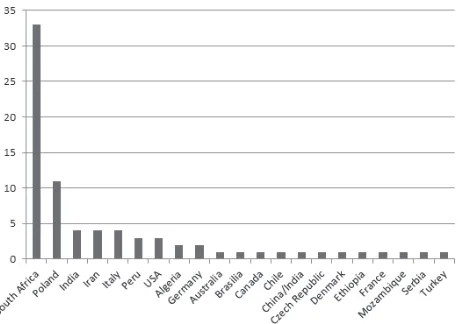
We found 78 specimens that are historically or nomenclaturally important (Table 1):
two holotypes, 20 isolectotypes, 14 isotypes, 29 syntypes (including one probable
syntype of
Juncus exsertus
Buchenau (1875: 435)), three paratypes, one isoneotype,
five sheets of historically-relevant material (for names not validly published) or
ad-ditional material from type localities collected by the author of the name (so-called
“topotypes”) and four sheets of probable original material to be analysed in the future
(Fig. 1). Holotypes, isotypes and isolectotypes constitute 46.2% of all types (and other
historically- and nomenclaturally-important specimens) of
Juncus
specimens
recog-nised at the WRSL. The most significant discovery was the identification of the three
following
Juncus
types in the WRSL Herbarium (see also remarks for them in Table 1,
last column of rows 46, 56, 20):
1) ISOTYPE of
Juncus lomatophyllus
Spreng. (1821: 108) [sine dato,
Bergius s.n.
(
J. lomatophyllus
Spreng., Bergius’sches Exemplar, bestimmt von K. Sprengel, 11 Jan
Tab
le
1.
A list of historically- and nomenclaturally-impor
tant
Juncus
specimens identified in the H
erbarium G
enerale at
WRSL. A sequence of species alphabeti
-cally accor
ding to the basionym
Juncus
names. N
o. – S
uccessiv
e N
umber; N.f
. – N
umber of fascicle (= herbarium bo
x) at
WRSL; underline text – ne
w findings after
examination of the pr
otologues; gr
ey r
ows – indicate types that w
er
e stor
ed in B
erlin and w
er
e destr
oy
ed during the
WWII; * – asterisk indicates additional herbaria
wher
e G
lobal P
lants (plants.jstor
.org) r
ecor
ds duplicates.
No . N.f. Kind of type and type of
(basionym)
C
urr
ent name
H
erbarium label data (original spelling)
T:
Type citation fr
om pr
otologue, including herbaria
acr
onyms (accor
ding to K
irschner et al. (2002a, b)) and
additional r
emar
ks (R
em.:)
Locality (label data)
D
ate
Leg
. et det.
Flora of / H
erbarium 1 151 A uthentic/original material of Juncus antonianus S teud. in W . Lechler , Berberid . A mer . A ustr al .
(1857: 56), nom. inv
al. Juncus balticus subsp. andicola (H ook. 1848:
8, pl. 714) S
noger up in S noger up , Z ika & Kirschner , Pr eslia 7 4 (2002: 258) PER
U. S. Antonio
Jun 1854
W
. Lechler 1808
(as
Juncus andicola
,
04 D
ec 1887, F
r. Buchenau) W . Lechler , P l. Per
uvianae ed. R.
F. H ochenacker / H erbarium H enschelianum
Authentic/original material: Peru, S
an Antonio, J
un 1954,
W
. Lechler 1808
, G, GOET
,
K, KW*. Rem.: After Kirschner et al. (2002b: 74) err
oneous collection
date of J
un 1954 to be corr
ected to J
un 1854. 2 151 Isoneotype of Juncus atr atus Kr ock., Fl. S iles
. 1 (1787: 562)
Juncus atr atus Kr ock., Fl. S iles
. 1 (1787: 562)
POL AND. B reslau [W rocław], O der dämme bei Carlo witz [Karło wice, no
w a settlement within
W rocław city] 10 J ul 1892 A. C allier 721
A. Callier F
lora S
ilesiaca
exsiccata / H
erbarium W agnerianum T: S ilesia, A.J.Kr ocker
; syn: not extant; B
reslau, O der dämme bei Carlo witz [Karlo wice betw een W
rocław and O
pole,
Poland], 10 J
ul 1892, A.C allier [F l. S iles. E xs.] 721
; neo: S,
designated b
y Kirschner et al. (2002a: 178); isoneo: L, PR
C,
W
, WU.
Rem.: After Kirschner et al. (2002a: 178) err
oneous locality
translated as ‘Karlo
wice [village] betw
een
W
rocław and O
pole,
Poland
’ which is on the S
tobrawa riv
er [not O
dra] and is ca.
55 km SE fr
om the Karło
wice [settlement] in
W
rocław on the
O
dra riv
er
.
The status of the type was corr
ected (iso to isoneo) in
accor
dance with the
Shenzhen Code . 3 154 Syntype of Juncus br unneus Buchenau,
Junc. S. A
mer . (1879: 403) Juncus ebr acteatus E. M ey ., Syn. J unc. (1822: 28) PER U. I m paludosis pr ope A zangar o Jun 1854 W
. Lechler 1749
, det. Fr . B uchenau, 22 Jan 1879 W . Lechler , P l. Per uvianae ed. R.F . H ochenacker / H erbarium H enschelianum
T: Bolivia, La P
az, Lar
ecaja, 2700–3800 m,
G. M
andon 1436
;
syn: BM, G, K, MO, NY
, P; P
er
u, A
zangar
o,
W
. Lechler 1749
;
syn: BR, G, GOET
, K, O, P
, S. 4 152 Isotype of Juncus buchenaui Sv ed., Juncac. R egn. E xp. ( Bih. Kongl. Sv enska V etensk.-Akad. H andl.
) 23(3), no 6 (1897: 9)
Juncus mar ginatus Rostk., D e J unco (1801: 38) BRASILIA. B rasiliae
civit. Rio G
rande do S
ul, Q uinta 07 D ec 1892 C.A.M. L indman 857 H erb . B rasil. R egnell. M
usei bot. S
tockholm
T: B
razil, Rio G
rande do S
ul, Q
uinta pr
ope opp
. Rio G
rande,
7 D
ec 1892,
C.A.M. L
indman A857
; holo: S; iso: GH,
W [cf
.
Juncus ×buchenaui
D
örfl. 1897. an prius?].
Rem.: After Kirschner et al. (2002a: 48) collection
N
o. A875
(pr
obably to be corr
No
.
N.f.
K
ind of type and type of
(basionym)
C
urr
ent name
H
erbarium label data (original spelling)
T:
Type citation fr
om pr
otologue, including herbaria
acr
onyms (accor
ding to K
irschner et al. (2002a, b)) and
additional r
emar
ks (R
em.:)
Locality (label data)
D
ate
Leg
. et det.
Flora of / H
erbarium
152
Pr
obably original material
of
Juncus bufonius
v
ar
.
halophilus
Buchenau & F
ernald,
Rhodor
a
6
(1904: 39)
Juncus r
anarius
Songeon & E.P
. P
errier
in P
.C. B
illot,
Annot.
Fl. F
rance A
llemagne
(1859: 192)
CANADA. Rivièr
e du
Loup
Aug 1902
W
.W
. E
ggleston 3036
Plants of the Lo
w
er S
t.
Lawr
ence
T: Canada, Q
uebec, Rivièr
e du Loup
, 2 A
ug 1902,
E.F
.W
illiams & M.L.F
er
nald
; holo: GH; iso: CM*, K, L, P
,
PH*. Paratypes (see pr
otologue): Rivièr
e du Loup
, 15 A
ug 1892,
G.G. K
ennedy
; Rivièr
e du Loup
, 8 A
ug 1902,
J.R. Chur
chill
,
W
.W
. E
ggleston
,
M.L. F
er
nald
. S
ee also pr
otologue for many
other paratypes. Rem.: After Kirschner et al. (2002b: 15) collection should be of E.F
. W
illiams & M.L. F
ernald but the herbarium label is
mar
ked as ‘
Type
’.
Accor
ding to the pr
otologue the paratype should be collected
by
J.R. Chur
chill
,
W
.W
. E
ggleston
,
M.L. F
er
nald
(instead of
W.
W.
Eggleston
only) and with the exact collection date (8 A
ug 1902).
152
H
olotype
of
Juncus bulbosus
f.
submucr
onatus
P
roćkó
w,
Ann.
Bot. F
enn.
47 (2010: 412)
Juncus bulbosus f. submucr
onatus
Pr
oćkó
w,
Ann. Bot.
Fenn.
47 (2010: 412)
POL
AND. W
rocław
Leśnica, ad ripam et in aqua piscinae eutr
ophicae, situ
meridiano-occidentali lacus
31 M
ay
1999
J. P
roćkó
w 990531/1
H
erbarium J. P
roćkó
w
T: P
oland, D
olny Ś
ląsk,
W
rocław Leśnica, ad ripam et in aqua
piscinae eutr
ophicae, situ meridiano-occidentali lacus, 31 M
ay
1999,
J. P
roćkó
w
; holo:
WRSL; iso:
WRSL; para: B, BIL, BM,
BR, C, DBN, DRAPN, E, GOET
, H, HAL, HBG, KRA, L,
LA
U, L
G, LISU, M, MA, MSB, P
, PBMA, POZ, S,
TRN,
TUB, W
A, WRSL, WSRP
, ZBI.
Rem.: After P
roćkó
w (2010: 420–423)
152
Isotype
of
Juncus bulbosus
f.
submucr
onatus
P
roćkó
w,
Ann.
Bot. F
enn.
47 (2010: 412)
Juncus bulbosus f. submucr
onatus
Pr
oćkó
w,
Ann. Bot.
Fenn.
47 (2010: 412)
POL
AND. W
rocław
Leśnica, ad ripam et in aqua piscinae eutr
ophicae, situ
meridiano-occidentali lacus
31 M
ay
1999
J. P
roćkó
w 990531/2
to 6
H
erbarium J. P
roćkó
w
T: P
oland, D
olny Ś
ląsk,
W
rocław Leśnica, ad ripam et in aqua
piscinae eutr
ophicae, situ meridiano-occidentali lacus, 31 M
ay
1999,
J. P
roćkó
w
; holo:
WRSL; iso:
WRSL; para: B, BIL, BM,
BR, C, DBN, DRAPN, E, GOET
, H, HAL, HBG, KRA, L,
LA
U, L
G, LISU, M, MA, MSB, P
, PBMA, POZ, S,
TRN,
TUB, W
A, WRSL, WSRP
, ZBI.
Rem.: After P
roćkó
w (2010: 420–423).
152
Paratype
of
Juncus bulbosus
f.
submucr
onatus
P
roćkó
w,
Ann.
Bot. F
enn.
47 (2010: 412)
Juncus bulbosus f. submucr
onatus
Pr
oćkó
w,
Ann. Bot.
Fenn.
47 (2010: 412)
GERMANY
. Leipzig,
D
ahlen, 2.
Teich in
Richtung Schmanne
witz,
Teichschlamm.
03 A
ug
1984
Peter G
utte 34378
(WRSL 69420)
Flora des B
ezir
kes
Leipzig.
T: P
oland, D
olny Ś
ląsk,
W
rocław Leśnica, ad ripam et in aqua
piscinae eutr
ophicae, situ meridiano-occidentali lacus, 31 M
ay
1999,
J. P
roćkó
w
; holo:
WRSL; iso:
WRSL; para: B, BIL, BM,
BR, C, DBN, DRAPN, E, GOET
, H, HAL, HBG, KRA, L,
LA
U, L
G, LISU, M, MA, MSB, P
, PBMA, POZ, S,
TRN,
TUB, W
A, WRSL, WSRP
, ZBI.
H
erb
. U
niv
. Lipsiensis.
Pflanz
en der DDR
Rem.: After P
roćkó
No
.
N.f.
K
ind of type and type of
(basionym)
C
urr
ent name
H
erbarium label data (original spelling)
T:
Type citation fr
om pr
otologue, including herbaria
acr
onyms (accor
ding to K
irschner et al. (2002a, b)) and
additional r
emar
ks (R
em.:)
Locality (label data)
D
ate
Leg
. et det.
Flora of / H
erbarium 13 152 Paratype of Juncus bulbosus f. submucr onatus P roćkó w, Ann. Bot. F enn.
47 (2010: 412)
Juncus bulbosus f. submucr
onatus Pr oćkó w, Ann. Bot. Fenn.
47 (2010: 412)
CZECH REPUBLIC. Bohemia meridionalis, distr
. České B
udějo
vice;
ad margines tur
fosas
stagnor
um pr
ope rivulum
Bor
ovnický potok haud
pr
ocul ab vico Bor
ovnice,
copiose, ca. 450 m s. m.
24 A ug 1962 J. K učer a 154 (WRSL 26580) Plantae Čechoslo vacae Exsiccatae. C ura
Sectionis Botanicae Musei N
ationalis P
ragae
Editae. Centuria II
T: P
oland, D
olny Ś
ląsk,
W
rocław Leśnica, ad ripam et in aqua
piscinae eutr
ophicae, situ meridiano-occidentali lacus, 31 M
ay 1999, J. P roćkó w ; holo: WRSL; iso:
WRSL; para: B, BIL, BM,
BR, C, DBN, DRAPN, E, GOET
, H, HAL, HBG, KRA, L,
LA
U, L
G, LISU, M, MA, MSB, P
, PBMA, POZ, S,
TRN,
TUB, W
A, WRSL, WSRP
, ZBI.
Rem.: After P
roćkó
w (2010: 420–423).
14 152 Paratype of Juncus bulbosus f. submucr onatus P roćkó w, Ann. Bot. F enn.
47 (2010: 412)
Juncus bulbosus f. submucr
onatus Pr oćkó w, Ann. Bot. Fenn.
47 (2010: 412)
POL AND. distr . S iedlce, Kr zymosz
e, na obnaż
onej
ziemi w bor
ze bagiennym
obok tor
u [on bar
e soil
in marshy for
est next to a
railway track]. 27 J ul 1974 Z. G ło
wacki s. n.
(WRSL 35948) Zielnik Z akładu Biologii W yższ ej Szkoły N auczy cielskiej w Siedlcach T: P oland, D olny Ś ląsk, W
rocław Leśnica, ad ripam et in aqua
piscinae eutr
ophicae, situ meridiano-occidentali lacus, 31 M
ay 1999, J. P roćkó w ; holo: WRSL; iso:
WRSL; para: B, BIL, BM,
BR, C, DBN, DRAPN, E, GOET
, H, HAL, HBG, KRA, L,
LA
U, L
G, LISU, M, MA, MSB, P
, PBMA, POZ, S,
TRN,
TUB, W
A, WRSL, WSRP
, ZBI.
Rem.: After P
roćkó
w (2010: 420–423).
15 152 Isolectotype of Juncus caespiticius E. M ey
. in J.G.C.
Lehmann,
Pl. P
reiss.
2 (1846:
47)
Juncus caespiticius E. M
ey
. in J.G.C.
Lehmann,
Pl. P
reiss.
2
(1846: 47)
AUSTRALIA. ad fluvium Canning, P
er th, no vae H ollandiae. 02 N ov 1839 Pr eis. ( L. P reiss ) 1733 H erbarium Schumann T: [ W estern A ustralia, P er
th, Canning R.] ad fluvium Canning
(P
er
th) no
vae H
ollandiae, 2 N
ov 1839, L.P reiss [P l. A ustr al. O ccid.] 1733 ; lecto: W
, designated b
y Kirschner et al. (2002a:
38); isolecto: BM, BREM, G*, K, L, LD*, MEL, NSW
, P
, W
.
Rem.: The status of the type corr
ected (iso to isolecto) in
accor
dance with the
Shenzhen Code. 16 155 Isotype of Juncus caffer B er tol., M em. R eale A
ccad. Sci. I
st.
Bologna
3 (1851: 253, P
l. 19,
fig. 3).
Juncus kr
aussii
H
ochst. in C. Krauss
Flor
a
28 (1845: 342)
subsp. kr aussii MOZ AMBIQ UE. ‘Inhambane M ozambici ’ 06 D ec 1848 For nasinio s.n. T: M ozambique, ’I nhambane M ocambici
’, 6 D
ec 1848,
For
nasinio
, holo: BOL
O. 17 152 Syntype of Juncus capensis subsp . angustifolius v ar . ecklonii Buchenau, M onogr . J unc.
Juncus capensis Thunb
., Pr odr . P l. C ap.
1 (1794: 66)
SOUTH AFRICA. Paludosa ad pedem montis diaboli 19 & 28 Nov 1827 [after Buchenau 1875: 485]
C.F . E cklon 35 (as Juncus capensis Thbg. subsp . angustifolius var . eckloni B uchn, det. F r. B uchenau, 11 J an 1875) H erbarium H enschelianum T: Cape, T eufelsberg, C.F . E cklon 897 , U nio I tin. , no 35 [annotated b
y E. M
ey
er under no 18]; syn: BOL, JE*, S,
W
.
Ca
p
(1875: 485) [
Abh. N atur wiss. Ver . B remen
4 (1875: 485)]
Rem.: A
dditional r
emar
k b
y B
uchenau (1875: 485): ‘U
n. it. N o. 35’. 18 152 Syntype of Juncus capensis subsp . angustifolius v ar . ecklonii Buchenau, M onogr . J unc.
Juncus capensis Thunb
., Pr odr . P l. C ap.
1 (1794: 66)
SOUTH AFRICA. Paludosa planitiei capensis
D
ec 1827
[after Buchenau 1875: 485]
C.F . E cklon 899 (as Juncus capensis Thbg. subsp . angustifolius var . eckloni B uchn, det. F r. B uchenau, 11 J an 1875) H erbarium H enschelianum T: Cape, T eufelsberg, C.F . E cklon 897 , U nio I tin. , no 35 [annotated b
y E. M
ey
er under no 18]; syn: BOL, S,
W
.
Ca
p
(1875: 485) [
Abh. N atur wiss. V er. Br emen 4 (1875: 485)] Rem.:
Kirschner et al
.
(2002a: 36) did not mention this type
(
C.F
. E
cklon 899
) but it is listed b
y B
uchenau (1875: 485) in
the pr
otologue of the ne
w tax
on
; additionally
, the specimen
really seen b
y B
uchenau (with his o
wn handwritten label);
Kirschner et al. (2002a: 36) listed v
ar . ecklonii as homotypic with Juncus capensis v ar . angustifolius E. M ey
.; syn: JE*,
No
.
N.f.
K
ind of type and type of
(basionym)
C
urr
ent name
H
erbarium label data (original spelling)
T:
Type citation fr
om pr
otologue, including herbaria
acr
onyms (accor
ding to K
irschner et al. (2002a, b)) and
additional r
emar
ks (R
em.:)
Locality (label data)
D
ate
Leg
. et det.
Flora of / H
erbarium
152
Syntype
of
Juncus capensis
subsp
.
angustifolius
v
ar
.
sphangnetor
um
f.
frondescens
Buchenau,
M
onogr
. J
unc. C
ap
(1875: 490) [
Abh. N
atur
wiss.
Ver
. B
remen
4 (1875: 490)]
Juncus capensis Thunb
.,
Pr
odr
. P
l. C
ap.
1 (1794: 66)
SOUTH
AFRICA. Cape,
Tafelberg
sine dato
J.F
. Dr
ège aa
(det.
as
Juncus capensis
var
.
angustifolius
E.
M.), (det. as
Juncus
capensis
Thbg. subsp
.
angustifolius
v
ar.
sphangnetor
um
f.
frondescens
, det. F
r.
Buchenau 11 J
an
1874)
H
erbarium
H
enschelianum
T:
Cape, T
afelberg,
J.F
. Dr
ège aa
; syn: K*, P
, S,
W
; G
ipfel des
Tafelberges,
C.L.P
. Z
eyher 47
; syn: B, destr
oy
ed.
152
Isolectotype
of
Juncus capensis
subsp
.
longifolius
v
ar
.
gr
acilior
Buchenau,
M
onogr
. J
unc. C
ap
(1875: 483) [
Abh. N
atur
wiss.
Ver
. B
remen
4 (1875: 483)]
Juncus capensis Thunb
.,
Pr
odr
. P
l. C
ap.
1 (1794: 66)
SOUTH AFRICA. Cap
.
B. S
pei.
05 M
ar
1816
C.H. B
ergius s.n.
,
det. K. S
pr
engel
(gesamm. v
on
Bergius, det. F
r.
Buchenau 11 J
an
1875)
H
erbarium
H
enschelianum
T: Caput bonae spei, 5 M
ar 1816,
Bergius
; lecto (as holo): B,
destr
oy
ed,
fide
A.A. O
bermey
er
,
in
A.A. O
bermey
er
, J. Le
wis
& R.B. F
aden,
Fl. S. Afr
.
4/2 (1985: 83); syn:
W
.
Rem.:
Ther
e ar
e mor
e specimens mentioned in the pr
otologue
of a ne
w tax
on (B
uchenau, 1875: 484) thus the lectotype
was designated
. I
solectotype (
the only duplicate kno
wn
)
redisco
ver
ed at
WRSL (the specimen includes the collection
date (i.e. 5 M
ar 1816), as in the the pr
otologue). The syntype
(B
ergius specimen at
W
) does not hav
e the collection date.
The status of the type corr
ected (iso to isolecto) in accor
dance
with the
Shenzhen Code.
152
Syntype
of
Juncus capensis
subsp
.
longifolius
v
ar
.
gr
acilior
Buchenau,
M
onogr
. J
unc. C
ap
(1875: 483) [
Abh. N
atur
wiss.
Ver
. B
remen
4 (1875: 483)]
Juncus capensis Thunb
.,
Pr
odr
. P
l. C
ap.
1 (1794: 66)
SOUTH AFRICA. [Cape] zwischen P
aarl
und F
ranschehoek
sine dato
J.F
. Dr
ège b
(det. as
Juncus capensis
β
.
angustifolius
E. M.),
(det. as
J. capensis
subsp
.
longifolius
v
ar
.
gr
acilior
B
uchenau,
det. F
r. B
uchenau 11
Jan 1875)
H
erbarium
H
enschelianum
T: Caput bonae spei, 5 M
ar 1816,
Bergius
; lecto (as holo): B,
destr
oy
ed,
fide
A.A. O
bermey
er
,
in
A.A. O
bermey
er
, J. Le
wis &
R.B. F
aden,
Fl. S. Afr
.
4/2 (1985: 83); isolecto:
W
.
Rem.: A specimen not mentioned b
y Kirschner et al. (2002a:
37), but listed b
y B
uchenau (1875: 484), thus it is a syntype
because ther
e ar
e mor
e specimens within the pr
otologue of a
ne
w tax
on; syn: S*.
The status of the type corr
ected (iso to isolecto) in accor
dance
with the
No
.
N.f.
K
ind of type and type of
(basionym)
C
urr
ent name
H
erbarium label data (original spelling)
T:
Type citation fr
om pr
otologue, including herbaria
acr
onyms (accor
ding to K
irschner et al. (2002a, b)) and
additional r
emar
ks (R
em.:)
Locality (label data)
D
ate
Leg
. et det.
Flora of / H
erbarium 22 152 H olotype of Juncus capensis subsp . par viflor us B uchenau, M onogr . J unc. C ap (1875: 491) [ Abh. N atur wiss. Ver . B remen 4 (1875: 491)]
Juncus capensis Thunb
., Pr odr . P l. C ap.
1 (1794: 66)
SOUTH AFRICA. ad ripas fl. Z
onder E inde, Zw ellendam N ov 1836 C. Kr auss s.n. (det. as Juncus capensis Thbg. subsp . par viflor us
Buchenau, leg. Ferd. Krauss, det. Fr. B
uchenau, 11
Jan 1875; det. b
y
C. Krauss as
Juncus cephalotes Thunb .) H erbarium H enschelianum
T: Cape, S
w
ellendam, Rivier Z
onder einde, N ov 1838, C. Kr auss s.n.
; holo: WRSL;
iso: W
.
Rem.: B
uchenau (1875: 491) listed only one specimen stor
ed
at ‘H
erbarium der schlesischen G
esellschaft für v
aterländische
C
ultur und des naturhistorischen
Ver
eines der pr
eussischen
Rheinlande und
W
estfalens
’, i.e. in
W
rocław
. Thus, this
holotype of the name was confirmed b
y the follo
wing: 1) it
was obser
ved b
y B
uchenau on 11 J
an 1875 and 2) it is only
one specimen that lacks a clearly written collection y
ear
, which
was misr
ead b
y B
uchenau in the pr
otologue (1875: 491) as
‘N
ov 1838’, ho
w
ev
er
, identical sheets (fr
om H
erbarium R.
v. Uechtritz & H
erbarium Schumann, both at
WRSL) r
ead
‘N
ov 1836’. Compar
e also with A.A. O
bermey er , in A.A. O bermey er
, J. Le
wis & R.B. F
aden,
Fl. S. Afr
.
4/2 (1985: 83).
The status of the type corr
ected (iso to holo (for
WRSL), and
lecto to iso (for
W
)) in accor
dance with the
Shenzhen Code. 23 152 Isotype of Juncus capensis subsp . par viflor us B uchenau, M onogr . Junc. C ap
(1875: 491) [
Abh. N atur wiss. V er. Br emen 4 (1875: 491)]
Juncus capensis Thunb
., Pr odr . P l. C ap.
1 (1794: 66)
SOUTH AFRICA. ad ripas fl. Z
onder-E inde, Zw ellendam N ov 1836 C. Kr auss s.n. (det. as Juncus cephalotes Thunb .) H erbarium Schumann
Rem.: see abo
ve 24 152 Isotype of Juncus capensis subsp . par viflor us B uchenau, M onogr . Junc. C ap
(1875: 491) [
Abh. N atur wiss. V er. Br emen 4 (1875: 491)]
Juncus capensis Thunb
., Pr odr . P l. C ap.
1 (1794: 66)
SOUTH AFRICA. ad ripas fl. Z
onder-E inde, Zw ellendam (Cap . B. spei.) N ov 1836 C. Kr auss s.n. (det. as Juncus cephalotes Thunb .) H
erbarium R. v
.
Uechtritz
Rem.: see abo
ve 25 152 Syntype of Juncus capitatus v ar . physcomitrioides B aen., Pr osp. H erb . E ur
. (1873: 4);
Schriften Königl. P hys.-Ö kon. G es. Königsberg
14 (1873: 16).
Juncus capitatus Weigel,
O bser v. Bot. (1772: 28) POL AND. D anzig [Gdańsk], S trand bei Zoppot [S opot] 08 J ul 1872 C. B aenitz s.n. H erbarium Schumann T: D anzig, S
trand bei Z
oppot [P
oland, Gdańsk, S
opot], 8
Jul 1872,
K.G. B
aenitz
; syn: L; additional authentic material
from the same site: 5 J
ul 1876, K.G.B aenitz [H erb . E ur .] 1506 (LD, W ). 26 152
Additional material fr
om type
locality) [collected b
y the author
of the name] of
Juncus capitatus var . physcomitrioides B aen., Pr osp. H erb . E ur
. (1873: 4);
Schriften K önigl. P hys.-Ö kon. G es. K önigsberg
14 (1873: 16).
Juncus capitatus Weigel,
O bser v. Bot. (1772: 28) POL AND. D anzig [Gdańsk], A d mar e balticum (Z oppot [S opot]) 05 J ul 1876 C. B aenitz 1506 D
r. C. B
aenitz, H erbarium E ur opaeum T: D anzig, S
trand bei Z
oppot [P
oland, Gdańsk, S
opot], 8
Jul 1872,
K.G. B
aenitz
; syn: L; additional material fr
om the
same site, collected b
y the author of the name: 5 J
No
.
N.f.
K
ind of type and type of
(basionym)
C
urr
ent name
H
erbarium label data (original spelling)
T:
Type citation fr
om pr
otologue, including herbaria
acr
onyms (accor
ding to K
irschner et al. (2002a, b)) and
additional r
emar
ks (R
em.:)
Locality (label data)
D
ate
Leg
. et det.
Flora of / H
erbarium
152
Additional material fr
om type
locality) [collected b
y the author
of the name] of
Juncus capitatus
var
.
physcomitrioides
B
aen.,
Pr
osp. H
erb
. E
ur
. (1873: 4);
Schriften K
önigl. P
hys.-Ö
kon.
G
es. K
önigsberg
14 (1873: 16).
Juncus capitatus Weigel,
O
bser
v. Bot.
(1772: 16)
POL
AND. D
anzig
[Gdańsk], A
d mar
e
balticum (Z
oppot
[S
opot])
05 J
ul
1876
C. B
aenitz 1506
D
r. C. B
aenitz,
H
erbarium E
ur
opaeum
T: D
anzig, S
trand bei Z
oppot [P
oland, Gdańsk, S
opot], 8
Jul 1872,
K.G. B
aenitz
; syn: L; additional material fr
om the
same site, collected b
y the author of the name: 5 J
ul 1876,
K.G.B
aenitz [H
erb
. E
ur
.] 1506
(LD, W
).
156
Syntype
of
Juncus cephalotes
var
.
minimus
H
ochst.,
Flor
a
28
(1845: 342),
p.p.
Juncus cephalotes Thunb
.,
Pr
odr
. P
l. C
ap.
(1794: 66)
SOUTH AFRICA. in arenos. plan. Cap
.
No
v
[18]38
C. Kr
auss s.n.
H
erbarium R. v
.
Uechtritz
T: [S
outh Africa, Cape] ‘in ar
enosis planitiei capensis
’, N
ov
1828,
C. Kr
auss
; syn:
W
, K [both mix
ed collections].
Rem.: The material needs to be r
evised because
W & K contain
mix
ed collections; after Kirschner et al. (2002a: 73), the
collection date was N
ov 1828 (to be corr
ected to N
ov 1838).
156
Syntype
of
Juncus cephalotes
var
.
minimus
H
ochst.,
Flor
a
28
(1845: 342),
p.p.
Juncus cephalotes Thunb
.,
Pr
odr
. P
l. C
ap.
(1794: 66)
SOUTH AFRICA. in arenos. plan. Cap
.
No
v
[18]38
sine coll. [C. Kr
auss]
s.n.
H
erbarium Schumann
T: [S
outh Africa, Cape] ‘in ar
enosis planitiei capensis
’, N
ov
1828,
C. Kr
auss
; syn:
W
, K [both mix
ed collections].
Rem.: O
riginal material was fr
om Krauss because the identical
label is on a sheet fr
om H
erbarium R. v
. Uechtritz wher
e ‘D
r.
Krauss
’ was added; the material needs to be r
evised because
W &
K contain mix
ed collections; after Kirschner et al. (2002a: 73),
the collection date is N
ov 1828 (to be corr
ected to N
ov 1838).
152
Syntype
of
Juncus cephalotes
var
.
minimus
H
ochst.,
Flor
a
28
(1845: 342),
p.p.
Juncus cephalotes Thunb
.,
Pr
odr
. P
l. C
ap.
(1794: 66)
SOUTH AFRICA. in arenosis plan. Cap
.
No
v
[18]38
sine coll. [C. Kr
auss]
s.n.
(det. as
Juncus
cephalothes
Thbg.
var
.
varius
Bchn., F
r.
Buchenau, 23 O
ct
1874)
H
erbarium
H
enschelianum
T: [S
outh Africa, Cape] ‘in ar
enosis planitiei capensis
’, N
ov
1828,
C. Kr
auss
; syn:
W
, K [both mix
ed collections].
Rem.: O
riginal material was fr
om Krauss because the identical
label is on a sheet fr
om H
erbarium R. v
. Uechtritz wher
e ‘D
r.
Krauss
’ was added; the material needs to be r
evised because
W
& K contain mix
ed collections; after Kirschner et al. (2002a:
73), the collection date is N
ov 1828 (to be corr
ected).
152
Isolectotype
of
Juncus cephalotes
var
.
ustulatus
B
uchenau,
M
onogr
.
Junc. C
ap
(1875: 451) [
Abh.
N
atur
wiss. V
er.
Br
emen
4 (1875:
451)]
Juncus cephalotes Thunb
.,
Pr
odr
. P
l. C
ap.
(1794: 66)
SOUTH AFRICA. Cape, Tafelberg
O
ct 1827
C.F
. E
cklon J
unc.
13.
,
2.12
(as
Juncus capensis
v
ar
.
angustifolius
E. M.,
det. C.F
. E
cklon)
H
erbarium Schumann
T: S
outh Africa, Cape,
Tafelberg, O
ct 1827,
C.F
. E
cklon 13
;
lecto: BOL,
fide
R.S. A
damson,
J. L
inn. Soc.
,
Bot.
50 (1935:
32);
No
.
N.f.
K
ind of type and type of
(basionym)
C
urr
ent name
H
erbarium label data (original spelling)
T:
Type citation fr
om pr
otologue, including herbaria
acr
onyms (accor
ding to K
irschner et al. (2002a, b)) and
additional r
emar
ks (R
em.:)
Locality (label data)
D
ate
Leg
. et det.
Flora of / H
erbarium 32 152 Syntype of Juncus cephalotes v ar . ustulatus B uchenau, M onogr . Junc. C ap
(1875: 451) [
Abh. N atur wiss. V er. Br emen 4
(1875: 451)] or/and v
ar . varius Buchenau, M onogr . J unc. C ap
(1875: 451) [
Abh. N atur wiss. Ver . B remen
4 (1875: 451)].
Juncus cephalotes Thunb
., Pr odr . P l. C ap. (1794: 66)
SOUTH AFRICA. Paludosa montis tabularis septentr
. N ov 1826 C.F . E cklon 901 H erbarium Schumann T: [S
outh Africa, Cape] Camps B
ay , C.F . E cklon s.n. (BOL); syn: PR C*, S*. Rem.: M ix
ed material containing v
ar . ustulatus B uchenau & var . varius B
uchenau, mentioned in both pr
otologues, to be
analysed. 33 152 Syntype of Juncus cephalotes var . varius B uchenau, M onogr . Junc. C ap
(1875: 451) [
Abh. N atur wiss. V er. Br emen 4 (1875: 451)].
Juncus cephalotes Thunb
., Pr odr . P l. C ap. (1794: 66)
SOUTH AFRICA. Wor
cester beim W ater fall sine dato C.F . E
cklon & C.L.P
. Zeyher J unc. 8 , 1.11 (as Juncus capensis v ar. minimus La H arphe, det.
Ecklon & Z
eyher
)
H
erbarium Schumann
T: [S
outh Africa, Cape] Camps B
ay , C.F . E cklon s.n. (BOL).
Rem.: Kirschner et al. (2002a: 73) did not mention this type, but it is listed b
y B
uchenau (1875: 452) within the pr
otologue
of the ne
w tax
on; ho
w
ev
er B
uchenau (1875: 452) indicates
stunted stamens in this material.
34 153 Syntype of Juncus clausonis Trab
. in J.A. B
attandier &
L.C. T
rabut,
Fl. A
lgérie
, ed. 2
(1895: 84).
Juncus striatus Schousb
. ex E. M
ey
.,
Syn. J
unc
. (1822: 27)
AL GERIA. Ain T aya (Alger) Jul 1889 J.A. B attandier & L.C. T rabut 586 Battandier et Trabut, P l. d’Algérie
T: [Algeria] Ain
Taya pr ès Alger , J un 1888, L.C. T rabut
; syn: G;
Jul 1889,
J.A. B
attandier & L.C.
Tr
abut 586
; syn: G, L, MPU*.
35 157 Isotype of Juncus delicatulus Steud., Syn. P l. G lumac. 2 (1855: 304)
Juncus capensis Thunb
., Pr odr . P l. C ap.
1 (1794: 66)
SOUTH AFRICA. Africa australis [Cape, Grahamsto
wn V alley] sine dato J.F . Dr ège 1604e H erbarium H enschelianum
T: Africa australis [Cape, G
rahamsto wn Valley], J.F . Dr ège 1604e
; holo: P; iso: G, S,
W . 36 152 Syntype of Juncus dr egeanus var . conglomer atus B uchenau, M onogr . J unc. C ap (1875: 463) [ Abh. N atur wiss. Ver . B remen 4 (1875: 463)]. Juncus dr egeanus K unth, Enum. P l. 3 (1841: 344) subsp. dr egeanus
SOUTH AFRICA. Cap
. Bon. S pei (H assagaibosch [Assegaaibos]) sine dato C.L.P . Z eyher ( C.F .
Ecklon & C.L.P
. Zeyher ) Junc. 10 , 26.1 (det. as Juncus cephalotes L ’H arpe var . conglomer ata N
ees, det. Z
eyher) H erbarium Schumann T: H assagaibosch [Assegaaibos], C.F . E
cklon & C.L.P
. Z
eyher
10
; syn: BOL,
W ; Albany , C.F . E cklon ; syn : n.v . 37 156 Pr obable syntype of Juncus exser tus B uchenau, M onogr . Juncac. C ap
(1875: 435) [
Abh. N atur wiss. V er eine Br emen 4 (1875: 435)] Juncus e xser tus Buchenau, M onogr . Juncac. C ap (1875: 435) [ Abh. N atur wiss. Ver eine B remen 4 (1875: 435)]
SOUTH AFRICA. Wor
cester , W ater fall sine dato C.F . E
cklon & C.L.P
.
Zeyher 1. 11
(det.
as
Juncus punctorius
Thbg)
T: [Cape P
ro vinces, S war tkops Riv er] Z war tkops Rivier , C.L.P . Zeyher 103
; syn: B [destr
oy
ed after having been selected as
type b
y R.S.A
damson,
J. L
inn. Soc. Bot.
50 (1935: 15)], BOL;
W or cester , W ater fall, C.F . E
cklon & C.L.P
. Z
eyher [
as
Juncus
punctorius 1. 11] p.p.
; syn: B [destr
oy
ed], PRE; Z
ondagsrivier
bei G
raaff-R
einet [S
undays Riv
er at G
raaff-R
einet],
H. Bolus
188
; syn: BOL, K*; ‘Camdeboosberg, 4–5000 F
uss ’, J.F .Dr ège [J uncus o xy carpus ‘ c’] ; syn: W [only!]. Rem.: C.F . E
cklon & C.L.P
. Z
eyher
[as
Juncus punctorius
1. 11] pr
o
par
te as a syntype of the name (Kirschner et al. 2002a: 239).
38 153 Syntype of Juncus glaucus v ar . acutissimus B uchenau, M onogr . Junc. C ap (1875: 417) Juncus infle xus L., Sp. Pl
. (1753: 326)
SOUTH AFRICA. Cape, W
odehouse,
Klein
Buffels
Vallei near G
aatjie
sine dato
J.F
. Dr
ège 8796 c
H erbarium H enschelianum T: Cape, W
odehouse, Klein B
uffels
Vallei near G
aatjie,
J.F
.
Dr
ège 8796c
; syn: E*, LE*, LD, S,
W
No
.
N.f.
K
ind of type and type of
(basionym)
C
urr
ent name
H
erbarium label data (original spelling)
T:
Type citation fr
om pr
otologue, including herbaria
acr
onyms (accor
ding to K
irschner et al. (2002a, b)) and
additional r
emar
ks (R
em.:)
Locality (label data)
D
ate
Leg
. et det.
Flora of / H
erbarium 152 Syntype of Juncus inaequalis v ar . viridescens B uchenau, M onogr . Junc. C ap
(1875: 455) [
Abh. N atur wiss. V er. Br emen 4 (1875: 455)]
Juncus cephalotes Thunb
., Pr odr . P l. C ap. (1794: 66)
SOUTH AFRICA. Wor
cester beim W ater fall sine dato C.F . E cklon J unc 14. , 1.11 H erbarium Schumann T: S
outh Africa, Cape, S
w ellendam, C.L.P . Z eyher 4319 ; syn: BOL, K*, W [ p.p. , ut Juncus isolepoides N ees, nom. inv al. ]; H ottentotts-H olland, C.L.P . Z eyher 46
; syn: BOL,
W , S*; C.F . Ecklon 14 ; syn: n.v . 152 Pr
obable original material
of Juncus × inundatus D rejer , N atur hist. Tidsskr
. 2 (1838: 181)
Juncus balticus DENMARK. Thy , Jyllandia sine dato Dr ejer s.n. ex herb . J oh. Lange / H
erbarium R. v
.
Uechtritz
T:
n.v
.
– BM*, C*,
W*. W illd., G es. N atur f. Fr eunde B er lin M ag. N euesten E ntdeck. G esammten N atur k .
3 (1809: 298)
subsp. balticus × filifor mis L., Sp. P l
. (1753: 326)
Rem.: The pr
otologue of Juncus × inundatus D rejer pr ovided the follo
wing sites: R
ors Klit in Thy district and at B
ulbjerg
(both found b
y D
rejer) and K
oller
up Klit in
Vesterhanherr ed (found b y P oulsen). H ow ev er
, they ar
e cited only as geographic
localities and not as specimens. M
or
eo
ver
, the date of
collection in the pr
otologue is J
uly 1837. The specimen at
WRSL was collected in Thy district, but no exact locality or collection date was pr
ovided; after Kirschner et al. (2002b:
141): type –
n.v
.
[
non vidi
].
After Kirschner et al. (2002b: 141) place of publication is ‘Bot. T
idsskr
.’ to be corr
ected to N atur historisk T idsskrift ( Copenhagen
), i.e. ‘
N atur hist. T idsskr .’. 154 Isolectotype of Juncus inv olucr atus S
teud. ex B
uchenau, Abh. N atur wiss. Ver eine B remen
4 (1875: 121)
Juncus micr
ocephalus
H
umb
., Bonpl. &
K unth., G en. S p. 1
(1816: 237 [Q
uar to], 190 [F olio]) PER U. T abina Jul 1854 W
. Lechler 2078
W
. Lechler pl. per
uviana ed. R.F . H ochenacker / H erbarium H enschelianum T: P er u, Tabina, 1854, W .Lechler 2078
; lecto: GOET
, fide H.B alslev , Fl. N eotr op. M onogr .
68 (1996: 106); isolecto: G*,
K, KW*, LE*, MO, O, S. Rem.: The status of the type corr
ected (iso to isolecto) in
accor
dance with the
Shenzhen Code . 154 Isolectotype of Juncus kotschyi
Boiss. in C.G.T
. K otschy , Pl. Persiae A ustr . [exsiccate series edited b y R.F . H ohenacker ,
printed label description], no
.
446 (1845) & Boissier
,
Diagn.
Pl. O
rient.
, ser
. 1, 7 (1846: 101)
Juncus fontanesii subsp.
kotschyi (Boiss.) S noger up in K.H. R echinger , Fl . Ir anica
75 (1971: 25)
IRAN. I
n paludosi ad
rad. M. S
abst-B
uschom,
pr
. U. Schiras
31 M ay 1842 C.G.T . K otschy 446 Th. K otschy . P l. Pers. austr . E d. R.F . H
ohenacker 1845 /
H
erbarium Schumann
T: [I
ran] m. S
abst-B
uschon pr
.[ope] u.[rbem] Schiras, 31 M
ay 1842, C.G.T . K otschy [P l. P ers. A ustr .] 446
; lecto: G-BOISS,
fide S. S noger up , in K.H. R echinger , Fl. I ranica
75 (1971: 25);
isolecto: B*, BM, CAS*, CGE, CORD*, E*, FI*, G, GOET*, HAL*, K, KW*, MO*, P
, PR, S*, UPS.
Rem.: The status of the type corr
ected (iso to isolecto) in
accor
dance with the
Shenzhen Code . 154 Isolectotype of Juncus kotschyi
Boiss. in C.G.T
. K otschy , Pl. Persiae A ustr . [exsiccate series edited b y R.F . H ohenacker ,
printed label description], no
.
446 (1845) & Boissier
,
Diagn.
Pl. O
rient.
, ser
. 1, 7 (1846: 101)
Juncus fontanesii subsp.
kotschyi (Boiss.) S noger up in K.H. R echinger , Fl . Ir anica
75 (1971: 25)
IRAN. I
n paludosi ad
rad. M. S
abst-B
uschom,
pr
. U. Schiras
31 M ay 1842 C.G.T . K otschy 446 (det. F r. B uchenau, 31 J
an 1875, as
J. kotschyi ) Th. K otschy . P l. Pers. austr . E d. R.F . H ohenacker
1845 / H
erbarium
H
enschelianum
T: [I
ran] m. S
abst-B
uschon pr
.[ope] u.[rbem] Schiras, 31 M
ay 1842, C.G.T . K otschy [P l. P ers. A ustr .] 446
; lecto: G-BOISS,
fide S. S noger up , in K.H. R echinger , Fl. I ranica
75 (1971: 25);
isolecto: B*, BM, CAS*, CGE, CORD*, E*, FI*, G, GOET*, HAL*, K, KW*, MO*, P
, PR, S*, UPS.
Rem.: The status of the type corr
ected (iso to isolecto) in
accor
dance with the
Shenzhen Code
No
.
N.f.
K
ind of type and type of
(basionym)
C
urr
ent name
H
erbarium label data (original spelling)
T:
Type citation fr
om pr
otologue, including herbaria
acr
onyms (accor
ding to K
irschner et al. (2002a, b)) and
additional r
emar
ks (R
em.:)
Locality (label data)
D
ate
Leg
. et det.
Flora of / H
erbarium 44 154 Isolectotype of Juncus kr aussii H
ochst. in C. Krauss
Flor a 28 (1845: 342) Juncus kr aussii H
ochst. in C. Krauss
Flor
a
28 (1845: 342)
SOUTH AFRICA. ad ripas N
otsinakama R., distr . G eorge Jan 1839 C. Kr auss s.n. ( C. Kr aussii S pecimen authenticum, F r.
Buchenau, 11 J
an 1875) H erbarium H enschelianum T: S
outh Africa, G
eorge D
istr
., N
otsinakama R., J
an 1839,
C.Kr
auss
; lecto: G-BOIS,
fide S.S noger up , W illdeno wia 23
(1993: 57); isolecto: M,
TUB*.
Rem.: The status of the type corr
ected (iso to isolecto) in
accor
dance with the
Shenzhen Code . 45 154 Isolectotype of Juncus kr aussii H
ochst. in C. Krauss
Flor a 28 (1845: 342) Juncus kr aussii H
ochst. in C. Krauss
Flor
a
28 (1845: 342)
SOUTH AFRICA. ad ripas N
otsinakama R., distr . G eorge Jan 1839 C. Kr auss s.n. H erbarium Schumann T: S
outh Africa, G
eorge D
istr
., N
otsinakama R., J
an 1839,
C.Kr
auss
; lecto: G-BOIS,
fide S.S noger up , W illdeno wia 23
(1993: 57); isolecto: M,
TUB*.
Rem.: The status of the type cor