GRAIN YIELD AND SELECTED QUALITY TRAITS IN WINTER WHEAT
IN CENTRAL ASIA
Khazratkulova Shakhnoza Usmonovna1, Juraev Diyor Tirdiqulovich2 and Juraev Sirojiddin Turdiqulovich3
1,2
Kashkadarya branch of Research Institute for Grain and Leguminous crops (KbRIGLc) 180100, Beshkent Yuli, Karshi, Kashkadarya region, Uzbekistan
3
Department of Agricultural Plants Genetics, Selection and Seed breeding, Tashkent State Agrarian University, Tashkent-100140, University str., 3, Uzbekistan
Abstract
High grain yield and improved quality determine commercial success of winter wheat (Triticum aestivum L.) varieties in Central Asia. This study was conducted to determine effect of environment on grain yield, 1000-kernel weight (TKW), test weight (TWT), protein and gluten content, and to identify superior wheat genotypes for yield and quality. Thirty winter wheat genotypes were evaluated in three years (2010-2012) over multiple locations. Genotype and genotype x environment interaction (GGE) biplot analysis was used to determine superior genotypes. There were significant effects of environment and genotype x environment interaction on yield and quality traits. The 30 wheat genotypes showed variations for grain yield (3.7 to 5.6 t ha-1), TKW (33.6 to 42.4 g), TWT (753 to 797 g/l), protein (13.3 to 14.8%) and gluten (27.2 to 29.5%) content. There was a significant positive correlation between grain yield and TKW in three out of seven environments. There was no correlation of grain yield with TWT, protein and gluten content with one exception. There were different sets of five most superior genotypes for individual traits. However, certain genotypes were superior based on grain yield and quality traits. ‘Gozgon’, ‘Elomon’, ‘ID800994.W/Vee//Lagos-12’, ‘Jaikhun’, and ‘Kroshka’ were five most superior genotypes for four quality traits. ‘Elomon’, ‘Gozgon’, ‘Jaikhun’ ‘ID800994.W/Vee//Lagos-12’, and ‘Kiriya’ were five most superior genotypes based on grain yield, TKW, TWT, protein and gluten content. This study demonstrates wheat breeding successes in combining high yield and improved quality in winter wheat. This study provides information on combined stability of high yield and improved quality of the internationally important winter wheat genotypes. Therefore, the results of this study could be valuable for national and international winter wheat breeding programs to develop new varieties with high, stable grain yield and quality.
Keywords - Genotype x environment interaction, gluten, grain yield, protein, quality, stability, Triticum aestivum, winter wheat.
I. INTRODUCTION
High yield and improved quality are primary objectives of the winter bread wheat (Triticum
There is a more complex influence of weather conditions on quality parameters of winter wheat compared to spring wheat (Johansson and Svensson, 1998). Winter bread wheat growing environments in Central Asia are diverse (Sharma et al., 2014a), and there is significant effect of environment and genotype x environment (GE) interaction on grain yield both under irrigated (Sharma et al., 2010) and rainfed (Sharma et al., 2012) conditions. Similar findings on the effect of GE interaction on wheat grain yield have been reported for the surrounding regions (Osmanzai and Sharma, 2008; Sakin et al., 2011; Sharma et al., 2014b). Previous studies have also reported significant effect of GE interaction on quality related traits in wheat (Kopell and Ingver, 2008; Zecevic et al., 2009; Sakin et al., 2011) suggesting difficulties in identification of genotypes with stable quality. A wheat breeding program aims to develop genotypes with stability for high grain yield and quality. Such efforts face difficulties not only because of high effect of environment on yield and quality but also due negative correlation of grain yield with one or more of the quality traits (Tayyar 2010; Sokoto et al., 2012).
1000-kernel weight (TKW), test weight (TWT), and the protein and gluten content are considered major quality related traits to release new varieties in many developing countries including Central Asia. Previous studies have reported positive correlation of grain yield with TKW (Sokoto, 2012) and TWT (Tayyar, 2010). Bilgin et al. (2010) found a weak negative correlation between grain yield and protein content. On the other hand, Tayyar (2010) and Sokoto et al. (2012) reported non-significant correlation between grain yield and protein content. Tayyar (2010) found a negative correlation between grain yield and gluten content, whereas Sokoto et al. (2012) reported inconsistent correlation between these two traits in two years. These findings from the previous reports suggest that correlation between grain yield and quality may also depend on environment. This in turn could determine the effectiveness of selection for simultaneous improvement of grain yield and quality.
There is a lack of information on effect of GE interaction on quality of winter wheat in Central Asia. In order to develop winter wheat genotypes to be accepted by the farmers stability of grain yield and quality traits must be determined. This study was conducted to find out genotypic variation for grain yield and quality traits among a set of leading cultivars and advanced breeding lines of winter wheat, determine GE interaction for grain yield and quality traits, and identify genotypes superior for yield and quality.
II. MATERIALS AND METHODS
A set of 30 winter wheat genotypes differing in their origin and genetic background was used in this study (Table 1). These included 19 advanced breeding lines from the International Winter Wheat Program (IWWIP) and three released (‘Jaikhun’, ‘Saidaziz’ and ‘Kroshka’) and three perspective (‘Hazrati Bashir’, ‘Elomon’ and ‘Gozgon’) cultivars of Uzbekistan, and five genotypes from other sources. The field experiments were conducted at four diverse sites, Karshi (38°52'N and 65°48'E, 416 meters above sea level (masl)), Kasbi (38°57'N and 65°24'E, 322 masl) Kibray (41°23'N and 69°27'E, 785 masl), and Namangan (41°00N and 71°40'E, 476 masl) in Uzbekistan.
The experiment at each site was conducted in a randomized complete block design in three
replications using 10 m2 plots. The experiments were managed under irrigated conditions at Karshi,
Kibray and Namagan, whereas Kasbi site was rainfed. The field trials were planted between 15 and 30 October in each year which is optimal seeding time in the region. The experiments in Karshi and
Namagan were fertilized in the amount of 200, 80 and 50 kg ha-1 of N, P2O5 and K2O, respectively.
The experiment at Kibray site was fertilized at 150, 60 and 25 kg ha-1 of N, P2O5 and K2O,
respectively. In Kasbi site, fertilizers were applied at the rate of 100, 50 and 25 kg ha-1 of N, P2O5
and K2O, respectively. The plots were kept free from weeds by hand weeding. In 2010, there was
incidence of yellow rust in Karshi and Kibray sites, which was controlled by single spray of
fungicide Titul 390 (Schyolkovo Agrochim; a.i. propiconazole 390 g/l) at the rate of 0.5 l ha-1. In the
other years and sites there were no incidences of diseases and pests in the experimental plots.
emerged from the boot. At maturity, plant height in each plot was measured from ground level to the tip of the spikes. After maturity, plants in the plots were individually harvested and threshed. 1000 kernels were randomly counted from each plot’s seed package and weighed to determine TKW. To determine TWT, two samples of 500 ml grain volume were used. Protein content was determined using the filter spectrometer Inframatic 8620 ASH (Perten, Sweden). Wet gluten content was determined using 25 g grain samples converted to flour.
Statistical analysis. An analysis of variance (ANOVA) was calculated using Genstat 14.2 (2013) software, first for each trial at each site. After confirming the homogeneity of variances (Gomez and Gomez, 1984), a combined analysis of variance was conducted to test the significance of environments, genotypes and GE interaction. An individual year-site combination was considered as a unique and random environment, while genotypic effect was analyzed as fixed. Genotype and genotype x environment (GGE) biplot analyses were conducted using GGE biplot software (Yan and Kang, 2002) to determine performance and stability for grain yield, TKW, TWT, protein and gluten content. The biplot analysis was used to identify genotypes superior for individual as well as for multiple traits. GGE biplot analysis has been widely used to determine performance stability in multilocation trials when identifying superior genotypes (Yan et al., 2007; Roozeboom et al., 2008; Sharma et al., 2010). Correlation coefficients (r) between traits were calculated in each environment.
III. RESULTS AND DISCUSSION
The seven environments were diverse as suggested by a range of value for grain yield, quality
traits, heading days and plant height. Grain yield ranged from 2.7 to 5.9 t ha-1. 1000- kernel weight
varied from 33.1 to 41.5 g. Test weight ranged from 759 to 784 g/l. Protein and gluten content varied from 12.8 to 15.5% and 26.7 to 30.5%, respectively.
Analyses of variance for individual traits showed significant difference among the 30 genotypes for grain yield, TKW, TWT, protein content, gluten content, heading days and plant height in each environment (ANOVA not presented). The combined analysis of variance revealed significant effect of environment for all traits. The 30 genotypes differed significantly for each trait. Genotype x environment interaction was significant for each trait.
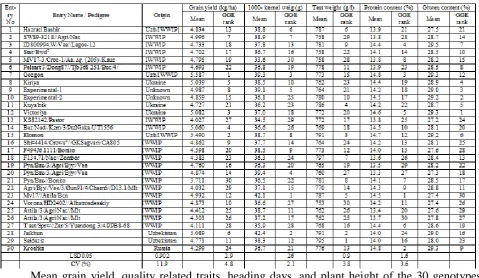
Correlation of grain yield with four quality related traits differed in different environments. Grain yield showed significant positive correlation with TKW in three out of seven environments. Grain yield was significantly positively correlated with protein content in one out seven environments. Grain yield was not correlated with TWT and gluten content in all environments. The 30 genotypes showed arrays of variation for grain yield in each environment (data not presented). The relative grain yield of the 30 genotypes changed greatly over the locations. However, certain genotypes consistently yielded high. Over seven environments, ‘Gozgon’ (#7), ‘Elomon’ (#15), ‘Jaikhun’ (#28), ‘Victoriya’ (#12), and ‘Bez/Nad//Kzm/3/Ptz Niska/UT1556- 170’ (#14) were the five highest yielding genotypes (Table 1). The GGE biplot analysis showed that ‘Gozgon’ (#7) and ‘Elomon’ (#15) were the most superior among the highest yielding genotypes based on both mean and stability of the grain yield. There were arrays of variation for quality traits among the 30 genotypes, and their relative values changed over the environments (data not presented). ‘Jaikhun’ (#28), ‘Mv17//Attila/Bcn’ (#23), ‘Pyn/Bau/3/Agri/Bjy//Vee’ (#20), ‘Gozgon’ (#7), and ‘Hazrati Bashir’(#9) had the highest TKW values (Table 1). The GGE biplot analysis showed that ‘Jaikhun’ (#28) and ‘Mv17//Attila/Bcn’ (#23) were the most superior based on the mean and stability for TKW. Over environments, ‘F134.71/Nac//Zombor’ (#18), ‘Saidaziz’ (#29), ‘Jaikhun’ (#28), ‘Elomon’ (#15), and ‘Hazrati Bashir’ (#1) had the highest TWT (Table 1). The GGE biplot analysis demonstrated that ‘Saidaziz’ (#29), ‘Jaikhun’ (#28), and ‘Elomon’ (#15) were the most superior genotypes for TWT (Figure 3). ‘Kroshka’ (#30), ‘Gozgon’ (#7), ‘Elomon’ (#15), ‘Victoriya’ (#12), and ‘Mv17//Attila/Bcn’ (#23) had the highest mean protein content
‘Kroshka’ (#30), ‘Victoriya’ (#12), and ‘Nazorat-2’ (#10) (Table 1). Based on GGE biplot analysis, ‘Victoriya’ (#12), and ‘Nazorat-2’ (#10) were the most superior for gluten content. The GGE biplot analysis of multiple quality related traits (TKW, TWT, protein and gluten content) across seven environments showed that ‘Elomon’ (#15) and ‘Gozgon’ (#7) were the most superior genotypes (Figure 1). The GGE biplot analysis of the grain yield and the four quality traits also identified ‘Elomon’ (#15) and ‘Gozgon’ (#7) as the most superior genotypes.
Table 1. Name, origin, mean values and superiority (rank based on GGE biplot analysis) across seven environments in Uzbekistan, 2010-2012.
Mean grain yield, quality related traits, heading days, and plant height of the 30 genotypes differed significantly suggesting that the seven environments represented diversity to allow assessment of GE interaction and stability of performance for different traits. The presence of significant GE interaction for grain yield, TKW, TWT, protein and gluten content suggested that relative differences among the genotypes for these traits changed over the environments. The environments with the highest (Karshi, 2010) and the lowest (Kasbi, 2011) grain yield had relatively lower values for TKW but the highest value for protein content. These two environments had equal values for TWT but differed significantly for gluten content. This demonstrates complex effect of environments on grain yield and quality related traits. Previous studies have also reported significant GE interaction for grain yield and TKW in Central Asia (Sharma et al., 2013). The presence of GE interaction on quality related traits (TWT, protein and gluten content) in wheat has also been reported in Central Asia (Gomez-Becerra et al., 2010) and Turkey (Tayyar, 2010).
The range of value for grain yield suggested that the seven environments had different level of productivity. This allowed examination of correlation between grain yield and quality parameters under a range of productivity levels. There was no indication of association between mean grain yield in low and high productive environments with any of the four quality related traits reported here. This suggests that it could be possible to maintain high yield and quality of wheat irrespective of the level of productivity of the environments. This finding is not in agreement with the study by Balla et al. (2011), who reported a linear decrease in protein content with increase in wheat yield. This difference could be due to different sets of materials and environmental conditions used in the two studies.
as shown by GGE rank, differed for grain yield and quality traits among the genotypes. The superior genotypes were not the same for individual quality traits. However, a few genotypes were stable for quality related traits. This is in agreement with the results published by Grausgruber et al. (2000), who reported possibility of identifying wheat genotypes stable for multiple quality traits. Nevertheless, certain genotypes superior for grain yield were also superior for one or more of the quality- related traits. ‘Gozgon’ (#7), one of the most superior for grain yield, was also among the five most superior genotypes for TKW and protein content. Considering all four quality traits, ‘Gozgon’ (#7) ranked as second. Similarly, ‘Elomon’ (#15) ranked second for grain yield superiority and was the most superior considering the four quality traits. ‘Victoriya’ (#12) was among five the most superior genotypes for grain yield, protein and gluten content. These results suggest that it could be possible to identify winter wheat genotypes superior for grain yield and quality traits. The two of the most superior genotypes (‘Gozgon’ and ‘Elomon’) for grain yield and quality are perspective cultivars under seed multiplication and limited commercial cultivation in Uzbekistan. These are expected to be released for large- scale commercial cultivation in for 2015-2016 winter wheat crop season. ‘Elomon’ was resistant to yellow rust during the epidemics of 2009, 2010 and 2013 in Central Asia (Sharma et al., 2013).
Both grain yield and quality related traits in wheat are influenced by GE interactions making it challenging to identify genotypes with superior and stable performance. However, our study presents genotypic variability for stability of grain yield and quality traits considered together. This finding is in agreement with the published reports by Grausgruber et al. (2000) and Peterson et al. (1998). Previous studies have reported selection for high grain yield and one or more superior quality parameters in fewer environments (Tayyar, 2010; Sokoto et al., 2012). However, multiple quality parameters were not included in those studies. The lack of negative correlation between grain yield and individual quality traits found in our study suggests that it could be possible to improve both grain yield and quality in winter wheat. However, the fact that not all genotypes superior for grain yield were necessarily also better for individual quality traits suggests that some compromise would be required in selecting for both grain yield and quality. This might necessitatethat the selection criteria for high, stable grain yield and improved, stable quality to be flexible to allow balancing modest deficiency in one or more of the quality traits with an obvious gain in yield. This strategy should be considered where food security is important; the opposite could be done when there is a premium price for high quality. This concept of a flexible selection scheme to allow balancing good qualities against moderate defects has been described as intuitive index selection by Simmonds (1981, p. 180).
IV. CONCLUSIONS
Both the yield and the quality of bread wheat are important to meet the food and nutrition security of the growing population in Central Asia. This study confirms the complex effect of genotype x environment interactions on grain yield and quality related traits. In past, wheat breeders have found it difficult to combine high yield and quality under diverse environment conditions. Our study shows that progress has been made in this direction in the wheat improvement programs. A few new wheat varieties and advanced breeding lines possess high, stable yield and improved, stable quality under different environmental conditions. Such superior genotypes could be considered as new varieties as well as improved parents in crossing programs by wheat breeders. Most of the superior genotypes for yield and quality originate from the International Winter Wheat Improvement Program and are distributed to the countries in Central Asia and other regions. Therefore, the findings of this study are valuable for national and international winter wheat breeding programs.
BIBLIOGRAPHY
[1] Balla K., Rakszegi M., Li Z., Bekes F., Bencze S., Veisz O. 2011. Quality of winter wheat in relation to heat and drought shock after anthesis. Czech J Food Sci 29: 117-128.
[3] Genstat. 2013. GenStat 64 bit Release 14.2. Lawes Agricultural Trust, Rothamsted Experimental Station, UK. [4] Gomez K.A., Gomez A.A. 1984. Statistical procedures for agricultural research. 2nd ed. John Wiley & Sons, New
York.
[5] Gomez-Becerra H.F., Abugalieva A., Morgounov A., Abdullaev K., Bekenova L., Yessimbekova M., Sereda G., Shpigun S., Tsygankov V., Zelenskiy Y., Pena R.J., Cakmak I. 2010. Phenotypic correlations, G x E interactions and broad sense heritability analysis of grain and flour quality characteristics in high latitude spring bread wheats from Kazakhstan and Siberia. Euphytica 171: 23-38.
[6] Grausgruber H., Oberforster M., Werteker M., Ruckenbauer J., Vollmann J. 2000. Stability of quality traits in Austrian-grown winter wheats. Field Crops Res 66: 257-267.
[7] Johansson E., Svensson G. 1998. Variation in bread-making quality: effects of weather parameters on protein concentration and quality in some Swedish wheat cultivars grown during the period 1975-1996. J Sci Food Agric 78: 109-118.
[8] Koppel R., Ingver A. 2008. A comparison of the yield and quality traits of winter and spring wheat. Latvian J Agronomy 11: 83-89.
[9] Osmanzai M., Sharma R.C. 2008. High yielding stable wheat genotypes for the diverse environments in Afghanistan. Int J Agric Res 3: 340-348.
[10] Peterson C.J., Graybosch R.A., Shelton D.R., Baenziger P.S. 1998. Baking quality of hard red winter wheat: response of cultivars to environment in the Great Plains. Euphytica 100: 157162.
[11] Roozeboom K.L., Schapaugh W.T., Tuinstra M.R., Vanderlip R.L., Milliken G.A. 2008. Testing wheat in variable environments: genotype, environment, interaction effects, and grouping test locations. Crop Sci 48: 317-330. [12] Sakin M.A., Akinci C., Duzdemir O., Donmez. 2011. Assessment of genotype x environment interaction on yield
and yield components of durum wheat genotypes by multivariate analyses. African J Biotechnology 10: 2875-2885.
[13] Sharma R.C., Morgounov A., Akin B., Bespalova L., Lang L., Litvinenko M., Mustatea P., Ozturk I., Postolatiy A., Rajaram S., Braun H.J. 2014. Winter wheat East European Regional Yield Trial: Identification of superior genotypes and characterization of environments. Crop Sci 54: 2469-2480.
[14] Sharma R.C., Morgounov A.I., Braun H.J., Akin B., Keser M., Bedoshvili D., Bagci A., Martius C., van Ginkel M. 2010. Identifying high yielding stable winter wheat genotypes for irrigated environments in Central and West Asia. Euphytica 171: 53-64.
[15] Sharma R.C., Morgounov A.I., Braun H.J., Akin B., Keser M., Kaya Y., Khalikulov Z., van Ginkel M., Yahyaoui A., Rajaram S. 2012. Yield stability analysis of winter wheat genotypes targeted to semi-arid environments in the International Winter Wheat Improvement Program. Int J Plant Breeding 6: 7-13.
[16] Sharma R.C., Rajaram S., Alikulov S., Ziyaev Z., Hazratkulova S., Khodarahami M., Nazeri M., Belen S., Khalikulov Z., Mosaad M., Kaya Y., Keser M., Eshonova Z., Kokhmetova A., Ahmadov M.G., Jalal Kamali M.R., Morgounov A. 2013. Improved winter wheat germplasm for Central and West Asia. Euphytica 190: 19-31. [17] Sharma R.C., Ziyaev Z., Amanov O., Khalikulov Z., Eshonova Z., Bedoshvili D., Keser M., Morgounov A. 2013.
Yellow rust resistant, new winter wheat genotypes for Central Asia and the Caucasus. In: International Plant Breeding Congress Abstract Book. 10-14 November 2013, Antalya, Turkey, p. 251.
[18] Sharma R.K., Osmanzai M., Singh R.P., Braun H.J., Sharma R.C. 2014. Identification of high yielding wheat genotypes through evaluation of international nurseries. Cereal Res Communications 42: 303-313.
[19] Simmonds N.W. 1981. Principles of crop improvement. 2nd ed. Longman Group, New York.
[20] Sokoto M.B., Abubakar I.U., Dikko A.U. 2012. Correlation analysis of some growth, yield, yield components and grain quality of wheat (Triticum aestivum L.). Nigerian J Basic Appl Sci 20: 349-356.
[21] Tayyar S. 2010. Variation in grain yield and quality of Romanian bread wheat varietiescompared to lo cal varieties in northwestern Turkey. Romanian Biotechnological Letters 15: 5189-5196.
[22] Yan W., Kang M.S. 2002. GGE Biplot analysis: A graphical tool for breeders, geneticists, and agronomists. CRC Press, New York.
[23] Yan W., Kang M.S., Ma B., Woods S., Cornelius P.L. 2007. GGE biplot vs. AMMI analysis of genotype-by-environment data. Crop Sci 47:643-653.