International Journal of Sciences
Research Article
(ISSN 2305-3925)
Volume 2, Issue Mar 2013
http://www.ijSciences.com
Modelling and Statistical Optimisation of
Citric Acid Production from Solid State
Fermentation of Sugar Cane Bagasse
Using Aspergillus Niger
N.A. Amenaghawon
1
, S.O. Areguamen
1
, N.T. Agbroko
1
,
S.E. Ogbeide
1
, C.O. Okieimen
1
1
Department of Chemical Engineering, Faculty of Engineering University of Benin, PMB 1154, Benin City, Nigeria
Abstract: This study investigated the production of citric acid from solid state fermentation of treated sugarcane bagasse using Aspergillus niger. Response surface methodology (RSM) was employed for the optimisation of fermentation conditions namely broth pH, fermentation time and substrate loading. A three-variable, three-level Box-Behnken design (BBD) comprising 15 experimental runs was used to develop a statistical model for the optimisation of fermentation conditions. The optimal fermentation conditions that resulted in the maximum citric acid concentration were broth pH, 2.0; fermentation time, 6 days and substrate loading, 80 g/L. Under these conditions, the concentration of citric acid produced was 18.63 g/L. Validation of the model indicated no difference between predicted and observed values as seen in the high correlation between model predicted results and experimental results.
Keywords:
Citric acid, solid state fermentation, Box-Behnken design, Sugarcane bagasse
1. Introduction
Citric acid is a natural constituent and common metabolite of plants and animals. It is a versatile organic acid that is utilised in a wide range of industries. It is used as an anti-oxidising, acidifying, flavouring, preserving, chelating and buffering agent in the food and beverages, pharmaceutical, and cosmetics industries [1-3]. It is traditionally produced by submerged fermentation of molasses by Aspergillus niger [4]. However, increased demand for citric acid has led to the search for more economical means of producing the acid [5-7].
Recently, a lot of interest has been shown in producing citric acid via solid state fermentation of agricultural residues and wastes such as sugar cane bagasse, corn cobs, pineapple waste, apple and grape pomace [2,3,8]. Solid state fermentation has several advantages over submerged fermentation such as biomass energy conservation, less risk of bacterial contamination and less environmental concern as a result of using solid waste for the production of value added products like citric acid [8].
Citric acid production during fermentation by
carbon substrate source and concentration, temperature, pH, inoculum density, aeration, agitation, moisture content etc [9]. In order to get the best performance during fermentation, these factors need to be optimised. The traditional ‘one-factor at a time’ technique used for optimisation is time consuming and often does not capture the interactions between the factors. Response surface methodology is used for optimising all the factors collectively. It is an empirical statistical technique employed for multiple regression analysis of quantitative data obtained from statistically designed experiments by solving the multivariate equations simultaneously [10,11]. It has been successfully applied to the optimization of many bioprocesses [12,13,14]. This work reports the application of Box-Behnken design for the optimisation of citric acid production from sugarcane bagasse by solid state fermentation using
Aspergillusniger.
2. Materials and Methods
2.1 Substrate and pretreatment
overnight with 2 N HCl at room temperature and washed thoroughly with distilled water to get neutral washing, after which it was further dried.
2.2 Microorganism
Aspergillus niger ATCC 9142 was obtained from the biotechnology division of the Federal Institute of Industrial Research Oshodi (FIIRO), Lagos, Nigeria. Conidia suspensions of fungal strains were obtained from cultures grown on potato dextrose agar slants at 30 oC for 5 to 7 days. The spores were washed with sterilized 0.8% Tween 80 solution by shaking vigorously for 1 minute. Spores were counted with a haemocytometer to obtain approximately 2 x 10⁷ spores/ ml.
2.3 Culture medium, inoculum and fermentation
Solid state fermentation was carried out in 250 ml Erlenmeyer flasks using treated bagasse with particle size of 1.2 - 1.6 mm, moistened with sucrose medium (g/L) (sucrose, 310; NH4NO3, 25;
MgSO4.7H2O, 2.5; CuSO4, 0.04; methanol 4%
(v/w)) in such a way that the moisture level of 75% (v/w) could be sustained in the system. The flask
containing the fermentation medium was inoculated with 0.5 ml of the inoculum of concentration 2 x 10⁷ spores/ml and then incubated at 30oC.
2.4 Analytical Methods
The citric acid content of the final hydrolysate was determined using the method of Marier & Boulet [15]. The pH of the sample was determined using a Unican 9450model pH meter.
2.5 Design of Experiment
A three variable Box-Behnken design for response surface methodology was used to study the combined effect of broth pH, fermentation time and substrate loading on citric acid concentration over three levels. The range and levels of the variables optimized are shown in Table 1. The Box-Behnken design is suitable for exploration of quadratic response surfaces and generates a second degree polynomial model, which in turn is used in optimizing a process using a small number of experimental runs. This design requires an experimental number of runs according to:
N= k
2+ k + c
p(1)
Where k is the factor number (3) and cp is the number of replications at the center point (3). The design which was developed using Design Expert® 7.0.0 (Stat-ease, Inc. Minneapolis, USA), resulted in 15 experimental runs as shown in Table 2. The 15 experimental runs were randomized to maximize the effects of unexplained variability in the observed responses due to extraneous factors. The levels of the independent variables as shown in Table 1 were selected based on preliminary experiments and previous studies [16,17]. The relation between the coded and actual values is described as follows:
i o
i i
X X
x X
(2)
Where xi and Xi are the coded and actual values of the independent variable respectively. Xo is the actual value of the independent variable at the center point, and ΔXi is the step change of Xi. A second degree polynomial was fitted to the experimental data using the statistical software Design Expert® 7.0.0 to estimate the response of the dependent variable and predict the optimal point. The second degree polynomial was expressed as follows:
2 2 2
1 1 2 2 3 3 12 1 2 13 1 3 23 2 3 11 1 22 2 33 3
o
Y b b X b X b X b X X b X X b X X b X b X b X
(3)
Where Y is predicted response, X1, X2 and X3 are independent variables, b0 is offset term, b1, b2, b3 are linear effects, b11, b22, b13 are interaction terms.
Table 1: Coded and actual levels of the factors for three factor Box-Behnken design
Independent
Variables Symbols
Coded and Actual Levels
-1 0 +1
pH (-) X1 2 5 8
Time(days) X2 2 4 6
Table 2: Three factor Box-Behnken design with experimental as well as predicted responses of dependent variable (citric acid concentration, g/L)
Runs
Factors Response
Coded values Actual values Citric acid concentration (g/L)
X1 X2 X3 X1 X2 X3 Observed Predicted
1 0 0 0 5 4 60 10.082 9.982
2 0 +1 -1 5 6 40 9.577 9.970
3 0 0 0 5 4 60 9.394 9.910
4 0 -1 -1 5 2 40 9.150 9.860
5 -1 0 +1 2 4 80 13.942 14.001
6 0 -1 +1 5 2 80 14.526 14.130
7 +1 0 +1 8 4 80 12.461 12.550
8 0 0 0 5 4 60 10.265 9.990
9 0 +1 +1 5 6 80 16.556 16.840
10 -1 -1 0 2 2 60 9.960 10.340
11 +1 +1 0 8 6 60 9.864 9.490
12 -1 0 -1 2 4 40 13.332 13.240
13 +1 -1 0 8 2 60 10.195 10.500
14 +1 0 -1 8 4 40 9.150 9.860
15 -1 +1 0 2 6 60 15.485 15.180
3. Results and Discussion
3.1 Statistical Analysis
The results obtained from the 15 experimental runs carried out according to the Box-Behnken design are summarised in Table 2. The proposed second degree polynomial was fitted to the data presented in Table 2 using multiple linear regressions to determine the optimum fermentation conditions
that resulted in the maximum concentration of citric acid. The effects of broth pH, fermentation time and substrate loading were quantitatively evaluated using response surface curves. By applying multiple regression analysis on the experimental data, the following second degree polynomial was found to represent the relationship between the concentration of citric acid produced and broth pH, fermentation time and substrate loading.
1 2 3 1 2 1 3
2 2 2
2 3 1 2 3
25.424 0.844 0.596 0.502 0.244 0.011 +0.010 0.068 0.212 0.00423
Y X X X X X X X
X X X X X
(4)
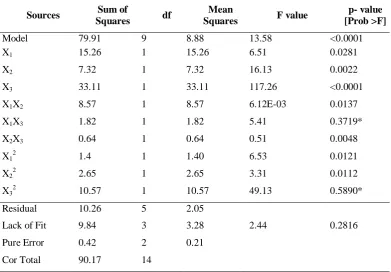
The predicted levels of citric acid concentration using Equation (4) are given in Table 2 along with experimental data. The significance of the fit of the second-order polynomial for the concentration of citric acid was assessed by carrying out analysis of variance (ANOVA) as shown in Tables 3 and 4.
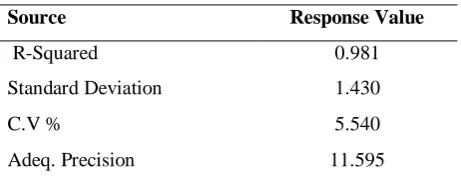
Table 3: Statistical information for ANOVA
Source Response Value
R-Squared 0.981
Standard Deviation 1.430
C.V % 5.540
Table 4: Analysis of variance (ANOVA) for quadratic model of citric acid concentration
Sources Sum of
Squares df
Mean
Squares F value
p- value [Prob >F]
Model 79.91 9 8.88 13.58 <0.0001
X1 15.26 1 15.26 6.51 0.0281
X2 7.32 1 7.32 16.13 0.0022
X3 33.11 1 33.11 117.26 <0.0001
X1X2 8.57 1 8.57 6.12E-03 0.0137
X1X3 1.82 1 1.82 5.41 0.3719*
X2X3 0.64 1 0.64 0.51 0.0048
X12 1.4 1 1.40 6.53 0.0121
X22 2.65 1 2.65 3.31 0.0112
X32 10.57 1 10.57 49.13 0.5890*
Residual 10.26 5 2.05
Lack of Fit 9.84 3 3.28 2.44 0.2816
Pure Error 0.42 2 0.21
Cor Total 90.17 14
*not significant
The coefficient of determination (R2) of the model was 0.981 (Table 3), which indicated that the model adequately represented the relationship between the chosen factors (broth pH, fermentation time and substrate loading) and response (citric acid concentration). An R2 value of 0.981 means that 98.1% of the variability was explained by the model and only 1.90% was as a result of chance. The coefficient of variation (C.V.) obtained was 5.54%. The Coefficient of Variation (C.V) indicates the degree of precision with which the treatments were carried out. A low value of C.V suggest a high reliability of the experiment [11,18]. An adequate precision value of 11.595 was obtained. This parameter measures the signal to- noise ratio, and a ratio greater than 4 is generally desirable [19].
Results obtained after carrying out ANOVA is presented in Table 4. Values of ‘‘Prob. > F’’ less than 0.05 indicate the model terms are significant. Values greater than 0.10 indicate the model terms are not significant. A model F-value of 13.58 and a very low probability value [(Prob > F) less than 0.0001] imply that the model shows significant fit to the experimental data. From the regression model, the model terms X1, X2, X3, X12 and X22
were significant with a probability of 95%. The terms X1X2 and X2X3 were also significant
indicating that there was interaction between broth pH and fermentation time as well as fermentation time and substrate loading. The interaction between the terms X1 and X3 however had no significant
during fermentation. The "Lack of Fit" F-value of 2.44 implies that there is insignificant lack of fit. The "Lack of Fit" (Prob > F) value of 0.2816 implies that there is only 28.16 % chance that the “Lack of Fit" F-value could occur due to noise.
3.2 Optimization of citric acid fermentation
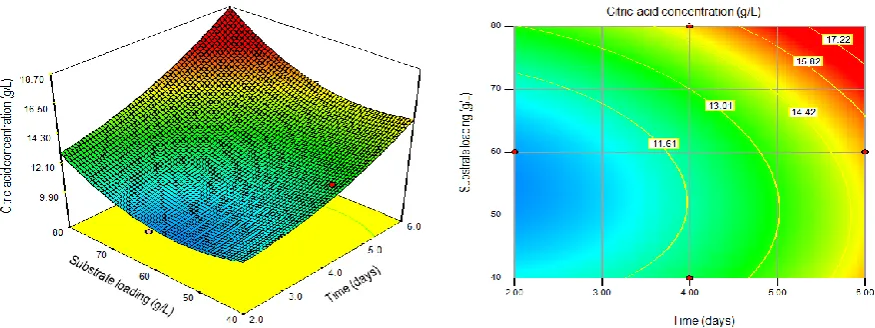
In order to determine optimal levels of the variables affecting the production of citric acid from sugarcane bagasse, three-dimensional (3D) response surface plots were constructed according to the regression model. The response surface plots showed the effect of broth pH, fermentation time and substrate loading on the concentration of citric acid produced.
Figures 1 to 3 represent the response surface and contour plots for the optimization of citric acid production. Figure 1 shows the response surface and corresponding contour plots for citric acid concentration as a function of fermentation time and broth pH. A small trough in the response surface indicates an initial decrease in citric acid production with the initial decrease of broth pH before a steady increase in citric acid production until a maximum of about 18.7 g/L at 6 days of fermentation and 2.0 broth pH.
g/L was obtained at a substrate loading of 80 g/L and a broth pH of 2.0.
Figure 1: Response surface plot and the corresponding contour plot showing the effects of fermentation time and broth pH on citric acid concentration
Figure 2: Response surface plot and the corresponding contour plot showing the effects of substrate loading and broth pH on citric acid concentration
Figure 3 shows the interaction between substrate loading and fermentation time on citric acid production. An increase in substrate loading with corresponding increase in fermentation time resulted in an increase in citric acid concentration from about 12 g/L to a maximum value of 18.7 g/L at 80 g/L substrate loading and 6 days of fermentation.
The regression model was optimised in order to select the optimum fermentation conditions and their respective levels. The maximum response predicted from the model was a citric acid concentration of 18.63 g/L. This was predicted with a desirability of 96.2%. The final optimised fermentation conditions obtained with RSM were a substrate loading of 80 g/L, a broth pH of 2.0 and a fermentation time of 6days.
The broth pH plays a major role in the microbial production of citric acid. Protons are released during fermentation when Aspergillus niger
metabolises the nitrogen component of the fermentation medium. This metabolic activity lowers the pH of the medium. Hence, a decrease in broth pH as fermentation progresses is often seen as an indication of citric acid production. The low pH provides a sterile environment which reduces the risk of contamination, inhibits the production of unwanted organic acids which makes recovery difficult and consequently improves citric acid production [9].
Polysaccharides are only useful in the production of citric acid if the fermenting organism has the hydrolytic enzymes which are effective at low pH values required for fermentation. This is the reason sucrose is preferred to glucose because Aspergillus niger has an effective mycelium-bound invertase that is active at low pH [20,21,22].
The suitability of the model equation for predicting the optimum response value was tested using the recommended optimum conditions. When optimum values of the independent variables (2.0 broth pH, 6 days fermentation time, 80 g/L substrate loading) were incorporated into the regression equation, 18.63 g/L citric acid concentration was obtained, whereas actual experiment at the stated optimum conditions gave a citric acid concentration of 18.23 g/L. Thus, predicted values from regression model and observed values from experiment were in very good agreement.
4. CONCLUSION
In this work, citric acid production from solid state fermentation of sugarcane bagasse using Aspergillus niger was optimised. The following conclusions can be drawn from the study.
The use of response surface methodology
the production of citric acid from treated sugarcane bagasse has been demonstrated.
Citric acid production from solid state fermentation of sugarcane bagasse is influenced by broth pH, fermentation time and substrate loading.
A validated quadratic regression model relates the concentration of citric acid produced during fermentation to the broth pH, fermentation time and substrate loading.
The quadratic regression model was able to predict to a high level of confidence, the concentration of citric acid produced during fermentation by Aspergillus niger as seen in the substantial correlation between the model predicted results and experimental results and the high R2 value (R2=0.981).
The combination of optimum fermentation conditions were a broth of pH 2.0, fermentation time of 6 days and substrate loading of 80 g/L. Under these conditions, the maximum concentration of citric acid was obtained to be 18.63 g/L.
REFERENCES
[1] Amenaghawon, N.A. & Aisien, F.A. Modelling and Simulation of Citric Acid Production from Corn Starch Hydrolysate Using Aspergillus Niger.
Environ Nat Resour Res, 2(1), 2012. pp.73–85.
[2] Kumar, A. & Jain, V.K. Solid state fermentation studies of citric acid production. Afr J Biotechnol, 7(5), 2010. pp.644–650.
[3] Baei, M.S., Mahmoudi, M. & Yunesi, H. A kinetic model for citric acid production from apple pomac by Aspergillus niger. Afr J Biotechnol, 7(19), 2008. pp.3487–3489.
[4] Assadi, M.M. & Nikkhah, M. Production of citric acid from date pulp by solid state fermentation. J Agr Sci Technol, 4(3), 2002. p.119.
[5] Alvarez-Vasquez, F., Gonzalez-Alco, C. & Torres, N.V. Metabolism of citric acid production by Aspergillus niger: Model definition, steady-state analysis and constrained optimization of citric acid production rate. Biotechnol Bioeng, 70,2000. pp.82–108.
[6] Pazouki, M., Felse, P.A., Sinha, J. & Panda, T. Comparative studies on citric acid production by Aspergillus niger and Candida lipolytica using molasses and glucose. Bioprocess Eng, 22, 2000. pp.353–361.
Bioresource Technol, 74, 2000. pp.175–178.
[8] Imandi, S.B., Bandaru, V.V.R., Somalanka, S.R., Bandaru, S.R. & Garapati, H.R. Application of statistical experimental designs for the optimization of medium constituents for the production of citric acid from pineapple waste.
Bioresource Technol, 99(10), 2008. pp.4445– 4450.
[9] Max, B., Salgado, J. M., Rodríguez, N., Cortés, S., Converti, A., & Domínguez, J. M. Biotechnological production of citric acid. Braz J Microbiol, 41(4), 2010. pp. 862-875.
[10] Khuri, A.I. & Cornell, J.A. Response Surfaces: Design and Analysis, New York: Marcel Dekker, 1987.
[11] Montgomery, D.C.,. Design and Analysis of experiments 6th ed., New York: John Wiley & Sons, Inc., 2005.
[12] Anupama, M.P., Mahesh, D.G. & Ayyanna, C. Optimization of fermentation medium for the production of Ethanol from jaggery using box-behnken design. Int J Appl Biol Pharm Technol, 1(1), 2010. pp.34–45.
[13] Fang, H., Zhao, C. & Song, X. Optimization of enzymatic hydrolysis of steam-exploded corn stover by two approaches: Response surface methodology or using cellulase from mixed cultures of Trichoderma reesei RUT-C30 and Aspergillus niger NL02. Bioresource Technol, 101, 2010. pp. 4111–4119.
[14] Tian, S., Wang, Z., Fan, Z. & Zuo, L. Optimization of CO2 laser-based pretreatment of corn stover using response surface methodology.
Bioresource Technol, 102, 2011. pp.10493– 10497.
[15] Marier, J.R. & Boulet, M. Direct Determination of Citric Acid in Milk with an Improved Pyridine-Acetic Anhydride Method. J Dairy Sci, 41(12), 1958. pp. 1683–1692.
[16] Lotfy, W.A. Ghanem, K.M, El-Helow, E.R. Citric acid production by a novel Aspergillus niger isolate: II. Optimization of process parameters through statistical experimental designs. Bioresource technology. 98(18), 2007. pp. 3470– 3477.
[17] Kim, J.K. Optimization of Citric Acid Production by Aspergillus Niger NRRL 567 in Various Fermentation Systems. PhD Thesis. Quebec, Canada: McGill University. 2004.
[18] Mason, R.L., Gunst, R.F. & Hess, J.L. Statistical Design & Analysis of Experiments, New York: Wiley. 1989.
[19] Cao, G., Ren, N., Wang, A., Lee, D.J., Guo, W., Liu, B., Feng, Y. & Zhao, Q. Acid hydrolysis of corn stover for biohydrogen production using Thermoanaerobacterium thermosaccharolyticum W16. Int J Hydrogen Energy, 34, 2009. pp.7182– 7188.
Effect of sugars, hydrogen ion concentration and ammonium nitrate on the formation of citric acid by Aspergillus niger. Acta Microbiologica Academiae Scientiarum Hungaricae, 23(1), 1976. p.63.
[21] Hossain, M., Brooks, J.D. & Maddox, I.S. The effect of the sugar source on citric acid production by Aspergillus niger. Appl Microbiol Biotechnol, 19(6), 1984. pp.393–397.