• No results found

Determination of heavy metal (Cr, Zn, Cd and Pb) concentrations in water, sediment and benthos of the Gorgan Bay (Golestan province, Iran)

N/A
N/A
Protected

Academic year: 2020

Share "Determination of heavy metal (Cr, Zn, Cd and Pb) concentrations in water, sediment and benthos of the Gorgan Bay (Golestan province, Iran)"

Copied!
7
0
0

Loading.... (view fulltext now)

Full text

(1)

Determination of heavy metal (Cr, Zn, Cd and Pb) concentrations

in water, sediment and benthos of the Gorgan Bay (Golestan

province, Iran)

Saghali, M.

1

*; Baqraf, R.

2

; Patimar, R.

3

; Hosseini, S. A.

4

; Baniemam, M.

5

Received: February 2012 Accepted: November 2013

Abstract

The coastal area of the Caspian Sea and Gorgan Bay are important ecosystems receiving discharge from their tributaries. In this study, concentration of lead (Pb), cadmium (Cd), zinc (Zn) and chromium (Cr) was seasonally determined at 8 sampling points during 2009-2010. Water samples were collected from the sampling stations and transferred to laboratory in polyethylene containers, whereas, sediment and benthic fauna samples were collected using a Van Veen grab. The levels of heavy metals were determined by atomic absorption spectroscopy method. Results showed that range of Pb, Cd, Cr and Zn in the water samples were 80-123, 61-97, 63-87 and 82-120 ppb, respectively; and their ranges in the sediment samples were 479-1072, 98-293, 102-622 and 937-1577 ppb, respectively. The range of Pb, Cd, Cr and Zn in the benthos samples were 95-132, 59-110, 26-58 and 103-155 ppb, respectively. Zn and Pb were the most concentrate metals in all samples. Likewise, sediment had the highest heavy metal content amongst the samples. This study demonstrated that the level of metals in the environment is increasing, bringing a serious warning to industries and threat of man-made contamination, which can be restricted and a necessity to control ecosystem and food-chain pollution.

Keywords:Water, Heavy metals, Sediment, Benthos, Gorgan Bay

1-Iran Fisheries organization, Bandar-E-Torkman, Iran

2-Azerbaijan Oil Company, Baku, Azerbaijan

3-Departement of fisheries, University of Gonbad-E-Kavoos, Gonbad-E-Kavoos, Iran

4-Department of Fisheries, Faculty of Fisheries and Environment, Gorgan University of Agricultural Sciences

and Natural Resources

*Corresponding author's email: [email protected]

(2)

Introduction

Heavy metals are of the important source of hazardous pollutants in the aquatic ecosystems (Martin and Covghtry, 1982; Gibbs and Miskiewicz, 1995). They cause serious problem in the aquatic organisms, intertidal organisms and human (Holland and White, 1982; Hodson, 1988; Domingo, 1994; Rossi et al., 1996; Boening, 2000; Di Gioacchino et al., 2008; Jezierska et al., 2009; Couture and Pyle, 2011). Study on the heavy metal in aquatic ecosystems can give valuable information about the environmental condition of that ecosystem.

Water and sediment of the polluted sites contains various levels of heavy metals. Measurement of heavy metals in both water and sediment samples can show the condition of the ecosystem regard to heavy metal pollution. On the other hand, aquatic organisms are the target of heavy metal intoxication, which accumulate large volume of heavy metals in their tissues. Therefore, determination of heavy metals in the aquatic organisms' tissue may be valuable and informative. Benthic organisms are highly exposed to heavy metal because they live on sediments that trap huge volume of heavy metal. Also, because these organisms are

consumed by larger animals, they can transfer their heavy metals in the food chain. Thus, determination of heavy metal content in benthic organisms' tissue may be valuable. The Caspian Sea and Gorgan Bay are the economically and socially important aquatic ecosystems in Iran. They also are important from the aspect of wildlife, because they have number of endemic species. Protection of this environment is vital due to its importance as well as that they receive heavy metals from all adjacent countries (Korotenko et al., 2000; Andresen, 2010; Nejatkhah et al., 2010). Heavy metal concentrations were reported in the Caspian Sea by De Mora et al. (2004) and Tabari et al. (2010). However, continuous monitoring is necessary to pursue the condition of the region. Accordingly, the purpose of this study was to determine the concentration of heavy metals (Pb, Cd, Cr, Zn) in water, sediment and benthic fauna in the coastal waters of the Caspian Sea and Gorgan Bay during 2009-2010.

Materials and methods

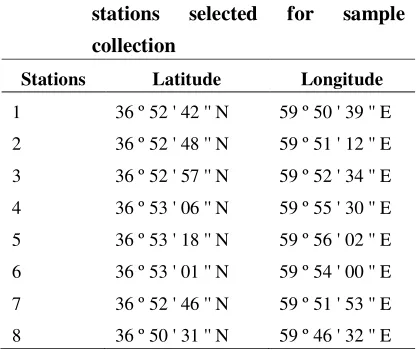
8 sampling stations were selected in the southeast coasts of the Caspian Sea (Fig. 1; Table 1).

(3)

Figure 1: Sampling sites in the Gorgan Bay and Caspian Sea

Table 1: Geographical coordinates of the stations selected for sample collection

Stations Latitude Longitude

1 36 º 52 ' 42 '' N 59 º 50 ' 39 '' E

2 36 º 52 ' 48 '' N 59 º 51 ' 12 '' E

3 36 º 52 ' 57 '' N 59 º 52 ' 34 '' E

4 36 º 53 ' 06 '' N 59 º 55 ' 30 '' E

5 36 º 53 ' 18 '' N 59 º 56 ' 02 '' E

6 36 º 53 ' 01 '' N 59 º 54 ' 00 '' E

7 36 º 52 ' 46 '' N 59 º 51 ' 53 '' E

8 36 º 50 ' 31 '' N 59 º 46 ' 32 '' E

Seasonal sampling took place over one year in 2009- 2010. Three samples were collected per season from each station. Water samples were collected by Nansen bottle and poured into polyethylene containers. Sediment and benthos samples were collected using a Van Veen grab. The benthos samples, taken from the sediment bed by grab were washed in a tub and passed through a 500 µ sieve. All benthos on the filter mesh was collected and washed with distilled water. To analyze heavy metal content of the benthos, all benthos were

pooled and used for analyses. Bivalves were de-shelled before pooling and soft tissues were used for analyses.

Water samples were passed through Watman 42 filters the water was gently heated and evaporated. Next, 1 ml samples were added to 65% nitric acid and again filtered and stored in polyethylene containers for injection into the Atomic Absorption . Sediment and benthos samples were heated in an electric oven at 70oC until dry. The samples were separated using sieve no. 230 (0.063 mm), then softened and homogenized using a pestle and mortar and 1 g was weighed using a digital scale (with 0.01 g precision) which was stored in a polyethylene container and 5 ml of nitric acid with 5 ml perchloric acid (1:1) were added and placed on a water bath at 100 oC for complete dissolving of the samples and change of color to pale yellow, next a little distilled water was added and the solution turned colorless after heating. The solution was passed through a Watman 42 filter and its volume was increased to 30 ml with distilled

(4)

water and injected into the Atomic Absorption to assign the amount of heavy metals.

Calibration of the apparatus was performed by reference materials (Merck, Germany). R2 value of heavy metals standard curve was 0.99. To ensure data quality, 3 known concentrations of reference metals (Merck, Germany) were measured 6 times. Coefficient of variation was found to be 2.78 %.

SPSS12 software was used to analyze the results. One way ANOVA and Duncan tests were used for the statistical studies and assignment of the variance of metal concentrations as well as Excel for recording

of the results. Data are presented as mean ± SD.

Results

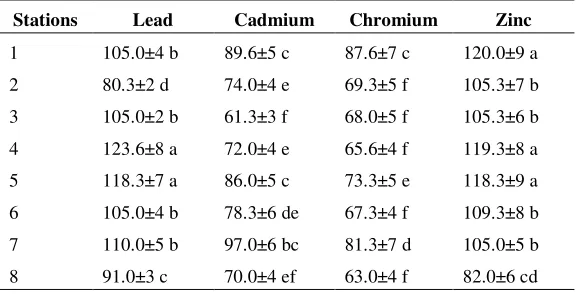
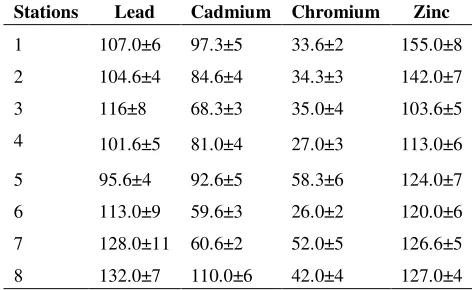
Results showed that range of Pb, Cd, Cr and Zn in the water samples were 80-123, 61-97, 63-87 and 82-120 ppb, respectively (Table 2). The range of Pb, Cd, Cr and Zn in the sediment samples were 479-1072, 98-293, 102-622 and 937-1577 ppb, respectively (Table 3). The range of Pb, Cd, Cr and Zn in the benthos samples were 95-132, 59-110, 26-58 and 103-155 ppb, respectively (Table 3). Zn and Pb were the most concentrate metals in all samples; likewise, sediment had the highest heavy metal content among the samples (Tables 2, 3 and 4).

Table 2: Heavy metal concentration (ppb) in water samples collected during 2009-2010 from southeast coast of the Caspian Sea, n = 4.

Zinc Chromium

Cadmium Lead

Stations

120.0±9 a 87.6±7 c

89.6±5 c 105.0±4 b

1

105.3±7 b 69.3±5 f

74.0±4 e 80.3±2 d

2

105.3±6 b 68.0±5 f

61.3±3 f 105.0±2 b

3

119.3±8 a 65.6±4 f

72.0±4 e 123.6±8 a

4

118.3±9 a 73.3±5 e

86.0±5 c 118.3±7 a

5

109.3±8 b 67.3±4 f

78.3±6 de 105.0±4 b

6

105.0±5 b 81.3±7 d

97.0±6 bc 110.0±5 b

7

82.0±6 cd 63.0±4 f

70.0±4 ef 91.0±3 c

8

(5)

Table 3: Heavy metal concentration (ppb) in sediment samples collected during 2009-2010 from southeast coast of the Caspian Sea, n = 4.

Zinc Chromium Cadmium Lead Stations 1414.6±11 b 244.0±2 q 110.3±5 u 817.6±8 i 1 1577.3±12 a 362.3±3 m

145.6±6 s 806.3±6 i 2 1077.0±9 e 233.3±2 q 123.6±4 t 479.3±3 k 3 1381.3±10 c 313.6±4 n 293.0±6 p 1072.3±10 e 4 1299.3±9 c 310.6±5 n 170.0±3 r 957.0±8 g 5 1408.0±11 b 622.3±7 j 138.6±4 s 1017.0±9 f 6 1103.3±9 d 236.6±4 q 135.3±3 s 826.6±8 i 7 937.0±4 h 102.0±2 w 98.0±4 w 615.0±5 j 8

Table 4: Heavy metal concentration (ppb) in benthic fauna samples collected during 2009-2010 from southeast coast of the Caspian Sea, n = 4.

Zinc Chromium Cadmium Lead Stations 155.0±8 33.6±2 97.3±5 107.0±6 1 142.0±7 34.3±3 84.6±4 104.6±4 2 103.6±5 35.0±4 68.3±3 116±8 3 113.0±6 27.0±3 81.0±4 101.6±5 4 124.0±7 58.3±6 92.6±5 95.6±4 5 120.0±6 26.0±2 59.6±3 113.0±9 6 126.6±5 52.0±5 60.6±2 128.0±11 7 127.0±4 42.0±4 110.0±6 132.0±7 8

Discussion

Results of the analysis of water samples at the eight stations in the southeast Caspian Sea coast and Gharehsoo River areas indicate that the maximum amount of Pb, Cd, Cr and Zn were accumulated at the stations 1, 1, 4 and 7 being 124±8; 97±6; 82±7 and 120±9 µg/L, respectively. The minimum amounts of measured heavy metals in the water were at stations 8, 8, 3 and 2 with minimum averages of 91±3 and 61.3±3 and 63±4 and 82±6 µg/L for Pb, Cd, Cr and Zn, respectively. Due to the

indirect access of industrial waste water to these areas, Cr and Pb (especially Cr) possess less solubility than other metals (Bowen, 1979) showing reduced absorption and fluid formation than other elements and as Pb is more common on the surface it possesses greater solubility characteristics. The amount of Pb at these stations is therefore higher than other metals. Comparison of above mentioned metals in this study in consideration of the standards presented by the International Hygiene Organization and IRI Standard

(6)

Organization shows lower levels of pollution. Bed sediments have the highest intake rate of varied contaminants especially heavy metals within the marine ecosystems. The trend of metal accumulation in the sediments of the studied area according to the results obtained is Cd<Cr<Pb<Zn and due to the density of agricultural, urban and industrial activities near the Gorgan Bay, stations 4 and 6 showed greater accumulation compared to the other areas. The maximum amount of elements Pb, Cd, Cr and Zn were 1072±10 and 293±6 and 622.3±7 and 1577.3±11 µg/kg, whereas, the minimum amount of elements were 479.3±3 and 98±4 and 102±2 and 937±4 mg/kg, respectively.

The result of analysis of sediments at several stations compared to the standards provided for the sediments appropriate to the environmental conditions of sea bed dwellers showed that the levels of some elements in sediments are slightly higher than acceptable amounts for living condition of sea bed dwellers but the contamination level has not reached intolerable and hazardous levels. In consideration of the high amounts of heavy metals in the water and sediments, and entry of varied contaminants into the studied area from urban, agricultural and industrial sewage networks in the regional water-ways and industrial rivers (especially Gharehsoo and Gaz rivers), there will be inevitable effect on the bottom dwelling animals. The accumulation of metals in the benthos, according to the results obtained, is as follows: Cr <Cd <Pb <Zn where the maximum amount of these metals are 132±7, 110±6, 58.3±6 and

155±8 µg/kg, respectively and the minimum amounts were 95.6±4, 59.6±3, 26±2 and 103.6±5 µg/kg, respectively.

The results from the analysis of benthos compared with the standards provided for consumption of animals which consume this benthic community is slightly hazardous but the volume of contaminant of such elements in the animals has not reached intolerable and hazardous levels. Similar research studies (i.e. effects of contaminant elements on accumulation of heavy elements in bottom dwellers) have also been conducted by other researchers (Komaya and Nanamoori, 2000; Karadede-Akin and Unlu, 2007). Research carried out by Komaya and Nanamoori (2000) shows the higher significant correlation between heavy elements in water, sediments and Benthos and dispersion of elements in their bodies. Karadede-Akin and Unlu (2007) reported that some benthic organisms (crab, snail, green algae and mussel) accumulate the heavy metals presented in sediment samples and can be used for biomonitoring.

This study demonstrated that the level of metals in the environment is increasing, bringing a serious warning to industries and threat of man-made contamination, which can be restricted and a necessity to control ecosystem and food-chain pollution.

References

Andresen, H., 2010. Monitoring heavy metal

concentrations in the sediments of the Moskva

and Oka River system-Results of the

Volga-Rhine-Project. In EGU General Assembly

Conference Abstracts. Vol. 12, 12167P.

(7)

Boening, D. W., 2000. Ecological effects,

transport, and fate of mercury: a general review.

Chemosphere, 40(12), 1335-1351.

Bortleson, G. C., Cox, S. E. and Munn, M. D.,

1992. Sediment Quality Assessment of Franklin

Roosvelt lake and the upstream Reach of the

Columbia River, Washington, S. Geological

survey, pp.94-315.

Couture, P. and Pyle, G., 2011. 9-Field studies on

metal accumulation and effects in fish. Fish

Physiology, Elsevier, New York, 31, 417-473.

Diagomanolin, V., Farhang, M.,

Ghazi-Khansari, M. and Jafarzadeh, N., 2004.

Heavy metals (Ni, Cr, Cu) in the Karoon

waterway River, Iran. Toxicology Letters,

151(1), 63–67.

Gibbs, P. J. and Miskiewicz, A. G., 1995. Heavy

metals in fish near major primary treatment

sewage outfall. Marine Pollution Bulletin,

30(10), 667–674.

Hodson, P. V., 1988. The effect of metal

metabolism on uptake, disposition and toxicity

in fish. Aquatic Toxicology, 11(1), 3-18.

Holland, M. K. and White, I. G., 1982. Heavy

metals and human spermatozoa: II. The effect of

seminal plasma on the toxicity of copper metal

for spermatozoa. International Journal of

Fertility, 27(2), 95-99.

Korotenko, K. A., Mamedov, R. M.and Mooers,

C. N. K., 2000. Prediction of the dispersal of oil

transport in the Caspian Sea resulting from a continuous release. Spill Science and

Technology Bulletin, 6(5), 323-339.

Karadede-Akin, H. and Unlu, E., 2007. Heavy

metal concentrations in water, sediment, fish

and some benthic organisms from Tigris River,

Turkey. Environment Monitoring and

Assessment, 131(22), 323–337.

Koyama, J. and Nanamori, N., 2000.

Bioaccumulation of water borne, and Dietary

cadmium by oval squid, Sepioteuthis

lessoniana, and its Discription among organs.

Marine Pollution Bulletin, 40(11), 961-967.

Martin, M. H. and Covghtrey, P. J., 1982.

Biological Monitoring of Heavy Metal

pollution. Land and Air Applied Science,

London: 475P.

Mason, C. F., 1991. Biology of freshwater

pollution, second ed. Longman, New York:

351P.

Nejatkhah Manavi, P., Sedighi, O., Saghali, M.,

Mirshekar, D., Arabha, F. and Nikbakhat,

A., 2010. Variation of some physical and

chemical parameters in the Caspian Sea. In:

Proceeding of International conference of

Ecology of Caspian Sea. Sari, Iran, pp.11-13.(in

Persian)

Rossi, A., Poverini, R., Di Lullo, G., Modesti, A.,

Modica, A. and Scarino, M.L., 1996. Heavy

metal toxicity following apical and basolateral

exposure in the human intestinal cell line

Caco-2. Toxicology in vitro, 10(1), 27-36.

Tabari, S., SaeediSaravi, S. S., Bandany, G.,

Dehgan, A. and Shokrzadeh, M., 2010. Heavy

metals (Zn, Pb, Cd and Cr) in fish, water and

sediments sampled form Southern Caspian Sea,

Iran. Toxicology and Industrial Health, 26(10), 649–656.

Figure

Figure 1: Sampling sites in the Gorgan Bay and Caspian Sea
Table 2: Heavy metal concentration (ppb) in water samples collected during 2009-2010 from
Table 3: Heavy metal concentration (ppb) in sediment samples collected during 2009-2010 from

References

Related documents

Another meditation teacher, who has facilitated meditation teachers training, has also worked with vulnerable populations in San Francisco including those with psychiatric

VETERANS’ PREFERENCE: Preference is given to all veterans, or their surviving spouses, who served on active duty in time of war as defined in Section 85 of the Civil Service

Faktor-faktor yang mempengaruhi kestabilan lereng dapat menghasilkan tegangan geser pada seluruh massa tanah, dan suatu gerakan akan terjadi kecuali tahanan geser

• Enhanced design grouping /ungrouping allows designs or letters to move as a group • Color Visualizer with pin-able color selections. • Direct Spool Selection to change

Exchange is the email system of corporate America • Microsoft supports the product as a professional service and not a commodity • The online Microsoft Office 365 Suite mimics the

Installer Bootstrap Host As an early step in the site installation process, one of the hosts (which is eventually re-provisioned as a Database Server) is minimally provisioned to act

Wastes from production ,formulation &amp; use of resins, latex, plasticizers, glues/adhesives New Caledonia 50 19/10/2015 Waste Management NZ Limited (amalgamated with