
Decision Support for a Centre Pivot Irrigation
System Based on Numerical Modelling
Andrei-Mugur Georgescu
1, Remus Alexandru Madularea
2, Petre-Ovidiu
Ciuc
2and Sanda-Carmen Georgescu
2*1
Technical University of Civil Engineering Bucharest, Bucharest, Romania 2University “Politehnica” of Bucharest, Bucharest, Romania
[email protected], [email protected], [email protected], [email protected]
Abstract
We focus on the operation of a real centre pivot irrigation system. The system encountered problems in 2016 and did not operate for several weeks due to the low level of the Danube (its water source). In that period, water level in the Danube went below the most probable minimal level during summer, with a return period of 30 years. With a natural desire to solve the problem, the owner of the system added a new pump near the water intake. This new, double-entry vertical axis pump, coupled in series with the existing pumping station situated further downstream, added roughly 1 bar to the pressure in the system. Things went well till the end of summer 2017 when, due to a pressure surge in the pumping station (most likely at shutoff head), one of the anti-vibration joints detached suddenly from the discharge pipe, and the pumping station was entirely flooded. The performed analysis helped understand the reasons of the accident and provided solutions (including pumping operating rules and schedule for pivots that can be operated simultaneously) that will hopefully avoid reoccurrences in the future, without affecting the day to day operation of the system.
1
Introduction
In this paper, we focus on the operation of a new centre pivot irrigation system, located in Romania (at Seimenii Mici), in the Dobrogea region (between the Danube river and the Black Sea, about 9 km away from the Nuclear Power Plant of Cernavoda).
The centre pivot is a method of irrigation based on the rotation of equipment around a pivot. The crops are watered by overhead sprinklers mounted on the equipment, thus, a circular area centred on the pivot is irrigated [1,2]. In order to avoid unbalanced watering of the crops, a pressure reducing
* Corresponding author
Engineering
Volume 3, 2018, Pages 764–771
valve is mounted before each sprinkler. Equipment’s rotation around the pivot is usually propelled by electric motors. Such systems are considered to be highly efficient and use less water than other surface irrigation systems. The pivot itself is just a vertical pipe coming out of the ground and supplying the sprinklers of the equipment. Within a hydraulic analysis, modelling the pivot as a simple nozzle, i.e. an uncontrolled orifice, where the discharge depends on the pressure [3], is not representative for the real behaviour of the system. Of course the multitude of sprinklers supplied by the pivot can be modelled as a single "bigger" orifice (its outflow coefficient can be computed based on pivot's technical specifications, namely the nominal flow rate and the pressure requested for full service), but a pressure reducing valve should also be inserted before the orifice to avoid the increase of flow rate in case of exceeding pressure. Such a behaviour fits the pressure-driven simulation models. Pressure-driven analysis can be directly performed in software like Bentley WaterGEMS, WDNetXL [4], WaterNetGen [5] and others. Demand-driven simulation models are not primarily fit for uncontrolled discharge orifices. Although EPANET allows performing mainly demand-driven analysis, it also incorporates emitters that model pressure-dependent outflow at orifices [6] and pressure reducing valves. Being a free software and due to its versatility, EPANET was thus the preferred choice for the analysis presented in this paper.
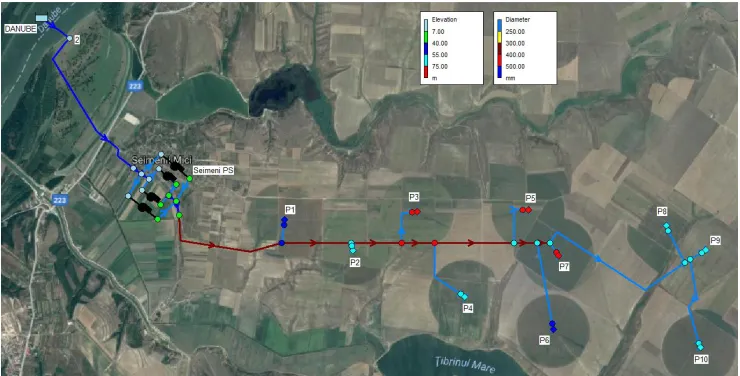
The model of the irrigation system consists of 10 identically equipped centre pivots, supplied with water pumped from the Danube, through a branched network. The total cumulated length of the pipes in the system is of 16.25 km. Each pivot must be able to supply a flow rate of about 55 l/s at 3 bar (minimum 2.6 bar) for the correct operation of the equipment. A scheme of the irrigation system with elevations (from 3.5 m to 88 m) and pipes' inner diameters (from 200 mm to 582 mm) is presented in figure 1, superposed on a Google map screen shot of the area.
Figure 1: Hydraulic scheme of the centre pivot irrigation system configuration : water source (Danube), Seimeni PS and 10 pivots (P1 to P10); elevations [m] and diameters [mm] are displayed using colour bars
The irrigation system built based on the above design configuration, termed further as configuration (figure 1), was commissioned in the spring of 2016 and used during the summer of 2016. Unfortunately, in the summer of 2016, the Danube level decreased to a level below the minimal design limit and the system had to be stopped frequently, due to unusual vibrations and noises in the pumping station (at times, pumps' rotors ran with cavitation on their suction side, but saving the crops prevailed over protecting the rotors). Obviously, insufficient watering of the crops also occurred.
To avoid future problems related to cavitation of pumps and to water shortage (when Danube’s level will get lower than the minimal design value), by the end of 2016, the owner of the irrigation system installed an additional pump (double-entry vertical axis pump, variable speed driven) on the intake pipe, located at node 2, near the Danube (figure 1) the new configuration of the system will be termed further as configuration . Within the configuration , during the summer of 2017, Seimeni PS became a second stage PS, operating in better conditions than in the previous year.
The overpressure of about 1 bar, induced by the double-entry pump from node 2, pushed the system near its upper pressure limit on the discharge pipes of pumps from Seimeni PS (pipes with PN16 nominal pressure). In September 2017, due to a pressure surge at one pump (most likely at shutoff head), the anti-vibration joint detached suddenly from the discharge pipe, the Seimeni Pumping Station was entirely flooded, and equipments were severely damaged. Following that event, the owner requested a solution for refurbishing Seimeni PS with minimal costs.
In order to understand the reasons of the accident, and to analyse the refurbished system within the configuration , EPANET numerical models for both configurations and were built, based on the methodology presented in Section 2. Further, in Section 3, the results were compared, and finally a decision support tool, including safety pumping operating rules and a schedule for pivots that can be operated simultaneously within the configuration was provided.
2
Methodology
An EPANET model of the irrigation system was built for the configuration (figure 1). As mentioned above, the pivot can be modelled as a nozzle, where the discharge Qn is defined upon the
full service pressure pn, namely: Qnap0n.5, where the value of the outflow coefficient (emitter
coefficient in EPANET) results a9.94103 m2.5/s, at the nominal flow rate of the considered pivot:
3
10 44 .
54
n
Q m3/s. Before each pivot, a pressure reducing valve keeps the downstream pressure at
30
n
p mWG (about 3 bar), when the upstream pressure is above that limit.
Several simulations with different conditions were performed for the configuration of the system. It turned out that some combinations of pivots could not ascertain the requested flow or pressure requirements, resulting in improper irrigation of the crops, even at design level of the Danube. Subsequently, a more thorough analysis of all the possible combinations of 3 pivots out of the existing 10 was performed. This analysis assumed that all 3 pivots operate at nominal conditions and that all 3 (identical) centrifugal pumps of the PS are working at nominal speed. With this assumption, the flow through one pump must equal the requested flow of one pivot; hence the head given by a pump at the nominal flow rate of one pivot can be directly obtained from the pump curve. The head versus flow rate curve of the pumps from Seimeni PS, constructed at nominal speed and introduced in the EPANET model, is presented in figure 2.
The available specific energy (available head) of the system, HA (measured in [m]), is computed
as the sum between the level of water in the Danube and the pumping head: HAzDHp, where
D
pump working at a flow rate equal to the nominal flow rate of the pivot. From the pump curve, the resulting pump head is Hp 149.7 m (see the operation point in figure 2). The discharge pressure of pumps in Seimeni PS reaches 151.6 mWG for the configuration (meaning that the pressure is below, but quite closed to the admissible PN16 level).
Figure 2: Head versus flow rate curves of pumps in Seimeni PS, at nominal speed (speed factor 1) and at speed factors 0.98 and 0.973; operation point for configurations and at nominal speed;
operation points for configuration at 0.98 and 0.973
The necessary specific energy (necessary head) of the system, HN (in [m]), is computed as the maximum value of the sum between the necessary head of each pivot and the corresponding head losses in the system, for each combination of 3 operating pivots, as:
}
{
D P; ;
) (
max n n r n
k j i n
N z p g h
H
, (1)
where n
i; j;k
represent the indexes of the 3 operating pivots, zn represents the ground elevationat the location of pivot Pn, the pressure head pn (
g)30 m ( is the water density and g thegravity), and
n r
hDP is the value of head losses on the path from the Danube up to the pivot Pn. The
head losses can be expressed as:
m m mn
r R Q
hD P ( 2), where m is the index of the pipes between
Danube and the pivot Pn; Rm is the hydraulic resistance of the pipe (measured in [s2/m5]); Qm is the flow rate through the pipe of index m; the roughness was set on each pipe (from 2 mm on the intake pipe, to 0.1 mm on pipes connected to pivots); the Darcy-Weisbach friction factor was computed using the Swamee and Jain formula [7]. Minor losses on pipes, as well as inlet and outlet kinetic terms, were neglected.
Going back to figure 1, we notice that, for any combination of 3 operating pivots, the flow rate through the main pipes between the Danube (inlet) and the ramification of the first pivot equals 3Qn. The flow through the ramification of each pivot, as well as the flow rate through the pipes that couple the pumps to the mains is always equal to Qn. This leaves only the pipes between the ramification of
the first pivot to the ramification of the pivot P8 that can experience either Qn, 2Qn or 3Qn, depending on the combination of operating pivots. This observation reduces drastically the calculations (number of EPANET runs) required in order to ascertain the head losses on the pipes for
0 20 40 60 80 100 120
80 90 100 110 120 130 140 150 160 170
flow rate [l/s]
pum
p
he
ad
[m
]
Q
n = 54.44 l/s
pump curve at nominal speed
pump curve at = 0.98
pump curve at = 0.973
operation point at nominal speed
operation point, = 0.98
all 120 possible combinations. An MS Excel spread sheet was used subsequently, in order to calculate the sums of the head losses for all the possible combinations of 3 pivots.
Finally, the available specific energy and the necessary specific energy were compared. As long as the necessary specific energy was below the available one, HNHA, the combination of operating pivots was marked as feasible. Otherwise, the combinations could not be realized.
The solution obtained for the system with configuration , denoted further as solution , provided a schedule for pivots that can be operated simultaneously in the given conditions.
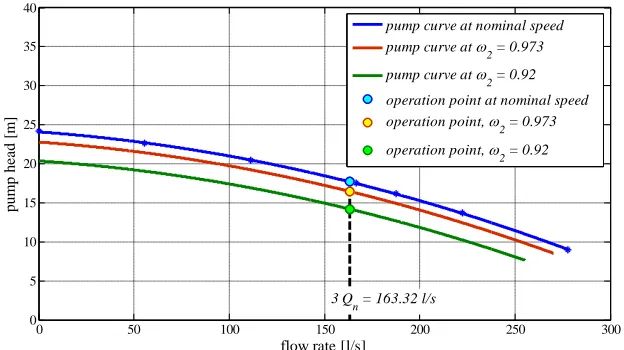
As already mentioned, in order to improve the overall system operation, an additional pump was connected in node 2 on the intake pipe (figure 1), leading to the configuration of the system. To analyse the refurbished system, we modified the EPANET model built for the configuration , and obtained a model for the refurbished configuration . The head flow rate curve of the additional pump, at nominal speed, inserted in the second EPANET model, is shown in figure 3.
Figure 3: Head versus flow rate curves of the additional pump in node 2, within the configuration , at nominal speed (speed factor 21), at speed factors 20.973 and 20.92, and operation points
The same specific energy analysis was performed for the new configuration, by simply adding to the available specific energy, the head Hp2 provided by the additional pump at a flow rate of 3Qn,
that is: HAzDHp2Hp. If all pumps are running at their nominal speed within the configuration
, from the pump curves (figures 2 and 3), the operation points result: {3Qn 163.32103 m 3
/s;
69 . 17
2 p
H m} for the additional pump in node 2, and {Qn 54.44103 m3/s; Hp149.7 m} for each of the 3 working pumps in Seimeni PS. The discharge pressure of pumps in Seimeni PS reaches 161.83 mWG for the configuration (meaning that the pressure is above the admissible PN16 level). The solution, denoted further as solution , reduced considerably the number of unavailable combinations of 3 pivots, but the discharge pressure is dangerously high in Seimeni PS.
In order to decrease the discharge pressure of pumps in Seimeni PS, the obvious choice, ensuring safety in operation, is to set a lower speed for the working pumps within the configuration .
The head flow rate curves were derived for each pump, based on affinity laws, as second order polynomial regressions, with speed factor and
2 respectively as parameter. Thus, the resultingcurves, HH
Q,
for pumps in Seimeni PS and H2H2
Q2,
2
for the additional pump in node0 50 100 150 200 250 300
0 5 10 15 20 25 30 35 40
flow rate [l/s]
pum
p
he
ad
[m
]
3Q
n = 163.32 l/s
pump curve at nominal speed
pump curve at
2 = 0.973
pump curve at
2 = 0.92
operation point at nominal speed
operation point,
2 = 0.973
operation point,
2 were: H157.8920.16103Q2.76103Q2; 22 3 2
2 2
2
2 24.09 0.018 Q 0.13 10 Q
H
with pumping heads in [m], for flow rates in [l/s].
As stated before, the flow rate value attached to the operation point was imposed for each working pump, namely: QQn for 3 pumps in PS, and Q23Qn for the pump in node 2. Moreover, to minimize the energy consumption, all 3 pumps in PS must work at the same speed factor [8].
The pumping schedule related to speed factors was derived in GNU Octave [9], as a solution of the nonlinear system of equations describing the operation of the hydraulic system, containing mass balance equations in nodes and energy balance equations on pipes, on the path from Danube, to the discharge section (DS) of pumps in Seimeni PS. The pressure head at the discharge section of pumps in PS is denoted by HDSpDS (
g).Taking into account the fact that within the PS, pumps are mounted on similar hydraulic circuits (leading to the same head losses between the PS inlet and the discharge section of each pump), and that all 3 pumps have identical operation points, the above system of equations reduces to a single equation, as:
2
DS DS D DS 2DHp 3Qn, Hp Qn, z H hr
z , (2)
where zDS is the elevation of the horizontal discharge section, and hrDDS is the value of head losses on the path from the Danube up to the discharge section of a pump in PS. Equation (2) has 3 unknowns, namely the speed factors
2 and , and the pressure head HDS. Due to pipe pressurelimit (PN16), the following condition is added: HDS160 m (an imposed constant value of HDS can
be used further). Another condition must be defined for the speed factors, e.g.
2
; or 1 (imposed value) and
2 computed; or
21 and computed. The new set of rules regarding the pumps operation yielded the third EPANET model.3
Results and Discussion
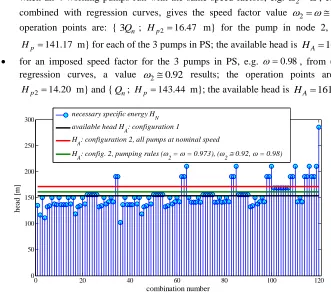
The resulting necessary total head HN, for all 120 combinations of 3 pivots in simultaneous operation, for both configurations (the initial one) and (refurbished), is plotted in figure 4.
For the system within configuration , where all 3 pumps in Seimeni PS run at nominal speed, and the available head was HA153.2 m, the solution provided 72 feasible combinations of 3 pivots in simultaneous operation; thus, 48 out of the total of 120 combinations (i.e. 40%) do not meet the requirements see figure 4, where HN HA153.2 m for 48 combinations.
For the system within configuration , where all 4 working pumps (one in node 2 and three in PS) run at nominal speed, and the available head is HA170.9 m, the solution reduced considerably the number of unavailable combinations of 3 pivots: only 21 out of 120 combinations (i.e. 17.5%) do not meet the requirements see figure 4, where HNHA170.9 m for 21 combinations. From this point of view, the additional pump improved the operation of the system. Unfortunately, in this case, the discharge pressure is dangerously high in Seimeni PS (above the PN16 limit), so the solution does not ensure safety in operation.
when all 4 working pumps run with the same speed factors, e.g.
2
, equation (2), combined with regression curves, gives the speed factor value
2
0.973; theoperation points are: {3Qn; Hp2 16.47 m} for the pump in node 2, and {Qn;
17 . 141
p
H m} for each of the 3 pumps in PS; the available head is HA161.14 m;
for an imposed speed factor for the 3 pumps in PS, e.g. 0.98, from (2) and the regression curves, a value
20.92 results; the operation points are: { 3Qn ;20 . 14
2 p
H m} and {Qn; Hp 143.44 m}; the available head is HA161.14 m.
Figure 4: Necessary total head HN for all 120 combinations of 3 working pivots out of the total 10 pivots,
and available head HA, at the minimal design level of Danube (3.5 m), for configuration , and for configuration where all pumps run at nominal speed, or pumps run under specified operation rules
Obviously, for a fixed HDS value, the same HA value results from calculations (the same value
of the sum between Hp2 and Hp), for different pumping rules. Other pumping rules can be selected,
e.g.
21 and computed (where the resulting value is 0.969 ).The solution , attached to the above pumping operating rules, yields 28 out of 120 combinations (i.e. 23.3%) that do not meet the requirements see figure 4, where HNHA161.14 m for 28 cases. The solution can be adopted as decision support, valid on short and medium term (up to the moment when the owner of the system will change all pipes on the discharge side of the PS with pipes of PN25 nominal pressure).
To exemplify the results, we present in figure 5 the flow rate distribution on pipes and pressure at nodes, for the operation of pivots P3, P5 and P10, within configuration , for
2
0.973.4
Conclusions
In this paper, a centre pivot irrigation system, located in Romania, was modelled in order to get a decision support tool for the day to day operation of the system. The above mentioned tool includes a pumping schedule (via speed factors values) and a schedule for combinations of 3 pivots that can be
0 20 40 60 80 100 120
0 50 100 150 200 250 300
combination number
he
ad
[m
]
necessary specific energy H
N
available head H
A: configuration 1
H
A: configuration 2, all pumps at nominal speed
H
operated simultaneously. The proposed solution considered the previous problems encountered for that irrigation system. The solution was derived based on pressure restrictions imposed in the pumping station (to avoid reoccurrence of pressure surges), without affecting crops watering.
Figure 5: Flow rate on pipes (in [l/s]) and pressure in nodes (in [mWG]), displayed using colour bars, for the operation of pivots P3, P5 and P10, within configuration , for 20.973
References
[1] L. New, G. Fipps, Center pivot irrigation, Texas Agricultural Extension Service, The Texas A&M University System, B-6096, 2000.
[2] P. Smith, J. Foley, S. Priest, S. Bray, J. Montgomery, D. Wigginton, J. Schultz, R. Van Niekerk, A review of centre pivot and lateral move irrigation installations in the Australian Cotton Industry, New South Wales Department of Primary Industries, 2014.
[3] O. Giustolisi, T.M. Walski, Demand components in Water Distribution Network Analysis, J. Water Res. Pl.-ASCE, 138(4) (2012), 356–367.
[4] O. Giustolisi, D.A. Savić, L. Berardi, D. Laucelli, An Excel based solution to bring water distribution network analysis closer to users, in: D.A. Savić, Z. Kapelan, D. Butler (Eds.), Urban Water Management: Challenges and Opportunities, University of Exeter, vol. 3, 2011, pp. 805–810.
[5] J. Muranho, A. Ferreira, J. Sousa, A. Gomes, A. Sá Marques, Pressure-dependent demand and leakage modelling with an EPANET extension – WaterNetGen, Procedia Engineering, 89 (2014), 632–639.
[6] L. Rossman, EPANET 2 Users Manual, U.S. Environmental Protection Agency, EPA/600/R-00/057, Cincinnati, OH, 2000.
[7] P.K. Swamee, A.K. Jain, Explicit equations for pipe flow problems, J. Hydr. Eng. Div.-ASCE, 102(5) (1976), 657–664.
[8] S.-C. Georgescu, R. Popa, Application of Honey Bees Mating Optimization Algorithm to pumping station scheduling for water supply, U.P.B. Sci. Bull., Series D, 72(1) (2010), pp. 77–84.
![Figure 2: at speed factors Head versus flow rate curves of pumps in Seimeni PS, at nominal speed (speed factor 1) and .098 and .0973; operation point for configurations and at nominal speed; operation points for configuration flow rate [l/s] at .098 and .0973](https://thumb-us.123doks.com/thumbv2/123dok_us/8879021.1818621/4.612.149.460.169.346/figure-factors-seimeni-nominal-operation-configurations-operation-configuration.webp)
![Figure 5: Flow rate on pipes (in [l/s]) and pressure in nodes (in [mWG]), displayed using colour bars, for the operation of pivots P3, P5 and P10, within configuration , for 2 .0973](https://thumb-us.123doks.com/thumbv2/123dok_us/8879021.1818621/8.612.105.515.152.358/figure-flow-pressure-displayed-colour-operation-pivots-configuration.webp)
