A Voyage to
Maturing Usability
Effie Lai-Chong Law Research Fellow ETH Zürich, Institut TIK, Gloriastrasse 35, CH-8092 Zürich, Switzerland/ University of Leicester, Dept. of Computer Science, LE1 7RH, Leicester, UK [email protected]/ [email protected]
Abstract
In this article, the chief editor of the recently published book
Maturing Usability: Quality in Software, Interaction and Value
reports her experiences, from the very beginning when the book project was conceived to the time when the book was delivered. The two-year process was marked with different problems. It required trust, optimism, patience, and commitment of the contributors to overcome these challenges.
The book aims to provide an understanding of how current research and practice have contributed to improving quality from the perspectives of software features, interaction experiences, and achieved value. Specifically, the Q-SIV framework addresses quality in software by looking at how using development tools can enhance usability and other qualities, and how methods and models can be integrated into the development process.
The book addresses quality in interaction by applying theoretical frameworks on the nature of interactions and methodologies to evaluate qualities, such as usability, reliability, and pleasure; It addresses quality in value by assessing the impact that a system has in the real world, focusing on both increasing value for software development and on increasing value for users and other stakeholders. While the voyage to Maturing Usability has been anchored, other voyages to matured usability are envisioned and will likely be set sail in the near future.
Keywords
Introduction
Publishing an edited book in which a number of international contributors are involved is analogous to a worldwide voyage. Our “voyage” has recently been completed. As the chief editor of the recently released book: Maturing Usability: Quality in Software, Interaction and Value(2008, Springer UK), I am delighted to share my experiences gained from the voyage, which, thanks to the fruitful collaboration with the two co-editors – Ebba Hvannberg and Gilbert Cockton, was very pleasant and enlightening.
It was a two-year voyage marked with exciting, stimulating, frustrating, surprising, jolly as well as amusing anecdotes. Presumably all who have edited a multi-authored book can enumerate such a list of mixed affects and emotions derived from the related editing tasks. Our voyage crisscrossed four continents (Europe, North America, South America, and Asia) and 35 countries.
We set sail in mid-September 2005 and reached our destination in mid-December 2007. While I can tell approximately when the beginning and finishing times were, I am not able to specify exactly the corresponding locations, because it was all started with our international project, COST294-MAUSE (http://www.cost294.org, hereafter ‘MAUSE’ - Toward the MAturation of IT USability Evaluation), of which the members are distributed over 21 countries in Europe. MAUSE is a four-year project (2005 - 2009) being run under the auspices of COST
(http://www.cost.esf.org/), which is one of the longest-running instruments supporting co-operation among scientists and researchers across Europe.
The mission of MAUSE is to bring more science to bear on usability evaluation method (UEM) development, evaluation, and comparison, aiming for results that can be transferred to industry and educators. Specifically, the grant enables the members of MAUSE to physically meet on a regular basis to work on specific issues under the framework of the four working groups, to organize thematic workshops, to sponsor short-term research exchange visits, and to support scientific publications.
All these instruments have contributed to the realization of the voyage, and thus the emergence of the book. In the ensuing text, I elaborate how the plan for the voyage was developed and implemented, and how the voyage has weathered some mild as well as relatively severe “storms” in its course. Then, I portray what “treasures” we have collected during the voyage. While the actual impact of the voyage is not yet fully known, we have already set the agenda for some others, which may be launched by us, as well as by some other crews.
From a Workshop Proposal to a Book Proposal (Sept. 2005 – March 2006)
The idea for the book project was conceived when we were working on a workshop proposal submitted to INTERACT 2005 (i.e., the tenth IFIP TC13 international conference on Human Computer Interaction (HCI)). “User interface quality models” (UIQM’05; Vanderdonckt, Law & Hvannberg, 2005) was the overarching theme selected for the workshop. Ambitiously, we, the three workshop co-chairs, planned to publish a book based on its outcomes. At the time, we faced several uncertainties:• the acceptance of the workshop proposal • the quality of the workshop’s submissions • the financial support for the book project.
We simply remained optimistic. Our efforts and optimism were soon rewarded: The proposal was accepted and the two-day workshop took place on 12-13 September 2005 in Rome, Italy. We received 15 submissions, which could roughly be categorized into four themes:
• usability evaluation
• web usability and accessibility guidelines and tools • software quality models and standards
Presentations and group discussions were framed accordingly. Interesting and inspiring ideas were exchanged among the 27 participants. In arcing the workshop theme back to the mission of MAUSE, a compelling question then emerged: How can we define the maturation of usability?
Gilbert Cockton, one of the workshop participants, who later became a co-editor of the book, made the observation that maturing usability manifests in terms of quality in software, quality in interaction, and quality in value. This idea resonated with some enthusiastic feedback in the workshop. We continued musing over it after the workshop and decided to adopt it as the skeleton of the book. So, the destination of the voyage was identified!
Apparently, the most challenging part of the voyage was to flesh out the book skeleton with chapters. We hit our very first and critical stride by writing a “Call for Chapters” in mid-October 2005, outlining the major goal and overall structure of the book. The Call was sent to an editor of Springer from the Netherlands office, who managed its HCI series. It elicited some keen response from the editor, but cautious general interest from an informal reviewer because the table of contents was then lacking. Clearly, without named authors, no baseline of quality could be assured. Nothing from the publisher’s side could be secured then – our first little storm in the voyage!
Subsequently, we faced a rather difficult decision: closed versus open calls. The former implied that we would have to invite targeted contributors and run the risk of excluding some potential ones, who might slip our memory, attention, or even recognition, whereas the latter implied that we might have to sieve through hundreds of proposals, but might not get a reasonable number of quality ones. A compromise was to issue a semi-open call: the Call was distributed to the participants of the workshop UIQM’05 and to the MAUSE consortium, which comprised 37 HCI researchers working on usability issues, and, in parallel, invitations were sent to a number of prestigious authors worldwide.
In end-Nov 2005, a batch of chapter proposals were collected in response to the Call and invitations. Not surprisingly, some declined the invitation and others failed to respond. Each submitted proposal was peer-reviewed for quality, fit, and feedback. This initial gatekeeping took about six weeks to complete. At this phase, the voyage sailed south as far as Argentina where some reviewers reside.
In early January 2006, a tentative table of contents was sent to the editor for consultation. The editor responded with excitement—and an extra requirement to further expand the authorship beyond Europe. Another round of hunting-inviting-waiting was launched. Meanwhile, some unpleasant storms occurred: The appalling news about the untimely death of an author, David Carr, who was also an active member of MAUSE; the withdrawal of a couple of promising chapter proposals; the resigning of one of the editors due to personal reasons.
From a Skeleton to a Fleshed-out Body (March 2006 – March 2007)
By the end of March 2006, we sent the revised proposal with an enriched table of contents to the editor, who responded very encouragingly. Even more encouraging was that our application for funding the book project had been approved at about the same time.
In June, we were promised a contract, and in November the contract was signed. In this transitional period, from acknowledgement through assurance to actualization, the voyage was steered with trust and optimism when the authors extended their accepted proposals to full chapters, despite the pending contract. Each of the full chapters was also peer-reviewed, sometimes twice, to ensure high quality. The authors were required to revise their chapters accordingly.
Concurrently, we dealt with the issues of content proofreading and typesetting by first
identifying affordable and quality service providers. The publisher had advised us earlier that it might speed up the whole production process by outsourcing these services. However, after screening some applicants, we found out that a more economical and efficient solution was to employ an independent proofreader on a fixed-rate basis and to return to the publisher for typesetting, considering their highly specific formatting requirements.
withdrawing their full chapters because of the substantial revisions required, necessitating some negotiations. Considerable delays of some chapters also led to some synchronization problems. Furthermore, the book project was handed over from Springer’s Netherlands office to its UK counterpart, due to their internal personnel changes. The transfer process, however, was smooth and did not cause any adverse effect. Having overcome these hurdles, the voyage proceeded with a crew of 40 (including authors, reviewers, editors and publishers) navigating toward the destination. The book thus had flesh on its bones. The fleshing out process lasted about 12 months – the longest part of the voyage.
From the Spring Wrap-up to the Christmas Delivery (March 2007 - Dec 2007)
The next milestone of the voyage was to wrap up the core body – 16 chapters - plus the front matter and indices; it was not a particularly challenging task, but quite tedious. The complete manuscript was then sent off for typesetting in March 2007. Two iterations of page-proofreading (i.e., format, layout) took about five months, from April to September 2007, to complete. At this time, the voyage sailed east as far as India where the typesetting was performed (i.e., outsourced by Springer). It was a pleasant excursion. The voyage from then on was tranquil. Most crew members were already long gone to engage in their many other tasks. In early November 2007, I was thrilled when I received the message that the book was ready for delivery. I was even more thrilled when boxes of the book reached my doorstep about one month later. A fantastic timing indeed! I delightfully played the role of Santa Claus to send each author a present. The voyage was finally completed with the contributors celebrating their efforts and successful collaborations.Overview and Vision of
Maturing Usability
The 420-plus page book aims to provide an understanding of how current research and practice has contributed to improving quality from the perspectives of software features, interaction experiences, and achieved value. The target group is those who are interested in exploring usability and emerging usage qualities in HCI.
Divided into three parts, ‘Quality in Software’ (Part I: Chapters 1-5) looks at how using
development tools can enhance the usability of a system, and how methods and models can be integrated into the process to help develop effective user interfaces.
‘Quality in Interaction’ (Part II: Chapters 6-10) addresses theoretical frameworks on the nature of interactions; techniques and metrics for evaluating interaction quality and experience; and the transfer of concepts and methods from research to practice.
Finally, ‘Quality in Value’ (Part III: Chapters 11-15) assesses the impact that a system has in the real world, focusing on increasing the value of usability practice for software development and on increasing value for the users.
Software
Models
& Standards
Necessity & Utility of Standards
Quality Models
Software engineering
models & methods
Conceptual model
Task Model
Meta-usability
Empirical validation
Definition of usability HCI wisdom
Standard-ization Documents
Quality criteria
Development of UEM
Figure 1. Impacts of software models and standards on usability evaluation methods (UEMs)
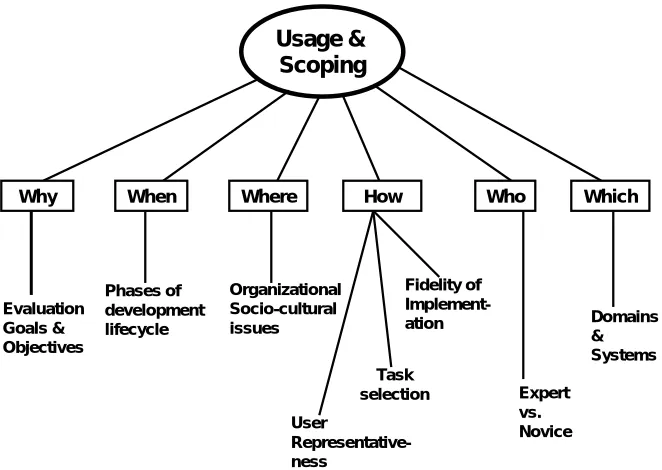
Usage &
Scoping
Why When Where How Which
User
Representative-ness
Fidelity of Implement-ation
Task selection Phases of
development lifecycle
Organizational Socio-cultural
issues Domains&
Systems Who
Expert vs. Novice Evaluation
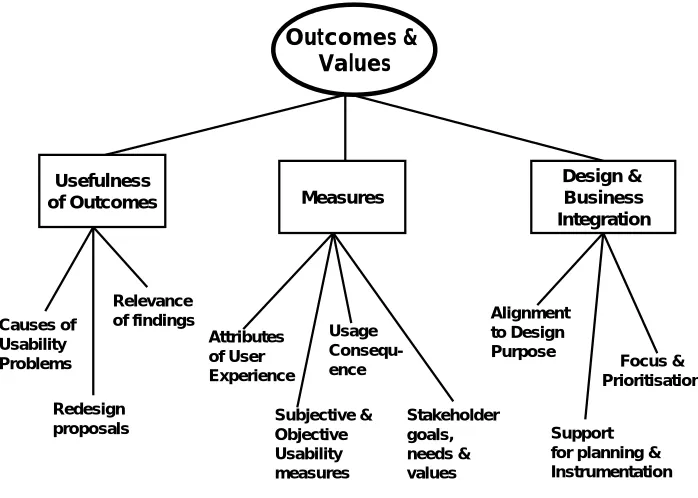
Outcomes &
Values
Usefulness of Outcomes
Causes of Usability Problems
Redesign proposals
Measures
Design & Business Integration
Attributes of User Experience
Stakeholder goals, needs & values
Focus & Prioritisation
Subjective & Objective Usability measures Relevance
of findings
Usage Consequ-ence
Alignment to Design Purpose
Support for planning & Instrumentation
Figure 3. Measures and values of usability evaluation
Furthermore, we, the three editors, stimulated by the book’s chapters, have highlighted some research challenges under the Q-SIV (i.e. Quality in Software, Interaction and Value) framework.
Quality in Software:
• Synchronization of quality engineering and software development processes in teams with different characteristics and resources, e.g., size of teams, experience, skills, and application domains
• Economics of quality engineering, especially those qualities that affect user interaction • Identification of different types of models, in terms of level of abstraction, formalism
and application domains, to express user interactions
• Levels of skills and specialization needed for developing quality user interaction
Quality in Interaction
• The roles of HCI theories in addressing issues related to design and evaluation of innovative interactive systems, taking users' dynamic needs and goals, various interaction devices, and changeable social and physical environments into account • The inter-dependencies among significant software quality attributes, such as creativity,
automaticity, safety, security, usability, reliability, and evolvability
• The accommodation of two paradigms: quantifiable performance versus indeterminate experience – with innovative methodologies
• Systematic return-on-investment (ROI) analysis of usability evaluation methods and the persuasiveness of results of ROI analysis for usability
Quality in Value
• Development of value concepts as ‘achieved worth’, made concrete through
• Derivation of supra-disciplinary HCI methods, such as worth inspection methods
drawing economics, marketing, business strategy, consumer psychology, creativity methods, social and cultural anthropology, cultural humanities, and institutional sociology
• Practice based research to track the value of methods in development contexts Voyages for exploring the above challenges can be very exciting and inspiring as well. As illustrated by the above descriptions, such a voyage, however, is expected to be long-term and thus requires the trust, patience, and commitment of crew members. Definitely, the outcome of the voyage is valuable. So is the process, if not even more so.
Apart from loads of emails, what I have gained from the voyage to Maturing Usability was, of course, a deeper understanding of the topics of interest, and fruitful editorial as well as managerial experiences. More important, I have been able to collaborate with a group of outstanding researchers in HCI, and learned a lot from them. I am much ready for some other voyages. Who wants to be on board?
Acknowledgements
Here I express my gratitude to the two co-editors, Ebba and Gilbert, for the very stimulating collaborative experiences. Thanks also go to all the contributors of the book and to the members of COST294-MAUSE. Last but not least, the support of COST was indispensable. Without it, the voyage would not have taken place.
References
Law, E. L-C., Hvannberg, E.T., & Cockton, G. (2008). Maturing Usability: Quality in Software, Interaction and Value. London: Springer.
Vanderdonckt, J., Law, E. L-C., & Hvannberg, E. T. (2005). Proceedings of the First COST294-MAUSE International Workshop on User Interface Quality Models (UIQM’05) in conjunction with INTERACT 2005, 12-13 September 2005, Rome, Italy.
About the Authors
Effie Lai-Chong Law