ISSN (Online): 2348 – 3539
An Analysis of Energy Efficiency of Leach Protocol in Wireless Sensor
Network
M.Dhurgadevi
1, Dr.P.Meenakshi Devi
21Assistant Professor, Department of Information Technology, KSR Institute for Engineering and Technology,
Tamil Nadu
2Department of Information Technology KSR Institute for Engineering and Technology, Tamil Nadu
Abstract: A wireless sensor network (WSN) is formed by grouping a number of sensor nodes together to play its role like sensing, monitoring, gathering and forwarding the data. The application of a sensor includes vast areas like Home security, machine failure diagnosis and biological detection, military, agriculture, etc. Researchers are doing a lot of researchers in various areas of sensor networks like routing, energy efficiency, and data aggregation etc., Routing plays an important role in WSN. A number of routing protocols are emerging day to day. The energy efficiency is the main constraints. LEACH (Low-Energy Adaptive Clustering Hierarchy) is one of the routing protocols proposed to routing. This paper presents a review of the Variants of LEACH protocols proposed to wireless sensor networks. Finally, we provide a comparative study on these various protocols.
Keywords: Energy efficiency, LEACH, Routing Protocols, Wireless Sensor Networks
Reference to this paper should be made as follows: 1M.Dhurgadevi, 2Dr.P.Meenakshi Devi (2016) „An Analysis of Energy Efficiency of Leach Protocol in Wireless Sensor Network‟, International Journal of Inventions in Computer Science and Engineering,Volume 3 Issue 2 2016.
1 Introduction
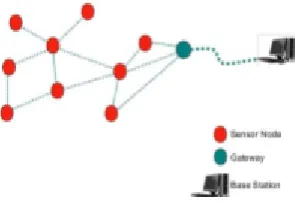
Wireless sensor network (WSN) becomes an essential element in our daily life. A sensor network includes low-cost, low-power wireless sensor nodes, with functions like sensing, monitoring and computation capabilities [1]. The communication distance between sensor nodes is very short. Sensor nodes are battery-powered and are expected to operate for a long time. The architecture of WSN is shown in Fig 1. The lifetime of a battery is limited. Each sensor loses its energy during the process of sensing, communicating and data forwarding. Even though in idle state a little bit of energy is utilized. It is very difficult and costly to recharge and replace the battery.
Figure 1 Architecture of WSN
The unique characteristics and constraints on the sensor network leads to new challenges. Researchers focus on various activities to explore and overcome the constraints on
WSNs and solve design and application issues. Hierarchical routing technique [2] is used to maintain the energy consumption of sensor nodes. Main objective is to reduce the level of transmission of the sink. LEACH [3] is one of the hierarchical routing protocols for sensor networks. The idea proposed to LEACH leads to many hierarchical routing protocols [4]. LEACH uses a cluster based routing in order to minimize the energy consumption. In this paper, we propose an improvement to the LEACH Protocol to improve the energy efficiency. Simulations are done to show the performance improvement. In this paper various routing protocols for wireless sensor network are discussed and compared. Section 2 of the paper briefs about the classification of routing protocols. In Sections 3, the various LEACH protocols are described. In Section 4, Simulation and comparison of various routing protocols are presented. Finally, Section 5 concludes the survey.
2. Classification Of Routing Protocol
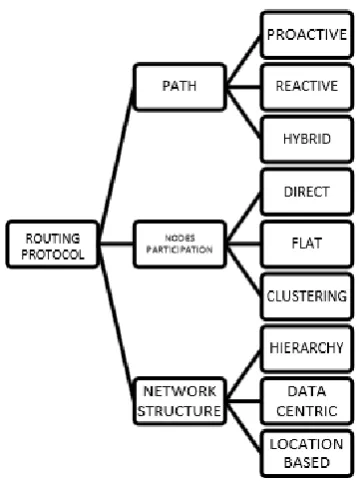
The sensor senses the target of its region and passes the information to the sink which is termed as routing. Various routing techniques [5] is proposed for information communication between the sensor nodes and the sink. The routing protocols are classified according to different parameters shown in fig 2.
Energy Adaptive clustering hierarchy protocol (LEACH) [7] falls under this category.
The reactive protocols are used in time critical situation where it reacts immediately if there is a sudden drop in threshold value while sensing. Threshold sensitive Energy Efficient sensor Network (TEEN) [8] is a best example of a reactive protocol.
Some of the protocol like Adaptive Periodic TEEN (APTEEN) incorporates both proactive and reactive concepts [9] which fall under Hybrid protocols.
Routing protocols can be classified as a direct communication, flat and clustering protocols, based on the way the nodes are participating.
The direct communication protocol operates by sending information by any to the sink node directly. The energy of the sensor nodes quickly drained in this case as it travels long distances to sink. SPIN is an example of a direct communication protocol.
For flat routing the node searches the correct route to reach the sink based on the routing table and then only it transmits the data. In this case the nodes which are nearer to the sink are chosen with all other nodes nearer to sink so the energy level of nodes which are around the sink reduced easily.
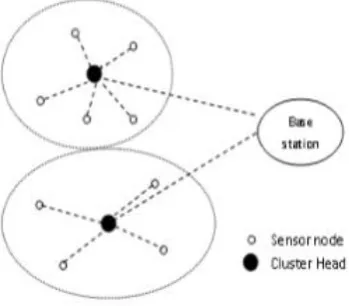
In Clustering protocol, the sensors are grouped into clusters and each cluster has a cluster head. The cluster head will take the responsibility of collecting information from all its cluster member nodes and it forwards it to the sink.
Based on the network structure, protocols are classified as hierarchical, data centric and location based protocols. In hierarchical routing the information is passed from higher level to lower level. Examples of this type are LEACH, TEEN, and APTEEN. Data centric protocols are a query based protocol where the sink senses the queries about getting information about a node and it waits for a reply. SPIN [10] was the first data centric protocol.
Figure 2 Classification of Routing Protocols
Location based routing protocols [11] perform its operation by collecting some location information of the sensor nodes through GPS (Global Positioning System) signals, received radio signal strength, etc. GEAR is the best example of a location based routing protocol.
3. Leach And Its Variants
3.1 Leach
Figure 3 LEACH Cluster
Next phase continues its operation by aggregating the data collected from clusters by CH and then the information is passed to sink. TDMA (Time division multiple access technique) is used by the nodes to send their data onto their CH.
The energy of CH is reduced quickly since it is playing dual roles of collecting the sensed data and then aggregation and then forward to the sink. The energy level of the CH which is far away from the sink will get reduced more when compared to nearer CH.
3.2. Ib Leach
IB-LEACH (Improved balance LEACH) is an improvement to the LEACH protocol, which attempts to decrease the probability of node failure. Just as LEACH IB-LEACH works in two phases and they are monitored by synchronizing the clock. IB-LEACH is a self-organizing, adaptive clustering protocol adopted for random distribution of energy to the nodes equally which is shown in fig 4.
Figure 4 IB-LEACH
The cluster heads are chosen by random in such a way that the energy of single sensor not to be reduced. IB-LEACH elects a gateway by the sensor with a certain probability. CH broadcasts its status using advertisement messages to all the other nodes. All the non-gateway nodes assume to be cluster-heads. The nodes other than CH wait for a CH announcement message from all the other nodes. Each node can choose its cluster by selecting the cluster head to which clusters it wants to join by sending Join-Req message. Once all the nodes are organized into clusters, each cluster head creates a schedule for the nodes in its cluster. Since this radio component of each non-cluster-head node to be turned on only during transmitting time. Then CH collects information and passes it to the sink node.
3.3 Leach-Ga
Genetic Algorithm based Energy-Efficient Adaptive Clustering Protocol for Wireless Sensor Networks is LEACH-GA. GA-based protocol is based on LEACH and includes a new phase in addition to the two phases of LEACH. Third phase is the preparation phase. This is the first phase in GA-LEACH. Next is set up and steady phases. The preparation phase starts with the cluster head selection process of all nodes and then it sends messages to the sink. The message includes whether the cluster is a candidate or not, node IDs, and then location of nodes. After the messages are received the sink searches for the cluster head by optimal probability of genetic algorithms. A broadcast message is sent by the sink to all other nodes to form clusters of setup phases. The first preparation phase is executed only once before the set-up phase next two phase will be performed just like LEACH.
3.4. W Leach
Weighted Low Energy Adaptive Clustering Hierarchy Aggregation (W-LEACH) is a centralized data aggregation algorithm. There are two phases in W-Leach setup phase and a steady state phase. In the setup phase, it calculates a weight value, 𝑤𝑖, and assigns it to each sensor 𝑠𝑖. In W-LEACH p is the percentage of the maximum number of CHs but in LEACH it is the number of CHs. Based on the weight the CH is chosen. In W-LEACH there is not a rule that the node which was chosen as CH previously is not chosen as CH for next time. The weights are calculated as
𝑤𝑖 = { 𝑒𝑖 * 𝑑𝑖, if 𝑑𝑖 > 𝑑thresh, 𝑑𝑖, otherwise, (1) Where 𝑑𝑖 = (1 + number of alive sensors in range 𝑟)/𝑛 is the density of the sensor 𝑠𝑖, 𝑟 - range that is reachable by sensor 𝑠𝑖 𝑒𝑖 - remaining energy in sensor 𝑠𝑖 𝑑thresh - density threshold to define the set of sensors in very low density areas.
3.4.1. Dynamic W-LEACH
Density is calculated as the ratio of the number of alive sensors in a cluster 𝑖 to the total number of alive sensors as follows: 𝑑CH𝑖 =number of alive sensors in cluster𝑖/total number of alive sensors (2)
3.4.2. Adaptivity Feature for Dynamic W-LEACH
Dynamic W-LEACH is modified with the feature of Adaptivity in order to handle sudden bursts in the underlying values of the data. During Sensing some sudden events may occur and handling of such events is based on actual sensed data. The algorithm keeps track of the values of the data for each sensor independently in the network and the change in values of the sensed data affects the weight of the sensor. If there are more changes then the weight is reduced. Sensors that have less weight are better candidates that can be chosen to send data onto their cluster heads.
The weight formula is accordingly modified as follows:
𝑤𝑖 = { 𝑒𝑖 * 𝑑 𝑖 1+𝑉𝑖 , if 𝑑𝑖 > 𝑑thresh, 𝑑 𝑖 1+𝑉𝑖 , otherwise. (3)
The comparison of various Leach variants is shown in the table 1.
4. Simulations
Simulation is done using the simulator JSIM and the parameters set during simulation are listed in table 2.
For our simulation, we consider all sensor nodes are homogeneous and distributed uniformly over the sensor field with limited energy. The links between nodes are symmetric and the messages from all nodes can reach the BS.
Table 1 Comparison of Various LEACH variants
Table 2 Simulation Parameters
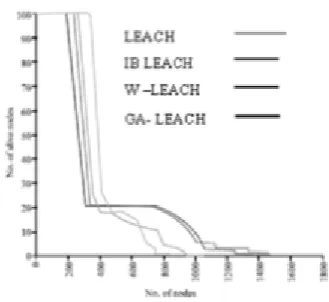
The nodes are distributed over the Grid in a random fashion in the square of size M × M .The environment consists of 25 sensor nodes and 1 sink node and 10 target nodes. The target nodes are dynamic and remaining nodes are considered to be static. The target dynamically moves around the environment, the corresponding cluster detects it, and then its energy level is reduced. The initial energy level of a node is considered as 0.5 joules and 0.001 is considered as energy utilized each time for sensing and data transmission. The sink node is responsible for collecting information from all the cluster heads .The sink node is considered to be static.
Figure 5.Performance comparison chart
5. Conclusion
A survey of LEACH is done as a part of our research. We have analyzed the clustering routing protocol and took four of the best LEACH variants and implemented. The drawback and advantages of each of the LEACH variants were discussed. The simulation is carried out in Jsim. The results are shown using graphs. This survey laid a platform for further investigation. Energy is the major constraint in wireless sensor networks. Future work will be carried out to improve the energy efficiency to better level.
References
[1] I. Akyildiz, W. Su, Y. Sankarasubramaniam, and E. Cayirci, “A survey on sensor networks,” IEEE Communications Magazine, vol. 40, no. 8,Aug. 2002, pp. 102–114.
[2] Abbasi and M. Younis, “A survey on clustering algorithms for wireless sensor networks,” Computer Communications, vol. 30, Oct.2007, pp. 2826–2841.
[3] HanadyM. Abdulsalam and Bader A. Ali “W-LEACH Based Dynamic Adaptive Data Aggregation Algorithm for Wireless Sensor Networks” International Journal of Distributed Sensor Networks Volume 2013, Article ID 289527, 11 pages.
[4] C. Intanagonwiwat., R. Govindan, D. Estrin, J. Heidemann, and F.Silva, “Directed diffusion for wireless sensor networking,” IEEE/ACM Transactions on Networking, vol. 11, issue 1, Feb. 2003, pp. 2-16.
[5] Jenn-Long Liu and Chinya V. Ravishankar “LEACH-GA Genetic Algorithm-Based Energy- Efficient Adaptive Clustering Protocol for Wireless Sensor Networks “International Journal of Machine Learning and Computing, Vol.1, No. 1, April 2011.
[6] I. Saha Misra, S. Dolui and A. Das, “Enhanced-Efficient Adaptive Clustering Protocol for distributed sensor networks”, ICON 2005.
[7] M. Bani Yassein, A. Al-zou'bi, Y. Khamayseh, W. Mardini ,Improvement on LEACH Protocol of Wireless Sensor Network (VLEACH), International Journal of Digital Content Technology and its Applications Volume 3, Number 2, June 2009.
[8] K. Akkaya and M. Younis, “A survey on routing protocols for wireless sensor networks,” Ad Hoc Networks, vol. 3, May 2005, pp. 325–349.
[9] H. M. Abdulsalam and L. K. Kamel, “W-LEACH: weighted low energy adaptive clustering hierarchy aggregation algorithm for data streams in wireless sensor networks,” in Proceedings of the 10th IEEE International Conference on Data Mining Workshops (ICDMW ‟10), pp. 1–8, December 2010.
[10] Femi A. Aderohunmu1, Jeremiah D. Deng2., An Enhanced Stable Election Protocol (SEP) for Clustered
Heterogeneous WSN,Number2009/07 October2009 ISSN1177-455X.