Liberalization and Performance of Micro, Small and
Medium Enterprises: A Comparative Study
Dr. Suman
Dept. of Commerce, Central University of Haryana, Mahendergarh [email protected]
Abstract:The Micro, Small and Medium Enterprises (MSMES) sector is a major contributor to the Indian economy. This sector is characterize by its low capital and technology requirement, highest capacity of employment generation and remarkable contribution in the India‘s total export. Despite its contribution and significance in the Indian economy, the MSME sector has been facing various hurdles since long. Government of India has taken various steps to overcome such constraints. It has passed MSME Development Act 2006 which brought big changes in this sector. This act has given defined criteria of MSMEs. After the economic reform measures in India since 1991, this sector is facing keen competition from domestic as well as from the MNCS because of the improved technology in the market. This current paper found that performance of MSMEsafter liberalization has improved significantly.
Key Words: MSME, MNC, liberalization, employment, export.
I. INTRODUCTION
Micro, Small and Medium Enterprises (MSMES) occupy a vital role in an Indian Economy. MSMESprovide large
employment opportunities at lower cost than large industries and also have considerable contribution to export and production. MSMES help in rural industrialization thereby reducing regional imbalances and assuring equal
distribution of national income [1]. There are over 6000 products which are being manufactured by the MSMES
sector. This sector contributes about 40% of India’s total export, 45% of India’s manufacturing output and 8 % in Gross Domestic Product [2].
During the pre-economic reforms period many facilities like incentives, subsidies and concession were being provided by the government for the development of the small scale industries because of its immense contribution in the growth of the Indian economy [3]. Economic reforms brought many relaxations in laws, government restrictions and administrative control. During the era of liberalization strategy for SSI was shifted from protection to competitive promotion. After the economic reforms measures in India since 1991, this sector is facing keen competition from domestic as well as from the MNCSbecause of the improved technology in the market. Despite its
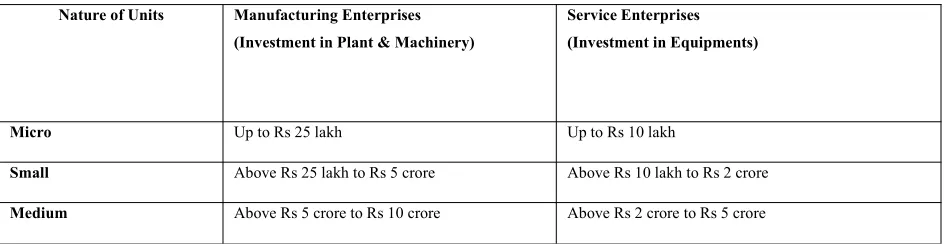
TABLE 1
DEFINITION CRITERIA OF SSIS
Nature of Units Manufacturing Enterprises
(Investment in Plant & Machinery)
Service Enterprises (Investment in Equipments)
Micro Up to Rs 25 lakh Up to Rs 10 lakh
Small Above Rs 25 lakh to Rs 5 crore Above Rs 10 lakh to Rs 2 crore
Medium Above Rs 5 crore to Rs 10 crore Above Rs 2 crore to Rs 5 crore
Source: Annual Report, 2006-07, Ministry of MSME[4]
Clear definition of the MSMESwas the biggest thing given by MSME Development Act 2006. Apart from it this act
made compulsory the composition of the National Board of MSMESto regulate the functioning and development of
MSMES. MSME Development Act 2006 framed the strict rules regarding the payment of dues and made the
registration procedure much simple and less time consuming.
II. REVIEW OF LITERATURE
Most of the studies related to MSMESpresents that this sector is the growth engine of the Indian Economy. Some of
them are as follows:
Mali[5] observed that small and medium enterprises (SMEs) and micro enterprises have to face increasing competition in the present scenario of globalization, they have to specifically improve themselves in the fields of management, marketing, product diversification, infrastructural development, technological up gradation. Moreover, new small and medium enterprises may have to move from slow growth area to the high growth area and they have to form strategic alliance with entrepreneurs of neighboring countries. Data bank on industries to guide the prospective entrepreneurs including investors from abroad is also needed.
Bala Subrahmanya[6] investigated the impact of economic reforms on small scale industries. He mentioned that small scale sector has faced constraints in term of growth of units, employment, output and exports. He recommended that small scale industries in India should improve the technology and financial infrastructure thereby this sector can compete at the international level.
Shastri, et al.[7] analyzed the implications of globalization and domestic economic liberalization for small-scale industries and analyses its growth performance in terms of units, employment, output and exports. They concluded with policy recommendations to ensure the sustenance and competitive growth of small scale industries in India. Vasu and Jayachandra[8] studied the growth and development of MSMES in India. They observed that this sector
III. OBJECTIVE & HYPOTHESIS OF THE STUDY Objective
The main objective of the current study is to evaluate the performance of MSMESin India during the pre and post
liberalization period Hypothesis
H0: There is no significant difference between the pre and post liberalization performance of MSMESin India.
H1: There is significant difference between the pre and post liberalization performance of MSMESin India.
IV. RESEARCH METHODOLOGY
The present study is based on secondary data which has been collected from various annual reports published by ministry of Micro, Small and Medium enterprises. The study is based on the time period from 1973-74 to 2012-2013. This study has used four variables namely number of units, production, employment and export to measure the performance of MSMES in India. To analyze the performance of MSMES during the pre and post liberalization
period paired sample t test has been used because a paired t-test is used to compare two population means where you have two samples in which observations in one sample can be paired with observations in the other sample. For example: Before-and-after observations on the same subject. All calculations are done in SPSS software.
V. EMPIRICAL FINDINGS
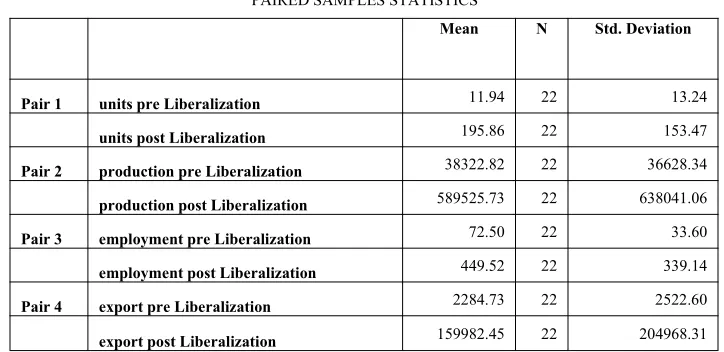
TABLE 2
PAIRED SAMPLES STATISTICS
Mean N Std. Deviation
Pair 1 units pre Liberalization 11.94 22 13.24
units post Liberalization 195.86 22 153.47
Pair 2 production pre Liberalization 38322.82 22 36628.34
production post Liberalization 589525.73 22 638041.06
Pair 3 employment pre Liberalization 72.50 22 33.60
employment post Liberalization 449.52 22 339.14
Pair 4 export pre Liberalization 2284.73 22 2522.60
export post Liberalization 159982.45 22 204968.31
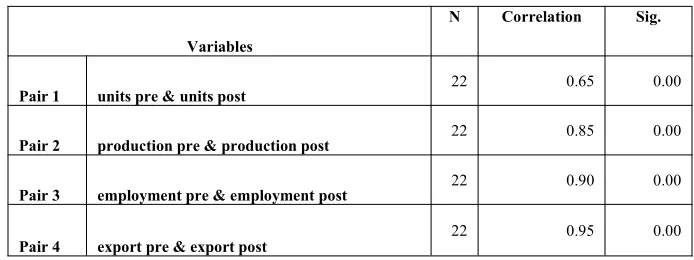
TABLE 3
PAIRED SAMPLES CORRELATIONS
Variables
N Correlation Sig.
Pair 1 units pre & units post 22 0.65 0.00
Pair 2 production pre & production post 22 0.85 0.00
Pair 3 employment pre & employment post 22 0.90 0.00
Pair 4 export pre & export post 22 0.95 0.00
Table 3 presents correlation between the pre liberalization and post liberalization values of variables. Employment and Export showing high degree of correlation. The degree of correlation is moderate in case of number of units and production.
TABLE 4 PAIRED SAMPLES TEST
Paired Differences t df sig.(2-tailed)
Mean Std.
Deviation
Std. Error Mean
95% Confidence Interval of the Difference
Lower Upper
Pair 1 Units pre – units post -183.92 145.16 30.95 -248.28 -119.56 -5.94 21 0
Pair 1
production pre –
production post -551203 607279.5 129472.4 -820456 -281950 -4.26 21 0
Pair 1
employment
pre-employment post -377.02 309.1 65.9 -514.06 -239.97 -5.72 21 0
Pair 1
Export pre – export
post -157698 202584.5 43191.16 -247519 -67876.8 -3.65 21 0
Table 4 shows that there is significant difference between pre and post liberalization mean value of all the variables (Units, Production, Employment and Export of MSMES) as the ‘p’ value of all the variable is less than .05. Thereby
null hypothesis can be rejected and alternative hypothesis is accepted that there is significant difference between the pre and post liberalization performance of MSMESin India.
VI. CONCLUSION
There is significant improvement in the performance of MSMEsafter liberalization which has been proved by the
paired sample ‘t’ test but under the era of liberalization and globalization, it is inevitable for MSMES to improve
agriculture this sector comes at second position to generate the employment opportunities in India This sector has immense potential; it requires support of government and financial institution. Government has formulated various policies and schemes but ensure proper implementation of such schemes.
REFERENCES [1] Annual Report 2003-04, Govt. of India, Ministry of Micro, Small and Medium Enterprises
[2] Mukand Chandra Mehta. “Challenges and Oppurtunities in Micro,Small and Medium Enterprises in India”.2ndInternational Conference on Management,Humanity and Economics,May 6-7,201 Kuala Lumpur(Malaysia).
[3] Tripathi BB. Bhartiya Arthavyavastha,Kitab Mahal Allahabad. [4] Annual Report, 2006-07, Ministry of MSME
[5] Mali, D.D. “ Development of Micro, Small and Medium Enterprises of India: Current Scenario and Challenges” SEDME (Small Enterprises Development, Management and Extension) Journal, Vol.25, No.4. 1998
[6] Bala Subrahmanya, M. H.” Small Industry and Globalization: Implications, Performance and Prospects”.Economic and Political Weekly, Volume XXXIX, No.18, pp 1826-1834. 2004
[7] Shastri, Tripathi and Ali. “Liberlization and its impact on small scale industries”. international journal of vocational and technical education, vol2, no 7, 81-83. 2011
[8] Vasu and JJayachandra. “Growth and Development of MSMESin India: Prospects and Problem”. Indian journal of applied research, vol 4, issue 5, 125-127. 2014
BIBLIOGHRAPHY
Annual Report 2010-11, Govt. of India, Ministry of Micro, Small and Medium Enterprises. Annual Report 2011-12, Govt. of India, Ministry of Micro, Small and Medium Enterprises. Annual Report 2012-13, Govt. of India, Ministry of Micro, Small and Medium Enterprises.