ISSN: 2372-4951 (Print), 2372-496X (Online) Copyright ©The Author(s). 2014. All Rights Reserved. Published by American Research Institute for Policy Development DOI: 10.15640/smq.v2n3-4a4 URL: http://dx.doi.org/10.15640/smq.v2n3-4a4
Concurrent Alignment of Human Resource Management and Business Strategies
Hadi Teimouri1, Eliza Baradaran Shokouhi2, Kim LaFevor3, Sam Khoury4 & Kouroush Jenab5
Abstract
Main objective of the present survey is to study human resource management (HRM) and Business strategies alignment. This survey was conducted using the field-descriptive method. The historical study method was used to collect theoretical subjects and the field study method was applied to confirm or reject research hypotheses. Based on cluster-stratified sampling method, the statistical population of this research included all experts and managers at various levels in the Mapna Group. According to results of the present survey, there is a direct correlation between HRM and Business strategies.
Keywords: Business Strategy, Human Resource Management Strategy, Alignment,
Mapna Group
Introduction
Human resources management used to be regarded as an organizational activity, where managers concentrated on variables such as lighting, work design, and other aspects management can control. It was not until the 1920s Hawthorne studies that brought about a realization that recognition and other intrinsic variables are the variables that truly motivate workers and lead to increased productively (Cox, Issa, & Koblegard (2005).
1
Management Department, University of Isfahan, Isfahan, Iran. E-mail: [email protected]
2
Management Department, University of Isfahan, Isfahan, Iran. E-mail: [email protected]
3
College of Business, Athens State University, 300 North Beaty Street, Athens, AL 35611. E-mail: [email protected]
4
College of Business, Athens State University, 300 North Beaty Street, Athens, AL 35611. Email: [email protected]
5
Since the Hawthorne studies researchers have stressed the importance of addressing human needs. As a result, more attention is now paid to the wellbeing of workers since countless research indicated that if workers’ needs are satisfied, they are more productive (Khoury, 2011). Ensuring they are properly trained, equipped, and their needs are met has become common practice. Therefore, it is a well-known fact that skilled human resources contribute to the achievement of business objectives. Therefore, it is believed that HRM is an integrated business strategy (Leopold, Watson, & Harris, 2005) and that HRM facilitates the realization of the business strategic objectives (Bohlander & Snell, 2010).
Furthermore, HRM coordinates individual practices with the existing policies to achieve the set objectives (Noe et al., 2010). In other words, these objectives would be realized through the alignment of the business and HRM strategies as any business development depends on the performance of its skilled and well-trained human resources. The overall performance of HR leads to social, cultural, and political developments in modern organizations. Also, HRM coordinates the individual skills to ensure the achievement of organizational objectives. According to Armstrong (2009), Strategic Human Resource Management (HRM) requires the development of HR plans and strategies that align with organizational strategies. The aim of this study is to consider the alignment between business and HRM strategies.
Literature Review
Business Strategy (BS)
A strategy is an integrated and coordinated set of commitments and actions which attempt to exploit the core competencies in an organization in order to gain a competitive advantage over its rivals in a given market. As Sleven and Covin (1997) point out, strategies are purposeful and are meant to precede intended actions. More specifically, a business-level strategy provides value to customers and allows a firm to gain a competitive advantage by exploiting core competencies (Dess et al., 1995). Therefore, a business-level strategy shows a firm’s belief on where and how it has an advantage over its rivals.
Porter (1985) emphasized that business strategies are concerned with the industry position of a firm, in comparison to others in the industry. Miles and Snow (1984) categorized strategy types as defenders, prospectors, and analyzers, whereas (Porter, 1985) classified strategies into three generic types: cost leadership, differentiation, and focus. Another categorization of strategy types was developed by Schuler and Jackson (1987). They used classified business strategy into three types: cost-reduction strategy (CS), innovation strategy (IS), and quality-enhancement strategy (QS). Schuler and Jackson’s categories were used in other studies, such as Beaumont (1993), Huang (2001), and Dowling (1990). This study adopted their method of classification, as well.
Schuler and Jackson (1987) describe a cost-reduction strategy as a strategy that allows a firm to lower prices on products and services. This method enhances production efficiency through reducing expenditures as well as adopting new technology, enlarging the scale of production, or re-engineering production processes that enable a firm to sell its products or services at a lower price in the intended market. Furthermore, an innovation strategy is a strategy that focuses on development of products or services that differ from those of competitors. Finally, the success of a quality-enhancement strategy depends on offering standard quality products, which are in many ways superior to that of other products or services.
Human Resources Management Strategy
It covers broad organizational concerns related to structure, culture, management of change, organizational effectiveness, performance, competence, matching resources to future business requirements, and employee development. Technical HRM or traditional HRM are concerned with the regulatory role and functions related to recruitment, selection, performance measurement, training, and the administration of compensation and benefits while Strategic HRM involves organizations developing and implementing policies and practices that leverage the full potential of the organization’s human capital (Baird, 1988; Jackson, 1995).
According to Schuler and Jackson (1987), an accumulation strategy (AS) emphasizes the careful selection of good candidates on the basis of personality rather than technical fit. On the other hand, a utilization strategy (US) emphasizes the selection of individuals on the basis of technical fit, while a facilitation strategy (FS) emphasizes the ability of employees to work together collaboratively.
Strategy Alignment (SA)
Skinner (1969) was the first to use the concept of SA in his research. Skinner pointed out that companies need to align production processes with the corporate strategy. According to contingency theory (Miles and Snow, 1984; Porter, 1985; Schuler & Jackson, 1987) and behavioral perspective (Jackson, Schuler, & Rivero, 1989), HRM strategies and specific business competitive strategies must be aligned in order to increase organizational performance or HRM practices effectiveness (HRMPE).
Based on the classification of Schuler and Jackson (1987), competitive strategies are categorized as cost-reduction, innovation, and quality-enhancement, while HRM strategies are divided into three types: utilization, facilitation, and accumulation that must fit together as follows:
Firms pursuing a cost-reduction strategy will require a utilization HRM Strategy
Firms following an innovation strategy will require a facilitation HRM strategy
And firms pursuing a quality-enhancement strategy will require an accumulation HRM Strategy
The study model was designed on the basis of the above concepts to examine the following hypothesis:
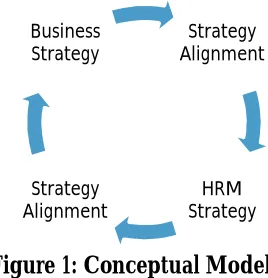
Hypothesis: There is a meaningful alignment between business and HRM strategies in the Mapna Group (Figure 1).
Figure 1: Conceptual Model
H1: There is a meaningful alignment between cost reduction business strategy and utilization HRM strategy in the Mapna Group.
H2: There is a meaningful alignment between quality enhancement business strategy and accumulation HRM strategy in the Mapna Group.
H3: There is a meaningful alignment between innovation business strategy and facilitation HRM strategy in the Mapna Group.
Methodology
The present study was conducted using a descriptive-field method in which a historical study (including scientific books and journals) was used to collect the information related to research literature and field study (such as semi-structured interview and questionnaire) was applied to respond to research questions and confirm or reject the hypotheses. This questionnaire was designed based on five-point Likert scale, which had acceptable validity (KMO coefficient= 0.90) and reliability (Cronbach's alpha coefficient equal to 0.87).
The study population consisted of 300 experts and managers employed at various levels in the Mapna Group. A Cluster-stratified sampling method was used in the study. A pilot study was carried out on 30 subjects to determine the required sample size. The estimated sample size was equal to 256 persons. Having distributed the questionnaires, 225 questionnaires were collected.
Strategy Alignment
HRM Strategy Strategy
Data Analysis
The collected data which deals with both demographical issues and study hypothesis was analyzed through the application of descriptive and interpretative statistics, including structural equation modeling.
Figure 2: The Conceptual Model for HRM and Business Strategies Alignment
The following proportion and acceptability indices of the model are acceptable and there is no need for modification.
X2/df= 1.7365<3
RMSEA=0.074<0.1
P-value<0.05
GFI=0.98
Figure 3: The Meaningful Model for HRM and Business Strategies Alignment
As indicated in figures 2 and 3, there is a positive meaningful relationship between HRM and business strategies in the Mapna Group. (Sig=107.96>1.96 confidence level 95%). Also, according to figure 4, the index of business strategy to HRM strategy equals 100%.
Table 1: Strategic Alignment
Strategic Alignment between Business & HRM Strategies
Significant Pearson Correlation
Cost Reduction Business Strategy and Utilization HRM Strategy
.000 .890**
Quality Enhancement Business Strategy and Accumulation HRM Strategy
.000 .926**
Between Innovation Business Strategy and Facilitation HRM Strategy
.000 .898**
** Correlation is significant at the 0.01 level (2-tailed).
The SPSS 18 data analysis as given in the above table indicates that hypothesis H0 is not confirmed (Sig= 5% and Confidence level=99%). Also, there is a meaningful relationship between business strategies and HRM strategies. Thus, H1, H2, and H3 are confirmed.
Conclusions
According to the Schuler and Jackson (1987) model, the findings of the Mapna Group case study are as follows:
The business cost reduction strategy is aligned with utilization HRM strategy in 99% confidence level when the coefficient index is 0.890.
The business innovation strategy is aligned with facilitation HRM strategy in 99% confidence level when the coefficient index is 0.898.
The business quality-enhancement strategy is aligned with accumulation HRM strategy in 99% confidence level when the coefficient index is 0.926.
These findings confirmed the previous research results and indicated that there would be a positive meaningful alignment between HRM and Business strategies.
Implications for Future Research
While this present study offers insight into the association between HRM practices and innovation, cost cutting measures, and quality, it also provides the opportunity to assess other measures of HRM practices in the development of an organizations business strategy and realized outcomes. Future research in the area of HRM practices in recruitment and selection, risk management and business continuity, total rewards, labor relations, training and development, and performance management and their respective effects on setting business strategy, their integration, and realized business performance would allow a better understanding to be gained relative to HRM and organizational practices that would facilitate proactive organizational outcomes and long-term sustainability. In addition, it might be further beneficial to assess HRM actor discipline specific preparation, such as HR certification and its effect on designing and establishing robust and highly effective business strategy models. To close, this present research offers clear evidence of the relationship between HRM practices and setting effective business strategy. However, as the emergence of the discipline of human resources has evolved from a more operational to also a strategic focus, more research is needed to gain a greater understanding of this relationship and its impact on business strategy and realized organizational outcomes.
References
Armstrong, M.A. (2009). A handbook of human resources management. (11th ed.). London: Kogan Page.
Baird, L.A. (1988). Managing two fits of strategic human resource management. Academy of Management Review, 13, 116–128.
Batt, R. & Banerjee, M. (2012). The scope and trajectory of strategic HR research: Evidence from American and British journals. International Journal of Human Resource Management, 23(9), 1739-1762.
Beaumont, P.B. (1993). Human resource management: Key concepts and skills. London: Sage Publications.
Bohlander, & Snell, G. (2010). Managing Human Resources. (16th ed.). Newyork: South-Western College Pub.
Cox, R.F., Issa, R., & Koblegard, K. (2005). Management’s perception of key behavioral indicators for construction. Journal of Construction Engineering & Management, 131(3), 368-376.
Dess, G., Gupta, G., Hennart, A., & Hill, C. (1995). Conducting and integrating strategy research at the international, corporate, and business levels: Issues and directions. Journal of Management, 21.
Huang, T. (2001). The effects of linkage between business and human resource management. Personnel Review, 30, 132-145.
Jackson, S.A. (1995). Understanding human resource management in the context of organizations and their environments. Annual Review of Psychology, 46(1), 237-264. Jackson, S., Schuler, R., & Rivero, J. (1989). Organizational characteristics as predictors of
personnel practices. Personnel Psychology, 42(4), 727-86.
Khoury, S. (2011). Perceptions held by community college computer instructors in North Carolina. International Journal of Industrial Engineering and Production Research, 22(4), 237-241.
Leopold, J., Watson, T., & Harris, N. (2005). Employe participation, involvement, and communications. In J. H. Leopold, the Strategic Managing Of Human Resource, 434-460. Essex, England: Prentice Hall, Pearson Education.
Miles, R., & Snow., c. (1984). Designing strategic human resources systems. Organizational Dynamics, 13(1), 36-52.
Noe, R., Gerhart, B., Wright, P., & Hollenbeck, J. (2010). Human resourse management: Gaining a competitive advantage. (7th ed.). New York: McGraw-Hill.
Porter, M. (1985). Competitive advantage: Creating and sustaining superior performance. New York: The Free Press.
Schuler, R., & Jackson, S. (1987). Organizational strategy and organization level asdeterminants of human resource management practices. Human Resource Planning, 10(3), 125-42.
Skinner, W. (1969). Manufacturing – missing link in corporate strategy. Harvard Business Review, 47(3), 136-45.
Slevin, D., & Covin, J. (1997). Strategy formation patterns, performance, and the significance of. Journal of Management, 23(2), 189-209.
Strategic Planning (2014). What are the key performance indicators, and how do they relate to the human resource function? Society for Human Resource Management. Retrieved from http:www.shrm.org