CCET JOURNAL OF SCIENCE AND ENGINEERING EDUCATION
(ISSN 2455-5061)
Vol. – 4, Page-65-70, Year-2019
65
Current Controller for SPV Grid Interconnection
Sridhar Burla
*, Muna Biswal
***
Asst. Prof., Dept. of Electrical Engineering, CCET, Chhattisgarh, India,
[email protected]
**
Asst. Prof., Dept. of Electrical Engineering, CCET, Chhattisgarh, India,
[email protected]
Abstract
In present times, gigantic development in the utilization of solar photovoltaic network interconnection framework has been accomplished by interconnecting the SPV from few kilowatt to Megawatt and even to Gigawatt. For the most part in Grid Connected PV framework separated from the nearby utilization of solar PV Power, a lot of surplus power is typically sent back to the lattice with relevant IEEE and IEC grid standards for its remote use. Subsequently the power quality is the most alluring region to be considered for lattice interconnection. Legitimate upkeep of framework recurrence just as voltage is the genuine test that a power lattice at any point is confronted. A nonstop research has been completed since the previous decade to improve the execution of the current controlled device dependent on Linear and Non-Linear Controller. In this Paper a short examination in the field of Different kinds of Linear Current Controller has been depicted and that of another enemy of windup strategy has been portrayed. A MATLAB Simulink condition has been decided for structuring of the Grid Connected Solar PV framework with Current Control Techniques.
Index Terms:
SPV, Linear Controller, Non-Linear Controller, MATLAB
1. INTRODUCTION
Sun oriented Photovoltaic Energy Conversion System and that of its Grid Interconnection has been expanded at a quick rate from its first business establishment amid the late 80s. It very well may be found from the writing that there is an exceptional increment in the entrance of sun oriented PV framework to the conventional matrix with a yearly increment in its interconnection of 12% every year. This immense increment in the development of Solar PV Penetration is a result of the Increase in the PV effectiveness and that of the Govt. Motivating forces and advancement in regards to the Use of Solar PV framework in everyday life. Again as the Solar PV framework does not have a capacity gadget along these lines the unwavering quality of the framework can be kept up at a rate of 99% amid the day time. The greater part of the inverter utilizes voltage source inverter topology to interconnect the inexhaustible sources to the matrix and along these lines keeping up the lattice synchronization and solidness [9].
As on account of the expansion in the fame of the network interconnection, a noteworthy increment in the lattice codes has been presented by the IEEE and IEC. Power Current Controller are commonly utilized in the Grid Connected Converters because of their vigorous soundness and can ready to follow the reference current all the more precisely. The framework parameters are normally associated with a Phase Locked Loop which can restore a Sinusoidal Signal of comparative stage as that of the Voltage. D-Q reference outline (Dasgupta et al., 2011)
is generally used to change over the flag to its proportionate turning outline reference which can be contrasted and that of the reference flag to produce the control motion for the PWM converter.
Blaabjerg et al., 2006, Bojoi et al., 2011, Lascu et al., 2007 have explored about the diverse sorts of current control methods and their appropriateness for framework interconnection. Diverse kinds of direct Current Controller, for example, PI and PR Controller were portrayed. Anyway one of the disadvantage of these converter is that, its computerized Implementation is very perplexing and inadmissible. Another sort of current controller, for example, dreary controller and sliding mode controller was likewise explored by Escobar et al., 2007 and Zhang et al., 2003, 2016. It for the most part expands the increase upto unendingness at the reverberation recurrence. Killjoy controller as portrayed by the u et al., 1991; Timbus et al., 2009 and Monferad et al., 2012 can constrain the pinnacle current and accordingly can give greatest execution among all the straight controllers. Presently to beat the above said troubles Karimi-Ghartemani and Iravani 2004, have proposed a technique where a particular recurrence can be dropped with the utilization of an Adaptive Notch Filter (ANF) for three stage framework.
CCET JOURNAL OF SCIENCE AND ENGINEERING EDUCATION
(ISSN 2455-5061)
Vol. – 4, Page-65-70, Year-2019
66
for lopsided matrix condition. Last Rodriguez et. al in their paper have proposed a twofold decoupled strategy to build the execution of the transient amid lopsided lattice condition. It is beneficial to specify here that the outcome found in both the strategies are very like one another. Voltage source converter utilizes both AC and DC detached components. All the latent components has a capacity work as in light of the fact that they have inductor and capacitor in their circuit. In a voltage source converter DC capacitor is the measure component which stores vitality for the VSC.The paper is sorted out as pursues, first part depicts about the Introduction of the sun oriented PV framework pursued by the second part portraying the Linear Controller with uncommon accentuation to PI controller. The third piece of the paper portrays about the Result Analysis pursued by fourth part depicting about the Conclusion and future Scope.
2. LINEAR CONTROLLER
Displaying of network associated voltage source inverter with PI-controller begins with changing over the three stage abc amounts into DQ amounts through Park's change. The controlling factors along these lines changed from abc to dq-factors can be controlled with a basic PI controller. Exchange work for a PI-controller can be composed as
(1)
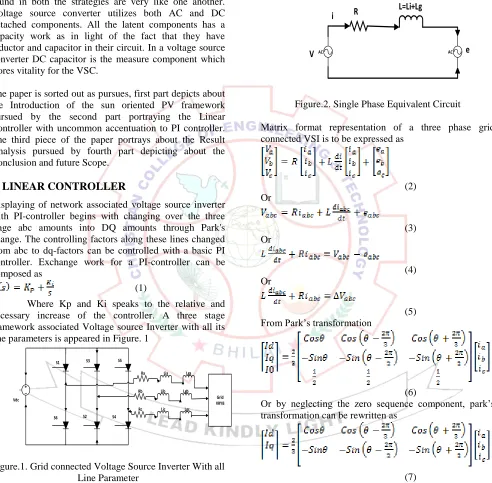
Where Kp and Ki speaks to the relative and necessary increase of the controller. A three stage framework associated Voltage source Inverter with all its line parameters is appeared in Figure. 1
DC
Grid VRYB Vdc
Ra
Rb
Rc Lia
Lib
Lic Lga
Lgb
Lgc
S1 S3 S5
S6 S2 S4
Figure.1. Grid connected Voltage Source Inverter With all Line Parameter
In the above Figure Ra,b,c represents Resistance of each
phase for line connected between Inverter and Grid. Va, Vb and Vc represents Inverter outout voltage or pole voltage. Li and Lg represents filter Inductance and Line inductance respectively. Ia, Ib and Ic represents phase current flowing through each line of conductor. Single Phase Equivalent circuit for a three phase grid connected
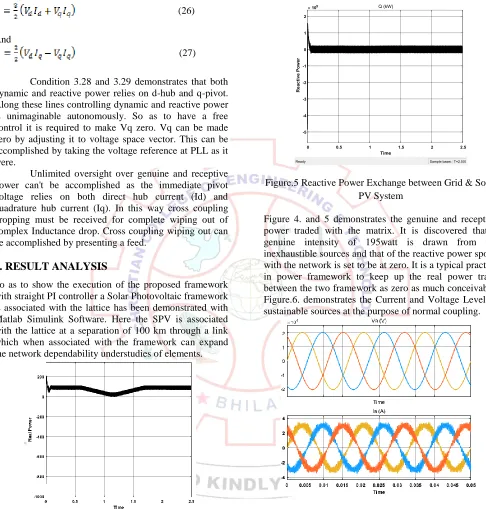
voltage source inverter with all its parameter is shown in Figure 2
AC AC
V
i R L=Li+Lg
e
Figure.2. Single Phase Equivalent Circuit
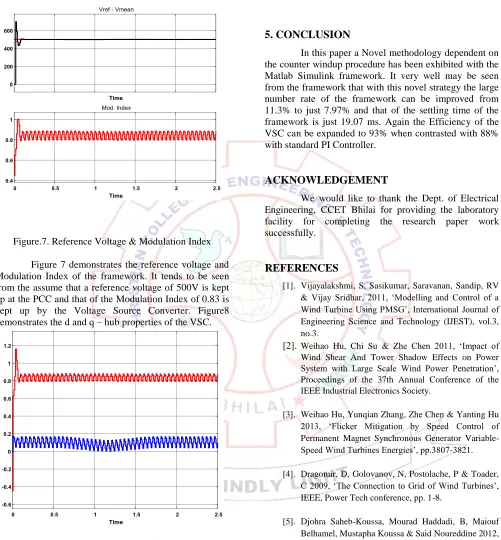
Matrix format representation of a three phase grid connected VSI is to be expressed as
(2) Or
(3) Or
(4) Or
(5) From Park’s transformation
(6)
Or by neglecting the zero sequence component, park’s transformation can be rewritten as
(7)
Where ω represents the angular frequency and f represents the grid frequency. From modified park’s transformation method Id and Iq can be written as
CCET JOURNAL OF SCIENCE AND ENGINEERING EDUCATION
(ISSN 2455-5061)
Vol. – 4, Page-65-70, Year-2019
67
(9)Similar to Current transformation voltage transformation using Park’s transformation can be obtained as
(10) And
(11)
Differentiating equation (3.10) and (3.11) w.r.t time
(12) And
(13) Again from equation 3.7
(14) Or
(15) Putting equation 3.17 in equation 3.14 gives
(16) Rewriting equation (3.18) shows that
(17)
First part of equation 3.19 shows the ∆Vd and that of
second part represents the id. Hence equation 3.19 can be
rewritten as
(18) Or
(19)
Similarly with the help of Park’s transformation equation 3.15 can be rewritten as
(20) Or
(21)
By combining all the equations from equation 3.8 to equation 3.23, equation 3.7 can be written as
(22) Inverse Laplace transform of equation 3.24 becomes
(23)
Block diagram for equation 3.25 is shown in Figure 3
dq
αβ abc PWM PI
Id*
Iq*
3-ɸ Load Thyristor
αβ
PI
dq
αβ abc αβ
Iq Id Id
Iq
Figure.3. Synchronous PI with Rotating DC Component Voltage 'e' speaks to the matrix aggravations present in the framework and 'V ' speaks to voltage accessible at the terminal of inverter. Yield current vector can be to a great extent delivered with the assistance of a present controller.
Direct and quadrature hub voltage condition dependent on the above dialog is as per the following.
(24)
And
(25)
CCET JOURNAL OF SCIENCE AND ENGINEERING EDUCATION
(ISSN 2455-5061)
Vol. – 4, Page-65-70, Year-2019
68
(26)And
(27)
Condition 3.28 and 3.29 demonstrates that both dynamic and reactive power relies on d-hub and q-pivot. Along these lines controlling dynamic and reactive power is unimaginable autonomously. So as to have a free control it is required to make Vq zero. Vq can be made zero by adjusting it to voltage space vector. This can be accomplished by taking the voltage reference at PLL as it were.
Unlimited oversight over genuine and receptive power can't be accomplished as the immediate pivot voltage relies on both direct hub current (Id) and quadrature hub current (Iq). In this way cross coupling dropping must be received for complete wiping out of complex Inductance drop. Cross coupling wiping out can be accomplished by presenting a feed.
3. RESULT ANALYSIS
So as to show the execution of the proposed framework with straight PI controller a Solar Photovoltaic framework is associated with the lattice has been demonstrated with Matlab Simulink Software. Here the SPV is associated with the lattice at a separation of 100 km through a link which when associated with the framework can expand the network dependability understudies of elements.
Figure.4. Real Power Exchanged Between Grid & Substation
Figure.5 Reactive Power Exchange between Grid & Solar PV System
Figure 4. and 5 demonstrates the genuine and receptive power traded with the matrix. It is discovered that a genuine intensity of 195watt is drawn from the inexhaustible sources and that of the reactive power spoke with the network is set to be at zero. It is a typical practice in power framework to keep up the real power trade between the two framework as zero as much conceivable. Figure.6. demonstrates the Current and Voltage Level of sustainable sources at the purpose of normal coupling.
CCET JOURNAL OF SCIENCE AND ENGINEERING EDUCATION
(ISSN 2455-5061)
Vol. – 4, Page-65-70, Year-2019
69
Figure.7. Reference Voltage & Modulation IndexFigure 7 demonstrates the reference voltage and Modulation Index of the framework. It tends to be seen from the assume that a reference voltage of 500V is kept up at the PCC and that of the Modulation Index of 0.83 is kept up by the Voltage Source Converter. Figure8 demonstrates the d and q – hub properties of the VSC.
Figure.8. D & Q axis Parameter of the System
5. CONCLUSION
In this paper a Novel methodology dependent on the counter windup procedure has been exhibited with the Matlab Simulink framework. It very well may be seen from the framework that with this novel strategy the large number rate of the framework can be improved from 11.3% to just 7.97% and that of the settling time of the framework is just 19.07 ms. Again the Efficiency of the VSC can be expanded to 93% when contrasted with 88% with standard PI Controller.
ACKNOWLEDGEMENT
We would like to thank the Dept. of Electrical Engineering, CCET Bhilai for providing the laboratory facility for completing the research paper work successfully.
REFERENCES
[1]. Vijayalakshmi, S, Sasikumar, Saravanan, Sandip, RV & Vijay Sridhar, 2011, ‘Modelling and Control of a Wind Turbine Using PMSG’, International Journal of Engineering Science and Technology (IJEST), vol.3, no.3.
[2]. Weihao Hu, Chi Su & Zhe Chen 2011, ‘Impact of Wind Shear And Tower Shadow Effects on Power System with Large Scale Wind Power Penetration’, Proceedings of the 37th Annual Conference of the IEEE Industrial Electronics Society.
[3]. Weihao Hu, Yunqian Zhang, Zhe Chen & Yanting Hu 2013, ‘Flicker Mitigation by Speed Control of Permanent Magnet Synchronous Generator Variable-Speed Wind Turbines Energies’, pp.3807-3821.
[4]. Dragomir, D, Golovanov, N, Postolache, P & Toader, C 2009, ‘The Connection to Grid of Wind Turbines’, IEEE, Power Tech conference, pp. 1-8.
CCET JOURNAL OF SCIENCE AND ENGINEERING EDUCATION
(ISSN 2455-5061)
Vol. – 4, Page-65-70, Year-2019
70
[6]. Deepak Sangroya & Jogendra Kumar Nayak 2015,‘Evaluating the Role of State Incentives in the Deployment of Wind Energy in India’, International Journal of Renewable Energy Research, vol.5, no.1.
[7]. Ali, H, Kasem Alaboud, Ahmed, A, Daoud, B, Sobhy, S, Desouky, B & Ahmed A Salem 2013, ‘Converter Controls and Flicker Study of PMSG-Based Grid Connected Wind Turbines’, Ain Shams Engineering Journal vol. 4, pp.75-91.