409
Int. J. Data Envelopment Analysis (ISSN 2345-458X)
Vol.2, No.3, Year 2014 Article ID IJDEA-00231,13 pagesResearch Article
Portfolio Performance Evaluation in a Modified
Mean-Variance-Skewness Framework with Negative
Data
Sh.Banihashemia*,M.Saneib, M.Azizia
(a) Department of Mathematics and Computer Science, Faculty of Econimics Allameh Tabataba’i
University.
(b) Department of Applied Mathematics, Islamic Azad University, Central Tehran Branch, Tehran,
Iran.
Received 28 May 2014, Revised 5 July 2014, Accepted 26 September 2014
Abstract
The present study is an attempt toward evaluating the performance of portfolios using variance-skewness model with negative data. Mean-variance non-linear framework and mean-variance-skewness non- linear framework had been proposed based on Data Envelopment Analysis, which the variance of the assets had been used as an input to the DEA and expected return and skewness were the output. Conventional DEA models assume non-negative values for inputs and outputs. However, we know that unlike return and skewness, variance is the only variable in the model that takes non-negative values. This paper focuses on the evaluation process of the portfolios in a mean-variance-skewness model with negative data. The problem consists of choosing an optimal set of assets in order to minimize the risk and maximize return and positive skewness. This method is illustrated by application in Iranian stock companies and extremely efficiencies are obtained via mean-variance-skewness non-linear framework with negative data for making the best portfolio. The finding could be used for constructing the best portfolio in stock companies, in various finance organization and public and private sector companies.
Keywords: Portfolio, Data Envelopment Analysis (DEA), Skewness, Efficiency, Negative data.
1. Introduction
In financial literature, a portfolio is an appropriate mix investments held by an institution or private
individuals. Evaluation of portfolio performance has created a large interest among employees also
academic researchers because of huge amount of money are being invested in financial markets. The
*Corresponding author: [email protected]. Tel:+98 21 22494937. Fax:+98 21 88524194.
theory of mean – variance, Markowitz [11] is considered the basis of many current models and this
theory is widely used to select portfolios. This model is due to the nature of the variance in quadratic
form. . Due to quadratic form, a study by Arditti [1], Kane [9] and Ho and Cheung [7] shown that
investors prefer skewness which means that utility functions of investors are not quadratic. Other
problem in Markowitz model is that increasing the number of assets will be developed the covariance
matrix of asset returns and will be added to the content calculation. Due to these problems sharp one-
factor model is proposed by Sharp [16]. This method reduces the number of calculations required
information for the decision. Data envelopment analysis (DEA) has proved the efficiency for
assessing the relative efficiency of Decision Making Units (DMUs) that employing multiple inputs to
produce multiple outputs (Charnes et al [4]). Morey and Morey [13] proposed mean – variance
framework based on Data Envelopment Analysis, which the variance of the portfolios is used as an
input to the DEA and expected return is the output. Joro& Na [8] introduced mean - variance –
skewness framework and skewness of returns are also considered as an output. Briec et al. [3]
introduced shortage function. This shortage function obtains an efficiency measure that looks for
improvements in both mean and skewness and decreases in variance. Kerstence et al. [10] introduced
a geometric representation of the MVS frontier related to a new tool introduced in the literature by
Briec. Mhiri and prigent [12] analyze the portfolio optimization problem by introducing the higher
moments of the main financial index returns. In new models instead of estimating the whole efficient
frontier, only the projection points of the assets are calculated. In these models are used a non-linear
DEA-like framework where the correlation structure among the units is taken into account.
Conventional DEA models assume non-negative values for inputs and outputs. These models cannot
be used for the case in which DMUs include both negative and positive inputs and/or outputs. Poltera
et al. [14] consider a DEA model which can be applied in the cases where input/ output data take
positive and negative values.The other models solve negative data such as Modified slacks-based
measure model (MSBM) [2006], semi-oriented radial measure (SORM) [2010] and etc. The portfolio
optimization problem is a well-known problem in financial real world. The investor’s objective is to
get the maximum possible return on an investment with the minimum possible risk. Also the investors
prefer to maximize positive skewness. Since there are a large number of assets to invest in, this
objective leads to select the best assets via mean-variance-skewness non-linear model with negative
data.
The rest of the paper is organized as follows: Section 2 briefly reviews the portfolio performance
literature. Section 3 explainsmean-variance RDM and mean-variance-skewness RDM non-linear
models. Section 4 presents computational results using Iranian stock companies data and finally
2. Background
Portfolio theory to investing is published by Markowitz [11]. This approach starts by assuming that
an investor has a given sum of money to invest at the present time. This money will be invested for a
time as the investor’s holding period. The end of the holding period, the investor will sell all of the
assets that were bought at the beginning of the period and then either consume or reinvest. Since
portfolio is a collection of assets, it is better that to select an optimal portfolio from a set of possible
portfolios. Hence the investor should recognize the returns (and portfolio returns), expected (mean)
return and standard deviation of return. This means that the investor wants to both maximize expected
return and minimize uncertainty (risk). Rate of return (or simply the return) of the investor’s wealth
from the beginning to the end of the period is calculated as follows:
Return =(end−of−period wealth)—(beginning−of−period wealth)
beginning−of−period wealth (1)
Since Portfolio is a collection of assets, its return rpcan be calculated in a similar manner. Thus
according to Markowitz, the investor should view the rate of return associated to any one of these
portfolios as what is called in statistics a random variable. These variables can be described expected
the return (min or rp) and standard deviation of return. Expected return and deviation standard of
return are calculated as follows:
1/ 2
1 1 1
, (2)
n
n np i i p i j ij
i i j
r r
Where:
n=the number of assets in the portfolio
p
r =The expected return of the portfolio
i
=The proportion of the portfolio’s initial value invested in asset i
i
r =The expected return of asset i
p
= The deviation standard of the portfolio
ij= The covariance of the returns between asset i and asset j
In the above, optimal portfolio from the set of portfolios will be chosen that maximum expected return
for varying levels of risk and minimum risk for varying levels of expected return(Sharp [17] ).
Data Envelopment Analysis is a nonparametric method for evaluating the efficiency of systems with
concepts that will be used in other sections in DEA. They will not be discussed in details. Consider
j
DMU , ( j 1,...,n) where each DM U consumes m inputs to produce s outputs. Suppose that the
observed input and output vectors of DMUj are Xj (x1j, ...,xmj) and Yj (y1j,...,ysj) respectively, and let X j 0and X j 0, Y j 0andYj 0. A basic DEA formulation in input
orientation is as follows:
min ( )
1 1
. 1, ..., , (3)
1
1, ..., , 1
,
, 0,
0
s m
s s
r i
r i
n
s t x s x i m
j ij i io j
n
y s y r s
j rj r ro j
s s
Where
is a n-vector of
variables, sas-vector of output slacks,san m-vector of input slacksand set is defined as follows:
with constant returns to scale,
with non-increasing returns to scale ,
with variable returns to scale
{
{ ,1 1}
{ ,1 1}
(4)
n R
n R
n R
Note that subscript ‘o’ refers to the unit under the evaluation. A DMU is efficient iff
1and all slackvariables s,sequal zero; otherwise it is inefficient (Charnes et al. [4]). In the DEA formulation
above, the left –hand sides in the constraints define an efficient portfolio. 𝜃 is a multiplier defines the
distance from the efficient frontier. The slack variables are used to ensure that the efficient point is
fully efficient. This model is used for asset selection. The portfolio performance evaluation literature
is vast. In recent years these models have been used to evaluate the portfolio efficiency. Also in the
Markowitz theory, it is required to characterize the whole efficient frontier but the proposed models
The distance between the asset and its projection which means the ratio between the variance of the
projection point and the variance of the asset is considered as an efficiency measure( )
. In thisframework, there is n assets,
jis the weight of asset jin the projection point,r
jis the expected return of asset j,
oand
o2 are the expected return and variance of the asset under evaluationrespectively. Efficiency measure
can be solved via following model:
min ( )
1 2
. . 1 ,
1 2 2 ( ( )) 2 1 1 0 1
5
s s ns t E j jr s o j
n
E j rj j s o
j n
j j
Model (5) is revealed by the non-parametric efficiency analysis Data Envelopment Analysis (DEA).
Joro and Na [8] extended the described approach in (5) into mean-variance-skewness framework
where
ois the skewness of the asset under evaluation. The efficiency measure
can be solvedthrough using the following model:
min (1 2 3)
. . ,
1 1
2 2
( ( )) 2
1 3 ( ( )) 3 1 1 0 1
6
s s s
n
s t E j jr s o j
n
E j rj j s o
j n
E j rj j s o j
n j j
Model (6) projects the asset with the efficient frontier by fixing the expected return and skewness
Fig 1. Different projections (input oriented, output oriented, combinationoriented)
Fig 1 illustrates different projection that consist of input oriented, output oriented and combination
oriented in models of data envelopment analysis. C is the projection point obtained via fixing
expected return and minimizing variance, B via maximizing return and minimizing variance
simultaneously, and D via fixing variance and maximizing return.
In the conventional DEA models, each DMUj(j1,..., )n is specified by a pair of non-negative
input and output vectors (x yj, j)Rm s , in which inputs x iij( 1,..., )m are utilized to produce
outputs, yrj(r1,..., )s . These models cannot be used for the case in which DMUs include both
negative and positive inputs and/or outputs. Poltera et al.[14] consider a DEA model which can be
applied in the cases where input/ output data take positive and negative values. Rang Directional
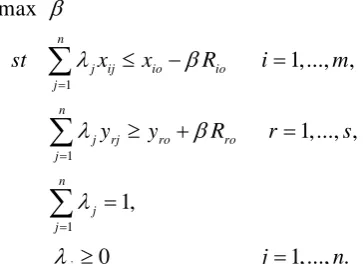
Measure (RDM) model proposed by Polera et al. goes as follows:
1
1
1
max
1,..., ,
1,..., , (7)
1,
0 1,..., .
n
j ij io io
j
n
j rj ro ro
j
n
j j
j
st x x R i m
y y R r s
j n
Ideal point (I ) within the presence of negative data, is :
(max {j rj: 1,..., }, min {j ij: 1,..., }
I y r s x i m where
0 5 10 15 20 25
0 50 100 150 200 250 300
Assets
Projection Points
D
A B B
,
min { : 1,..., }, 1,..., ,
max { : 1,..., } 1,..., . (8)
io io j ij
ro j rj ro
R x x j n i m
R y j n y r s
The other models solve negative data such as Modified slacks-based measure model (MSBM),
Emrouznejad [6], semi-oriented radial measure (SORM), Sharp et al. [15] and etc.
3. Modified models in the presence of negative data
In model (6) if return and skewness is considered positive then the results are correct, hence the
problem can happen only if return and skewness can take both positive and negative values. As we
know that unlike return and skewness, variance is only a non-negative number. Also, Bhattacharyya et
al. [2] predicted that for assets with negative expected returns, expected return will be a declining and
convex function of skewness. Assume the basic problem is to select a portfolio from n financial
assets. A portfolio
( ,...,
1
n)is a vector of proportions in each of these n financial assets withn i i 1
1
. Excluding short sales, one must impose the condition
i0for all i{1,..., n}. In general,the set of admissible portfolio is written as follows:
n n
i i
i 1
{
R :
1,
0}
.Assets are characterized by an expected return E[ri]. By a covariance matrixwith
ij cov(r , r )i j E[(ri E[r ])(ri j E[r ])]j (9)
And by a co-skewness tensor of rank three with:
ij E[(ri E[r ])(ri j E[r ])(rj k E[r ])]k (10)
.
Then, we have:
n i i i 1
n 2
i j ij i, j 1 n 3
i j k ij i, j,k 1
E[r( )] E[r ]
V ar[r( )] E[(r( ) E[r( )]) ] (11)
Sk[r( )] E[(r( ) E[r( )]) ]
To condense notation, the function
: R3defined by: ( ) (E[r( )], V ar[r( )],Sk[r( )])is introduced to represent the expected return, variance and skewness of a given portfolio
.In thereminder, an element of R3is called a MVS point. Thus, a MVS point can be the image by of a
portfolio, or any arbitrary point in this three-dimensional space. It is useful to define the MVS image
of as the image
( ) , with( ) { ( ); }.
This set can be extended by defining a MVS disposal representation set via:
DR
( ) (RRR ).For the purpose of gauging portfolio efficiency, a subset of this representation set the weakly and
strongly efficient frontier must be defined as:
Definition 1: In the MVS space, the weakly efficient frontier is defined as:
w ' ' ' ' ' '
( ) {(M, V, S) DR; ( M , V , S ) ( M, V, S) (M , V , S ) DR}
.
Definition 2: In the MVS space, the strongly efficient frontier, is defined as:
s ' ' ' ' ' ' ' ' '
( ) {(M, V, S) DR; ( M , V , S ) ( M, V, S)and ( M , V , S ) ( M, V, S) (M , V , S ) DR}
Extremely, we present following non-linear mean-variance RDM model on the basis of negative data:
2 o
n
j j o o
j 1 n
2 2
j j j o
j 1 n
j j 1
max
s.t. E r R
E ( (r )) R (12)
1 0
Ideal point (I ) within the presence of negative data, is
2 o
2
j j j j
o j j o
2 2
o j j
I (min { }, max { }) where,
R max { : j 1,..., n} (13)
R min { : j 1,..., n}.
The above model can be expressed as following:
2o o o 2 o n j j 1 max
s.t. E r( ) R
Var r( ) R (14)
Also, we present following non-linear mean-variance-skewness RDM model on the basis of negative data: 2 1 2 2 1 3 1 1 max . . ( (15) ( ) 1 0
o o o nj j o
j
n
j j j o
j
n
j j j o
j
n
j j
j
s t E r R
E r R
E r R
Ideal point (I ) within the presence of negative data, is
2
j j j j j
I(min {
}, max {
, })Where
o 2 o o j o 2 2 o o j o R maxR min (16)
R max
The above model can be expressed as following:
2 2 1 max . . ( )( ) (17)
( ) 1 0
o o o o o o n j j js t E r R
Var r R
Sk r R
The methodology in this paper starts with asset selection via performance evaluation in presence of
negative data. The data used for this methodology is from 20 Iranian stock companies. In many cases
similar to this example there are a lot of assets. It is better that starts with asset selection via
performance evaluation. The choice of the asset can be random or discrete. The random choice of
assets is usually biased and do not promise an optimum portfolio; hence it is more rational to have an
objective choice while selecting the assets to be included in the portfolio. Performance evaluation is
calculated by using models 14 and 17.
4. Application in Iranian Stock Companies
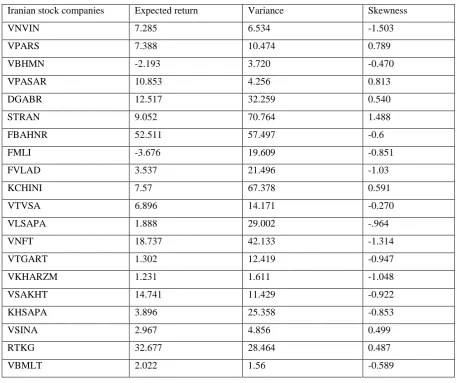
We illustrate our approach in non-linear mean-variance-skewness model for a data set 20 Iranian
stock companies. A list of stocks used is provided in Table 1. In this report, there is expected return,
variance, skewness of stocks which expected return and skewness are considered as output and
variance is as input. The example is received from Iranian stock companies and is about portfolio
performance evaluation in a mean-variance-skewness RDM framework. Thus, we know that unlike
return and skewness, variance is the only variable in the model that takes non-negative values. In the
analysis, the variance of the stocks is used as an input to the DEA and expected return and skewness
are used as output.
Table1. Descriptive statistics of the Iranian stock companies
Iranian stock companies Expected return Variance Skewness
VNVIN 7.285 6.534 -1.503
VPARS 7.388 10.474 0.789
VBHMN -2.193 3.720 -0.470
VPASAR 10.853 4.256 0.813
DGABR 12.517 32.259 0.540
STRAN 9.052 70.764 1.488
FBAHNR 52.511 57.497 -0.6
FMLI -3.676 19.609 -0.851
FVLAD 3.537 21.496 -1.03
KCHINI 7.57 67.378 0.591
VTVSA 6.896 14.171 -0.270
VLSAPA 1.888 29.002 -.964
VNFT 18.737 42.133 -1.314
VTGART 1.302 12.419 -0.947
VKHARZM 1.231 1.611 -1.048
VSAKHT 14.741 11.429 -0.922
KHSAPA 3.896 25.358 -0.853
VSINA 2.967 4.856 0.499
RTKG 32.677 28.464 0.487
VBMLT 2.022 1.56 -0.589
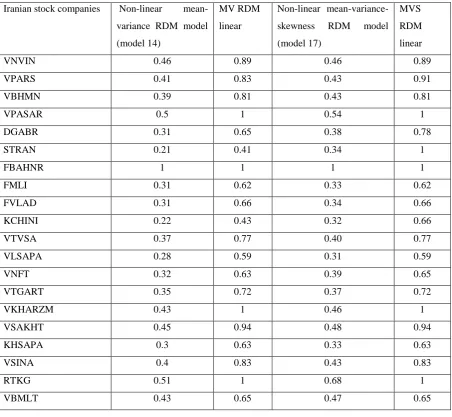
Linear MV and linear MVS with RDM model are calculated at table 2. Also, non linear MV
efficiency measure and non-linear MVS efficiency measure using models 14 and 17 are calculated at
Table2. Efficiency measure of the Iranian stock companies Iranian stock companies Non-linear
mean-variance RDM model (model 14)
MV RDM linear
Non-linear mean-variance-skewness RDM model (model 17)
MVS RDM linear
VNVIN 0.46 0.89 0.46 0.89
VPARS 0.41 0.83 0.43 0.91
VBHMN 0.39 0.81 0.43 0.81
VPASAR 0.5 1 0.54 1
DGABR 0.31 0.65 0.38 0.78
STRAN 0.21 0.41 0.34 1
FBAHNR 1 1 1 1
FMLI 0.31 0.62 0.33 0.62
FVLAD 0.31 0.66 0.34 0.66
KCHINI 0.22 0.43 0.32 0.66
VTVSA 0.37 0.77 0.40 0.77
VLSAPA 0.28 0.59 0.31 0.59
VNFT 0.32 0.63 0.39 0.65
VTGART 0.35 0.72 0.37 0.72
VKHARZM 0.43 1 0.46 1
VSAKHT 0.45 0.94 0.48 0.94
KHSAPA 0.3 0.63 0.33 0.63
VSINA 0.4 0.83 0.43 0.83
RTKG 0.51 1 0.68 1
VBMLT 0.43 0.65 0.47 0.65
Table 2 represents the calculated and compared the results of efficiency of model 14 and model 17 to
linear MV RDM model and linear MVS RDM model. As seen in Table 2, model 14 and model 17
scores are as a conservative estimate of the linear MV RDM and linear MVS RDM scores. In this
example all the linear DEA scores are greater than the non-linear model.Also, we compare the results
linear MV RDM and linear MVS RDM. Because of, skewness equation is increased the results are not
better. But, we know that the RDM model gives inefficiency score. Therefore, the efficiency score
linear MVS RDM model is greater than linear MV RDM. But, those having positive skewness, have
more efficiency increasing. For example, STRAN having the most positive skewness, Firstly linear
MV RDM efficiency score has 0.41 and linear MVS RDM efficiency score ,secondly becomes 1. But
scores are become nearly better than non-linear MV RDM efficiency scores. But those having positive
skewness, have more efficiency increasing. For example, STRAN and KCHINE.
The results are obtained by General Algebraic Modeling System (GAMS) software.
5. Conclusion
This paper introduced a measure for portfolio performance using non-linear
mean-variance-skewness RDM model. Joro and Na had proposed models for evaluating portfolio efficiency in which
Data Envelopment Analysis model was employed. In these models was used a non-linear DEA-like
framework where the correlation structure among the units was taken into account. We have applied
model 14, and model 17 with return and skewness as output and the variance as the input to 20 stocks.
The detailed results are presented in Table 2. In the numerical example is also observed that
compared with linear, these models are highly exact in all the units, that is, all the linear DEA scores
are greater than the non-linear models. This means that the DEA frontier is always dominated via the
non-linear modified mean-variance frontier. But, those having positive skewness, have more
efficiency increasing. For example, STRAN having the most positive skewnes. Firstly, linear MV
RDM efficiency score has 0.41 and linear MVS RDM efficiency score, Secondly becomes 1. But
those having negative skewness, don’t change in efficiency score. Non-linear MVS RDM efficiency
scores are nearly better than non-linear MV RDM efficiency scores. But, those having positive
skewness, have more efficiency increasing. For example, STRAN and KCHINE.
Acknowledgement
The authors’ sincere thanks go to the known and unknown friends and reviewers who meticulously
covered the article and provided us with valuable insights.
Reference
[1] Arditti, “Skewness and investors_ decisions: A reply,” Journal of Financial and Quantitative
Analysis, vol. 10, pp. 173–176, 1975.
[2] Na. Bhattacharyya, Th. garrett, St. Louis, “Why people choose negative expected return assets- an
emprical examination of a utility Theoretic explanation ,2006.
[3] W. Briec, K. Kerstens and O. Jokung, “Mean-Variance-Skewness Portfolio Performance Gauging:
A General Shortage Function and Dual Approach,” Management Science, vol. 53,pp 135 – 149, 2007. [4] A. Charnes, W.W. Cooper and E. Rhodes, “Measuring Efficiency of Decision Making Units,”
[5] A. Charnes, W.W. Cooper and Lewin, A.Y. Seiford, “Data Envelopment Analysis: Theory, Methodology and Applications,”Kluwer Academic Publishers, Boston, 1994.
[6] A. Emrouznejad,, “A semi-oriented radial measure for measuring the efficiency of decision
making units with negative data, using DEA”, European journal of Operational Research, 200,pp.
297-304, 2010.
[7] Y.K.. Ho and Y.L. Cheung, “Behavior of intra-daily stock return on an Asian emerging market— Hong Kong,” Applied Economics, vol. 23, pp. 957–966, 1991.
[8] T. Joro and P. Na, “Portfolio performance evaluation in a mean-variance-skewness framework”
European Journal of Operational Research, vol. 175,pp. 446–461, 2005.
[9] A. Kane, “Skewness preference and portfolio choice,” Journal of Financial and Quantitative
Analysis, vol. 17, pp. 15–25, 1982.
[10] K. Kerstens, A. Mounir and I. Woestyne, “Geometric representation of the
mean-variance-skewness portfolio frontier based upon the shortage function, European Journal of Operational
Research, pp. 1-33, 2011.
[11] H.M. Markowitz, “Portfolio selection,” Journal of Finance, vol. 7, pp. 77–91, 1952.
[12] M. Mhiri and J. Prigent, “International portfolio optimization with higher moments,”
International Journal of Economics and Finance, Vol. 2, no. 5, pp. 157-169, 2010.
[13] M.R. Morey and R.C. Morey, “Mutual fund performance appraisals: A multi-horizon perspective with endogenous benchmarking,” Omega, vol. 27,pp 241–258, 1999.
[14] M.C. Portela, e. Thanassoulis, and g. Simpson, “A directional distance approach to deal with
negative data in DEA : An application to bank branches, ”Journal of Operational Research Society,
55 ,pp. 1111-1121, 2004.
[15] JA. Sharp, W. Meng and W. Liu, “A modified slacks-based measure model for data envelopment
analysis with ‘natural’ negative outputs and inputs, “ Journal of the Operational Reaserch Society, 57,
pp.1-6, 2006.
[16] W.F. Sharpe, “Capital asset prices: A theory of market equilibrium under conditions of risk,”
Journal of Finance, vol. 19,pp. 425–442, 1964.