A Genetic Programming-based trust model for
P2P Network
Mahdi Sattarivand1
Received (2015-02-23) Accepted (2015-04-05)
Abstract - Peer-to-Peer systems have been the center of attention in recent years due to their advantage. Since each node in such networks can act both as a service provider and as a client, they are subject to different attacks. Therefore it is vital to manage confidence for these vulnerable environments in order to eliminate unsafe peers. This paper investigates the use of genetic programing for achieving trust of a peer without central monitoring. A model of confidence management is proposed here in which every peer ranks other peers according to calculated local confidence based on recommendations and previous interactions. The results show that this model identifies malicious nodes without the use of a central supervisor or overall confidence value and thus the system functions.
Index Terms - peer-to-peer systems, confidence, genetic programing, malicious nodes.
I. INTRODUCTION
I
N the past decade with the growth of Peer-to-Peer (P2P) systems, malicious activities have turned in to an important security issue in these networks. Due to the openness of P2P systems, unsafe users may occupy a great partof the population of P2P system. Confidence
management in such an open area is a problem and
an important subject. The aim of the confidence
models is generally to eliminate unsafe peers. Although maintaining communication by recognizing malicious peers from safe ones
without prior knowledge is a difficult task.
Therefor most of the proposed models in this
research offer an approximate decision-making
guideline about peers.
Confidence management can be carried
out by a central supervisor like eBay. But a central supervisor is not compatible with a P2P environment. Peers must prepare themselves for management and data storage about their safe connections [1, 2, 3]. In pure P2Ps like Gnutella,
peers send great volumes of confidence queries to the network in order to gain confidence
information about others [4]. In this model
all the peers save confidence data about their
neighbors according to previous interactions [2, 5, 6]. Queries are able to gather recommendations about asked peers and decide accordingly. Some models use distributed hash tables (DHT) to
save information. Every peer saves confidence data about other specified peers using a DHT algorithm which enables them to effectively
access information [1, 3, 7]. In this way peers can
access information of overall confidence about other nodes without sending so many queries
about the overall network. 1- School of Electrical and Computer Engineering, Guilan
Confidence management in P2P systems is a
problem due to the absence of a central supervisor
and unsafe gathered data from peers. Confidence models must be able to detect the complex
behavioral pattern of unsafe peers and make a smart decision for recognizing them from safe
nodes. Using artificial intelligence techniques can be a useful method for a complex subject as
this one.
Nowadays artificial intelligence has been used in many sciences, e.g., to recognize the quality of
a football goal-keeper and football talent fuzzy
expert systems and A Novel Fuzzy Approach for
Determining Best Position of Soccer Players [8, 9] Also, the fuzzy theory based on the uncertainty were used in geographic information systems
[10]. AI classification algorithms were used in
medicine and psychology [11], and its important
applications in the field of bioinformatics [12] or use expert systems in risk managements [13].
In this paper a genetic program based on
confidence management model is proposed. This model utilizes features extracted from peers
to detect malicious peers from safe ones. Peers save previous interactions with other peers and gather recommendations about neighboring peers. Two types of information are gathered by peers: interactions and recommendations, which
are the ground elements of features. A confidence
model including these features and using genetic
programing to measure the level of confidence
of peers is proposed. The rest of this research is continued as follows: in the second part the
proposed confidence model is presented. In
part three and four the results of simulation and conclusion are presented.
II. THE PROPOSED CONFIDENCE MODEL
In The proposed model in this paper utilizes
genetic programing to make a confidence
decision. Genetic programing is an evolutionary
calculation technique which was offered by Koza
for machine learning community [14].
In genetic programing functions include operators, phrases, etc. and terminals include features and constants build up a genetic
programing (GP) tree. Every GP tree is unique. A group of these unique trees which are possible
solutions to a problem are produced by GP of every generation.
1. A. Operators and Features
The Choosing a set of proper features is
a difficult subject and also the key point for
achieving successful results in GP and other
learning machine techniques [9]. In our model
the gathered data from previous interactions and recommendations of neighbors build the set of features. Interactions are gained through previous
experience of peers with other peers. These experiences have happened directly among two
peers that have interacted before and can include any special activity in P2P networks like sharing
files sharing CPU or memory. The table below
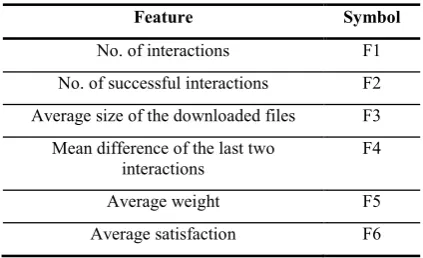
shows features based on interactions.
TABLE 1
INTERACTION-BASED FEATURES
Feature Symbol
No. of interactions F1
No. of successful interactions F2
Average size of the downloaded files F3
Mean difference of the last two
interactions F4
Average weight F5
Average satisfaction F6
The satisfaction and weight parameters are calculated like [16]. Successful interactions are
the ones in which a file download is finished
successfully. Satisfaction is calculated according to average bandwidth, agreed bandwidth before
interaction and the size of the online and offline
periods of loader:
S= ( ) / 2
AvB On
AgB On Off+ + if AvB > AgB
(1 On ) / 2
On Off
+
+ Otherwise (1)
In which AvB is average bandwidth, AgB is
agreed bandwidth and on and off show periods of online and offline status of the loader respectively.
Weight is calculated according to file size, the number of downloaded file loaders and maximum number of files loaded by loaders.
max
( ) / 2
100
s NU W
MB U
= +
if s< 100 MB
max (1 NU ) / 2
U
= +
otherwise (2)
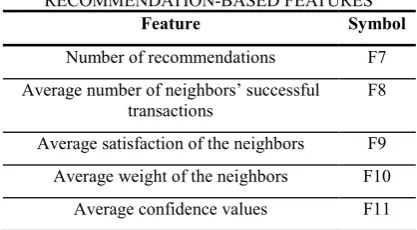
The second set of features is based on recommendations. When a peer wants to interact with another he asks his neighbors about their
experience with that peer. The neighbors which have an experience of interaction with that
peer send their recommendations. Actually
the experience about other nodes is called
recommendation. A recommendation includes the following information: average number of successful transactions, the average satisfaction of the interactions, the average weight of the transactions, and the amount of calculated
confidence for the specific peer. The features
based on recommendation are shown in the table below.
TABLE 2
RECOMMENDATION-BASED FEATURES
Feature Symbol
Number of recommendations F7
Average number of neighbors’ successful
transactions F8
Average satisfaction of the neighbors F9
Average weight of the neighbors F10
Average confidence values F11
In the specified genetic model, simple operators are used to produce a formula for confidence
calculations. The used operators include addition, subtraction, division, multiplication, inverse,
logarithm, square root and square:
B. Compatibility Function
Compatibility function is one of the most
important factors affecting the performance of evolutionary computation techniques. It
determines how well a program can function in solving a problem [8.11]. In the developed
confidence model, compatibility function is used
as reduced number of attacks. In other words if Tr
att
N shows the number of attacks with the
confidence model and NoTr att
N shows the number
of attacks without the confidence model then the
compatibility function would be as follows:
NoTr att
Tr att
N F
N
=
(3)
If the produced trees can reduce the number of attacks, the amount of compatibility function reduces and the success of the model increases. So in the genetic model, the aim is minimizing the
compatibility function. At the end of evolution, the most successful tree is the one chosen as the solution. GP algorithm is shown below:
Initial determination of population
While (present population < = maximum
generation
} for( all trees in the present generation) {simulation run;
{ ; evaluating compatibility function ; genetic operators run
creating a new population ; }
Although malicious peers may download
unidentified files or receive unjust
recommendation to harm the system, the goal of a
confidence management model is to reduce unsafe and injected files or unjust recommendations.
In this confidence model, nodes are supposed
to show two types of behavior: Naïve or hypocritical.
Naïve: Attackers usually download
unidentified or injected virus files and gives an
unjust recommendation to other nodes [18]. Hypocritical: Attackers carry out attacks
by downloading unidentified files or unjust recommendations with x% probability. In other
words they act as good peers [3, 5].
III. RESULTS OF SIMULATION
In the test, the model is initially tested for all kinds of attackers. Testing with network settings is carried out with 10 percent malicious peers, the best result out of ten for each attack is chosen. Then the model is tested with 10, 30 and 50 percent malicious peers in the network. The probability of hypocritical peers in considered
20% in all interactions. If a peer downloads an unidentified or a virus file it is considered an attack on the file. Simulation is first carried out with the confidence model.
Then simulation is carried out for the
developed confidence model, the success of the confidence model in preventing attacks is
emphasized with this model. Table 3 shows the
TABLE 3
CONFIDENCE MODEL SUCCESS RATE
50% 30%
10%
73.6 78.9
83.8 Naïve
47.1 57.7
71.8 Hypocritical
As the table shows, the model has achieved noticeable success against Naïve attackers. That is why identifying naïve attackers become easy
after first interaction.
Our model shows a good rate of success for
hypocritical attackers, in a network with 10% malicious peers this amount is 71.8% and in a network with 50% malicious peers the model can
prevent half of the attacks. In a network with this amount of malicious nodes, this is good rate of success.
Speed of convergence of the confidence model
is an important item in recognizing an attack in a
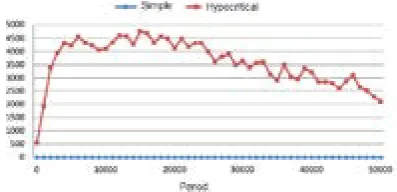
reasonable time. Figure 1 shows how the number
of attacks by naïve and hypocritical attackers has reduced.
Figure 2 shows reduce in attacks based on
recommendation over time.
In the second part of the simulation, simulation is carried out for collaborative malicious peers. These peers act as a team to create a good recommendation for each other.
Fig. 1. Attacks based on file
Fig. 2. Reduce in attacks based on recommendation
Table 4 presents rates of success for this state which shows a reduce in success for both naïve and hypocritical peers ith respect to the previous state.
TABLE 4
RATE OF SUCCESS FOR COLLABORATIVE MALICIOUS PEERS
50% 30%
10%
71.9 75.1
79.3 Naïve
39.5 46.3
61.7 Hypocritical
Figure 3 depicts the number of attacks based on file over time for a network with 10 percent
collaborative mallicious peers. The model
reduces the number of effective attacks by naïve
and hypocritical peers.
Fig. 3. File-based attacks with collaborative malicious peers
Figure4, shows attacks based on
recommendation which are carried out by fellow attackers. Cooperation between malicious peers increases unjust recommendations.
Fig. 4.attacks based on fellow peers’ recommendations
IV. CONCLUSIONS
This paper presented a developed model of
between malicious and pure peers. Naïve and hypocritical attackers were also studied separately and the results showed that the model is considerably successful for naïve attackers and fairly good for hypocritical ones.
The developed model proved that genetic programing can be used in Peer-to-Peer networks
for building a confidence model.
REFERENCES
[1] Kang, Xin, and Yong dong Wu. “A trust-based
pollution attack prevention scheme in peer-to-peer streaming networks.” Computer Networks 72 (2014): 62-73.
[2] Hendrikx, Ferry, Kris Bubendorfer, and Ryan Chard. “Reputation systems: A survey and taxonomy.” Journal of
Parallel and Distributed Computing 75 (2015): 184-197. [3] England, Philip, et al. “A Survey of Trust
Management in Mobile Ad-Hoc Networks.” Proceedings of the 13th annual post graduate symposium on the convergence of telecommunications, networking, and broadcasting, PGNET. 2012.
[4] Qi, Xiaoguang, et al. “A complex network model
based on the Gnutella protocol.” Physica A: Statistical Mechanics and its Applications 388.18 (2009): 3955-3960.
[5] Fan, Xinxin, et al. “Behavior-based reputation management in P2P file-sharing networks.” Journal of
Computer and System Sciences 78.6 (2012): 1737-1750. [6] Zhou, Runfang, Kai Hwang, and Min Cai. “Gossiptrust for fast reputation aggregation in peer-to-peer networks.” Knowledge and Data Engineering, IEEE
Transactions on 20.9 (2008): 1282-1295.
[7] Sattarivand, Mahdi, Reza Ebrahimi Atani, and
Yashar Fekri Sustani. “Anew METHOD FOR SECURITY IN PEER TO PEER NETWORK USING MODIFIED PARTICLE SWARM ALGORITHM.” Chemical and
Process Engineering )2014(, 435-441.
[8] Bazmara, Mohammad, Shahram Jafari, and Fatemeh Pasand. “A Fuzzy expert system for goalkeeper quality recognition.” arXiv preprint arXiv:1309.6433 (2013).
[9] Mohammad Bazmara,”A Novel Fuzzy Approach for
Determining Best Position of Soccer Players”, IJISA, vol.6, no.9, pp.62-67, 2014. DOI: 10.5815/ijisa.2014.09.08
[10] Mohammadi, Fereshteh, and Mohammad Bazmara. “A New Approach of Fuzzy Theory with Uncertainties in
Geographic Information Systems.” International Journal of Mechatronics, Electrical and Computer Technology 3.6 (2013): 1001-1014.
[11] M. Bazmara, S. Vahedian and S. Ramadhani, “KNN Algorithm for Consulting Behavioral Disorders in Children,” Journal of Basic and Applied Scientific Research,
3(12) 2013, pp. 981-986
[12] Pal, Sankar K. “Computational theory perception
(CTP), rough-fuzzy uncertainty analysis and mining in
bioinformatics and web intelligence: a unified framework.” Transactions on Rough Sets XI. Springer Berlin Heidelberg,
2010. 106-129.
[13] Fereshteh Mohammadi, Mohammad bazmara,
Hatef Pouryekta,”A New Hybrid Method for Risk
Management in Expert Systems”, IJISA, vol.6, no.7,
pp.60-65, 2014. DOI: 10.5815/ijisa.2014.07.08
[14] Koza, John R. “Survey of genetic algorithms
and genetic programming.” Wescon Conference Record.
WESTERN PERIODICALS COMPANY, 1995.
[15] Hall, Mark A. Correlation-based feature selection for machine learning. Diss. The University of Waikato, 1999.
self-organization peer-to-peer semantic communities for network
resource management.” Expert Systems with Applications
38.1 (2011): 94-105.
[17] Cramer, Nichael Lynn. “A representation for the adaptive generation of simple sequential programs.”Proceedings of the First International Conference
on Genetic Algorithms. 1985.
[18] Dellarocas, Chrysanthos. “Immunizing online