USF Scholarship: a digital repository @ Gleeson Library | Geschke
USF Scholarship: a digital repository @ Gleeson Library | Geschke
Center
Center
Master's Theses Theses, Dissertations, Capstones and Projects
1997
Components of Marianist Educational Culture: In a Content
Components of Marianist Educational Culture: In a Content
Analysis of Published Works of William Joseph Chaminade and in
Analysis of Published Works of William Joseph Chaminade and in
Phenomenological Interviews of Persons Designated as Best
Phenomenological Interviews of Persons Designated as Best
Experienced in Marianist Education
Experienced in Marianist Education
Joseph H. Lackner
COMPONENTS OF MARIANIST EDUCATIONAL CULTURE: IN A CONTENT ANALYSIS
OF PUBLISHED WORKS OF WILLIAM JOSEPH CHAMINADE
AND
IN PHENOMENOLOGICAL INTERVIEWS OF PERSONS DESIGNATED AS BEST EXPERIENCED
IN MARIANIST EDUCATION
A Dissertation
Presented to
The Faculty of the School of Education
Private School Education Program
In Partial Fulfillment
of The Requirements for the Degree
Doctor of Education
by
Joseph H. Lackner, SM
dissertation committee and approved by the members of the committee,
has been presented to and accepted by the Faculty of the School of
Education in partial fulfillment of the requirements for the degree of
Doctor of Education.
Dissertation Committee
lna~'~ (}[;~~~-
t1(J
Many more persons than could ever be named individually have supported me in the completion of this dissertation. To all of them I offer heartfelt thanks. But among those who must be named are the Provincial Council (James Fitz, SM, Joseph Kamis, SM, Ronald
Overmann, SM, Thomas Pieper, SM, and Bertrand Buby, SM), Robert Metzger, SM, Assistant Treasurer, who expedited financial matters, and the general membership of the Province of Cincinnati, Society of Mary, who have both encouraged and subsidized my studies for the doctorate in education. Included in this membership for special mention is the
Marianist Community at Archbishop Moeller High School in Cincinnati, Ohio, the community from which I travelled to San Francisco and from which I always received such a generous welcome when I returned for holidays during the two years of study. The School of Education at the University of Dayton also kindly granted me a leave of absence and financial support for my studies, and the Assistant General for Education, Thomas Giardino, SM, helped to finance the printing costs of the
dissertation. Here in San Francisco I received a warm reception from the officers and members of the Province of the Pacific, Society of Mary, and in particular from the Marianist Community of San Francisco located at Archbishop Riordan High School. Brother Thomas Redmond, its director, made every effort to show me the fraternal concern that is at the heart of Marianist life. I also profited greatly from observing the
principal of Archbishop Riordan High School, Reverend Timothy
Kenney, SM, inculcate Marianist educational culture 'in the school. From my perspective this high school appears to be one of the best in the
United States at actualizing what I have written about in this dissertation. Even more, I appreciate his brotherly friendship and stimulating
conversation as well as that of Marianist seminarians in residence in the community, particularly Thomas French, SM, and Timothy Kim, SM. Also among those whose conversation and friendship I must mention are my fellow students, especially Bruce Colville, Michelle Dvorak, PHJC, Doreen Jones, Lilian Kay Matan, Gustavo Ramirez, FSC, and Susan Seeley.
I would not have come to the University of San Francisco had it not been for the inspiration of Sister Mary Peter Traviss, OP, my advisor
learning, practical experience in teaching and administration, involvement in Catholic educational circles throughout the nation and beyond, and genuine care for the student that challenges and develops as well as supports. She brought all that to bear in the criticism, advice, and encouragement she offered me through the process of research and writing. Though constantly confronted by demands, she always found time to respond to me. For all these things and more that she gave to me I am deeply thankful.
I also very much appreciate the close eye, the careful scrutiny, the critical suggestions, and the warm friendship of my second reader,
Virginia Hodel Shimabukuro. I can only hope that in the future I will be as generous as she was to me in giving so much time to the tedious chore of reading page upon page of drafts of this dissertation. She always turned appointments about re-writes into delights for me through the engaging conversations that accompanied concentration on the
corrections.
I would also like to thank Denis Collins, SJ, who served as the third member of my committee for his constant encouragement. Sadly, illness forced him to take a medical leave immediately before the defense. Fortunately, Robert Niehoff, SJ, graciously stepped in and took on the yeoman task of serving at the last moment on my committee. Two other persons not on my committee deserve thanks, Edwin McDermott, SJ, for the person of faith and insight that he is, and Joseph 'Stefanelli, SM, one of the best Marianist historians living today. Of course, the research could not have been conducted had not a number of Marianists listed in the appendices been willing to nominate individuals for the study. The same is true of the contribution made by the panel of judges also named in the appendices. And without the gracious participation of the
interviewees, William Bolts, SM, Raymond Fitz, SM, Philip Eichner, SM, Thomas Giardino, SM, Stephen Glodek, SM, James Heft, SM, Joseph Kamis, SM, and Eugene Meyerpeter, SM, a most fruitful part of this study would have been missing. Their time, cooperation, and
genuine interest were a real encouragement to me.
Francisco for their financial support through the Ignatian Tuition Grant. Without this gift I would not have been able to pursue this doctorate. I promise them, the Province of Cincinnati of the Society of Mary, and the University of Dayton that their investment in me will benefit the ministry of the gospel of Jesus Christ.
LIST OF TABLES . . . . IX
CHAPTER ONE: THE RESEARCH PROBLEM . . . . 1
Statement of the Problem . . . 1
Purpose and Need for the Study . . . . 5
Conceptual Framework of the Study . . . 12
Background of the Study . . . 22
Research Questions . . . 121
Delimitations . . . 121
L . . . ImitatiOnS . . . 122
Significance . . . 123
Implications 123 Applications 124 Definition of Terms . . . 126
CHAPTER TWO: REVIEW OF RELATED LITERATURE . 134 Overview . . . 134
The Concept of Culture
in Organizational Theory and Practice 134
Popularization and Applications by Practitioners .
The Concept of School Culture and
Its Implementation . . . .
Study of Specific School Cultures . . . .
Official Catholic Statements
on Education and School Culture
Studies and Documents
on Education and School Culture
Writings of John Baptiste Lalanne
Scholarly Research Related to Marianist Education .
184
194
207
308
331
332
352
Constitutions . . . 371
Constitutions of the Society of Mary, 1891 373 Constitutions of the Society of Mary, 1967 389 Rule of Life of the Society of Mary . . . 394
Documents of General Chapters . . . 399
Response . . . 399
New Call . . . 402
Vision and Journey 403
Mission and Culture 406
CHAPTER THREE: METHODOLOGY . . . 418
Restatement of the Purpose . . . 418
Research Design and Method 419
Content Analysis . . . 419
Description and Process of Content Analysis 419
Pilot Study of Content Analysis . . . 420
Reliability and Validity in Content Analysis 421
Data Analysis . . . 422
In-Depth Phenomenological Interviews . . . 423
Validity or Trustworthiness in the Interview Process
Qualifications of the Researcher .
427
428
CHAPTER FOUR: FINDINGS . . . 430
Introduction:
Research Question One
A Construction of Marianist Educational Culture From the Content Analysis of the Writings of
430
William Joseph Chaminade . . . 441
Introduction:
Research Question Two . . . 4 73
A Narrative Construction of Marianist Educational Culture and Schools Based on Eight In-Depth Interviews of Persons Designated
as Best Experienced in Marianist Education . . . 4 7 4
Research Question Three . . . 554
CHAPTER SIX: CONCLUSIONS, IMPLICATIONS, RECOMMENDATION . . . 563
Overview . . . 563
Conclusions and Implications . . . 564
Recommendations . . . 569
Recommendations for Professional Practice . . . 569
Recommendations for Future Research . . . . -. . . 586
Closing Remarks . . . 588
APPENDIXES . . . 589
Appendix A: Table 4, Catholic High School Survey . . . . 589
Appendix B: Table 6, Schema of Categorization 593 Appendix C: Panel of Judges, Personal Profiles 599 Appendix D: Panel of Judges, Codification Verification . . 603
Interviewees . . . 605
Appendix F: Letter to Those Nominating Interviewees 609
Appendix G: Letter to the Nominees Requesting Their Participation
in the Dissertation Research . . . 612
Appendix H: Permission Form Regarding Dissertation Research on
Marianist Educational Culture . . . 615
Appendix 1: Biographical Data Form . . . 617
Appendix J: Table 7, Content Analysis, Constitutions of the Society of Mary, 1839 . . . 620
Appendix K: List of Interviewees
Appendix L: Table 9, Schematic Outline of Marianist Culture and Schools
BIBLIOGRAPHY . . . ..
Vlll
639
643
Table 1: Comparison of Organizational Culture and Organizational Culture . . . .
Table 2: Time Frame of Contemporary Conciliar and
Post-199
Conciliar Documentation on Catholic Education . . . 309
Table 3: Composite Portrait of the Ideal Catholic School Teacher Drawn from Roman and American
Documents on Education, 1965-1990 . . . 311
Table 4: Course Division and Curriculum in the Marianist
School at Colmar . . . 364
Table 5: Catholic High School Survey . . . 589
Table 6: Schema of Categorization 593
Table 7: Content Analysis, Constitutions of the Society
Mary (1839) . . . 620
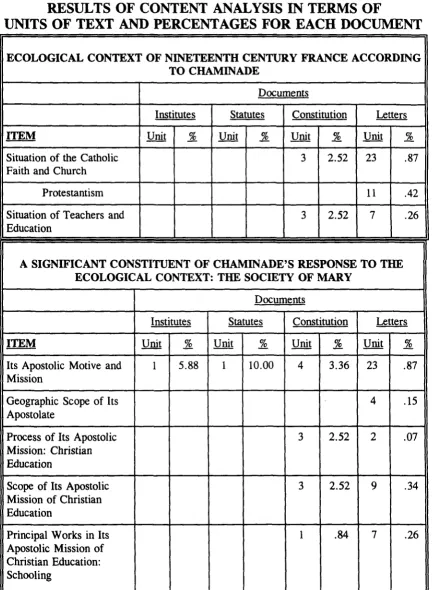
Table 8: Results of Content Analysis in Terms of
Units of Text and Percentages for Each Document . . 435
Table 9: Schematic Outline of Marianist Culture and Schools . 643
Table 10: Inventory of Practices and Behaviors
in Marianist Schools . . . 572
THE RESEARCH PROBLEM
Statement of the Problem
Schools, like every organization, constitute cultures.1 Harrison
Trice and Janice Beyer distinguished two basic components of culture:
"(1) its substance, or the networks of meanings contained in its
ideologies, norms, and values; and (2) its forms, or the practices whereby
these meanings are expressed, affirmed, and communicated to
members. "2 Terrence Deal expanded on the latter component by naming
examples of the forms and practices through which the culture is
expressed, affirmed, and communicated: the organization's " ... heroes
and heroines, ritual and ceremony, stories, and an informal network of
1
Terrence E. Deal and Allan A. Kennedy, Corporate Cultures: The Rites and Rituals of Corporate Life (Reading, MA: Addison-Wesley, 1982), 4; Thomas J. Sergiovanni, The Principalship: A Reflective Practice Perspective 3rd ed. (Boston: Allyn and Bacon, 1955), 95.
2
cultural players. "3
Because each school has its own heroes and heroines, rituals, and
organizational saga,4 each school's culture is distinctive.5 But because
schools often share similar networks of meanings, commonalities exist
among groups of schools.6 For example, Catholic schools exhibit
similarities because they share an identity as explicated in documents on
education promulgated by the Roman Catholic Church. 7 But even within
this general Catholic identity various groups of schools exhibit a certain
specificity that sets them off from other Catholic schools because of the
3Terrence E. Deal, "The Symbolism of Effective Schools," The
Elementary School Journal 85 (1985): 605.
4
Burton R. Clark, "The Organizational Saga in Higher Education," Administrative Science Quarterly 17 (1972): 178-184.
5
For the distinctiveness of organizational cultures in general, see: Joanne Martin, Martha S. Feldman, Mary Jo Hatch, and Sim B. Sitkin,
"The Uniqueness Paradox in Organizational Stories," Administrative Science Quarterly 28 (1983): 438-39; in regard to schools, both public and Catholic, see: John Philip Pejza, "An Investigation of Strong
Religious Cultures in Selected Catholic Secondary Schools" (Ed.D. diss., University of San Diego, 1987), 1-2.
6
Reba N. Page, "Cultures and Curricula: Differences Between and Within Schools," Educational Foundations 4 (Winter 1990): 52.
7
Gregory A. Brandao, "Faculty Perceptions Regarding Practice of Brothers of Sacred Heart New Orleans Province Charism in Community-Owned Secondary Schools" (Ed.D. diss., University of San Francisco,
religious orders that founded them. 8
The Congregation for Catholic Education highlighted this
difference among Catholic schools in 1982 in "Lay Catholics in
Schools: Witnesses to Faith":
Certain elements will be characteristic of all Catholic schools. But these can be expressed in a variety of ways; often enough, the concrete expression will correspond to the specific charism of the religious institute that founded the school and continues to direct it. 9
A similar statement was made in 1988 in The Religious Dimension
of Education in a Catholic School:
Most Catholic schools are under the direction of religious
congregations, whose consecrated members enrich the educational climate by bringing to it the values of their own religious
communities. . . . Each congregation brings the richness of its own educational tradition to the school, found in its original charism.10
8Brandao, "Brothers of the Sacred Heart New Orleans Province
Charism," 34-36.
9 Congregation for Catholic Education, "Lay Catholics in Schools:
Witnesses to Faith," in Vatican Council II. More Postconciliar
Documents, ed. Austin Flannery (Grand Rapids, MI: Wm. B. Eerdmans Publishing Co., 1982), #39, p. 645.
10
Into the 1960s, the overwhelming majority of the professional
personnel in Catholic schools consisted of members of religious orders
and priests.11 It was assumed that their presence would guarantee the
school's Catholic culture and the characteristics specific to the charism of
the religious order that served therein. 12 However, since the Second
Vatican Council, the composition of faculties in Catholic schools has
radically changed. In fact, projections suggest that by the turn of this
century all-lay faculties will be the norm within Catholic schools.13 This
change raises the question, among others, of the continuation of the
Catholic character of these institutions as well as the preservation of the
specific educational climate of the religious orders that founded them. 14
11Anthony S. Bryk, Valerie E. Lee, and Peter B. Holland, Catholic
Schools and the Common Good (Cambridge, MA: Harvard University Press, 1993), 71.
12Brandao, "Brothers of the Sacred Heart New Orleans Province
Charism," 1; Thomas C. Hunt and Norlene M. Kunkel, "Catholic Schools: The Nation's Largest Alternative School System," in Religious Schooling in America, ed. James C. Carper and Thomas C. Hunt
(Birmingham, AL: Religious Education, 1984), 1-34.
13Bryk, Common Good, 33-34, 71.
14
Purpose and Need for the Study
If a Catholic school wishes to maintain the culture in which it was
founded, it is essential that its personnel have an understanding of the
"network of meanings" that constitute Catholic identity15 as well as those
that characterize the charism and educational tradition of the religious
order that originally established it. Attention to this need is ever more
crucial today because most Catholic schools are staffed mainly by lay
persons. Since most of these men and women have not, like their
colleagues who are vowed religious or priests, experienced intense
spiritual formation programs sponsored by religious communities and
seminaries, it can no longer be assumed that the special identity of the
school will simply be maintained because of the presence of faculty, staff,
Salesian High Schools in the United States" (Ed.D. diss., University of San Francisco, 1994), 2-5.
15Virginia H. Shimabukuro, "Profile of an Ideal Catholic School
Teacher: Content and Analysis of Roman and American Documents, 1965 to 1990" (Ed.D. diss., University of San Francisco, 1993), 1-3; Joseph D. Massucci, "The Unique Identity of Catholic High Schools: A
Comparison of the Church's Expectations and A School Community's Experiences and Beliefs" (Ph.D. diss., University of Dayton, OH, 1993),
and administrators who have received such a training.16 Thus, as with
any organization, conscious, purposeful action must be taken by leaders
of Catholic schools to articulate and nurture among the personnel "the
basic assumptions and beliefs" 17 that create the school's specific culture
and thereby its identity. 18
What is true of Catholic schools in general is also true of those
schools founded or staffed by members of the Society of Mary of Paris
(Marianists) in the United States. For those schools to continue within
the Marianist tradition it is essential that their personnel understand and
be committed to the network of meanings that constitute the Marianist
educational culture. As a contribution to this process of enculturation,
this study will elaborate an articulation of that culture.
Crucial to the culture of any institution is the "charisma, foresight,
16Brandao, "Brothers of the Sacred Heart New Orleans Province
Charism," 1-4; Kurimay, "The Teacher in the Jesuit Educational
Tradition, "1-3; Shafran, "The Educational Method of Saint John Bosco," 2-5.
17
Edgar H. Schein, Organizational Culture and Leadership (San Francisco: Jossey-Bass, 1985), 6.
18
and vision" of its founder. 19 Therefore, in order to accomplish the
purpose of this study, a content analysis of the writings of the founder of
the Society of Mary of Paris, William Joseph Chaminade, will be
researched to determine the marks of the educational culture that he
initiated.
At the same time, for the culture of an organization to exist across
generations, new members must be regularly initiated into it. 20 In this
process of initiation and socialization, new members gradually integrate
into their own personal network of meanings those of the organization of
which they are becoming members. One way these interpretations or
fundamental assumptions are mediated to new members is through those
whom the initiates experience as important to themselves and to the
19Terrence E. Deal and Kent E. Peterson, The Principal's Role in
Shaping School Culture <Washington, DC: U.S. Government Printing Office, 1990), 71; also see: Edgar H. Schein, "The Role of the Founder in the Creation of Organizational Culture," in Reframing Organizational Culture, ed. Peter Frost and others (Newbury Park, CA: Sage
Publications, 1991), 14-15.
20
organization. 21
However, these new members do not simply absorb the new world
of meaning in which they are immersed. In the process of appropriating
it, they select and modify what is communicated to them according to
their previous history and their location in the new organization and in
the various other societies to which they belong.22 Also, extant in even the most traditional of societies and organizations are variants and/or
competing versions or interpretations of elements of the cultural network
of meaning. 23 These also provide new members with choices in
determining the construction of their identity as well as the enactment of
their role within the organization. 24 Thus, it is this multi variant process of the transmission and acquisition of culture that in part accounts for
changes within the cultural system over time. 25
21Peter L. Berger and Thomas Luckmann, The Social Construction of
Reality (Garden City, NY: Doubleday & Company, Inc., 1967), 130-131; see also: Meredith B. McGuire, Religion: The Social Context (Belmont, CA: Wadsworth Publishing Company, 1987), 26-27.
221bid.
23
Harrison M. Trice and Janice M. Beyer, The Cultures of Work Organizations (Englewood Cliffs, NJ: Prentice Hall, 1993), 175.
24
McGuire, Religion, 26-27.
25
One way of conceptualizing the process whereby members
represent this constructed identity to themselves and others is through
narrative.26 Sidney Callahan claimed that "persons are inevitably
following various scripts and playing parts in the many narratives and
dramas of social interaction . . . . "27 She further suggested that "our
brains may be preset to function in a narrative mode of thinking, as well
as through conceptual abstractions and categories. "28 Another researcher,
Margaret Eisenhart, added that
telling stories about self is not only a way to demonstrate
membership in a group or to claim an identity within it. Telling stories about self is also a means of becoming; a means by which an individual helps to shape and project identities in social and cultural spaces; and a way of thinking about learning that requires the individual to be active as well as socially and culturally
responsive. 29
Stories of self coalesce around the "identities that the teller holds
[or the cultures or communities to which the individual belongs],"
26Margaret Eisenhart, "The Fax, the Jazz Player, and the Self-Story
Teller: How Do People Organize Culture?" Anthropology and Education Quarterly 26 ( 1995): 19.
27
Sidney Callahan, In Good Conscience: Reason and Emotion in Moral Decision Making (San Francisco: Harper San Francisco, 1991), 207.
281bid.
29
forming substories that are woven together into an over-arching life
story. 30 "Each subs tory groups a set of episodes into a single unit
organized around a central theme. 'Religious life,' 'career,' and 'family'
are some common themes for telling life stories in our culture. "31
From a somewhat different perspective, the importance of
"storytelling" in the process of socialization has also been recognized by
academic researchers as well as practitioners concerned with
organizational culture. For example, Wilkins claimed:
In general, stories are powerful in passing on a culture because they are like maps that help people know how things are done in a particular group. People want to know how to fit in and avoid major blunders in a new culture. Of course, fitting in and being able to get things done in a new organization is not just a matter of learning how to find one's way around the building, and it is not just a matter of having technical "maps" about how to be an engineer, or how to type, or how to advertis~. The new
employee needs a social map which will point out the dangerous areas and the safe turf. Organizational stories are an important way to map this social territory. . . .
Stories need to operate in two different ways to serve as maps for participants which help to coordinate their actions in the service of a common purpose. The stories must symbolize the overarching purpose and philosophy in a way that inspires and teaches. However, they must also provide enough of a suggestion about how participants should act that they know what to do once
3
°Carole Cain, "Personal Stories: Identity Acquisition and Self-Understanding in Alcoholics Anonymous," Ethos 19 (1991): 238.
they have been inspired. 32
But unlike Callahan or Eisenhart the focus among management scientists
has usually been on often-told anecdotes rather than on life stories. 33
Such insights about narrative informed the second part of this
study. The researcher conducted in-depth, phenomenological interviews
with eight persons of U.S. citizenship recognized as "best experienced" in
Marianist education by a nominating body that is representative of the
membership of the five provinces of the Society of Mary in the United
States. Their designation as "best experienced" was considered an
indication that they qualified as those individuals recognized as
well-grounded in Marianist educational culture and important to the
transmission of that culture, that is, some of its "storytellers."
These interviews will focused on their life stories from the
32Alan L. Wilkins, "The Creation of Company Cultures: The Role of
Stories and Human Resource Systems," Human Resource Management 23 (Spring 1984): 43-40.
33Wilkins, "The Role of Stories", 41-60; Martin, "The Uniqueness
Paradox," 438-453; David M. Boje, "The Storytelling Organization: A Study of Story Performance in an Office-Supply Firm," Administrative Quarterly 36 (1991): 106-126; Carol D. Hansen and William M.
perspective or theme of Marianist education in order to discover "how
these individuals interpret and understand the world around them, "34
specifically that of Marianist educational culture. Through the data
gathered in these interviews, the researcher constructed both a textural
and structural description35 of a perception of the contents of Marianist
educational culture that presently exists in the United States.
Conceptual Framework of the Study
The theoretical construct informing this study is that of school as
culture. Since at least the middle of the 1970s both educational
researchers and practitioners36 have evidenced a renewed interest37 in this
34Meredith D. Gall, Walter R. Borg, and Joyce P. Gall, Educational
Research. An Introduction, 6th ed. (White Plains, NY: Longman Publishers, 1996), 604.
35
Ibid., 602.
36Carolyn S. Anderson, "The Search for School Climate: A Review
of the Research," Review of Educational Research 52 (1982): 402-404; Stewart C. Purkey and Marshall S. Smith, "Effective Schools: A
Review," The Elementary School Journal 83 (1983): 440-442; Jon Saphier and Matthew M. King, "Good Seeds Grow in Strong Cultures," Educational Leadership 42 (1985): 67-74; Sergiovanni, Principalship, 83-112.
37Like others, Lee, Bryk, and Smith point out that early in the
twentieth century Willard Waller and Pi trim Sorokin had devoted
concept, which continues to frame a considerable amount of research and
practice in the present. 38
Though Deal suggested that "the momentum for studying culture
was stimulated, in part, by research in public schools . . . ", 39 still
educationists exhibit a significant dependence upon studies produced by
organizational researchers,40 and these along with educationists rely upon
the work of anthropologists and sociologists.41 Since disagreements about
the definition and genesis of culture exist in anthropology and
Smith, "The Organization of Effective Secondary Schools," in Review of Research in Education 19, ed. Linda Darling-Hammond (Washington, DC: American Educational Research Association, 1993), 172; see also: Aikin, Marvin, eds. Encyclopedia of Educational Research, 6th ed. (New York: Macmillan Publishing Company, 1992), s.v.
"Organizational Climate and Culture," by Terrence E. Deal.
38 "Dissertation Abstracts" for January, 1987, to September, 1995,
reported 272 entries that employed the concept of school culture and ERIC for January, 1992, to June, 1995, listed 307 titles in which it was utilized.
39Terrence E. Deal, "The Symbolism of Effective Schools," The
Elementary School Journal 85 (1985): 608.
40Encyclopedia of Educational Research, 6th ed. , s. v. "Organizational
Climate and Culture," by T. E. Deal.
41John VanMaanen and Stephen R. Barley, "Cultural Organization:
sociology, 42 differences in the interpretation of the concept of culture
exist among organizational scholars and educational researchers and
practitioners who depend upon these social sciences. There simply is no
unified theory of culture which commands assent by all scholars at
present. 43 However, there are certain characteristics of culture upon
which there is general scholarly agreement. It is a composite description
of these that will direct this study.
The first element of cultural analysis involves attention to the
culture's ecological context. 44 Cultures are embedded in a physical
territory, anchored in the material world, persisting in or across periods
42Meryl Reis Louis, "An Investigator's Guide to Workplace Culture,"
in Organizational Culture, ed. Peter J. Frost, Larry F. Moore, Meryl Reis Louis, Craig C. Lundberg, Joanne Martin (Beverely Hills, CA: Sage Publications, 1985), 74-75; Edgar F. Borgatta and Marie L. Borgatta, eds., Encyclopedia of Sociology (New York: Macmillan Publishing Company, 1992), s.v. "Culture," by Samuel Gilmore; Robert Wuthnow and Marsha Witten, "New Directions in the Study of Culture," in Annual Review of Sociology. Volume 14, ed. W. Richard Scott and Judith Blake (Palo Alto, CA: Annual Reviews Inc., 1988), 49-53, 65.
43Wuthnow, "New Directions," 65; Linda Smircich, "Is the Concept
of Culture a Paradigm for Understanding Organizations and Ourselves?" in Organizational Culture, ed. Peter J. Frost, Larry F. Moore, Meryl Reis Louis, Craig C. Lundberg, Joanne Martin (Beverely Hills, CA: Sage Publications, 1985), 57.
44
of time, and situated in a social context that includes other groups. 45
Cultures, therefore, are historically based. Each culture's history is
unique, that of II a particular group of people coping with a unique set of
physical, social, political, [religious/philosophical,] and economic
circumstances. 1146 Trice and Beyer47 noted that many sociologists and
anthropologists, such as Clyde Kluckhohn, Thomas Luckmann, and Peter
Berger, see culture creation as an effort to keep chaos at bay, to mask
life's fundamental insecurities, to reduce and contain the II anxiety of
dealing with an unpredictable and uncertain environment. 1148
Secondly, culture is constituted by collectives, not simply
aggregates of individuals. 49 Only as a process of differential interaction
takes place -- that is, only as persons begin to associate with one another
and only as these associations begin significantly to supercede
451bid.
46Trice, Cultures of Work Organizations, 6.
47lbid., 1-4, 8-9.
48Edgar H. Schein, "The Role of the Founder in the Creation of
Organizational Culture, II in Reframing Organizational Culture, ed. Peter Frost, Larry F. Moore, Meryl Reis Louis, Craig C. Lundberg, and Joanne Martin (Newbury Park, CA: Sage Publications, 1991), 15.
49
associations with other persons and groups in the environment -- will "a
common frame of reference regarding ecologically based problems II be
likely to develop. 50 This interaction fosters similar feelings and
understandings, and the members' dependence upon one another for
emotional support engenders commitment to the group. Shared personal
characteristics such as age, ethnicity, social and economic class as well as
shared experiences also foster the emergence of collective meanings and
group cohesion. 51
Though some management scientists have criticized the claim that
the founder of an organization or group has a primary and lasting effect
upon the creation and maintenance of its culture, 52 many others have
singled out founder leadership as pivotal to the development of
organizational culture. 53 Schein summarized the importance of the leader
50Van Maanen, "Fragments of a Theory," 34.
51Trice, Cultures of Work Organizations, 10, 176.
52Joanne Martin, Sim B. Sitkim, and Michael Boehm, "Founders and
the Elusiveness of A Cultural Legacy," in Organizational Culture, ed. Peter J. Frost, Larry F. Moore, Meryl Reis Louis, Craig C. Lundberg, Joanne Martin (Beverely Hills, CA: Sage Publications, 1985), 99-101.
53Philip Selznick, Leadership and Administration (Evanston, IL: Row
Peterson, 1957); Clark, "The Organizational Saga II; Andrew M. Pettigrew, "On Studying Organizational Cultures," Administrative
in the following manner:
Founders usually have a major impact on how the group defines and solves its external problem of surviving and growing, and how it will internally organize itself and integrate its own efforts. Because they had the original idea, founders will typically have their own notion, based on their own cultural history and personality, of how to get the idea fulfilled. Founders not only have a high level of self-confidence and determination, but typically they also have strong assumptions about the nature of the world, the role that organizations play in that world, the nature of human nature and relationships, how truth is arrived at, and how to manage time and space. . . . As new members and leaders come into the group, the founder's assumptions and beliefs will gradually be modified, but they will always have the biggest impact on what will ultimately be the group's culture.54
The third factor in cultural analysis is the very content of the
culture, the collective understandings that develop within a group as it
negotiates its ecological context.55 This content consists of "the webs of
meaning" the collective weaves, the world of significance it constructs,56
its "interpretations of objects, events, and activities, "57 its "network of
of Organizations: Initiation, Innovation, and Institutionalization," Academy of Management Journal 22 (1979).
54
Schein, "The Role of the Founder," 15.
55Van Maanen, "Fragments of a Theory," 34.
56Smircich, "Is Culture a Paradigm," 63.
57
meanings contained in its ideologies, norms, and values . . . , "58 its
"template or blueprint for the organization of social and psychological
processes, "59 its
. . . pattern of basic assumptions -- invented, discovered, or
developed . . . [by which] it learns to cope with its problems of external and internal integration -- that has worked well enough to be considered valid and, therefore, to be taught to new members as the correct way to perceive, think, and feel in relation to those problems. 60
These basic assumptions, which shape not only behavior but the
perceptions, cognitions, and feelings of the members of the culture,61 are
accepted as natural, a totally accurate description of the way reality is. 62
As such, they usually operate unconsciously, in an unexamined manner,
58Trice, "Rites and Ceremonials," 654.
59 Clifford Geertz, The Interpretation of Cultures (New York: Basic
Books, Inc., Publishers, 1973), 216.
60Schein, Organizational Culture, 9. Emphasis in the original. Italics
will be used in the body of the paper and in footnotes when these appear in the citation itself or when the work referenced in a citation appears in italics and for foreign words. Underlining will be used in the footnotes to indicate titles of books.
61
Edgar H. Schein, "What Is Culture?" in Reframing Organizational Culture, ed. Peter J. Frost, Larry F. Moore, Meryl Reis Louis, Craig C. Lundberg, Joanne Martin (Newbury Park, CA: Sage Publications, 1991), 245.
62
though the core elements may come to the surface, especially when
members of the culture find themselves confronted with an
out-of-the-ordinary experience that conflicts with one of these assumptions. 63
These webs of meaning are regularly "expressed, affirmed, and
communicated to members" in a variety ways. 64 Among them, Trice has
distinguished the following cultural forms: rite, ceremonial, ritual, myth,
saga, legend, story, folktale, symbol, language, gesture, physical setting,
and artifact. 65 These are some of the means by which the culture of a
tribe, society, school, or corporate organization is transmitted from one
generation to the next.
A fourth consideration in cultural analysis involves attention to this
socialization process. Cultures endure only to the degree that the worlds
they create are communicated to succeeding generations and internalized
by them. 66 Yet, in the very process of transmission they change to some
63Trice, Cultures of Work Organizations, 11; Karl E. Wieck, "The
Significance of Corporate Culture," in Organizational Culture, ed. Peter J. Frost, Larry F. Moore, Meryl Reis Louis, Craig C. Lundberg, Joanne Martin (Beverely Hills, CA: Sage Publications, 1985), 386.
64Trice, "Rites and Ceremonials," 654.
66Van Maanen, "Fragments of a Theory," 35; also see: J. Richard
degree, since communication is always an imperfect enterprise; and the
highly symbolic nature of cultural communication only enhances the
possibilities for imprecision and variation in understanding. 67
Change also can be motivated by developments in the culture's ecological
context. 68 Further, cultures are inherently ambiguous, containing within
themselves "patterns counteractive to the primary ones." These "exist as
subdominant but nonetheless important themes in ... any culture. "69
What is true of cultures in general is that much more characteristic of
contemporary Western culture, marked by a "modern consciOusness ..
[whose hallmark] is its enormous multiplicity. "70
More over, cultures, even those of tribal and pastoral societies, are
characterized by subcultures which contribute to the ambiguity and
Transmission in Formal Organizations," Administrative Science Quarterly 36 (1991): 552-53.
67Trice, Cultures of Work Organizations, 6.
68Geertz, Interpretation of Cultures, 409.
69Ibid., 406. See also: Debra E. Meyerson, "Acknowledging and
Uncovering Ambiguities in Cultures," in Reframing Organizational
Culture, ed. Peter J. Frost, Larry F. Moore, Meryl Reis Louis, Craig C. Lundberg, Joanne Martin (Newbury Park, CA: Sage Publications, 1991), 254-284.
7°Clifford Geertz, Local Knowledge (New York: Basic Books, Inc.,
dynamic nature of cultures. 71 Recent organizational theorists have
pressed this point against what has appeared to them a simplistic
description of organizational culture as monolithic. 72
These dimensions of cultural analysis (ecological context, collective
nature of culture, importance of the founder, collective understandings,
and socialization process) framed this study. Special attention was
focused on the pivotal role of the founder of the Society of Mary of Paris
(Marianists), William Joseph Chaminade, and the educational culture he
formulated. To gain access to it, the researcher performed a content
analysis upon the artifact of his published writings. Secondly, to gain an
71
Trice, Cultures of Work Organizations, 175.
72See, for example: Kathleen L. Gregory, "Native View Paradigms:
Multiple Cultures and Culture Conflict in Organizations," Administrative Science Quarterly 28 (1983): 359-76; Joanne Martin and Caren Siehl, "Organizational Culture and Counterculture: An Uneasy Symbiosis," Organizational Dynamics 12 (Autumn, 1983): 52-64; Joanne Martin, Sim B. Sitkin, and Michael Boehm, "Founders and the Elusiveness of A Cultural Legacy," in Organizational Culture, ed. Peter J. Frost, Larry F. Moore, Meryl Reis Louis, Craig C. Lundberg, Joanne Martin (Beverely Hills, CA: Sage Publications, 1985), 99-124; Debra E. Meyerson,
appreciation of how that culture is now expressed and transmitted, eight
in-depth, open-ended interviews of present individuals designated as "best
experienced" in Marianist education were analyzed. Finally, to gain
some sense of how that Marianist culture of education has developed over
time, these two expressions of the culture were compared.
Background for the Study
In order to understand the genesis of Marianist educational culture,
it is essential that the historical setting of William Joseph Chaminade and
the condition of schooling at his time be understood. Also, to grasp the
need for the study and its significance, it is important to have a general
appreciation of the number of vowed Marianist religious engaged in
secondary education today (1997) as compared with that of thirty years
ago. 73 The following background material will address both of these
Issues.
At the time of the storming of the Bastille (July 14, 1789), the
73 As indicated below, primary education was a central focus of
historic symbol of the French Revolution, William Joseph Chaminade, the
founder of the Society of Mary of Paris, was twenty-eight years old (b.
April 7, 17 61, at Perigueux, capital of the Perigord region of
southwestern France). 74 Eighteen of those years had been spent at the
Royal College of St. Charles in Mussidan, a town located on the Isle
River about twenty miles southwest from his birthplace. 75 When he
arrived at this minor seminary in November, 1771, his brother, Louis,
had already been studying there for some months and his priestly brother,
74For biographical material on Chaminade see: Henry Rousseau, SM,
William Joseph Chaminade. Founder of the Society of Mary, trans. John E. Garvin, SM (Dayton: The Brothers of Mary, 1914); Joseph Simler, SM, William Joseph Chaminade. Founder of the Marianists, trans. Joseph Roy, SM (Dayton: Marianist Resources Commission, 1986); Vin~ent R. Vasey, SM, Chaminade. another portrait, ed. Joseph Stefanelli, SM, and Lawrence Cada, SM (Dayton: Marianist Press, 1987); Joseph Verrier, SM, Jalons d'histoire sur la route de Guillaume-Joseph Chaminade, Documento 5.1-5.11. 11.1-11. 16.1-16.13. 19.1-19.2 (Rome: CEMAR, Marianist Center for Research and Development, 1977-84). The English version of Jalons cited in the course of this work is from a translation made by Joseph Stefanelli, SM. It exists in a transcript form and is deposited in the Marianist Archives of the Pacific Province of the Society of Mary.
75
John Baptist, had recently been appointed its superior by Bishop Jean
Chretien Macheco de Premeaux of Perigueux. Eventually Chaminade
would serve the school as both a teacher of philosophy, physics, and
mathematics and business manager.
Nothing of 1789 presaged the cataclysmic rupture between Church
and State that was to occur the next year.76 In fact, Chaminade, who
would eventually risk his life in defiance of the revolutionary
government, served as a delegate to the meeting of the Three Estates at
Mussidan held in the church of Notre-Dame du Roc (January, 1789) and
then again as proxy to the meeting of the Three Estates for the region of
Perigord (March 1789). At the latter assembly, he, along with his
brother Louis and a fellow teacher, Henry Moze, was one of the 440
delegates to vote against the wishes of his bishop, the president of the
meeting, regarding the manner of composing Perigord's
cahier de
doleances.
In reaction to what he considered insubordination, the bishopleft the meeting in a rage, renounced his presidency, and shortly departed
76Franc;ois Furet stated this point quite simply: " . . . the ordinary
for Paris; he was never to see Perigueux again.77 Commenting upon the
incident, Joseph Verrier, remarked:
If they [Chaminade and his colleagues] had sided with the Bishop, they would have seemed to be more traditionalists. In taking their place deliberately with the lower clergy, they showed that tradition no longer satisfied them and, since it was not a matter of faith, they hoped for a reasonable democratization even among the clergy.78
77The bishop, Emmanuel Louis de Grossoles de Flamarens, eventually
emigrated to England and died in London on January 6, 1815, unwilling to comply with Pius VII's request at the time of the Concordat with Napoleon (1801) that all legitimate French bishops renounce their Sees. Those who left the meeting with him numbered 220. The
cahiers de
doleances
were lists of grievances to be presented at the meeting of theEstates-General. Verrier, Jalons. Documento 5.5, 6.
78V errier, J alons, Documento 5. 5, 11. However, such a comment
must not be misunderstood. Chaminade was clearly a royalist, but one who, in that context, recognized a fundamental sense of equality. Vasey has suggested that since Chaminade was raised in Perigueux, " .. :he understood more than the generality of Frenchmen true equality, though he was an out-and-out royalist. The government of Perigueux was unique in France. Throughout the centuries this city had been able to preserve its character of Roman
municipium.
The city was governed by its citizens in council; one would say today, collegially." But morefundamental still to the sense of equality that would characterize his work was the biblical vision embodied in his motto,
cor unum et anima una
[one heart and one soul; see: Acts 4:32], and a recognition that the new times needed new ways of being, which, he believed, were already to be found within primitive Christianity. Also, though his sympathies were with the monarchy, his policy in regard to the state was always to
Though most in 1789 could not have imagined what was shortly to
transpire, still a pervasive alienation from the Church had grown during
the second half of the eighteenth century, preparing the soil for the
dechristianization France was to experience:
. . . something profound was happening in France in the second half of the eighteenth century. . .. a (small) minority [of persons] gave up practising the Catholic religion; fewer men entered the priesthood, and recruitment to male and female orders declined even faster; men and women making their wills bothered less and less about masses for their souls; religious books, as a proportion of both production and consumption, declined sharply; old forms of religious sociability, such as the penitents, shed their religious content and/or lost their appeal; more unmarried girls got pregnant, more young couples slept together before marriage, and some married couples began to flaunt the Catholic taboo on
contraception. 79
Most bishops usually resided outside their dioceses, and these
Chaminade clearly stated this policy in a letter to the Chevalier Adophe de Rubelles following the July Revolution [1830]: "I have a principle, that nothing must ever be done against a Government already established. It is in this way that, by the application of this principle, I have passed safely through all the Revolutions, in occupying myself only with my ministry and being of service to my neighbor." Chaminade to Chevalier Adolphe de Rubelles, 2 March 1831 [#582], in Letters of Father Chaminade, Vol. 2, Part 2, trans. Thomas Poitras, SM (Dayton, OH: Marianist Press, 1976), 463. The letters of Chaminade are
numbered and the number in brackets following the date indicates the letter's number in the volume.
79Ralph Gibson, A Social History of French Catholicism 1789-1914
were, at best, administrators, neither scandalous nor edifying, focused on
the pleasures of this world. 80 Perhaps an example of the nadir to which
some among the higher clergy fell was Cardinal Etienne Charles de
Lomenie de Brie nne. When he was suggested for the See of Paris, Louis
XVI is reported to have said, "'At the very least . . . the Archbishop of
Paris must believe in God. '"81
Priests in the towns and members of the great secular congregations were, like the bishops, infected with the philosophical ideas of the time. There was a superior of the Lazarists . . . who avoided using the name of our Lord in his sermons. Well-known preachers refrained from making the sign of the cross at the beginning of theirs, confined themselves to advocating a natural morality without religious basis or even went so far as to praise Voltaire. 82
The popularity of the Encyclopedie, "the Enlightenment's great
machine de guerre,"
"anti-Catholic by clear implication if not by e_xplicitstatement, "83 was another indication of the decline of religious faith. At
80Adrien Dansette, Religious History of Modern France, trans. John
Dingle, vol. 1 (New York: Herder and Herder, 1961), 13.
81 John McManners, The French Revolution and the Church (New
York: Harper & Row, Publishers, 1969), 16.
82
Dansette, Religious History, 15.
83
Ralph Gibson, Social History, 15. Furet also noted the
philosophes'
least 11 ,500 copies of it reached France by 1789, even in some remote
areas.
It did not particularly appeal to merchants and manufacturers, but was gobbled up by noblemen (particularly of the robe), clerics, royal
o.fficiers,
army officers, professional men andrentiers. . ..
its diffusion throughout the French elite must have at least
reinforced the notables' inclination to abandon the religion of their forefathers. 84
This disaffection also abounded among landed bourgeoisie, local
civil servants, inkeepers, retired soldiers, and even touched peasants in
some areas. 85 Such was certainly the situation in the region in which
Chaminade ministered. For example, in Bordeaux it was estimated that
841bid. According to Dansette, in the Perigord area, the territory in
which St. Charles was located, ". . . curiosity concerning the new ,ideas was particularly keen. The names of twenty-four priests were to be found among a list of forty subscribers to the
Encyclopedie.
On the eve of the Revolution, the seminary of St.-Die was full of deists andepicureans." Religious History, 17. One of those subscribers was
probably Louis Chaminade, in whose library the
Encyclopedie
was found at his death. William and Louis were also corresponding members ofthe
Musee de Paris,
whose most outstanding members were Masons.Yet, they were staunchly devoted to the Catholic faith. This fact warns against automatically equating irreligion with the possession of works such as the
Encyclopedie
or participation in such organizations as theMusee de Paris.
Verrier, Jalons. Documento 5.5, 2.85
two thirds of the population abstained from fulfilling its Easter duties. 86
On November 2, 1789, the Assembly in Paris voted to "'place at
the disposal of the nation'" the possessions of the Church, selling them to
the public at large in order "to make up the government's deficit, the
original reason for which the Estates General had been convoked. "87
Such action was not unprecedented in European history and it was argued
that the Church, as a public servant, did not possess the property but had
use of its benefits for the "purpose of discharging certain functions,
responsibility for which could be withdrawn from it and reassigned to
other institutions. "88 Ultimately, this law not only made it impossible for
86
Dansette, Religious History, 26. About specific parishes in the city Verrier noted the following: "On the eve of the Revolution, there were only five thousand annual Communions in Sainte Eulalie, a parish of forty thousand members. Forty-five hundred of the thirty thousand members of Saint Remy parish made their annual Communions as did seven to eight hundred of the five thousand of Saint Pierre's. One day Father Chaminade would write, 'Before the Revolution the frequentation of the Sacraments, even at Easter, was almost lost among men.'" Joseph Verrier, SM, The Sodality of Father Chaminade, trans. Robert E. Brown, SM, ed. Margaret and Joseph Cavanaugh and Raymond McQuade, SM, vol. 1 (Dayton: Marianist Press, 1981), 281.
87
Francois Furet and Mona Ozouf, eds. A Critical Dictionary of the French Revolution (Cambridge, MA: The Belknap Press of Harvard U Diversity Press, 1989), s. v. "Civil Constitution of the Clergy," by Francois Furet.
88
the Church to continue its monopoly in education and health care, 89 but
"by selling the Church's possessions to the public, by lot, they [the
Assembly] firmly bound a large proportion of the French people to the
Revolution, by way of their new acquisitions. "90
The Assembly continued its offensive against the Church with
passage of a law (February 13, 1790) both forbidding the taking of
solemn religious vows and dissolving all orders and congregations, except
those involved in education or care of the sick. Within two years
(August 18, 1792) those active in education and care for the sick and the
poor were also dispersed. 91
But the irrevocable breach between the Church and the Revolution
occurred about four months later with the Constituent Assembly's passage
of the Civil Constitution of the Clergy (July 12, 1790). At first neither
89Though percentages varied according to geographic region, taken as
a whole, the Church possessed about 10 percent of all the land in France at the time of the Revolution. Because of the law of November 2, 1789, and its subsequent modifications, among the possessions which it lost were nearly 2,200 hospitals, with a budget of thirty million francs a year, 600 colleges, and 25,000 primary schools. Aubert, Between Revolution and Restoration, 14; Dansette, Religious History, 9-10.
9°Furet, Revolutionary France, 81.
churchmen nor assemblymen sensed the far-reaching implications of the
legislation. In fact, Champion de Cice, Archbishop of Bordeaux, Keeper
of the Seals, and leader of the episcopal members of the Constituent
Assembly, advised Louis XVI to sign the document. 92 However, by
October of 1790 the bishops of the Assembly recognized the ramifications
of the law and issued a refutation entitled
Expositions des principes sur La
Constitution civile du clerge.
93 Nonetheless, the Assembly persisted in itsdemands, requiring all clergy serving in a public function to swear an
oath approving the Civil Constitution of the Clergy or suffer the loss of
their posts and salaries.94 The oath was administered on January 4, 1791.
Of the forty-nine bishops who were members of the Assembly, only
Charles Maurice de Talleyrand-Perigord, who had proposed placing_ the
possessions of the Church at the II disposal of the Nation, II and Jean
Baptiste Joseph Gobel subscribed to it.95
What was at stake in the Civil Constitution of the Clergy was the
92Furet, Revolutionary France, 83-85.
93Furet, Revolutionary France, 90.
94
Dansette, Religious History, 57.
95
universal nature of the Catholic Church. In effect it claimed the right of
the state to enact changes in religion without reference to the body of the
Church or the pope, thereby making the Church completely dependent
upon temporal authority, severed from any ties with the sovereign
pontiff. 96 Thus, its passage marked "a crucial date in the political and
religious history of the Revolution. The vote finalized the divorce
between the Revolution and Catholic tradition, a divorce that polarized
public opinion and provided the counterrevolution with its first troops. "97
More than 50 percent of parish priests opposed the Civil
Constitution. 98 Like them, Chaminade also refused to take the oath and
urged others, such as his former classmate of Saint Charles, Pierre
Pontard, then pastor of the parish at Sarlat and soon to be elected
Constitutional bishop, to be steadfast against it.99 In fact, Chaminade's
efforts against the oath and those of his colleagues at Saint Charles and at
other regional schools led Pontard, once he had been installed as bishop,
96 Aubert, Between Revolution and Restoration, 23; Furet, "Civil
Constitution," 452.
97
Furet, "Civil Constitution," 449.
98
Dansette, Religious History, 60.
99Verrier, Jalons, Documento 5.6, 10. The letter was written on
to request the Assembly in Paris to provide financial assistance for the
publication of materials to counteract them. 100
Because he refused the oath, Chaminade lost his right to teach, and
as a result of the law of November 2, 1789, Saint Charles became the
property of the state. 101 Either these factors or some other unknown
reasons led Chaminade in the autumn of 1791 to depart Mussidan, which
had been his home for twenty years, for Bordeaux. 102
From the end of 1791 to the following spring, the climate for
non-juring priests103 in Bordeaux was peaceful, with no indication that they
might ever have to fear for their lives. But in May signs of the future
terror began to appear. For example, a Bordelaise wrote to her brother
(May 26, 1792):
"I do not know how calm things are where you are. For us, matters are constantly in flux. Non-juring priests especially are
1001bid., 17.
101Chaminade and Moze argued in court that since they had invested
their own money in the improvement of the school, they deserved to be reimbursed. However, their case was not successful. Verrier, Jalons, Documento 5. 7.
102Vasey, Chaminade, 61.
103
being bothered. They have all taken disguises; all are in secular garb. A few days ago five or six were put in prison for having said Mass in homes. They hear confessions and bring the good God secretly. So far none has been punished, but that will certainly come soon. "104
Two months later (July 15, 1792), two priests, John Simon
Langoiran, vicar-general of the diocese and former professor of theology
at the university, and Louis Dupuy, were killed by a mob on the staircase
outside the bishop's residence.105 On the following day, the municipal
authorities began secretly to advise the non-juring clergy to leave France.
As a result, by the end of the month (July 31, 1792) more than 260
passports had been issued to priests desiring to emigrate. 106 The situation
in France continued to grow more violent and in September three hundred
clergymen and three bishops were among the 1, 100 victims massacr~d in
the Paris jails.107 Within the following months more than 30,000
104Verrier, Jalons, Documento 5.8, 6.
105Ibid., Documento 5.6, 21 (ftn).
106Ibid., Documento 5.8, 7.
107 Aubert, Between Revolution and Restoration, 31. "The massacres
form part of the general history of the country; since the victims were all those designated 'traitors to the fatherland'. . .. Similar, but less
clergymen escaped France.108 Faced with the approaching terror,
Chaminade chose not to emigrate but to join ranks with approximately a
hundred priests in Bordeaux who continued their ministry in secret. 109
About fifty years later, at the age of eighty-three, he wrote about this
time: " ... only a step separated me from the scaffold: the thickness of a
plank. nllO
In Paris the Convention continued to pass laws against non-juring
priests and those who harbored them (February 14, 1793; July 7, 1793).
And from the summer of 1793 to that of 1794 a wave of
dechristianization and terror spread across France. 111 In October, 1793,
108 Aubert, Between Revolution and Restoration, 31.
109Verrier, Jalons, Documento 5.9, 12. There is no way to know
exactly how many priests remained undercover in Bordeaux during this period. The number one hundred represents the careful judgment of Verrier.
11°Chaminade to George Caillet, 17 August 1844 [#1313], Letters of
Father Chaminade, vol. 6, trans. and ed. Joseph Roy, SM (Dayton, OH: Marianist Press, 1983), 41.
111 "Revolutionary tribunals during the Reign of Terror sent to the real