University of New Orleans University of New Orleans
ScholarWorks@UNO
ScholarWorks@UNO
University of New Orleans Theses and
Dissertations Dissertations and Theses
8-7-2003
Adaptive Predictive Handoff Scheme with Channel Borrowing in
Adaptive Predictive Handoff Scheme with Channel Borrowing in
Cellular Network
Cellular Network
Lei Yu
University of New Orleans
Follow this and additional works at: https://scholarworks.uno.edu/td
Recommended Citation Recommended Citation
Yu, Lei, "Adaptive Predictive Handoff Scheme with Channel Borrowing in Cellular Network" (2003). University of New Orleans Theses and Dissertations. 38.
https://scholarworks.uno.edu/td/38
This Thesis is protected by copyright and/or related rights. It has been brought to you by ScholarWorks@UNO with permission from the rights-holder(s). You are free to use this Thesis in any way that is permitted by the copyright and related rights legislation that applies to your use. For other uses you need to obtain permission from the rights-holder(s) directly, unless additional rights are indicated by a Creative Commons license in the record and/or on the work itself.
ADAPTIVE PREDICTIVE HANDOFF SCHEME WITH CHANNEL BORROWING IN CELLULAR NETWORK
A Thesis
Submitted to the Graduate Faculty of the University of New Orleans
in partial fulfillment of the requirements for the degree of
Master of Science in
The Department of Computer Science
by
Lei Yu
B.S., Qingdao Institute of Architecture and Engineering, China, 1993 M.S., Louisiana State University, 1999
ii
ACKNOWLEDGEMENTS
The author would like to thank Dr. Ming-Hsing Chiu for his constant support and tireless advice.
The author would like to thank Dr. Shengru Tu and Dr. Richard Golden for their time and help.
iii
TABLE OF CONTENTS
ACKNOWLEDGEMENTS...ii
ABSTRACT ...iv
CHAPTER 1 INTRODUCTION ...1
CHAPTER 2 RELATED WORK...5
CHAPTER 3 DESCRIPTION OF THE SCHEME ...12
CHAPTER 4 SIMULATION MODEL ...22
CHAPTER 5 SIMULATION RESULTS ...25
CHAPTER 6 CONCLUSION...37
REFERENCES ...39
iv
ABSTRACT
Previously, we presented an extension of predictive channel reservation (PCR) scheme, called HPCR_CB, for handoff motivated by the rapid evolving technology of mobile positioning. In this thesis, the author proposes a new scheme, called adaptive PCR_CB (APCR_CB), which is an extension of HPCR_CB by incorporating the concept of adaptive guard channels.
1
CHAPTER 1 INTRODUCTION
In the recent years, the rapid growth in the demand for mobile communications has led to research and development efforts toward a new generation of cellular systems. To get a better performance characteristic with limited bandwidth in the real world, the author proposed a new scheme for the channel assignments in cellular network.
1.1 Cellular Architecture
In modern cellular architecture there are limited available spectrums. The fixed base stations (BS) are interconnected to each other through a fixed network. They communicate with mobile stations (MS) via wireless links. The geographic area is separated to cells in which there is a base station in each cell. Cells are divided into groups, in which each group is controlled by a mobile switching center (MSC). Neighboring cells overlap with each other to ensure the continuity of communications when the users move from one cell to another. The certain number of channels (spectrum) is assigned to each base station. The model of such a system is shown in figure 1 [12].
2
Figure 1. Architecture of cellular networks [12]
1.2 Handoff
Handoff in cellular networks is the mechanism that transfers an ongoing call from the current cell to the next cell as the mobile station (MS) moves through the coverage area of the cellular system. As in figure 2, the movement of M1 is the process of handoff. A successful handoff provides continuation of the call which is vital for the perceived quality of service (QoS). In case the next cell does not have a radio channel available for the incoming MS, handoff blocking occurs and the call is dropped. The lack of channel resources also results in the blocking of new calls.
One of the universally accepted design concepts in cellular networks is that blocking of handoff requests is less desirable than the blocking of new calls. The QoS is mainly determined by the two blocking probabilities and the overall resource utilities. One of the important objectives in the development of the new generation is improving the quality of cellular service, with handoffs nearly invisible to the MSs.
WIRED NETWORK
Mobile Switching Center (MSC)
Base Station (BS)
3
A
B C
P0
P1 M1
M2(t1)
M2(t2)
TD
Figure 2. The process of handoff [12]
1.3 Tradeoff of the Prioritization of the Handoff
The system performance characteristics include probability of blocking of new traffic, probability of forced termination of ongoing calls, delay in channel assignment, and total carried traffic. There is a tradeoff between the quality of service and
implementation complexity of the channel allocation algorithms, number of database lookups and spectrum utilization. In selecting a channel assignment strategy, the
objective is to achieve a high degree of spectrum utilization for a given quality of service with the least possible number of database lookups and simplest possible algorithms employed at the BS and/or the MSC. Handoff prioritization schemes are channel assignment strategies that allocate channels to handoff requests more readily than
originating calls. Prioritization schemes provide improved performance at the expense of reduction in the total admitted traffic [1].
1.4 Resource Utilization
4 resource utilization, more channels should be assigned to the new calls when the number of handoff requests is small under the low traffic load. If more channels are saved for the handoff request in this condition, the resources are wasted because the channels don't serve for either handoff request or new call request. The balance of the two blocking probabilities should be monitored and maintained to get better resource utilization in cellular network.
In this thesis, the author investigates a new scheme, called APCR_CB (adaptive predictive-reserved scheme with channel borrowing), which is an integration of adaptive guard channel and predictive-reservation with channel borrowing strategy. A hard constraint is set on the handoff call blocking probability. It will be able to achieve optimal performance by guaranteeing maximum resource utilization and will have the ability to adapt to changes in traffic conditions automatically.
The remainder of this thesis is organized as follows. In chapter 2, the author discusses previous results on related work in cellular network and briefly examines the evolving technology of mobile positioning. Chapter 3 briefly reviews the original PCR scheme, HPCR scheme, HPCR_CB scheme and introduces the basic concept and the design consideration of the APCR_CB scheme. This simulation model and performance results are presented in chapter 4 and chapter 5. Chapter 6 concludes the thesis.
5
CHAPTER 2 RELATED WORK
2.1 Categorization of the Schemes Based on Guard Channel Concept
In the cellular network, channel assignment strategies can be classified into fixed, flexible and dynamic. In the category of the fixed channel assignment schemes, there are fixed number of channels assigned to each cell. The proposed scheme in this study is a variation of this kind. For the schemes under this category, the number of Guard Channel (GC) can be fixed (static), adaptive, predictively reserved, distributed (borrowed from cold cell), or controlled by queuing pool for handoff request, which is a key factor affecting the performance effectively. In the thesis the author analyzes the performance of the schemes based on the use of GC. The GC concept is proved to be an important role to categorize the fixed channel assignment strategies.
The fixed channel assignment (FCA) is the oldest scheme used in cellular network, in which there are fixed number of channels assigned to each cell and there isn't any GC set aside for handoff requests only. Whenever new call request or handoff request arrives, the base station will check to see if there is a channel available in current cell. The call will be connected if there is a channel available and it will be dropped if there isn't any channel left. So handoff request and new call request are dealt with equally. The cell doesn't consider the difference between HO request and new call request. It assigns the channels to BS by First Come First Serve basis. The QoS is not satisfied because the handoff blocking rate is as same as new call blocking rate.
6 channel number can be set from the experienced handoff blocking rate. Under the
condition of changing traffic load, the number of guard channel in this scheme is a critical factor to guarantee the QoS. If the guard channel number is too big, the new call blocking rate will be high because several channels are set aside for handoff requests even when the traffic load is low. In this case, the resources are wasted by not serving either for handoff request or new call request. If the number is too small, the handoff blocking rate can't be guaranteed under high traffic load. So this scheme enhances the QoS by lowing the handoff blocking rate in a stable traffic load. While when the traffic load is changing periodically or dynamically due to big event or working rush hours, it is not flexible enough to get good QoS.
Adaptive GC scheme is built upon the concept of guard channel using an adaptive algorithm to search automatically the optimal number of guard channels to be reserved at each base station. The current traffic and time determine the number of guard channel, which is much better than the basic GC scheme on the performance. This scheme will be introduced and analyzed later in this chapter.
Predictive-based scheme uses either probabilistic or deterministic methods to estimate the mobility of the mobile stations. The estimation is subsequently used to either make reservation for handoff or perform call admission control. In HPCR (Hybrid Predictive Channel Reservation) scheme we proposed before, the fixed guard channel is used in the scheme and reservation of the channels in the handoff cells is made based on the motion of mobile stations. So the total average reserved channel number (guard channel number) is changing with the reservation of channels and the manually assigned fixed guard channels.
2.2 Revisiting GC Scheme
The GC scheme provides a generic means of improving the probability of successful handoff by simply reserving a number of channels exclusively for handoff requests. There are some disadvantages in the scheme we need to consider.
7 of originating calls. But the method is feasible because originating calls are considerably less sensitive to delay than handoff requests [1].
Another shortcoming of the employment of guard channels, especially with fixed channel assignment strategies, is the risk of inefficient spectrum utilization. Careful estimation of channel occupancy time distributions is essential in order to minimize this risk by determining the optimum number of guard channels [1].
With flexible or dynamic channel assignment strategies, the guard channel concept is revisited in a modified manner. Cells do not keep guard channels in their possession. The MSC can keep a collection of channels only for handoff requests, or it can have a number of flexible channels with associated probabilities of being allocated for handoff requests [1]. With adaptive GC scheme, the optimal number of guard channel can be searched automatically based on experienced QoS.
2.3 The Use of Guard Channel is Critical
From our simulation results and the analysis above, the guard channel number is approved to be very critical to get a better QoS for some channel assignment strategies. This can be verified by the followings.
(1). In the schemes above, for a changing traffic condition, the fixed guard channel number needs to be adjusted manually to get satisfied QoS. When the traffic load is high, the fixed guard channel number needs be set to a bigger one to guarantee the low handoff blocking rate. When the traffic load is low, the fixed guard channel number needs to be adjusted to small number to protect new call request.
(2). A set of simulations was done to test the use of guard channel in PCR
schemes. In the simulation model, there is no guard channel set aside for each cell. The result showed that the averaged reserved channel number was less than 2 no matter how much the traffic load was. This implies that at most 2 channels in each cell can be reserved for the handoff request even there are many handoff requests under high traffic load.
8 showed the handoff blocking rate was improved effectively by the integration of the guard channel and the new call blocking rate doesn't be affected much. So the QoS is enhanced after incorporating fixed guard channel in this scheme.
So the role of the guard channel in these schemes is critical. The selection of the number of guard channel is an important factor too to get good QoS. For different traffic load and different need of handoff blocking rate threshold, different fixed guard channel number should be applied. The number of guard channel can't be fixed when the traffic load is changing with the time. This problem can be solved by the concept of adaptive guard channel. So the concept of adaptive guard channel is incorporated into the author's scheme, which is called APCR_CB (adaptive predictive channel reservation with channel borrowing).
2.4 An adaptive Guard Channel algorithm
The adaptive guard channel scheme was introduced by Zhang and Liu in 2001 [2]. This is an adaptation algorithm built upon the concept of guard channels and it searches automatically the optimal number of guard channels to be reserved at each base station [2]. The principle idea is as follows. The total number of available channels or codes (denoted by C) will be divided into two parts: One part (denoted by Ca) is used for handling admitted calls and the other part (denoted by Ch) is reserved for handling handoff calls. In this case, C = Ca + Ch and Ch indicates the number of guard channels. A new call request will be granted for admission if the total number of on-going calls (including handoff calls from other cells) is less than the number Ca. A handoff call request will be granted for admission if the total number of on-going calls in the cell is less than the total capacity C. The algorithm can be illustrated as follows [2]:
9 If handoff call request
{
If Pa < C, then Pa = Pa +1 and grant admission. Otherwise, Dh = Dh +1 and reject.
}
If new call request {
If Pa < Ca, then Pa = Pa +1 and grant admission. Otherwise, Dn = Dn +1 and reject.
}
If a call is completed or handoffed to another cell {
Pa = Pa –1. }
The number of guard channels has been considered to be one of the key design parameters which have tremendous effects on the performance of wireless networks. In the approach, the number of guard channels of a wireless network at each base station will be determined through optimizing certain performance goal with service quality constraints. When a base station experiences high handoff blocking rate, the number of guard channels will be increased until the handoff blocking rate drops to below its threshold. When a base station does not get to use a significant portion of the guard channels over a period of time, we can gradually decrease the number of guard channels until most of the guard channels are used frequently. By doing this, the handoff blocking rate is controlled to close to its threshold [2]. The following algorithm was proposed for determining adaptively the number of guard channel Ch:
t = time period for updating the measurements.
H = total number of handoff calls into the present cell (including both rejected and admitted) in the past t seconds.
10 Th = threshold for handoff call blocking probability.
If a handoff call is dropped and Dh/H >= AuTh then Ch = min{ Ch +1, Cmax},
where Au is a threshold chosen as, e.g., 0.9. If Dh/H <= AdTh for N consecutive handoff calls, then
Ch = max{Ch – 1, Cmin},
where Ad is another threshold chosen as, e.g., 0.6, and N is an integer chosen as, e.g., 10.
This algorithm has the following important features [2]:
(1). It adjusts the number of guard channels Ch adaptively according to the dropping rate of handoff calls in time period t; and
(2). It tries to make sure that the handoff call blocking rate is below the given threshold Th and it also tries to reduce the new call blocking rate by decrementing Ch when it is observed to be more than needed.
The present algorithm will only increase the number of guard channels when a handoff call is dropped under the condition that Dh/H >= Au*Th, and it will only
decrease the number of guard channels after a number of consecutive handoff calls under the condition that Dh/H <= Ad*Th. Au and Ad are usually chosen to be less than 1. By choosing Au < 1, the algorithm will most likely keep the handoff blocking rte below its given threshold.
The simulation studies are performed for comparisons of the present algorithm with static guard channel policy in their study. It shows that the algorithm guarantees that the handoff blocking rate is below its given threshold and at the same time the new call blocking rate is minimized.
2.5 Mobile Station Positioning
11 emergency services via 911 [13]. The ruling plays a vital role in recent advancements in the position measurement of mobile devices, which has become one of the important features of the 3G mobile communication systems.
Zhao discussed the location technologies specified by the 3G Generation
Partnership Project (3GPP) and 3GPP2, respectively, in his recent article [14]. Various wireless systems are covered by these specifications: Wideband code-division multiple access (W-CDMA) and Global System for Mobile Communications (GSM) systems are covered by 3GPP while cdma2000 and cdmaOne systems are covered by 3GPP2[15]. Three likely solutions for location measurement are specified in 3GPP, namely, Cell-Id based positioning method, OTDOA positioning method, and Assisted GPS positioning method. Cell-Id based method determined the position of a UE (user equipment) based on the coverage information of its serving cell. OTDOA operates by applying the principle similar to that of GPS, except the satellites are replaced by base stations. Hence, no GPS receivers are required. Both OTDOA and A-GPS provide UE-based (position calculated at the handset) and UE-assisted (position calculated at the network) solutions. UE-based solution is more decentralized than UE-assisted solution, has better scalability, but requires some highly functional unit on the UE. In general, among the three methods specified, the cell-ID-based method has the worst positional accuracy, while A-GPS has the best accuracy. GPS has been widely used in Intelligent Transport Systems. The accuracy achieved by GPS using basic point positioning technique is 100 meters at the 95% probability level. If DGPS (Different GPS) is employed, accuracy at the 3-5 meters level can be achieved [16]. With the removal of SA (selective
12
CHAPTER 3 DESCRIPTON OF THE SCHEME
The idea of PCR (Predictive Channel Reservation) is as the following. Each mobile station periodically measures its current position and reports this information to the base station. Based on the position information, the base station extrapolates the path of the mobile to determine the neighboring cell that the mobile is currently heading to. We may use either OTDOA or A-GPS positioning method described in the previous section. To alleviate the burden of the network, the UE-based solution is preferred. When the mobile is within a certain distance from a neighboring cell, the current base station issues a reservation request to the new base station to pre-allocate a channel for the expected handoff. Cancellation of reservation is also sent if the mobile changes its direction and moves away from the neighboring cell. We have first implemented and tested a simple predictive channel reservation (PCR1) scheme. A high level description of various procedures in this scheme is as follows [3].
Handoff
If (handoff call has a prior reservation) {allocate the reserved channel} elseif (there is a free channel)
{allocate the free channel} else {drop call} //handoff blocking
New Call
If (there is free channel)
{allocate channel}
13 Reservation
If (there is a free channel) {reserve the channel} else {ignore request}
Cancellation
{de-allocate a reserved channel}
3.1 PCR without Channel Borrowing
It is important to notice that the performance of the predictive schemes based on real-time positioning may be adversely affected by the following factors [3].
(1). False reservations due to call termination or direction changing of MS that result in cancellation of reservations.
(2). The channel resources may be unnecessarily wasted when reservations are submitted too early.
(3). Reservations submitted at time of congestion are ignored and do not achieve their intended goal of handoff prioritization.
Based on the result of simulations [4], the PCR1 scheme was found to give little improvement over the non-predictive scheme (Guard Channel based), which confirms the above concern. We have proposed a number of strategies aiming to improve or enhance the performance of the basic scheme by rectifying the above factors. These include
Reservation Pooling
14 reservation may still use one of the reserved channels. By the degree of sharing, two schemes, PCR2 (partially shared) and PCR3 (totally shared), are added.
Careful Selection of the Threshold Distance (TD)
The concept of Threshold Distance (TD) is used to reduce the likelihood of false reservation. TD, being a distance smaller than the radius of the cell, specifies an inner circle co-centered with the cell. Reservation requests can only be sent when Ms is located outside of the TD. This purpose of TD is to counter the adverse effect of factor (1) and factor (2). The value of TD needs to be carefully selected: larger values of TD reduce the number of false reservations and smaller values of TD improve the chances that a channel will be secured for each handoff.
Queuing of Reservation Requests
So far, we haven't modified the reservation procedure of the basic PCR scheme in which the base station ignores reservation requests at time of congestion. To further alleviate the effect of factor (3), these requests are queued up waiting for channels to become free. When the reservation queue is not empty, the channel released by a
terminating call is added to the reservation pool and one reservation request is dequeued. Otherwise (i.e., when the reservation queue is empty), the released channel becomes free and can be used by new calls. The queuing mechanism for reservation requests ensures that a majority of the non-false reservation requests will be eventually granted. The schemes after above sequence of improvements are denoted by HPCRQ1, HPCRQ2 and HPCRQ3.
Extensive simulation results have clearly demonstrated that the predictive scheme significantly improves the handoff blocking rate, when compared to GC based scheme, with relatively minor degradation in the admission rate of new calls.
3.2 PCR Incorporating Fixed Guard Channel
15 reserved for predictive handoff requests and this number of guard channel was not
enough for the high traffic load.
On the other hand, the pure PCR schemes generate a pool of reserved channels whose size expands and shrinks (dynamic) based on the mobility dynamics in the neighboring cells. Integrating a number of guard channels (static) into the predictive scheme produces a highly improved scheme without introducing excessive bias against new calls. This is verified by simulation studies.
So the fixed number of guard channel was integrated into PCR scheme. The integrated schemes are called hybrid predictive channel reservation schemes (HPCR1, HPCR2 and HPCR3). The guard channels used to augment the PCR scheme ensures that the handoff requests will still get a priority service even when the reservation mechanism is hampered by a prior congested condition. This provision can be considered as a counter measure to adverse factor. The simulation results showed really good improvements on the QoS from the pure PCR schemes to HPCR schemes.
3.3 PCR with Channel Borrowing
In the HPCR_CB (Hybrid Predictive Channel Reservation with Channel
Borrowing) scheme we proposed in previous paper, channel borrowing is invoked when the cell receiving reservation request cannot find any channel available. It takes
advantage of the situation that neighboring cells may have some idle channels at that moment. Hence, PCR_CB has the effect of load balancing. However, to avoid the negative impact of depleting the channels from the busy neighboring cell, the lender cell must be carefully selected. It takes load balancing concept into consideration based on traffic trends. The fixed guard channels are set aside in each cell too in this scheme. The channels borrowed from other cells are used for handoff requests. This implies that a certain number of guard channels is distributed to the hot cell to keep a good QoS for the whole wireless networks. Below are the protocols for handling various events that may involve borrowed channel [3].
Reservation
16 {reserve the channel}
else
{select a neighboring cell X using the selection function if (cell X exists)
{borrow a channel from cell X lock channels in co-channel cells
reserve the channel}
else {ignore the request}}
Handoff
Same as that for PCR1, PCR2, or PCR3 except that borrowed channel is always allocated first if there is any.
Cancellation
if (there is a borrowed channel reserved) {return the channel
unlock channels in co-channel cells} else if (there is a reserved channel)
{de-allocate the channel}
Call Termination
if (borrowed channel is used) {return the channel
unlock channels in co-channel cells} else {free the channel}
Some features relevant to the implementation of PCR_CB are as follows. (1). The selection function for channel borrowing in the event of reservation is similar to that of LBSB described in section 3.3. However, for simplicity, we only
17 migration can only occur between neighboring cells. Recall that coldness is defined as the ratio of the number of available channels to the total number of channels in a cell.
(2). The channel borrowing process is activated the moment when a handoff reservation request arrives to a cell and there is no free channel at that cell. This implies the PCR_CB schemes predict incoming traffic to each cell based on the extrapolated motion path of every single mobile station, and then re-allocate channels according to the traffic trends. Thus with this predictive load balancing, the channel resources are utilized more efficiently.
(3). Enhancements to PCR scheme also apply to PCR_CB. These include reservation pooling, careful selection of TD, and incorporating guard channels. Since channel borrow strategy is incorporated into PCR_CB, the provision of queuing of the reservation requests is simply redundant. Consequently, the group of PCR_CB schemes includes HPCR1_CB, HPCR2_CB and HPCR3_CB.
(4). The borrowed channels are always allocated first to the incoming handoffs. So that they can be returned to the lenders and the channels in the co-channel cells can be unlocked as soon as possible.
3.4 PCR with Channel Borrowing Incorporating Adaptive Guard Channel
From the analysis and the simulation results of the above schemes, the following conclusions can be made.
(1). When the guard channel number is fixed, it is only good to a stable traffic load.
(2). There is no certain handoff threshold (QoS) that we can monitor and try to reach for the HPCR schemes introduced previously. So the handoff blocking rate can't be regarded as a threshold for the parameter of the QoS specification.
18 guard channels in the schemes, they can't guarantee the QoS for both the low traffic load and the high traffic load at the same time.
(4). Both the resource utilization and the QoS can be guaranteed only by the adaptively adjusted guard channel number based on different traffic load conditions.
In this study, the author proposed a scheme which is the integration of the concept of adaptive guard channel, predictive-reservation and the load balancing. Though the predictive-reservation and load balancing will affect the number of reserved guard channel for handoff request dynamically, the averaged number of reserved channels in this case is limited by the simulation results. At the same time, incorporating the fixed guard channels couldn't get satisfied QoS in the situation that the traffic load changes with the time. So the integration of the concept of adaptively adjusted guard channel is a good way to deal with the problem. Then how to integrate the concepts together so that the scheme will get the best performance is what the author concerned. So a large time period is set up. For every time period, the guard channel number is adjusted once based on the performance of QoS for the past time period. During the time period, the concept of predictive-reservation and channel borrowing are in effective. So the number of reserved channels for handoff requests is macro-tuned once for every period and is fine-tuned continually during the period.
19 Algorithm:
t = time period for updating the measurements h = handoff blocking rate in the past t seconds
Th1 = threshold 1 for maximum handoff call blocking probability Th2 = threshold 2 for minimum handoff call blocking probability Ngc = the number of guard channel in current cell
Ngc_max = the maximum guard channel number in current cell Ngc_min = the minimum guard channel number in current cell
If a handoff call is dropped and the certain time period has passed If h >= Th1, then
Ngc=min{Ngc + 1, Ngc_max}
End if
If h <= Th2, then
Ngc=max{Ngc-1, Ngc_min}
End if
End if
20
Reservation
if (there is a free channel) {reserve the channel} else
{select a neighboring cell X using the selection function if (cell X exists)
{borrow a channel from cell X lock channels in co-channel cells
reserve the channel}
else {ignore the request} }
Handoff
If (handoff call has a prior reservation) {if there a borrowed channel
allocate the borrowed channel else
allocate the reserved channel} elseif (there is a free channel)
{allocate the free channel} else {drop call} //handoff blocking If (the certain time period passed)
{
Calculate the handoff blocking rate h for the past time period
If ( h > certain threshold and guard channel number < maximum guard channel number)
{guard channel number is increased by 1}
21 {guard channel number is decreased by 1}
}
Cancellation
if (there is a borrowed channel reserved) {return the channel
unlock channels in co-channel cells} else if (there is a reserved channel)
{de-allocate the channel}
Call Termination
if (borrowed channel is used) {return the channel
unlock channels in co-channel cells} else {free the channel}
This scheme integrated the concept of adaptively adjusted guard channel and predictive-reservation concept with channel borrowing together. This is a big
improvement to the schemes using either concept only. The two hour time period set up is an idea for combining adaptive GC and PCR_CB, which will effectively carry out fine-tuning through PCR_CB and macro-fine-tuning through adaptive GC. The resource
22
CHAPTER 4 SIMULATION MODEL
In this chapter, we first describe the simulation language PARSEC and the simulation model of APCR_CB scheme.
4.1 Simulation Language
The language we use to simulate various Handoff schemes is a called PARSEC (Parallel Simulation Environment for Complex Systems), a C-based discrete-event simulation language developed at UCLA. PARSEC is designed to cleanly separate the description of a simulation model from the underlying simulation protocol, sequential or parallel, used to execute it. Thus, with few modifications, a PARSEC program may be executed using the traditional sequential (Global Event List) simulation protocol or one of many parallel optimistic or conservative protocols [8].
One of the important distinguishing features of PARSEC is its ability to execute a discrete-event simulation model using several different asynchronous parallel simulation protocols on a variety of parallel architectures. In addition, PARSEC provides powerful message sending and receiving constructs that result in shorter and more natural
simulation programs.
4.2 Simulation Model
In the simulation study of the APCR_CB scheme, we used a model that adhered to the general assumptions made in the literature. Below, we describe the various components of our simulation model and the assumptions for these components.
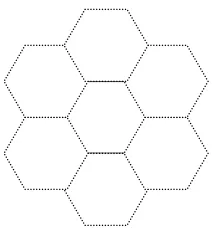
Cell Model
23 eliminates the burden of handling out of bound situations and is considered an efficient way to approximate the simulation of a very large cellular system. Each cell is
considered as a circle and has exactly six neighbors.
Figure 3. Layout of cell model
Traffic Model
We use exponential distribution to determine the duration of each generated call with a mean of 180s. New Calls arrive according to a Poisson process and homogeneous traffic among all cells is considered. Each cell is assigned 18 channels unless otherwise stated. The traffic load to each cell is defined as
% 100 * *
ell annelsPerC NumberOfCh
lDuration AverageCal
eToTheCell ArrivalRat
Mobility Model
In our model, each MS is assigned a initial speed and direction with an average speed of 18 meters/s and a maximum speed of 24 meters/s (54mph). After a specified time period, which is generated randomly, the speed and direction of the MS are updated. The direction of the motion after this period may preserve the previous heading or may change to the opposite direction.
24 The interval is constant and the value is set to 3 seconds. In the remainder of the section, the performance of the proposed new scheme is evaluated via simulation.
The selection of ideal time period is an important parameter too. If the time period is too small, the overhead in network is too high and the algorithm can't take much advantage of the HPCR_CB. If the time period is too large, the handoff blocking rate will be adjusted to fit to the changing traffic load too slowly. The QoS will not be
25
CHAPTER 5 SIMULATION RESULT
Extensive simulations are conducted to evaluate the performance of APCR_CB scheme. In the following, we present the results based on the simulation model described in Chapter 4. Below is the list of parameter that was fixed during the simulations.
Number of cells: 36 Position measurement interval: 3 sec.
Number of channels per cell: 18 Threshold Distance: 0.8 Mean call duration: 180 sec. Minimum reuse distance: 3 Average speed of an Ms: 18 m/s Simulation time: 200,000 sec.
0.8 1 1.2 1.4 1.6 1.8 2
30 40 50 60 70 80 90
percentage of traffic load
reserved channel
PCR3_CB_RC PCR3_RC PCR1_RC
26
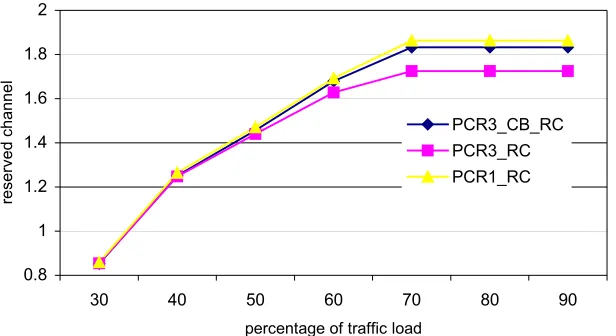
In figure 4, we first compare the performance of PCR1, PCR3 and PCR3_CB scheme without using any guard channel under different traffic load. Test results show that the number of averaged reserved channel is less than 2 no matter how much the traffic load is. Even the traffic load is as high as 90, the number of reserved channels is still around 1.8. Also the averaged reserved channel number is increased with the traffic load gradually, which means more channels were reserved for the handoff request when traffic load is increased. So we can get the conclusion that the concept of reservation and channel borrowing can dynamically adjust the number of reserved channel for the
handoff request, which remain under 2.
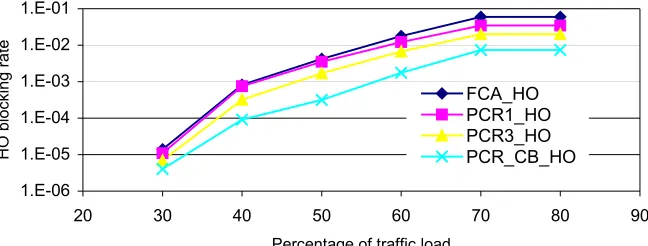
Figure 5 and 6 are the comparisons of PCR1 , PCR3, PCR_CB (without any guard channel) and FCA scheme. 1. FCA is a little bit better for the new call blocking rate since no guard channel is set for handoff request. But it has worst performance for handoff blocking rate when traffic load is higher than 50. It means that the QoS for the PCR schemes has better performance than FCA scheme even there is no fixed guard channel involved. 2. When we compare the PCR schemes, we find the new call blocking rate for PCR1, PCR3 and PCR_CB were very similar and the handoff blocking rate for them are different at the same time. It is obvious that the PCR_CB outperforms PCR3 and PCR3 outperforms PCR1. So the PCR_CB scheme can get better performance and it has potential to adjust the reserved channel number for the handoff requests. 3. Also, the results using 2-D simulation models are very similar to the previous result obtaining by using 1-D simulation model, which verified the conclusions we did before for the PCR schemes.
27
1.E-06 1.E-05 1.E-04 1.E-03 1.E-02 1.E-01
20 30 40 50 60 70 80 90
Percentage of traffic load
HO
blocking rat
e
FCA_HO PCR1_HO PCR3_HO PCR_CB_HO
Figure 5. HO Blocking Rate of Various PCR Schemes and FCA Scheme vs Traffic Load
1.E-06 1.E-05 1.E-04 1.E-03 1.E-02 1.E-01 1.E+00
20 30 40 50 60 70 80 90
Percentage of traffic load
New Call Blocking Rate
FCA_NEW PCR1_NEW PCR3_NEW PCR_CB_NEW
28
1.E-06 1.E-05 1.E-04 1.E-03
0 2 4 6 8
Number of Reserved Channels
HO Blocking Rate
GC_HO HPCR3_HO HPCR3_CB_HO
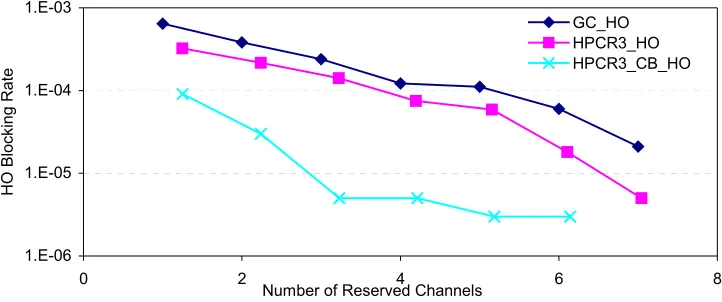
Figure 7. HO Blocking Rate of Various HPCR Schemes and GC Scheme vs Traffic Load
1.E-04 1.E-03 1.E-02 1.E-01 1.E+00
0 2 4 6 8 10
Number of Reserved Channels
New Call Blocking Rate
GC_NEW HPCR3_NEW HPCR3_CB_NEW
29 schemes and guarantees the QoS. So both the concept of reservation and channel
borrowing and the integration of fixed guard channel number is effective in the schemes. 3. The results using the 2-D simulation model also proved our previous research results based on 1-D simulation model, which is the performance of HPCR3_CB is much better than HPCR1 and HPCR3.
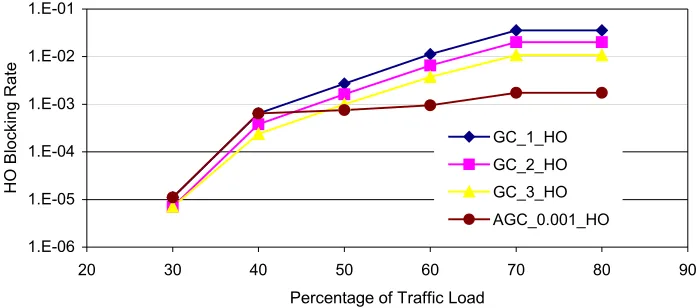
Figure 9 and 10 are comparisons between static GC scheme with guard channel number of 1, 2 and 3 and AGC (adaptive GC) scheme. 1. The results show the AGC scheme can keep a steady low HO blocking rate. For the new call blocking rate, they are at a similar basis. 2. From the comparison of static GC schemes with different guard channel number, we can get that the handoff blocking rate is affected directly by the number of guard channel. And the AGC scheme can guarantee the handoff blocking rate under certain threshold by adjusting number of guard channels automatically based on different traffic load. 3. AGC scheme has much better and stable performance than GC scheme when traffic load is higher than 40. The GC scheme with 4 guard channels was simulated also. Comparing to the GC scheme with 4 guard channel, AGC has better handoff blocking rate when traffic load is higher than 50. So the conclusion is that the AGC scheme can adaptively adjust the number of guard channel according to different traffic load so the certain threshold of handoff blocking rate is guaranteed. When the traffic load is low, the new call blocking rate is guaranteed too by reserving less guard channel number. The resource utilization is high using the AGC scheme.
30
1.E-06 1.E-05 1.E-04 1.E-03 1.E-02 1.E-01
20 30 40 50 60 70 80 90
Percentage of Traffic Load
HO Blocking Rate
GC_1_HO GC_2_HO GC_3_HO AGC_0.001_HO
Figure 9. HO Blocking Rate of adaptive GC Scheme vs Traffic Load
1.E-06 1.E-05 1.E-04 1.E-03 1.E-02 1.E-01 1.E+00
20 30 40 50 60 70 80 90
Percentage of Traffic Load
New Call Blocking Rate
GC_1_New GC_2_New GC_3_New
AGC_0.001_NEW
31
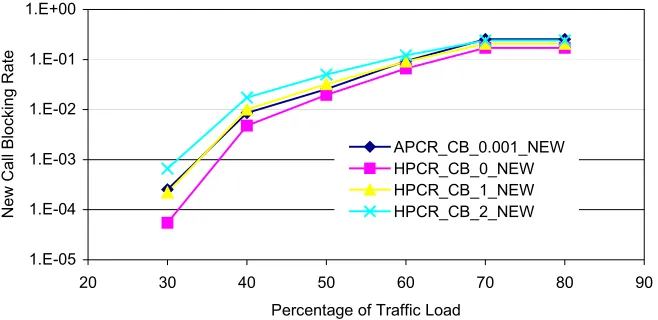
HPCR_CB with 2 fixed guard channels has better performance than APCR_CB when traffic load is less than 70. However, the new call is increased, which is the tradeoff for the unnecessary low handoff blocking rate in this case. So it again showed the
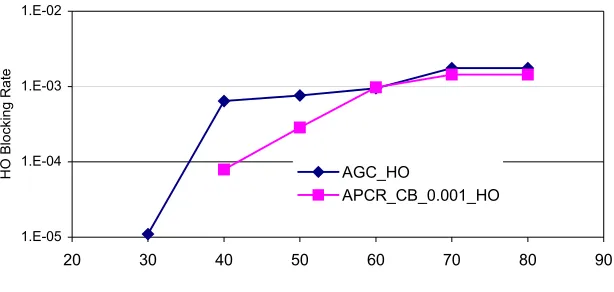
APCR_CB not only satisfied handoff QoS but also minimized the new call blocking rate. Figure 13 and figure 14 are comparisons of AGC scheme and APCR_CB scheme with thresholds between 0.001 and 0.0005. The handoff blocking rate for APCR_CB is much lower than AGC when traffic load is less than 60 though they have very similar new call blocking rate. It is because under certain traffic load, the APCR_CB can adjust the reserved channels dynamically and the handoff threshold can be achieved without additional guard channel needed at that time. So the APCR_CB has better QoS than AGC when traffic load is less than 60.
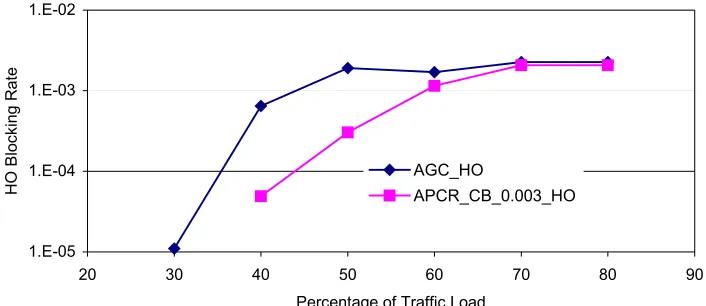
Figure 15 and figure 16 are comparisons of AGC scheme and APCR_CB scheme with thresholds between 0.003 and 0.0005. 1. The handoff blocking rate for APCR_CB is much lower than AGC all the time though they have very similar new call blocking rate. While when traffic load is higher than 60, the handoff blocking rate are very similar for these schemes. 2. When the traffic load is between 50 and 70, the APCR_CB scheme has better performance on both the handoff blocking rate and the new call blocking rate. This result verified again that the APCR_CB scheme outperforms the AGC scheme.
When we compare the figure 13, 14, 15 and 16, we can see the threshold range doesn't affect the performance much.
From the above simulation results, we can see though the two schemes have same threshold to constrain the handoff blocking rate, the APCR_CB can get better
performance. That means the fine tuning of the concept of PCR_CB works well during the certain time period.
Figure 17, 18, 19 and 20 showed the different performance of AGC and
32
1.E-06 1.E-05 1.E-04 1.E-03 1.E-02
20 30 40 50 60 70 80 90
Percentage of Traffic Load
HO Blocking Rate
APCR_CB_0.001_HO HPCR_CB_0_HO HPCR_CB_1_HO HPCR_CB_2_HO
Figure 11. HO Blocking Rate of adaptive PCR_CB (APCR_CB) Scheme and HPCR_CB scheme vs Traffic Load
1.E-05 1.E-04 1.E-03 1.E-02 1.E-01 1.E+00
20 30 40 50 60 70 80 90
Percentage of Traffic Load
New Call Blocking Rate
APCR_CB_0.001_NEW HPCR_CB_0_NEW HPCR_CB_1_NEW HPCR_CB_2_NEW
33
1.E-05 1.E-04 1.E-03 1.E-02
20 30 40 50 60 70 80 90
Percentage of Traffic Load
HO
B
locking Rat
e
AGC_HO
APCR_CB_0.001_HO
Figure 13. HO Blocking Rate of AGC Scheme and APCR_CB scheme vs Traffic Load (handoff blocking threshold is between 0.0005 and 0.001)
1.E-05 1.E-04 1.E-03 1.E-02 1.E-01 1.E+00
20 30 40 50 60 70 80 90
Percentage of Traffic Load
New Call Blocking Rate
AGC_0.001_NEW APCR_CB_0.001_NEW
Figure 14. New Call Blocking Rate of AGC Scheme and APCR_CB scheme vs Traffic Load
34
1.E-05 1.E-04 1.E-03 1.E-02
20 30 40 50 60 70 80 90
Percentage of Traffic Load
HO B
loc
ki
ng Rat
e
AGC_HO
APCR_CB_0.003_HO
Figure 15. HO Blocking Rate of AGC Scheme and APCR_CB Scheme vs Traffic Load (handoff blocking threshold is between 0.0005 and 0.003)
1.E-05 1.E-04 1.E-03 1.E-02 1.E-01 1.E+00
20 30 40 50 60 70 80 90
Percentage of Traffic Load
New Cal
l B
locki
ng Rat
e
AGC_NEW APCR_CB_NEW
Figure 16. New Call Blocking Rate of AGC Scheme and APCR_CB Scheme vs Traffic Load
35
1.E-06 1.E-05 1.E-04 1.E-03 1.E-02 1.E-01
20 30 40 50 60 70 80 90
Percentage of Traffic Load
HO B
loc
ki
ng Rat
e
AGC_0.001_HO
AGC_0.003_HO
Figure 17. HO Call Blocking Rate of AGC Scheme with Different Thresholds vs Traffic Load
1.E-06 1.E-05 1.E-04 1.E-03 1.E-02 1.E-01 1.E+00
20 30 40 50 60 70 80 90
Percentage of Traffic Load
New Cal
l B
loc
ki
ng Rat
e
AGC_0.003_NEW
AGC_0.001_NEW
36
1.E-06 1.E-05 1.E-04 1.E-03 1.E-02
20 30 40 50 60 70 80 90
Percentage of Traffic Load
H
O
B
loc
ki
ng R
ate
APCR_CB_0.001_HO
APCR_CB_0.003_HO
Figure 19. HO Blocking Rate of APCR_CB Scheme with Different Threshold vs Traffic Load
1.E-05 1.E-04 1.E-03 1.E-02 1.E-01 1.E+00
20 30 40 50 60 70 80 90
Percentage of Traffic Load
New Cal
l B
loc
ki
ng Rat
e
APCR_CB_0.001_NEW
APCR_CB_0.003_NEW
37
CHAPTER 6 CONCLUSION
In this paper, we presented a new handoff prioritization scheme in cellular networks. The scheme, called APCR_CB, is the integration of the adaptive guard channel concept and the predictive-based channel reservation with channel borrowing strategy. This integration takes advantage of the macro-tuning of the adaptive guard channel and the fine-tuning of the predictive-reservation concept. The resource utilization is protected while QoS is guaranteed. This thesis discussed the simulation model and presented the results which showed the improvement of multiple orders of magnitude over original HPCR schemes and GC based scheme.
From the simulation results, we found the integration of GC in PCR and PCR_CB were very important to get a good performance for handoff blocking rate. And another simulation test showed that when the guard channel (GC) was removed from the scheme, average reserved channel for handoff request was less than 2. So it is approved that the PCR_CB scheme we proposed before can reserve less than 2 guard channels dynamically using 2-D simulation model. Only when we applied fixed GC number in our schemes, the averaged reserved channels would be high and would satisfy the handoff request successfully. These implied that not only the concept of GC but also the number of GC were critical to our schemes. The APCR_CB scheme was proposed based on these research results and considerations.
For the evaluation of the performance of this scheme, a simulation model was created and lots of tests were done. The simulation results show that the present
38 As a conclusion, this scheme has high degree of spectrum utilization with a good QoS and is a simple algorithm with a satisfied implementation complexity.
In the previous research by our group, the schemes of PCR, HPCR, and
HPCR_CB were proposed and analyzed. From the simulation result, we proved that the concept of reservation and load balancing were effective for the Handoff prioritization. And the HPCR_CB outperformed the HPCR and PCR in both homogeneous traffic and non-homogeneous traffic. However, the simulation model for these comparisons was based on linear cellular system model (1-D) instead of 2-D compact pattern model. In this thesis, the author developed 2-D cellular system model to compare all these schemes and verified the previous simulation results. 2-D simulation is more realistic in the real world and has more practical usage for the verification of the schemes.
39
REFERENCES
[1]. Sirin Tekinay and Bijan Jabbari, Handover and Channel Assignment in Mobile Cellular Networks(Quick and timely handover has a crucial effect on how users perceive quality of service, however, handover strategies should not be too complicated.) IEEE Communications Magazine, November 1991.
[2] Yi Zhang and Derong Liu, An Adaptive Algorithm for Call Admission Control in Wireless Networks, IEEE 2001.
[3] Ming-Hsing Chiu, Mingyu Wu and Lei Yu, Predictive Handoff Scheme with Channel Borrowing Based on the Positioning of Mobile Stations
[4] Ming-Hsing Chiu and Mostafa A. Bassiouni, Predictive Schemes for Handoff Prioritization in Cellular Networks Based on Mobile Positioning, IEEE 2000.
[5] Sajal K. das, Sanjoy K. Sen and Rajeev Jayaram, A dynamic load balancing strategy for channel assignment using selective borrowing in cellular mobile environment, Wireless Networks 1997.
[6] Wee-Seng Soh and Hyong S. Kim, Dynamic Guard Bandwidth Scheme for Wireless Broadband Networks, IEEE 2001.
[7] Fei Yu and Victor C.M.Leung, Mobility-Based Predictive Call Admission Control and Bandwidth Reservation in Wireless Cellular Networks, IEEE 2001.
[8] PARSEC User Manual,
http://pcl.cs.ucla.edu/projects/parsec/manual/
[9] Anthony Noerpel, Yi-bing Lin, Handover Management for a PCS Network, IEEE 1997.
[10] Nishith D. Tripathi, Nortel Jeffrey H. Reed and Hugh F. Vanlandingham, Handoff in Cellular System, IEEE 1998.
40 [12] Mingyu Wu, Performance Evaluation of Predictive Handoff Schemes in Cellular Networks, thesis 2001.
[13] FCC AdoptsRules to Implement Enhanced 911 for Wireless Services, FCC News, CC docket no. 94-102, June 12, 1996.
[14] Y. Zhao, Standardization of Mobile Phone Positioning for 3G Systems, IEEE Comm. Mag, Vol. 40, no. 7, pp 108-116, July 2002.
[15] TIA/EIA/IS-801-1, Position Determination Service Standard for Dual-Mode Spread Spectrum Systems-Addendum, Mar. 2001.
41
VITA
Lei Yu was born in Harbin, P.R. China, in 1971. She received the Bachelor of Engineering degree in Architecture from the Qingdao Institute of Architecture and Engineering, China 1993. From 1993 to 1994, she worked as an architect in Shenzhen and Qingdao. From 1994 to 1996, she studied in Harbin Architectural University pursuing Master of Architecture Degree. In 1999, she received Master of Science in Architecture in Louisiana State University. In 2000, she started the study in the
![Figure 1. Architecture of cellular networks [12]](https://thumb-us.123doks.com/thumbv2/123dok_us/8928510.1845988/7.612.150.479.109.312/figure-architecture-of-cellular-networks.webp)
![Figure 2. The process of handoff [12]](https://thumb-us.123doks.com/thumbv2/123dok_us/8928510.1845988/8.612.227.409.74.246/figure-the-process-of-handoff.webp)