VOLUME 37, ARTICLE 60, PAGES 1917
,
1932
PUBLISHED 14 DECEMBER 2017
http://www.demographic-research.org/Volumes/Vol37/60/ DOI: 10.4054/DemRes.2017.37.60
Descriptive Finding
Dating across and hooking ‘up’:
Status and relationship formation at an
elite liberal arts university
Kristine M. Kilanski
David McClendon
© 2017 Kristine M. Kilanski & David McClendon.
This open-access work is published under the terms of the Creative Commons Attribution 3.0 Germany (CC BY 3.0 DE), which permits use, reproduction, and distribution in any medium, provided the original author(s) and source are given credit.
1 Introduction 1918
2 Data and methods 1919
3 Results 1920
4 Summary and conclusions 1926
Dating across and hooking ‘up’:
Status and relationship formation at an elite liberal arts university
Kristine M. Kilanski1
David McClendon2
Abstract
BACKGROUND
Demographic research on assortative mating underplays the role of social status in shaping partnering behavior, yet qualitative research suggests social status is critical in shaping partner desirability and structuring opportunities for partners to meet.
OBJECTIVE
This study investigates how social status of sororities and fraternities shapes relationship formation between women and men on a college campus.
METHODS
We draw on data from an online survey of sorority women at an elite liberal arts university about their romantic and sexual lives.
RESULTS
While status homophily is the dominant pattern in romantic relationships (dating ‘across’), sorority women up and down the status hierarchy are more likely to hook ‘up’ with high-status fraternity men. Concern about status is also associated with dating and hooking ‘up’ the status hierarchy.
CONCLUSIONS
Social status shapes the desirability of potential romantic and hookup partners and opportunities for potential partners to meet. Results also highlight gender differences in the operation of social status in cross-sex relationship formation.
1 Stanford University, USA. E-Mail:[email protected]. 2 Center for Social Measurement and Evaluation at Children at Risk, USA.
1. Introduction
Demographic research finds that people tend to partner with others who share their racial/ethnic background, as well as other social characteristics, such as religious affiliation, educational attainment, and class background. This is important for understanding the inter- and intra-generational perpetuation of inequality and population change (Kalmijn and Flap 2001; Schwartz 2013). Yet, research on assortative mating often overlooks a key sorting metric: social status ‒ or “inequality based on differences in esteem and respect” (Ridgeway 2014). Social status operates alongside differences in power and resources to shape interactions and relationship formation between people. However, few studies have systematically examined the role of social status in shaping cross-sex relationship formation. This article draws on an extreme case to reveal how social status shapes relationship formation between women and men: In particular, we examine how the status hierarchy among Greek organizations structures the platonic friendships, hookups, and romantic relationships sorority women form with fraternity men at an elite liberal arts university.
Sororities employ a number of strategies to increase their social status in the (1) highly stratified (DeSantis 2007; Robbins 2004; Waller 1937) and (2) gender unequal (Martin and Hummer 1989; Martin 2016; Sanday 2007) context of Greek systems. These include recruiting physically attractive and socially adept women as members and policing the sexual behavior of ‘sisters’ in order to maintain a positive “collective sexual reputation” in the heterosexual marketplace (Armstrong and Hamilton 2013; Handler 1995; Risman 1982; Strombler 1994). Less research has focused on how organizational stratification and unequal gender relations within the Greek system shape individual sorority women’s cross-sex relationship formation. Moreover, studies of assortative mating among college students largely focus on “master status” characteristics such as race or class background (Laumann et al. 1994; McClintock 2010) rather than local status characteristics. This gap in the literature is especially notable given that college students frequently note characteristics such as fraternity and sorority status in assessments of others’ sexual and/or romantic desirability and tend to view their own Greek membership as either an aid or detractor in attracting members of the opposite sex (Armstrong and Hamilton 2013; DeSantis 2007; Handler 1995; Holland and Eisenhart 1990; Risman 1982).
study findings are based on a single case, our research sheds light on the importance of considering (1) local social status alongside master status characteristics in studies of partner matching, (2) the ways status operates differently across relationship types, and (3) gender differences in the operation of social status in partner matching.
2. Data and methods
We draw on data collected through a 2007 online survey of heterosexual sorority women attending a small, selective private liberal arts university in the United States with fewer than 2,000 undergraduates enrolled. The survey was designed to examine the role of the Greek system and the influence of status in shaping heterosexual sorority women’s romantic and sexual lives.
In 2007, roughly 80% of women and men at Elite University were members of sororities and fraternities. Greek members were more homogeneous than the student body at large, which was overwhelmingly wealthy (80% came from households with annual incomes exceeding $100,000) and white (roughly 90%).
We received permission to survey the maximum number of students allowable per university policy. This number (500) fell short of, but nearly captured, the target population of the study: women enrolled in any one of the five National Panhellenic Council–affiliated sororities on campus. Using the preceding criteria, the university registrar selected a random sample of students for participation in the study. Of the 500 surveys distributed, 321, or 64.2%, were returned. This is a high response rate for an online survey, suggesting that the topics covered were salient to respondents. Freshmen were slightly over-represented in the sample, and there were slight differences in the representation of women by sorority. Analyses utilizing weighted data were not significantly different than analyses using unweighted data (presented here).
formed multiple relationship types with the same fraternity member or engaged in the same type of relationship with more than one member of a fraternity.
Additional questions assessed the extent to which respondents attached social significance to an individual’s membership in a Greek organization, in general (“Knowing what fraternity/sorority someone is in tells me a lot about what that person is like”) and in the context of selecting hookup and romantic partners (“Before I date/hook up with a member of the opposite sex, I take into consideration what fraternity he belongs to”). Finally, we assessed peer pressure to date members of specific fraternities (“Do you feel encouragement by other members of your sorority to date members of a certain fraternity or fraternities?”).
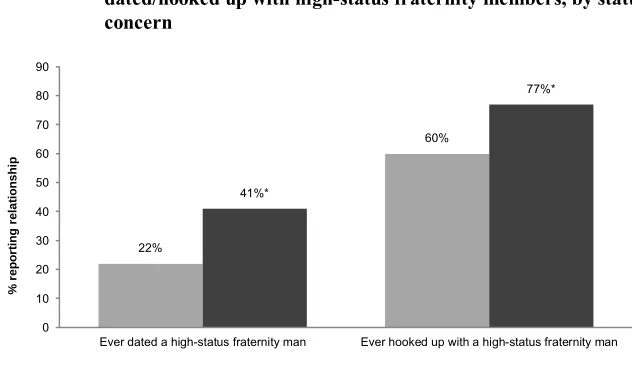
First, we use respondent data to establish the local social status hierarchy among Greek organizations. Next, we examine the association between sorority women’s status (as determined by sorority affiliation) and the status of the men (as determined by fraternity affiliation) with whom they formed platonic, romantic, and hookup relationships. Finally, we assess various explanations for these patterns using mixed methods. We test the associations between social status concerns and perceptions of peer pressure and relationship behavior (ever dating or hooking up with a high-status man) using multivariate logistic regression, controlling for sorority status and year in school. Finally, we summarize qualitative survey data to understand sorority women’s perceptions of the influences on their cross-sex relationship formation.
3. Results
Table 1 examines the status associated with each of the five sororities on Elite University’s campus. Despite subtle differences in how members and non-members ranked sororities ‒ suggesting ego-buffering (Gordon and Wilson 1969) ‒ there was a high level of agreement regarding the distribution of status among sororities: 83% of respondents ranked Tau the highest status sorority and 91% of respondents ranked Zi the lowest status sorority.
Table 1: Sorority status and cross-sex relationship formation
Sorority % sample Mean status ranking
(SD) MSR, members MSR, nonmembers % reporting romantic relationship % reporting hookup relationship % reporting friendship
Tau 19 1.3 (0.74) 1.2 1.3 84 97 86
Nu 19 2.2 (0.71) 1.6 2.4 61 89 86
Rho 21 2.9 (0.66) 2.4 3.0 56 87 85
Epsilon 25 3.8 (0.66) 3.2 3.9 61 86 90
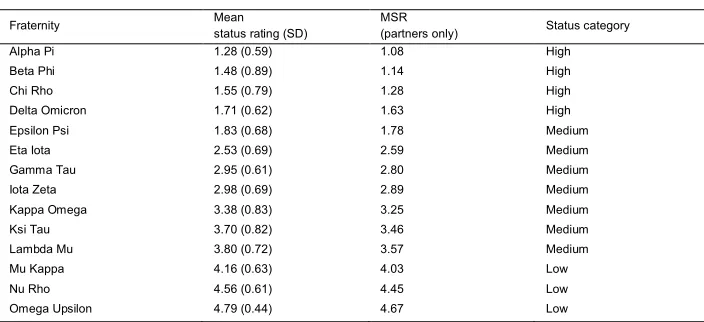
Table 2 examines the status respondents associated with each of the 14 fraternities on campus. Respondents with romantic and/or sexual ties to members of a fraternity were slightly more favorable in their assessments. Again, there was a high level of agreement regarding the distribution of status among fraternities. To simplify analyses, we assigned each fraternity a ‘high,’ ‘medium,’ or ‘low’ status category. Cut-off points for inclusion in a status category were based on (1) the mean status rating (priority) and (2) responses to an open-ended survey question. A majority of respondents attached significance to sorority affiliation (54%), while 61% felt that “knowing what fraternity someone is in tells me a lot about what that person is like.”
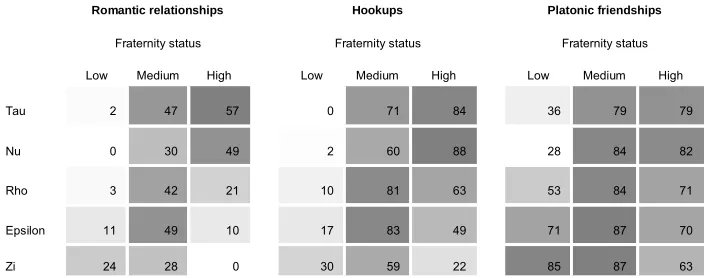
Next, we examined what percentage of respondents in each sorority had ever participated in a romantic relationship, hookup, and/or platonic friendship with a fraternity man on campus. As seen in Table 1, women in Tau (rank 1) were most likely to have ever participated in a romantic relationship with a fraternity member, while women in Zi (rank 5) were least likely to have ever participated in a romantic relationship with a fraternity member. We find a similar trend for hookups. Notably, 86% of women surveyed reported having hooked up with a fraternity member. Women in lower status sororities were slightly more likely to report having platonic friends in fraternities.
Table 2: Fraternity status rating by sorority members
Fraternity Mean
status rating (SD)
MSR
(partners only) Status category
Alpha Pi 1.28 (0.59) 1.08 High
Beta Phi 1.48 (0.89) 1.14 High
Chi Rho 1.55 (0.79) 1.28 High
Delta Omicron 1.71 (0.62) 1.63 High
Epsilon Psi 1.83 (0.68) 1.78 Medium
Eta Iota 2.53 (0.69) 2.59 Medium
Gamma Tau 2.95 (0.61) 2.80 Medium
Iota Zeta 2.98 (0.69) 2.89 Medium
Kappa Omega 3.38 (0.83) 3.25 Medium
Ksi Tau 3.70 (0.82) 3.46 Medium
Lambda Mu 3.80 (0.72) 3.57 Medium
Mu Kappa 4.16 (0.63) 4.03 Low
Nu Rho 4.56 (0.61) 4.45 Low
Omega Upsilon 4.79 (0.44) 4.67 Low
By contrast, there was a strong pattern of status homophily in the romantic relationship formation between respondents and fraternity men. A unique pattern, however, emerges when we examine hookups. High-status women tended to hook up with other high-status men, but they almost never hooked-up with low-high-status men. Lower high-status respondents, on the other hand, not only hooked up with men in a similar position on the social status hierarchy, they also hooked up ‒ or hooked ‘up’ ‒ with high-status men.
Figure 1: Percentages of respondents reporting relationships with low-, medium-, and high-status fraternity members, by sorority and relationship type
Romantic relationships Hookups Platonic friendships
Fraternity status Fraternity status Fraternity status
Low Medium High Low Medium High Low Medium High
Tau 2 47 57 0 71 84 36 79 79
Nu 0 30 49 2 60 88 28 84 82
Rho 3 42 21 10 81 63 53 84 71
Epsilon 11 49 10 17 83 49 71 87 70
Zi 24 28 0 30 59 22 85 87 63
Note:Romantic relationships, hookups, and platonic friendships are not mutually exclusive categories. Darker shades indicate more frequent pairings.
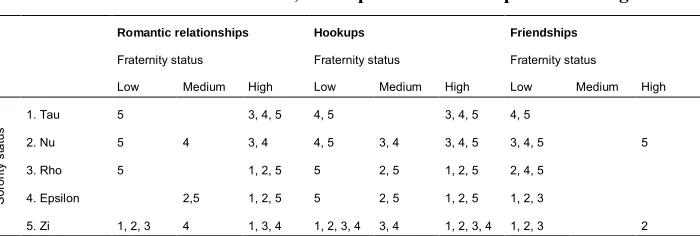
Table 3: Results from statistical significance tests of differences between sororities in cross-sex relationships with men in high-, medium-, and low-status fraternities; corresponds to heat map shown in Figure 1
Romantic relationships Hookups Friendships
Fraternity status Fraternity status Fraternity status
Low Medium High Low Medium High Low Medium High
S
o
ro
ri
ty
st
a
tu
s
1. Tau 5 3, 4, 5 4, 5 3, 4, 5 4, 5
2. Nu 5 4 3, 4 4, 5 3, 4 3, 4, 5 3, 4, 5 5
3. Rho 5 1, 2, 5 5 2, 5 1, 2, 5 2, 4, 5
4. Epsilon 2,5 1, 2, 5 5 2, 5 1, 2, 5 1, 2, 3
5. Zi 1, 2, 3 4 1, 3, 4 1, 2, 3, 4 3, 4 1, 2, 3, 4 1, 2, 3 2
Note: Numbers in cells indicate differences between groups that were statistically significant at the p < 0.05 level. For example, the
share of women in Zi who reported a romantic relationship with a member of a low-status fraternity was significantly different from the shares that did the same in each of the top three ranked sororities (Tau, Nu, and Rho).
Figure 2: Predicted probabilities of respondents reporting having ever dated/hooked up with high-status fraternity members, by status concern
Note: ‘Status concern’ refers to the particular relationship type; e.g., for romances, status concern reflects whether the fraternity status of potential partners matters for romantic relationships only. Predicted probabilities are calculated from logistic regression models that controlled for status concern, sorority status, and class year. * indicates that the difference is statistically significant at 0.05 level with controls.
Analyses of responses to the open-ended question “Do you feel encouragement by other members of your sorority to date members of a certain fraternity or fraternities?” provided insight into the pathways through which status shaped women’s cross-sex relationship formation. While the Greek system had an open-door policy, such that any student on campus (including non-Greeks) could attend nearly any Greek event, 26 respondents (out of 63) reported that belonging to a sorority shaped their peer group, leading to an increased likelihood they would date certain men:
I don’t feel that my sorority pressures me one way or another, but being in a sorority affects who you hang out with and what parties you attend.
When all of your friends hang out with a certain fraternity or don’t hang out with certain fraternities, there is an implied pressure to date members of the organizations you spend the most time with.
22% 60% 41%* 77%* 0 10 20 30 40 50 60 70 80 90
Ever dated a high-status fraternity man Ever hooked up with a high-status fraternity man
% re p o rt in g re la ti o n s h ip
Table 4a: Coefficients from logistic regression models predicting romantic relationships with high-status fraternity members
Ever dated a high-status fraternity member
M1 M2 M3
OR SE OR SE OR SE
Considers fraternity status before
dating (1 = yes) 2.398* (0.89) 3.222** (1.33)
Feels encouraged to date members
of certain fraternities (1 = yes) 0.781 (0.27) 0.503+ (0.20)
Sorority status (ref = Tau)
Nu 1.063 (0.43) 0.983 (0.39) 1.114 (0.45)
Rho 0.251** (0.11) 0.203*** (0.09) 0.240** (0.11)
Epsilon 0.101*** (0.05) 0.087*** (0.04) 0.095*** (0.05)
Zi (lowest) --- ---
---Class (ref = freshman)
Sophomore 2.748* (1.25) 2.343+ (1.04) 2.631* (1.21)
Junior 3.382** (1.55) 3.065* (1.37) 3.626** (1.69)
Senior 3.050* (1.37) 2.409* (1.04) 3.093* (1.40)
Model fit statistics
–2 log likelihood 244.5 249.7 241.4
Pseudo R2 0.19 0.17 0.20
N 242 242 242
Note: Members of Zi were dropped from romantic relationship analysis because none of the members interviewed reported a
romantic relationship with a high-status fraternity member. † p<0.1 * p<0.05 ** p<0.01 *** p<0.001
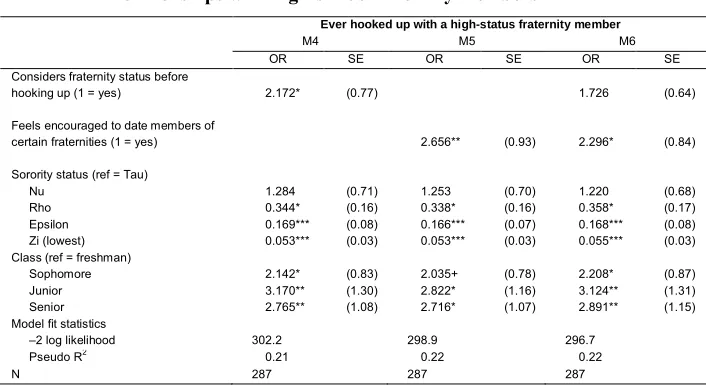
Table 4b: Coefficients from logistic regression models predicting hookup relationships with high-status fraternity members
Ever hooked up with a high-status fraternity member
M4 M5 M6
OR SE OR SE OR SE
Considers fraternity status before
hooking up (1 = yes) 2.172* (0.77) 1.726 (0.64)
Feels encouraged to date members of
certain fraternities (1 = yes) 2.656** (0.93) 2.296* (0.84)
Sorority status (ref = Tau)
Nu 1.284 (0.71) 1.253 (0.70) 1.220 (0.68)
Rho 0.344* (0.16) 0.338* (0.16) 0.358* (0.17)
Epsilon 0.169*** (0.08) 0.166*** (0.07) 0.168*** (0.08)
Zi (lowest) 0.053*** (0.03) 0.053*** (0.03) 0.055*** (0.03)
Class (ref = freshman)
Sophomore 2.142* (0.83) 2.035+ (0.78) 2.208* (0.87)
Junior 3.170** (1.30) 2.822* (1.16) 3.124** (1.31)
Senior 2.765** (1.08) 2.716* (1.07) 2.891** (1.15)
Model fit statistics
–2 log likelihood 302.2 298.9 296.7
Pseudo R2 0.21 0.22 0.22
N 287 287 287
In other words, the local status hierarchy mattered to partner matching because it placed men and women of similar status into more frequent contact with one another.
Twenty-nine respondents reported experiencing pressure to date or hook up with men from certain fraternities ‒ either to gain social approval or to avoid negative social appraisal:
You get looked down at if you date a Omega Epsilon or a Nu Rho, sometimes
[men at the military academy], too. You are ‘cooler’ if you date someone in the Big Four.
It was suggested that I hook up with members of certain fraternities to help us get mixers with them.
From this perspective, the local status hierarchy mattered because it placed women in a position to seek status through the relationships they formed with men in order to maintain or increase their individual and group social standing. Seven respondents mentioned both pathways in their responses.
4. Summary and conclusions
We found social status, and in particular sorority or fraternity status, played an important role in patterning cross-sex relationships. Moreover, status played a stronger role in structuring romantic and sexual relationships than platonic friendships.
Our data suggests gender differences in the operation of status across relationship types. Low-status fraternity men rarely formed romantic relationships or hooked up with sorority women, even those who were low status. Low-status women, however, were able to hook ‘up’ with higher status men, but did not form romantic relationships with them. The latter pattern is suggestive of a possible gendered “beauty-status exchange” (McClintock 2014). Indeed, hookups ‒ given their short-term and often public nature ‒ may offer the perfect setting for such a transaction (Armstrong and Hamilton 2013). As Wade (2017) found through qualitative interviews, students can in fact be quite blunt about their use of hookups to gain status (34). In addition, Hamilton (2007) found that college women weigh the level of men’s erotic interest heavily in their assessments of self and others.
England, and Fogarty 2012); and feelings of confusion, disempowerment, and regret (Glenn and Marquardt 2001). While some research suggests that hooking up may be experienced as a form of empowerment for class-privileged women (Hamilton 2014) like the ones in our study, these relationships nonetheless tend to form on men’s terms and, often, men’s turf. The tendency of hookups to take place in settings that involve alcohol use in party environments (LaBrie et al. 2014) means that women may be at increased risk of sexual assault and violence (Nicholson et al. 1998).
References
Allison, R. and Risman, B.J. (2013). A double standard for hooking up: How far have we come toward gender equality? Social Science Research 42(5): 1191‒1206.
doi:10.1016/j.ssresearch.2013.04.006.
Allison, R. and Risman, B.J. (2014). It goes hand in hand with the parties: Race, class, and residence in college negotiations of hooking up. Sociological Perspectives
57(1): 102‒123.doi:10.1177/0731121413516608.
Armstrong, E.A., England, P., and Fogarty, A.C.K. (2012). Accounting for women’s orgasm and sexual enjoyment in college hookups and relationships. American
Sociological Review77(3): 435‒462.doi:10.1177/0003122412445802.
Armstrong, E.A. and Hamilton, L.T. (2013). Paying for the party: How college
maintains inequality. Cambridge: Harvard University Press. doi:10.4159/
harvard.9780674073517.
Armstrong, E.A., Hamilton, L.T., and England, P. (2010). Is hooking up bad for women?Contexts 9(3): 22‒27.doi:10.1525/ctx.2010.9.3.22.
Brimeyer, T.M. and Smith, W.L. (2012). Religion, race, social class, and gender differences in dating and hooking up among college students. Sociological
Spectrum32(5): 462‒473.doi:10.1080/02732173.2012.694799.
DeSantis, A.D. (2007). Inside Greek U: Fraternities, sororities, and the pursuit of pleasure, power, and prestige. Lexington: University Press of Kentucky.
England, P. and Bearak, J. (2014). The sexual double standard and gender differences in attitudes toward casual sex among U.S. university students. Demographic
Research30(46): 1327‒1338.doi:10.4054/DemRes.2014.30.46.
Glenn, N. and Marquardt, E. (2001). Hooking up, hanging out, and hoping for Mr.
Right: College women on mating and dating today. New York: Institute for
American Values.
Gordon, M. and Wilson, S.R. (1969). Status inconsistency and satisfaction with sorority membership.Social Forces 48(2): 176‒183.doi:10.1093/sf/48.2.176.
Hamilton, L. (2007). Trading on heterosexuality: College women’s gender strategies and homophobia. Gender and Society 21(2): 145‒172. doi:10.1177/08912 43206297604.
Hamilton, L. (2014). The revised MRS: Gender complimentary at college. Gender and
Handler, L. (1995). In the fraternal sisterhood: Sororities as gender strategy. Gender
and Society9(2): 236‒255.doi:10.1177/089124395009002006.
Holland, D.C. and Eisenhart, M.A. (1990). Educated in romance: Women, college achievement, and college culture. Chicago: The University of Chicago Press. Kalmijn, M. and Flap, H. (2001). Assortative meeting and mating: Unintended
consequences of organized settings for partner choices. Social Forces 79(4): 1289‒1312.doi:10.1353/sof.2001.0044.
Kuperberg, A. and Padgett, J.E. (2015). Dating and hooking up in college: Meeting contexts, sex, and variation by gender, partner’s gender and class standing.The
Journal of Sex Research 52(5): 517‒531.doi:10.1080/00224499.2014.901284.
Kuperberg, A. and Padgett, J.E. (2016). The role of culture in explaining college student’s selection into hookups, dates and long-term relationships. Journal of
Social and Personal Relationships 33(8): 1070‒1096. doi:10.1177/0265
407515616876.
LaBrie, J.W., Hummer, J.F., Ghaidarov, T.M., Lac, A., and Kenney, S.R. (2014). Hooking up in the college context: The event-level effects of alcohol use and partner familiarity on hookup behaviors and contentment. Journal of Sex
Research 5(1): 62‒73.doi:10.1080/00224499.2012.714010.
Laumann, E.O., Gagnon, J.H., Michael, R.T., and Michaels, S. (1994). The social
organization of sexuality: Sexual practices in the United States. Chicago:
University of Chicago Press.
Martin, P.Y. (2016). The rape prone culture of academic contexts: Fraternities and athletics.Gender and Society 30(1): 30‒43.doi:10.1177/0891243215612708. Martin, P.Y. and Hummer, R.A. (1989). Fraternities and rape on campus. Gender and
Society 3(4): 457‒473.doi:10.1177/089124389003004004.
McClintock, E.A. (2010). When does race matter? Race, sex, and dating at an elite university. Journal of Marriage and Family 72(1): 45‒72. doi:10.1111/j.1741-3737.2009.00683.x.
McClintock, E.A. (2014). Beauty and status: The illusion of exchange in partner selection? American Sociological Review 79(4): 575‒604. doi:10.1177/00 03122414536391.
Paul, E.L. and Hayes, K.A. (2002). The causalities of ‘casual’ sex: A qualitative exploration of the phenomenology of college students’ hookups. Journal of
Social and Personal Relationships 19(5): 639‒661. doi:10.1177/0265407
502195006.
Ray, R. and Rosow, J.A. (2010). Getting off and getting intimate: How normative institutional arrangements structure black and white fraternity men’s approaches toward women. Men and Masculinities 12(5): 523–546. doi:10.1177/10 97184X09331750.
Ray, R. and Rosow, J.A. (2012). The two different worlds of black and white fraternity men: Visibility and accountability as mechanisms of privilege. Journal of
Contemporary Ethnography 41(1): 66‒94.doi:10.1177/0891241611431700.
Ridgeway, C. (2014). Why status matters for inequality.American Sociological Review
79(1): 1‒16.doi:10.1177/0003122413515997.
Risman, B. (1982). College women and sororities: The social construction of gender roles. Journal of Contemporary Ethnography 11(2): 231‒252. doi:10.1177/ 089124168201100205.
Robbins, A. (2004). Pledged: The secret life of sorority sisters. New York: Hyperion Books.
Sanday, P.R. (2007).Fraternity gang rape: Sex, brotherhood, and privilege on campus. New York: New York University Press.
Schwartz, C.R. (2013). Trends and variation in assortative mating: Causes and consequences. Annual Review of Sociology 39(1): 451–470. doi:10.1146/ annurev-soc-071312-145544.
Strombler, M. (1994). ‘Buddies or slutties’: The collective sexual reputation of fraternity little sisters. Gender and Society 8(3): 297‒323. doi:10.1177/ 089124394008003002.
Sweeney, B.N. (2011). The allure of the freshman girl: Peers, partying, and the sexual assault of first-year college women.Journal of College and Character 12(4): 1‒ 15.doi:10.2202/1940-1639.1790.
Uecker, J.R., Pearce, L.D., and Andercheck, B. (2015). The four U’s: Latent classes of hookup motivations among college students. Social Currents 2(2): 163‒181.
doi:10.1177/2329496515579761.